How to Make Web3 Products Inherently Viral? Four Years of User Growth Lessons from an Entrepreneur

比推Publié le 2025-12-30Dernière mise à jour le 2025-12-30

Résumé

The author, a Web3 founder with four years of experience, shares seven key lessons learned from building consumer-facing crypto products after previously working on failed infrastructure projects. Key insights include: 1. Target younger users (ages 13-21) who are more open to adopting new technologies. 2. Design products with built-in virality to reduce marketing costs, as crypto users expect incentives and trust is low. 3. Implement user-requested features quickly (within 2-3 days) to build trust and prevent churn to competitors. 4. Choose simple, memorable product names for easier word-of-mouth sharing. 5. Engage with users directly through cold DMs despite low response rates, focusing on acquiring 10-20 dedicated early users. 6. Iterate rapidly based on user behavior rather than just feedback, prioritizing what they actually pay for. 7. Simplify websites and onboarding to minimize cognitive load and clicks, ensuring the core value is immediately apparent. The author emphasizes that speed, user-centric design, and marketing are more critical than technical perfection in consumer crypto.

Author: Rishabh Gupta

Compiled by: Jiahuan, ChainCatcher

Original title:7 Painful Lessons from 4 Years of Web3 Entrepreneurship


As a budding founder, I spent years pouring my heart into three infrastructure-layer projects that ultimately failed. In 2025, I started building a consumer product that people actually want to use. Here, I share my hard-earned insights on user acquisition and fundraising.

I've been in this industry for about 4 years.

In 2023, when "account abstraction" was the hottest topic in the circle, I started developing in the EVM ecosystem. At that time, everyone was building SDKs (Software Development Kits) for account abstract wallets. Rollup scaling solutions were also hot—Optimism, Arbitrum, and various RaaS (Rollup as a Service) dominated.

As a math enthusiast, I was deeply attracted to ZK (Zero-Knowledge proofs), believing it would change the world (I firmly believe it will, eventually).

I mistakenly believed that: Complexity == Credibility.

When VCs asked about application scenarios, I would confidently list zkML (Zero-Knowledge Machine Learning), zk identity, zk voting—but even today, no one is really using these areas. I mistook amazing technology for a useful product.

Over time, I began to believe that the more complex an idea was, the greater its chance of success.

VCs also told me that in the crypto space, building infrastructure was the only path to success.

It took me nearly 2 years and over 500 rejections to realize this wasn't for me.

Entering the Solana Ecosystem

This was a completely new ecosystem for me—here, people care about application scenarios. Even meme coins are okay, because revenue matters.

Speed matters. Distribution matters.

Having built consumer applications on Solana for 7 months, here are my insights:

1. Build for Young Users Willing to Try New Things

Try to develop for young people who are naturally receptive to new products.

In the consumer crypto space, this usually means people trading in the "trenches" or young users aged 13-21.

A 2024 study by the Consumer Technology Association showed that 86% of Gen Z (11-26 years old) consider technology core to life—a higher percentage than any older generation. They own more devices and are more willing to spend on tech products.

They are more willing to try new apps, experiment with new features, and change habits.

Users over 25 are generally less willing to adopt new workflows unless there is a very strong incentive.

(Note: If you're in the institutional business, this may not apply.)

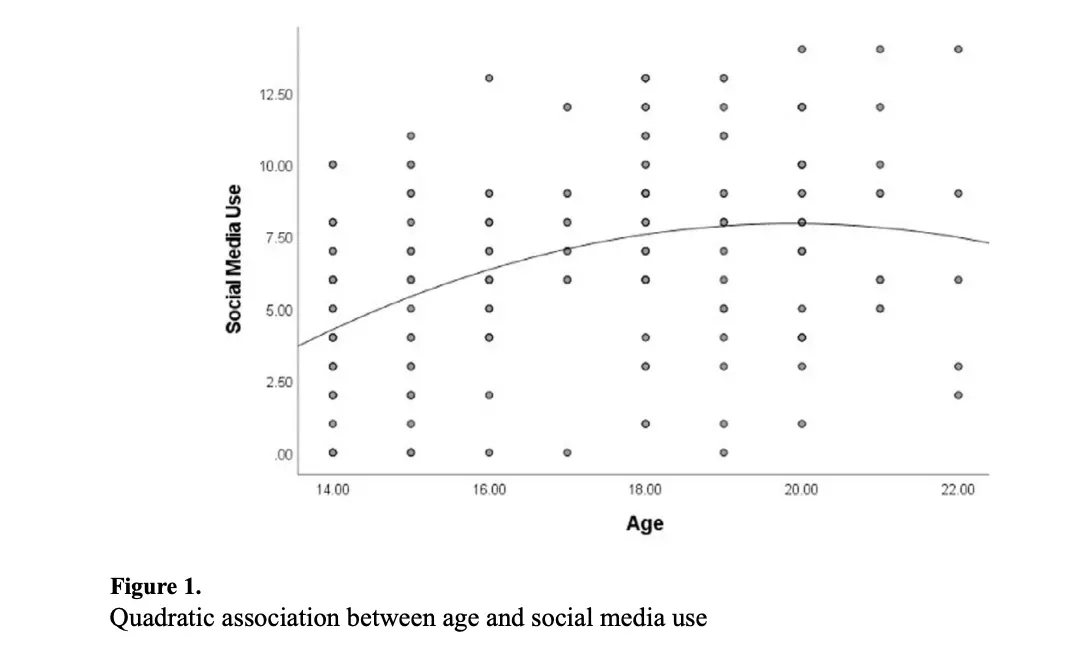
Research shows that social activity peaks around age 20-21. This means products built for young people are inherently more shareable.
2. Make the Product Inherently "Viral" to Reduce Marketing Costs

If you don't have a huge marketing or advertising budget, the product itself must be the traffic channel.

In crypto, shareability is especially important because:

  • KOL marketing is very expensive.

  • Trust is extremely low.

  • Everyone expects rewards or incentives.
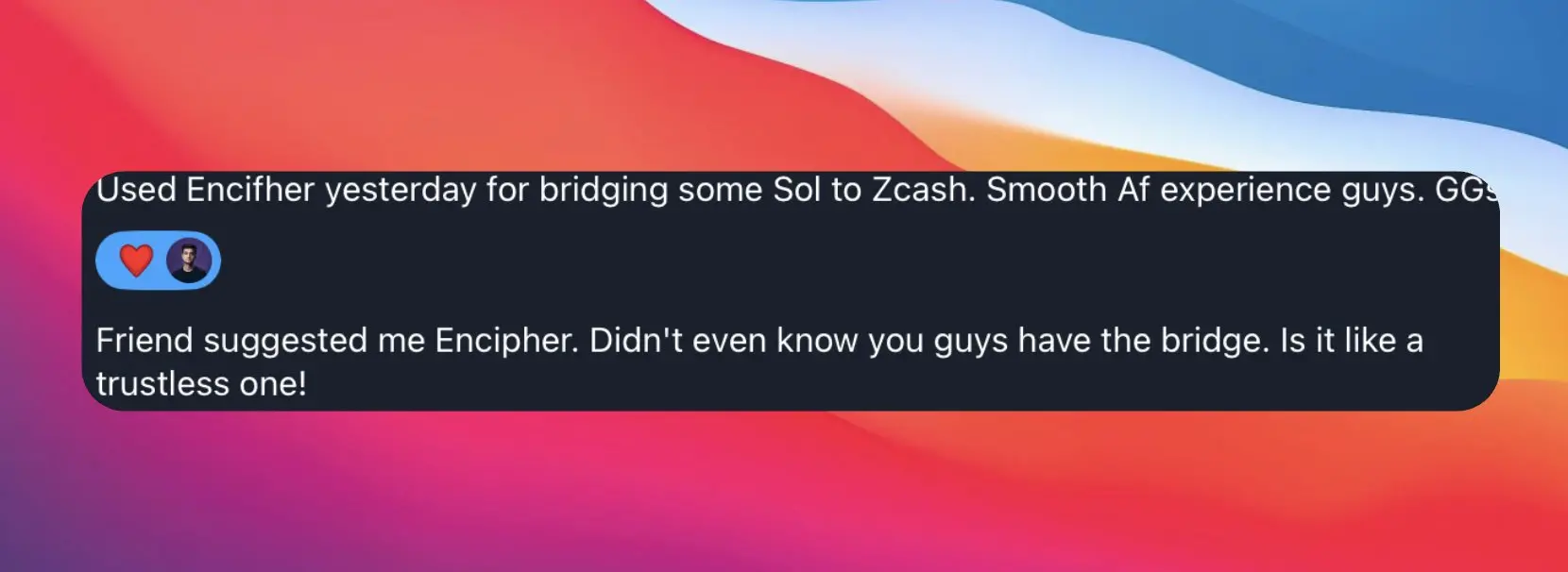
If your product gives users a reason to spontaneously share it with friends and communities, you've earned publicity without burning money. This is hard, but it's worth optimizing for from day one.

3. Launch Features Users Request as Soon as Possible

When users report a poor experience or a bug, fix it immediately, especially if it's a pain point that hinders use.

I used to wait until the end of the day to apply patches. The result was users DMing me: "Since your app doesn't have this feature, I'm going to use Product Y for now."

Once users go to a competitor and form a habit, it's hard to pull them back.

So, try to fix things immediately (ideally within 2-5 hours).

If multiple users request a feature and it's feasible:

  • Build it within 2-3 days.

  • Tell them it was launched based on their feedback.

  • Maybe even give them a reward.

This builds deep trust. Users will start to feel the product "belongs to them," and this sense of emotional ownership is incredibly powerful in early-stage products.
4. The App Name is Very Important

This seems simple, but many people (including me) have messed it up.

The app name should be highly recognizable and easy to share verbally.

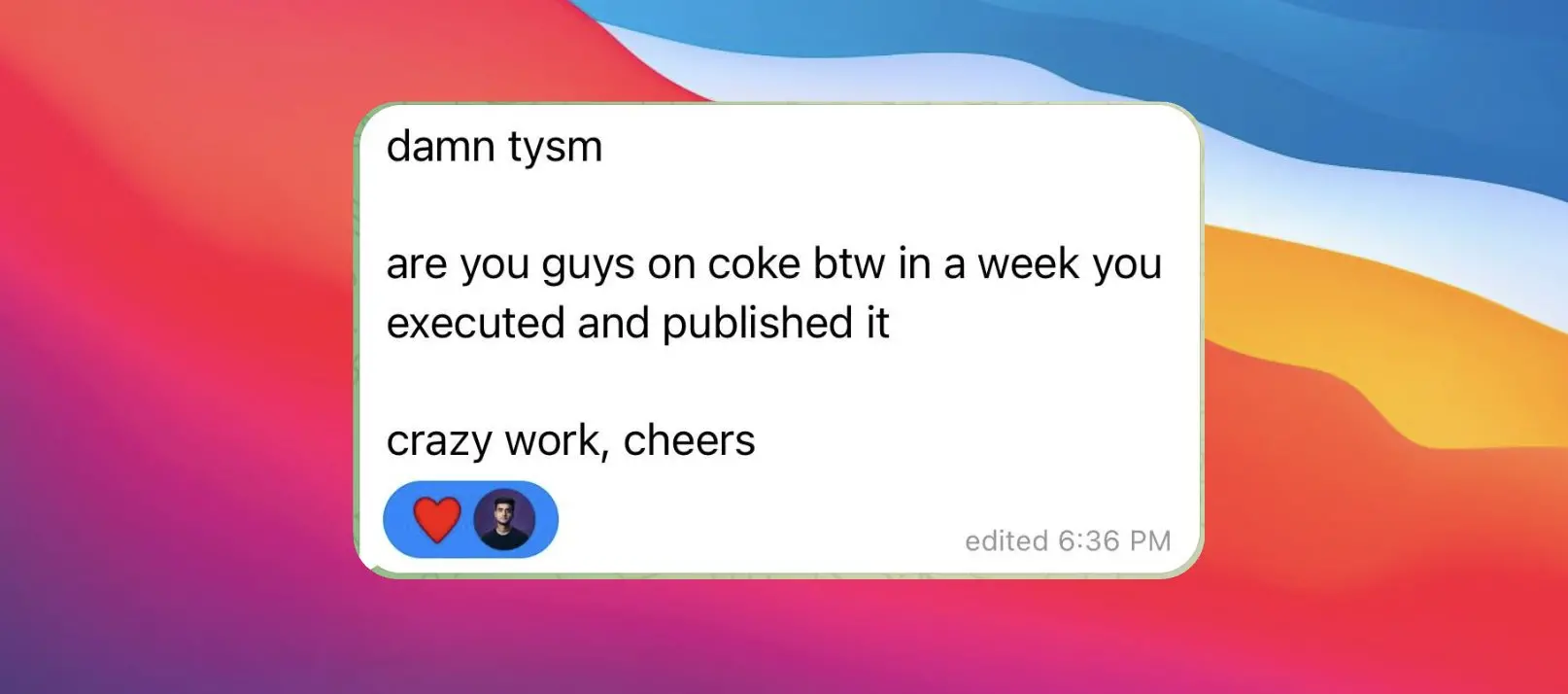
My previous product was called "Encifher," a name extremely hard to remember. Even investors and partners would misspell it when creating group chats.

So we later changed it to encrypt.trade. Simple, memorable, sexy.

5. Talking to Users is Hard, But Essential

Finding and talking to users is extremely difficult, especially when what you're building isn't part of the current "hot narrative."

When I started working on privacy, it wasn't popular. I contacted nearly 1000 people via Cold-DM: maybe 10 out of 100 would reply. Only 3-4 of those could provide substantial help.
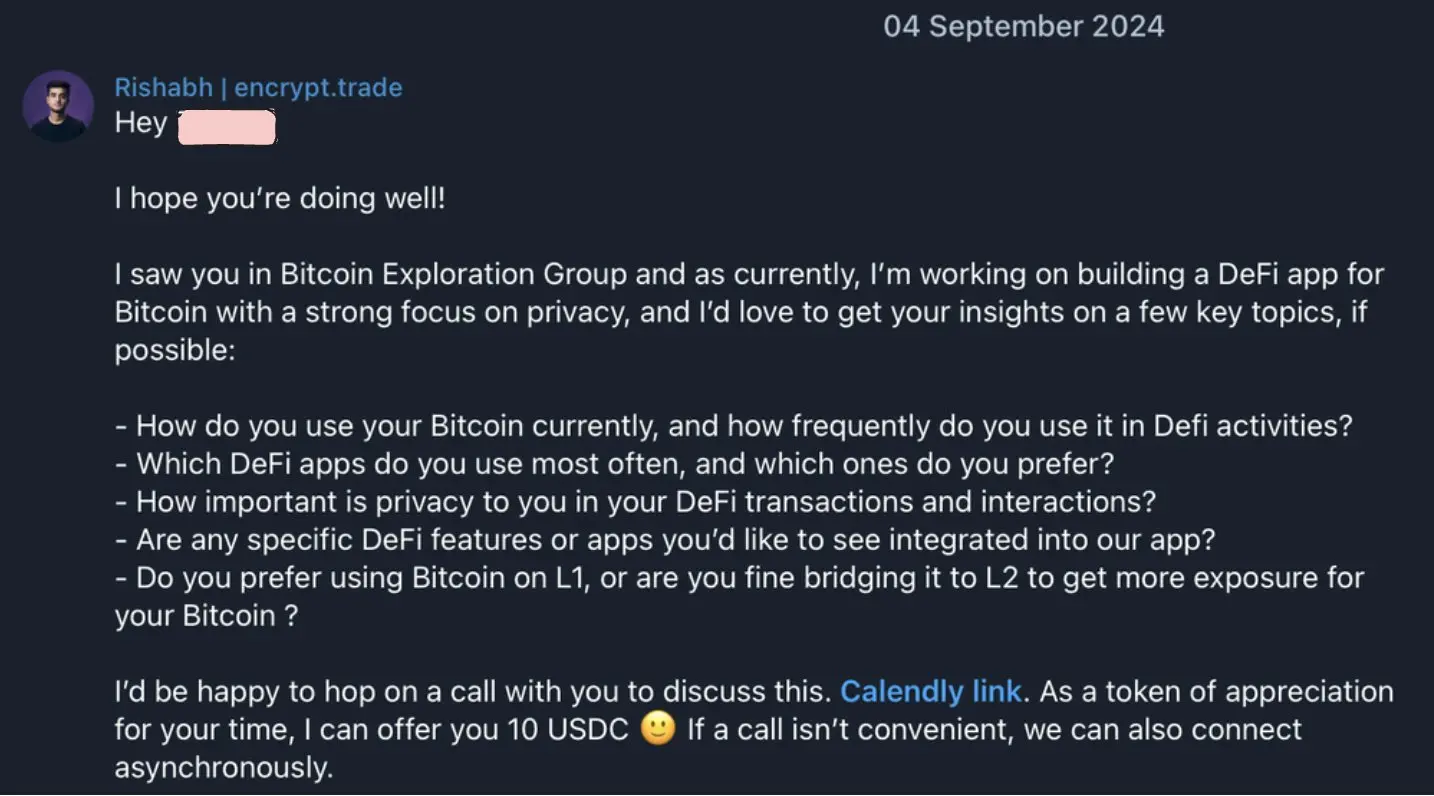
I talked to anyone who showed the slightest interest

I iterated on the product with them

Framing a Cold-DM is also an iterative process. Here are some key points to note:

  • Start with a warm greeting.

  • Put the highlights (funding status, trading volume, etc.) at the beginning.

  • Mention where you found them.

  • Give a friendly call to action.

  • Always remember to follow up.

There's no perfect Cold-DM; you must A/B test to find what works for your target audience.

Here's a decent Cold-DM template to use: But be aware, this process is slow and exhausting.
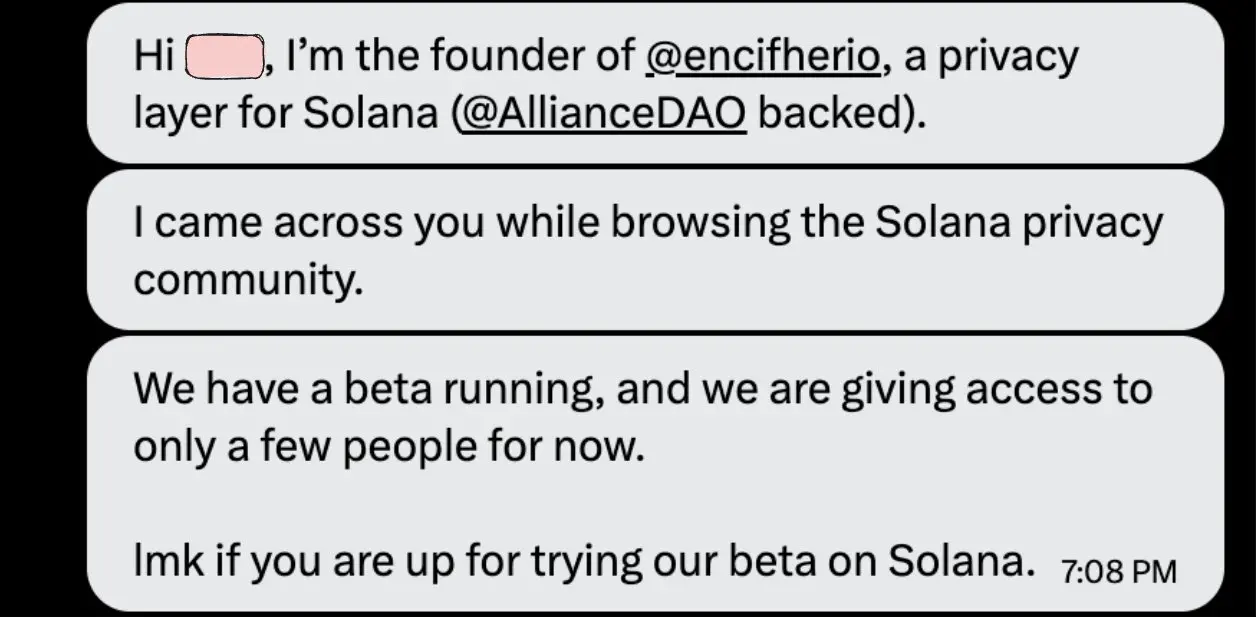

In the crypto circle, few people reply to DMs because scams are everywhere.

Low reply rates are the norm (I know, it's a bit frustrating).

Nevertheless, you must do it.

Your goal at this stage is not to get 1000 users.

Your goal is 10-20 early users who care about the problem, are willing to try the product, and will provide honest feedback.

These early users will become your support system.

Early products often go wrong; these users will help you through that phase.

6. Iterate Quickly

The crypto industry changes rapidly, and attention spans are extremely short.

You must study user behavior, not just listen to their words:

  • What are they doing repeatedly?

  • What kind of workarounds are they using?

  • What are they already willing to pay for? (Many ideas sound good, but if users aren't willing to pay, it can't survive.)

7. Make Your Website Simple to the Point of Being "Foolproof"

Never make any assumptions about the user's knowledge.

As a developer, you've stared at the product for hundreds of hours and find it obvious, but for someone entering for the first time, it's completely foreign.

  • Don't introduce new terminology or complex processes.

  • Minimize the number of clicks.

  • The core value should be presented within 5 seconds of entering the app.

Conclusion

Building consumer crypto products is both fun and challenging. Speed of iteration, user-centric thinking, and marketing ability are more important than perfect technology. This is completely different from B2B.


Twitter:https://twitter.com/BitpushNewsCN

Bitpush TG Discussion Group:https://t.me/BitPushCommunity

Bitpush TG Subscription: https://t.me/bitpush

Original link:https://www.bitpush.news/articles/7599210

Questions liées

QWhat is one of the key lessons the founder learned about building Web3 products for user growth?

AOne key lesson is to build for young, early-adopter users (like those aged 13-21) who are naturally more receptive to new products and have higher social activity, making the product more inherently shareable.

QWhy is it important for a Web3 product to have built-in shareability?

ABuilt-in shareability is crucial because KOL marketing is expensive, trust is low in crypto, and users expect rewards. If the product gives users a reason to share it with friends and communities organically, it reduces marketing costs and drives growth without burning cash.

QHow should founders handle user feedback and feature requests according to the article?

AFounders should address user feedback and bugs immediately, ideally within 2-5 hours for critical issues. If multiple users request a feasible feature, build it within 2-3 days, inform them it was based on their feedback, and even offer rewards to build deep trust and a sense of ownership.

QWhat did the founder realize about product names after his experience with 'Encifher'?

AHe realized that product names should be highly recognizable and easy to share verbally. 'Encifher' was hard to remember and often misspelled, so he changed it to 'encrypt.trade' for simplicity, memorability, and appeal.

QWhat is the recommended approach for cold outreach (Cold-DM) to potential users?

AThe approach includes starting with a warm greeting, highlighting key points (like funding or traction) upfront, mentioning where you found them, giving a friendly call-to-action, and always following up. The goal isn't to get thousands of users but to find 10-20 early users who care and provide honest feedback.

Lectures associées

Turbulences sur le marché crypto : qui achète à contre-courant ?

Le marché crypto a connu une correction sévère au premier trimestre 2026, avec Bitcoin en baisse de plus de 25 % et Ethereum de 35 %. Pourtant, les flux institutionnels sont restés robustes, marqués par une forte dichotomie. Les acheteurs institutionnels ont été actifs : Strategy (ex-MicroStrategy) a accru ses réserves de Bitcoin pour atteindre 815 061 BTC, tandis que des fonds souverains comme Mubadala ont augmenté leurs positions dans les ETF Bitcoin. Plusieurs nouveaux ETF ont été lancés, notamment par Morgan Stanley (MSBT, premier ETF Bitcoin d'une grande banque) et BlackRock (ETHB, premier ETF de staking d'Ethereum). Les banques européennes ont formé un consortium pour un stablecoin euro (Qivalos), et des institutions comme UBS et Citi ont élargi leurs services crypto. À l’inverse, certains hedge funds (Brevan Howard, Tudor) et mineurs ont massivement vendu. Les investissements en capital-risque ont chuté de 49 % en nombre de transactions, mais trois méga-deals (BVNK, Kalshi, Polymarket) ont représenté la moitié des fonds levés (environ 34 milliards de dollars). Les secteurs dominants sont les paiements/stablecoins et les marchés prédictifs, supplantant la DeFi. En résumé, l’accumulation institutionnelle se poursuit, portée par les trésoreries d’entreprise, les fonds souverains et les nouveaux produits ETF, tandis que le risque se concentre sur quelques acteurs majeurs.

marsbitIl y a 14 mins

Turbulences sur le marché crypto : qui achète à contre-courant ?

marsbitIl y a 14 mins

Test pratique de Hunyuan Hy3 preview : L'IA de Tencent est-elle enfin compétitive ?

Le modèle de langage Hy3 preview de Tencent, récemment lancé en open source, présente des capacités améliorées en raisonnement complexe, génération de code, compréhension contextuelle et interaction naturelle. Avec 295 milliards de paramètres et une prise en charge de contexte jusqu'à 256K, il est présenté comme le modèle le plus performant de la série Hunyuan. Les tests montrent des forces dans le raisonnement logique structuré et l'extraction d'informations en contexte bruité, mais une certaine instabilité face aux pièges logiques ou aux questions ambiguës. En génération de code et en tant qu'agent intelligent (via WorkBuddy), il excède dans les tâches simples et fermées (comme créer un jeu Snake) mais peine à mener à bien des missions complexes nécessitant une analyse approfondie et une livraison complète de résultats. Ses progrès les plus notables concernent le dialogue naturel et l'écriture créative, où il produit des textes fluides, moins stéréotypés et mieux contextualisés, imitant même des styles littéraires spécifiques avec succès. Bien que Hy3 preview ne soit pas révolutionnaire dans tous les domaines, il se positionne comme un modèle pratique et polyvalent. Son lancement marque un virage important pour Tencent, qui cherche à rattraper son retard perçu dans la course à l'IA et à intégrer un modèle performant dans son écosystème de produits (QQ, Tencent Docs, etc.). Une version plus grande est attendue prochainement.

marsbitIl y a 2 h

Test pratique de Hunyuan Hy3 preview : L'IA de Tencent est-elle enfin compétitive ?

marsbitIl y a 2 h

DeepSeek V4 fait sensation : La Silicon Valley « construit des murs », la Chine « construit des routes »

**DeepSeek V4 et l'approche collaborative chinoise face au modèle fermé de la Silicon Valley** Le 24 avril, DeepSeek a lancé son modèle V4, acclamé pour ses innovations majeures : une capacité de contexte étendue à un million de tokens avec une réduction de 90% de la consommation mémoire (KV Cache), et une compatibilité native avec les puces chinoises comme celles de Huawei. Contrairement à la concurrence agressive observée entre OpenAI, Google et Anthropic — marquée par des rivalités techniques et des guerres médiatiques — la Chine adopte une stratégie collaborative et open-source. Des entreprises comme DeepSeek et MoonShot AI (créateur de Kimi) partagent ouvertement leurs avancées, comme l’architecture MLA (Multi-head Latent Attention) ou l’optimiseur Muon, permettant une évolution synergique plutôt qu’une compétition destructive. Cette approche open-source réduit les coûts de formation (ex. : DeepSeek V3 formé pour moins de 600M$ contre 5Mds$ pour GPT-5) et stimule l’adoption. Alors que les géants américains se enferment dans des modèles fermés pour préserver leurs avantages, la Chine construit écosystème ouvert, optimisé pour les puces locales et orienté vers les agents IA. Malgré des revenus encore inférieurs à ceux des acteurs US, la croissance du trafic de tokens et la réduction des coûts laissent présager un avantage à long terme grâce à l’innovation collective et l’autonomie technologique.

marsbitIl y a 2 h

DeepSeek V4 fait sensation : La Silicon Valley « construit des murs », la Chine « construit des routes »

marsbitIl y a 2 h

Trading

Spot
Futures
活动图片