Glue Finance Founder: ETH Has Entered a Phase of Non-Consensus, an Inflection Point Is Approaching

链捕手Publié le 2026-06-26Dernière mise à jour le 2026-06-26

Résumé

Glue Finance founder argues that Ethereum's current price underperformance, despite high on-chain activity, stems from its incomplete state and lingering dependency on central stewards like the Ethereum Foundation. The core thesis is that the market is discounting ETH not for lack of use, but because the protocol remains a "machine under construction." Key unresolved issues include centralized L2 sequencers with limited escape hatches, state bloat, vulnerable public mempools, and the looming quantum computing threat. This perpetual "work-in-progress" status forces reliance on a small group of maintainers, undermining the network's promise of credible neutrality and immutability. The author, a self-described Ethereum maximalist, rejects two flawed paths: a "wartime mode" of centralizing for speed (surrendering Ethereum's unique value) or merely replacing the Foundation with another governing entity. The only solution is to complete and then "freeze" the protocol's neutral core through a focused "Manhattan Project" dubbed "Lean Ethereum." This project aims to bundle critical upgrades—consensus layer overhaul, massive scaling via ZK-proofs, quantum resistance, and statelessness—into a decisive push to finalize the base layer. Once the core rules are cryptographically solidified and beyond anyone's control (passing the "walk-away test"), Ethereum would shed its dependency discount and earn a "rigidity premium" for its credible neutrality and programmability, potentially surpassi...

Author:@LaLiLuLeL0x

Compiled by: Jiahuan, ChainCatcher

The debate about stewards is just a distraction. Ethereum truly wins when it no longer needs any stewards, when its core is frozen, beyond the reach of the EF, Ethlabs, or any future successors. This is its "Manhattan Project," and it's proceeding quite well.

It's mid-2026, and the numbers don't add up. Ethereum's settled value is at an all-time high, hosting the vast majority of stablecoins, tokenized funds, and DeFi. Yet ETH is trading around $1,750, down about 57% from its 2025 high and still below the peak set in 2021.

Five years on, with the technical transition complete, the asset price lags behind the past. Something is wrong. The comforting explanations about macroeconomics, the Fed, or capital rotation into Bitcoin don't touch the core issue.

The real explanation is more brutal, and it's the whole reason I'm writing this. Ethereum is a machine that runs but is unfinished. It's operational, it's decentralized, it's never down. But it's full of half-finished features, works in progress, promises rather than deliveries.

Especially post-Merge and with the rollup-centric roadmap, it feels less like a finished network and more like a long-term promise—credibly neutral and decentralized on paper, but each upgrade quietly adds a new pile of problems that need solving before that promise can be fully realized. And each pile eventually lands on the same small group of people to clean up.

An unfinished machine needs mechanics. So, while Ethereum is formally sovereign, controlled by no single entity, in practice, it's still indirectly dependent on the Ethereum Foundation's goodwill to keep building and steering.

The market isn't mispricing Ethereum's usage. The market is pricing this dependency. And the project to ultimately fix this has a name: Lean Ethereum, also known as Ethereum's Manhattan Project.

Let me break this down step-by-step because I know this will upset many. But I believe it nails the reality and the true challenges Ethereum faces right now, both in leadership and at the protocol level. Remember, I'm an Ethereum maximalist. I'm not here to spread FUD; I'm here to keep the conversation pointed in the right direction. I have my viewpoint. Please give me a chance to lay it out.

1. The State of the Machine

Take an honest look at where Ethereum stands today.

The L2 bet is half-lost where it matters most. The rollup-centric roadmap was a bet on scaling without sacrificing decentralization. Years later, every major L2 still runs a centralized sequencer—a single operator ordering transactions that can censor, extract value, or just go down, as Linea paused in 2024 and Base went offline in 2025.

Of the dozens of rollups, almost none have passed L2Beat's own Stage 1 maturity criteria, let alone Stage 2's full trustlessness.

We asked for this.

The only defensible justification for centralized sequencers has always been the escape hatch. Even if the operator censors you or goes completely offline, the rollup should allow you to force-include your own transaction from L1 and withdraw assets back to Ethereum without anyone's permission.

That guarantee is why centralized sequencers were tolerated in the first place: The keys to the chain were never yours, but the exit always was.

Yet, the exit lanes turned out to be conditional. In April 2026, after Kelp DAO's cross-chain bridge was drained of about $292 million, Arbitrum's security council—twelve elected members—invoked emergency powers, forcibly stepping in and moving 30,766 ETH (worth about $71 million) from the attacker's address into a governance-controlled wallet.

Freezing a thief's loot sounds like the system working, and perhaps it was. But look at what it proves. A small council can proactively seize and freeze funds on Arbitrum, meaning your assets there are subject to their discretion. A power that can stop a hacker can stop anyone, including under subpoena or government pressure.

The escape hatch can only save you if the people holding no privileged keys decide otherwise. The irony wrote itself: The moment the on-chain freeze took effect, a U.S. court pierced right through Arbitrum's supposed "decentralized" governance, ordering the DAO not to move the funds at all. So much for unstoppable.

The base layer itself carries open wounds that may never heal. State bloat keeps increasing the data each node must store. The mempool is worse.

Because pending transactions sit publicly, using the public mempool has become a frontrunning death spiral: The moment you broadcast a transaction, it's seen, sandwiched and tailgated before it confirms—a permanent tax where bots extract value from ordinary users just by seeing order flow first.

The fix, encrypted mempools, has been discussed and drafted for years, still not live. These aren't rare edge cases. They're core properties of anything that wants to call itself a neutral settlement layer, and they're still stamped "under construction."

Quantum computing is no longer science fiction without a date. Vitalik's 2026 cryptography roadmap names four parts of Ethereum potentially breakable by quantum computers, with a threat model that includes "harvest now, decrypt later"—an adversary records encrypted data today, then cracks it the day the hardware arrives.

It's a countdown, and the clock is ticking.

Against this backdrop, one faction wants Ethereum to respond by going into wartime mode. Become aggressive, court institutions on their terms, relax the decentralization standards that hold everything back, get faster, more centralized, to compete on throughput with Solana and pump the price.

It sounds like ambition. It's actually surrender.

Because if Ethereum trades away the neutrality that makes it unique, it doesn't beat Solana; it just becomes a slower Solana.

The best-case outcome for the wartime path is Ethereum falling to Solana's market cap, because that's what the market pays for a fast chain that gave up credible neutrality. You don't win a monetary premium by turning into something that never had one.

2. Why ETH Isn't at $10,000

So, here lies the answer to the question every ETH holder has been puzzling over.

The reason ETH isn't at five figures, or even holding old highs while the underlying network keeps growing, isn't lack of usage. Its usage is overwhelming. The reason is the machine is unfinished, and an unfinished machine isn't reliable; it can't stand alone.

Think about what a global settlement layer truly needs to promise. Not speed. Not features. It must promise the ground beneath you won't move, that if you settle a billion dollars on it today, the rules are the same tomorrow and no one can change them on a whim.

Ethereum can't make that promise yet because Ethereum is still under construction, and the act of construction is the act of change. Scaling isn't finished. L2 decentralization isn't finished. The consensus layer is a five-year-old design waiting to be replaced.

Quantum resistance is a roadmap, not a delivered fact. Every unclosed gap is a place where the protocol still needs to change, and every change must be decided by someone.

That someone is the Ethereum Foundation. It's not a conspiracy; it's because they're the ones who can finish this unfinished machine.

The market sees all of this clearly. The market doesn't pay a forever premium to a chain that still clearly needs its founders to finish and steer it. A settlement layer that depends on mechanics isn't a settlement layer at all. It's just a fancy machine with a maintenance contract. That's what $1,750 is pricing. Dependency.

I argued the bullish side in "The Ossification Premium": The market pays for eternity, and the chain that becomes the most immutable wins the monetary prize. This is the other side of the same coin. Ethereum hasn't earned that premium yet because it hasn't become immutable. It's not set in stone; what's not set needs stewarding, and what needs stewarding gets discounted.

3. Everyone Is Exhausted

The unfinished machine has a cost, a cost never priced in, only felt by those actually building here. Everyone building on Ethereum is exhausted, each layer with the same fatigue: The ground beneath them keeps shifting, and nothing lasting can be built on it.

Start with L2s. They can't fully decentralize because they're stuck waiting for the next standard, the next blob upgrade, the next interoperability layer, the next account abstraction model, and the next thing the base will change. So they keep the keys.

As of 2026, no major rollup reaches Stage 2 on L2Beat's criteria; Arbitrum and Optimism are stuck at Stage 1, meaning security councils holding upgrade keys remain a core trust point, a multisig that can rewrite bridges or shut down proofs.

Everyone says it's the price of the early phase. The early phase never ends because the base is unpredictable, and the centralization never leaves.

One layer up, Dapps have the same fatigue. They're forced to deploy on every L2 simultaneously—Arbitrum, Optimism, Base, ZK chains, etc.—maintaining a dozen deployment instances, fragmenting liquidity, and trusting cross-chain bridges that are attack surfaces themselves.

Because the foundational uncertainty, they keep their contracts upgradeable, with admin keys, proxies, and pause switches—the very escape hatches that cost contracts credible neutrality.

The original dream was to write immutable code that no one, not even the author, could change. The reality is that uncertainty forces every serious team to set an upgrade key, because publishing something truly frozen on a foundation that isn't is a bet most developers can't afford.

Client teams aren't faring better.

Browser vendors compete on performance and features, yet they spend all their time rewriting the deepest internals of the protocol just to digest the next hard fork, now twice a year, with a full consensus rewrite queued ahead. They're maintaining not a finished standard but something stuck in migration mode, rewriting the base over and over instead of building on it.

The Foundation sees the symptoms and wants to cure them with a schedule: a predictable, biannual fork cadence, marketed like iOS or Android releases, explicitly to reduce uncertainty for developers. It helps you plan but doesn't cure the sickness. Predictable churn is still churn.

And here's what should worry most: Those who came for the promise should worry more.

This endless, "under construction" state is quietly killing decentralization from top to bottom. You cannot build a credibly neutral, immutable, walk-away application on a foundation that is itself neither immutable nor walk-awayable.

The mutability at the base forces mutability up the stack: upgrade keys on rollups, admin keys on Dapps, migration mode for clients. The unfinished machine forces everyone building on it to have a mechanic too. And a mechanic is a skeleton key, the absolute opposite of what we all came here to build.

4. Two Wrong Escape Routes

There are two tempting ways out here, and both are traps.

The first is the wartime mode mentioned above. Centralizing to compete is to erase the only trait worth paying for. Dead end.

The second route is subtler and more tempting for those who care: Deciding the problem is the Foundation, and replacing it with a better institution, or going to war with Vitalik.

This is also wrong, completely misreading the situation. The Ethereum Foundation and Vitalik today are a gift. For a decade, they've steered Ethereum, remaining neutral when they didn't have to. I'm not writing this against them. I'm grateful they exist.

But some things gratitude can't solve. Dependency on good stewards isn't the same as not needing stewards. Even a perfect foundation is a single point of trust; it won't last forever, it's made of people, and people change.

The EF of 2035 won't be the EF of 2025. A foundation that stays neutral today can be captured, pressured, bought, or simply replaced by worse people tomorrow.

No one should want the credible neutrality of a global settlement layer to depend on the continued goodwill of the EF, Ethlabs, or whoever holds the reins next.

The whole point of cryptocurrency is not having to trust the people in power.

Ethereum needs about $30 million a year to keep its client teams and researchers running. Those researchers are underpaid relative to their market value, acknowledged by the ecosystem itself, making their teams easier acquisition targets.

New money is crowding into this vacuum. Ethlabs launched in June 2026, founded by five former EF researchers, backed by BitMine, SharpLink, and Joe Lubin, with a public mission to make Ethereum the settlement layer for the global economy. They may be perfectly well-intentioned and deliberately route funds through an independent steward to protect neutrality. But that's not the point.

The point is structural: When neutral stewards step back and capital fills the void, neutrality stops being anchored in an institution with no skin in the game and starts relying on players who inherently have one.

Sharper conflicts are already visible, like a live proposal to let a 51% staked-weight vote redistribute validator rewards, which critics call out as a governance capture machine because the people who would receive the money are the ones designing the system.

Replacing one steward with another doesn't solve anything. It just changes the name of the single point of trust.

5. The Walk-Away Test

There's a clean way to see through the whole issue, and it's the core test of the entire argument.

Ask one question. If the Ethereum Foundation and Vitalik collectively walked away tomorrow, could Ethereum keep running, unchanged and credibly neutral, forever?
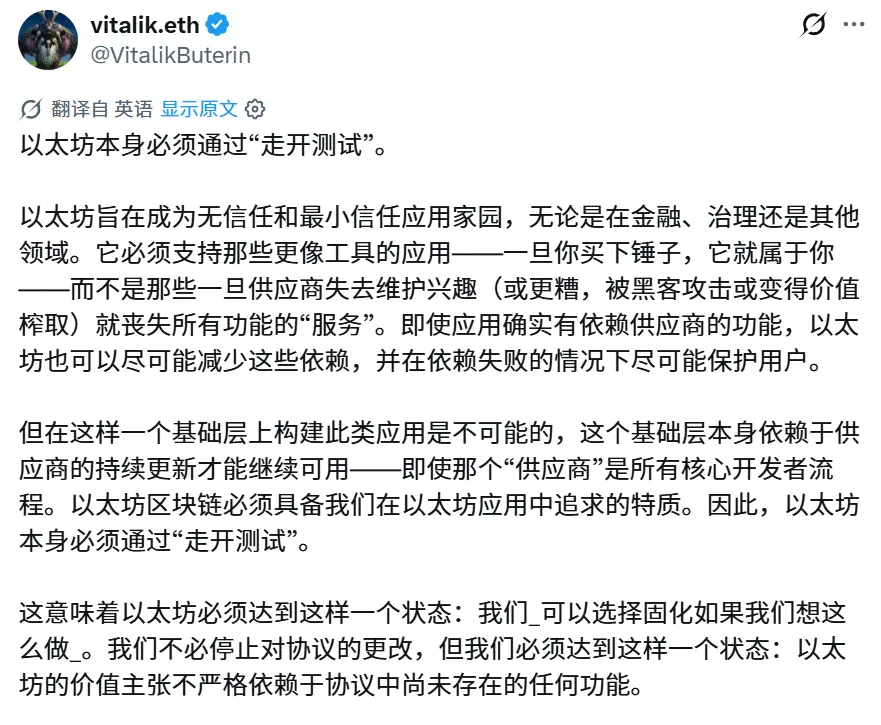
Be honest. The answer today is no. The machine is unfinished; it would stall if walked away from. And the neutrality it has is socially enforced, a promise kept by good people, not guaranteed by mechanics.

Vitalik himself defined credible neutrality as requiring transparent rules, equal application, open participation, and being hard to change. Ethereum achieves the first three but fails on the fourth.

Its rules are still easy to change, through a small off-chain process: an EIP proposal, a weekly All Core Devs call, rough consensus among ~150 core developers spread across ~11 organizations, and a few client teams. No enforced rules.

6. The Only Solution

The fix isn't a better foundation. It's finishing the machine, then freezing the parts that make it credibly neutral, putting the base layer into maintenance mode, so Ethereum finally passes the walk-away test on its own.

Once the neutral core is frozen, the dependency dissolves. Then, the Ethereum Foundation can do the healthiest thing a steward can do: become optional.

It can partner with a thousand new entities, shrink to a research lab, hand work off to a dozen competing teams, or even die off, and none of it threatens the blockchain because the part that defines Ethereum's neutrality can no longer be changed by anyone, whether captured or well-intentioned. You can't manipulate what can't be moved. You can't capture what's finished.

This is what makes the order non-negotiable, because the goal here isn't anti-capitalism; it's the opposite.

Private capital flooding into Ethereum research, entities like Ethlabs delivering tangible value instead of grant-chasing busywork, is one of the healthiest things that could happen to this ecosystem, and I hope for more of it.

But you can't put capitalism into an environment with no rule of law, where nothing stops you from hurting others, stealing, or tearing up contracts. A free market without an underlying rule of law doesn't create prosperity; it unleashes human nature's worst aspects, bound to money.

Capitalism on top of rule of law is a gift; apart from it, it's a predator.

Same for the protocol. First, freeze the parts that make Ethereum safe and credibly neutral, carve the fundamental rules into stone, then open the doors to private capital and let a hundred well-funded teams compete to build everything on top.

If you reverse the order, inviting capital in before the neutral core is frozen, you just get a Solana competitor with one-sixth of ETH's market cap today.

As an ETH maximalist, I don't enjoy writing what comes next, but it's the core truth of everything. Ethereum's endgame is its own Bitcoinization. Becoming as immutable as Bitcoin, earning the eternity premium the market actually pays for, and doing the one thing Bitcoin never could: cross the finish line with full programmability.

Bitcoin's freeze was accidental and neglectful, ending up as a rock that does nothing.

Ethereum has the chance to freeze (only certain parts) actively, intentionally, and end up the trusted neutral settlement layer for the entire tokenized economy. Same eternity. Much larger prize. That's the entire bullish case, and it demands ossification before wartime mode.

7. The Manhattan Project

Lean Ethereum is the path to finishing and freezing this machine, which is why I keep invoking the grandest historical metaphor. A Manhattan Project is when a field bundles its hardest problems into a single, concentrated, deadline-driven, existential push. That's the situation now.

It bundles the protocol's four hardest problems into one definitive plan, aiming for a single bundled hard fork rather than a decade of trickles.

Ossification. The consensus layer is being rebuilt from scratch as Lean Consensus, work formerly called Beam Chain, with 3-slot finality, ~12-second finality, and 4-second block times. Justin Drake calls the strategy ossification accelerationism: Pack every hard change into one jump to get the layer into maintenance mode as fast as possible. Build it once, then freeze it.

Scaling. The goal is L1-level trillion-gas-per-second, ~10,000 TPS at the base layer, millions at L2, through ZK verification and Blob- and PeerDAS-based data availability, not scaling blocks on centralized hardware. The pace is 3x, then 10x, then 100x.

Quantum Resistance. Validators' BLS signatures are replaced by leanXMSS, a hash-based, quantum-safe scheme, with a STARK aggregation engine compressing results ~250x. User accounts get signature agility via account abstraction, so wallets can opt into post-quantum protection without waiting for the whole chain. Target readiness ~2029.

ZK. Make the whole chain provable, letting anyone verify consensus with a succinct proof on cheap hardware, while the execution layer gets rebuilt around ZK-friendly VMs. Hash-based signatures also friendly to SNARKs are the key hinge merging quantum resistance and provability.

And, crucially, this plan closes the two specific wounds mentioned at the article's start.

Statelessness. State bloat is the first wound, where the full state copy each node must carry keeps growing, slowly pricing out home validators. Statelessness cuts it: Validators no longer store the whole state, instead verifying each block via compact proofs, turning the node-running burden back from a storage cost to cheap computation, keeping the validator set broad and decentralized.

Native Rollups. The L2 mess is the other wound, and the EXECUTE precompile in EIP-8079 is the fix. Native rollups no longer run their own proofs, governance, security councils; they hand their blocks back to Ethereum for direct validation, inheriting L1 security, upgrades, and quantum resistance for free.

No multisigs to hack, no upgrade keys to hold. The centralization trap rollups were forced into disappears: You're not reimplementing Ethereum; you're part of it, ossifying the day Ethereum ossifies.

Synchronous Compossability. Even better, it recovers what fragmentation stole. With shared execution and Ethereum-level ordering, rollups become atomically composable: A transaction can hit a few rollups and L1 in the same block, all succeed or all fail, like smart contracts on a single chain.

No cross-chain bridges, no routing, no doubt about what chain you're on. Liquidity pools into one whole, and Ethereum feels like the same computer no matter how many rollups run on top. It needs real-time proofs, still racing to production, but that's the finish line.

The work is already underway. The Fusaka upgrade is live, carrying PeerDAS and the first substantive steps of the scaling plan. Post-quantum efforts have a public home at pq.ethereum.org, with its alternative signature scheme designated. New client teams have formed around Lean Consensus.

The hard, definitive parts—the consensus rewrite, quantum migration, and final freeze—lie ahead, with the next forks, Glamsterdam and Hegotá, scheduled for 2026, targeting full readiness by the decade's end. That part is still on the clock.

The original Manhattan Project didn't just end the bloodiest war in history; it reshaped the global order around the nation that got there first.

Lean Ethereum aims for finality of the same magnitude. Not to win a blockchain race, but to end it. The day Ethereum freezes its neutral core, passes the walk-away test, and can no longer be steered by anyone, the race for the world's base layer is over.

Bitcoin has shown us what the market pays for an ossified rock that does nothing—over a trillion dollars for eternity alone.

The world has never priced an ossified rock that's also the global economy's settlement layer because it has never existed.

Lean Ethereum is the plan to build that thing. Finish it, and Ethereum doesn't just flip Bitcoin; it hits a number no model yet projects, and leaves Bitcoin behind for good because it finally has the one thing Bitcoin has—eternity—plus the one thing Bitcoin gave up—programmability.

That's why it can't be a decade of gentle incrementalism. It's a race between two clocks.

The first is the ossification clock: How fast Lean Ethereum finishes the machine and freezes the neutral core. The second is the capture clock: How fast the funding vacuum, the corporate stewards filling empty EF chairs, the wartime centralization push, and the quantum deadline harden into actual problems. Every year Ethereum stays unfinished is another year of window for capture, pressure, or just continued dependency on whoever happens to be holding the wheel.

8. Two Endings

So, past doomsaying and blind cheering, here's Ethereum's actual situation.

Finish the Manhattan Project, freeze the base, pass the walk-away test, and Ethereum becomes the world's first ossified, quantum-resistant, credibly neutral global economic settlement layer—a settlement layer that doesn't need a foundation, founders, or permission to stay neutral.

At that moment, the dependency discount crushing the price inverts into the eternity premium, a revaluation with no peer and no ceiling.

Stall, or let the wartime faction trade neutrality for speed, and Ethereum becomes, at best, a slower Solana; at worst, an untrustworthy, manipulated, forever-mutable chain, something captured and steered by its paymasters, with the premium it chased forever evaporated.

I'm long because I believe it can. But anyone telling you the outcome is guaranteed has skipped the hardest chapter. Finish the machine, freeze it, walk away from any need for stewards at all. That's the whole game now.


Cryptos en tendance

Questions liées

QAccording to the article, why hasn't ETH's price reached or sustained higher levels despite high usage and settlement volume?

AThe article argues that the market is not mispricing Ethereum's usage. Instead, it is pricing in its 'dependency' on the Ethereum Foundation and its incomplete, evolving nature. ETH's price is discounted because Ethereum is an 'unfinished machine' that still requires stewards for development and guidance, preventing it from achieving the 'immutability premium' that comes with a truly reliable, neutral, and final settlement layer.

QWhat is the 'Manhattan Plan' (Lean Ethereum) as described in the article, and what are its four core objectives?

AThe 'Manhattan Plan,' or Lean Ethereum, is a decisive, bundled initiative to complete and 'freeze' Ethereum's neutral core. Its four core objectives are: 1. **Rigidification**: Rebuilding the consensus layer (Beam Chain) for speed and then entering maintenance mode. 2. **Scale**: Achieving massive throughput (e.g., 1 trillion gas per second) via ZK proofs and advanced data availability. 3. **Post-Quantum Security**: Replacing BLS signatures with quantum-safe alternatives like leanXMSS. 4. **ZK**: Making the entire chain provable with ZK-friendly VMs, which also enables key features like statelessness and native rollups.

QWhat is the 'handoff test' mentioned in the article, and what is the author's conclusion about Ethereum's current state regarding it?

AThe 'handoff test' asks: If the Ethereum Foundation and Vitalik Buterin collectively stepped away tomorrow, could Ethereum continue running, unchanged and reliably neutral, forever? The author concludes the honest answer today is 'no.' The machine is unfinished and would stall without its stewards. Its current neutrality is upheld by social consensus and the goodwill of its maintainers, not by mechanisms that are frozen and beyond anyone's reach.

QThe article discusses two 'wrong escape routes' for Ethereum. What are they, and why does the author consider them traps?

AThe two wrong escape routes are: 1. **War Mode**: Sacrificing decentralization and reliable neutrality for speed to compete with chains like Solana. The author argues this is surrender, turning Ethereum into a 'slower Solana' and forfeiting its unique monetary premium. 2. **Replacing the Stewards**: Focusing criticism on the EF or Vitalik and trying to replace them with another entity. The author believes this misreads the problem, as it merely changes the name of the single point of trust/dependency rather than eliminating the need for a steward altogether.

QWhat is the author's ultimate vision for Ethereum's endgame, and how does it relate to Bitcoin?

AThe author's vision is for Ethereum to 'Bitcoinize itself'—to become as immutable as Bitcoin, thereby winning the 'eternity premium' the market pays. However, Ethereum's opportunity is to achieve this 'rigidity' *actively and selectively* while retaining full programmability. The endgame is for Ethereum to become 'the world’s first rigid, post-quantum, credibly neutral settlement layer for the global economy'—possessing Bitcoin's key property (immutability) without abandoning its own (programmability), which would allow it to surpass Bitcoin in value and utility.

Lectures associées

L'essor des stablecoins en Amérique latine n'est pas, par essence, une « victoire de la cryptographie »

L'essor des stablecoins en Amérique latine n'est pas une victoire de la crypto, mais une réponse à un besoin ancien : le besoin de faire parvenir de l'argent à la maison. Historiquement, des systèmes comme les "lettres d'argent" (银信) des immigrants chinois ou les *remesas* ont résolu ce problème par la confiance communautaire et des réseaux informels. Aujourd'hui, des pays comme le Mexique, l'Argentine ou le Venezuela font face à des monnaies locales volatiles, des coûts de transfert élevés et des contrôles de change. Les stablecoins (USDT, USDC) y sont adoptés non comme actifs spéculatifs, mais comme des "dollars numériques" pratiques pour les envois de fonds, les paiements transfrontaliers ou se protéger de l'inflation. Cependant, le véritable défi ne réside pas dans le transfert blockchain lui-même, qui est rapide et peu coûteux, mais dans les "deux extrémités" : l'entrée (où obtenir les stablecoins avec des devises locales) et la sortie (où les convertir en argent utilisable localement, via Pix au Brésil, SPEI au Mexique, ou du cash). Les régulateurs latino-américains, conscients de cette réalité, cherchent moins à interdire qu'à encadrer ces actifs, les traitant comme une nouvelle infrastructure de paiement et de change. Ainsi, l'avenir des stablecoins dans la région dépendra de leur capacité à s'intégrer de manière invisible dans des solutions qui répondent à la question centrale : l'argent est-il arrivé à bon port ?

marsbitIl y a 20 mins

L'essor des stablecoins en Amérique latine n'est pas, par essence, une « victoire de la cryptographie »

marsbitIl y a 20 mins

Le revirement d'Airwallex : Du mépris des stablecoins il y a un an, à un engagement capital flamboyant aujourd'hui

Le géant du paiement transfrontalier Airwallex (空中云汇) a dirigé un tour de financement de série initiale pour Metal, un réseau de règlement pour la finance tokenisée. Cette décision est remarquable car son fondateur, Jack Zhang, était l'un des critiques les plus acérés des stablecoins il y a un an, déclarant qu'ils n'offraient pas d'avantages concrets pour les paiements B2B et les transferts internationaux majeurs. L'article explique ce revirement stratégique. Metal vise à être une couche de règlement blockchain de niveau institutionnel pour la tokenisation d'actifs financiers traditionnels (actions, obligations). Pour Airwallex, cet investissement représente une opportunité d'intégrer ces nouveaux actifs numériques à son réseau de paiement existant. Bien que Zhang maintienne une distinction entre les stablecoins (qu'il considère comme des monnaies fiduciaires tokenisées) et les cryptomonnaies spéculatives, son action démontre une reconnaissance pragmatique de l'évolution du secteur. Le texte souligne que cette adoption s'inscrit dans une tendance plus large : les institutions financières traditionnelles (comme Stripe, Mastercard ou JPMorgan) développent ou acquièrent activement des capacités en matière de stablecoins et de paiements numériques. La conclusion est que, au-delà du débat sur l'utilité immédiate, les stablecoins et les réseaux tokenisés deviennent un champ stratégique incontournable pour l'avenir de la finance, en particulier pour les paiements transfrontaliers, l'inclusion financière et l'efficacité des règlements. Airwallex choisit ainsi de s'impliquer pour sécuriser sa place à cette nouvelle table des paiements.

marsbitIl y a 1 h

Le revirement d'Airwallex : Du mépris des stablecoins il y a un an, à un engagement capital flamboyant aujourd'hui

marsbitIl y a 1 h

Trading

Spot

Articles tendance

Qu'est ce que ETH 2.0

ETH 2.0 : Une nouvelle ère pour Ethereum Introduction ETH 2.0, largement connu sous le nom d'Ethereum 2.0, marque une mise à niveau monumentale de la blockchain Ethereum. Cette transition n'est pas simplement un relooking ; elle vise à améliorer fondamentalement la scalabilité, la sécurité et la durabilité du réseau. Avec un passage du mécanisme de consensus énergivore Proof of Work (PoW) à un Proof of Stake (PoS) plus efficace, ETH 2.0 promet une approche transformative pour l'écosystème blockchain. Qu'est-ce qu'ETH 2.0 ? ETH 2.0 est un ensemble de mises à jour distinctes et interconnectées axées sur l'optimisation des capacités et des performances d'Ethereum. La refonte est conçue pour résoudre des défis critiques auxquels le mécanisme actuel d'Ethereum fait face, en particulier en ce qui concerne la vitesse des transactions et la congestion du réseau. Objectifs d'ETH 2.0 Les principaux objectifs d'ETH 2.0 tournent autour de l'amélioration de trois aspects fondamentaux : Scalabilité : Avec pour objectif d'améliorer considérablement le nombre de transactions que le réseau peut traiter par seconde, ETH 2.0 cherche à dépasser la limitation actuelle d'environ 15 transactions par seconde, atteignant potentiellement des milliers. Sécurité : Des mesures de sécurité renforcées sont essentielles à ETH 2.0, en particulier grâce à une meilleure résistance aux cyberattaques et à la préservation de l'éthique décentralisée d'Ethereum. Durabilité : Le nouveau mécanisme PoS est conçu non seulement pour améliorer l'efficacité, mais aussi pour réduire considérablement la consommation d'énergie, alignant le cadre opérationnel d'Ethereum avec des considérations environnementales. Qui est le créateur d'ETH 2.0 ? La création d'ETH 2.0 peut être attribuée à la Fondation Ethereum. Cette organisation à but non lucratif, qui joue un rôle crucial dans le soutien au développement d'Ethereum, est dirigée par le cofondateur notable Vitalik Buterin. Sa vision d'un Ethereum plus scalable et durable a été la force motrice derrière cette mise à niveau, impliquant des contributions d'une communauté mondiale de développeurs et d'enthousiastes dédiés à l'amélioration du protocole. Qui sont les investisseurs d'ETH 2.0 ? Bien que les détails concernant les investisseurs d'ETH 2.0 n'aient pas été rendus publics, la Fondation Ethereum est connue pour recevoir le soutien de diverses organisations et individus dans le domaine de la blockchain et de la technologie. Ces partenaires incluent des sociétés de capital-risque, des entreprises technologiques et des organisations philanthropiques qui partagent un intérêt mutuel pour le soutien au développement des technologies décentralisées et des infrastructures blockchain. Comment fonctionne ETH 2.0 ? ETH 2.0 est notable pour l'introduction d'une série de caractéristiques clés qui le différencient de son prédécesseur. Proof of Stake (PoS) La transition vers un mécanisme de consensus PoS est l'un des changements marquants d'ETH 2.0. Contrairement au PoW, qui repose sur un minage énergivore pour la vérification des transactions, le PoS permet aux utilisateurs de valider des transactions et de créer de nouveaux blocs en fonction du nombre d'ETH qu'ils détiennent dans le réseau. Cela conduit à une meilleure efficacité énergétique, réduisant la consommation d'environ 99,95 %, faisant d'Ethereum 2.0 une alternative considérablement plus verte. Shard Chains Les shard chains sont une autre innovation essentielle d'ETH 2.0. Ces chaînes plus petites fonctionnent en parallèle avec la chaîne principale d'Ethereum, permettant à plusieurs transactions d'être traitées simultanément. Cette approche améliore la capacité globale du réseau, répondant aux préoccupations de scalabilité qui ont affecté Ethereum. Beacon Chain Au cœur d'ETH 2.0 se trouve la Beacon Chain, qui coordonne le réseau et gère le protocole PoS. Elle sert d'organisateur : elle supervise les validateurs, garantit que les shards restent connectés au réseau et surveille la santé globale de l'écosystème blockchain. Chronologie d'ETH 2.0 Le parcours d'ETH 2.0 a été marqué par plusieurs étapes clés qui tracent l'évolution de cette mise à niveau significative : Décembre 2020 : Le lancement de la Beacon Chain a marqué l'introduction du PoS, préparant le terrain pour la migration vers ETH 2.0. Septembre 2022 : L'achèvement de « The Merge » représente un moment pivot où le réseau Ethereum a réussi à passer d'un cadre PoW à un cadre PoS, annonçant une nouvelle ère pour Ethereum. 2023 : Le déploiement prévu des shard chains vise à améliorer davantage la scalabilité du réseau Ethereum, consolidant ETH 2.0 comme une plateforme robuste pour les applications et services décentralisés. Caractéristiques et avantages clés Scalabilité améliorée Un des avantages les plus significatifs d'ETH 2.0 est sa scalabilité améliorée. La combinaison de PoS et des shard chains permet au réseau d'étendre sa capacité, lui permettant de traiter un volume de transactions bien supérieur par rapport au système hérité. Efficacité énergétique L'implémentation du PoS représente un pas immense vers l'efficacité énergétique dans la technologie blockchain. En réduisant considérablement la consommation d'énergie, ETH 2.0 non seulement réduit les coûts d'exploitation mais s'aligne également plus étroitement avec les objectifs mondiaux de durabilité. Sécurité renforcée Les mécanismes mis à jour d'ETH 2.0 contribuent à améliorer la sécurité sur l'ensemble du réseau. Le déploiement du PoS, ainsi que des mesures de contrôle innovantes établies par les shard chains et la Beacon Chain, garantissent un degré de protection plus élevé contre les menaces potentielles. Coûts réduits pour les utilisateurs À mesure que la scalabilité s'améliore, les effets sur les coûts des transactions seront également visibles. Une capacité accrue et une congestion réduite devraient se traduire par des frais plus bas pour les utilisateurs, rendant Ethereum plus accessible pour les transactions quotidiennes. Conclusion ETH 2.0 marque une évolution significative dans l'écosystème blockchain d'Ethereum. Alors qu'il aborde des problèmes essentiels tels que la scalabilité, la consommation d'énergie, l'efficacité des transactions et la sécurité globale, l'importance de cette mise à niveau ne peut être sous-estimée. Le passage au Proof of Stake, l'introduction des shard chains et le travail fondamental de la Beacon Chain sont indicatifs d'un avenir où Ethereum peut répondre aux demandes croissantes du marché décentralisé. Dans une industrie guidée par l'innovation et le progrès, ETH 2.0 se dresse comme un témoignage des capacités de la technologie blockchain pour ouvrir la voie à une économie numérique plus durable et efficace.

180 vues totalesPublié le 2024.04.04Mis à jour le 2024.12.03

Qu'est ce que ETH 2.0

Qu'est ce que ETH 3.0

ETH3.0 et $eth 3.0 : Un examen approfondi de l'avenir d'Ethereum Introduction Dans le paysage en évolution rapide des cryptomonnaies et de la technologie blockchain, ETH3.0, souvent désigné sous le nom de $eth 3.0, est devenu un sujet d'intérêt et de spéculation considérable. Le terme englobe deux concepts principaux qui méritent clarification : Ethereum 3.0 : Cela représente une mise à niveau future potentielle visant à augmenter les capacités de la blockchain Ethereum existante, en se concentrant particulièrement sur l'amélioration de l'évolutivité et des performances. ETH3.0 Meme Token : Ce projet de cryptomonnaie distinct cherche à tirer parti de la blockchain Ethereum pour créer un écosystème centré sur les mèmes, promouvant l'engagement au sein de la communauté des cryptomonnaies. Comprendre ces facettes d'ETH3.0 est essentiel non seulement pour les passionnés de crypto, mais aussi pour ceux qui observent des tendances technologiques plus larges dans l'espace numérique. Qu'est-ce qu'ETH3.0 ? Ethereum 3.0 Ethereum 3.0 est présenté comme une mise à niveau proposée du réseau Ethereum déjà établi, qui a été la colonne vertébrale de nombreuses applications décentralisées (dApps) et de contrats intelligents depuis sa création. Les améliorations envisagées se concentrent principalement sur l'évolutivité, intégrant des technologies avancées telles que le sharding et les preuves à connaissance nulle (zk-proofs). Ces innovations technologiques visent à faciliter un nombre sans précédent de transactions par seconde (TPS), atteignant potentiellement des millions, répondant ainsi à l'une des limitations les plus significatives auxquelles fait face la technologie blockchain actuelle. L'amélioration n'est pas seulement technique, mais également stratégique ; elle vise à préparer le réseau Ethereum à une adoption et une utilité généralisées dans un avenir marqué par une demande accrue de solutions décentralisées. ETH3.0 Meme Token Contrairement à Ethereum 3.0, l'ETH3.0 Meme Token s'aventure dans un domaine plus léger et ludique en combinant la culture des mèmes Internet avec la dynamique de la cryptomonnaie. Ce projet permet aux utilisateurs d'acheter, de vendre et d'échanger des mèmes sur la blockchain Ethereum, fournissant une plateforme qui favorise l'engagement communautaire à travers la créativité et les intérêts partagés. L'ETH3.0 Meme Token vise à démontrer comment la technologie blockchain peut s'entrecroiser avec la culture numérique, créant des cas d'utilisation qui sont à la fois divertissants et financièrement viables. Qui est le créateur d'ETH3.0 ? Ethereum 3.0 L'initiative visant Ethereum 3.0 est principalement propulsée par un consortium de développeurs et de chercheurs au sein de la communauté Ethereum, incluant notamment Justin Drake. Connu pour ses idées et ses contributions à l'évolution d'Ethereum, Drake a été une figure de proue dans les discussions concernant la transition d'Ethereum vers un nouveau niveau de consensus, appelé la “Beam Chain.” Cette approche collaborative du développement signifie qu'Ethereum 3.0 n'est pas le produit d'un créateur unique mais plutôt une manifestation de l'ingéniosité collective axée sur l'avancement de la technologie blockchain. ETH3.0 Meme Token Les détails concernant le créateur de l'ETH3.0 Meme Token sont actuellement introuvables. La nature des tokens mèmes conduit souvent à une structure plus décentralisée et axée sur la communauté, ce qui pourrait expliquer l'absence d'attribution spécifique. Cela s'aligne avec l'esprit de la communauté crypto au sens large, où l'innovation naît souvent d'efforts collectifs plutôt qu'individuels. Qui sont les investisseurs d'ETH3.0 ? Ethereum 3.0 Le soutien à Ethereum 3.0 provient principalement de la Fondation Ethereum, ainsi que d'une communauté enthousiaste de développeurs et d'investisseurs. Cette association fondationnelle procure un degré de légitimité significatif et améliore la perspective d'une mise en œuvre réussie, car elle s'appuie sur la confiance et la crédibilité construites au fil des années d'opérations de réseau. Dans le climat en rapide évolution des cryptomonnaies, le soutien de la communauté joue un rôle crucial dans l'accélération du développement et de l'adoption, positionnant Ethereum 3.0 comme un prétendant sérieux pour de futures avancées blockchain. ETH3.0 Meme Token Bien que les sources actuellement disponibles ne fournissent pas d'informations explicites concernant les fondations ou organisations d'investissement soutenant l'ETH3.0 Meme Token, cela est indicatif du modèle de financement typique pour les tokens mèmes, qui repose souvent sur le soutien de base et l'engagement de la communauté. Les investisseurs dans de tels projets se composent généralement d'individus motivés par le potentiel d'innovation guidée par la communauté et l'esprit de coopération trouvé au sein de la communauté crypto. Comment fonctionne ETH3.0 ? Ethereum 3.0 Les caractéristiques distinctives d'Ethereum 3.0 résident dans son implémentation proposée du sharding et de la technologie zk-proof. Le sharding est une méthode de partitionnement de la blockchain en morceaux plus petits et gérables ou “shards,” qui peuvent traiter les transactions en parallèle plutôt qu'en séquence. Cette décentralisation du traitement aide à prévenir la congestion et garantit que le réseau reste réactif même sous une charge importante. La technologie de preuve à connaissance nulle (zk-proof) apporte une autre couche de sophistication en permettant la validation des transactions sans révéler les données sous-jacentes impliquées. Cet aspect améliore non seulement la confidentialité, mais augmente également l'efficacité globale du réseau. Il est également question d'incorporer une machine virtuelle Ethereum à connaissance nulle (zkEVM) dans cette mise à niveau, amplifiant encore les capacités et l'utilité du réseau. ETH3.0 Meme Token L'ETH3.0 Meme Token se distingue en capitalisant sur la popularité de la culture des mèmes. Il établit un marché pour que les utilisateurs participent à l'échange de mèmes, non seulement pour le divertissement mais aussi pour un potentiel gain économique. En intégrant des fonctionnalités telles que le staking, la fourniture de liquidités et des mécanismes de gouvernance, le projet favorise un environnement qui incite à l'interaction et à la participation communautaire. En offrant un mélange unique de divertissement et d'opportunité économique, l'ETH3.0 Meme Token vise à attirer un public diversifié, allant des passionnés de crypto aux amateurs occasionnels de mèmes. Chronologie d'ETH3.0 Ethereum 3.0 11 novembre 2024 : Justin Drake évoque la prochaine mise à niveau ETH 3.0, centrée sur les améliorations de l'évolutivité. Cette annonce signifie le début de discussions formelles concernant l'architecture future d'Ethereum. 12 novembre 2024 : La proposition tant attendue pour Ethereum 3.0 devrait être dévoilée à Devcon à Bangkok, posant les bases pour un retour d'information plus large de la communauté et des étapes potentielles à venir dans le développement. ETH3.0 Meme Token 21 mars 2024 : L'ETH3.0 Meme Token est officiellement listé sur CoinMarketCap, marquant son entrée dans le domaine public des cryptomonnaies et améliorant la visibilité de son écosystème basé sur les mèmes. Points clés En conclusion, Ethereum 3.0 représente une évolution significative au sein du réseau Ethereum, se concentrant sur le dépassement des limitations concernant l'évolutivité et les performances grâce à des technologies avancées. Ses mises à niveau proposées reflètent une approche proactive face aux exigences futures et à l'utilisabilité. D'autre part, l'ETH3.0 Meme Token encapsule l'essence d'une culture guidée par la communauté dans l'espace des cryptomonnaies, tirant parti de la culture des mèmes pour créer des plateformes engageantes qui encouragent la créativité et la participation des utilisateurs. Comprendre les objectifs distincts et les fonctionnalités d'ETH3.0 et de $eth 3.0 est primordial pour quiconque s'intéresse aux développements en cours dans l'espace crypto. Avec ces deux initiatives traçant des chemins uniques, elles soulignent collectivement la nature dynamique et multifacette de l'innovation blockchain.

185 vues totalesPublié le 2024.04.04Mis à jour le 2024.12.03

Qu'est ce que ETH 3.0

Comment acheter ETH

Bienvenue sur HTX.com ! Nous vous permettons d'acheter Ethereum (ETH) de manière simple et pratique. Suivez notre guide étape par étape pour commencer votre parcours crypto.Étape 1 : Création de votre compte HTXUtilisez votre adresse e-mail ou votre numéro de téléphone pour ouvrir un compte sur HTX gratuitement. L'inscription se fait en toute simplicité et débloque toutes les fonctionnalités.Créer mon compteÉtape 2 : Choix du mode de paiement (rubrique Acheter des cryptosCarte de crédit/débit : utilisez votre carte Visa ou Mastercard pour acheter instantanément Ethereum (ETH).Solde :utilisez les fonds du solde de votre compte HTX pour trader en toute simplicité.Prestataire tiers :pour accroître la commodité d'utilisation, nous avons ajouté des modes de paiement populaires tels que Google Pay et Apple Pay.P2P :tradez directement avec d'autres utilisateurs sur HTX.OTC (de gré à gré) : nous offrons des services personnalisés et des taux de change compétitifs aux traders.Étape 3 : stockage de vos Ethereum (ETH)Après avoir acheté vos Ethereum (ETH), stockez-les sur votre compte HTX. Vous pouvez également les envoyer ailleurs via un transfert sur la blockchain ou les utiliser pour trader d'autres cryptos.Étape 4 : tradez des Ethereum (ETH)Tradez facilement Ethereum (ETH) sur le marché Spot de HTX. Il vous suffit d'accéder à votre compte, de sélectionner la paire de trading, d'exécuter vos trades et de les suivre en temps réel. Nous offrons une expérience conviviale aux débutants comme aux traders chevronnés.

4.4k vues totalesPublié le 2024.12.10Mis à jour le 2026.06.02

Comment acheter ETH

Discussions

Bienvenue dans la Communauté HTX. Ici, vous pouvez vous tenir informé(e) des derniers développements de la plateforme et accéder à des analyses de marché professionnelles. Les opinions des utilisateurs sur le prix de ETH (ETH) sont présentées ci-dessous.

活动图片