From Fragmented Components to the Super Layer

marsbitPublié le 2026-01-27Dernière mise à jour le 2026-01-27

Résumé

In recent developments within the decentralized social space, Farcaster and Lens have both undergone significant strategic transitions, highlighting a broader shift toward platformization and operational specialization. Farcaster’s co-founder announced that Neynar, a major infrastructure provider and client, will acquire the protocol. This move reflects a growing consensus that long-term sustainability depends less on protocol-level iteration and more on professionalized infrastructure and execution. Neynar has abstracted away the complexity of running hubs and provides APIs that allow developers to focus on product development rather than protocol mechanics. Similarly, Lens announced that Mask Network will take over as the protocol’s next “steward,” shifting focus from infrastructure to consumer-facing products. Both Lens and Aave emphasized that the transition involves no change in ownership or governance—only a reallocation of responsibility toward productization and user experience. These cases illustrate that as protocols mature into platforms, the key challenge is no longer adding features, but clearly defining roles and optimizing the full operational stack—infrastructure, tooling, and distribution. The trend points toward the emergence of “super layers,” where tightly integrated technical and operational capabilities become essential to compete at scale. The movement signals that Web3 is entering an era of mature ecosystem competition, where independent teams and ...

Author: JayLovesPotato

Compiled by: Block unicorn

Over the past few days, a series of protocol announcements—along with Vitalik's comments—have reignited discussions in the decentralized social space. While these events may seem isolated, together they clearly indicate that the platformization of protocols is now advancing in a "strategic" manner.

1. The News and the Strategic Context Behind Them
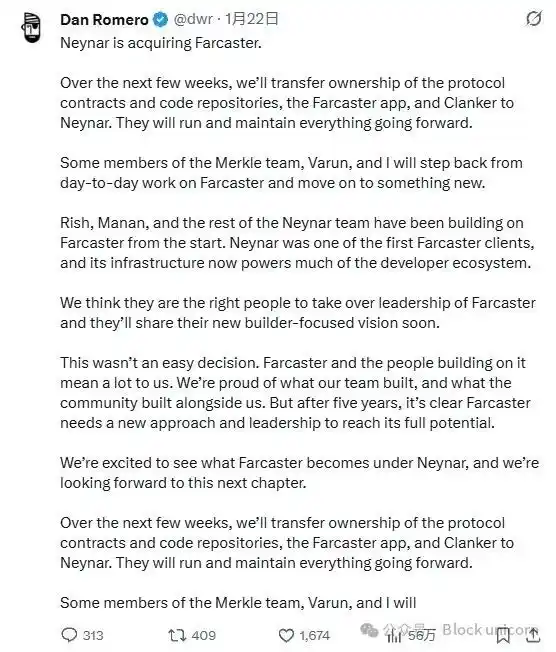
Last Wednesday, Dan Romero, co-founder of the decentralized social platform Farcaster, announced that Neynar, one of Farcaster's earliest and most influential clients, would acquire Farcaster. As part of this transition, ownership of the protocol contracts, core codebase, official applications, and (even) Clanker would be transferred in phases. Meanwhile, Romero noted that the founding team would step back from daily operations to focus on new projects.

Behind Farcaster's decision seems to be a growing internal consensus: the long-term sustainability of social protocols relies less on continuous iteration at the protocol design level and more on increasingly specialized infrastructure and operational execution capabilities at the current stage.

In practice, this means control naturally shifts to infrastructure providers who have successfully aggregated developer resources and traffic—Neynar has been emphasizing the cost and complexity of running Farcaster's hub servers since 2024, abstracting these challenges into APIs and infrastructure layers so developers can focus on product development rather than grappling with protocol internals.
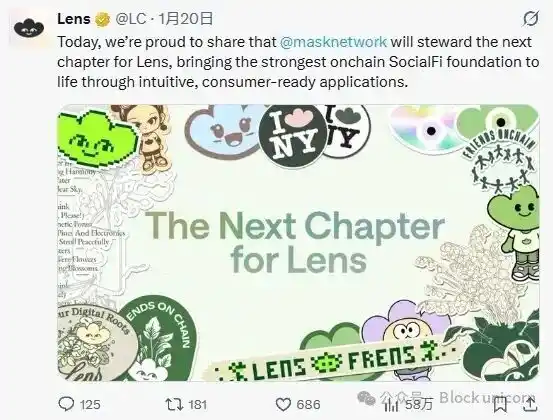
In contrast, Lens has adopted a more advanced—though conceptually aligned with Farcaster—approach. With a relatively richer set of tools, resources, and a mature user base, Lens has chosen to push further in the operational direction.

On January 20, 2026, Lens Labs officially announced that Mask Network would take on the role of "steward" for the next phase of Lens, shifting the project's focus from infrastructure building to consumer-facing products. Mask, for its part, stated that the move aims to translate the protocol's proven achievements into experiences accessible to the mass market.

Notably, both Lens and Aave specifically emphasized that this transition does not involve changes to ownership, financial structure, or governance. The focus is not on the acquisition itself but on a clear reallocation of responsibilities—specifically, who is responsible for turning the protocol into a product people use daily.

2. The Key to Platformization Lies in Clear Role Division

From a broader perspective, both cases point to the same conclusion: as protocols evolve into platforms, the key requirement is no longer adding more features but clearly dividing roles and responsibilities—i.e., how to efficiently optimize the complete operational stack required by a platform, including infrastructure resources, developer onboarding tools, distribution capabilities, and more.

Neynar's core value in the Farcaster ecosystem lies in standardizing social data and user behavior through APIs. Neynar enables developers to immediately start experimenting with products without dealing with the complexities of hub operations or the protocol level. Thus, this acquisition marks Neynar's entry into the next stage—enhancing Farcaster's development and operational layer by integrating the protocol itself.

Lens, though it followed a different path, ultimately landed in a similar framework. With Lens Chain and V3 already establishing the foundational architecture, the next challenge is no longer building more protocols but delivering consumer experiences that users truly engage with daily. The partnership with Mask Network is precisely aimed at bridging this gap.

3. The Battle of the Super Layers

In fact, the integration and consolidation of protocols are not new. Similar patterns have emerged in the Web2 and Web2.5 spaces since around 2025. Wallet providers, crypto payment companies, exchanges, and infrastructure providers are increasingly seeking to integrate adjacent services or make acquisitions to achieve vertical expansion and build so-called "super layers."

However, the most important aspect is not the range of functions these players are trying to bundle. Instead, the decisive shift lies in how they carefully design the integration—selecting the technology stack and operational platforms to integrate based on clearly defined target audiences.

The Neynar–Farcaster and Mask–Lens cases show that the Web3 ecosystem is also moving beyond the stage of loosely connected experimental protocols into an era of large-scale network ecosystems, where organization, operations, and technology are tightly interwoven. Even in the realm of building an open internet, Web3 product teams, long constrained by founder-centric, semi-closed structures, now face the reality of competition: independent team structures, clear division of responsibilities, and the ability to operate products long-term are no longer optional but essential.

Looking ahead, the market dynamics around building super layers (spanning both Web2 and Web3) are likely to become more strategic and more intense.

Questions liées

QWhat is the strategic shift behind Farcaster's acquisition by Neynar?

AThe strategic shift is that the long-term sustainability of social protocols relies more on specialized infrastructure and operational execution rather than continuous iteration at the protocol design level. Control naturally transfers to infrastructure providers like Neynar, which abstracts away the complexity and cost of running hubs, allowing developers to focus on product development.

QHow does the Lens and Mask Network partnership differ from a traditional acquisition?

AThe partnership does not involve changes in ownership, financial structure, or governance. The focus is on a clear reallocation of responsibility—specifically, who is responsible for turning the protocol into a product that people use daily, rather than a merger or acquisition itself.

QWhat is the core value that Neynar provides to the Farcaster ecosystem?

ANeynar's core value lies in standardizing social data and user behavior through APIs, enabling developers to immediately start product experiments without dealing with the complexities of hub operations or the protocol layer.

QWhat broader trend do the Farcaster and Lens cases indicate about Web3 ecosystem evolution?

AThey indicate that the Web3 ecosystem is moving beyond loosely connected experimental protocols into an era of large-scale network ecosystems where organization, operations, and technology are tightly interwoven, with clear role divisions and long-term operational capabilities becoming essential.

QWhat is meant by the 'super layer' in the context of Web2 and Web3?

AThe 'super layer' refers to the trend where providers (like wallets, exchanges, infrastructure companies) integrate adjacent services or make acquisitions to achieve vertical expansion, building comprehensive platforms that bundle functionalities based on carefully selected tech and operational stacks for specific target audiences.

Lectures associées

Arthur Hayes dans un nouvel article : La bulle de l'IA approche de son éclatement, le marché crypto sous pression à court terme

Arthur Hayes, cofondateur de BitMEX, analyse dans cet article les tensions géopolitiques actuelles et leurs implications sur les marchés financiers. Il estime que la hausse des prix du pétrole, liée au conflit entre les États-Unis et l'Iran autour du détroit d'Hormuz, exercera une pression inflationniste et influencera la campagne présidentielle américaine de novembre. Pour reconquérir les électeurs préoccupés par le coût de la vie, Hayes prédit que Donald Trump pourrait adopter un discours critique envers l'industrie de l'intelligence artificielle, promettant régulation et taxation. Une telle rhétorique, même tactique, pourrait provoquer un éclatement de la bulle des actions AI, d'autant plus que le secteur est déjà vulnérable à la hausse des coûts énergétiques et à l'introduction en bourse massive prévue de SpaceX, Anthropic et OpenAI. Hayes explique que la liquidité monétaire récente a été entièrement absorbée par le boom de l'IA, laissant peu de capitaux pour le bitcoin. Une correction sévère des actions AI entraînerait donc probablement une pression vendeuse sur l'ensemble des actifs risqués, y compris les cryptomonnaies. En conséquence, son fonds, Maelstrom, a vendu ses actions AI, réduit ses positions cryptos secondaires et se concentre désormais sur le pétrole et le gaz, ainsi que sur le bitcoin et l'ether en vue d'une reprise future après un éventuel krach et une nouvelle réponse monétaire accommodante des banques centrales.

marsbitIl y a 20 mins

Arthur Hayes dans un nouvel article : La bulle de l'IA approche de son éclatement, le marché crypto sous pression à court terme

marsbitIl y a 20 mins

Le « plan pour l'avenir » d'OpenAI : rendre l'IA bénéfique pour chaque personne dans le monde

Toutes les quelques générations, une nouvelle technologie transforme radicalement la société, à l’image de l’électricité au XXe siècle. L'électricité, initialement conçue pour simplifier la vie, a finalement ouvert de vastes possibilités, prolongé l’espérance de vie et accru la prospérité. L'IA est aujourd’hui à l’aube d’un impact similaire. Le potentiel de l’IA ne réside pas dans la technologie elle-même, mais dans ce que les gens peuvent en faire : comprendre une facture médicale, apprendre, créer une entreprise, accompagner des proches, concrétiser des idées ou faire avancer la science. OpenAI est convaincu que l’IA doit être accessible à tous, partout et selon les besoins de chacun, pour servir l’humanité et amplifier ses capacités, sans la remplacer. L’automatisation totale n’est pas un avenir souhaitable. Cette vision repose sur trois objectifs clés : construire un chercheur en IA automatisé pour accélérer la recherche (avec pour perspective qu’une part significative des travaux d’OpenAI soit menée en collaboration avec l’IA d’ici 2028) ; accélérer le progrès économique tout en veillant à une large répartition des bénéfices ; et offrir à chacun sur Terre un AGI personnel pour bénéficier de cette technologie transformatrice. Pour y parvenir, OpenAI souligne que des avancées rapides rendent le jugement humain et la coopération mondiale plus essentiels que jamais. La sécurité, l’alignement sur les valeurs humaines et une coordination internationale sont fondamentales pour gérer les risques. L’avenir doit être façonné collectivement, et non par une poignée d’entreprises. Enfin, une distribution large du pouvoir est vue comme la clé d’un futur meilleur et plus résilient. Un avenir où l’IA profite réellement à l’humanité doit être construit et partagé par de nombreuses personnes, entreprises, communautés et nations. Si elle est réalisée correctement, l’IA peut devenir une pierre angulaire pour la productivité, la créativité et la prospérité de tous.

marsbitIl y a 26 mins

Le « plan pour l'avenir » d'OpenAI : rendre l'IA bénéfique pour chaque personne dans le monde

marsbitIl y a 26 mins

Anthropic transforme les lancements de modèles en un langage que le marché comprend alors que le dernier modèle Claude arrive demain

TL;DR : Anthropic, évaluée à près de 1 000 milliards de dollars après un dernier tour de financement, a déposé confidentiellement son projet d'introduction en bourse (S-1). Cette étape coïncide avec des rumeurs concernant le prochain modèle Claude 5 (Fable 5), qui est déjà intégré au récit financier de la société. L'entreprise est désormais perçue comme un futur grand plateforme d'IA publique, devant démontrer sa valeur via des indicateurs concrets : croissance des revenus (plus de 470 milliards de dollars annualisés), fidélité de la clientèle entreprise, maîtrise des coûts de calcul et gestion des risques, notamment liés à la sécurité. La sortie présumée de Claude 5 est vue comme un signal crucial de sa capacité à maintenir son avance technologique. Le projet Mythos, un modèle frontalier aux capacités contrôlées destiné à la cybersécurité, offre à Anthropic un récit de valorisation distinct, axé sur les tâches complexes et à haute valeur pour les entreprises. Cependant, cette puissance implique aussi des responsabilités et des risques de régulation accrus qui devront être divulgués dans le S-1. À terme, le marché évaluera Anthropic non seulement sur la puissance de ses modèles, mais sur sa capacité à transformer cette avance en une croissance rentable et durable, en réduisant les coûts unitaires et en construisant un écosystème logiciel solide. La comparaison avec OpenAI portera moins sur la suprématie d'un modèle que sur la capacité à générer des revenus stables avec une incertitude maîtrisée.

marsbitIl y a 47 mins

Anthropic transforme les lancements de modèles en un langage que le marché comprend alors que le dernier modèle Claude arrive demain

marsbitIl y a 47 mins

Trading

Spot
Futures

Articles tendance

Comment acheter LAYER

Bienvenue sur HTX.com ! Nous vous permettons d'acheter Solayer (LAYER) de manière simple et pratique. Suivez notre guide étape par étape pour commencer votre parcours crypto.Étape 1 : Création de votre compte HTXUtilisez votre adresse e-mail ou votre numéro de téléphone pour ouvrir un compte sur HTX gratuitement. L'inscription se fait en toute simplicité et débloque toutes les fonctionnalités.Créer mon compteÉtape 2 : Choix du mode de paiement (rubrique Acheter des cryptosCarte de crédit/débit : utilisez votre carte Visa ou Mastercard pour acheter instantanément Solayer (LAYER).Solde :utilisez les fonds du solde de votre compte HTX pour trader en toute simplicité.Prestataire tiers :pour accroître la commodité d'utilisation, nous avons ajouté des modes de paiement populaires tels que Google Pay et Apple Pay.P2P :tradez directement avec d'autres utilisateurs sur HTX.OTC (de gré à gré) : nous offrons des services personnalisés et des taux de change compétitifs aux traders.Étape 3 : stockage de vos Solayer (LAYER)Après avoir acheté vos Solayer (LAYER), stockez-les sur votre compte HTX. Vous pouvez également les envoyer ailleurs via un transfert sur la blockchain ou les utiliser pour trader d'autres cryptos.Étape 4 : tradez des Solayer (LAYER)Tradez facilement Solayer (LAYER) sur le marché Spot de HTX. Il vous suffit d'accéder à votre compte, de sélectionner la paire de trading, d'exécuter vos trades et de les suivre en temps réel. Nous offrons une expérience conviviale aux débutants comme aux traders chevronnés.

346 vues totalesPublié le 2025.02.11Mis à jour le 2026.06.02

Comment acheter LAYER

Discussions

Bienvenue dans la Communauté HTX. Ici, vous pouvez vous tenir informé(e) des derniers développements de la plateforme et accéder à des analyses de marché professionnelles. Les opinions des utilisateurs sur le prix de LAYER (LAYER) sont présentées ci-dessous.

活动图片