Don't Just Focus on Iran, the US Private Credit Crisis is Step by Step Repeating the 'Subprime Crisis'

比推Publié le 2026-03-09Dernière mise à jour le 2026-03-09

Résumé

Amidst geopolitical tensions, a private credit crisis is rapidly unfolding within the US financial system, drawing parallels to the 2008 subprime mortgage crisis. Major asset managers are facing significant stress: BlackRock restricted redemptions from its $26 billion HPS Corporate Lending Fund (HLEND), capping repurchases at 5% despite 9.3% redemption requests to avoid forced asset sales. Similarly, Blackstone’s $82 billion private credit fund (BCRED) saw a record 7.9% in redemption demands, prompting internal capital injections to avoid gating. Blue Owl Capital, whose stock fell below its $10 SPAC IPO price, sold $1.4 billion in loans to manage redemptions, exacerbating liquidity fears. PIMCO issued a stark warning, predicting a "full default cycle" for direct lending due to relaxed underwriting standards, overexposure to the software sector (vulnerable to AI disruption), and insufficient liquidity compensation for investors. The crisis highlights structural vulnerabilities: semi-liquid funds offering quarterly redemptions are backed by long-duration private loans, creating a mismatch. Redemptions force asset sales, driving down valuations and triggering further withdrawals—a vicious cycle reminiscent of 2008. With the private credit market valued at $1.8 trillion, systemic risks from opacity, concentration, and liquidity mismatches are now under severe strain.

Source: Wall Street Insights

Original Title: Don't Just Focus on Iran, the US Private Credit Crisis is Step by Step Repeating the 'Subprime Crisis'


While market attention is focused on geopolitical risks, a quietly spreading private credit crisis is accelerating within the US financial system. Redemption waves, asset sell-offs, fund gating—this script, investors have seen it in 2008.

This week, the world's largest asset management company, BlackRock, announced restrictions on investor redemptions from its $26 billion HPS Corporate Lending Fund (HLEND), becoming the most impactful signal to date.

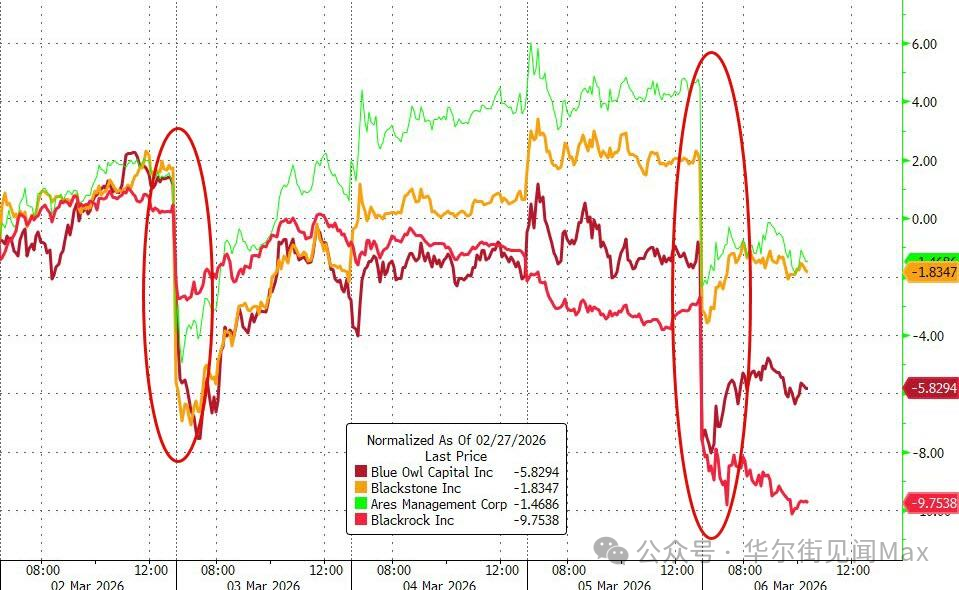
Previously, Blackstone's private credit fund faced a record 7.9% redemption request, and Blue Owl's stock price fell below its SPAC IPO price.

Three private credit giants sounding alarms in succession—the gears of a vicious cycle have already engaged.

Simultaneously, Pacific Investment Management Company (PIMCO) warned in its latest client report: the direct lending industry is about to face a "full default cycle," and stress testing is inevitable. This judgment comes from a long-time critic of private credit, and its weight cannot be ignored.

The spread of the private credit crisis is directly reflected in the stock price trends of related listed companies. Blue Owl's stock price fell below its SPAC issuance price, while private credit-related businesses of institutions like Blackstone and BlackRock face valuation pressure. The entire industry is undergoing a systemic reassessment of investor confidence.
01 Gating: BlackRock "Restricts Redemptions" for Its Private Credit Fund

According to a Wall Street Insights article, BlackRock stated in a declaration on Friday that shareholders of its HPS Corporate Lending Fund (HLEND) applied to redeem 9.3% of the shares this time, but the fund's management decided to set the repurchase上限 at 5%, approximately $12 billion.

BlackRock characterized this move in the statement as a "fundamental" arrangement for fund liquidity management, stating that without restrictions, a "structural mismatch" between investor capital and the duration of private credit loans would occur.

This wording sounds calm, but the market understood its implication: if redemptions were fully paid, BlackRock would be forced to initiate large-scale asset sales.

Previously, another private credit division under BlackRock had shown alarming signals—BlackRock TCP Capital Corp. reported in its Q4 report that it wrote down a $25 million loan to Infinite Commerce Holdings directly to zero from 100 cents, whereas just three months prior, the loan was marked at par value. From 100 to 0, three months, without warning.

02 Spreading Fire: The Vicious Cycle Triggered by Sell-offs

BlackRock's gating is not an isolated event, but the end point—or rather, a new starting point—of a fuse that has already been lit.

Three weeks ago, Blue Owl Capital took action first.

Faced with substantial redemption requests (primarily due to its highly concentrated exposure to software loans, which are rapidly depreciating under the impact of AI), Blue Owl announced the sale of $1.4 billion in private credit loans, effectively freezing investor funds by substituting asset sales for restoring the quarterly redemption mechanism.

The company emphasized that the assets slated for sale were all of the highest internal risk rating (Tier 1 or 2 on a five-tier system).

However, this strategy of "selling the best assets first" is precisely an accelerator for the crisis spread. If secondary market buying interest exists only for high-quality assets, the sale of investment portfolios from other Business Development Companies (BDCs) will face even thinner liquidity. It is reported that NMFC has indicated it is advancing the sale of approximately $500 million of its investment portfolio (17% of its total investments as of Q3 2025).

Blackstone's situation is equally severe. Its private credit fund BCRED manages $82 billion, and redemption requests this quarter reached a record 7.9%, exceeding the statutory上限 of 7%. To avoid triggering the gating mechanism, Blackstone employees were required to personally subscribe to $150 million to fill the gap.

Three institutions, three responses, but the same logic: gating or de facto gating to avoid forced sales triggering a greater valuation collapse. Analysis points out that the problem is, BlackRock's gating decision itself has sent the strongest panic signal to the market, potentially triggering more investors to rush for redemptions.

03 Blue Owl: Stock Price Falls Below IPO Price, Risk Exposure Continues to be Revealed

As the "epicenter" of this crisis, Blue Owl Capital's situation continues to deteriorate. Its stock price fell below the $10 SPAC IPO price this week, hitting a three-year low.

According to Bloomberg citing informed sources, Blue Owl holds a £36 million (approximately $48 million) exposure to London property lender Century Capital Partners Ltd.—a risk exposure it indirectly acquired through the acquisition of Atalaya Capital Management in 2024.

Century applied for administration last month, with total liabilities of about £95 million; NatWest Group and Hampshire Trust Bank are its priority creditors.

Blue Owl holds the riskiest junior tranche in Century's loan portfolio. Century's administrator, RSM UK, expects to fully recover the senior loans, but the fate of the junior tranche is another matter.

This event reveals another side of the private credit expansion period: asset-backed financing was once seen by industry leaders as a new frontier for growth, with executives from Pimco, Carlyle Group, Marathon, and Blackstone publicly optimistic about this track. Now, the risks of this track are emerging in unexpected ways.

04 PIMCO Warning: A Full Default Cycle is on the Way

Just as the private credit market was filled with alarm, PIMCO analysts Lotfi Karoui and Gabriel Cazaubieilh issued the most direct warning to date in their latest client report. The two analysts wrote in the report:

"Like every mature segment of the leveraged finance market, direct lending will eventually face a full default cycle—a cycle that will test its resilience to both industry-specific shocks and macroeconomic shocks."

PIMCO is one of the early critics of private credit. While direct lending strategies saw soaring fundraising规模, this institution managing approximately $2.3 trillion in assets chose to position contrarily, actively seeking potential problems among private credit-backed companies.

PIMCO's analysis pointed out several core risks:

First, record fundraising规模 post the 2008 financial crisis led to持续松弛 underwriting standards;

Second, the high concentration of direct loan portfolios in the software industry will drag down relative performance under AI impact;

Third, direct loan funds have long failed to provide sufficient risk premium compensation for investors' liquidity lock-up.

Regarding the liquidity困境 faced by BDC investors, PIMCO's wording was equally blunt: "Semi-liquidity does not equal full liquidity. Investors must assess their own liquidity needs and tolerance for capital being restricted."

However, PIMCO also differentiated between different tracks within private credit, believing that细分领域 like asset-backed financing still have investment value, offering "investment-grade-like" risk levels. Last year, PIMCO raised over $7 billion for its asset-backed financing strategy.

05 Repeating the Subprime Crisis?

The structural logic of this round of crisis is not complicated: semi-liquid products promise quarterly redemptions, but the underlying assets are longer-duration private loans; when redemption requests exceed a threshold, managers either gate or sell assets; selling depresses asset prices, triggers more valuation markdowns,进而引发更多赎回—thus the cycle.

This logic played out once in the subprime mortgage market in 2008. Back then, the initial cracks also appeared in a market corner considered "sufficiently diversified, sufficiently professional."

Today, the private credit market has reached a规模 of $1.8 trillion, and the risk concentration, valuation opacity, and liquidity mismatch within it are being tested in a similar way.


Twitter:https://twitter.com/BitpushNewsCN

Bitpush TG Discussion Group:https://t.me/BitPushCommunity

Bitpush TG Subscription: https://t.me/bitpush

Original link:https://www.bitpush.news/articles/7617966

Questions liées

QWhat major signal did BlackRock send regarding the private credit crisis, and what was the specific action taken?

ABlackRock announced it would limit investor redemptions from its $26 billion HPS Corporate Lending Fund (HLEND), capping repurchases at 5% of shares instead of the requested 9.3%, to prevent a structural mismatch between investor capital and the duration of private credit loans.

QAccording to the article, what is the 'vicious cycle' mechanism currently unfolding in the private credit market?

AThe vicious cycle involves redemption requests forcing fund managers to either gate redemptions or sell assets. Asset sales depress valuations, which triggers further markdowns and, in turn, prompts more redemption requests, creating a self-reinforcing downward spiral.

QWhich company is described as the 'epicenter' of this crisis, and what specific financial trouble is it facing?

ABlue Owl Capital is described as the 'epicenter.' Its stock price fell below its $10 SPAC IPO price, and it was revealed to have a high-risk, junior exposure of £36 million to the now-bankrupt London property lender Century Capital Partners Ltd.

QWhat stark warning did PIMCO issue in its client report about the direct lending industry?

APIMCO warned that the direct lending industry is headed for a 'full default cycle' that will test its resilience to both industry-specific shocks, like the impact of AI on the software sector, and broader macroeconomic shocks.

QHow does the article draw a parallel between the current private credit crisis and the 2008 subprime mortgage crisis?

AThe article draws a parallel by highlighting the similar structural logic: a liquidity mismatch where semi-liquid products (like private credit funds offering quarterly redemptions) are backed by illiquid, long-duration assets. This creates a cycle of redemptions, forced asset sales, and collapsing valuations, mirroring the initial cracks seen in the 'sufficiently diversified and professional' subprime mortgage market in 2008.

Lectures associées

Un Trader de Bitcoin Affirme que les Sommets et les Creux des Cycles Correspondent à des Délais Exactement Identiques

Un trader utilisant le pseudonyme Ryan (@DodysDD) affirme avoir identifié une précision mathématique étonnante dans les cycles de prix du Bitcoin. Selon son analyse, les phases de marché haussier, du plus bas au plus haut (ATH), dureraient exactement 1064 jours, comme observé lors des cycles 2014-2017, 2018-2021 et 2022-2025. De même, les phases baissières (du pic au creux) correspondraient à 364 jours, comme en 2017-2018 et 2021-2022. Ce schéma, s'il se vérifiait, offrirait aux investisseurs un cadre temporel simple pour anticiper les tendances majeures. Cependant, l'article souligne les risques inhérents à ce type de théorie. La précision apparente dépend souvent du choix des points de référence (cours de clôture, sommets intradays...), ce qui peut conduire à une sélection biaisée des données. Il n'existe aucune preuve que le Bitcoin soit régi par un minutage aussi exact, son prix étant influencé par une multitude de facteurs (halvings, conditions macroéconomiques, psychologie des investisseurs...). Malgré ces limites, ce récit cyclique trouve un écho dans la communauté des traders, surtout dans un contexte actuel d'incertitude sur la phase de marché. Il fournit une narration simple face à la complexité. En conclusion, si l'observation sert de cadre d'analyse populaire, elle doit être abordée avec scepticisme et ne peut, à elle seule, prédire les futurs sommets ou creux du marché.

bitcoinistIl y a 2 h

Un Trader de Bitcoin Affirme que les Sommets et les Creux des Cycles Correspondent à des Délais Exactement Identiques

bitcoinistIl y a 2 h

94 billions, le plus grand financement de l'année pour les robots humanoïdes est apparu

Dans le secteur des robots humanoïdes, un tournant majeur est marqué par le financement record de 14 milliards de dollars (environ 94,9 milliards de yuans) levé par l'entreprise allemande Neura. Cette levée de fonds de série C, menée par des investisseurs industriels de renom comme Schaeffler et Bosch, ainsi que des géants technologiques (NVIDIA, Amazon), porte l'évaluation de Neura à environ 70 milliards de dollars. Cet investissement massif signale un changement profond : la filière passe d'une phase de démonstration technologique à une phase d'industrialisation et de déploiement concret en usine. Contrairement aux sociétés axées sur un robot humanoïde "universel" (comme Figure AI), Neura adopte une approche pragmatique, ciblant d'abord des applications industrielles verticales et spécifiques, comme en témoigne son partenariat avec BMW. La conjonction de plusieurs facteurs explique cet afflux de capitaux : les progrès de l'IA (modèles de grande taille) qui améliorent les capacités de perception et de décision des robots, et les pressions structurelles sur le marché du travail (vieillissement, pénurie de main-d'œuvre, coûts salariaux) qui créent une demande croissante dans la fabrication. Les principaux défis pour une adoption massive ne sont plus uniquement techniques. Ils concernent désormais les coûts d'adaptation aux lignes de production existantes, la formation des opérateurs et la mise en place d'un réseau de maintenance fiable. L'entrée en scène de capitaux industriels expérimentés démontre une confiance accrue dans la capacité du secteur à résoudre ces problèmes d'ingénierie et de modèle commercial, achevant ainsi la transition cruciale du laboratoire au sol de l'usine.

marsbitIl y a 7 h

94 billions, le plus grand financement de l'année pour les robots humanoïdes est apparu

marsbitIl y a 7 h

Le marché de la pré-introduction en bourse d'Anthropic chute après qu'une directive américaine force l'arrêt du modèle

Anthropic a annoncé avoir reçu une directive du gouvernement américain lui ordonnant de suspendre l'accès aux modèles Claude Fable 5 et Claude Mythos 5 pour les ressortissants étrangers, y compris ses propres employés étrangers. Cette mesure d'urgence, justifiée par des préoccupations de sécurité nationale liées au contrôle des exportations, a forcé la désactivation mondiale des deux modèles le 12 juin. Les autres modèles d'Anthropic, comme Claude Opus 4.8, restent opérationnels. La réaction du marché a été immédiate : le contrat perpétuel lié à Anthropic sur Hyperliquid a chuté de 3,7%, reflétant l'impact sur sa valorisation pré-IPO. Anthropic a contesté la base de cette directive, arguant que la vulnérabilité de "jailbreak" évoquée par le gouvernement était mineure, déjà connue et non exclusive à ses modèles. La société a averti qu'un tel seuil d'intervention, s'il était généralisé, pourrait stopper les déploiements de nouveaux modèles d'IA de pointe. Cet événement illustre comment la régulation de l'IA devient un facteur négociable sur les marchés financiers. Les instruments tokenisés et les contrats pré-IPO permettent désormais aux traders de réagir instantanément à ce type de nouvelles réglementaires, même en l'absence d'informations publiques détaillées. Cela intègre l'infrastructure d'IA dans une dynamique de marché spéculative similaire à celle de la cryptomonnaie, avec des risques de volatilité basée sur des informations incomplètes.

bitcoinistIl y a 13 h

Le marché de la pré-introduction en bourse d'Anthropic chute après qu'une directive américaine force l'arrêt du modèle

bitcoinistIl y a 13 h

Un portefeuille lié à une exploitation convertit des jetons volés en 18 510 ETH et 1 548 BNB

Un portefeuille lié à une exploitation a converti des actifs compromis en 18 510 ETH (évalués à environ 30,83 millions de dollars) et 1 548 BNB (environ 924 000 dollars), selon une alerte de suivi sur la chaîne partagée par WuBlockchain citant Lookonchain. L'attaquant, associé à des « jetons H » compromis, détient encore 111,36 millions de ces jetons d'une valeur d'environ 14 millions de dollars. Cette conversion vers des actifs plus liquides comme l'ETH et le BNB est une étape courante après une exploitation, souvent avant une tentative de retrait ou de mélange de fonds. Les grands échanges de ce type peuvent exercer une pression sur les liquidités, signaler les prochaines étapes de l'attaquant et offrir de nouvelles pistes de transaction à suivre pour les enquêteurs. Le suivi sur la chaîne, bien qu'utile pour visualiser les mouvements de fonds en temps réel, présente des limites : les portefeuilles peuvent fractionner les actifs rapidement, les déplacer entre différentes chaînes ou utiliser des adresses intermédiaires, compliquant le traçage. Les étiquettes attribuées aux portefeuilles peuvent également changer. Ces données représentent donc un instantané et non une estimation finale des pertes. Cet incident souligne l'utilité des comptes de surveillance sur la chaîne comme Lookonchain, qui peuvent révéler une activité avant la publication d'une enquête officielle. La conversion en actifs liquides rend également plus difficile et urgente toute tentative de récupération des fonds volés.

bitcoinistIl y a 15 h

Un portefeuille lié à une exploitation convertit des jetons volés en 18 510 ETH et 1 548 BNB

bitcoinistIl y a 15 h

Trading

Spot
Futures
活动图片





