Crypto Whales Build A ‘Fortress Floor’ As Retail Panic Sells The Altcoin Sector

bitcoinistPublié le 2026-02-20Dernière mise à jour le 2026-02-20

Résumé

The crypto market is experiencing significant selling pressure, with altcoins struggling to regain momentum amid ongoing volatility and fragile sentiment. According to a CryptoQuant report, retail investors are panic-selling due to price weakness and negative headlines, amplifying short-term declines. However, underlying data reveals a more complex picture: trading volumes have surged since Ethereum’s recent bottom, suggesting repositioning rather than full capitulation. Larger market participants are systematically absorbing retail sell-offs, forming buying walls and accumulating assets while sentiment remains weak. This dynamic indicates potential accumulation or speculative positioning, though a sustained bullish reversal is not yet confirmed. Macro conditions, regulation, and Bitcoin's dominance will ultimately determine if this redistribution phase leads to a stronger altcoin cycle.

The crypto market continues to face notable selling pressure, with several leading altcoins struggling to regain upward momentum after months of volatility. Sentiment remains fragile as investors weigh macro uncertainty, liquidity conditions, and the lack of sustained bullish catalysts. While periodic rebounds have emerged, most altcoins remain well below previous cycle highs, reinforcing a cautious environment across the broader market.

A recent CryptoQuant report provides additional perspective on this dynamic. According to the analysis, retail investors appear to be under persistent pressure to sell altcoins, particularly as price weakness and negative sentiment dominate headlines. At the same time, the data suggests a more complex underlying picture. Despite ongoing pressure, certain segments of the market are forming notable buying walls, indicating that demand has not disappeared entirely.

Trading volume across altcoins has risen significantly since Ethereum established its recent bottom, reaching levels that are difficult to compare directly with the previous cycle. This increase in activity, even while prices remain depressed, may reflect repositioning rather than pure capitulation. Importantly, most altcoins have yet to stage meaningful recoveries, suggesting that current participation could represent accumulation, speculative positioning, or a mix of both as the market searches for direction.

Retail Capitulation Meets Strategic Crypto Accumulation

The CryptoQuant analysis indicates that much of the current altcoin selling pressure is being driven by retail participants reacting defensively to volatility and prolonged drawdowns. Fear-driven liquidations often emerge during uncertain phases, particularly when liquidity tightens, and price recovery lacks momentum. This behavior tends to amplify short-term weakness, especially across mid- and lower-cap crypto assets.

However, the same data suggests that a portion of this selling volume is being systematically absorbed by larger or more patient market participants. This absorption dynamic typically reflects positioning rather than speculation, as buyers accumulate exposure while sentiment remains fragile. Historically, such phases have preceded structural market transitions, although timing remains uncertain and outcomes are not guaranteed.
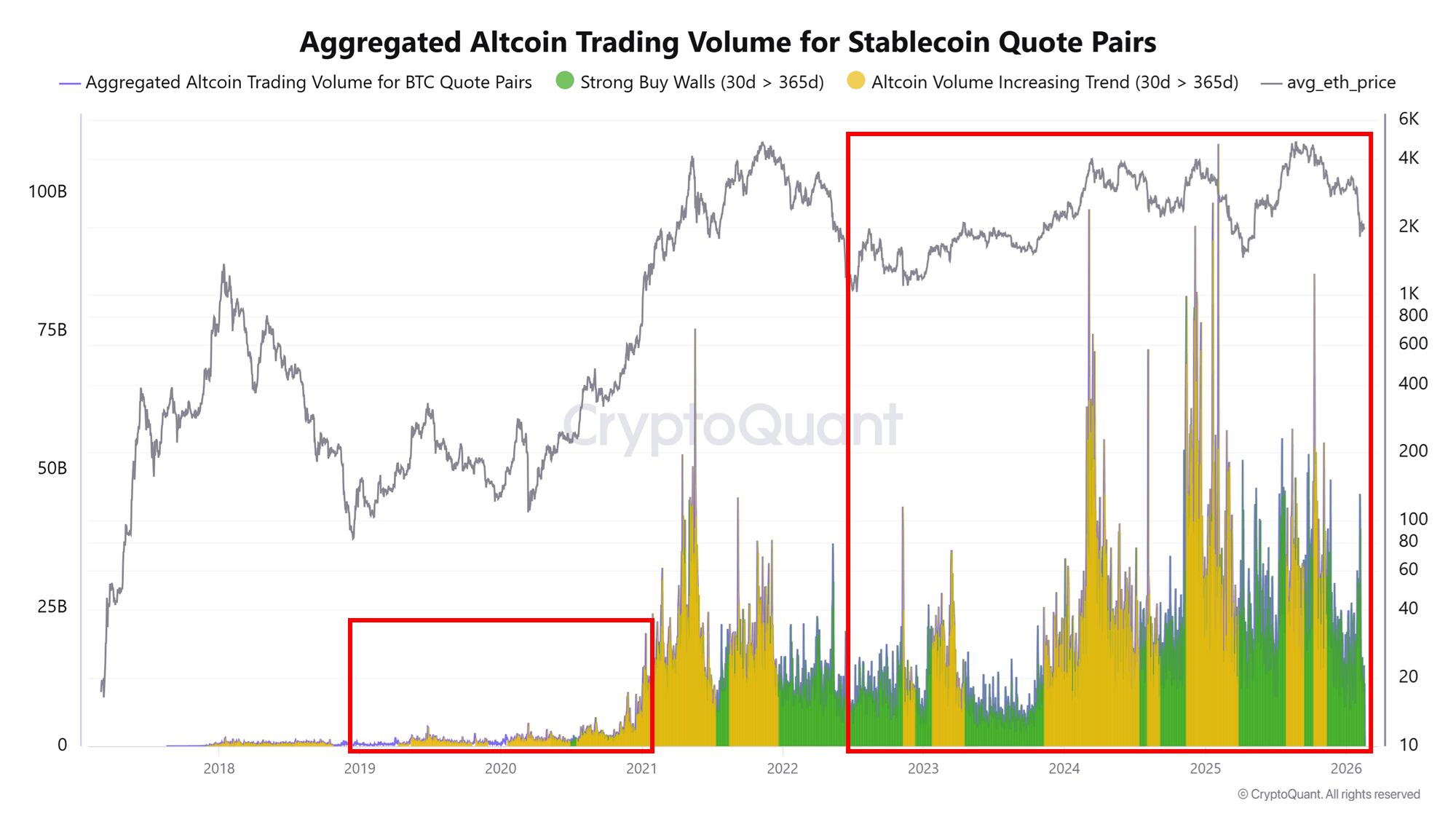
Aggregated Altcoin Trading Volume for Stablecoin Quote Pairs | Source: CryptoQuant

Some analysts argue that the current cycle may be characterized by unusually strong preparatory accumulation compared with previous market phases. Elevated spot volumes alongside persistent volatility suggest capital rotation rather than outright market exit in certain segments.

That said, projections about a future altcoin bull phase being significantly stronger than the previous cycle remain speculative. Market structure, macro liquidity conditions, regulatory developments, and Bitcoin dominance will all influence whether such expectations materialize. The data primarily supports a market undergoing redistribution rather than a confirmed bullish reversal.


Questions liées

QAccording to the CryptoQuant report, who is primarily driving the current altcoin selling pressure?

ARetail investors are primarily driving the current altcoin selling pressure, reacting defensively to volatility and prolonged drawdowns.

QWhat does the data suggest is happening to the altcoins being sold by retail investors?

AThe data suggests that a portion of this selling volume is being systematically absorbed by larger or more patient market participants, indicating accumulation.

QWhat is one reason cited for the significant rise in altcoin trading volume despite depressed prices?

AThe increase in activity may reflect repositioning, accumulation, or speculative positioning rather than pure capitulation as the market searches for direction.

QWhat do some analysts argue is unusual about the current market cycle compared to previous ones?

ASome analysts argue the current cycle may be characterized by unusually strong preparatory accumulation.

QWhat factors does the article say will influence whether expectations for a strong altcoin bull phase materialize?

AMarket structure, macro liquidity conditions, regulatory developments, and Bitcoin dominance will all influence whether such expectations materialize.

Lectures associées

Casper Network publie le Casper Manifest, une feuille de route pluriannuelle pour alimenter les actifs du monde réel réglementés et l'économie des machines

La Casper Association a publié le Casper Manifest, une feuille de route technique pluriannuelle visant à faire de Casper Network l'infrastructure de référence pour la tokenisation d'actifs réels réglementés et l'économie machine-à-machine. Présentée lors du Digital Finance Forum à Bermudes, cette feuille de route détaille neuf initiatives principales. Ces initiatives visent à : offrir une compatibilité complète avec l'EVM pour attirer les développeurs Solidity ; éliminer les frictions utilisateur via des transactions sans frais de gaz, des opérations groupées et des comptes intelligents avec authentification biométrique ; intégrer la conformité réglementaire (norme ERC-3643) et la confidentialité des transactions en un seul système ; implémenter le standard de paiement ouvert X402 pour permettre les micropaiements automatiques entre machines et agents IA ; créer un registre de tokens natifs pour des coûts fixes et prévisibles quel que soit le token ; et enfin, préparer la sécurité post-quantique avec des comptes hybrides. Le déploiement s'étalera jusqu'en 2027, en commençant par les micropaiements X402, suivi de la compatibilité EVM et des tokens conformes en 2026. L'objectif global est de fournir une infrastructure blockchain invisible pour les utilisateurs, de confiance pour les institutions, et native pour les systèmes autonomes.

TheNewsCryptoIl y a 1 h

Casper Network publie le Casper Manifest, une feuille de route pluriannuelle pour alimenter les actifs du monde réel réglementés et l'économie des machines

TheNewsCryptoIl y a 1 h

Trading

Spot
Futures
活动图片




