Cross-Chain Bridges Actively Adapt, LI.FI Leverages Intent Architecture to Become the Liquidity Hub for TradFi Institutions

Odaily星球日报Publié le 2026-06-03Dernière mise à jour le 2026-06-03

Résumé

Cross-Chain Bridge LI.FI Transforms with Intents Architecture to Serve as Liquidity Hub for TradFi Institutions Facing declining cross-chain transaction volumes and overall crypto market liquidity, cross-chain bridge protocol LI.FI is proactively shifting its strategy. Moving beyond its role as a "liquidity transfer protocol," LI.FI is targeting new assets, clients, and operational systems. Key to this transformation is the launch of LI.FI Intents, an intent-based execution architecture. This product positions itself as a foundational layer for stablecoin payments, Real World Assets (RWA), and compliant on-chain liquidity, catering specifically to fintech companies, neobanks, wallets, and regulated financial institutions. LI.FI Intents simplifies user experience by offering a turnkey solution. It leverages a solver network for market-maker level execution, enabling precise cross-chain swaps (e.g., between USDC and USDT) without users managing gas tokens or complex blockchain steps. It lowers barriers to entry by integrating with applications like Jumper and Rabby, allowing enterprise users to bypass direct wallet interactions for transactions like payments and asset transfers. The architecture emphasizes compliance. Its network consists of verified legal entities, and enterprises can review and approve orders within their compliance frameworks before processing. All interacting wallets undergo OFAC screening. For ecosystem coverage, LI.FI Intents supports major networks i...

Original|Odaily Planet Daily (@OdailyChina)

Author|Wenser(@wenser2010)
When TradFi becomes a must-have for the crypto industry, no project can stand apart. However, some choose to start with asset types, while others set their sights on the various companies and institutions behind the assets.

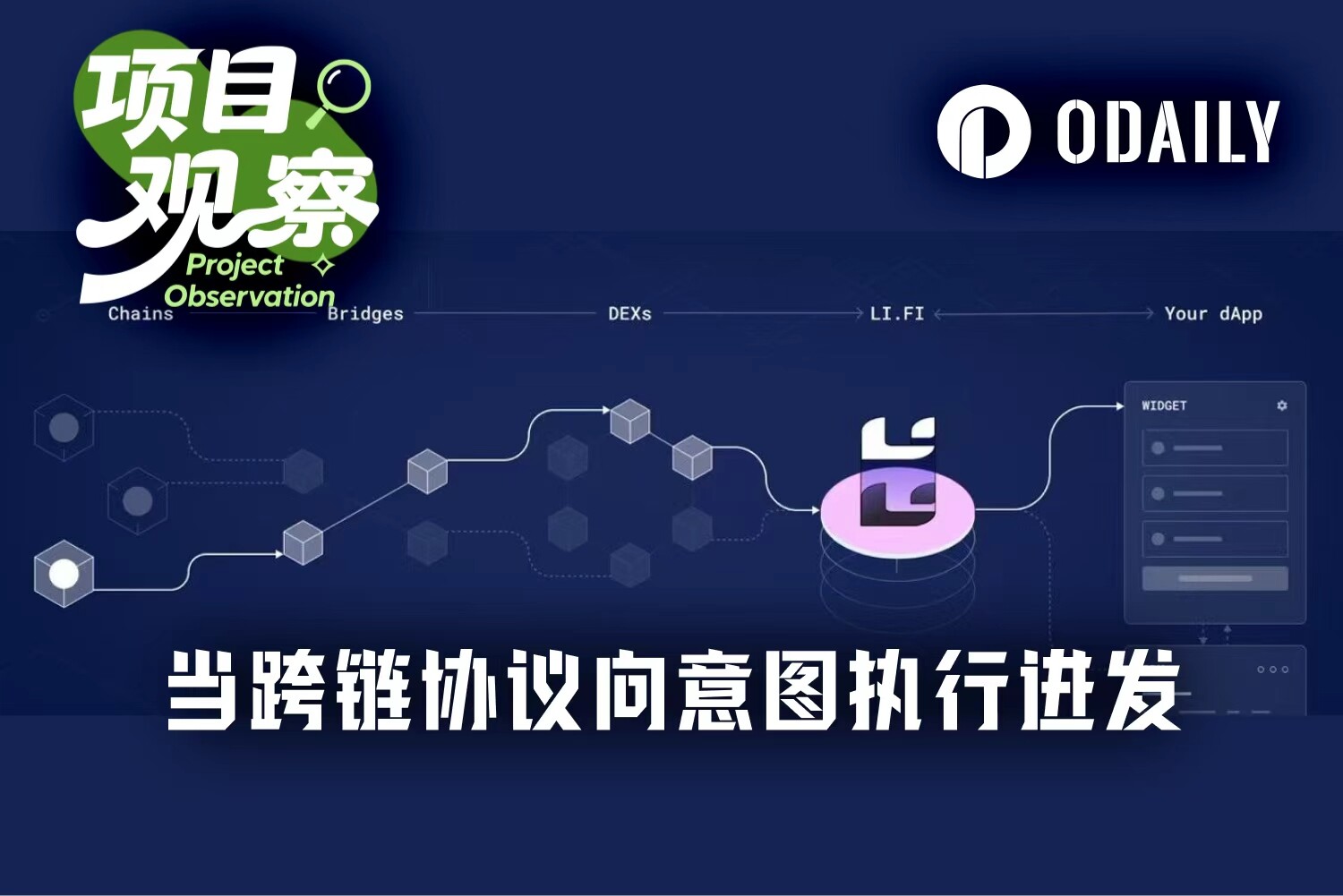
Last month, the cross-chain bridging protocol LI.FI officially and prominently announced the launch of its intent-based execution architecture, LI.FI Intents. This product will serve as the underlying execution layer providing stablecoin payments, RWA, and compliant on-chain liquidity, targeting services for fintech companies, neobanks, wallets, and regulated financial institutions.

Amidst the current trend of stablecoin payments, RWA assets, and compliant assets converging with the on-chain ecosystem, Li.Fi is no longer content with being just a "liquidity transfer protocol." Instead, it is proactively seeking breakthroughs and role upgrades in areas such as new assets, new customers, and new operating systems.

When Industry Liquidity Tightens, Cross-Chain Bridge Protocols Actively Adapt

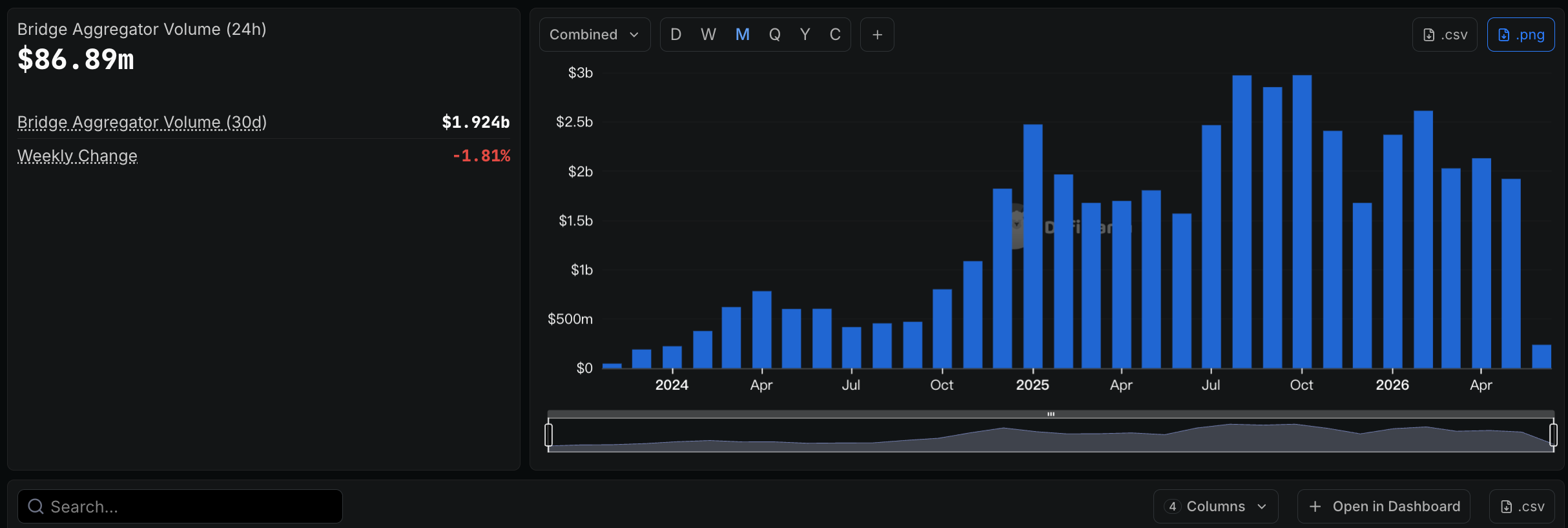
According to DefiLlama data, cross-chain bridge aggregated trading volume over the past 30 days was approximately $1.92 billion, with a weekly decline of about 1.81%. Since reaching a high of $2.974 billion in October last year, the monthly trading volume of cross-chain bridges has shown a slow downward trend. The trading volume in May dropped to around $1.9 billion, representing a decline of nearly 34% compared to the peak.
On the other hand, the overall crypto market is in a fluctuating downward trend, with BTC spot trading volume having fallen by as much as 81% from last year's highs; on-chain liquidity has further tightened as a result.

Faced with this situation, Li.Fi, as a cross-chain bridge protocol, did not wait passively like most crypto projects. Instead, it actively explored new business areas, seeking new application scenarios and service targets to ensure its long-term development.

In December last year, LI.FI announced the completion of a $29 million funding round led by Multicoin and CoinFund, bringing its total funding raised to $52 million. At that time, the project stated it planned to use this latest funding to expand its business into different trading domains, including perpetual futures, yield opportunities, prediction markets, and lending markets.

Ample funding gave Li.Fi the confidence to explore and build new products while maintaining its core business.

In April this year, LI.FI announced the launch of a new product, LI.FI Earn, providing on-chain yield functionality for enterprises with digital asset strategies. It supports accessing strategies from over 20 vault protocols through a single integration and features built-in cross-chain execution capabilities across more than 60 chains.

In May, the intent execution architecture LI.FI Intents was released, marking Li.Fi's official entry into the enterprise services sector. It empowers a range of B2B clients with the underlying operational capabilities for stablecoin payments, RWA assets, and compliant liquidity.

In the current convergence of TradFi assets and crypto assets, Li.Fi's new direction for upgrades is to lower user barriers, improve liquidity operation efficiency, and open channels for tokenized asset exchange from the operational execution layer. Compared to cross-chain protocols limited to the crypto market, providing financial services to global fintech companies, neobanks, wallets, and regulated financial institutions is undoubtedly a cash cow business with a much higher ceiling.

In terms of user experience, Li.Fi Intents provides users with a more streamlined execution solution, ready to use. It is reported that it primarily offers market-maker-level execution through a solver network, supporting precise output cross-chain swaps between stablecoins like USDC and USDT without requiring users to manage Gas tokens or handle complex underlying blockchain steps. Simultaneously, the architecture allows applications to integrate multiple tokenized asset issuers through a unified interface.

Regarding entry barriers, LI.FI Intents is already live on applications and wallets like Jumper and Rabby. Moreover, with LI.FI Intents, enterprise users do not need to interact with any wallet, which will significantly lower the cognitive barrier for enterprises in areas like transfer payments and asset movements, reducing many cumbersome operational steps.
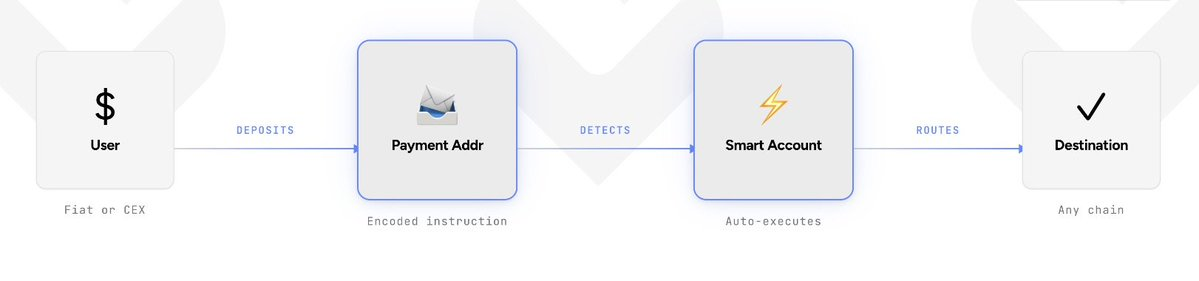
In terms of compliance, the network built by LI.FI Intents consists of verified legitimate entities. Enterprises can review and approve corresponding orders one by one before the trading processing system handles them, precisely choosing the trading processing systems they trust. This ensures orders flow within a compliant approval system. All wallets interacting with this system are subject to OFAC (U.S. Department of the Treasury's Office of Foreign Assets Control) screening, which can be considered the final layer of "compliance insurance."

Regarding ecosystem coverage, LI.FI Intents covers mainstream blockchain networks, including the EVM ecosystem, Solana network, and Tron network. It achieves a certain level of adaptation in ecosystem usability and broad coverage, avoiding potential security risks or single points of failure caused by high dependence on a single blockchain network.

Conclusion: Efficient Automated Services Behind Intent Execution

If tokenized U.S. stocks and RWA assets solve the problems of asset type updates and traditional finance entry barriers, then what Li.FI Intents targets is how to introduce stablecoin payments, RWA assets, and compliant on-chain liquidity into the ecosystems of enterprise users in a better and faster way, improving their operational efficiency and capital utilization.

More importantly, the Li.FI Intents system serves intent execution. Like destination navigation in autonomous driving, enterprise users only need to set the goal; all intermediate execution steps are outsourced and handled by the system.

In today's world of extremely rich asset types, the value of efficient operations will be further amplified, and Li.Fi has already taken the most crucial step.


Lectures associées

Collection des points de vue haussiers et baissiers sur l'ETH : La valeur de l'Ethereum peut-elle refluer vers l'ETH ?

Le débat sur l'ETH oppose actuellement les optimistes et les pessimistes, reflétant une incertitude quant à sa capacité à capter la valeur créée par l'écosystème Ethereum. Les partisans restent convaincus qu'Ethereum, en tant qu'infrastructure fondamentale sécurisée et neutre pour la finance décentralisée (DeFi), les actifs tokenisés (RWA), les stablecoins et l'IA agentique, verra sa valeur reconnue à long terme. Des figures comme Tom Lee (BitMine), Raoul Pal et Joseph Lubin (Consensys) misent sur une adoption institutionnelle croissante et une réévaluation. Ils argumentent que l'importance systémique du réseau garantit sa pérennité et que sa capitalisation boursière est sous-évaluée par rapport à sa domination sur les indicateurs clés. À l'inverse, les sceptiques, dont David Hoffman (cofondateur de Bankless) qui a vendu ses ETH, estiment que la croissance de l'écosystème ne se traduit plus suffisamment par une appréciation du jeton natif. Ils pointent le manque de flux de trésorerie directs, la faiblesse des frais sur le L1 au profit des L2, et le retrait de certains fonds institutionnels. Pour eux, la fenêtre de l'« ETH est une monnaie » se serait refermée. Au-delà du prix, la question centrale est de savoir si l'ETH peut évoluer d'un simple « utilitaire » à un « actif de réserve » que les institutions et les investisseurs achèteront et détiendront durablement, capturant ainsi la valeur future du réseau.

marsbitIl y a 32 mins

Collection des points de vue haussiers et baissiers sur l'ETH : La valeur de l'Ethereum peut-elle refluer vers l'ETH ?

marsbitIl y a 32 mins

Le monde des cryptos est mort, les Perps sont éternels

Le secteur de la cryptographie traverse une transformation profonde. L'ère où il se définissait comme une "usine à nouveaux actifs" (blockchains, tokens, modèles économiques) basée sur la narration et la spéculation est révolue. Les actifs natifs, à l'exception du Bitcoin, voient leur utilité comme réserve de valeur largement décrédibilisée. Le pivot majeur est le passage de la création d'actifs à celui de "canal global pour les actifs". La capacité de la blockchain à être un système de transfert et de règlement pair-à-pair mondial, efficace et sans frontières, est désormais sa proposition de valeur centrale, incarnée d'abord par les stablecoins (USDT, USDC). Les actifs traditionnels (actions américaines, or, pétrole) et les nouvelles technologies comme l'IA, qui offrent à la fois un récit et des produits concrets, éclipsent les "altcoins" sans revenus ni utilité tangible. Même Ethereum, pilier de l'univers natif, subit cette pression alors que son jeton ETH devient moins nécessaire pour utiliser les applications construites sur lui. Dans ce nouveau paradigme, l'innovation phare qui émerge est le **contrat perpétuel (Perp)**. Il incarne la transformation du secteur en "nouvelle API pour l'ancien monde financier". Au lieu de réinventer des actifs comme les actions, il permet de spéculer sur leur volatilité 24h/24 et 7j/7, de manière globale et sans les complexités de la propriété directe (conformité, garde, dividendes...). Des plates-formes comme Hyperliquid ont su saisir ce momentum en combinant une expérience proche des exchanges centralisés avec la transparence de la blockchain, capitalisant sur les besoins après la crise de confiance de 2022 et la demande pour trader les actifs macro. Ainsi, l'industrie ne cherche plus à remplacer la finance traditionnelle, mais à en devenir la couche de transmission ultraliquide et accessible. Le contrat perpétuel, invention à la fois "dangereuse" et géniale, en est l'outil suprême : il ne fournit pas la propriété, mais l'exposition au risque, transformant tout actif en un simple prix sur lequel parier. L'idéalisme des débuts a cédé la place à une efficacité brutale au service d'une demande immuable : le trading.

marsbitIl y a 37 mins

Le monde des cryptos est mort, les Perps sont éternels

marsbitIl y a 37 mins

Tencent, Alibaba, ByteDance s'affrontent dans les boutiques de Skill

Les compétences ("Skills") sont des instructions structurées permettant aux agents IA d'exécuter des tâches spécifiques. Les plateformes de distribution de ces compétences, ou "Skill Stores", voient une bataille s'engager entre géants chinois comme Tencent, Alibaba, ByteDance, ainsi que des acteurs comme Zhipu AI, Meituan et Xiaohongshu. La course à ces boutiques s'explique par la volonté de contrôler un futur point d'entrée utilisateur à l'ère de l'IA, à l'image des App Stores. Les revenus ne viendraient pas des Skills eux-mêmes (gratuits sur presque toutes les plateformes, sauf tentative de vente sur ByteDance's Coze), mais des services annexes de l'écosystème : consommation de puissance de calcul cloud, appels au modèle de langage sous-jacent, ou opportunités de transaction et de publicité. Cependant, plusieurs obstacles entravent le développement d'un véritable marché. La difficulté à standardiser et à évaluer les Skills, dont les performances varient selon le modèle et le contexte, empêche une tarification claire. Les coûts d'exécution (consommation de tokens) sont peu transparents. Des risques de sécurité (Skills malveillants) existent, et l'absence de protocoles standards limite la portabilité. Ainsi, les Skill Stores actuelles ressemblent plus à des vitrines qu'à des places de marché actives. Si des besoins payants existent (pour des scénarios métier standardisés ou des outils personnels), transformer ce potentiel en un business comparable à l'App Store nécessitera de surmonter ces défis techniques et d'expérience utilisateur.

marsbitIl y a 38 mins

Tencent, Alibaba, ByteDance s'affrontent dans les boutiques de Skill

marsbitIl y a 38 mins

Trading

Spot
Futures
活动图片