Cross-Chain Bridges Actively Adapt, LI.FI Leverages Intent Architecture to Become the Liquidity Hub for TradFi Institutions

Odaily星球日报Publié le 2026-06-03Dernière mise à jour le 2026-06-03

Résumé

Cross-Chain Bridge LI.FI Transforms with Intents Architecture to Serve as Liquidity Hub for TradFi Institutions Facing declining cross-chain transaction volumes and overall crypto market liquidity, cross-chain bridge protocol LI.FI is proactively shifting its strategy. Moving beyond its role as a "liquidity transfer protocol," LI.FI is targeting new assets, clients, and operational systems. Key to this transformation is the launch of LI.FI Intents, an intent-based execution architecture. This product positions itself as a foundational layer for stablecoin payments, Real World Assets (RWA), and compliant on-chain liquidity, catering specifically to fintech companies, neobanks, wallets, and regulated financial institutions. LI.FI Intents simplifies user experience by offering a turnkey solution. It leverages a solver network for market-maker level execution, enabling precise cross-chain swaps (e.g., between USDC and USDT) without users managing gas tokens or complex blockchain steps. It lowers barriers to entry by integrating with applications like Jumper and Rabby, allowing enterprise users to bypass direct wallet interactions for transactions like payments and asset transfers. The architecture emphasizes compliance. Its network consists of verified legal entities, and enterprises can review and approve orders within their compliance frameworks before processing. All interacting wallets undergo OFAC screening. For ecosystem coverage, LI.FI Intents supports major networks i...

Original|Odaily Planet Daily (@OdailyChina)

Author|Wenser(@wenser2010)
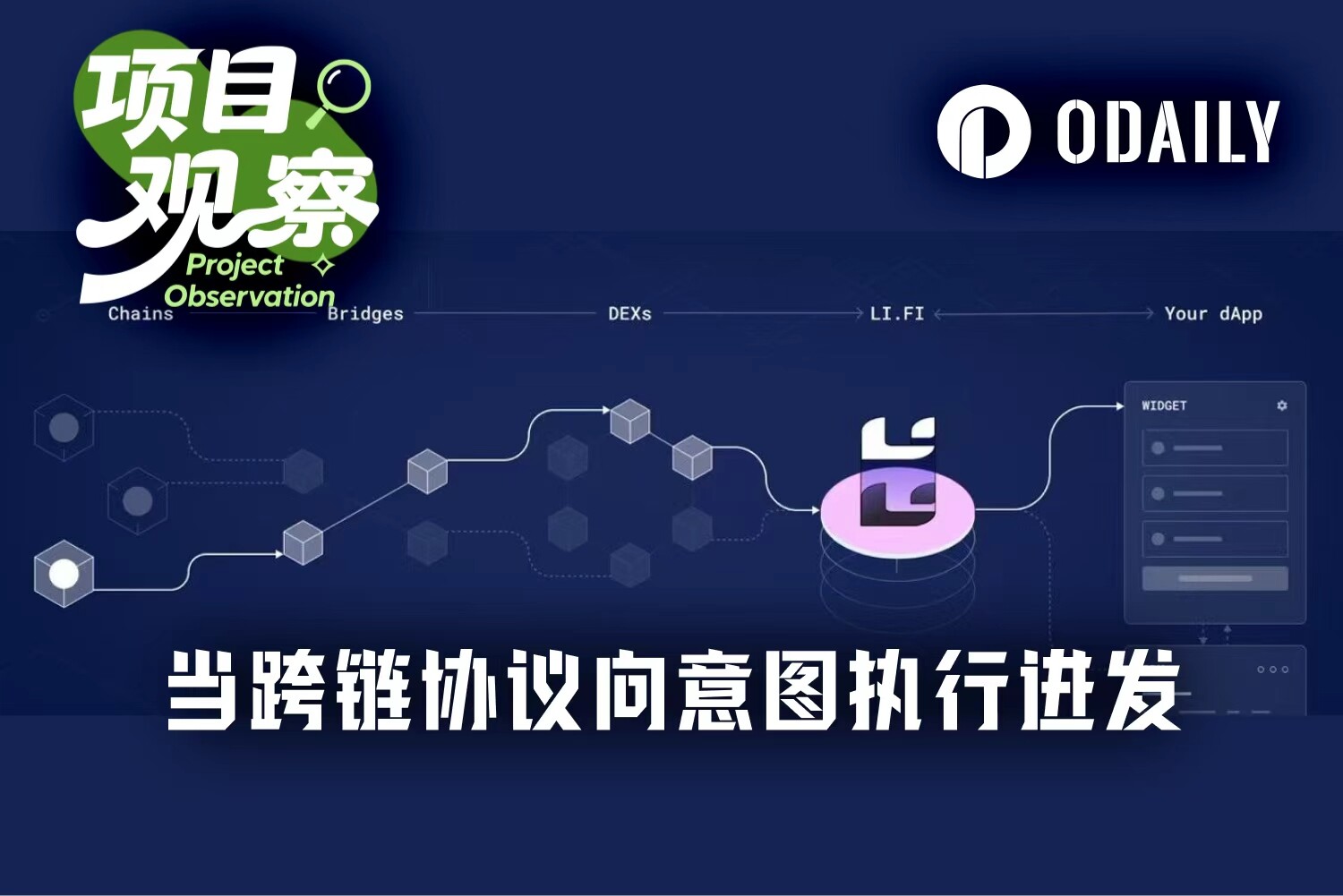
When TradFi becomes a must-have for the crypto industry, no project can stand apart. However, some choose to start with asset types, while others set their sights on the various companies and institutions behind the assets.

Last month, the cross-chain bridging protocol LI.FI officially and prominently announced the launch of its intent-based execution architecture, LI.FI Intents. This product will serve as the underlying execution layer providing stablecoin payments, RWA, and compliant on-chain liquidity, targeting services for fintech companies, neobanks, wallets, and regulated financial institutions.

Amidst the current trend of stablecoin payments, RWA assets, and compliant assets converging with the on-chain ecosystem, Li.Fi is no longer content with being just a "liquidity transfer protocol." Instead, it is proactively seeking breakthroughs and role upgrades in areas such as new assets, new customers, and new operating systems.

When Industry Liquidity Tightens, Cross-Chain Bridge Protocols Actively Adapt

According to DefiLlama data, cross-chain bridge aggregated trading volume over the past 30 days was approximately $1.92 billion, with a weekly decline of about 1.81%. Since reaching a high of $2.974 billion in October last year, the monthly trading volume of cross-chain bridges has shown a slow downward trend. The trading volume in May dropped to around $1.9 billion, representing a decline of nearly 34% compared to the peak.
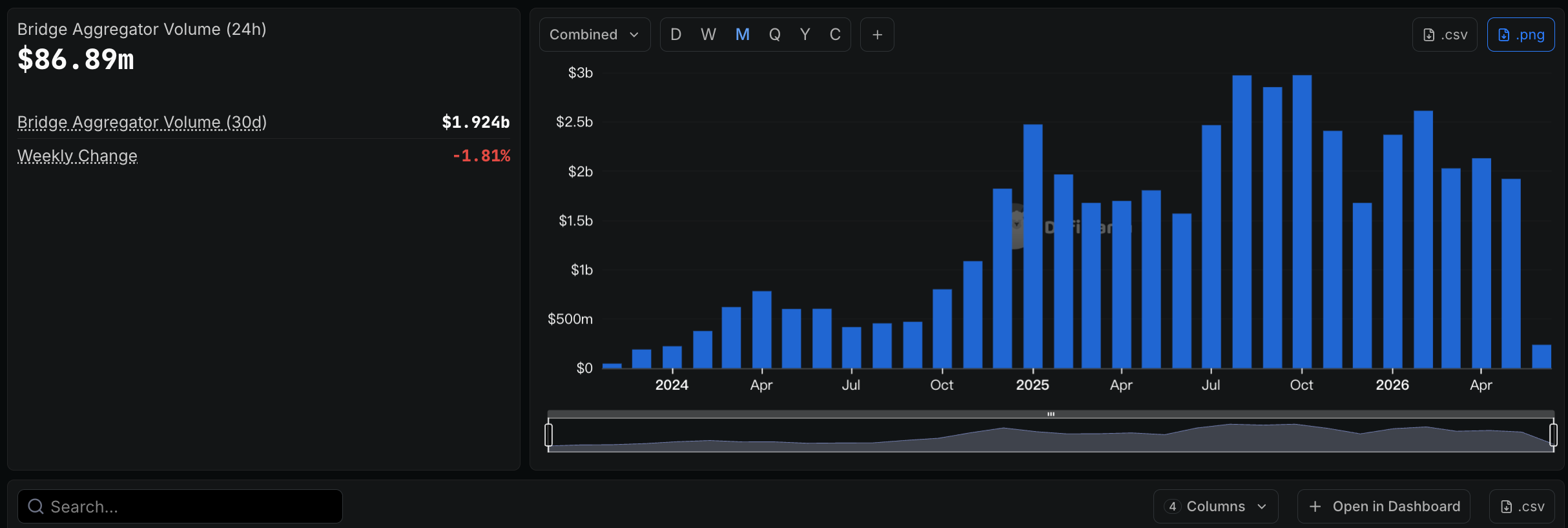
On the other hand, the overall crypto market is in a fluctuating downward trend, with BTC spot trading volume having fallen by as much as 81% from last year's highs; on-chain liquidity has further tightened as a result.

Faced with this situation, Li.Fi, as a cross-chain bridge protocol, did not wait passively like most crypto projects. Instead, it actively explored new business areas, seeking new application scenarios and service targets to ensure its long-term development.

In December last year, LI.FI announced the completion of a $29 million funding round led by Multicoin and CoinFund, bringing its total funding raised to $52 million. At that time, the project stated it planned to use this latest funding to expand its business into different trading domains, including perpetual futures, yield opportunities, prediction markets, and lending markets.

Ample funding gave Li.Fi the confidence to explore and build new products while maintaining its core business.

In April this year, LI.FI announced the launch of a new product, LI.FI Earn, providing on-chain yield functionality for enterprises with digital asset strategies. It supports accessing strategies from over 20 vault protocols through a single integration and features built-in cross-chain execution capabilities across more than 60 chains.

In May, the intent execution architecture LI.FI Intents was released, marking Li.Fi's official entry into the enterprise services sector. It empowers a range of B2B clients with the underlying operational capabilities for stablecoin payments, RWA assets, and compliant liquidity.

In the current convergence of TradFi assets and crypto assets, Li.Fi's new direction for upgrades is to lower user barriers, improve liquidity operation efficiency, and open channels for tokenized asset exchange from the operational execution layer. Compared to cross-chain protocols limited to the crypto market, providing financial services to global fintech companies, neobanks, wallets, and regulated financial institutions is undoubtedly a cash cow business with a much higher ceiling.

In terms of user experience, Li.Fi Intents provides users with a more streamlined execution solution, ready to use. It is reported that it primarily offers market-maker-level execution through a solver network, supporting precise output cross-chain swaps between stablecoins like USDC and USDT without requiring users to manage Gas tokens or handle complex underlying blockchain steps. Simultaneously, the architecture allows applications to integrate multiple tokenized asset issuers through a unified interface.

Regarding entry barriers, LI.FI Intents is already live on applications and wallets like Jumper and Rabby. Moreover, with LI.FI Intents, enterprise users do not need to interact with any wallet, which will significantly lower the cognitive barrier for enterprises in areas like transfer payments and asset movements, reducing many cumbersome operational steps.

In terms of compliance, the network built by LI.FI Intents consists of verified legitimate entities. Enterprises can review and approve corresponding orders one by one before the trading processing system handles them, precisely choosing the trading processing systems they trust. This ensures orders flow within a compliant approval system. All wallets interacting with this system are subject to OFAC (U.S. Department of the Treasury's Office of Foreign Assets Control) screening, which can be considered the final layer of "compliance insurance."

Regarding ecosystem coverage, LI.FI Intents covers mainstream blockchain networks, including the EVM ecosystem, Solana network, and Tron network. It achieves a certain level of adaptation in ecosystem usability and broad coverage, avoiding potential security risks or single points of failure caused by high dependence on a single blockchain network.

Conclusion: Efficient Automated Services Behind Intent Execution

If tokenized U.S. stocks and RWA assets solve the problems of asset type updates and traditional finance entry barriers, then what Li.FI Intents targets is how to introduce stablecoin payments, RWA assets, and compliant on-chain liquidity into the ecosystems of enterprise users in a better and faster way, improving their operational efficiency and capital utilization.

More importantly, the Li.FI Intents system serves intent execution. Like destination navigation in autonomous driving, enterprise users only need to set the goal; all intermediate execution steps are outsourced and handled by the system.

In today's world of extremely rich asset types, the value of efficient operations will be further amplified, and Li.Fi has already taken the most crucial step.


Lectures associées

Le CPU, retour discret au centre de la scène du calcul IA

Ces trois dernières années, l'histoire du calcul IA a été presque entièrement centrée sur les GPU, les CPU étant relégués au rôle de soutien. Cependant, à partir de 2026, ce récit évolue. Alors que l'IA passe de l'entraînement massif de modèles au déploiement à grande échelle d'agents et d'inférences, la coordination, la concurrence et la circulation des données deviennent des goulots d'étranglement critiques. Ces tâches d'orchestration, où les GPU sont moins performants, remettent le CPU au centre en tant que « plan de contrôle » de l'infrastructure IA. Intel illustre cette tendance avec son processeur Xeon 6+, lancé en juin 2026. Fabriqué en procédé 18A, il mise sur une densité extrême avec jusqu'à 288 cœurs éco-efficaces (E-cores), optimisés pour le traitement simultané de milliers de tâches légères typiques des charges de travail des agents IA et de l'inférence. Cette approche « haute densité, haut débit » contraste avec la quête traditionnelle de performances mono-cœur. Cependant, la trajectoire d'Intel n'est pas assurée. Le récit du « retour du CPU » est confronté à plusieurs défis : les solutions intégrées CPU-GPU de NVIDIA, la montée des CPU ARM à haute densité développés en interne par les grands clouds (AWS Graviton, Google Axion, etc.), et la nécessité pour le procédé 18A de rivaliser avec les technologies N2 de TSMC et 2 nm de Samsung. En résumé, le CPU retrouve une place essentielle dans l'écosystème du calcul IA, non pas en rivalisant avec le GPU sur le pic de performance, mais en adressant les nouveaux besoins systémiques d'orchestration. La bataille pour savoir quelle architecture (x86 d'Intel/AMD, ARM des clouds ou solutions intégrées de NVIDIA) dominera cette nouvelle ère reste toutefois ouverte.

marsbitIl y a 3 mins

Le CPU, retour discret au centre de la scène du calcul IA

marsbitIl y a 3 mins

Après avoir collaboré avec plus de 35 projets DeFi, Pink Brains découvre les nouvelles règles du marketing KOL pour 2026

Après trois ans de collaboration avec plus de 35 projets DeFi leaders, Pink Brains, un studio spécialisé, révèle une nouvelle approche de marketing par influenceurs (KOL) pour 2026. L'analyse montre que les campagnes les plus efficaces partent non de la perspective du projet, mais de celle de l'utilisateur : comment il découvre un produit, établit la confiance et s'engage. Le parcours de découverte est social (souvent via X), mais la décision est guidée par les données (DefiLlama, DeBank, documents officiels). Un simple post ne suffit pas ; il doit mener à des données vérifiables et une documentation solide pour convertir des utilisateurs sérieux. En 2026, les utilisateurs DeFi sont attirés par des thèmes concrets et vérifiables : nouvelles tendances (perpétuels, RWA, IA x crypto), airdrops exigeant une contribution réelle, revenus réels ("Real Yield"), tokens capturant la valeur de l'adoption (comme HYPE d'Hyperliquid avec ses rachats massifs), et nouvelles plateformes d'échange (marchés prédictifs, cartes à collectionner, iGaming). La fidélisation repose sur quatre piliers : un produit utile au quotidien, un support client réactif, une tokenomie alignée sur les intérêts à long terme (comme VVV de Venice lié à l'usage réel), et une communauté stratégique. Pour les KOL, il est crucial de les choisir selon leur rôle (éducateur, créateur de contenu, expert...) et d'éviter les erreurs courantes : utiliser des créateurs ne comprenant pas le produit, un contenu générique, un mauvais ciblage, ou une dépendance excessive à quelques grandes figures. En résumé, le marketing DeFi performant en 2026 doit refléter le comportement utilisateur : la découverte vient de sources crédibles, l'intérêt de mécanismes vérifiables, et la fidélisation d'une tokenomie solide et d'un design produit robuste, bien au-delà du simple discours marketing.

marsbitIl y a 20 mins

Après avoir collaboré avec plus de 35 projets DeFi, Pink Brains découvre les nouvelles règles du marketing KOL pour 2026

marsbitIl y a 20 mins

a16z : L’avenir de l’IA visuelle n’est pas dans les images, mais dans le code

Au cours des dernières années, l'IA visuelle a été largement évaluée sur sa capacité à générer des pixels réalistes, comme avec les modèles de diffusion produisant des images et vidéos. Cependant, selon a16z, l'avenir ne réside pas seulement dans des rendus visuels, mais dans la génération d'artefacts de code sous-jacents—des fichiers structurés (HTML/CSS, SVG, scripts 3D, etc.) qui peuvent être édités, itérés et intégrés dans des workflows de production. L'article distingue deux approches : la génération native pixel (adaptée au réalisme et à l'exploration) et la génération native code (qui produit des représentations symboliques). Cette dernière permet un cycle "code → rendu → vérification → modification", où le modèle affine un programme visuel plutôt que de simplement échantillonner de nouvelles images. Cela est crucial pour des domaines comme la conception UI, l'animation et la 3D, où les acteurs ont besoin d'actifs modifiables et réutilisables, et non de simples rendus statiques. La pile technologique repose sur un modèle de codage, une représentation symbolique et un moteur de rendu. Cette approche est particulièrement prometteuse pour la 3D, où la cohérence structurelle et les contraintes fonctionnelles (ex. : articulations, mouvements) sont essentielles. Des outils comme OmniLottie, VIGA ou Articraft3D illustrent cette tendance. Si cette vision se concrétise, les futurs outils d'IA visuelle maîtriseront l'ensemble du cycle de production, utilisant les moteurs de rendu comme environnements de feedback. L'objectif n'est plus seulement de créer de belles images, mais de produire des artefacts visuels véritablement exploitables, ouvrant ainsi la voie à une intégration plus profonde de l'IA dans les chaînes de création.

marsbitIl y a 1 h

a16z : L’avenir de l’IA visuelle n’est pas dans les images, mais dans le code

marsbitIl y a 1 h

Trading

Spot
Futures
活动图片