Chainlink Founder Sergey Nazarov Identifies 3 Trends That Will Define the Cryptosphere as Hyper Token Soars

bitcoinistPublié le 2026-02-10Dernière mise à jour le 2026-02-10

Résumé

Chainlink co-founder Sergey Nazarov identifies three key trends shaping the crypto industry: real-world asset (RWA) tokenization, cross-chain interoperability, and high-performance infrastructure. These shifts signal a move from speculation to practical, institutional-grade applications. Bitcoin Hyper ($HYPER) emerges as a solution addressing Bitcoin’s scalability and utility limitations. By integrating the Solana Virtual Machine (SVM) as a Bitcoin Layer 2, it enables high-speed, low-cost smart contracts while leveraging Bitcoin’s security. The project has raised over $31.3M in its presale, with significant whale activity, indicating strong institutional interest. Bitcoin Hyper aims to unlock Bitcoin’s dormant capital through DeFi applications, staking rewards, and a decentralized bridge for seamless BTC transfers. This aligns with Nazarov’s vision of a verifiable, interconnected financial ecosystem.

Trusted Editorial content, reviewed by leading industry experts and seasoned editors. Ad Disclosure

Quick Facts:

  • ➡️ Chainlink’s Sergey Nazarov identifies RWA tokenization, cross-chain interoperability, and high-performance infrastructure as the three pillars of the next crypto cycle.
  • ➡️ Bitcoin Hyper addresses the liquidity gap by bringing the Solana Virtual Machine (SVM) to Bitcoin, enabling high-speed smart contracts on the world’s most secure chain.
  • ➡️ Institutional interest in Bitcoin Layer 2s is rising, evidenced by over $31M raised in the Bitcoin Hyper presale and verified whale accumulation.
  • ➡️ Whales join the race with over $1M raised across three transactions-only; FOMO is real.

The crypto market is undergoing a structural transformation that extends far beyond daily price tickers.

In recent keynotes, Chainlink co-founder Sergey Nazarov outlined three critical trends signaling the industry’s shift from speculative experimentation to critical global infrastructure.

It’s a bold claim, but his analysis suggests the next bull cycle won’t be defined by hype, it’ll be defined by the collision of traditional finance (TradFi) and decentralized protocols.

First, Nazarov points to the inevitability of Real-World Assets (RWAs) migrating on-chain. Major institutions aren’t just testing the waters anymore; they’re actively building tokenization platforms. This isn’t just about efficiency, it’s about creating a ‘verifiable web’ where asset ownership is mathematically guaranteed rather than legally promised.

Then there’s the collapse of cross-chain friction. The future isn’t a winner-take-all single chain, but an interconnected ecosystem where liquidity flows seamlessly between networks via protocols like CCIP.

The third trend is perhaps the most immediate: the demand for high-performance infrastructure capable of handling ‘internet-scale’ transactions. As DeFi matures, users are rejecting high latency and exorbitant gas fees.

This sentiment shift is driving capital away from legacy Layer 1s that refuse to scale and toward specialized execution layers. That’s exactly where new solutions are emerging to unlock the dormant capital on the world’s largest blockchain: Bitcoin Hyper ($HYPER).

$HYPER is available here.

Bitcoin Hyper Integrates SVM To Solve The Liquidity Fragmentation Crisis

While Nazarov emphasizes cross-chain standards, a glaring inefficiency remains: Bitcoin holds over 50% of the industry’s market cap but lacks the native programmability to participate in this new ‘verifiable web.’

Enter Bitcoin Hyper ($HYPER). By integrating the Solana Virtual Machine (SVM) directly as a Bitcoin Layer 2, the project introduces high-speed, low-cost transaction execution to the Bitcoin network.

The architecture here is distinct. Rather than relying on slow settlement times, Bitcoin Hyper utilizes a modular setup: Bitcoin L1 handles final settlement and security, while the SVM L2 handles real-time execution.
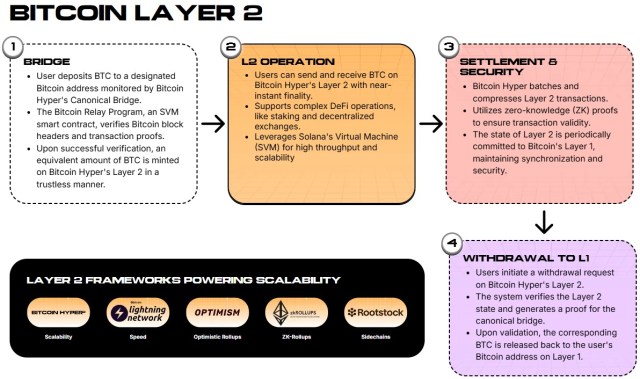
The result? A network capable of sub-second finality and negligible fees, outperforming even Solana in specific latency benchmarks. For developers, this means the ability to build high-performance DeFi applications using Rust, finally bridging the gap between Bitcoin’s liquidity and modern smart contract utility.

Smart money seems to be watching this setup. On-chain data from Etherscan indicates that two whale wallets accumulated $1M+ in recent transactions, with the largest single purchase of $500K occurring on Jan 15, 2026.

This accumulation suggests traders are betting on Layer 2s that can unlock Bitcoin’s yield-bearing potential without compromising its security.

Read more about $HYPER here.

Presale Momentum Accelerates As Capital Rotates Into Bitcoin Layer 2s

The narrative shift toward infrastructure that Nazarov predicts is already reflecting in capital flows. Investors are hunting for protocols offering immediate utility rather than vague roadmap promises.

Bitcoin Hyper ($HYPER) has tapped into this demand, raising over $31.3M in its ongoing presale. With tokens currently priced at $0.0136754, the project is drawing liquidity from traders hedging against Ethereum’s congestion and Solana’s occasional instability.
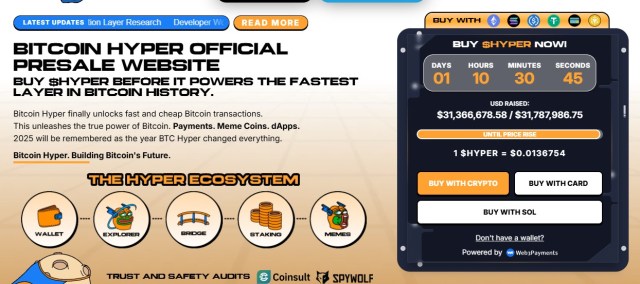
Plus, the economic model is driving interest. Bitcoin Hyper introduces a high-yield staking protocol available immediately after the Token Generation Event (TGE). Unlike traditional mining (which requires hardware), $HYPER staking rewards community participation and governance with a short 7-day vesting period for presale stakers.

It’s a setup designed for both exposure to a high-growth infrastructure token and yield generation on a Bitcoin-native layer.

The project’s Decentralized Canonical Bridge aligns with the industry’s push for interoperability. By allowing trustless transfers of $BTC into the L2 ecosystem, it enables Bitcoin to be used as collateral in lending and derivatives markets previously accessible only to $ETH or $SOL holders.

As the market moves toward the ‘verifiable web’ Nazarov describes, protocols that make Bitcoin actually usable could be positioned to capture significant value.

Buy $HYPER here.

This article is for informational purposes only and does not constitute financial advice. Cryptocurrencies are high-risk assets with significant volatility. The presale data and technical claims regarding Bitcoin Hyper are based on information provided by the project team. Always perform your own due diligence before investing.

Editorial Process for bitcoinist is centered on delivering thoroughly researched, accurate, and unbiased content. We uphold strict sourcing standards, and each page undergoes diligent review by our team of top technology experts and seasoned editors. This process ensures the integrity, relevance, and value of our content for our readers.

patrubogdan

Follow

Full Profile

Related Posts

Russian Lawmaker Predicts Bitcoin Collapse While Smart Money Rotates into Layer 2 Utility

Solana’s Low Fees Create Strong Competition for Base, BNB, and Polygon and Fuel SUBBD Token

Bitcoin Demand Plunges Per CryptoQuant, Yet Maxi Doge Endures

Crypto Markets Catch A Breather As Outflows Begin To Slow: Analysts

SUBBD Token’s Massive Projected Impact on the Content Creation Market in 2026

Government Shutdown Fears Trigger 2% Crypto Dip, But Bitcoin Hyper Remains Unshaken

Questions liées

QWhat are the three critical trends identified by Chainlink's Sergey Nazarov that will define the next crypto cycle?

AThe three trends are Real-World Assets (RWA) tokenization, cross-chain interoperability, and high-performance infrastructure capable of handling internet-scale transactions.

QHow does Bitcoin Hyper ($HYPER) address the liquidity fragmentation problem on the Bitcoin network?

ABitcoin Hyper integrates the Solana Virtual Machine (SVM) as a Bitcoin Layer 2, enabling high-speed smart contracts and low-cost transactions while using Bitcoin L1 for final settlement and security.

QWhat evidence suggests institutional interest in Bitcoin Hyper's presale?

AThe project raised over $31.3 million in its presale, with on-chain data showing whale transactions including a single purchase of $500,000 on January 15, 2026.

QWhat technical advantage does Bitcoin Hyper claim over other networks?

AIt claims sub-second finality and negligible fees, outperforming even Solana in specific latency benchmarks, while maintaining Bitcoin's security through its modular architecture.

QHow does Bitcoin Hyper's staking model differ from traditional Bitcoin mining?

AIt offers a high-yield staking protocol with immediate vesting after Token Generation Event (TGE), requiring no hardware and featuring a 7-day vesting period for presale participants, unlike hardware-dependent mining.

Lectures associées

La réallocation de 750 milliards de dollars d'actifs à risque : Comment l'introduction en bourse de SpaceX va-t-elle impacter les marchés américains et le Bitcoin ?

Le géant spatial SpaceX a fait son entrée en bourse avec une introduction en Bourse (IPO) historique de 75 milliards de dollars, valorisant la société à environ 1 770 milliards de dollars. Cet événement majeur place simultanément sous les projecteurs le marché américain des actions, l'engouement pour l'IA, les cryptomonnaies et les flux de fonds indiciels. L'IPO, parmi les plus importantes de l'histoire, agit comme un puissant redirectionneur de capitaux, drainant potentiellement des liquidités d'autres actifs à risque comme les actions technologiques ou les cryptomonnaies. Bien que le Bitcoin soit resté stable autour de 63 300 $ lors de l'annonce, le marché des dérivés crypto a anticipé l'événement avec un trading actif sur les contrats futures perpétuels liés à SpaceX. L'article établit un parallèle avec l'introduction en bourse de Coinbase en 2021, qui avait coïncidé avec un sommet temporaire du marché crypto, suggérant qu'une telle maturité narrative peut parfois précéder une correction. Cependant, SpaceX apporte aussi une légitimation notable au Bitcoin. Son document S-1 révèle qu'elle détient environ 18 712 BTC d'une valeur de près de 1,2 milliard de dollars, intégrant ainsi la cryptomonnaie au bilan de l'une des sociétés technologiques les plus en vue au monde. Bien que ce montant représente une fraction minime de sa valorisation, il sert de référence pour l'adoption institutionnelle. En résumé, l'IPO de SpaceX présente un double tranchant pour les cryptomonnaies : à court terme, elle pourrait entraîner une compétition pour les capitaux au profit des actions liées à l'IA et à l'espace ; à plus long terme, elle renforce la narrative du Bitcoin en tant qu'actif de réserve pour les entreprises. Cet événement agit à la fois comme une pompe à liquidités et un sceau de légitimité.

链捕手Il y a 35 mins

La réallocation de 750 milliards de dollars d'actifs à risque : Comment l'introduction en bourse de SpaceX va-t-elle impacter les marchés américains et le Bitcoin ?

链捕手Il y a 35 mins

La Loi de Tao (τ) propulse l'EDA sur le devant de la scène

Loi de Tao (τ) : Un nouveau principe chinois fait monter l’EDA sur le devant de la scène Le 25 mai 2026, lors de l'IEEE ISCAS, Huawei a présenté la "Loi de Tao (τ)", un nouveau principe directeur pour l'industrie des semi-conducteurs. Contrairement à la Loi de Moore axée sur la miniaturisation géométrique, la loi τ prône la "miniaturisation temporelle". Elle vise à optimiser la constante de temps τ à tous les niveaux (composant, circuit, puce, système) pour améliorer les performances de traitement de l'information, indépendamment du nœud de fabrication. Ce changement de paradigme replace l'EDA au cœur de la conception. Pour soutenir la loi τ, les outils EDA doivent évoluer au-delà des flux 2D traditionnels. Trois exigences majeures émergent : 1. **Conception 3D native et optimisation multiniveau** : Les flux "pseudo-3D" actuels sont insuffisants. Une véritable conception 3D, permettant une répartition flexible des cellules logiques à travers plusieurs puces (dies), est nécessaire pour des techniques comme le "Logic Folding". 2. **Optimisation STCO (System Technology Co-Optimization)** : Avec la coexistence des technologies Chiplet, 3DIC et Logic Folding, une approche systémique unifiée est cruciale pour optimiser conjointement l'architecture logique, la disposition physique, l'intégrité du signal et de l'alimentation, ainsi que les contraintes thermiques et mécaniques. 3. **Analyse couplée multi-physique** : L'analyse thermique, électrique et mécanique ne peut plus être menée de manière isolée dans les systèmes 3D empilés, nécessitant des outils de simulation intégrés. Ces défis représentent une opportunité pour les éditeurs d'EDA chinois, comme Huada Jiutian, qui a déjà développé une plateforme de vérification physique 3DIC complète, ou l'Université de Pékin, dont un prototype d'outil "vrai 3D" montre des améliorations significatives (réduction de 30% de la longueur des interconnexions, baisse de la température). La loi τ pourrait ainsi catalyser la transition de l'EDA chinois d'une collection d'outils ponctuels vers une base logicielle industrielle complète et intégrée, capable de répondre aux exigences de la miniaturisation temporelle.

marsbitIl y a 2 h

La Loi de Tao (τ) propulse l'EDA sur le devant de la scène

marsbitIl y a 2 h

Ce n'est pas Jensen Huang qui veut changer le PC, c'est le PC qui va faire sa propre révolution

L'industrie du PC, vieille de 40 ans, est en pleine transformation. En juin 2026, NVIDIA a lancé le super-puce RTX Spark pour PC Windows, marquant son entrée sur le marché des processeurs centraux. Soutenu par Microsoft et les principaux fabricants de PC, cet événement a officialisé la redéfinition de l'AI PC. Lors du Build 2026, Microsoft a repositionné Windows comme "plateforme native pour les agents d'IA locaux" et a présenté le Surface RTX Spark Dev Box. Jensen Huang a souligné que l'IA redessine l'industrie du PC, transformant l'ordinateur d'un outil passif en un assistant d'IA autonome capable d'exécuter des tâches en arrière-plan. Pourtant, le concept d'AI PC a été initialement lancé par Intel début 2026 avec ses processeurs Core Ultra de 3ᵉ génération. Le marché voit également l'arrivée de Qualcomm, AMD et Apple, signalant une tendance claire : l'IA migre massivement vers les dispositifs de calcul personnels. L'article retrace l'essor historique du duopole Wintel (Microsoft-Intel) qui a dominé l'industrie pendant des décennies, reléguant NVIDIA au rôle de fournisseur de composants. Le tournant est survenu avec les puces M d'Apple et la définition des "Copilot+ PC" par Microsoft en 2024, exigeant une puissance NPU minimale. Cependant, le manque d'applications IA locales tangibles a initialement freiné l'adoption. La stratégie de NVIDIA repose sur son écosystème. Avec 6 millions de développeurs CUDA, l'entreprise possède un avantage considérable en matière de logiciels. Le RTX Spark, une SoC intégrant CPU ARM, cœurs CUDA et mémoire unifiée, vise à porter cet écosystème sur PC portable, permettant l'exécution locale de grands modèles de langage. Trois signaux majeurs se dégagent : 1) Le PC passe d'une architecture centrée sur le CPU à une architecture centrée sur une SoC IA. 2) Il évolue d'un outil opéré par l'humain vers une plateforme de collaboration avec des agents IA autonomes. 3) La base massive de développeurs CUDA de NVIDIA trouve un nouveau support matériel grand public. Le succès dépendra du prix final, de la maturité de l'écosystème logiciel Windows sur ARM et de l'émergence d'applications phares pour les agents IA locaux. En définitive, la révolution est moins menée par un acteur spécifique que par la trajectoire inévitable de la technologie IA cherchant à s'intégrer au PC. Intel, avec ses processeurs Panther Lake, suit la même direction. Microsoft, en adaptant Windows, conserve un rôle pivot. L'ère de l'AI PC est ouverte, et l'industrie du PC est en train de se réinventer.

marsbitIl y a 4 h

Ce n'est pas Jensen Huang qui veut changer le PC, c'est le PC qui va faire sa propre révolution

marsbitIl y a 4 h

Trading

Spot
Futures

Articles tendance

Comment acheter LINK

Bienvenue sur HTX.com ! Nous vous permettons d'acheter ChainLink (LINK) de manière simple et pratique. Suivez notre guide étape par étape pour commencer votre parcours crypto.Étape 1 : Création de votre compte HTXUtilisez votre adresse e-mail ou votre numéro de téléphone pour ouvrir un compte sur HTX gratuitement. L'inscription se fait en toute simplicité et débloque toutes les fonctionnalités.Créer mon compteÉtape 2 : Choix du mode de paiement (rubrique Acheter des cryptosCarte de crédit/débit : utilisez votre carte Visa ou Mastercard pour acheter instantanément ChainLink (LINK).Solde :utilisez les fonds du solde de votre compte HTX pour trader en toute simplicité.Prestataire tiers :pour accroître la commodité d'utilisation, nous avons ajouté des modes de paiement populaires tels que Google Pay et Apple Pay.P2P :tradez directement avec d'autres utilisateurs sur HTX.OTC (de gré à gré) : nous offrons des services personnalisés et des taux de change compétitifs aux traders.Étape 3 : stockage de vos ChainLink (LINK)Après avoir acheté vos ChainLink (LINK), stockez-les sur votre compte HTX. Vous pouvez également les envoyer ailleurs via un transfert sur la blockchain ou les utiliser pour trader d'autres cryptos.Étape 4 : tradez des ChainLink (LINK)Tradez facilement ChainLink (LINK) sur le marché Spot de HTX. Il vous suffit d'accéder à votre compte, de sélectionner la paire de trading, d'exécuter vos trades et de les suivre en temps réel. Nous offrons une expérience conviviale aux débutants comme aux traders chevronnés.

905 vues totalesPublié le 2024.12.13Mis à jour le 2026.06.02

Comment acheter LINK

Discussions

Bienvenue dans la Communauté HTX. Ici, vous pouvez vous tenir informé(e) des derniers développements de la plateforme et accéder à des analyses de marché professionnelles. Les opinions des utilisateurs sur le prix de LINK (LINK) sont présentées ci-dessous.

活动图片













