BlackRock vs. Strategy: Who Will Win the Bitcoin Accumulation Battle?

marsbitPublié le 2026-03-20Dernière mise à jour le 2026-03-20

Résumé

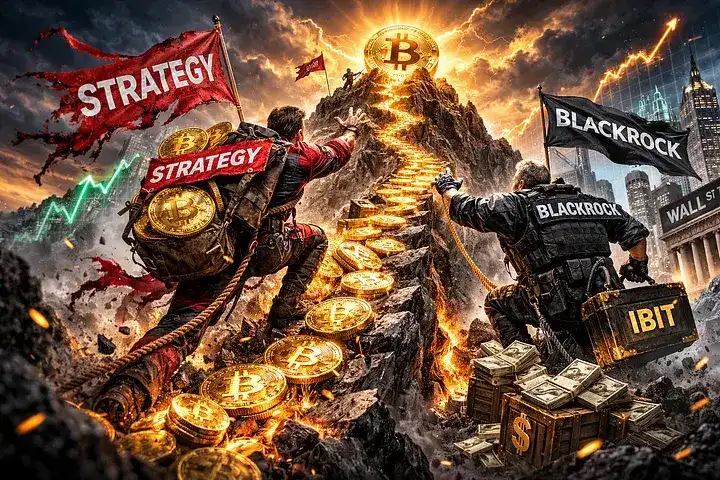
BlackRock and Strategy (formerly MicroStrategy) are engaged in an unprecedented race to accumulate Bitcoin. As of March 16, 2026, BlackRock’s iShares Bitcoin Trust (IBIT) holds 784,062 BTC, while Strategy holds 761,068 BTC—a gap of 22,994 coins that could close within days given Strategy’s aggressive purchasing pace. BlackRock accumulates Bitcoin indirectly through its IBIT ETF, where investor inflows drive purchases. In contrast, Strategy actively raises capital via debt, equity, and preferred stock offerings to buy and hold Bitcoin directly, with no intention of selling. This competition highlights two distinct models: BlackRock offers a regulated, low-complexity vehicle for institutional exposure, while Strategy employs leverage and corporate strategy for accelerated accumulation. Both are rapidly reducing Bitcoin’s available supply, intensifying market scarcity. Strategy faces higher risks, including significant debt and sensitivity to Bitcoin’s declines, whereas BlackRock’s model is more resilient to sentiment shifts. The outcome symbolizes broader institutional adoption, fueled by regulatory clarity and new accounting rules. Ultimately, both entities reinforce Bitcoin’s growing legitimacy and supply squeeze, impacting all market participants.

Author: Jawad Hussain

Compiled by: Plain Language Blockchain

The world's largest asset manager and a 37-year-old software company that has pivoted its entire balance sheet to digital assets are locked in an unprecedented race to accumulate Bitcoin on a massive scale in the crypto market.

As of March 16, 2026, BlackRock's iShares Bitcoin Trust (IBIT) held 784,062 Bitcoin. Meanwhile, Strategy (formerly MicroStrategy) held 761,068 Bitcoin.

The gap between them is approximately 22,994 coins. At Strategy's current purchasing rate, this gap could disappear within days.

This is more than just a footnote in digital asset history. It is one of the most influential financial stories of 2026.

Two entities with different structures, motivations, and risk profiles are competing for the same finite asset. Bitcoin has a fixed supply cap of 21 million coins.

Every coin purchased by these institutions is one coin no longer available for sale. The race between BlackRock and Strategy is accelerating the supply squeeze long predicted by Bitcoin traders.

BlackRock vs. Strategy: Who Will Win the Bitcoin Accumulation War?

Here, we will break down how each participant accumulates Bitcoin, what drives their purchasing speed, the risks for both sides, and what the outcome of this race means for off-exchange investors. Whether you hold IBIT shares, MSTR stock, Bitcoin directly, or none of the above, this race directly impacts the market you participate in.

Two Entities, Two Completely Different Models

Both BlackRock and Strategy hold massive amounts of Bitcoin. But their reasons for holding, the mechanisms, and the associated obligations are completely different.

How BlackRock Accumulates Bitcoin

BlackRock does not buy Bitcoin for itself. The company launched the iShares Bitcoin Trust (ticker: IBIT) on Nasdaq in January 2024, providing investors with a regulated instrument to gain Bitcoin exposure by directly holding the asset. When investors buy IBIT shares, Authorized Participants (large financial institutions) buy Bitcoin on the open market and deliver it to the fund. When investors sell IBIT, the process occurs: the fund sells Bitcoin back into the market.

This means BlackRock's Bitcoin holdings are a function of investor demand. IBIT's holdings grow when institutional and retail buyers want Bitcoin exposure purely through traditional accounts. When sentiment turns bearish and investors redeem, the holdings shrink. BlackRock has no strategic mandate to accumulate Bitcoin; it is a custodian. The Bitcoin it holds economically belongs to IBIT shareholders, not BlackRock itself.

According to SoSoValue data, since its launch, IBIT has attracted cumulative net inflows of $63.21 billion. In the week of March 9 to March 13 alone, IBIT garnered net inflows of $600.1 million, accounting for 78% of the net Bitcoin inflows into ETFs that week. The fund has maintained positive inflows every day since March 9, momentum highlighting the institutional demand driving BlackRock's Bitcoin accumulation.

How Strategy Accumulates Bitcoin

Strategy's model is the complete opposite. The company does not wait for investor funds; it proactively raises capital specifically for buying Bitcoin. This capital primarily comes from three sources: convertible notes (debt instruments convertible into MSTR common stock); at-the-market (ATM) equity offerings (selling new shares directly to the market); and preferred stock instruments, recently the STRC Preferred Shares with an 11.5% annual yield, sold to investors who provide funds directly for Bitcoin purchases in exchange for monthly payments.

Once Strategy secures cash, it purchases Bitcoin through institutional trading desks (primarily Coinbase Prime), storing the coins in secure cold wallets. The company does not trade these coins or hedge. There is a simple directive: buy and hold. This means Strategy's Bitcoin holdings only move in one direction. Unlike IBIT, which can shrink due to redemptions, Strategy's Bitcoin inventory grows with every capital raise, regardless of market conditions.

According to Michael Saylor, in the first week of March 2026, Strategy acquired 40,332 Bitcoin, increasing its holdings by 3.0%. As of mid-March 2026, the company had accumulated 88,568 Bitcoin year-to-date, a 3.4% increase. These numbers reflect an accumulation speed never before attempted by a public company.

The Current Numbers: A Race That Could Conclude in Days

The current gap is the smallest since BlackRock briefly surpassed Strategy's holdings in July 2025. As of March 16, 2026, BlackRock held 784,062, Strategy held 761,068, a gap of 22,994.

At Strategy's recent weekly purchase rate of 22,337 coins, the company could almost erase the entire gap in one week. At its daily rate of approximately 2,881 coins, it would take about 7 to 8 days to surpass BlackRock's current holdings *if IBIT inflows completely stopped*. This last condition is key: IBIT is not standing still; the fund takes in money daily, meaning the target is constantly moving upward as Strategy closes the gap.

The race became a true nail-biter in mid-March because MSTR's purchase speed coincided precisely with a weekly slowdown in BlackRock's growth. This contraction narrowed the gap faster than most analysts expected. Bitcoin Magazine reported on March 17 that MSTR's stock price was approaching $1,500, suggesting market participants are watching the race and betting on Strategy's thesis.

The more core issue is not just who crosses the holding threshold first, but the impact these two entities' continuous purchasing has on the available supply in the open market. According to Checkonchain data, by the end of February 2026, U.S. spot ETFs held a combined reserve of 1.29 million Bitcoin. Adding Strategy's 761,000, these institutional vehicles have absorbed over 2 million Bitcoin. Exchange inventories are declining. The supply shock driving long-term price appreciation is not a theoretical future event; it is happening.

The Financial Architecture Behind Each Model

BlackRock's Structural Advantages

BlackRock operates the world's most liquid Bitcoin investment product. According to its own disclosures, IBIT is the highest-volume Bitcoin exchange-traded product since issuance. The fund manages over $55 billion in Bitcoin assets, offers daily liquidity to investors, and charges a 0.25% annual management fee. It leverages the credibility of a company managing over $14 trillion in assets.

For institutional investors, IBIT eliminates the operational complexity of Bitcoin custody. Bitcoin is held by Coinbase Custody Trust Company, a qualified custodian regulated under New York banking law. Investors access it through existing accounts, without managing wallets, private keys, or operational processes. This simplicity is invaluable for the pension funds, sovereign wealth funds, and family offices driving IBIT's inflows.

BlackRock also benefits from a structural isolation that Strategy lacks. Since IBIT's holdings are tied to investor demand rather than the company's balance sheet, a collapse in investor sentiment triggers redemptions, not bankruptcy. BlackRock the company does not face solvency risk from a Bitcoin price crash. Its IBIT fee income would shrink, but its own financial health is isolated from the assets it holds on behalf of others.

Strategy's Structural Advantages

Strategy's advantage over BlackRock is its ability to act without waiting for market permission. IBIT's purchases depend on the sentiment of millions of investors, while Strategy can buy whenever it successfully raises capital.

VanEck research highlighted Strategy's debt structure as its "silent engine." By early 2026, the company held significant zero-coupon convertible notes issued at near-zero interest rates. These instruments gave Strategy access to nearly a billion dollars at virtually zero cost, all used to buy Bitcoin. The company also noted that IBIT shareholders pay a 0.25% annual fee, making MSTR a cheaper vehicle for leveraged exposure than paying ongoing ETF fees.

Strategy's model also benefits from what analysts call the mNAV premium. When its market capitalization exceeds the market value of its Bitcoin holdings, the premium allows the company to raise equity capital at a price that supplements the Bitcoin value, meaning each new share issued adds more Bitcoin value than it dilutes. This flywheel can accelerate accumulation rapidly when the premium is high and sentiment is bullish. The company leveraged this dynamic to raise $25.3 billion in 2025, almost entirely for Bitcoin purchases.
Risks Borne by Each Party

Strategy's Risks

Strategy's risks are real and well-documented. The company carries total debt exceeding $8.2 billion, and preferred stock obligations add significant annual cash requirements. The STRC Preferred Shares alone carry an 11.5% annualized yield. Although the company has built a relief reserve covering approximately 23 months, this reserve is not infinite, and the burden increases with each new issuance.

mNAV compression is the most visible near-term risk indicator. Strategy's market-to-net-asset-value (mNAV) ratio peaked at 3.4x in 2024 and had compressed to 1.20x by mid-March 2026. This compression is critical because the premium is key to its value-accretive equity financing. When the premium trends towards 1.0x or below, its "raise funds to buy coins" flywheel fails.

Furthermore, Strategy's strategic breakeven point warrants attention. According to research, if the Bitcoin price falls and sustains below approximately $40,000, its ability to credit or refinance debt would be challenged; if it falls below approximately $20,000, the risk of forced asset sales gradually increases. Strategy's rating is designated as "non-investment grade (junk)" by major agencies, meaning its borrowing costs are higher and it lacks access to investment-grade institutional capital.

IBIT's Risks

BlackRock's risks are smaller in absolute terms but not non-existent. IBIT's inflows are driven by market sentiment, and sentiment can reverse. During the downturn in early 2026, IBIT recorded outflow weeks.

IBIT's structural risk comes from competitive pressure from other Bitcoin ETFs. Fidelity's FBTC, Grayscale's GBTC, and new entrants are all vying for the same capital. If a competitor offers lower fees or more attractive features, IBIT could lose market share. Additionally, while highly unlikely, a regulatory reversal would impact IBIT, a regulated product, more severely than a direct holder like Strategy.

Implications for Bitcoin Market Structure

The race between BlackRock and Strategy is more than a story about two companies; it is altering the structural dynamics of the Bitcoin market.

Both entities are removing Bitcoin from circulation. Coins purchased by Strategy and stored in cold wallets are permanently off the market barring a corporate collapse. Bitcoin absorbed by IBIT is also typically held long-term in custody. Currently, U.S. spot ETFs plus Strategy control approximately 2 million Bitcoin, nearly 10% of the total supply.

Bernstein analysts described Strategy as the "central bank and lender of last resort for Bitcoin." This is not an exaggeration; it provides a foundation of institutional confidence that prevents disorderly market crashes. BlackRock's IBIT plays a different role: it is the gateway and on-ramp, converting institutional interest into actual demand.

The Investor's Choice: IBIT, MSTR, or Direct Holding?

Reasons to Choose IBIT

IBIT suits investors who want Bitcoin exposure but wish to avoid operational complexity, corporate risk, or leverage volatility. It provides a 1:1 relationship with the Bitcoin price (minus the 0.25% fee) and can be held in retirement accounts, brokerage portfolios.

Reasons to Choose MSTR

MSTR is for investors seeking leveraged exposure and willing to accept additional corporate risk for potentially higher returns. When Bitcoin rallies sharply, MSTR has historically significantly outperformed IBIT due to the leverage embedded in its capital structure. But note, in a sustained bear market, MSTR's risk factors amplify losses.

Reasons to Hold Bitcoin Directly

Direct holding eliminates annual fees and corporate risk, giving investors complete sovereignty. For investors seeking pure, unleveraged exposure and who are comfortable with self-custody, this remains the structurally cleanest option.

What Happens After Strategy Surpasses BlackRock?

When Strategy's holdings surpass BlackRock's, it will be a significant symbolic milestone. It will be the first time a corporate treasury holds more Bitcoin than the world's largest institutionalized ETF product. Based on current trends, this could happen within the next few weeks.

But this event, while publicly notable, changes no fundamental dynamics. The race does not end. More importantly, in less than three years, the scale of institutional commitment to Bitcoin has become one of the fastest institutionalizations of any asset class in finance.

The Bigger Picture: Corporate Adoption Beyond

Beyond this, the corporate Bitcoin treasury model is spreading. Japanese investment firm Metaplanet held over 10,000 coins in early 2026; Tesla holds approximately 11,509; Block holds about 8,883; SpaceX holds about 8,285.

New FASB fair value accounting rules effective in 2025 removed the biggest financial hurdle for corporate Bitcoin holdings, allowing companies to reflect fair value gains quarterly. Furthermore, the U.S. political environment is strongly supportive, with the SEC officially classifying Bitcoin as a digital commodity on March 17, providing clear regulatory guidance.

Conclusion: Two Models, One Asset, One Direction

The core of the race between BlackRock and Strategy is two different answers to the same investment thesis: Bitcoin's supply is fixed, demand is growing, and the best time to accumulate is before the next cycle peaks.

BlackRock answers through distribution: it built a democratized product for millions to participate.

Strategy answers through conviction: it leverages every financial tool to keep buying, without waiting for market sentiment.

Who holds more on any given day is less important than the collective long-term impact these two entities are having on the market structure. This force is massive, accelerating, and shows no signs of abating.


Questions liées

QWhat are the key differences between BlackRock's and Strategy's models for accumulating Bitcoin?

ABlackRock's iShares Bitcoin Trust (IBIT) acts as a custodian, accumulating Bitcoin based on investor demand through its ETF, with holdings potentially decreasing due to redemptions. Strategy (formerly MicroStrategy) actively raises capital through debt and equity to purchase and hold Bitcoin indefinitely, with its holdings only increasing and never being sold or hedged.

QAs of March 16, 2026, what was the gap in Bitcoin holdings between BlackRock and Strategy, and how quickly could it close?

AAs of March 16, 2026, BlackRock held 784,062 BTC and Strategy held 761,068 BTC, a gap of 22,994 coins. At Strategy's then-current weekly purchase rate of approximately 22,337 BTC, it could close the gap in just over a week, assuming IBIT's inflows stopped.

QWhat are the primary financial risks associated with Strategy's Bitcoin accumulation strategy?

AStrategy's primary risks include its significant debt burden of over $8.2 billion, high annual cash requirements from preferred stock obligations (e.g., an 11.5% annual yield on STRC preferred shares), the potential failure of its funding 'flywheel' if its market-to-NAV premium compresses to 1.0x or below, and the risk of forced asset sales if Bitcoin's price falls significantly below $40,000.

QHow does the article describe the broader impact of BlackRock's and Strategy's accumulation on the Bitcoin market?

AThe article states that both entities are removing Bitcoin from circulation, accelerating a long-predicted supply squeeze. Combined, U.S. spot ETFs and Strategy control approximately 2 million BTC, nearly 10% of the total supply, significantly impacting market structure and reducing available liquidity.

QWhat was a key regulatory and accounting development in 2025 that supported corporate Bitcoin adoption?

AA key development was the生效 (effective) FASB fair value accounting rules, which allowed companies to mark their Bitcoin holdings to market value each quarter, eliminating a major financial reporting obstacle for corporate treasuries holding Bitcoin.

Lectures associées

Trading

Spot
Futures

Articles tendance

Qu'est ce que BITCOIN

Comprendre HarryPotterObamaSonic10Inu (ERC-20) et sa position dans l'espace crypto Ces dernières années, le marché des cryptomonnaies a connu une augmentation de la popularité des monnaies mèmes, suscitant l'intérêt non seulement des traders, mais aussi de ceux qui recherchent un engagement communautaire et une valeur divertissante. Parmi ces jetons uniques, HarryPotterObamaSonic10Inu (ERC-20) est un projet intrigant qui mêle des références culturelles à l'univers des cryptomonnaies. Cet article explore les aspects clés de HarryPotterObamaSonic10Inu, en examinant ses mécanismes, son ethos axé sur la communauté, et son engagement avec le paysage crypto plus large. Qu'est-ce que HarryPotterObamaSonic10Inu (ERC-20) ? Comme son nom l'indique, HarryPotterObamaSonic10Inu est une monnaie mème construite sur la blockchain Ethereum, classée selon la norme ERC-20. Contrairement aux cryptomonnaies traditionnelles qui peuvent mettre l'accent sur l'utilité pratique ou le potentiel d'investissement, ce jeton prospère grâce à sa valeur divertissante et à la force de sa communauté. Le projet vise à favoriser un environnement où des utilisateurs engagés peuvent se rassembler, partager des idées et participer à des activités inspirées par divers phénomènes culturels. Une caractéristique notable de HarryPotterObamaSonic10Inu est son absence de taxe sur les transactions. Cet élément attrayant vise à encourager le trading et l'implication de la communauté, sans frais supplémentaires pouvant décourager les petits traders. L'offre totale de la monnaie est fixée à un milliard de jetons, un chiffre qui marque son intention de maintenir une circulation substantielle au sein de la communauté. Créateur de HarryPotterObamaSonic10Inu (ERC-20) Les origines de HarryPotterObamaSonic10Inu sont quelque peu obscures ; les détails concernant le créateur restent inconnus. Le développement de ce jeton ne comporte pas d'équipe identifiable ou de plan explicite, ce qui n'est pas rare dans le secteur des monnaies mèmes. Au lieu de cela, le projet a émergé de manière organique, son progrès s'appuyant fortement sur l'enthousiasme et la participation de sa communauté. Investisseurs de HarryPotterObamaSonic10Inu (ERC-20) En ce qui concerne les investissements externes et le soutien, HarryPotterObamaSonic10Inu reste également ambigu. Le jeton ne mentionne aucune fondation d'investissement connue ou un soutien organisationnel significatif. Au lieu de cela, le cœur battant du projet est sa communauté de base, qui informe sa croissance et sa durabilité par des actions collectives et un engagement dans l'espace crypto. Comment fonctionne HarryPotterObamaSonic10Inu (ERC-20) ? En tant que monnaie mème, HarryPotterObamaSonic10Inu opère principalement en dehors des cadres traditionnels qui régissent souvent la valeur des actifs. Plusieurs aspects distinctifs définissent comment le projet fonctionne : Transactions sans taxe : Sans frais de taxe sur les transactions, les utilisateurs peuvent acheter et vendre librement le jeton sans se préoccuper de frais cachés. Engagement communautaire : Le projet prospère grâce à l'interaction communautaire, exploitant les plateformes de médias sociaux pour créer du bruit et faciliter l'implication. Les discussions, le partage de contenu et l'engagement sont des éléments cruciaux qui aident à étendre sa portée et à favoriser la loyauté parmi les supporters. Pas d'utilité pratique : Il est important de noter que HarryPotterObamaSonic10Inu n'offre pas d'utilité concrète au sein de l'écosystème financier. Au contraire, il est classé comme un jeton principalement pour des activités de divertissement et communautaires. Référence culturelle : Le jeton intègre habilement des éléments de la culture populaire pour susciter l'intérêt, s'adressant à la fois aux amateurs de mèmes et aux suiveurs de crypto. HarryPotterObamaSonic10Inu illustre comment les monnaies mèmes fonctionnent différemment des projets de cryptomonnaies plus traditionnels, entrant sur le marché en tant que constructions sociales innovantes plutôt qu'actifs utilitaires. Chronologie de HarryPotterObamaSonic10Inu (ERC-20) L'histoire de HarryPotterObamaSonic10Inu est jalonnée de plusieurs étapes notables : Création : Le jeton est né d'un mème viral, captivant l'imagination de nombreux passionnés de crypto. Les dates de création spécifiques ne sont pas disponibles, soulignant son ascension organique. Listing sur les échanges : HarryPotterObamaSonic10Inu a fait son apparition sur divers échanges, permettant un accès et un trading plus faciles par la communauté. Initiatives d'engagement communautaire : Activités en cours visant à améliorer l'interaction communautaire, y compris des concours, des campagnes sur les réseaux sociaux, et la génération de contenu par des fans et des défenseurs. Plans d'expansion futurs : La feuille de route du projet comprend le lancement d'une collection NFT, de marchandises, et d'un site eCommerce lié à ses thèmes culturels, engageant davantage la communauté et tentant d'ajouter plus de dimensions à son écosystème. Points clés concernant HarryPotterObamaSonic10Inu (ERC-20) Nature axée sur la communauté : Le projet privilégie l'apport collectif et la créativité, garantissant que l'implication des utilisateurs est au cœur de son développement. Classification de monnaie mème : Il représente l'apogée de la cryptomonnaie basée sur le divertissement, se distinguant des véhicules d'investissement traditionnels. Pas d'affiliation directe avec Bitcoin : Malgré la similitude dans le nom du ticker, HarryPotterObamaSonic10Inu est distinct et n'a aucun lien avec Bitcoin ou d'autres cryptomonnaies établies. Focus sur la collaboration : HarryPotterObamaSonic10Inu est conçu pour créer un espace de collaboration et de partage d'histoires parmi ses détenteurs, offrant une voie pour la créativité et le lien communautaire. Perspectives d'avenir : L'ambition de s'étendre au-delà de son concept initial vers des NFT et des marchandises dessine un chemin pour le projet afin de potentiellement entrer dans des avenues plus grand public au sein de la culture numérique. Alors que les monnaies mèmes continuent de captiver l'imagination de la communauté des cryptomonnaies, HarryPotterObamaSonic10Inu (ERC-20) se distingue par ses liens culturels et son approche centrée sur la communauté. Bien qu'il ne corresponde pas au modèle typique d'un jeton axé sur l'utilité, son essence réside dans la joie et la camaraderie cultivées parmi ses supporters, soulignant la nature en évolution des cryptomonnaies dans un âge de plus en plus numérique. À mesure que le projet continue de se développer, il sera important de surveiller comment les dynamiques communautaires influencent sa trajectoire dans le paysage toujours changeant de la technologie blockchain.

1.4k vues totalesPublié le 2024.04.01Mis à jour le 2024.12.03

Qu'est ce que BITCOIN

Comment acheter BTC

Bienvenue sur HTX.com ! Nous vous permettons d'acheter Bitcoin (BTC) de manière simple et pratique. Suivez notre guide étape par étape pour commencer votre parcours crypto.Étape 1 : Création de votre compte HTXUtilisez votre adresse e-mail ou votre numéro de téléphone pour ouvrir un compte sur HTX gratuitement. L'inscription se fait en toute simplicité et débloque toutes les fonctionnalités.Créer mon compteÉtape 2 : Choix du mode de paiement (rubrique Acheter des cryptosCarte de crédit/débit : utilisez votre carte Visa ou Mastercard pour acheter instantanément Bitcoin (BTC).Solde :utilisez les fonds du solde de votre compte HTX pour trader en toute simplicité.Prestataire tiers :pour accroître la commodité d'utilisation, nous avons ajouté des modes de paiement populaires tels que Google Pay et Apple Pay.P2P :tradez directement avec d'autres utilisateurs sur HTX.OTC (de gré à gré) : nous offrons des services personnalisés et des taux de change compétitifs aux traders.Étape 3 : stockage de vos Bitcoin (BTC)Après avoir acheté vos Bitcoin (BTC), stockez-les sur votre compte HTX. Vous pouvez également les envoyer ailleurs via un transfert sur la blockchain ou les utiliser pour trader d'autres cryptos.Étape 4 : tradez des Bitcoin (BTC)Tradez facilement Bitcoin (BTC) sur le marché Spot de HTX. Il vous suffit d'accéder à votre compte, de sélectionner la paire de trading, d'exécuter vos trades et de les suivre en temps réel. Nous offrons une expérience conviviale aux débutants comme aux traders chevronnés.

5.0k vues totalesPublié le 2024.12.12Mis à jour le 2025.03.21

Comment acheter BTC

Qu'est ce que $BITCOIN

OR DÉMATÉRIEL ($BITCOIN) : Une Analyse Complète Introduction à OR DÉMATÉRIEL ($BITCOIN) OR DÉMATÉRIEL ($BITCOIN) est un projet basé sur la blockchain opérant sur le réseau Solana, qui vise à combiner les caractéristiques des métaux précieux traditionnels avec l'innovation des technologies décentralisées. Bien qu'il partage un nom avec Bitcoin, souvent appelé “or numérique” en raison de sa perception en tant que réserve de valeur, OR DÉMATÉRIEL est un jeton distinct conçu pour créer un écosystème unique au sein du paysage Web3. Son objectif est de se positionner comme un actif numérique alternatif viable, bien que les spécificités concernant ses applications et fonctionnalités soient encore en développement. Qu'est-ce qu'OR DÉMATÉRIEL ($BITCOIN) ? OR DÉMATÉRIEL ($BITCOIN) est un jeton de cryptomonnaie explicitement conçu pour une utilisation sur la blockchain Solana. Contrairement à Bitcoin, qui joue un rôle de stockage de valeur largement reconnu, ce jeton semble se concentrer sur des applications et caractéristiques plus larges. Les aspects notables incluent : Infrastructure Blockchain : Le jeton est construit sur la blockchain Solana, connue pour sa capacité à gérer des transactions rapides et peu coûteuses. Dynamique de l'Offre : OR DÉMATÉRIEL a une offre maximale plafonnée à 100 quadrillions de jetons (100P $BITCOIN), bien que les détails concernant son offre en circulation soient actuellement non divulgués. Utilité : Bien que les fonctionnalités précises ne soient pas explicitement décrites, il y a des indications que le jeton pourrait être utilisé pour diverses applications, impliquant potentiellement des applications décentralisées (dApps) ou des stratégies de tokenisation d'actifs. Qui est le Créateur d'OR DÉMATÉRIEL ($BITCOIN) ? À l'heure actuelle, l'identité des créateurs et de l'équipe de développement derrière OR DÉMATÉRIEL ($BITCOIN) reste inconnue. Cette situation est typique parmi de nombreux projets innovants dans l'espace blockchain, en particulier ceux alignés avec la finance décentralisée et les phénomènes de meme coin. Bien qu'une telle anonymité puisse favoriser une culture axée sur la communauté, elle intensifie les préoccupations concernant la gouvernance et la responsabilité. Qui sont les Investisseurs d'OR DÉMATÉRIEL ($BITCOIN) ? Les informations disponibles indiquent qu'OR DÉMATÉRIEL ($BITCOIN) n'a pas de bailleurs de fonds institutionnels connus ou d'investissements en capital-risque notables. Le projet semble fonctionner sur un modèle peer-to-peer axé sur le soutien et l'adoption de la communauté plutôt que sur des voies de financement traditionnelles. Son activité et sa liquidité se situent principalement sur des échanges décentralisés (DEX), tels que PumpSwap, plutôt que sur des plateformes de trading centralisées établies, soulignant davantage son approche de base. Comment fonctionne OR DÉMATÉRIEL ($BITCOIN) Les mécanismes opérationnels d'OR DÉMATÉRIEL ($BITCOIN) peuvent être élaborés en fonction de sa conception blockchain et des attributs du réseau : Mécanisme de Consensus : En s'appuyant sur le mécanisme de preuve d'historique (PoH) unique de Solana combiné à un modèle de preuve d'enjeu (PoS), le projet assure une validation efficace des transactions contribuant à la haute performance du réseau. Tokenomics : Bien que des mécanismes déflationnistes spécifiques n'aient pas été largement détaillés, l'immense offre maximale de jetons implique qu'elle pourrait répondre à des microtransactions ou à des cas d'utilisation de niche qui restent à définir. Interopérabilité : Il existe un potentiel d'intégration avec l'écosystème plus large de Solana, y compris diverses plateformes de finance décentralisée (DeFi). Cependant, les détails concernant des intégrations spécifiques restent non spécifiés. Chronologie des Événements Clés Voici une chronologie qui met en évidence des jalons significatifs concernant OR DÉMATÉRIEL ($BITCOIN) : 2023 : Le déploiement initial du jeton a lieu sur la blockchain Solana, marqué par son adresse de contrat. 2024 : OR DÉMATÉRIEL gagne en visibilité en devenant disponible à la négociation sur des échanges décentralisés comme PumpSwap, permettant aux utilisateurs de l'échanger contre SOL. 2025 : Le projet connaît une activité de trading sporadique et un intérêt potentiel pour des engagements dirigés par la communauté, bien qu'aucun partenariat notable ou avancée technique n'ait été documenté jusqu'à présent. Analyse Critique Forces Scalabilité : L'infrastructure sous-jacente de Solana prend en charge des volumes de transactions élevés, ce qui pourrait améliorer l'utilité de $BITCOIN dans divers scénarios de transaction. Accessibilité : Le potentiel faible prix de négociation par jeton pourrait attirer les investisseurs de détail, facilitant une participation plus large grâce aux opportunités de propriété fractionnée. Risques Manque de Transparence : L'absence de bailleurs de fonds, de développeurs ou de processus d'audit connus publiquement peut susciter du scepticisme quant à la durabilité et à la fiabilité du projet. Volatilité du Marché : L'activité de trading dépend fortement du comportement spéculatif, ce qui peut entraîner une volatilité des prix significative et une incertitude pour les investisseurs. Conclusion OR DÉMATÉRIEL ($BITCOIN) émerge comme un projet intrigant mais ambigu au sein de l'écosystème Solana en rapide évolution. Bien qu'il tente de tirer parti du récit de “l'or numérique”, son éloignement du rôle établi de Bitcoin en tant que réserve de valeur souligne la nécessité d'une différenciation plus claire de son utilité prévue et de sa structure de gouvernance. L'acceptation et l'adoption futures dépendront probablement de la résolution de l'opacité actuelle et de la définition plus explicite de ses stratégies opérationnelles et économiques. Remarque : Ce rapport englobe des informations synthétisées disponibles jusqu'en octobre 2023, et des développements peuvent avoir eu lieu au-delà de la période de recherche.

83 vues totalesPublié le 2025.05.13Mis à jour le 2025.05.13

Qu'est ce que $BITCOIN

Discussions

Bienvenue dans la Communauté HTX. Ici, vous pouvez vous tenir informé(e) des derniers développements de la plateforme et accéder à des analyses de marché professionnelles. Les opinions des utilisateurs sur le prix de BTC (BTC) sont présentées ci-dessous.

活动图片