The Scriptures Chanted by OpenAI and Anthropic Might Be Crooked

marsbitPublié le 2026-05-28Dernière mise à jour le 2026-05-28

Résumé

In the current AI landscape, "Harness-style" Multi-Agent Systems (MAS)—where multiple AI agents with temporary roles collaborate under a central workflow for task efficiency—dominates the conversation, championed by players like OpenAI and Anthropic. However, the author argues this approach, focused on orchestration and software engineering, may be misguided. A more transformative, yet less discussed, alternative is the "Protocol-Native Agent System." Here, the core unit shifts from task-specific agents to persistent "Personal Agents" or "unmanned companies" that represent individuals. These agents possess sovereignty, long-term memory, identity, resources, and relationships. This paradigm change transforms MAS from a distributed software system into a digital society. Collaboration can no longer rely on shared prompts or context, but must be built on protocols governing identity, trust, incentives, reputation, and value exchange—essentially, "Protocol as Organization." The future's true challenge lies not in improving single-agent capabilities, but in enabling long-term coordination among autonomous entities with differing goals, world models, and values. The author suggests that future organizations might themselves be dynamic alliances of such sovereign agents, leading to an "intelligence-native civilization."

Over the past year, "Multi-Agent System (MAS)" has become one of the hottest directions in the AI world.

A large number of frameworks and products have emerged simultaneously. The most famous among them are obviously Claude Code and Codex. This step indeed makes money, but this path might not be the right one!

The early internet was about portals, but that wasn't the final form!

At the very least, we should know there is another path entirely parallel to this.

Today, we are talking about what other routes exist besides: "How multiple AI Agents collaborate to complete complex tasks."

Let's first summarize this popular and familiar route.

We can touch on this topic a bit in a live stream, but I don't want to focus entirely on it. There aren't many people watching anyway, and I'm worried it might get the stream taken down...

The First Route: Harness-style MAS

This is the current mainstream direction for MAS. Its essence is: "Multiple AI roles collaborate to complete tasks." For example:

  • One Agent writes code
  • One Agent does testing
  • One Agent does planning
  • One Agent does searching
  • One Agent does review

They cooperate with each other, forming an automated workflow. The core characteristics of such systems are:

  • Shared context
  • Shared goal
  • Centralized scheduling
  • Temporary roles
  • No long-term identity
  • No sustained interests
  • No true ownership

Essentially, it's more like: A Workflow Engine. Adding Ontology merely makes the workflow flexible and complex; it doesn't change this essence.

It is not a Society. So, most of today's MAS is essentially LLM Orchestration, where one large model schedules multiple sub-roles to complete complex reasoning.

The Agent here is more like:

  • A callable function
  • A tool with personality
  • A task node

Their existence is to improve the efficiency of completing individual tasks. Therefore, keywords associated with Harness MAS are (each has been hot, and might even cycle back):

  • Prompt Engineering
  • Context Management
  • Task Routing
  • Tool Calling
  • Planning
  • Memory
  • Workflow

Essentially, I think this still falls under software engineering problems. So, the experienced "old masters" good at programming have been reborn. To control these things well, without solid programming skills and good abstraction ability, it's actually very difficult to manage.

If you can't manage it, the large model will be like the Monkey King, occasionally popping out and hitting you with a stick.

The word "Harness" is used in reverse here.

Springtime for the old masters.

The Second Route: Protocol-Native Agent System

But there is another route, one almost nobody mentions. I've written a bit about it in my upcoming new book, but this line of thinking actually presupposes the concept of an "unmanned company." Without deeply understanding the unmanned company, it's easy to misunderstand.

The core of this route is no longer about multiple Agents completing tasks. Instead, it's "each person owns their own Personal Agent" or "each person owns their own dedicated unmanned company."

This is an extremely huge change. Because when an Agent truly belongs to an "individual," the nature of the Agent undergoes a fundamental transformation.

It is no longer task-scoped, but becomes identity-scoped. These are two terms the model helped me coin; I struggled for a long time to come up with the English words.

The core idea here is actually decision-making sovereignty. The biggest difference between a Personal Agent/an unmanned company and a general system is that they need to have a certain kind of sovereignty. Otherwise, the essence discussed later doesn't hold. The difference between an unmanned company and an unmanned system also lies in the sovereignty over cash flow.

In other words, the future Personal Agent or unmanned company needs to possess the following characteristics:

  • Has long-term memory
  • Has a persistent identity
  • Has preferences
  • Has resources
  • Has permissions
  • Has history
  • Has a relationship network
  • Has interests/boundaries
  • Has representation (represents "you")

It is no longer a one-time AI Tool. It is a continuously existing proxy personality with a certain kind of sovereignty.

Dual-native architecture, the key to not misusing AI.

From "Software Module" to "Digital Society"

Once entering the world of Personal Agents and true unmanned companies, the entire system philosophy changes completely. Because Agents are no longer:

  • Belonging to the same model
  • Belonging to the same company
  • Sharing the same context
  • Sharing the same goal

Therefore, collaboration between systems can no longer rely on (this current hot keyword list can be extended further):

  • Prompt
  • Workflow
  • Shared Context

It can only rely on protocols (Protocol). This means: the core of the AI world will shift from Prompt Engineering to Protocol Engineering. It also means the various current hot keywords become largely meaningless.

Why will protocol become the core? Because when massive Agents exist independently, they must solve among themselves:

  • Identity confirmation
  • Permission boundaries
  • Trust mechanisms
  • Delegation relationships
  • Negotiation mechanisms
  • Incentive mechanisms
  • Reputation systems
  • Value exchange
  • Capability declaration
  • Long-term contracts

These needs are different from the needs of current task-oriented multi-agents. At this point, interactions between Agents are no longer like API Calls, but more like Institutional Interaction. With sovereignty comes a complex intertwined system of rights and responsibilities. For humans, this is contracts, laws, etc. What about for intelligent agents?

This is why it was said earlier that this would build a completely different kind of Multi-Agent System. Here, the essence of MAS changes from a distributed software system to a digital social system.

Philosophical Notes (7)

"Protocol as Organization"

In the traditional internet, the role of protocols is data communication, where the sender and receiver agree on the format for talking to each other. For example:

  • TCP/IP
  • HTTP
  • SMTP

They define how data is transmitted. In the blockchain world, protocols have further evolved into: Protocol as State Computation. For example: The essence of Ethereum is not merely message passing, but the entire network jointly executing state transition rules. Thus all nodes: Same input → Same execution → Same state. For the first time, protocol becomes a shared state machine.

But entering the stage of Agent Society, protocols will continue to evolve. Future protocols will not only define:

  • Communication
  • Computation
  • But also define:
  • Coordination
  • Permissions
  • Incentives
  • Identity
  • Organizational relationships

This is clearly a brand-new system of rights and responsibilities, so protocols will begin to assume the function of "organization." Ultimately evolving into: Protocol as Organization.

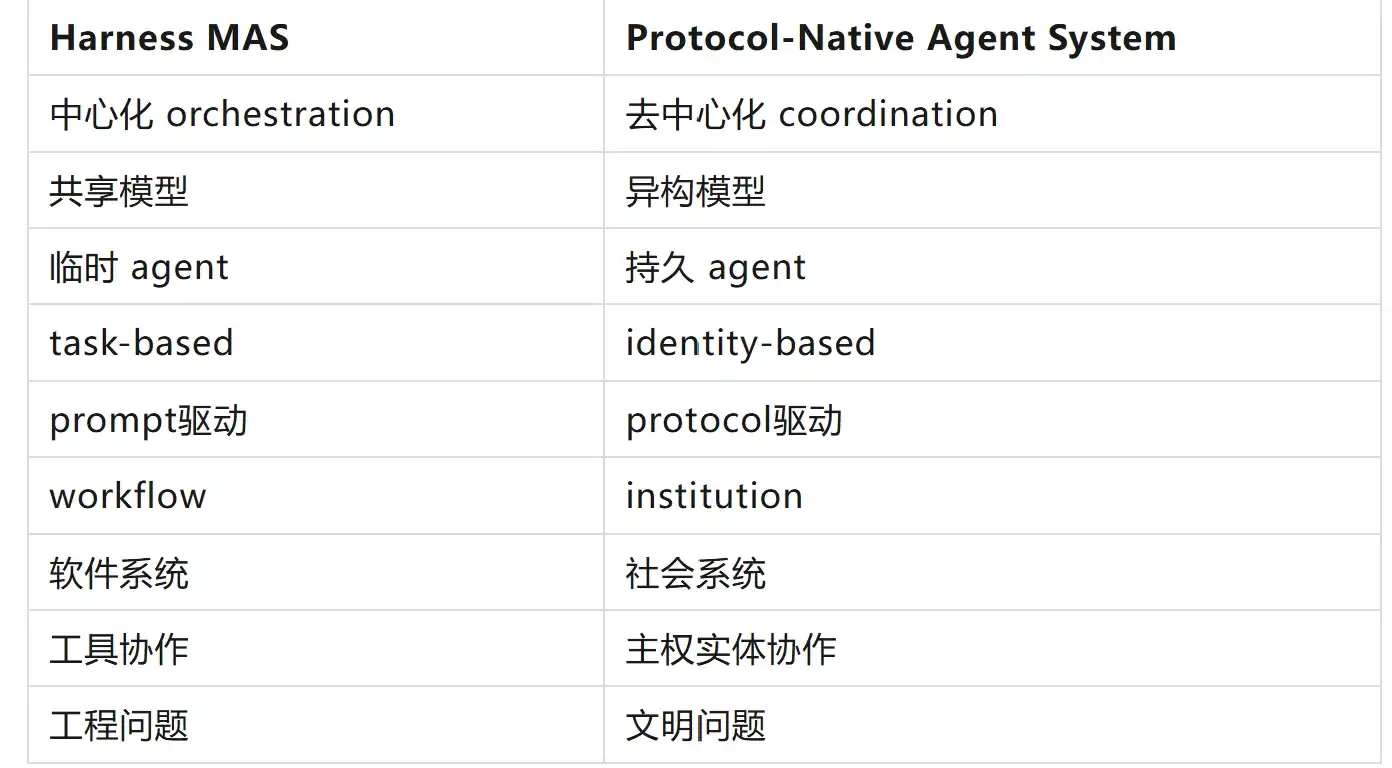
Let's make a table to compare the fundamental differences between the two MAS approaches mentioned earlier:
After "Intelligence"

Many people today believe the biggest problems with AI are:

  • Reasoning ability
  • Model capability
  • Long context
  • Multimodality
  • Agent execution

These indeed pose current challenges, but I truly believe all these will be solved soon. However, upon truly entering Agent Society, the most difficult problem might become: how autonomous entities achieve long-term collaboration.

Kepler was revered as the "lawgiver of the heavens" because of his three laws. But what are the laws for Agents here? When sovereignty is partially separated, this is an unavoidable question.

Because in the future:

  • Agents will have different goals
  • Agents will have different world models
  • Agents will have different interests
  • Agents will have different memories
  • Agents will have different value systems

Therefore, the truly difficult thing in the future is not "making Agents talk," but "enabling Agents to form a coherently interpretable world model."

This means: Ontology, Semantic Protocol, these fields once neglected by the internet, will become core again. There are already some signs; Ontology, such an obscure term, is now almost becoming a mainstream engineering vocabulary. It's truly an astonishing thing.

The Secret of Palantir

Companies Might Just Be "Agent Associations"

Pushing this further, future "companies" might not even be human organizations. (Students who often read my articles, does this sound familiar? The high-end game of unmanned companies has appeared.) They could be protocol alliances of numerous Personal Agents.

For example:

  • Your Agent
  • My Agent
  • AI CFO
  • AI Lawyer
  • AI Sales
  • AI Factory

Dynamically forming organizations through protocols. Organizations are no longer fixed structures, but Agent associations that can be reorganized in real-time.

Therefore, many future systems may no longer be software running, but may be transforming into: organizations computing. And this might be the true: Intelligence-Native Civilization.

Finally, I'll use an AI-generated image to summarize the entire article:
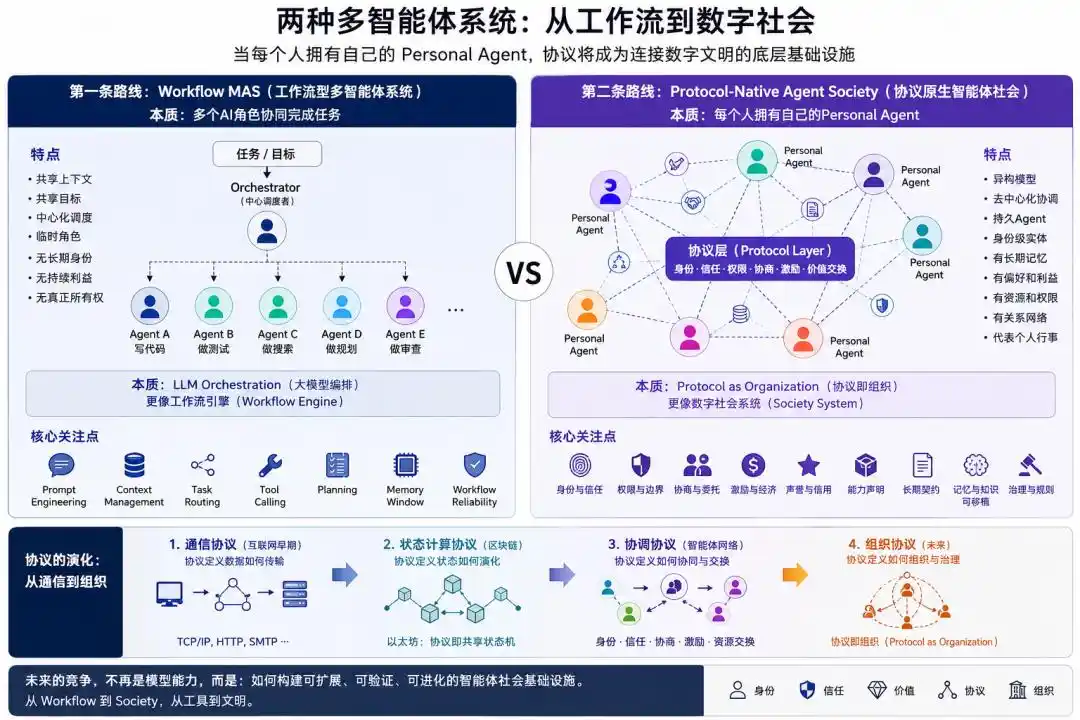
(The summary is indeed better than banana)

I have established a "universe" of AI ontology.

Galloping with the wind, spring grows old; The world is fickle, the traveler's steps are slow.

This article is from the WeChat public account "琢磨事," author: Li Zhiyong

Questions liées

QWhat are the two main AI Multi-Agent System (MAS) development paths discussed in the article, and how do they fundamentally differ?

AThe article discusses two main MAS paths. The first is 'Harness-style MAS,' which is currently mainstream. It involves multiple AI agents (like coders, testers) orchestrated by a central system to complete complex tasks. It's essentially a sophisticated workflow or orchestration system. The second path is 'Protocol-Native Agent System.' Here, the focus shifts to personal or sovereign agents (like a Personal Agent or an 'unmanned company') that represent individuals with long-term memory, identity, and resources. The fundamental difference is in their nature: the first is a task-oriented, centrally controlled software system, while the second envisions a society-like system of autonomous entities that must coordinate through protocols.

QAccording to the article, why will 'protocols' become the core challenge in a future populated by autonomous Personal Agents?

AIn a future with many independent, sovereign Personal Agents (each with its own goals, memory, and value systems), central coordination methods like shared context or workflows become impossible. Therefore, protocols will become the core mechanism for enabling coordination. These protocols will need to solve complex social and institutional problems like identity verification, trust establishment, permission boundaries, incentive mechanisms, reputation systems, and long-term contracts between autonomous entities. The core challenge thus shifts from 'prompt engineering' to 'protocol engineering' to manage interactions in this digital society.

QWhat key characteristics define a true 'Personal Agent' or 'unmanned company' as opposed to a task-specific agent in the first MAS path?

AA true Personal Agent or unmanned company is defined by sovereignty and persistent identity, unlike temporary task agents. Its key characteristics include: long-term memory, a continuous identity, personal preferences, owned resources, specific permissions, a personal history, a relationship network, defined interest boundaries, and the ability to represent its owner ('you'). It is an identity-scoped entity, not a task-scoped tool. This sovereignty is what necessitates the complex protocol-based interactions described in the article.

QThe article suggests the concept of 'Protocol as Organization.' What does this mean in the context of Agent Society?

A'Protocol as Organization' means that in an Agent Society, the protocols governing agent interactions will take on the functions traditionally associated with human organizations. Beyond just defining data communication (like HTTP) or shared state computation (like blockchain), these advanced protocols will define coordination rules, permission structures, incentive models, identity management, and the very organizational relationships between agents. In this way, a 'company' or collective entity could be formed dynamically not by legal documents and fixed structures, but by a set of protocols that allow a coalition of Personal Agents and specialized AI agents to collaborate and operate together.

QWhat does the author believe will be the most difficult challenge after basic AI 'intelligence' problems (like reasoning, context) are solved?

AThe author believes the most difficult challenge will be enabling long-term collaboration between autonomous entities (agents). Once agents have different goals, world models, interests, memories, and value systems, the core problem shifts from making agents intelligent to making their interpretations of the world align enough for cooperation. This will make fields like Ontology (defining shared conceptual frameworks) and Semantic Protocols (protocols with shared meaning) critically important, moving the focus from technical execution to social and philosophical coordination within a digital civilization.

Lectures associées

TechFlow Intelligence : L’or au comptant chute sous les 4 400 dollars, le marché des crypto-monnaies baisse partout

Les grands titres du jour : l'or chute sous les 4400 dollars, et les marchés cryptos reculent. **IA & Tech :** Un débat anime Hacker News : Claude et ChatGPT sont-ils passés du statut de "jouets coûteux" à d'authentiques outils pour développeurs, ou leur adoption est-elle artificielle ? Par ailleurs, de graves vulnérabilités touchent des outils populaires comme VLLM, menaçant des millions d'agents IA. Du côté des modèles, Gemini Omni Flash est critiqué pour sa censure excessive, tandis qu'une simple amélioration de la quantification (de Q4 à Q6) boosterait significativement les capacités de codage de Qwen3.6-35B. **Crypto / Web3 :** Un employé de Google est accusé d'avoir utilisé des données internes de tendances de recherche pour gagner plus d'un million de dollars sur le marché de prédiction Polymarket. Une analyse révèle aussi des comptes suspects sur cette plateforme, avec un taux de gain de 98%. Parallèlement, une société crypto liée à Trump serait au bord de la faillite après avoir perdu 1,5 milliard de dollars. **Entreprises & Marchés :** En réaction à l'intégration forcée de l'IA par Google, le moteur de recherche respectueux de la vie privée DuckDuckGo a vu son trafic bondir de 28%. Une donnée interne de Microsoft indique que l'utilisation de l'IA coûterait, dans de nombreux cas, plus cher que le recours à des employés. Sur les marchés, les actions coréennes et celles liées aux puces IA (comme Micron) performent, tandis que Meta teste l'eau des abonnements payants sur Facebook et Instagram. **Contexte macro :** L'or a connu une chute brutale sous les 4400 $/once, en partie à cause des signaux hawkish de la Fed. À l'inverse, le pétrole Brent a grimpé à 97 dollars après une escalade militaire américaine contre l'Iran. **En filigrane :** Les frontières de l'information privilégiée sont redéfinies à l'ère de l'IA et des données massives, comme le montrent les affaires Polymarket. Parallèlement, le récit du "tout à l'IA" est contesté par des réalités de coût et les préférences des utilisateurs, suggérant un rééquilibrage en cours.

marsbitIl y a 4 mins

TechFlow Intelligence : L’or au comptant chute sous les 4 400 dollars, le marché des crypto-monnaies baisse partout

marsbitIl y a 4 mins

Le vent de l'IA "active" souffle sur la Silicon Valley, Hark lève 700 millions de dollars

L'entreprise américaine Hark, fondée fin 2025 et encore sans produit public, a levé 700 millions de dollars en série A, atteignant une valorisation de 6 milliards de dollars. Le tour de table est mené par Parkway Venture Capital et comprend des géants technologiques comme NVIDIA, AMD Ventures, Intel Capital, Qualcomm Ventures et Salesforce Ventures. Hark vise à créer la prochaine interface universelle homme-machine en combinant un "modèle de base auto-développé" avec du "matériel sur mesure". Son objectif est de développer une nouvelle interface d'intelligence artificielle matérialisée par du matériel natif AI : une gamme d'appareils matériels personnalisés dotés de capacités d'agent intelligentes, équipés de modèles vocaux de bout en bout et d'une mémoire hautement personnalisée. Ces systèmes AI multimodaux sont conçus pour comprendre et interagir de manière naturelle. Le fondateur, Brett Adcock, a auparavant créé Archer et Figure. Son expérience dans les systèmes intégrant l'IA, le matériel et l'interaction avec le monde réel (comme chez Figure) est considérée comme un atout clé pour Hark. L'entreprise a également recruté d'anciens cadres d'Apple, Meta, Google et Tesla. L'article souligne que l'IA actuelle, bien que puissante, est principalement confinée aux écrans et fonctionne de manière réactive. Hark et d'autres pionniers visent à créer une IA "active" qui agit comme un collaborateur, anticipant les besoins et agissant de manière autonome. Cette évolution nécessite des avancées conjointes en modèles de base, systèmes d'exploitation pour agents, mémoire personnalisée et terminaux matériels. Enfin, l'article note que les startups chinoises possèdent des avantages significatifs dans ce domaine, notamment un écosystème manufacturier complet (comme à Shenzhen), un vaste marché d'adoption et un soutien politique fort en faveur de l'IA. Le financement majeur de Hark confirme une tendance émergente : l'avenir de l'IA se jouera non seulement sur les écrans, mais aussi dans le monde physique via des appareils natifs intelligents.

marsbitIl y a 44 mins

Le vent de l'IA "active" souffle sur la Silicon Valley, Hark lève 700 millions de dollars

marsbitIl y a 44 mins

Les concurrents s'introduisent en Bourse les uns après les autres, Kimi commence à s'impatienter

La société chinoise d'IA Moon (Kimi) a officiellement entamé la démantèlement de sa structure VIE et Red Chip, préparant ainsi une introduction potentielle à la Bourse de Hong Kong. Cette décision intervient alors que ses concurrents directs, Zhipu AI et MiniMax, ont déjà réalisé leur IPO en début d'année 2026, déclenchant un réévaluation importante des sociétés de grands modèles de langage sur les marchés financiers. La valorisation de Moon a connu une croissance spectaculaire, passant de 3 milliards de dollars à sa création en 2023 à plus de 200 milliards de dollars en mai 2026. Les experts estiment que cette valorisation reflète une anticipation par le marché du potentiel de la société à devenir une future plateforme d'entrée vers l'IA en Chine, plutôt que ses performances financières actuelles. Historiquement focalisée sur la recherche et le développement technique sous la direction de son fondateur Yang Zhilin, la société a récemment opéré un virage stratégique. Elle a réduit ses dépenses publicitaires et ses objectifs en termes d'utilisateurs actifs mensuels pour se concentrer sur le développement d'Agents IA et la monétisation via des abonnements payants et des API. Cette nouvelle orientation commerciale semble porter ses fruits, avec des revenus récurrents annuels dépassant les 2 milliards de dollars. Les analystes préviennent que l'entrée en bourse imposera de nouvelles contraintes. La société devra équilibrer ses investissements en R&D avec les attentes de rentabilité des investisseurs, tout en renforçant sa gouvernance, sa conformité et la transparence de sa stratégie commerciale. Le défi pour Moon sera de transformer son avance technologique en une rentabilité durable pour justifier sa valorisation élevée.

marsbitIl y a 1 h

Les concurrents s'introduisent en Bourse les uns après les autres, Kimi commence à s'impatienter

marsbitIl y a 1 h

Les marchés américains atteignent des sommets, alors pourquoi les consommateurs sont-ils de plus en plus pessimistes ?

Malgré les records successifs du marché boursier américain, le sentiment des consommateurs atteint des niveaux historiquement bas. Cet écart apparent s'explique par une division structurelle croissante de l'économie, qualifiée de "K-shaped". Premièrement, l'enquête sur la confiance des consommateurs de l'Université du Michigan pourrait être biaisée par un échantillon surreprésentant les démocrates, généralement plus pessimistes. Cependant, le malaise est réel pour une partie de la population qui subit la pression de l'inflation passée sur les prix alimentaires et énergétiques, sans voir ses salaires suivre. Le cœur du problème réside dans l'inégalité de l'exposition aux actifs. Environ 60% des Américains détiennent des actions, directement ou indirectement, et bénéficient de la hausse des marchés. Les 40% restants, sans investissements, se sentent davantage distancés. Ainsi, la vigueur apparente de la consommation agrégée est en réalité portée par le haut de la pyramide : les 10% des consommateurs les plus aisés contribuent désormais à près de 50% des dépenses. Les ménages modestes, majoritaires, voient leur part se réduire et leur situation se fragiliser. Pour les investisseurs, cette faible confiance est historiquement un bon indicateur contraire, annonciatrice de rendements boursiers solides à un an. Mais cette dynamique perpétue le clivage : les facteurs qui alimentent la hausse des actifs financiers (détenus par les plus riches) accentuent simultanément les pressions inflationnistes sur les budgets des ménages sans patrimoine. L'économie américaine montre une résilience de plus en plus concentrée, creusant le fossé entre les détenteurs d'actifs et les autres.

marsbitIl y a 1 h

Les marchés américains atteignent des sommets, alors pourquoi les consommateurs sont-ils de plus en plus pessimistes ?

marsbitIl y a 1 h

Trading

Spot
Futures

Articles tendance

Comment acheter ONE

Bienvenue sur HTX.com ! Nous vous permettons d'acheter Harmony (ONE) de manière simple et pratique. Suivez notre guide étape par étape pour commencer votre parcours crypto.Étape 1 : Création de votre compte HTXUtilisez votre adresse e-mail ou votre numéro de téléphone pour ouvrir un compte sur HTX gratuitement. L'inscription se fait en toute simplicité et débloque toutes les fonctionnalités.Créer mon compteÉtape 2 : Choix du mode de paiement (rubrique Acheter des cryptosCarte de crédit/débit : utilisez votre carte Visa ou Mastercard pour acheter instantanément Harmony (ONE).Solde :utilisez les fonds du solde de votre compte HTX pour trader en toute simplicité.Prestataire tiers :pour accroître la commodité d'utilisation, nous avons ajouté des modes de paiement populaires tels que Google Pay et Apple Pay.P2P :tradez directement avec d'autres utilisateurs sur HTX.OTC (de gré à gré) : nous offrons des services personnalisés et des taux de change compétitifs aux traders.Étape 3 : stockage de vos Harmony (ONE)Après avoir acheté vos Harmony (ONE), stockez-les sur votre compte HTX. Vous pouvez également les envoyer ailleurs via un transfert sur la blockchain ou les utiliser pour trader d'autres cryptos.Étape 4 : tradez des Harmony (ONE)Tradez facilement Harmony (ONE) sur le marché Spot de HTX. Il vous suffit d'accéder à votre compte, de sélectionner la paire de trading, d'exécuter vos trades et de les suivre en temps réel. Nous offrons une expérience conviviale aux débutants comme aux traders chevronnés.

384 vues totalesPublié le 2024.12.12Mis à jour le 2025.03.21

Comment acheter ONE

Discussions

Bienvenue dans la Communauté HTX. Ici, vous pouvez vous tenir informé(e) des derniers développements de la plateforme et accéder à des analyses de marché professionnelles. Les opinions des utilisateurs sur le prix de ONE (ONE) sont présentées ci-dessous.

活动图片