HyperEVM Ecosystem Heats Up: Memes Pause, Next Robinhood?

marsbitPublié le 2026-08-26Dernière mise à jour le 2026-08-26

Résumé

The HyperEVM ecosystem is experiencing a surge in activity, shifting from its role as infrastructure for Hype to a high-volatility trading arena. This shift is driven by HYPE reaching a new all-time high and a rapid memecoin rotation, causing network gas fees to spike above those on Ethereum Mainnet. Key drivers include HYPE's price performance, rising over 35% in a week following public endorsement. The memecoin sector saw explosive growth, with EGG achieving a 14,000%+ 24-hour surge and CHAMELEON capitalizing on founder narrative, though both have since retraced significantly. The ecosystem's infrastructure is developing rapidly. Motion.meme serves as a launchpad for new tokens, akin to Pump.fun. Kinetiq (KNTQ) is a leading liquid staking protocol, with its tokenomics bolstered by revenue from its new HIP-3 perp exchange launchpad. HyperLend (HPL) has emerged as a major lending market with high TVL, and Project X is the dominant DEX by trading volume. In conclusion, the current heat is primarily a revaluation driven by HYPE's price. For a sustained "HyperEVM Season," key challenges include user retention post-meme frenzy, the ability of utility projects to generate real revenue, and critically, the prohibitively high gas fees (often $10-20 per transaction) which threaten to cap the ecosystem's growth and mainstream adoption.

Over the past few days, HyperEVM abruptly transitioned from being infrastructure dedicated to Hype into a "high-volatility trading ground"—amid HYPE hitting new all-time highs and a rapid meme rotation, the on-chain Gas on HyperEVM once surged to over ten dollars per transaction, far exceeding that of the Ethereum mainnet!

The underlying driver of this market movement stems primarily from HYPE's strong performance following Trump's endorsement. HYPE is currently priced around $79.65, up 35.4% over 7 days and 38.7% over 30 days, reaching a new all-time high of $83.27 yesterday.

Roundup of Popular Memes and Projects on HyperEVM
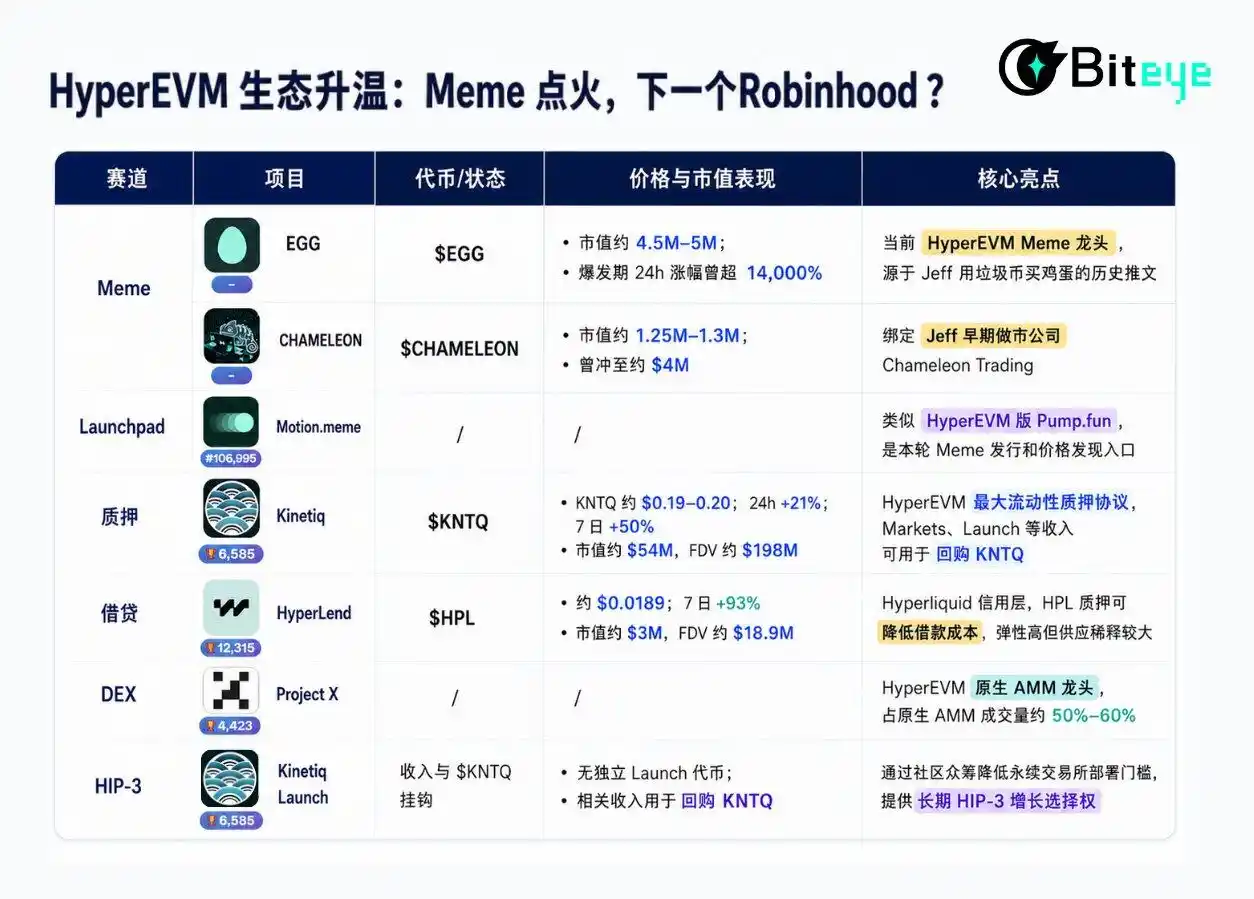
Meme: EGG and CHAMELEON Ignite Sentiment

EGG: The Current Sentiment Leader on the Hype Chain

EGG originates from an early tweet by Jeff Yan: "Just buy eggs with your shitcoins."

The community packaged it into a native HyperEVM meme, creating mini-games and the interactive website eggonhype.com.

Contract: 0xb75d5ee14708e7efbea939311090061d72265608

Summary: During its explosive phase, EGG saw a 24h increase of over 14,000%, with its market cap once reaching approximately $8M–9M, but it has since experienced a significant pullback.

CHAMELEON: Narratives from Jeff's Early Entrepreneurial History

CHAMELEON is tied to Jeff's real entrepreneurial history. Before Hyperliquid existed, Jeff operated Chameleon Trading, and his X account handle remains @chameleon_jeff to this day.

Contract: 0xddfed493a114d610C5709FEFd22BAEF40DC23428

Summary: CHAMELEON's market cap once surged to around $4M but has since retraced by approximately 65%–70%.

Launchpad: Motion

Motion.meme is akin to the HyperEVM version of Pump.fun. Projects first undergo price discovery via a Bonding Curve before moving to the HyperSwap V3 pool for trading.

Its fee mechanism is as follows:

· Token Launch Fee: 0.05 HYPE;

· Bonding Phase: Approximately 0.5% platform fee;

· HyperSwap Pool Fee: Approximately 0.01%;

Summary: Motion plays the "pickaxe seller" role in this round of the meme rally. If the HyperEVM Meme Season's momentum proves sustainable, Motion will significantly benefit.

Staking: Kinetiq (KNTQ)

Kinetiq is the largest liquid staking protocol on HyperEVM. Users stake HYPE to receive kHYPE, gaining staking rewards while also being able to use kHYPE for lending and providing liquidity.

KNTQ's advantage lies in its relatively clear value capture: Revenue from Markets, Launch, and part of the validator income is used to buy back KNTQ and distribute it to sKNTQ stakers.

Summary: Overall, Kinetiq appears to be the most fundamentally sound utility project in this round of HyperEVM activity.

HIP-3: Kinetiq Launch

Kinetiq Launch is a launchpad for HIP-3 perpetual trading platforms.

Deploying a HIP-3 trading platform requires staking over 500,000 HYPE, which at current prices is nearly $40M. Kinetiq Launch allows the community to crowdfund this capital and uses independent exLST tokens to isolate risks between different trading platforms.

Summary: Launch revenue earned by Kinetiq is used to repurchase KNTQ, adding the new narrative of "HIP-3 Trading Platform Incubator" to KNTQ.

Lending: HyperLend (HPL)

HyperLend is the primary lending market on HyperEVM, supporting the collateralization of assets like HYPE and kHYPE, and is positioned as the credit layer for Hyperliquid.

· TVL: Approximately $570M

· Borrowing Volume: Approximately $308M

Summary: HPL can be staked as sHPL to reduce borrowing costs, with a potential rebate cap of up to 80%. The market is bullish on it due to its "low market cap, high TVL" profile.

DEX: Project X

Project X is a concentrated liquidity AMM with leading transaction volume on HyperEVM.

· TVL: Approximately $45.8M

· 24h Volume: Approximately $152M

Summary: Among HyperEVM's native AMMs, Project X accounts for approximately 50%–60% of the trading volume share.

Conclusion:

Currently, the HyperEVM hype seems more like an ecosystem revaluation driven by HYPE's new highs. Whether this can evolve into a genuine HyperEVM Season requires further observation: the retention rate of users attracted by meme fever, and whether a series of utility projects can convert into real users and actual revenue.

Moreover, every time HyperEVM activity increases and on-chain transactions become active, the Gas fees spike noticeably. During peak periods, the cost per transaction can easily reach 10–20 U. While this increases the demand for HYPE Gas and its burn, it also caps the potential ceiling for meme trading and the long-term prosperity of the HyperEVM ecosystem.


Questions liées

QWhat are the main factors driving the recent surge in activity on HyperEVM according to the article?

AThe primary drivers are the strong performance of the HYPE token following an endorsement from Trump and a fast-paced meme coin rotation. HYPE reached a new all-time high of $83.27, with 7-day and 30-day gains of 35.4% and 38.7% respectively. This led to a 'high volatility trading field' with on-chain gas fees spiking above those on the Ethereum mainnet.

QWhich two meme coins on HyperEVM are highlighted as the major emotional drivers, and what are their respective narratives?

AThe two highlighted meme coins are EGG and CHAMELEON. EGG's narrative originates from a past tweet by Jeff Yan, 'Just buy eggs with your shitcoins.' CHAMELEON is tied to Jeff Yan's real entrepreneurial history, named after his former company, Chameleon Trading, which existed before Hyperliquid.

QWhat is the role of the Motion.meme platform in the HyperEVM ecosystem?

AMotion.meme serves as a launchpad similar to Pump.fun on HyperEVM. It functions as the 'shovel seller' for the meme coin season. Projects first go through a Bonding Curve for price discovery and are then listed for trading in HyperSwap V3 pools, with the platform charging fees at each stage.

QAccording to the article, what is Kinetiq (KNTQ) and what makes it a key 'utility-type project' on HyperEVM?

AKinetiq is the largest liquid staking protocol on HyperEVM. Users stake HYPE to receive kHYPE, which can be used for additional yield, borrowing, and providing liquidity. Its value capture is clear: revenue from Markets, Launch, and some validator income is used to buy back KNTQ tokens and distribute them to sKNTQ stakers.

QWhat is identified as a significant challenge that could limit the long-term growth of the HyperEVM ecosystem?

AA major challenge is the high on-chain transaction (gas) costs. During peak activity, the cost per transaction can reach $10–20 USD. While this increases demand for and burn of HYPE tokens, it limits the potential for meme trading volume and the overall long-term prosperity of the HyperEVM ecosystem.

Lectures associées

Le PDG de Circle : Les stablecoins en sont au stade de l'internet en 2002, et atteindront plusieurs milliers de milliards de dollars à l'avenir

Le PDG de Circle, Jeremy Allaire, a participé à une séance de questions-réponses suite aux résultats du Q2 2026. Il a abordé plusieurs sujets clés concernant l'avenir des stablecoins et la stratégie de Circle. Allaire compare la phase actuelle des stablecoins et de la finance décentralisée à celle d'Internet en 2002, prédisant une croissance massive vers des milliers de milliards de dollars. Les principales applications identifiées incluent les marchés d'actifs numériques (fonctionnant 24/7), la réserve de valeur en dollars numériques dans les marchés émergents, et le règlement transfrontalier. Concernant USDC, les plus grandes opportunités se situent dans le règlement transfrontalier, les paiements sur les marchés de capitaux, les paiements entre agents d'IA et, à plus long terme, les paiements de détail (cartes, QR codes). Circle vise à étendre considérablement l'adoption d'USDC en collaborant avec des partenaires mondiaux. Allaire a également présenté Arc, un nouveau réseau conçu comme un système d'exploitation économique. Arc, dont le mainnet public est prévu pour le 16 septembre, vise à rendre la technologie blockchain invisible pour l'utilisateur final en utilisant l'USDC pour les frais et en permettant aux développeurs de supporter ces coûts. Sur EURC, le stablecoin en euros de Circle a atteint 400 millions d'euros en circulation, profitant de la réglementation MiCA et du réseau de distribution existant. Son adoption devrait continuer à croître. Enfin, Allaire a réaffirmé que l'adoption des stablecoins, en particulier d'USDC, continuerait de croître mondialement, indépendamment de la progression de lois spécifiques comme le CLARITY Act aux États-Unis, citant la dynamique réglementaire mondiale et la demande intrinsèque.

marsbitIl y a 26 mins

Le PDG de Circle : Les stablecoins en sont au stade de l'internet en 2002, et atteindront plusieurs milliers de milliards de dollars à l'avenir

marsbitIl y a 26 mins

Recettes inférieures de 3,8 milliards à celles de ChangXin, mais bénéfice net supérieur de 8,6 milliards : Quel secret cache l'introduction en bourse de Changcun Holding ?

Le 21 août, le géant chinois de la mémoire NAND, Changcun Holding, a déposé son prospectus d'introduction en bourse après avoir finalisé sa préparation. Les performances financières du premier trimestre 2026 sont remarquables : un chiffre d'affaires de 470,42 milliards de yuans et un bénéfice net attribuable aux actionnaires de la société mère de 333,79 milliards de yuans. Une comparaison avec Changxin Technology, spécialisé dans la DRAM, révèle une anomalie apparente : malgré un chiffre d'affaires inférieur de 37,58 milliards de yuans, le bénéfice net de Changcun dépasse celui de Changxin de 86,17 milliards de yuans. L'analyse montre que la différence ne provient pas d'une marge brute supérieure (76,77% pour Changcun contre 79,16% pour Changxin), mais principalement de la structure capitalistique des actifs de production clés. Changcun Holding détient directement 100% de sa principale entité opérationnelle, Yangtze Memory Technology Co., Ltd., ce qui lui permet de conserver la quasi-totalité des bénéfices consolidés pour ses actionnaires principaux (bénéfice net attribuable : 333,79 milliards sur 334,85 milliards de bénéfice consolidé). En revanche, Changxin Technology exerce un contrôle, mais ne détient pas la totalité des droits économiques de ses principales entités de production (comme Changxin Xinqiao). Par conséquent, une part significative des bénéfices consolidés (82,49 milliards de yuans au T1 2026) est attribuée aux actionnaires minoritaires, réduisant ainsi le bénéfice net attribuable à ses propres actionnaires à 247,62 milliards de yuans. Malgré un bénéfice net attribuable plus élevé, les évaluations pré-IPO de Changcun (~3000 milliards de yuans) restent inférieures aux perspectives de Changxin (2000-3000 milliards de yuans). Cela s'explique par les perspectives de marché différentes : Changxin, dans la DRAM, bénéficie du potentiel de croissance du HBM pour l'IA, tandis que le marché NAND de Changcun, plus limité en taille, dépendra de sa capacité à monter en gamme (SSD d'entreprise) pour soutenir sa valorisation future.

marsbitIl y a 50 mins

Recettes inférieures de 3,8 milliards à celles de ChangXin, mais bénéfice net supérieur de 8,6 milliards : Quel secret cache l'introduction en bourse de Changcun Holding ?

marsbitIl y a 50 mins

Le déluge de liquidations de contrats perpétuels fait son retour, la fourchette de 62 000 à 67 000 dollars pourrait être l'« épicentre »

Une nouvelle vague de liquidations frappe les contrats perpétuels, avec la fourchette 62 000 - 67 000 dollars identifiée comme une zone à haut risque pour le Bitcoin. Le 23 août, une chute sous 76 000 dollars a entraîné la liquidation de 84 millions de dollars en positions longues en une heure, illustrant l'effet démultiplicateur et dangereux de l'effet de levier. L'approbation fin mai par la CFTC des contrats perpétuels sur Bitcoin de Kalshi, une plateforme régulée aux États-Unis, a remodelé le paysage. Malgré une croissance rapide (55 milliards de dollars de volume en deux semaines), des experts comme Benjamin Schiffrin alertent sur les risques, soulignant l'absence de protections renforcées pour les investisseurs particuliers. L'analyse des cartes de liquidations révèle une forte concentration de liquidations longues potentielles entre 62 000 et 67 000 dollars. Si la résistance autour de 82 000 dollars tient, le marché pourrait s'orienter vers cette zone pour "balayer" cette liquidité. Des traders mettent en garde contre la volatilité extrême, comme l'événement récent ayant liquidé 27 à 35 milliards de dollars en positions courtes. Les experts conseillent aux débutants d'éviter le levier et les options, instruments complexes pouvant conduire à des pertes totales. Malgré les risques, la demande pour les contrats perpétuels sur chaîne persiste parmi les acteurs institutionnels, attirés par l'auto-custodie et la transparence. Le message principal reste : le levier amplifie les gains comme les pertes, pouvant provoquer des liquidations soudaines et brutales.

marsbitIl y a 52 mins

Le déluge de liquidations de contrats perpétuels fait son retour, la fourchette de 62 000 à 67 000 dollars pourrait être l'« épicentre »

marsbitIl y a 52 mins

Trading

Spot
活动图片