Author: Yang Chen
In Warsh's debut, several strong signals suggest imminent changes, including a significant reduction in the length of the policy statement and a shorter press conference. Warsh stated that the Committee is clear and unanimous in its commitment to achieving price stability and the 2% inflation target. He announced the establishment of special working groups, including one to review the Fed's $6.7 trillion balance sheet and study whether monetary policy emanates from interest rate tools or balance sheet tools. Warsh did not submit his own "dot plot" interest rate forecast. All other officials submitted theirs, with half expecting at least one rate hike this year and the other half expecting rates to remain unchanged or fall. After the Fed's statement and press conference, U.S. stocks fell sharply, and U.S. Treasury yields surged.
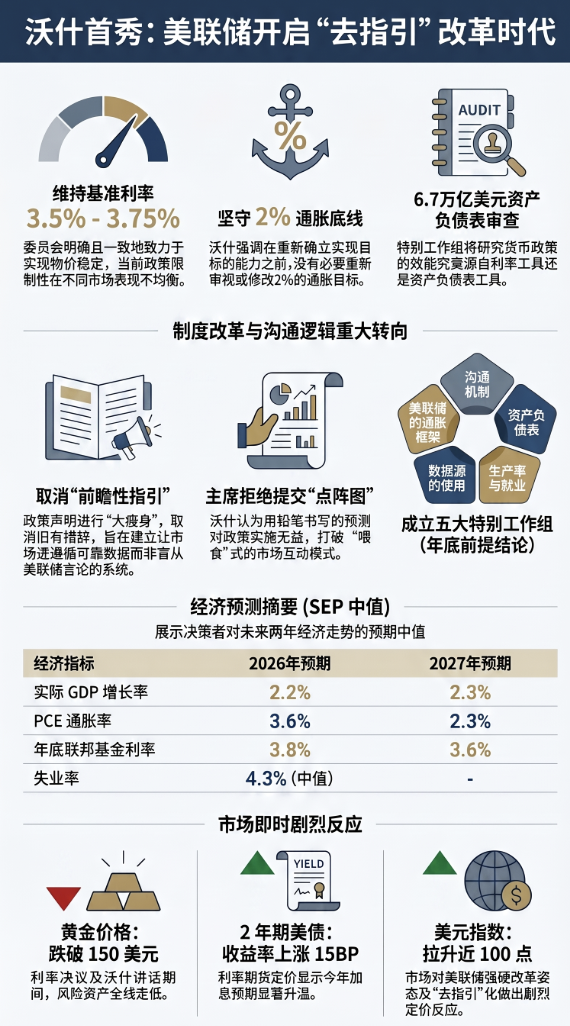
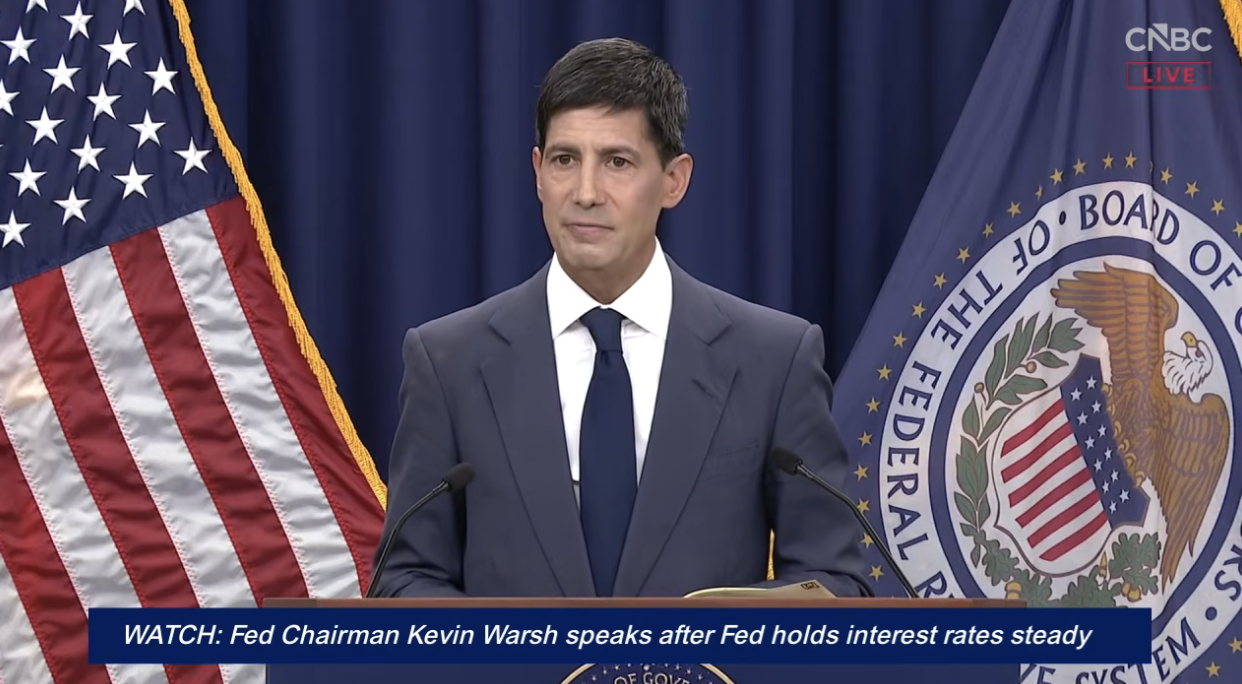
In his first FOMC press conference, newly appointed Fed Chair Warsh announced that interest rates would remain unchanged at 3.5%-3.75%, stating the Committee is clear and unanimous in its commitment to achieving price stability and the 2% inflation target.
Simultaneously pushing forward reforms, this statement eliminated the longstanding "forward guidance" and announced the immediate establishment of five special working groups (on Communication Mechanisms, Balance Sheet, Use of Data Sources, Productivity & Employment, and the Fed's Inflation Framework), with recommendations for improvement to be proposed by year-end.
One of the special working groups will review the Fed's $6.7 trillion balance sheet and study whether monetary policy emanates from interest rate tools or balance sheet tools.
Warsh declined to submit his own economic projections (SEP). Among the 18 policymakers who submitted projections, there was a clear divergence on the path of interest rates. Half expect at least one rate hike this year, while the other half expect rates to remain unchanged or fall.
From the rate decision until the end of Warsh's remarks, risk assets such as U.S. stocks fell across the board, gold plunged over $150, the 2-year Treasury yield rose by 15 basis points, the U.S. Dollar Index surged nearly 100 points, and interest rate futures priced in a 39 basis point increase in hikes for this year, up 18 basis points.
Sticking to the 2% Inflation Bottom Line, Describes Current Policy Restraint as "Uneven"
Facing persistently high prices over the past five years, the market is highly focused on the Fed's tolerance for inflation. Warsh offered no compromise on this:
"Today, I announce that this Committee has made the clear and unanimous decision that we will achieve (the 2%) target.
The members of the FOMC are clear and unanimous that this Committee will achieve price stability."
When asked if the 2% inflation target would be revised, Warsh used his characteristically sharp language to dispel market speculation:
"There is no need to revisit it until we have re-established our commitment and capability to achieve the 2% inflation target."
Regarding whether the current level of interest rates is sufficiently restrictive, Warsh offered a thought-provoking assessment—"uneven." He pointed out:
"If I look at the housing market as an example, Fed policy seems to have a certain degree of restrictiveness. But if I were to describe what's happening in financial markets, it's hard to use the word 'restrictive.'"
This statement implies that the Fed has taken note that soaring asset prices do not reflect the tightening effect of current monetary policy.
Establishing Five Major Working Groups Responsible for Reviewing Fed Balance Sheet, Reducing Data Errors, etc.
To fundamentally change how the Fed operates, Warsh announced the immediate establishment of five special working groups, focusing respectively on: Fed Communication, Balance Sheet, Use of Data Sources, Productivity & Employment (impact of AI), and Inflation Framework. He expects these groups to draw conclusions by the end of this year.
Warsh stated that one of the independent working groups he is forming will "review the benefits and risks of the current ample reserves regime and the composition of the balance sheet," studying "whether monetary policy emanates from interest rate tools or balance sheet tools."
Speaking about the data working group, Warsh offered sharp criticism of current economic statistical methods. He believes the old survey methods central bankers rely on fail to reflect the true state of the current U.S. economy, and data releases suffer from severe lags.
"Some of the data we receive... may just be 'an echo of history.' We need to narrow those error ranges. What we are truly interested in is what is happening now, not the echo of history."
Forward Guidance Canceled This Time, Chair Unprecedentedly "Refuses to Submit" Dot Plot
In this meeting, what most surprised investors was the "slimming down" of the Fed's policy statement. Warsh said straightforwardly at the press conference:
"You might have noticed a difference in today's policy statement. It's shorter, more concise, and omits some old language. The so-called 'forward guidance' is also no longer included; we are unanimous that it is not appropriate for the current policy mix."
Not only that, but as Fed Chair, Warsh broke precedent by explicitly refusing to submit his own Summary of Economic Projections (SEP) and dot plot. He explained this as follows:
"I reviewed the dot plot, and when I saw the submissions, I noticed all submissions were made in pencil, you know, the kind with the big eraser... For me, that's not helpful for policy implementation."
Although Warsh himself did not submit projections, according to the median of the SEP submitted by other participants: the expected real GDP growth rate this year is 2.2%, and 2.3% next year; overall PCE inflation this year is 3.6%, and 2.3% next year; the unemployment rate is about 4.3%. The median federal funds rate is expected to be 3.8% by year-end this year and 3.6% by year-end next year.
Breaking the "Fed-Speak" Market Interaction, Says AI Brings Huge Demand
For a long time, Wall Street has been accustomed to pricing based on Fed officials' speeches. Warsh explicitly stated at the meeting his intention to break this "Fed-speak" market interaction. Warsh emphasized:
"When financial markets do nothing but reflect what we say, then we are taking away the most important source of information and ignoring it.
I want us to establish a system that removes those blinders, allowing the market to follow data they believe in. They will bring us better information through market prices, and we can make more informed decisions."
Addressing the market's hot topic of artificial intelligence (AI), Warsh defined AI as "the most significant change experienced in my adult life" and pointed out that AI brings huge demand (manifested in data centers, electricity, etc.), but its potential for supply-side expansion remains uncertain.
"AI may be the most significant change experienced by the economy, business, and families in my adult life. If we do our jobs well, we can make robust growth, low prices, and strong employment compatible with each other."
A translation of Warsh's remarks from the press conference follows:
Warsh
Good afternoon. It is a pleasure, truly a pleasure, to be back at the Federal Reserve and to take up this responsibility at a time of such great consequence. I have been particularly heartened by the warm welcome from old friends and new colleagues alike. I have also listened carefully to my FOMC colleagues, absorbing many new ideas, new thinking, and a genuine desire to move the Fed forward.
Warsh
This week's FOMC meeting fully reflected the finest traditions of the Fed: rigorous debate, open-mindedness, commitment to mission, and a sense of accountability and responsibility for performance. In this business, all of that boils down to one thing: getting monetary policy right, or as close to right as possible—that is our North Star.
Warsh
My colleagues and I are here to fulfill our statutory mandates, as you've heard us say before: price stability and maximum employment. Those goals guided the work in the meeting we just concluded.
Warsh
As you saw moments ago, the Committee decided to maintain the target range for the federal funds rate at 3.5% to 3.75%. In support of the Fed's dual mandate, the Committee also reaffirmed the policy of maintaining ample reserves in the banking system. Although uncertainty is elevated due to factors such as conflict in the Middle East, economic activity continues to expand at a solid pace. Productivity growth and capital investment are both robust, employment growth remains in step with labor force growth, and the unemployment rate has changed little. We recognize that inflation has been persistently well above the Fed's long-stated 2% inflation goal. This has been the case for over five years now. Persistently high prices are a burden on the American people, but past experience need not be prologue.
Warsh
I am pleased to report that the members of the FOMC are clear and unanimous that this Committee will achieve price stability. In any institution, leadership transitions are a natural and timely occasion to reaffirm its mission, take stock of current practices, and consider whether those practices best serve our goals. I and my colleagues at the Fed will work closely together on what changes might help improve the implementation of monetary policy.
Warsh
On that point, you may have noticed a difference in today's policy statement. It's shorter, more concise, and omits some old language. This statement simply states the facts as best we know them. The so-called "forward guidance" is also no longer included; we are unanimous that it is not appropriate for the current policy mix.
Warsh
Later this afternoon, you will also receive the usual Summary of Economic Projections (SEP). The Committee's long-standing practice is for participants to submit these projections, and I encouraged my colleagues to continue doing so. However, I did not provide any projections myself, consistent with my long-held views on the SEP, at least in its current structure. In terms of median projections, real GDP growth is 2.2% this year and 2.3% next year; overall PCE inflation is 3.6% this year and 2.3% next year; the unemployment rate is about 4.3%. Participants' median projection for the federal funds rate is 3.8% at the end of this year and 3.6% at the end of next year.
Warsh
Now, let me say a few words about a key step we are announcing today. I will appoint a special working group in each of five areas critical to the broad implementation of monetary policy. First, Fed communication; second, the Fed's balance sheet; third, our use of and reliance on existing data sources; fourth, productivity and employment in a time of transformation; and finally, the Fed's inflation framework.
Warsh
These topics are timely, important, and, in my view, deserve a fresh look. My colleagues and I had vibrant and purposeful discussions about them over the past several days. For each independent working group, I am enlisting some of the very best talent, including from outside and inside the economics profession. They will be supported by subject-matter experts from our excellent Fed staff and will have a clear charge.
Warsh
Start from first principles, ask hard questions, take stock of current practices, consider alternatives, and, ultimately, propose next steps for policymakers. My colleagues have been discussing possible approaches to improve the form and function of Fed communication since last summer. This new working group will build on that work, and I expect it to propose some thoughtful changes, including to the SEP I just mentioned. The second working group, on balance sheet policy, will review the benefits and risks of the current ample reserves regime and the composition of the Fed's balance sheet. They will evaluate alternative frameworks for implementing and operating monetary policy.
Warsh
The third working group, the data working group, will assess new sources of information and consider methodological changes to data collection, aiming to provide policymakers with more accurate, relevant, timely, and perhaps most importantly, actionable information about our economic condition.
Warsh
Fourth, the productivity and employment working group will examine the pace, scope, and economic impact of new general-purpose technologies, including artificial intelligence, and explore their potential implications for the Fed's pursuit of its employment and inflation mandates.
Warsh
The final working group, the inflation framework working group, will study the drivers of inflation. Fundamentally, exploring ideas on achieving price stability in a changing economy. In the coming weeks, you'll hear more about these working groups and this overall initiative. For now, a simple statement: each working group will serve the goal shared by everyone in the system, by everyone who sat around the table with me in recent days—a Fed with a clear sense of its mission, aligned to its goals, and looking to the future. All right, thank you for your attention, I'm happy to take your questions.
---
Speaker 2
Hello, Chair Warsh. Good to see you again, and welcome back. With so many things launched so quickly, what is the envisioned timeline for each of these working groups?
Warsh
I think it will depend on the group. It will also depend on the urgency with which we need clear answers. My expectation—I am still in the process of recruiting and finalizing membership—is that the working groups will begin their work in the coming weeks. We will start getting more input from them on how they see the issues framed by late summer. Hopefully, most, if not all, will have conclusions by year-end.
Speaker 2
Specifically on the inflation framework, you mentioned first principles. Does this include a review of the 2% target itself? You've spoken about numbers to the right of the decimal not mattering. Does that mean starting from the premise that "2% as a point target is too precise"?
Warsh
Let me split that in two. First, on the inflation framework review, its charge is: what are the drivers of inflation? To what extent is the Fed responsible for inflation? How do we measure inflation? But that will overlap with my data working group. Regarding the 2% inflation target, that is the Fed's long-held 2% goal. You've heard me say before, I tend to focus on numbers to the left of the decimal. Well, 2 is now to the left of the decimal, zero to the right. I think there is no need to revisit it until we have re-established our commitment and capability to achieve the 2% inflation target. So that is not within the scope of this work.
Speaker 3
Cobie, thank you very much. Cobie Smith, New York Times. You have said before that inflation is a choice. The policy statement included your reaffirmation today of the commitment to achieve price stability. But looking at the SEP, most of your colleagues project core PCE to be around 3.3% by year-end, and the 2% inflation target not being achieved until 2028. So I'm wondering, at this juncture, how much patience can the Fed have in waiting for one-off inflationary waves to pass, and in waiting for inflation to come down after years of it being high? Under what circumstances would you support the Fed taking action and raising rates?
Warsh
Okay, that's several questions. Let me try to unpack. First, we have the capability and commitment to achieve the 2% price stability target. That is what we are going to do. In the Fed's review of its strategy over recent years, including in January—the strategy we are still bound by—the Fed statement said inflation is primarily determined by monetary policy. Of course it is. I have said for years inflation is a choice. Of course it is. Today, I announce that this Committee has made the clear and unanimous decision that we will achieve that target. The rest of your question sounded like an encouragement for me to give forward guidance. We have abandoned forward guidance. Some on the Committee, I think, abandoned it because they felt it inappropriate to provide forward guidance at the current moment. Others had a different view, that as a general proposition, forward guidance is not a business we should be in. But that will be handled by the communications working group and my policymaker colleagues. We will listen carefully to the experts and then make our own decisions. But I cannot give any forward guidance about our next steps. The good news is we will meet again in six weeks.
Speaker 3
Then, I want to follow up on the current policy setting. Given the data flow we see and the projections, how restrictive do you think current policy is?
Warsh
I've heard various descriptions inside and outside the Fed. I'll offer my own: uneven. If I look at the housing market as an example, Fed policy is not the sole determinant of conditions there. But overall, I think Fed policy there seems to have a certain degree of restrictiveness. If I were to describe what's happening in financial markets, it's hard to use the word 'restrictive.' So I say it's uneven. That may be a function of different transmission mechanisms of monetary policy, whether policy emanates from our interest rate tools or our balance sheet tools. The good news is we have a working group on that too, the balance sheet working group, to dig deeper into this.
Speaker 4
You said you don't like forward guidance, removed it from the statement this time. But the dot plot shows nine members said they want higher rates by year-end, and the market has already taken that as forward guidance. So what does that mean for how you guide the market and the future of the dot plot?
Warsh
I have to give you the same answer I gave Ms. Smith. We have a working group on this. Let me say a little more. I reviewed the dot plot, and when I saw the submissions, I noticed all submissions were made in pencil, you know, the kind with the big eraser. That is to say, I think the colleagues sitting around the table who submitted their dots understand the world changes fast, and they don't feel bound by where they think we will be in six weeks or six days. Just in case... I'd also note a couple other points. What I heard at the table is that when they submit model projections—to be clear, this is not saying this is more likely than not, it's just saying it's more likely than other scenarios. So I didn't hear great confidence. I heard a humility, which I think we should have. I didn't submit a dot. For me, that's not helpful for policy implementation. I suspect, as I mentioned in my opening, that by year-end, there will be a review of all aspects of communications—the press conference, the dot plot, the meetings, the transcripts, the minutes. That will be part of it. I don't want to prejudge the outcome, but I am fairly open-minded about what that might be. I have been extremely impressed, frankly, over the past several days, and over the past three weeks, by how open my colleagues are to change and to risky, simple change. But our primary goal is to get monetary policy right. The way to get monetary policy right is to fulfill the duties Congress gave us, achieve price stability, and there's no disagreement on that.
Speaker 4
Probably the same answer on the working groups... On communications, what are your thoughts on these press conferences? Do you think you'll continue to hold them after every meeting? Do you find them useful? What is the future of Kevin Warsh's communication style?
Warsh
Well, we may have another 15 or 20 minutes of this one, so I don't want to prejudge. Press conferences can be very useful ways to communicate with families, businesses, and more broadly through media like yourselves. I had a great, late mentor named George Shultz whose mantra was press conferences are useful, but when you hold them, make sure you have something important to say. Today, I think we had something important to say: our commitment to price stability, our commitment to rethinking practices with a view to moving the Fed forward. And for you and the American people to feel that these are not just aspirations but concrete ideas, we are going to seek the very best talent—whether it's the best thinking inside the Fed or the very best people I know in business, economics, academia, technology—to share their views. That's what we'll do here, pursue the truth. I think we will come up with something new and interesting. We made some changes today. I expect there will be more changes, and some of them might be worthy of a press conference.
Speaker 5
Hi, I'm Chris Rugaber with the Associated Press. Thank you for taking our questions. Can you give us your longer-term take on inflation? I know you might not comment on short-term moves, but is this primarily driven by energy prices and the Iran war? Or do you have any concerns about underlying inflationary pressures in the economy? Thank you.
Warsh
I can't say it better than the Committee just did, so let me reiterate. Inflation remains elevated relative to the Committee's 2% objective, reflecting in part supply shocks that have boosted prices in some sectors, including energy. That passage goes on to say, but to be clear, the Fed will achieve price stability. My own sense is the Committee spent a fair amount of time on this not just in these two days, but over the weeks. That's what we prepared to say on inflation. But the commitment to achieve it is firm, unanimous, and clear. I think that's an important message that has been missing for five years, and we will correct it.
Speaker 5
Okay. Also, on your data working group and otherwise, I mean, in general, I think people feel the Fed has considered all the data. Certainly, that was the feeling before. Is there any data you feel hasn't gotten enough attention? I mean, you've mentioned "mean reversion" trends before, but again, that's well known to most Fed members. So what is this working group looking at? What might the outcome be? I know you don't want to prejudge, but are there examples of data you expect to get more attention? Thanks.
Warsh
So, you're asking my question. Let me say, I don't want to prejudge the outcome. I also don't want to telegraph too much what they will do because I have a call or two to make before I finalize the leadership. I'm interested in what outside experts think about this. I will say this: generally, most of the data consumed by U.S. central bankers and other government officials come from old-fashioned survey methods, based on national accounts... The depiction of the U.S. economy looks quite different from the U.S. economy of 2026. The response rates to survey methods are not where we need them to be, the questions asked may have been very relevant a generation ago but are less so now. So even within official statistics, I would be open to how, if the working group and our own best thinking propose, to bring those official statistics up to the standards of our time using new analytical methods. I would also say almost every private company CEO running their own business is using real-time information that doesn't get heavily revised, telling them what just happened. As you know, there are normal, long, and variable lags in monetary policy implementation. What we're truly interested in is what is happening now. We are less interested in the echo of history. You can hear from my answer that some of the data we get, like the payroll index we wait for on the first Friday of the month or others, may just be an echo of history, albeit quite useful by its third revision. We need to narrow those error ranges because we have to make tough decisions in real time. I am very confident we can learn a lot from new data sources in the private sector, reforms in the official sector, and new analytical techniques that are far more sophisticated than simply asking a question about whether something is core or non-core.
Speaker 6
Thanks. Welcome, Mr. Chairman. Fox Business. So, if you don't provide a lot of ongoing forward guidance, won't there be more volatility in markets? Shouldn't Americans know more about your future thinking?
Warsh
I think financial markets are at their best when they are reacting to incoming data. I think they are less efficient when financial markets ask, "How will the Fed react to incoming information?" The more markets focus on what is happening in the real economy, judging what is good data and what is poorer data, the more financial markets can price the most likely scenario and tail risks. Financial market prices are probably the most important source of information guiding central bankers. But when financial markets do nothing but reflect what we say, then we are taking away the most important source of information and ignoring it. I want us to establish a system that removes those blinders, allowing the market to follow data they believe in. They will look at the data, we will look at the data. They will bring us better information through market prices, and we can make more informed decisions. But ultimately, the goal I set at the outset—achieving the price stability goal Congress directed us to—is what we have to get on with.
Speaker 6
If I can take you back into the meeting a little bit. This is your first meeting. The Board members seem quite hawkish. When you listened to them overall, was there any discussion about future rate cuts?
Warsh
Today? There was only one proposal on the table. There was no discussion of any other proposal. The discussion on that proposal, I would say, was quite limited. It was unanimous and clear. The practice of this central bank and others is to have a range of alternatives. Today, we had one. I think further discussion deepened the understanding of what we need to do and how to achieve it. I don't want to prejudge what will happen in the future, but there was only one important agenda item for us. We accepted it. We had a good couple of days of internal debate on it, and in the end, I think we are in a better place.
Speaker 7
Thank you very much, Claire Jones, Financial Times. You know, reading this very brief statement, which I think all of us here appreciate, one might wonder, given what you're saying here about U.S. inflation risks and your mandate, why not raise rates today? I want to ask, why not? What would you need to see to take action to raise rates? Second, on your working groups, will you consider borrowing any best practices from other central banks? Thanks.
Warsh
I'm glad they're used to letting you ask two questions, because my answer to your first will be very brief: I have nothing to add beyond the statement itself. In response to a question I got earlier about the market's reaction to our unfiltered words, I think it's more helpful than speaking off the cuff after releasing a statement. On best practices for working groups, that's a topic I've thought about some. I've also served on a working group or two in my life. Best practices are: find the smartest people; ensure the working group has people of different backgrounds and predispositions so they can have some internal debate too; ensure that when you form a working group, the team on the receiving end of the information also feels they have a stake in it. That's why we are looking for—haven't finalized the list yet—some of the most important talent in this building and at reserve banks around the country, in each area, and in a sense, seconding them to this group for a few months. That way the working group lead can understand what the world's most analytically capable central bank thinks about this and can reflect that in the ultimate best practices. We are not outsourcing decisions to anyone. The Administration and successive reserve banks chose the 19 people at the table. These will be our decisions. We can agree with some recommendations, disagree with others, and have a good internal debate about it. But their output, I hope and believe, will make our internal discussions better, stronger, more dialectical, so that we can ultimately achieve our price stability goal.
Speaker 7
Quick follow on your market view point. If you look at two-year Treasury yields, they actually suggest the market thinks more tightening is needed. Is that also your reading of the message from two-year yields?
Warsh
Hmm? We were in a good state. I guess that's why we don't answer third questions. I'm not going to comment on market reactions over the past 30 or 60 minutes. What we gave the market is a new chapter for the central bank, some new thinking. What we gave the market, families, and businesses, I think, is a commitment to ask ourselves hard questions so we can deliver on promises made before. That's a lot of change for financial markets to digest. I wouldn't be particularly interested in their reaction over the first few minutes or even days. I think what matters most is that financial markets, and at least as importantly, families and businesses know this central bank will achieve price stability.
Speaker 8
Hi, Chair Warsh. Brian Cheung, NBC News. Thank you for taking our questions. So when you say we've abandoned forward guidance, to the average person, that might sound like the Fed will speak less or provide less insight into where its borrowing costs are headed. So, for those you might meet in the grocery store whose price tags are rising faster than their paychecks, how would you explain that to them? I don't know, maybe "working groups" is the answer. But how would you communicate this era, this chapter of the Fed?
Warsh
If I told someone in front of the milk shelf that I have a working group on this, I think that would go poorly. So I appreciate your question. If I met someone in a grocery store, I would say to them: We cannot have a very large effect on specific prices, like today's oil price or even the price of a dozen eggs. That doesn't have a primary influence on what we do. But we have a very important task there, which is to ensure that these changes in oil, beef, eggs, or milk don't diffuse through the economy, don't have second and third-round effects. That's our job, our commitment, our capability, and we will achieve it.
Speaker 8
Is the Fed's relationship with the Treasury also under review? There are usually breakfasts with the Treasury Secretary. Do you plan to continue those? Have you spoken with the President since being sworn in?
Warsh
On the President, I have nothing to tell you. On the Treasury Secretary, he's been posting pictures of the breakfasts. So I guess I can't deny the long tradition of weekly meetings between the central bank chair and the Treasury Secretary. I think we've had three so far. I believe he's abroad this week, so this week will be an exception. I think those discussions are very useful. The central bank's goals and our role and responsibilities are fairly clearly delineated from the fiscal authority. In my view, monetary policy is independent in what we do. That doesn't mean we aren't interested. What happens in the fiscal authority, the way I think about it, is this central bank needs to be broad in outlook but narrow in mandate. We need to be quite interested in what's happening in the world. I'm not breaking news here to say we are quite interested in what's happening in the Middle East. That does have some effect on our day-to-day. That doesn't mean it's our responsibility, but I think we will maintain a broad outlook. My meetings with Secretary Besant so far have been helpful in broadening that outlook. So we can be aware of things that might affect our day job, even if it's not our direct responsibility.
Speaker 9
Steve Liesman, CNBC. Mr. Chairman, thank you. Thanks for taking my question. You said before you became chair that you thought productivity was a reason the Fed could cut rates. Do you still believe that now?
Warsh
The Committee discussed productivity today. AI was mentioned. My prior view on this, and from social discourse, is that artificial intelligence, the latest generation of general-purpose technology, may be the most significant change experienced by the economy, business, and families in my adult life. It is full of enormous opportunity and risk. I take both very seriously. You may have heard me say AI is shorthand for American ingenuity. That doesn't mean it will be easy. It certainly doesn't mean it won't be disruptive. But in the long run, my belief—and I heard quite a bit of support for this in the Committee today—is that America wins, and America ends up better off as we go down this road. Now, back to policy implementation, timing, scale, speed, impact on output and employment, that's what one of our working groups is set up to do.
Speaker 9
If you don't mind a follow from another angle, it's that when you see robust job growth, high inflation, GDP seems to be doing well, the stock market seems to be soaring. You look at this economy, do you feel the federal funds rate is restrictive?
Warsh
So that's your second question. I'll give the same answer as before. I said, when I think about policy implementation, what matters is the effect of policy, not what we say, but what happens. The best way I can describe it is uneven. I do see some restrictiveness in areas like the housing market. But it's hard to use that same description anywhere else. Let me add one more thing. You talked about one of our dual mandates and the employment side. I don't think we face cruel choices. I disagree with the view expressed a generation or two ago that a Fed chair standing at a podium like this says you have to choose, you have to decide if you are willing to tolerate higher inflation to get more people employed. I don't believe that. What I believe is if we do our jobs well, we can make robust growth, low prices, and strong employment compatible with each other. So what you heard from the Committee today is we have some work to do on price stability.
Speaker 10
Thanks, I'm Nick Timiraos, Wall Street Journal. Chair Warsh, you've said many times that credibility is earned by delivering. If credibility needs to be earned by delivering, then the action should be to tighten, or at least threaten to tighten. Now, you didn't do that today. Why?
Warsh
That judgment you expressed was not expressed by any of the 19 people in the room. We will meet again in six weeks and discuss it again.
Speaker 10
If I could ask about AI. The infrastructure build-out is creating enormous demand. Capex, data centers, electricity, the productivity payoff may be further out. So in your judgment today, is AI more adding to demand or supply?
Warsh
That's a good question for central banks and the economics profession. We spend most of our time counting demand. That's easier, we can see it, we can count it, we can check it, we can revise it. But what we have to do is infer supply. You'll notice in the second paragraph of what one of your colleagues described as a very short statement, we have a sentence about the demand side and a sentence of equal length about the supply side. Both matter, just because we can count one better doesn't mean we will favor it over the other. On AI and the growth of data centers and related infrastructure, we are counting the demand side, no doubt that is showing up in GDP data. When we are inferring the timing and extent of growth on the supply side, we are less sure. Maybe intuitively, supply will expand, but it takes longer. I'd describe it this way: there's a race between supply and demand. Milton Friedman said the only thing we know about economics is there is a supply line, a demand line. They will eventually intersect. What does that mean for policy? The good news is we have a working group on that.
Speaker 11
Thanks, Mr. Chairman. It sounds like the data working group, you're thinking about overhauling the national accounts system, how the government measures the economy. Is that your goal?
Warsh
One-word answer: no. Fewer words: most of that data collection happens in other government agencies, for which we have enormous respect and deference. But if in the process we make suggestions—Fed staff have already started developing those—about what they can do to help us as policymakers get information, we won't hesitate. Again, I don't want to try to define the four corners of what the data working group studies. But I do think there will be a review of official statistics, and at least as importantly, consideration of bringing in private sector best practices and new analytical tools enabled by AI. So we can integrate them to give us better real-time information. So that, as I mentioned earlier, when we make decisions, we are acting on truly contemporaneous data, not what we call contemporaneous data but is actually an echo of history.
Speaker 11
Okay, thanks. Another question I had was about the building renovation. Are you considering any changes to the renovation project? Given it's become something of a political football over the past year.
Warsh
I've heard something about that. I think I'm not breaking news, but my view is when you enter a new institution, you should meet the Inspector General, that's just good practice. I hope to continue that practice. I've already had one meeting with the Inspector General. He told me what I think the world knows, he will issue a report on the building and building project later this summer. I will be interested to read that report. From my perspective, looking forward, what we can or should do from now until project completion to do our very best to be good stewards of taxpayer money and ensure we deliver on promises made. There is some work to do. You may not be surprised, in the initial weeks I've been somewhat occupied with other matters, but I am committed to dealing comprehensively with the Fed's various mandates in the coming weeks.
Speaker 12
Victoria Guida, Politico. I know you didn't submit projections, but you are the person authorized to speak for the FOMC. So I'm wondering if you could tell us, in the SEP, the rise in inflation expectations, is that all because of the Iran war? What was the discussion like about rising inflation expectations and potentially slowing growth?
Warsh
My read of the meeting discussion is—I must acknowledge, the SEP shows half of my colleagues think, given all developments, the policy rate should be at current levels or lower from now to year-end; the other half think it should be higher. The 19th voter is me, and I didn't submit. There was a range of views on the question of first and second-round effects, no consensus or firm view. But we will meet again in six weeks. I think we will know more then, and I think my colleagues will be very attentive to new developments between now and then.
Speaker 13
Could I quickly follow up on the SEP, you said you are still encouraging your Committee colleagues to submit projections, even if you don't. So what do you see as the benefit of them doing that (even if you don't)?
Warsh
That's a commitment the FOMC made, and it's one I hope we can fulfill. The commitment we made is to achieve price stability. I expect we will deliver on that by year-end. As I mentioned, I wouldn't be surprised if there is a new communications framework. There will be some changes. On the SEP, that's a Committee discussion, a vigorous one. I think we will have that discussion. I believe we will arrive at a better communications mix to deliver on our commitment. But I don't want to prejudge what those are. But until then, I will continue to expect colleagues to submit their SEPs. Some of them, I think, think the current structure is okay, but I heard a lot of genuine interest in real reform on all these topics. You didn't ask this, but I'll answer. The past several days have been very kind, the past several weeks quite warm. This institution wants to figure out how we can do better. Institutions returning to first principles. I am heartened that what we did in the statement, the changes we are contemplating on the SEP, that instinct to open a new chapter is real. By year-end, I hope we have something to show for it in form and substance.
Speaker 13
Could you please share some of the principles that guide your own reaction function and tell us some of the conditions under which you think the Fed should act?
Warsh
This is going to be a very unsatisfying final answer. The Fed has many responsibilities, not just monetary policy, but supervision and regulation, consumer affairs, and payments. My own view is our credibility comes from delivering on what we say in everything we do. In my first three weeks, I've spent more time on monetary policy than all other things combined. But the more we deliver on our commitments as good regulators and supervisors, the more we benefit and the more our credibility on monetary policy grows. Look, when we achieve our price stability target—and we will—the American people will feel the hardship they've experienced from inflation these past five years is behind them. And that credibility will yield dividends in what we do. This institution will come to press conferences like this with the momentum of reform, the momentum of doing better. But we will have something to show for it.
Speaker 14
Labor data across regions. How do you summarize the labor market?
Warsh
The labor market now, do you see it as stable, or could it be a source of inflation? Thanks. Okay, yes. If I were to capture the Committee's view, the Committee sees the labor market as stable. Some on the Committee think the trend is better than that. The trend is more important than the data point. What happens over three or six months is more important than any single data point, any one release. I'd say the employment data have been moving in a good direction. If I heard one other thing on this topic over the past several days, it's that strong productivity-led growth is not something we fear, it's something we embrace. Thank you all very much.