Did rapper YG just flex a $30M Bitcoin stack in his new music video?

CointelegraphPublié le 2022-03-25Dernière mise à jour le 2022-03-25

Résumé

Keenon Dequan Ray Jackson, the rapper who goes by the name YG appears to show off a fat $30 million stack of Bitcoin (BTC) in his latest music video.

Keenon Dequan Ray Jackson, the rapper who goes by the name YG appears to show off a fat $30 million stack of Bitcoin (BTC) in his latest music video.
The reveal appears to either be an eye-watering — but possibly fake — flex, or a crafty bit of product placement, as a cold storage device from crypto wallet provider Ledger is featured prominently in the video. The social team from Ledger was on it immediately too:
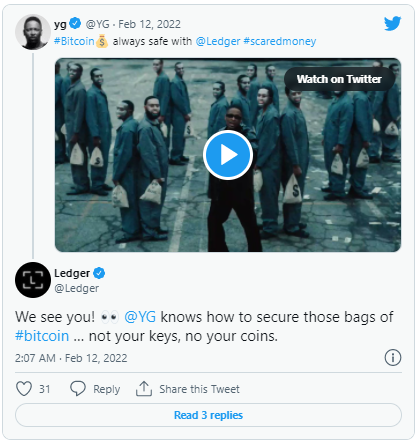
In one of the scenes of the music video for the song titled “Scared Money” featuring J. Cole and Moneybagg Yo, YG is seen holding a Ledger wallet close to a smartphone which has a screen bearing a wallet app with more than $30.6 million worth of BTC in it.
While the image could have easily been faked, rappers are well known for flaunting their wealth and success, especially so in this song which has a theme focused on spending money, investing and wearing half a million dollars worth of jewelry around one's neck.
YG is quite the BTC proponent, as he has mentioned owning digital gold in multiple other songs such as “Big Bank” from 2018, and also in an interview with RollingStone from mid-2021.
During that interview YG said that he liked the simplicity of hodling crypto as he could invest his money into the asset class without being distracted from his music career. He drew comparisons to the real estate market, where he would have to spend a lot time working and learn to do it successfully.
“I f*ck with Bitcoin. [...] I got Ethereum recently and I got Dogecoin recently but I’ve had Bitcoin for about three years. [...] Bitcoin came around and it was like ‘what?’ and I can just do it and it turns into that?” he said in reference to the booming price of the asset last year.
In a Reddit post on the r/Bitcoin Reddit community earlier today, users were questioning YG’s mammoth BTC stack, with AvoidMyRange stating that “the chance of all these ending at 0 and the cents ending in .00 is incredibly low. This is obviously fake.”
“It is fake because that isn’t even the layout of the ledger app,” user AKeveryday responded.
Other users saw the funny side of YG’s music-based BTC antics, with Redditor Lexstell11 doing the math on the lyrics from the Big Bank song when BTC was priced around the mid $7,000 range.
“In YG’s song Big Bank, he says ‘I might buy her red bottoms with the crypto- 3 coins that’ll pay your whole semester…’ the song was released on 5/25/2018 when BTC was $7,459 at close. So presumably YG paid $132,000 by today’s conversion for a girl's semester at what I’m assuming was University of Phoenix. I think about this a lot.”
Crypto has attracted a strong cohort of rappers over recent years, with icons such as Jay Z and NFT-bull Snoop Dogg both making heavy plays in the sector. Other well-known figures to jump on the gravy train include Meek Mill who snapped up Dogecoin amid the hype last year, Nas who tokenized his music as NFTs earlier this year, and Post Malone who featured a Bored Ape Yacht Club NFT in one of his recent music videos.


Lectures associées

De Web3 à l'Agent IA, le vieux VC crypto Variant mise 2 milliards sur une transformation

Variant, un vétéran du capital-risque crypto, annonce un nouveau fonds de 222 millions de dollars, le "Variant 4". Ce fonds marque une évolution de sa thèse d'investissement centrale : du concept de "propriété numérique" vers celui plus large de "souveraineté individuelle" (autonomie). Cette autonomie concerne le contrôle accru que les utilisateurs ont sur leur vie numérique, leurs actifs, leur identité et leur capacité d'action, au-delà de la simple automatisation. La distinction clé est que l'automatisation intelligente doit servir l'utilisateur final, et non la plateforme, pour véritablement accroître l'autonomie. Variant investira donc dans les technologies qui étendent cette souveraineté, en augmentant l'accès, les connaissances et la propriété des utilisateurs. Ce cadre englobe ses investissements passés dans les blockchains (Ethereum, Solana), l'infrastructure pour développeurs, les marchés financiers décentralisés et les produits grand public. Le fonds voit dans la convergence des agents d'IA intelligents et des rails financiers globaux ouverts un potentiel de transformation structurelle d'Internet, passant d'un modèle où "l'utilisateur est le produit" à un modèle où l'utilisateur dispose d'une autonomie inédite. Variant mettra son expertise, acquise dans l'écosystème crypto, au service des fondateurs qui construisent aux frontières de ces systèmes autonomes.

marsbitIl y a 1 h

De Web3 à l'Agent IA, le vieux VC crypto Variant mise 2 milliards sur une transformation

marsbitIl y a 1 h

Bloomberg révèle : Comment les riches Chinois contournent la limite annuelle de 50 000 dollars pour transférer leurs actifs ?

Bloomberg révèle que malgré le plafond annuel de 50 000 dollars par personne fixé par l'administration chinoise des changes, environ 150 milliards de dollars s'échappent chaque année via des canaux informels ou souterrains. L'article retrace l'évolution du contrôle des capitaux depuis 1994, avec un durcissement notable après la dévaluation de 2015 et une sophistication numérique accrue entre 2024 et 2026, incluant le CRS et un suivi renforcé des transactions. Cinq principales méthodes de transfert sont identifiées : le système de compensation "Duiqiao" (aucune sortie effective de RMB), le "déménagement de fourmis" utilisant les quotas légaux de multiples personnes, la falsification des factures commerciales, la migration vers des canaux de gestion de fortune des grandes banques (ex: QDII), et les arrangements structurels comme les fiducies ou l'immigration. La réponse réglementaire se concentre désormais sur les individus plutôt que sur les seules entreprises, avec le CRS comme outil de rétrospection clé pour identifier les actifs offshore. Même les cryptomonnaies, parfois perçues comme une échappatoire, font l'objet de poursuites pour infraction. La pression pour diversifier les actifs à l'étranger reste forte parmi les millions de ménages aisés chinois, malgré un "mur" réglementaire de plus en plus haut et intelligent.

marsbitIl y a 1 h

Bloomberg révèle : Comment les riches Chinois contournent la limite annuelle de 50 000 dollars pour transférer leurs actifs ?

marsbitIl y a 1 h

Trading

Spot
Futures
活动图片