Terence Tao's Remote Dialogue with Wang Hong: Mathematics Must Learn to 'Digest' AI

marsbitPublié le 2026-08-20Dernière mise à jour le 2026-08-20

Résumé

Two Fields Medalists, Terence Tao and Maryna Viazovska, share a common view on the flood of AI-generated proofs in mathematics: the community must learn to "digest" them. While AI can rapidly produce and even formally verify proofs, Tao argues that a correct proof is only the first step. For a result to become usable knowledge, it must be understood, absorbed, and integrated into the existing mathematical framework by human mathematicians. He illustrates this by spending several days "digesting" an AI-assisted proof of the long-standing Sendov conjecture. His process involved tracing sources, identifying key ideas, simplifying the argument, and rewriting it into a human-readable narrative. This digestion not only verified the proof but also revealed it could solve a stronger conjecture and be presented with more elementary tools. Tao criticizes the current race for priority based solely on who announces a proof first, often skipping verification and explanation. He proposes shifting value to the crucial work of interpreting, reviewing, and consolidating results. In his recent ICM talk, he emphasized that if authors cannot explain their AI-generated proof to peers, it shouldn't be published. To facilitate this new workflow, Tao introduced "Palomar," a registry for Lean-verified results. It serves as a digestion hub, cataloging problems, proof code, and AI involvement, aiming to coordinate efforts and ensure completeness. Under this model, full credit for a result would requ...

Too many AI-generated proofs isn't necessarily a good thing... the mathematics community can hardly keep up with reading them.

But there's good news—

In the face of this crisis, two generations of Fields Medalists, Terence Tao and Wang Hong, have offered nearly identical judgments:

Digest.
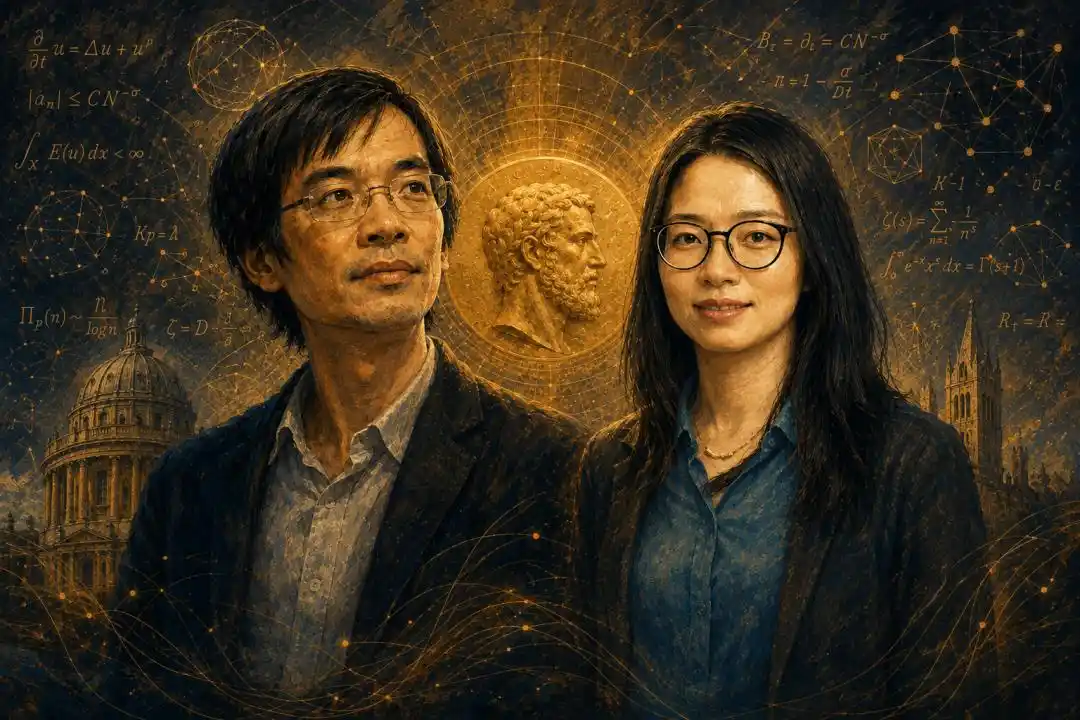
The School of Mathematical Sciences at Peking University recently released a lengthy 10,000-word interview with Wang Hong, where she offered quite pertinent advice:

The mathematics community cannot ignore the counterexamples or proofs generated by AI; we need to learn to use them, but also understand and digest them.

Terence Tao, on the other hand, spent several days thoroughly digesting a proof that involved AI from start to finish.

This proof solves the Sęndov conjecture, which had been pending for 67 years.
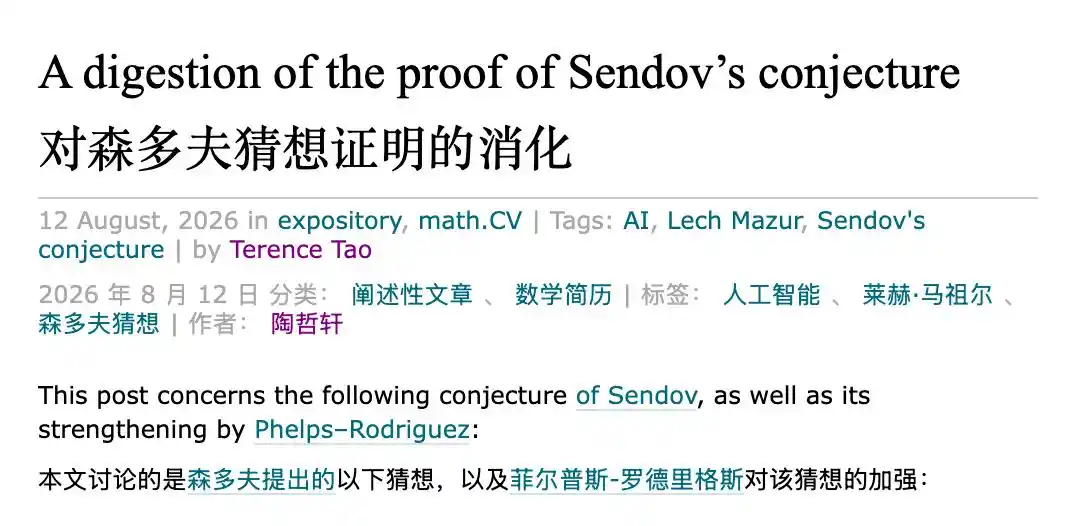
This sounds somewhat counterintuitive. If AI is here to help mathematicians solve problems and the answer is already out, why digest it again?

The answer from 'whistleblower' Terence Tao is:

A correct proof is only the first hurdle for a mathematical result; it must be understood and absorbed by professional mathematicians to be fully usable.
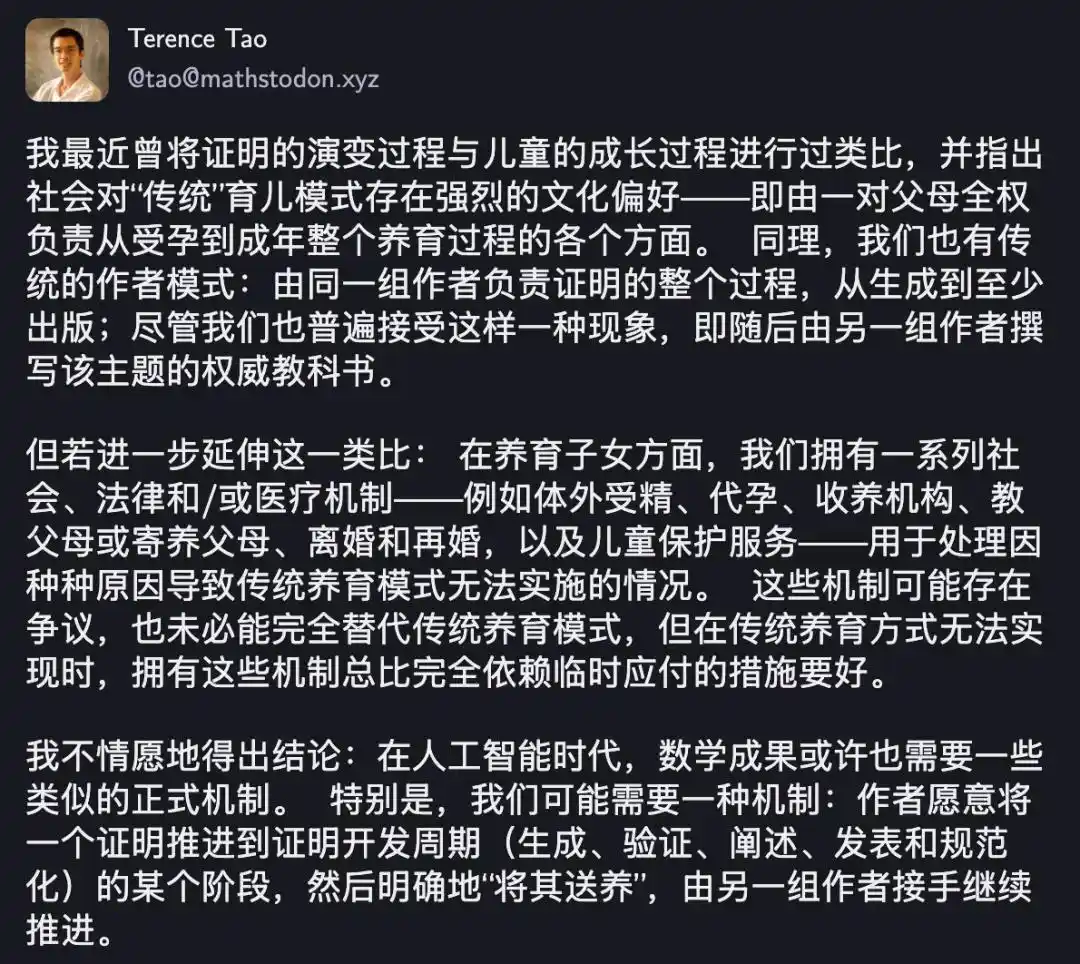
To use an analogy, traditional authors are like responsible parents, fully accompanying a proof from birth to publication. But moving forward, working with AI, this relationship may be more like 'adoption':

Someone uses AI to advance a proof to the generation or verification stage, then formally hands it off to another group for professional interpretation, organization, and publication.

Mathematicians still have much to do.

Digestion is the Next Step in Solving Mathematics' Century-Old Crisis

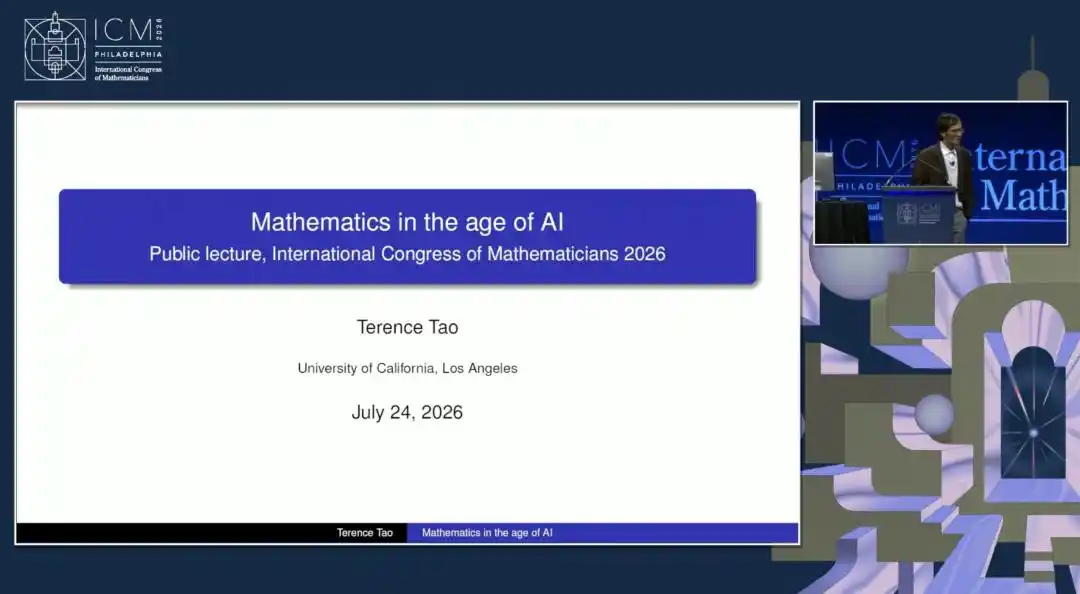
To put it bluntly, this is also Terence Tao's response to the question he left in his ICM lecture a month ago:

If answers can be mass-produced by AI, what is mathematical research really pursuing?

OpenAI's new model Astra solved 10 challenging problems in mathematics and theoretical computer science in a row, spanning high-dimensional geometry, coding theory, group theory, and more.

A neurosurgeon without formal higher mathematics training had ChatGPT 5.6 autonomously run for about 16 hours, producing a key proof for Crouzeix's conjecture in numerical linear algebra.

......
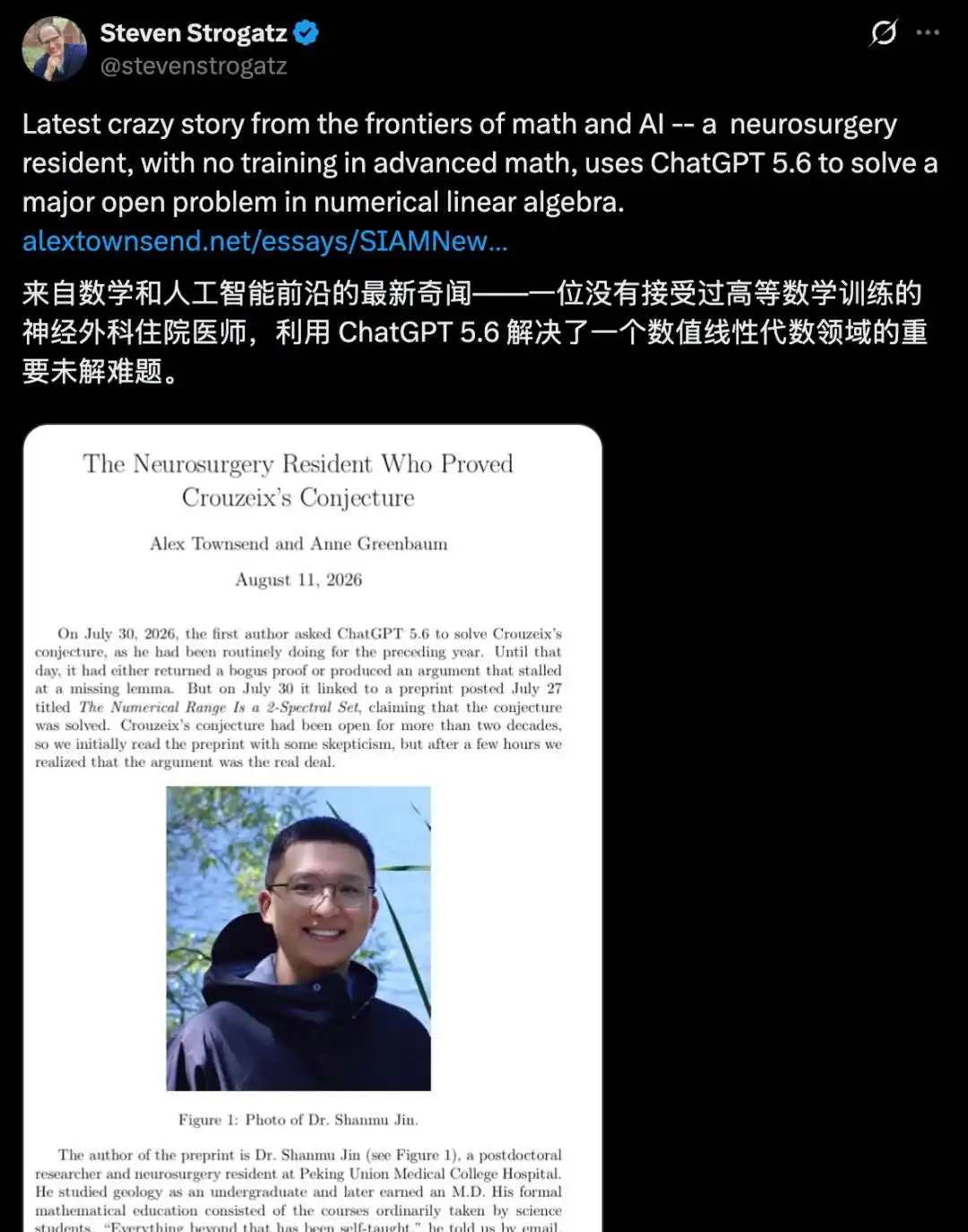
The high wall of mathematics seems to have had a back door chiseled open by AI.

Even laypeople can use it to break through cutting-edge problems. Is mathematics about to get its "next civil engineering" script? (doge)

Not at all! In fact, a complete mathematical achievement is never just about 'obtaining a proof'.

Terence Tao breaks it down into five stages:

First, generate the argument; then verify its correctness; next, explain the idea to peers, letting it undergo publication and community verification; finally, reorganize the results, find their relationship to old theories, and solidify them into standard knowledge for future use.

AI currently excels at accelerating the first two steps. The further along you go, the more you need mathematicians to judge what's truly core and what the results mean.
And the Sęndov conjecture Tao just processed is almost a 1:1 live demonstration of this workflow.

The conjecture studies the distance between polynomial zeros and critical points. Lower-degree cases and sufficiently high-degree cases had already been solved, but the middle range remained vacant for a long time.

A few days ago, math enthusiast Lech Mazur used AI to fill this gap, providing a formalized proof verified by Lean.

It seemed the story should end there. But Terence Tao noted that this original proof hadn't been organized into mathematical text suitable for human reading and publication, meaning the mathematical result was not yet usable.

So he spent several days, with the assistance of both ChatGPT and pen-and-paper derivation, conducting a complete digestion of the result:

Tracing literature sources → Extracting the identities that truly mattered → Removing detours → Rewriting the machine-discovered argument into a version showing a clear main line.
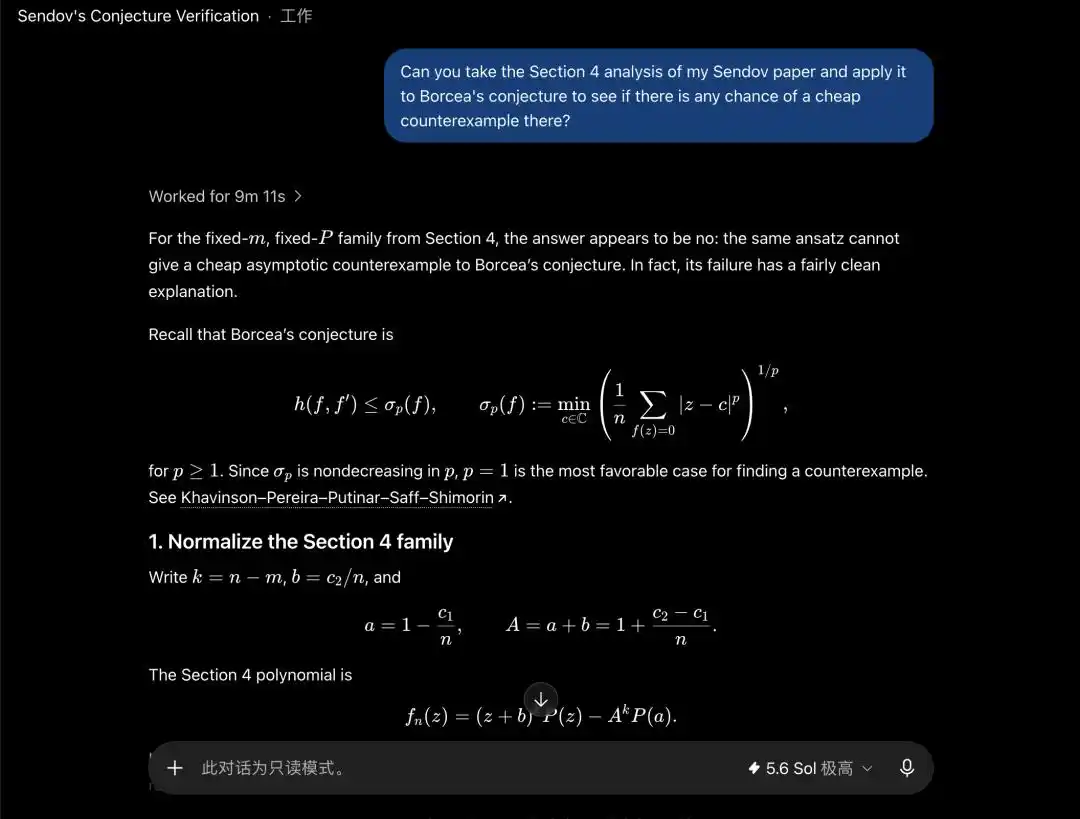
Reading it this way, he actually uncovered something new.

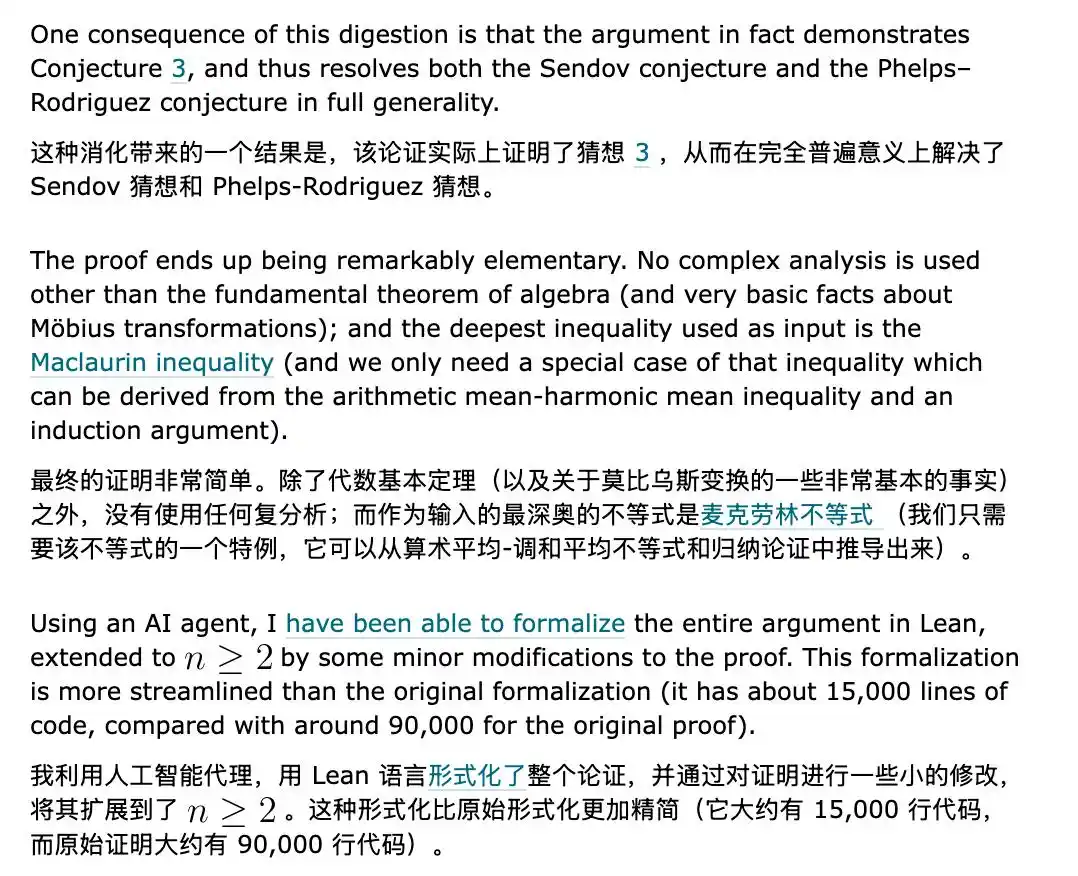
The reorganized argument not only solves the Sęndov conjecture but can also cover the stronger Phelps–Rodriguez conjecture. The core tools required are also much more elementary than what the original formalization presented, compressing the Lean code from about 90,000 lines to 15,000 lines.

In other words, digestion is not just a re-verification of an AI proof, but also an effective way to broaden mathematical achievements.
More importantly, Tao wants to use digestion to overturn the old rule in mathematics of "whoever announces first gets priority."

The attribution of mathematical results was first based on journal publication date, then changed to arXiv timestamp.

Now AI proofs come too fast, and even arXiv is considered too slow by some. Some results are thrown onto social platforms immediately after generation. In the race to be first, verification and interpretation are all skipped, ultimately creating an artificial burden for the mathematics community.

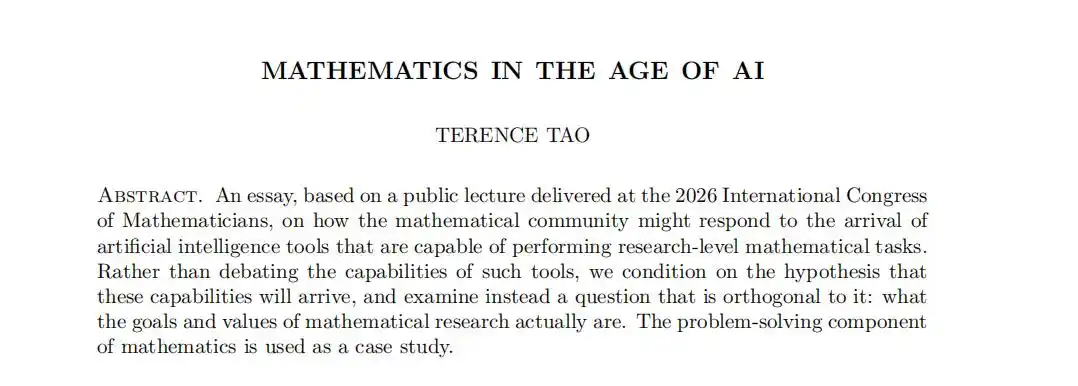
Therefore, in his ICM speech, Tao argued that the mathematics community should stop blindly celebrating "the first person to give a proof" and elevate the status of "digesting and organizing proofs."

Work like explaining proofs, peer review, and organizing results into classical theory should also be valued; not only producing new theorems counts as merit.

If the paper's authors themselves cannot give a competent lecture at a professional level to explain the results clearly, no matter how correct the AI verification is, this achievement should not be published.

If even humans can't understand the proof, how can it be considered a complete result?

So Tao calls on the academic community to calmly sit down, engage in a profound discussion about AI's capability limits and the values of mathematics, while emphasizing those parts of mathematical work that cannot be replaced by machines.
One More Thing

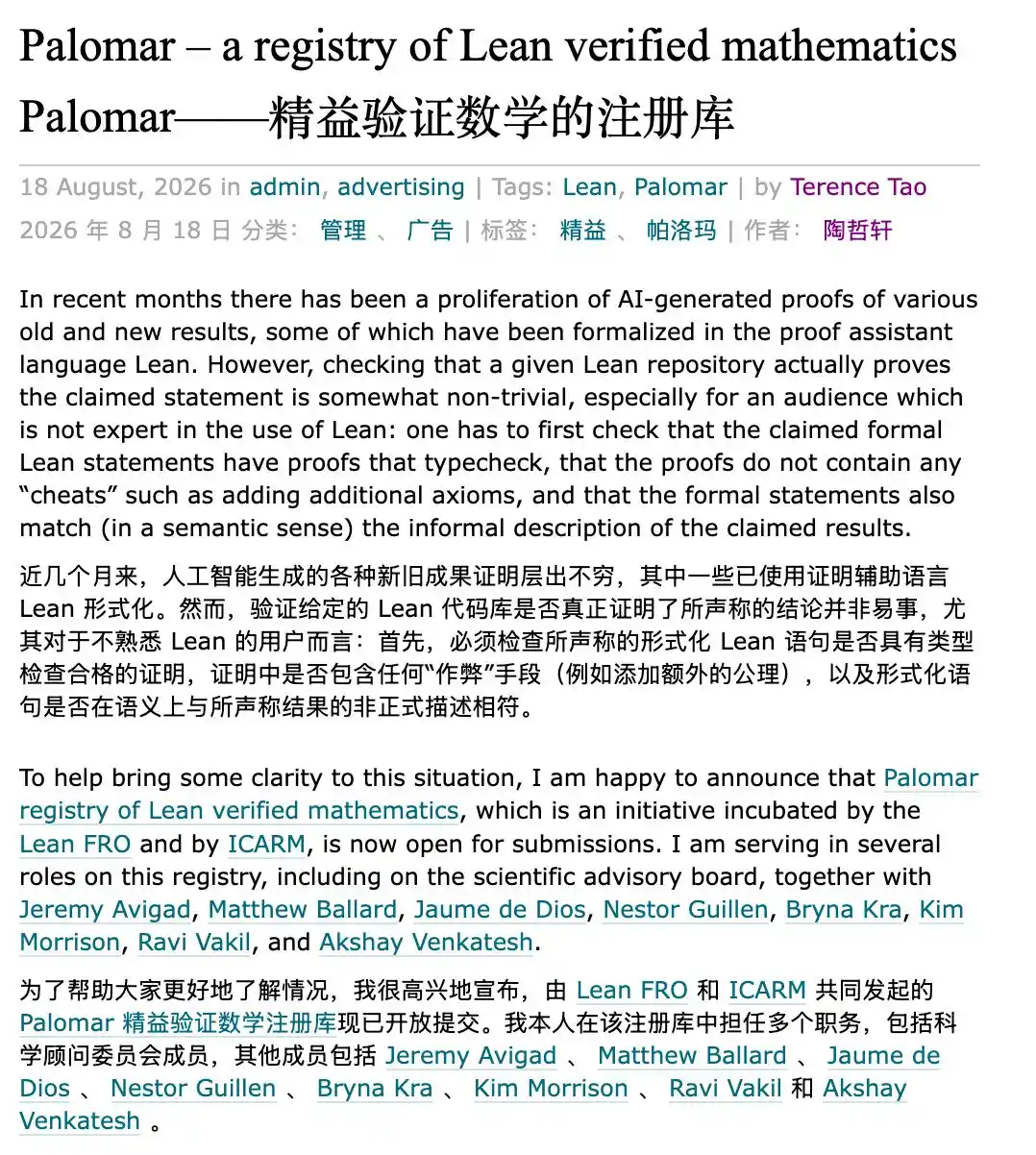
Meanwhile, Terence Tao has also publicly released a real registry for Lean verification results — Palomar.

Palomar clearly registers the problem statement, proof code, AI involvement method, and version information. After independent kernel re-evaluation, it gathers AI proofs scattered across GitHub, social media, and news in one place.

It will serve as a digestion relay station between verification and publication, letting future researchers know where AI and peers have reached and what work remains to be done.
Teams interested in the same problem can collaborate via Palomar.

Notably, Palomar does not judge the importance of a particular result, nor does it replace peer review.

The attribution of specific results will be determined in the future by the chronological order of four key stages:

Generative achievement documenting how the proof was produced, e.g., AI chat logs;

Verification achievement confirming logical correctness, e.g., Lean code;

Interpretation achievement clearly explaining the idea, e.g., public lecture;

Publication achievement formally presenting the result, e.g., paper.

In other words, priority is granted to whoever first submits a complete set of all achievements.

Currently, Terence Tao's digested version of the Sęndov conjecture has become one of the first entries in Palomar's archives.

References:

[1]https://arxiv.org/abs/2608.16753

[2]https://mathstodon.xyz/@tao/117123957813926355

[3]https://www.youtube.com/watch?v=M0--ZH1lOzg

[4]https://mp.weixin.qq.com/s/w-UfVMmwTZqXjNsC81CzYw

This article is from the WeChat public account "QbitAI", author: Focus on Frontier Technology

Questions liées

QAccording to the article, what is the main challenge faced by the mathematics community regarding AI-generated proofs?

AThe mathematics community is struggling to keep up with the sheer volume of AI-generated proofs and counterexamples, creating a need to 'digest' this information effectively.

QHow did Terence Tao and June Huh suggest the mathematics community should approach AI-generated mathematical content?

ABoth Terence Tao and June Huh emphasized the need for the mathematics community to 'digest' AI outputs—meaning they must learn to use, understand, and integrate these AI-generated proofs or counterexamples into the field's knowledge base.

QWhat are the five stages of a complete mathematical result as outlined by Terence Tao in the article?

ATerence Tao outlined five stages: 1) Generating the argument, 2) Verifying its correctness, 3) Explaining the idea to colleagues, 4) Getting it published and passing community scrutiny, and 5) Reorganizing the result, relating it to existing theory, and solidifying it as standard, reusable knowledge.

QWhat is 'Palomar' and what is its intended purpose, as mentioned in the article?

A'Palomar' is a registry, proposed by Terence Tao, for formalized (e.g., Lean-verified) mathematical results. It serves as a 'digestion relay station' between verification and publication, providing a centralized record of AI-assisted proofs, their source code, and verification details to prevent duplication and facilitate collaboration.

QAccording to Tao's proposed new framework, what determines the attribution of priority for a mathematical result in the age of AI?

APriority would be determined by who first completes a full set of four milestones: the generative work (e.g., AI chat logs), the verification work (e.g., Lean code), the expository work (e.g., a clear public lecture), and the published work (e.g., a formal paper). The complete suite, not just the initial proof, grants priority.

Lectures associées

Une licorne de dix milliards de yuans de Shanghai est sur le point d'entrer en bourse

La licorne chinoise Calterah (加特兰微电子), spécialisée dans les puces radar millimétriques pour l'automobile, a déposé un dossier pour une introduction en Bourse sur le marché Star de Shanghai, visant à lever 34,89 milliards de yuans. Fondée en 2014 par Chen Jiashu, un docteur de Berkeley, et son professeur Ali Niknejad, l'entreprise a parié sur la technologie CMOS pour ses puces, une approche différente de la voie traditionnelle au germanium-silicium. Ce choix s'est avéré payant, permettant de réduire significativement les coûts et de démocratiser les radars dans les véhicules grand public. Calterah a réalisé plusieurs premières mondiales, comme la première puce entièrement intégrée 77GHz en 2015. En 2025, elle détenait 31,1% de part de marché en Chine et se classait quatrième mondiale, avec plus de 30 millions de puces expédiées. Ses clients incluent BYD, Geely, Nio et Volvo. La société a réalisé onze tours de table, attirant des investisseurs prestigieux comme le fonds public "Big Fund II", Huadeng International et GAC Capital. Son估值 (valorisation) dépasse désormais les 10 milliards de yuans. Malgré une croissance rapide des revenus (6,32 milliards de yuans en 2025), Calterah reste non rentable, accumulant des pertes nettes de plus de 9 milliards de yuans sur les trois dernières années, principalement en raison d'investissements R&D massifs (plus de 10,39 milliards de yuans cumulés). L'entreprise fait face à des défis, notamment une forte dépendance à son premier client, BYD (plus de 50% des ventes en 2025), et une concentration de sa chaîne d'approvisionnement. L'introduction en Bourse vise à lever des fonds pour atténuer ces risques en diversifiant sa production, sa clientèle et ses fournisseurs.

marsbitIl y a 15 mins

Une licorne de dix milliards de yuans de Shanghai est sur le point d'entrer en bourse

marsbitIl y a 15 mins

La secrétaire au Trésor américain tente de contenir les rendements des bons du Trésor et alimente les « transactions de dépréciation monétaire » ! L'or atteint un plus haut de trois mois, le Bitcoin bondit de plus de 25 % en une semaine

La déclaration de la secrétaire américaine au Trésor, Janet Yellen, visant à contenir les rendements des obligations d'État à long terme n'a eu qu'un effet éphémère sur le marché obligataire. Cependant, elle a accentué un mouvement de marché baptisé « trade de la dépréciation monétaire », alimenté par des craintes concernant le déficit budgétaire américain et l'orientation de la politique économique. Ce scénario s'est traduit par un affaiblissement du dollar, tandis que l'or a atteint un sommet de trois mois et le bitcoin a bondi de plus de 25% en une semaine, leur corrélation étant à son niveau le plus élevé depuis la pandémie, renforçant le récit des cryptomonnaies comme couverture. Les analystes soulignent les limites de l'action du Trésor face aux pressions structurelles sur les taux : un déficit public élevé, une inflation persistante et une concurrence mondiale intense pour les capitaux, notamment en raison des emprunts publics massifs et des besoins de financement colossal du secteur de l'intelligence artificielle. Malgré la résilience des marchés actions, portés par des anticipations de bénéfices solides, le rendement des obligations américaines approchant les 5% constitue une pression concurrentielle croissante. Ray Dalio a conseillé de réduire l'exposition aux obligations et de détenir de l'or et du bitcoin pour se prémunir contre un risque de crise de la dette américaine. Si la logique du « trade de la dépréciation » reste séduisante, certains doutent de sa pérennité en l'absence de nouveau catalyseur immédiat, notant la modeste ampleur des rachats annoncés par rapport au marché obligataire global. La tension entre le souhait du Trésor de maîtriser les coûts d'emprunt et l'objectif de la Fed de réduire son intervention sur les marchés reste un point d'attention majeur pour les investisseurs.

华尔街日报Il y a 3 h

La secrétaire au Trésor américain tente de contenir les rendements des bons du Trésor et alimente les « transactions de dépréciation monétaire » ! L'or atteint un plus haut de trois mois, le Bitcoin bondit de plus de 25 % en une semaine

华尔街日报Il y a 3 h

Aleksandr Chokhine : le monde des affaires a besoin d'un taux directeur inférieur à 10 % et d'un dollar entre 90 et 95 roubles

Alexandre Chokhine, président du syndicat russe des industriels et des entrepreneurs (RSPP), évoque l'utilisation possible d'outils « non marchands » pour maintenir le rouble dans un corridor de change prédéfini. Selon lui, cette approche réduirait la volatilité excessive de la monnaie nationale et apporterait la stabilité nécessaire aux entreprises. L'idée d'un corridor de change pour le rouble n'est pas nouvelle. Chokhine l'a déjà mentionnée, soulignant que le taux de change actuel n'est pas entièrement déterminé par le marché en raison du volume limité des transactions et d'une faible demande en devises étrangères. De nombreux acteurs économiques préconisent de fixer un corridor, même par des moyens non conventionnels, pour garantir la prévisibilité. L'objectif du monde des affaires pour fin 2026 est une combinaison de taux directeur de la Banque centrale à 12%, une inflation entre 4 et 5%, et un taux de change du dollar autour de 90-95 roubles. Chokhine précise qu'une baisse du taux directeur en dessous de 10% serait idéale pour les entreprises, et souligne l'importance cruciale d'une monnaie stable pour les décisions d'investissement. Enfin, une analyse rappelle que la Russie a déjà expérimenté un corridor de change entre 1995 et 1998, un système qui a finalement cédé lors du défaut d'août 1998, illustrant la vulnérabilité de tels mécanismes en période de chocs externes. La question centrale reste la capacité à défendre un tel corridor, ce qui nécessiterait des réserves substantielles, surtout dans un marché des changes aux liquidités limitées. L'évolution de ce débat vers des propositions concrètes sera à observer dans les prochains mois.

cryptonews.ruIl y a 5 h

Aleksandr Chokhine : le monde des affaires a besoin d'un taux directeur inférieur à 10 % et d'un dollar entre 90 et 95 roubles

cryptonews.ruIl y a 5 h

Trading

Spot
活动图片