Elon Musk: In 5 Years, People on the Internet Will Become a Statistical Error — Only Bots Will Remain

cryptonews.ruPublié le 2026-08-11Dernière mise à jour le 2026-08-11

Résumé

Elon Musk commented on social media X, agreeing with a Cloudflare forecast that AI agent traffic will "significantly exceed" human traffic. Cloudflare predicts that within five years, bot traffic could be 1,000 times greater than human traffic. The company's CEO, Matthew Prince, noted that bot traffic first surpassed human traffic in May 2026, earlier than their original forecast of late 2027. Cloudflare's CFO, Thomas Seifert, stated that at current growth rates, humans risk becoming a "statistical margin of error" online, not due to declining human activity, but due to the explosive growth of AI agent activity. The company tracks this ratio via its Cloudflare Radar dashboard, which measures bot versus human traffic based on HTTP requests for HTML content. However, methodologies for measuring bot traffic vary. Another report from Thales/Imperva recorded automated traffic at 53% of global internet traffic in 2025, differing from Cloudflare's figures due to different sampling and criteria. This lack of a unified measurement standard poses a challenge for regulators and infrastructure developers seeking a clear picture of online activity.

Elon Musk wrote on social network X that the traffic of AI agents will "definitely significantly exceed" human traffic, citing a forecast by Cloudflare. The entrepreneur's comment referred to the company's assessment that in five years, bot traffic will exceed human traffic by 1,000 times.

The traffic of AI agents will clearly and significantly exceed human traffic, there is no question about it. The Cloudflare forecast is accurate.

Cloudflare has been developing the idea that automated systems are surpassing humans in terms of internet activity volume for several months. Back on June 3, 2026, the company's CEO, Matthew Prince, announced that bot traffic had for the first time in internet history surpassed human traffic. According to him, the company expected this event closer to the end of 2027, then shifted the forecast to early 2027, but AI agent traffic grew so rapidly that the tipping point was recorded in May 2026.

Humans as a 'Statistical Error'

At the conference on the results of the second quarter of 2026, held on August 6, Cloudflare's CFO, Thomas Seifert, stated that if the current trend continues, in five years, bot traffic will exceed human traffic by 1,000 times. Seifert clarified that the company's previous forecasts on this topic had been incorrect — but not in the usual direction: reality consistently outpaced expectations. In his words, humans risk becoming a "statistical error" on the internet — not due to a decrease in human activity, but due to the rate of growth in agent activity.
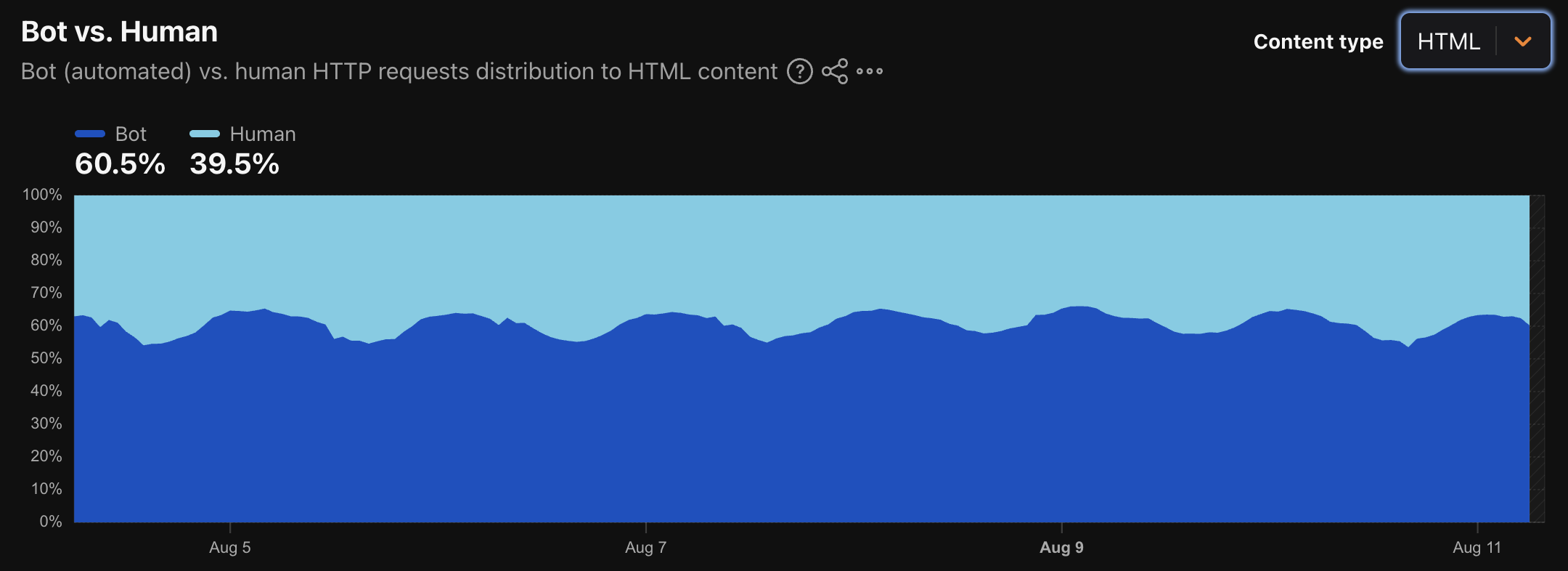
Ratio of bot traffic to human traffic based on HTTP requests for HTML content. Source: Cloudflare

The data referenced by Prince and Seifert is updated daily on the Cloudflare Radar dashboard, which tracks the ratio of bot traffic to human traffic. It was this section that Prince linked to in his June post, and a month later, Musk drew attention to it while commenting on Cloudflare's conclusions.

AI's Opinion

From a methodological standpoint, comparing different sources of telemetry opens an interesting perspective. Cloudflare Radar measures the share of bots based on HTTP requests for HTML content on the company's servers, whereas Thales/Imperva recorded a different figure in its annual report: in 2025, the share of automated traffic across the entire global network reached 53%, compared to 51% the previous year. The discrepancy in numbers between providers is explained by different domain samples and different criteria for classifying a request as a "bot" — a unified measurement standard does not yet exist.

A historical parallel can be drawn with early disputes about internet provider coverage in the 1990s, when each company used its own methodology for counting users. The technical risk that remains off-screen: the more vendor metrics diverge, the harder it becomes for regulators and infrastructure developers to rely on a unified picture of what's happening. Will the market be left without a common standard for accounting for agent traffic?

end-content

Cryptos en tendance

Questions liées

QWhat did Elon Musk claim about the future of internet traffic, according to the article?

AElon Musk claimed that the traffic of AI agents will "clearly and significantly exceed" human traffic. He agreed with a Cloudflare forecast stating that within five years, bot traffic would exceed human traffic by 1,000 times, making people a "statistical error."

QWhat key milestone regarding bot traffic did Cloudflare report occurring in mid-2026?

AIn mid-2026, specifically in May 2026, Cloudflare reported that bot traffic surpassed human internet traffic for the first time in history. This event occurred earlier than the company's previous forecasts, which had predicted it for late 2027 or early 2027.

QWhat was the financial director of Cloudflare's prediction about the future ratio of bot-to-human traffic?

AThomas Seifert, the CFO of Cloudflare, predicted that if current trends continue, bot traffic would exceed human traffic by 1,000 times within five years. He clarified that past forecasts on this topic were not incorrect but were too conservative, as reality consistently outpaced expectations.

QWhy do different cybersecurity companies report different figures for bot traffic, as mentioned in the article?

ADifferent companies report different figures due to differing methodologies. For example, Cloudflare Radar measures bot share based on HTTP requests to HTML content on its servers, while others like Thales/Imperva use different samples of domains and criteria for classifying a request as a "bot." There is currently no unified standard for measurement.

QWhat potential problem does the article suggest could arise from the lack of a unified standard for measuring agent traffic?

AThe article suggests that the greater the divergence in metrics between different vendors, the harder it becomes for regulators and infrastructure developers to rely on a single, coherent picture of what is happening on the internet. This creates a technical risk and raises the question of whether the market will remain without a common standard for accounting for agent traffic.

Lectures associées

Grayscale : « Si les propositions sont adoptées, les prix de ces deux altcoins pourraient augmenter »

Zach Pandl, responsable de la recherche chez Grayscale, estime que des modifications envisagées de la tokenomique d'Ethereum (ETH) et de Solana (SOL) pourraient ralentir considérablement la croissance de leur offre, exerçant ainsi une pression haussière sur leurs prix. Ces propositions visent à réduire le taux d'inflation annuel des jetons ETH et SOL. Un ralentissement de la création de nouveaux jetons augmenterait la rareté des actifs existants. Grayscale prévoit que, si elles sont adoptées, l'inflation annuelle de l'offre d'Ethereum pourrait tomber à environ 0,4% d'ici fin 2031, se rapprochant ainsi du Bitcoin, tandis que celle de Solana pourrait atteindre environ 1,1%. En comparaison, l'offre d'or croît d'environ 1,8% par an et l'inflation (IPC) aux États-Unis est d'environ 3,3%. Pandl note que les propositions pour Solana semblent rencontrer un soutien plus large et ont donc une probabilité de mise en œuvre plus élevée. Cependant, il souligne un compromis potentiel : une inflation réduite pourrait diminuer les récompenses pour les investisseurs pratiquant le staking, une partie importante de leurs revenus provenant de l'émission de nouveaux jetons. En conclusion, un ralentissement de l'offre pourrait profiter aux prix des deux actifs, les détenteurs de jetons sans staking étant particulièrement bien placés pour en bénéficier. Ces changements restent à l'étude et ne sont pas encore approuvés.

cryptonews.ruIl y a 3 h

Grayscale : « Si les propositions sont adoptées, les prix de ces deux altcoins pourraient augmenter »

cryptonews.ruIl y a 3 h

Les experts ont nommé les raisons de la chute du bitcoin après la baisse de l'inflation aux États-Unis

Les données favorables sur l’inflation aux États‑Unis n’ont pas réussi à soutenir le bitcoin. Selon les analystes de CryptoQuant, la principale raison est la faible demande sur le marché au comptant. Le bitcoin n’a pas réagi aux chiffres de l’inflation de juillet, publiés le 12 août, et a même légèrement baissé, passant d’environ 64 500 $ à près de 63 000 $. Pourtant, l’indice des prix à la production (PPI) était meilleur que prévu. Alors que les rendements des obligations du Trésor américain ont reculé et que les marchés actions ont progressé, le bitcoin est resté dans une fourchette de 63 000 à 64 000 $. Cette absence de réaction s’explique notamment par la faible demande au comptant : les entrées de capitaux dans les ETF américains spot de bitcoin restent limitées, et l’indice Coinbase Premium (reflétant l’écart de prix entre Coinbase et les autres grandes plateformes) est négatif depuis mai, indiquant une pression d’achat modérée de la part des investisseurs américains. Dans le même temps, le positionnement des traders sur le marché à terme reste élevé, créant un déséquilibre entre une faible liquidité, une demande spot atone et un volume important de positions à effet de levier. Les analystes estiment que dans ces conditions, même des nouvelles macroéconomiques positives pourraient ne pas déclencher de hausse. Si le prix n’évolue pas malgré un contexte favorable, les traders pourraient commencer à clôturer leurs positions longues à effet de levier, ce qui exercerait une pression supplémentaire à la baisse. Un niveau de résistance clé se situe autour de 68 700 $, coût moyen approximatif pour les détenteurs à court terme, au‑delà duquel une prise de bénéfices est possible. Pour CryptoQuant, une reprise soutenue nécessiterait : une reprise des entrées dans les ETF américains, un retour de l’indice Coinbase Premium en territoire positif, une hausse des volumes de trading au comptant et un franchissement stable des 68 700 $.

cryptonews.ruIl y a 4 h

Les experts ont nommé les raisons de la chute du bitcoin après la baisse de l'inflation aux États-Unis

cryptonews.ruIl y a 4 h

Trading

Spot

Articles tendance

Comment acheter ELON

Bienvenue sur HTX.com ! Nous vous permettons d'acheter Dogelon Mars (ELON) de manière simple et pratique. Suivez notre guide étape par étape pour commencer votre parcours crypto.Étape 1 : Création de votre compte HTXUtilisez votre adresse e-mail ou votre numéro de téléphone pour ouvrir un compte sur HTX gratuitement. L'inscription se fait en toute simplicité et débloque toutes les fonctionnalités.Créer mon compteÉtape 2 : Choix du mode de paiement (rubrique Acheter des cryptosCarte de crédit/débit : utilisez votre carte Visa ou Mastercard pour acheter instantanément Dogelon Mars (ELON).Solde :utilisez les fonds du solde de votre compte HTX pour trader en toute simplicité.Prestataire tiers :pour accroître la commodité d'utilisation, nous avons ajouté des modes de paiement populaires tels que Google Pay et Apple Pay.P2P :tradez directement avec d'autres utilisateurs sur HTX.OTC (de gré à gré) : nous offrons des services personnalisés et des taux de change compétitifs aux traders.Étape 3 : stockage de vos Dogelon Mars (ELON)Après avoir acheté vos Dogelon Mars (ELON), stockez-les sur votre compte HTX. Vous pouvez également les envoyer ailleurs via un transfert sur la blockchain ou les utiliser pour trader d'autres cryptos.Étape 4 : tradez des Dogelon Mars (ELON)Tradez facilement Dogelon Mars (ELON) sur le marché Spot de HTX. Il vous suffit d'accéder à votre compte, de sélectionner la paire de trading, d'exécuter vos trades et de les suivre en temps réel. Nous offrons une expérience conviviale aux débutants comme aux traders chevronnés.

354 vues totalesPublié le 2024.12.12Mis à jour le 2025.03.21

Comment acheter ELON

Discussions

Bienvenue dans la Communauté HTX. Ici, vous pouvez vous tenir informé(e) des derniers développements de la plateforme et accéder à des analyses de marché professionnelles. Les opinions des utilisateurs sur le prix de ELON (ELON) sont présentées ci-dessous.

活动图片