Citi Research Report Analysis: U.S. Proposed Ban on Chinese Optical Modules Has No Substantial Progress, Short-term Enforcement Faces Supply Constraints

marsbitPublié le 2026-08-11Dernière mise à jour le 2026-08-11

Résumé

Citi Report Analysis: U.S. Proposed Ban on Chinese Optical Modules Lacks Substantive Progress, Faces Supply Bottlenecks in Short Term. Reuters reported on August 4th that the U.S. government and FCC are considering a ban on Chinese optical modules. Citi's August 9th report clarifies that optical modules are not listed on any effective FCC ban. The FCC's Order 26-50 established two restricted list mechanisms (based on manufacturer and production location), but optical modules were only mentioned once, as an example in a disclosure requirement, not as a restricted product. The reported ban remains at a proposal stage. Citi estimates Chinese suppliers provide 60-70% of high-speed optical modules for U.S. hyperscalers. Non-Chinese suppliers cannot fill this gap in the short term, making the immediate implementation of a genuine ban unlikely. Future regulatory paths could be manufacturer-based (least likely), location-based covering all offshore production (strictest), or location-based covering only China (more feasible but with unresolved definitions). A ban would pressure U.S. AI infrastructure, conflicting with stated policy goals. Citi sees low near-term implementation probability, with the issue potentially becoming a negotiation chip in bilateral talks. U.S. domestic capacity build-out is a key long-term variable. Among Chinese companies, XSENS and Dongshan Precision have the highest U.S. exposure, while Tianfu Communication, as a passive component supplier, is relatively i...

Written by: Rita

Reuters reported on August 4th that the Trump administration and the FCC are considering banning Chinese optical modules from entering the U.S. market. In a research report dated August 9th, Citi reviewed the regulatory framework already enacted by the FCC and found that optical modules do not appear on any effective ban list. FCC Order 26-50 established two restricted list mechanisms: one based on manufacturers and one based on country of origin. However, optical modules were only mentioned once in the order, as an example in the context of hardware/material list disclosure requirements, not as a restricted product. The reported ban remains at the proposal stage. Citi's assessment is that Chinese suppliers provide 60% to 70% of high-speed optical modules for U.S. hyperscale customers. Non-Chinese suppliers cannot fill this gap in the short term, making the immediate enforcement of a real ban unlikely.

Optical Modules Not Listed in Effective Bans; FCC Mechanism Has Three Potential Paths

The FCC's Order 26-50, passed on July 22nd, formally established two types of restricted lists. The first is manufacturer-based, directly naming entities like Huawei and ZTE, restricting their products regardless of where they are produced. The second is country-of-origin-based, restricting entire product categories produced outside the U.S., currently covering drones, routers, inverters, and advanced robotics equipment. Optical modules are not in either category.

The only place optical modules appear in FCC Order 26-50 is in an example sentence regarding hardware/software material list disclosure requirements: "Should we list several key components, such as modular transmitters, IoT modules, semiconductors, and optical modules?" This sentence appears in the disclosure section, not the ban section. The status of optical modules as components is similar to that of chips in routers or sensors in drones.

Citi outlines three potential regulatory paths forward. The manufacturer-based scenario is the least likely, as Chinese suppliers meet 60% to 70% of U.S. hyperscalers' high-speed optical module demand. Banning major manufacturers would directly impact U.S. AI infrastructure construction. The country-of-origin scenario covering all foreign production is the most stringent but would have similarly massive impact, likely forcing the U.S. to implement broad exemption mechanisms, which could benefit equipment and automation companies. The country-of-origin scenario restricting only Chinese production leaves room for overseas capacity deployment, but the definition of "origin" remains unresolved, with factors like design, firmware, and supply chain control playing a role. Citi believes origin-based restrictions are more likely to be implemented than manufacturer-based ones, but the probability of near-term implementation is low.

Chinese Optical Modules Are Supply Mainstay; Ban Difficult to Enforce in Short Term

Citi estimates that Chinese optical module suppliers collectively hold a 60% to 70% share of the high-speed optical module market for U.S. hyperscale customers. U.S. optical module companies are already building domestic production lines, but ramping up capacity takes time and cannot meet the demand from AI data centers in the short term. If a ban were actually enforced, U.S. AI infrastructure construction would come under direct pressure, contradicting the Trump administration's publicly stated goal of advancing AI leadership.

The FCC explicitly reserves the right to modify or suspend restrictions, with similar precedents existing. The U.S.-China diplomatic calendar in September and November 2026 provides natural inflection points. Optical module restrictions could be incorporated into negotiations on topics like rare earths, agricultural product purchases, or other bilateral priorities, serving as a bargaining chip rather than necessarily being implemented.

The speed of domestic production line construction by U.S. optical module companies will be a key variable. Companies providing automation equipment and production line integration may benefit from this process, but it requires a ramp-up cycle spanning several quarters. Citi judges the probability of a ban being implemented in the near term as low, though the long-term trend of substitution is already established.

Sunny Optical (XYS) and Dongshan Precision Most Exposed; TFC Optical Relatively Insulated

If an optical module ban is implemented, the degree of impact will vary significantly among companies. Sunny Optical (XYS) and Dongshan Precision have the largest exposure to U.S. optical module exports, facing higher risks under both the manufacturer-based and the all-foreign-origin scenarios, only moderating under the China-only origin scenario due to overseas capacity ramp-up. TFC Optical, as a supplier of passive components, is only indirectly affected and relatively insulated.

Dongshan Precision: Citi gives a target price of RMB 350 based on a sum-of-the-parts valuation, with a Buy rating. This values the optical module business at 20x expected 2027 EPS, the optical chip business at 50x, the AI PCB business at 25x, and the traditional business at 15x. Dongshan Precision's optical module and optical chip businesses have dual exposure, but if the regulatory path ultimately remains at the origin level, its overseas capacity layout may provide some buffer.

Sunny Optical (XYS): Citi gives a target price of RMB 701 with a Buy rating, based on 20x expected 2027 EPS, 0.5 standard deviations below its five-year historical average. This valuation already reflects the strong 800G/1.6T cycle and ASIC/Scale-Up opportunities but does not fully account for the potential replacement risk from CPO for NVIDIA customers.

TFC Optical: Citi gives a target price of RMB 419 with a Buy rating, based on 34.3x expected 2027 EPS, in line with its five-year average. As a supplier of passive components, TFC's products are not covered by the restricted lists regardless of how a ban is formulated, making it the lowest-risk stock among the three.

Citi's conclusion is clear: Chinese optical module manufacturers hold an irreplaceable position in the U.S. AI supply chain, and the U.S. lacks sufficient capacity to fill this gap in the short term. Ban discussions will continue but are unlikely to materialize quickly. What investors should truly monitor is the pace of U.S. domestic capacity build-out and the negotiation trajectory of the optical module issue within the U.S.-China diplomatic agenda. The logic of domestic substitution for optical modules remains unchanged, but the time window is longer than the market expects.

Disclaimer

This article is a compilation and interpretation by Trend Research of a third-party brokerage research report (Citi Research, August 9, 2026), combined with publicly available market information. The ratings, target prices, earnings forecasts, and related judgments cited herein are the views of the analyst(s) from that brokerage, representing only the stance of their institution, and do not represent the views of Trend Research, nor do they constitute any investment advice.

The market carries risks, and decisions should be made independently. This article should not be used as a basis for trading any securities.


Cryptos en tendance

Questions liées

QAccording to Citigroup's report, what is the key reason why a potential US ban on Chinese optical modules is unlikely to be implemented in the near term?

ACitigroup's report highlights that Chinese suppliers account for 60% to 70% of the high-speed optical modules for US hyperscalers. Non-Chinese suppliers lack the capacity to fill this gap in the short term, and a ban would directly pressure US AI infrastructure construction, conflicting with the stated goal of AI leadership. Therefore, near-term implementation is considered low.

QIn the FCC's regulatory framework (Order 26-50), how are optical modules currently categorized, and what are the two types of restricted lists established?

AOptical modules are not listed in any effective ban under FCC Order 26-50. They are only mentioned once in an example sentence regarding Hardware/Software Bill of Materials disclosure requirements, not as a restricted product. The order established two restricted list mechanisms: one based on producers (naming entities like Huawei, ZTE) and one based on country of origin (covering product categories like drones, routers).

QWhat are the three potential regulatory paths for optical modules outlined by Citigroup, and which does the report consider most and least likely?

ACitigroup outlines three paths: 1) A producer-based ban (least likely due to severe supply impact), 2) A broad country-of-origin ban covering all non-US production (most strict but would likely require widespread exemptions), and 3) A country-of-origin ban limited to China-produced goods (leaves room for overseas capacity). The report considers producer-based restrictions least likely and country-of-origin restrictions more plausible, though still with low near-term implementation probability.

QWhich two Chinese optical module companies are identified as having the greatest exposure to the US market, and which company is seen as relatively insulated?

AAccording to the report, XinYiSheng and Dongshan Precision have the greatest exposure to US optical module exports. Tianfu Communication, as a supplier of passive components, is relatively insulated as its products are not covered by the potential restricted lists.

QWhat does Citigroup identify as the key long-term trend and critical variable for investors to watch regarding the US-China optical module situation?

ACitigroup concludes that the long-term trend of substitution/supply chain decoupling is established. The key variable for investors is the pace of US domestic optical module production capacity build-out. Additionally, the negotiation trajectory of the optical module issue within the broader US-China diplomatic agenda (e.g., linked to talks on rare earths, agriculture) is important to monitor.

Lectures associées

Bitcoin à 1 million de dollars d’ici 2030 est « mathématiquement impossible », selon Markus Thielen

Selon Markus Thielen, responsable de la recherche chez 10x Research, la prédiction souvent citée selon laquelle le Bitcoin atteindra 1 million de dollars d'ici 2030 est "mathématiquement impossible". Il explique qu'historiquement, il a fallu environ 1 000 milliards de dollars d'afflux de capitaux pour porter la capitalisation boursière du Bitcoin à 1 000 milliards de dollars. Pour atteindre 1 million de dollars par Bitcoin (soit une multiplication par 15 par rapport à son cours actuel d'environ 64 000$), il faudrait attirer environ 15 000 milliards de dollars supplémentaires, ce qui équivaudrait à détourner 25% de la valeur totale du marché boursier américain vers le Bitcoin en seulement quatre ans. Thielen souligne que plus le prix du Bitcoin augmente, plus l'intérêt des petits investisseurs faiblit psychologiquement, car beaucoup préfèrent posséder une unité entière de l'actif plutôt qu'une fraction. Il met également en garde contre l'attente d'un rebond identique aux cycles précédents, notant qu'atteindre de nouveaux sommets (comme 126 000$) ou même 100 000$ serait déjà un énorme succès qui nécessiterait des capitaux massifs. Il critique les prédictions audacieuses de figures comme Brian Armstrong ou Cathie Wood, les qualifiant de moyens faciles d'obtenir l'attention des médias, mais potentiellement néfastes pour les investisseurs particuliers qui pourraient avoir des attentes irréalistes. Pour Thielen, un prix d'1 million de dollars ne serait envisageable qu'en cas d'événement catastrophique majeur pour le système financier traditionnel.

cointelegraphIl y a 4 mins

Bitcoin à 1 million de dollars d’ici 2030 est « mathématiquement impossible », selon Markus Thielen

cointelegraphIl y a 4 mins

Grayscale prédit une augmentation de la rareté de l'Ethereum et du Solana

Grayscale prévoit une augmentation de la rareté de l'Ethereum et du Solana en raison de modifications potentielles de leur tokenomie. Selon l'analyse de Zach Pandl de Grayscale, les deux blockchains envisagent des changements techniques qui pourraient réduire l'émission annuelle de leurs jetons natifs ($ETH et $SOL), les rendant ainsi plus déficitaires. Les projections indiquent que d'ici 2031, l'inflation annuelle de l'Ethereum pourrait atteindre environ 0,4%, et celle du Solana 1,1%, des niveaux inférieurs à l'approvisionnement en or (1,8%) ou à l'inflation américaine (3,3%). Ces changements, encore en discussion, bénéficieraient d'un soutien plus large dans la communauté Solana. Une réduction de l'émission affecterait directement les récompenses du staking, payées via les nouveaux jetons. Les détenteurs qui ne stakent pas pourraient bénéficier de la rareté accrue, tandis que pour les stakers, le résultat dépendrait de l'équilibre entre récompenses réduites et appréciation potentielle du prix. Pour Ethereum, la proposition EIP-8363 vise même à brûler une partie des récompenses de staking. Pandl conclut que ces évolutions pourraient créer une pression haussière sur les prix. Parallèlement, Solana développe son infrastructure (mise à jour Alpenglow) et voit le volume de ses actifs tokenisés fortement augmenter, passant de 2,69 à 5,7 milliards de dollars entre les premier et deuxième trimestres de 2026.

cryptonews.ruIl y a 47 mins

Grayscale prédit une augmentation de la rareté de l'Ethereum et du Solana

cryptonews.ruIl y a 47 mins

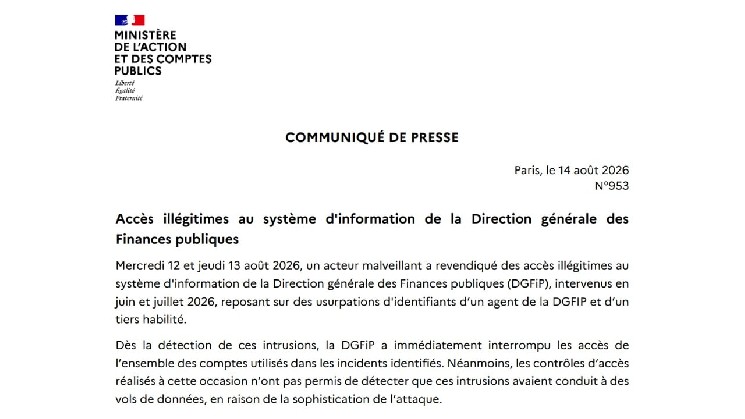
L'agence fiscale française reconnaît une fuite de données : un pirate s'empare de 678 000 enregistrements

L'agence fiscale française (DGFiP) a reconnu une fuite de données après qu'un pirate informatique se faisant appeler Zerobytes a volé 678 438 enregistrements concernant des contribuables. L'attaque, survenue le 12 juin, aurait été menée via un outil de recherche interne en utilisant un VPN. Bien que l'accès du pirate ait été coupé et qu'il n'ait pas pu récupérer l'intégralité des données, le fichier volé est proposé à la vente pour quelques milliers d'euros. La DGFiP a confirmé avoir immédiatement interrompu les comptes compromis, mais a reconnu que la sophistication de l'attaque avait empêché la détection initiale du vol. L'agence assure que les identifiants de connexion au site n'ont pas été compromis et annonce le déploiement de nouvelles mesures de sécurité. Les personnes affectées seront contactées individuellement la semaine prochaine pour être informées des données probablement consultées et des précautions à prendre. Cette fuite inquiète particulièrement les détenteurs de cryptomonnaies en France, qui redoutent une recrudescence d'attaques ciblées. Des appels, comme celui d'Alexandre Stachtchenko de Bitstack, demandent un moratoire sur la collecte de données par l'État jusqu'à ce que leur protection soit assurée, soulignant le droit fondamental à la vie privée. Ce incident survient dans un contexte où la France a déjà enregistré de nombreux cas d'enlèvements liés aux cryptomonnaies cette année.

cryptonews.ruIl y a 49 mins

L'agence fiscale française reconnaît une fuite de données : un pirate s'empare de 678 000 enregistrements

cryptonews.ruIl y a 49 mins

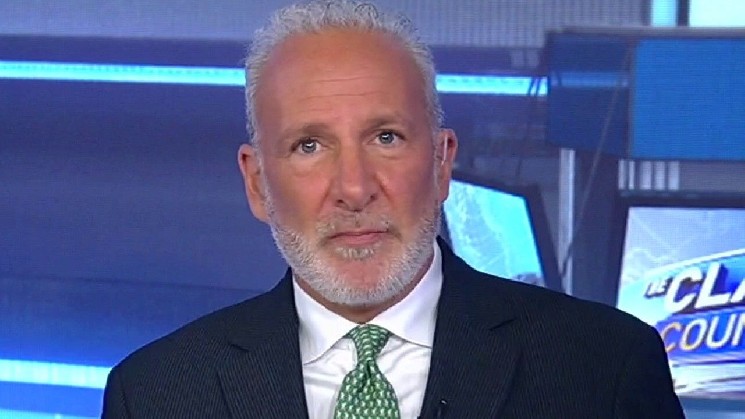
Peter Schiff estime que Michael Saylor pourrait vendre encore plus de bitcoins

Peter Schiff estime que Michael Saylor pourrait devoir vendre davantage de bitcoins et d'actions de sa société, MicroStrategy (MSTR), si celle-ci veut relever le cours de ses actions privilégiées (STRC) à l'objectif de 100$. Actuellement, les STRC se négocient sous les 95$, malgré les rachats d'actions financés par la vente d'actifs. Début août, MicroStrategy a vendu 1 637 bitcoins pour 102 millions de dollars et a utilisé ces fonds pour racheter environ 1,15 million d'actions STRC. La société a également cédé 6,59 millions d'actions MSTR pour 653,1 millions de dollars, portant ses réserves en dollars à environ 4,65 milliards. Schiff soutient que de nouvelles ventes de bitcoins et d'actions MSTR pour soutenir le cours des STRC exerceraient une pression supplémentaire sur le bitcoin, qui perdrait alors encore face à l'or. Selon lui, la récente faiblesse du bitcoin est liée à la hausse du prix de l'or, qui a dépassé les 4 300$, tandis que le bitcoin est tombé autour de 62 000$. L'économiste prévoit une nouvelle appréciation de l'or, ce qui pèserait davantage sur le bitcoin. Cependant, des données récentes du marché du travail américain, plus faibles, ont renforcé les anticipations d'un assouplissement de la politique de la Fed, ce qui pourrait offrir un soutien temporaire aux actifs risqués comme les cryptomonnaies.

cryptonews.ruIl y a 52 mins

Peter Schiff estime que Michael Saylor pourrait vendre encore plus de bitcoins

cryptonews.ruIl y a 52 mins

Trading

Spot

Articles tendance

Comment acheter BAN

Bienvenue sur HTX.com ! Nous vous permettons d'acheter Comedian (BAN) de manière simple et pratique. Suivez notre guide étape par étape pour commencer votre parcours crypto.Étape 1 : Création de votre compte HTXUtilisez votre adresse e-mail ou votre numéro de téléphone pour ouvrir un compte sur HTX gratuitement. L'inscription se fait en toute simplicité et débloque toutes les fonctionnalités.Créer mon compteÉtape 2 : Choix du mode de paiement (rubrique Acheter des cryptosCarte de crédit/débit : utilisez votre carte Visa ou Mastercard pour acheter instantanément Comedian (BAN).Solde :utilisez les fonds du solde de votre compte HTX pour trader en toute simplicité.Prestataire tiers :pour accroître la commodité d'utilisation, nous avons ajouté des modes de paiement populaires tels que Google Pay et Apple Pay.P2P :tradez directement avec d'autres utilisateurs sur HTX.OTC (de gré à gré) : nous offrons des services personnalisés et des taux de change compétitifs aux traders.Étape 3 : stockage de vos Comedian (BAN)Après avoir acheté vos Comedian (BAN), stockez-les sur votre compte HTX. Vous pouvez également les envoyer ailleurs via un transfert sur la blockchain ou les utiliser pour trader d'autres cryptos.Étape 4 : tradez des Comedian (BAN)Tradez facilement Comedian (BAN) sur le marché Spot de HTX. Il vous suffit d'accéder à votre compte, de sélectionner la paire de trading, d'exécuter vos trades et de les suivre en temps réel. Nous offrons une expérience conviviale aux débutants comme aux traders chevronnés.

1.1k vues totalesPublié le 2024.12.11Mis à jour le 2026.06.02

Comment acheter BAN

Discussions

Bienvenue dans la Communauté HTX. Ici, vous pouvez vous tenir informé(e) des derniers développements de la plateforme et accéder à des analyses de marché professionnelles. Les opinions des utilisateurs sur le prix de BAN (BAN) sont présentées ci-dessous.

活动图片