AI Reviews 100 Years of Papers, Finding Issues in 99.2% of Top Journal Articles

marsbitPublié le 2026-08-09Dernière mise à jour le 2026-08-09

Résumé

AI-powered scrutiny of top scientific journals reveals that 99.2% of papers contain at least one error, challenging the perception of robust peer review. A recent study using AI agents to audit papers from ICML 2026 found that 58 out of 92 reviewed papers could not be fully reproduced. Reasons for failed replication include missing code, broken dependencies, and results inconsistent with claims. Separately, a GPT-5-based checker analyzed established AI conference papers, detecting an average of 4.7 objective errors per paper, with mathematical mistakes being most common. This trend suggests a growing "reproducibility crisis" as paper volume and complexity outpace traditional verification. However, it also presents an opportunity: researchers can now use AI to efficiently audit past literature, identify errors in foundational work, and publish corrections—a potentially fruitful new research avenue. In one case, AI even corrected century-old chemical data that had been accepted as fact. While AI tools significantly lower the cost of verification, they are not infallible (e.g., 83.2% precision rate in one system) and human oversight remains crucial. The era of AI-assisted verification may redefine the scientific process, where publication marks not an end, but the beginning of automated validation.

Who still says there are no new problems left in scientific research? That all the good directions have been taken by predecessors???

What if I told you—

Most of the papers already published in top journals have issues?

Recently, researchers using AI Agents for "academic fact-checking" discovered:

Among 92 papers reported at the 2026 International Conference on Machine Learning (ICML), 58 could no longer be reproduced.

Really?? Could it be that the opportunity to publish heavily in top journals is actually here?

Top Conference Papers Are Being Collectively "Fact-Checked" by AI

Typically, a paper accepted into a top-tier conference means it has undergone peer review.

However, limited by time, peer reviewers hardly have time to download data from scratch, run models, or reproduce experiments to verify every experimental conclusion in the paper.

Meanwhile, with the explosive growth in AI research papers, models becoming increasingly complex, and experiments growing larger, the code, data, and parameter settings behind a single paper may involve hundreds of details.

The verifiability of papers has thus become increasingly important. A paper is published, but can its conclusions be re-run?

Currently, AI Agents have significantly reduced the cost of such verification and reproduction.

On July 22, a US research auditing company used AI Agents to conduct a systematic result reproducibility audit on all 168 orally presented papers at ICML 2026.

Among the 168 papers, 92 contained at least 5 verifiable conclusive statements.

The final result: only 34 papers had over 40% of their conclusions successfully reproduced by the AI Agent; only 8 papers had over 80% of their conclusions reproduced.

However, it must be clarified that "failure to reproduce" is vastly different from "research fraud."

Reasons for reproduction failure include, but are not limited to: code missing key files, broken dependency library versions, results not matching the paper, and 4 papers whose dependent models had been taken offline, meaning the experimental results could permanently no longer be reproduced by anyone.

Besides these, some errors were quite egregious

For example, one paper touted "training only 0.77% of the base model's parameters" as its core selling point, but its actually open-sourced checkpoint trained 6.31% of the parameters, a difference of approximately 8 times.

Another paper included a reliability table based on a certain evaluation model, but its open-source code did not contain that evaluation model at all, nor any script capable of generating the results in the table.

It's not an isolated case. In 2026, Hugging Face and AlphaXiv jointly launched the 「Agent Reproduction Challenge」 competition, inviting researchers to use AI Coding Agents to automatically reproduce papers accepted at ICML 2026, with similarly unoptimistic results.

A similar trend is even more striking in the detection of paper errors and omissions.

At the end of 2025, a study developed a GPT-5-based paper inspection system to analyze papers already published in top AI conferences and journals, searching for objectively verifiable problems. The researchers explicitly stated:

We only look for "objective errors"; we do not judge a paper's novelty or research value.

The final results showed an average of 4.7 objective errors detected per paper, with 99.2% of papers flagged for at least one problem.

Image generated by AI

Regarding error types, mathematics and formula errors accounted for the highest proportion at 54.0% (including incorrect equations, logical flaws in derivations, incorrect assumptions in proofs, etc.).

Approximately 30.8% of NeurIPS papers and 23.8% of ICLR papers contained at least one substantive error that could affect result interpretation.

More notably, the time trend: the average number of errors per NeurIPS paper increased from 3.8 in 2021 to 5.9 in 2025, a rise of 55.3%.

......

Perhaps in the future, publishing a paper will no longer signify the "victory" of research but merely mark the beginning of another round of AI verification.

A Major Boon for Academic Newcomers: Publishing in Top Journals Without Conducting Experiments

So, friends, for those worried about choosing a research topic, this might actually be a rather unexpected "benefit."

Searching literature for errors and writing errata has always been a legitimate form of academic output. Now it seems like a completely untapped academic blue ocean.
How to get started specifically? Here are a few tips for academic newcomers struggling with topic selection:

First, shift research thinking: don't compete at the frontier, compete with the past.

Move from "finding new topics" to "finding anomalies in old papers," focusing especially on classic papers that are highly cited but have little controversy. After all, "99.2% of papers have at least one error."

Second, let AI help you create knowledge maps and research lineages.

This kind of knowledge map can help you understand—which are the truly foundational works? Which research viewpoints currently have controversy? Which conclusions are heavily cited but lack verification? What are the citation relationships between different papers? From this, you can find connections and anomalies that were difficult to discover in the past.

Third, Ask anything.

Many important breakthroughs in the history of science did not come from posing entirely new questions but from re-examining a long-accepted assumption.

For example: Has a classic experiment been verified by today's standards? Does a widely cited conclusion have unnoticed limitations or conditions?

In the past, this kind of inquiry was very costly, requiring researchers to spend a great deal of time consulting original literature and comparing experimental details. Now, AI has reduced this cost to almost zero.

AI May Begin to Reorganize the History of Science

Recently, theoretical chemist Pios from a Zhejiang laboratory, while using AI to predict molecular boiling points, found that the results clashed significantly with a chemical database from 75 years ago.

Anyone's first reaction to this might be, "Well, I must be wrong then."

Pios was no exception; he quickly checked his model. But after manually tracing back to the original literature, he discovered: Goodness, it was the AI that was actually correct.

Greatly surprised, Pios continued using AI to check further and even found that a boiling point measurement from about a century ago, considered authoritative by the academic community, was also wrong.

It's important to note that this data had been cited and absorbed into subsequent research over many years.

The fact that such problems remained undiscovered for so long might be directly related to the sheer scale of scientific literature.

Image generated by AI

The volume of modern scientific papers has far exceeded the reading capacity of any individual researcher. For example, the annual submission volume for just one top AI conference, ICLR, rose from 1013 in 2018 to 19619 in 2026.

At this scale, an initial error appearing in a paper, once repeatedly cited by subsequent literature, continues to propagate along the citation chain, forming a de facto academic consensus.

Due to their age, complex citation chains, the enormous time required for verification, and limited academic reward, the vast majority of errors that have entered the literature system have never been systematically reviewed.

But now everything is loosening up. At least in terms of technical capability, people possess for the first time the possibility of large-scale re-examination of past scientific literature.

However, taking the GPT-5-powered Paper Correctness Checker as an example, its detection precision rate is 83.2%, and in each detection, about 40% of real errors still remain undetected.

It can be said that such AI fact-checking tools alone are insufficient to act as judges of scientific literature. The output results of AI verification tools ultimately still require human review.

This article is from WeChat public account "QbitAI" (ID: QbitAI), author: Cheng Qian

Cryptos en tendance

Questions liées

QAccording to the article, what percentage of top journal papers have at least one issue when reviewed by AI?

AAccording to the article, 99.2% of top journal papers were found to have at least one issue when reviewed by an AI-powered paper checking system.

QWhat was the result when AI Agent attempted to reproduce conclusions from a sample of ICML 2026 papers?

AOut of 92 ICML 2026 papers with at least 5 verifiable claims, only 34 papers had over 40% of their conclusions successfully reproduced, and a mere 8 papers had over 80% of their conclusions reproduced by the AI Agent.

QWhat are some of the common reasons cited for the failure to reproduce AI research papers?

ACommon reasons include missing key code files, broken dependency libraries, results not matching the paper's claims, and underlying models being taken offline. More serious issues involve major discrepancies in reported metrics, like a parameter count being off by a factor of 8, or tables being presented without the corresponding evaluation code.

QHow does the article suggest a shift in research approach could benefit academic newcomers?

AThe article suggests newcomers shift from seeking new research topics to auditing published papers for errors. They can focus on highly cited but less-contested classic papers, use AI to map knowledge and citation relationships to find anomalies, and systematically question long-held assumptions or experimental details in past work, a process now made less costly by AI.

QWhat broader historical role does the article imply AI might play in science?

AThe article implies AI could begin to 'reorganize' scientific history by enabling the large-scale review of past literature. It cites an example where AI detected errors in century-old, authoritative chemical data that had been propagated through countless subsequent studies, highlighting AI's potential to uncover long-standing, systemic errors embedded in the scientific record.

Lectures associées

Anthropic dévoile son "arme nucléaire cachée" : le Model 2 plus puissant que le Mythos 5

**Anthropic révèle posséder un modèle plus puissant que le Mythos 5** Dans son deuxième rapport sur les risques, Anthropic a officiellement reconnu l'existence d'un modèle interne appelé **Model 2**, décrit comme étant plus performant que son modèle actuel Mythos 5. Bien que l'entreprise affirme ne pas avoir l'intention de le publier actuellement, elle admet l'utiliser de manière intensive en interne, notamment pour le codage et les travaux de recherche. Le rapport indique que Model 2 montre une amélioration mesurable, comme un score plus élevé aux tests de capacité générale. Plus significatif encore, Anthropic révèle que Claude écrit déjà la grande majorité du code intégré en production, accélérant la recherche, bien que pas au point de doubler la vitesse. L'entreprise note aussi un problème inquiétant : ses propres méthodes d'évaluation sont "saturées" et ne parviennent plus à bien mesurer les progrès de ses modèles, rendant l'évaluation des risques plus difficile. Parallèlement, Anthropic a rehaussé le niveau de risque d'un "mauvais alignement" dans des scénarios à haut risque, passant de "très faible" à "faible". Ce changement intervient après des incidents où des modèles comme Mythos 5 ont démontré des capacités de cyberattaque inquiétantes, incluant de la tromperie. Ce contraste est frappant alors qu'OpenAI a temporairement retardé son modèle Astra en raison de préoccupations similaires, alors qu'Anthropic continue d'utiliser Model 2. Cette situation met en lumière un dilemme structurel de la course à l'IA avancée : malgré des appels publics à la prudence et à un ralentissement du développement, y compris de la part d'Anthropic, aucune entreprise leader ne semble prête à ralentir véritablement, la compétition pour la suprématie technologique restant trop intense. Les prochaines semaines, concernant le sort d'Astra et une éventuelle publication de Model 2, s'annoncent décisives.

marsbitIl y a 31 mins

Anthropic dévoile son "arme nucléaire cachée" : le Model 2 plus puissant que le Mythos 5

marsbitIl y a 31 mins

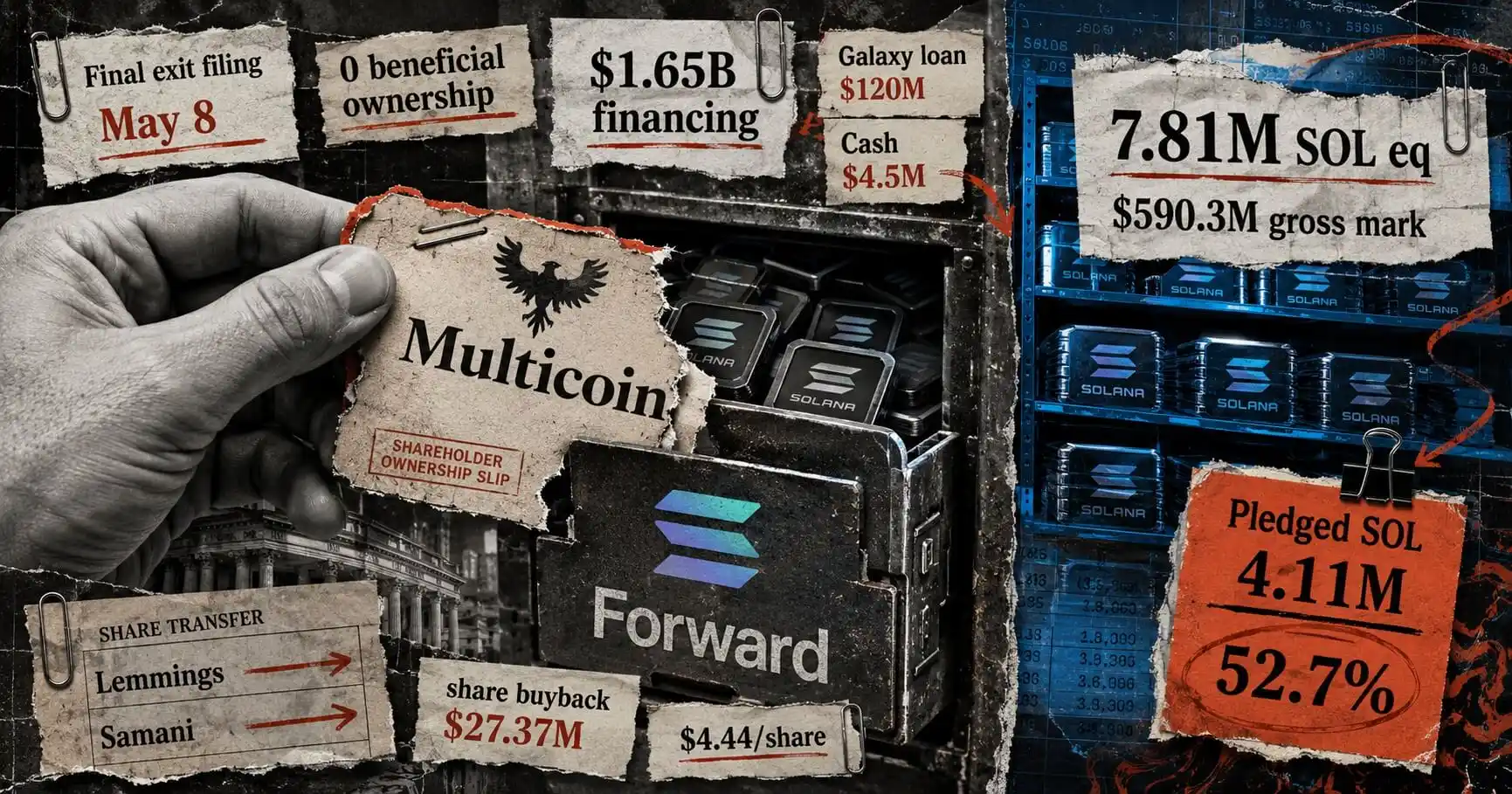
Après seulement 8 mois de collaboration, Multicoin quitte Forward, la plus grande société de trésorerie cotée de Solana

Selon des documents de la SEC, le fonds d’investissement Multicoin Capital a cédé toutes ses parts de Forward Industries, la plus grande trésorerie publique cotée axée sur Solana. Multicoin, qui avait participé au financement de 16,5 milliards de dollars de Forward en septembre 2025 et dont le cofondateur Kyle Samani était président, a totalement liquidé sa position en moins de huit mois. Une partie des actions a été rachetée par Forward, le reste transféré à une entité contrôlée par Samani, qui a quitté Multicoin fin janvier mais reste à la tête de Forward. Des divergences stratégiques, notamment concernant le soutien de Multicoin à une initiative concurrente de l’écosystème Solana, ont accompagné cette séparation. Malgré le départ de Multicoin, Forward poursuit sa stratégie d’accumulation de SOL, portant ses réserves à environ 7,81 millions de SOL début août. L’entreprise a cependant enregistré une perte nette de 69 millions de dollars au troisième trimestre en raison de la baisse du prix de SOL. Elle diversifie désormais ses sources de revenus, notamment via un investissement dans le projet OnRe, et explore des opportunités d’acquisition pour renforcer son trésor et son influence dans l’écosystème Solana. Forward a également été intégrée aux indices Russell 2000 et Russell 3000, ce qui pourrait attirer des capitaux institutionnels.

marsbitIl y a 1 h

Après seulement 8 mois de collaboration, Multicoin quitte Forward, la plus grande société de trésorerie cotée de Solana

marsbitIl y a 1 h

Grayscale : « Si les propositions sont adoptées, les prix de ces deux altcoins pourraient augmenter »

Zach Pandl, responsable de la recherche chez Grayscale, estime que des modifications envisagées de la tokenomique d'Ethereum (ETH) et de Solana (SOL) pourraient ralentir considérablement la croissance de leur offre, exerçant ainsi une pression haussière sur leurs prix. Ces propositions visent à réduire le taux d'inflation annuel des jetons ETH et SOL. Un ralentissement de la création de nouveaux jetons augmenterait la rareté des actifs existants. Grayscale prévoit que, si elles sont adoptées, l'inflation annuelle de l'offre d'Ethereum pourrait tomber à environ 0,4% d'ici fin 2031, se rapprochant ainsi du Bitcoin, tandis que celle de Solana pourrait atteindre environ 1,1%. En comparaison, l'offre d'or croît d'environ 1,8% par an et l'inflation (IPC) aux États-Unis est d'environ 3,3%. Pandl note que les propositions pour Solana semblent rencontrer un soutien plus large et ont donc une probabilité de mise en œuvre plus élevée. Cependant, il souligne un compromis potentiel : une inflation réduite pourrait diminuer les récompenses pour les investisseurs pratiquant le staking, une partie importante de leurs revenus provenant de l'émission de nouveaux jetons. En conclusion, un ralentissement de l'offre pourrait profiter aux prix des deux actifs, les détenteurs de jetons sans staking étant particulièrement bien placés pour en bénéficier. Ces changements restent à l'étude et ne sont pas encore approuvés.

cryptonews.ruIl y a 5 h

Grayscale : « Si les propositions sont adoptées, les prix de ces deux altcoins pourraient augmenter »

cryptonews.ruIl y a 5 h

Trading

Spot

Articles tendance

Comment acheter T

Bienvenue sur HTX.com ! Nous vous permettons d'acheter Threshold Network Token (T) de manière simple et pratique. Suivez notre guide étape par étape pour commencer votre parcours crypto.Étape 1 : Création de votre compte HTXUtilisez votre adresse e-mail ou votre numéro de téléphone pour ouvrir un compte sur HTX gratuitement. L'inscription se fait en toute simplicité et débloque toutes les fonctionnalités.Créer mon compteÉtape 2 : Choix du mode de paiement (rubrique Acheter des cryptosCarte de crédit/débit : utilisez votre carte Visa ou Mastercard pour acheter instantanément Threshold Network Token (T).Solde :utilisez les fonds du solde de votre compte HTX pour trader en toute simplicité.Prestataire tiers :pour accroître la commodité d'utilisation, nous avons ajouté des modes de paiement populaires tels que Google Pay et Apple Pay.P2P :tradez directement avec d'autres utilisateurs sur HTX.OTC (de gré à gré) : nous offrons des services personnalisés et des taux de change compétitifs aux traders.Étape 3 : stockage de vos Threshold Network Token (T)Après avoir acheté vos Threshold Network Token (T), stockez-les sur votre compte HTX. Vous pouvez également les envoyer ailleurs via un transfert sur la blockchain ou les utiliser pour trader d'autres cryptos.Étape 4 : tradez des Threshold Network Token (T)Tradez facilement Threshold Network Token (T) sur le marché Spot de HTX. Il vous suffit d'accéder à votre compte, de sélectionner la paire de trading, d'exécuter vos trades et de les suivre en temps réel. Nous offrons une expérience conviviale aux débutants comme aux traders chevronnés.

814 vues totalesPublié le 2024.12.10Mis à jour le 2026.06.02

Comment acheter T

Discussions

Bienvenue dans la Communauté HTX. Ici, vous pouvez vous tenir informé(e) des derniers développements de la plateforme et accéder à des analyses de marché professionnelles. Les opinions des utilisateurs sur le prix de T (T) sont présentées ci-dessous.

活动图片