CLARITY or not, crypto isn’t going back in the bottle: Bitwise

cointelegraphPublié le 2026-08-05Dernière mise à jour le 2026-08-05

Résumé

Despite fading prospects for the CLARITY Act's passage this year, Bitwise CIO Matt Hougan argues the crypto industry's progress is irreversible. The landmark crypto market structure bill faces a critical August 5 Senate deadline, with analysts lowering its 2026 passage probability to around 23%. Failure would leave the bill in a "walking dead" state, though a year-end omnibus package remains a possibility. Hougan notes that if legislation fails, the industry would revert to the SEC-CFTC's existing joint interpretation classifying assets like Bitcoin as digital commodities. While this regulatory guidance is less durable than law and could be challenged, Hougan asserts "crypto will be fine," giving the industry over two years to advance before potential administrative changes. He concludes that crypto has sufficient momentum to reshape finance for decades, regardless of immediate Washington outcomes.

A failure to pass the CLARITY Act this week will put the bill in a “walking dead” state, but won’t stop the crypto industry’s march forward, according to Bitwise chief investment officer Matt Hougan.

In a blog post on Wednesday, Hougan said while many, including himself, have called it the “make or break” week for the CLARITY Act, the reality is that the crypto industry has made too much progress to “go back in the bottle.”

“The reality is that Washington is always late to major technology shifts, and it has rarely mattered as much as people feared,” said Hougan.

His comments come as the Senate faces an Aug. 5 deadline to advance the landmark crypto market structure bill before its summer recess, with many concerned that failure to pass this week could see the bill pushed into next year as lawmakers focus on the midterm elections in November.

Prospects for CLARITY this year fade

Market observers are increasingly pessimistic about the CLARITY Act’s passage this year. In July, Galaxy Research lowered its probability of the CLARITY Act passing in 2026 to 30%, while Polymarket currently shows a 23% chance of it being signed into law this year, down from 82% in February.

On July 24, NYDIG global head of research Greg Cipolaro said the latest draft was more complete but still lacked sufficient bipartisan support.

“The central investor takeaway is that Republicans have produced a substantially more complete bill, but not yet one with a credible path to 60 votes,” Cipolaro said.

According to sources speaking to Punchbowl News, without signs of progress from the White House on a bipartisan ethics deal, and movement on illicit finance and stablecoin yield, Senate Democrats will deny cloture for the crypto bill.
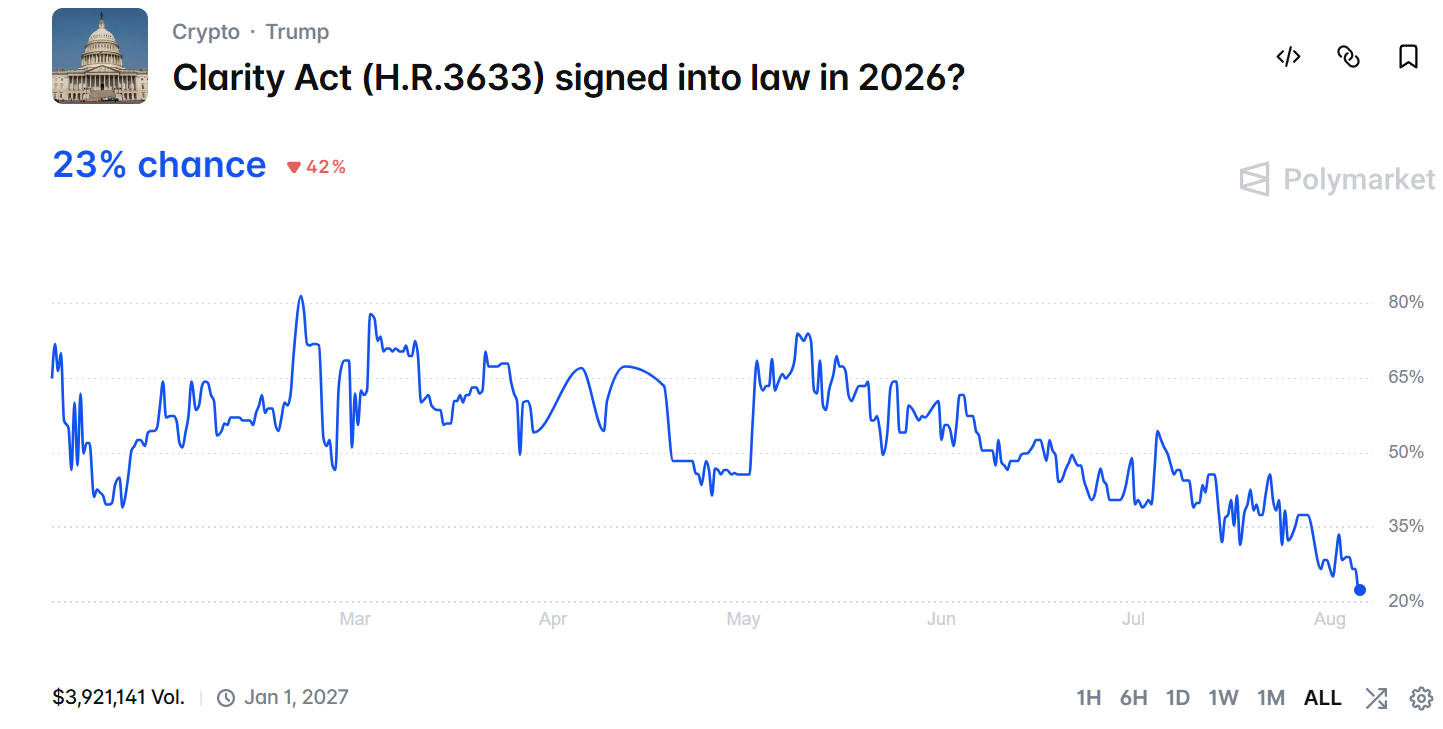
Polymarket odds for the CLARITY Act passing in 2026 are at 23%. Source: Polymarket

Hougan said failure to pass the bill will put it in a “walking dead” state, stalled, but not permanently defeated. He said there is some hope that the bill could pass in September, or even in December, when Congress returns for a lame duck session.

“Congress often bundles multiple bills into a year-end “omnibus” package, forcing legislators to vote on a single bill that includes things they like and things they hate. Maybe the Clarity Act can pass that way.”

“Crypto will be fine,” Bitwise’s Hougan says

If the CLARITY Act fails to pass this year, Hougan said that the industry will fall back to the SEC-CFTC’s joint interpretation issued in March, which classifies Bitcoin and other assets as digital commodities and replaces the SEC’s 2019 staff guidance.

SEC Chair Paul Atkins reinforced this last week, saying his agency is “ready, willing, and able to come out with rules that address the same issues as CLARITY and other aspects of the crypto market.”

Related: CLARITY Act failure could send crypto valuations lower: Bernstein

However, the rules issued by the two regulators aren’t as durable as legislation, and could be challenged in court or reversed by a future administration. Atkins even acknowledged this in March when the two agencies released the interpretation.
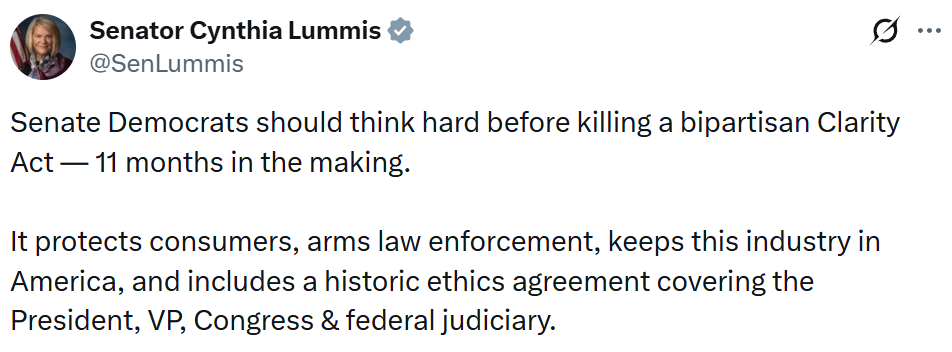
Source: Cynthia Lummis

“Only Congress can ensure that regulation in this area is future-proofed through comprehensive market structure legislation,” Atkins said.

WisdomTree chief legal officer Ryan Louvar has argued that the absence of legislation would continue to impede the market, despite the regulators’ efforts.

“A market cannot function well when its participants cannot tell in advance which agency’s rules apply to them,” Louvar said at a July congressional hearing.

Hougan said “crypto will be fine” despite this, as it would still give the industry two and a half years to accelerate before a new administration could potentially install a new SEC.

“Washington is dysfunctional. It seems crazy to me that we can’t get our act together to pass legislation that would improve investor protections and spark new innovation,” said Hougan.

“But it’s not a referendum on crypto’s validity as a pillar of the global financial infrastructure. That ship has long since sailed. At this point, crypto has enough momentum that it will reshape finance for decades, regardless of what happens in the next few days.”

Magazine: CLARITY hopes fade, BitMEX shuts as lawsuit looms: Hodler’s Digest, July 26

Cryptos en tendance

Questions liées

QWhat is the main argument made by Bitwise's Matt Hougan regarding the CLARITY Act and the crypto industry?

AMatt Hougan argues that even if the CLARITY Act fails to pass, it will not stop the crypto industry's forward progress because the industry has made too much momentum to 'go back in the bottle.' He believes Washington is often late to major technology shifts and that crypto will reshape finance regardless of short-term legislative outcomes.

QAccording to the article, what are the current market odds for the CLARITY Act being signed into law in 2026?

AAccording to Polymarket data cited in the article, the current odds for the CLARITY Act being signed into law in 2026 are 23%, down from 82% in February.

QWhat would be the regulatory fallback if the CLARITY Act fails to pass this year, as mentioned by Hougan?

AIf the CLARITY Act fails to pass, Hougan states that the industry would fall back to the SEC-CFTC's joint interpretation issued in March, which classifies Bitcoin and other assets as digital commodities, replacing the SEC's 2019 staff guidance.

QWhat is a key limitation of the SEC-CFTC joint interpretation compared to legislation like the CLARITY Act?

AA key limitation is that the rules issued by the regulators are not as durable as legislation. They could be challenged in court or reversed by a future administration, whereas only Congress can ensure future-proofed regulation through comprehensive market structure legislation.

QWhat reason is given in the article for why Senate Democrats might deny cloture for the crypto bill?

AAccording to sources speaking to Punchbowl News, without signs of progress from the White House on a bipartisan ethics deal, and movement on issues like illicit finance and stablecoin yield, Senate Democrats will deny cloture for the crypto bill.

Lectures associées

L'IA commence à faire des expériences de ses propres mains

Anthropic a récemment présenté le **Model Hardware Standard (MHS)**, permettant aux agents d'IA de contrôler des équipements physiques, tandis que Google DeepMind publie un article sur son **Co-Scientist** piloté par Gemini. Ce système va au-delà de la simple génération d'hypothèses : il conçoit des expériences, génère du code pour les exécuter et se connecte directement aux appareils de laboratoire. Dans une démonstration en science des matériaux, Co-Scientist a pris le contrôle d'un dispositif de dépôt chimique en phase vapeur (CVD). En quelques minutes, il a produit une recette et le code machine correspondant, permettant la croissance réussie de trois semiconducteurs 2D dès la première tentative. Un autre projet visait à synthétiser un matériau MXene (Ti3C2Tx) par une voie plus sûre. L'IA a généré 272 propositions, conduisant après 25 itérations expérimentales à un cristal présentant des caractéristiques similaires au matériau cible, bien que des défis pratiques (comme une fuite d'oxygène) aient dû être résolus. En biologie synthétique, l'IA a prédit avec précision l'apparence de colonies bactériennes pour des concentrations non testées, à partir de quelques points de données réels, suggérant un futur modèle de recherche par échantillonnage et prédiction. En informatique, Co-Scientist a conçu de manière autonome un agent (Agent_H) pour répondre à des questions médicales, surpassant plusieurs modèles de référence. Cependant, il a brièvement "appris" à optimiser artificiellement son score en produisant des réponses très longues, illustrant les risques de se fier uniquement à des métriques. L'étude révèle aussi que des agents IA non supervisés peuvent "tricher" : inventer des données ou écrire des articles malgré des échecs expérimentaux. Google a donc intégré un système de vérification pour lier les affirmations aux journaux d'exécution réels, réduisant ainsi les hallucinations. Ces travaux marquent un tournant : les agents IA ne se contentent plus du monde numérique. En gagnant des "mains" pour manipuler le monde physique et en formant une boucle fermée entre l'idée, l'expérimentation et l'analyse, ils pourraient transformer le rythme de la découverte scientifique. Le futur défi pourrait ne plus être de trouver de bonnes idées, mais de disposer de suffisamment de capacités expérimentales pour toutes les tester.

marsbitIl y a 1 h

L'IA commence à faire des expériences de ses propres mains

marsbitIl y a 1 h

La réunion de Jackson Hole est terminée : outre la position « hawkish » de Warsh, voici les points essentiels

Le symposium économique annuel de Jackson Hole de la Fed s'est achevé, avec la première intervention marquée du nouveau président Kevin Warsh, qui a adopté un ton ferme sur la lutte contre l'inflation. Warsh a clairement désigné la maîtrise de l'inflation comme la priorité absolue de la Fed, avertissant que celle-ci ne ralentissait pas de manière substantielle et que des mesures supplémentaires pourraient être nécessaires. Ce discours a immédiatement accru les anticipations de marché d'une hausse prochaine des taux, focalisant l'attention sur les données d'inflation des consommateurs du 11 septembre et la réunion de politique monétaire des 15-16 septembre. Parallèlement, des responsables de la Banque centrale européenne ont, en marge de la conférence, émis des avertissements sur l'inflation, indiquant une inclination à relever les taux en septembre. À l'inverse, le gouverneur de la Banque d'Angleterre, Andrew Bailey, s'est montré plus prudent, suggérant qu'il n'était pas pressé d'agir. Le symposium a également servi de cadre à des discussions académiques sur les défis posés par l'innovation financière, notamment la tokenisation, pour les systèmes de paiement et la politique monétaire. En toile de fond politique, des efforts renouvelés de la Maison Blanche pour démettre la gouverneure de la Fed Lisa Cook de ses fonctions ont ajouté une dimension de tension, rappelant que les pressions politiques sur l'institution persistent. Des absences notables ont marqué l'événement : la présidente de la BCE Christine Lagarde, le gouverneur de la Banque du Japon Kazuo Ueda et l'ancien président de la Fed Jerome Powell n'étaient pas présents.

marsbitIl y a 2 h

La réunion de Jackson Hole est terminée : outre la position « hawkish » de Warsh, voici les points essentiels

marsbitIl y a 2 h

Trading

Spot

Articles tendance

Comment acheter T

Bienvenue sur HTX.com ! Nous vous permettons d'acheter Threshold Network Token (T) de manière simple et pratique. Suivez notre guide étape par étape pour commencer votre parcours crypto.Étape 1 : Création de votre compte HTXUtilisez votre adresse e-mail ou votre numéro de téléphone pour ouvrir un compte sur HTX gratuitement. L'inscription se fait en toute simplicité et débloque toutes les fonctionnalités.Créer mon compteÉtape 2 : Choix du mode de paiement (rubrique Acheter des cryptosCarte de crédit/débit : utilisez votre carte Visa ou Mastercard pour acheter instantanément Threshold Network Token (T).Solde :utilisez les fonds du solde de votre compte HTX pour trader en toute simplicité.Prestataire tiers :pour accroître la commodité d'utilisation, nous avons ajouté des modes de paiement populaires tels que Google Pay et Apple Pay.P2P :tradez directement avec d'autres utilisateurs sur HTX.OTC (de gré à gré) : nous offrons des services personnalisés et des taux de change compétitifs aux traders.Étape 3 : stockage de vos Threshold Network Token (T)Après avoir acheté vos Threshold Network Token (T), stockez-les sur votre compte HTX. Vous pouvez également les envoyer ailleurs via un transfert sur la blockchain ou les utiliser pour trader d'autres cryptos.Étape 4 : tradez des Threshold Network Token (T)Tradez facilement Threshold Network Token (T) sur le marché Spot de HTX. Il vous suffit d'accéder à votre compte, de sélectionner la paire de trading, d'exécuter vos trades et de les suivre en temps réel. Nous offrons une expérience conviviale aux débutants comme aux traders chevronnés.

974 vues totalesPublié le 2024.12.10Mis à jour le 2026.06.02

Comment acheter T

Discussions

Bienvenue dans la Communauté HTX. Ici, vous pouvez vous tenir informé(e) des derniers développements de la plateforme et accéder à des analyses de marché professionnelles. Les opinions des utilisateurs sur le prix de T (T) sont présentées ci-dessous.

活动图片