Can Generative Models Finally Be Trained End-to-End? The Core Is a For Loop

marsbitPublié le 2026-08-03Dernière mise à jour le 2026-08-03

Résumé

This article introduces a novel training paradigm for generative models called Explorative Modeling (XM), which enables true end-to-end training. Traditionally, powerful generative models like autoregressive and diffusion models are not trained end-to-end. They are trained to predict a single small step but require iterative multi-step sampling for inference. This "exposure bias" leads to error accumulation and limits performance. The core challenge XM addresses is "mode blurring." In generative tasks, a single input (e.g., "generate a dog") corresponds to many valid outputs (multiple modes). Standard training objectives like reconstruction loss force the model to average these modes, producing unrealistic, blurry outputs. To avoid this, existing models break generation into many small, almost deterministic steps, sacrificing end-to-end training. XM tackles this by restructuring the training loop itself. Its key insight is to amplify "generative expressivity." For each training input, instead of generating one sample, the model generates K candidate outputs. Only the candidate closest to the real data is used for computing the loss and updating the model via backpropagation. This simple "best-of-K" mechanism is implemented as a short for-loop. By exploring multiple possibilities, the model learns to distribute its guesses across different modes rather than collapsing to their uninformative average. The paper demonstrates that "exploration" acts as a new, powerful scaling a...

In 2012, AlexNet decisively ended an era with an overwhelming victory. Before that, image recognition relied on manually designed, multi-stage feature extraction pipelines. AlexNet proved something that would be repeatedly validated later: handing the entire task to the model to learn end-to-end almost always outperforms human-designed, staged workflows.

From image classification to object detection to image segmentation, behind every leap in deep learning was the same mantra: let it learn everything in one go.

There has been only one consistent exception: generative models.

Today's strongest, most scalable generative models (whether autoregressive or diffusion models) are not end-to-end.

During training, they only learn to predict "one small step," but during inference, they have to recurrently unfold this step hundreds or thousands of times.

The sampling methods used for training and inference are not the same. This discrepancy leads to an old problem: errors from one step are fed into the next, the input gradually drifts away from the distribution seen during training, and errors accumulate layer by layer. Academically, this is called "exposure bias."

In other words, the core tenet of deep learning—"end-to-end is better"—has for over a decade failed to fully materialize in generative modeling.

Recently, however, a paper from UIUC and Harvard University attempts to complete this final piece of the puzzle.
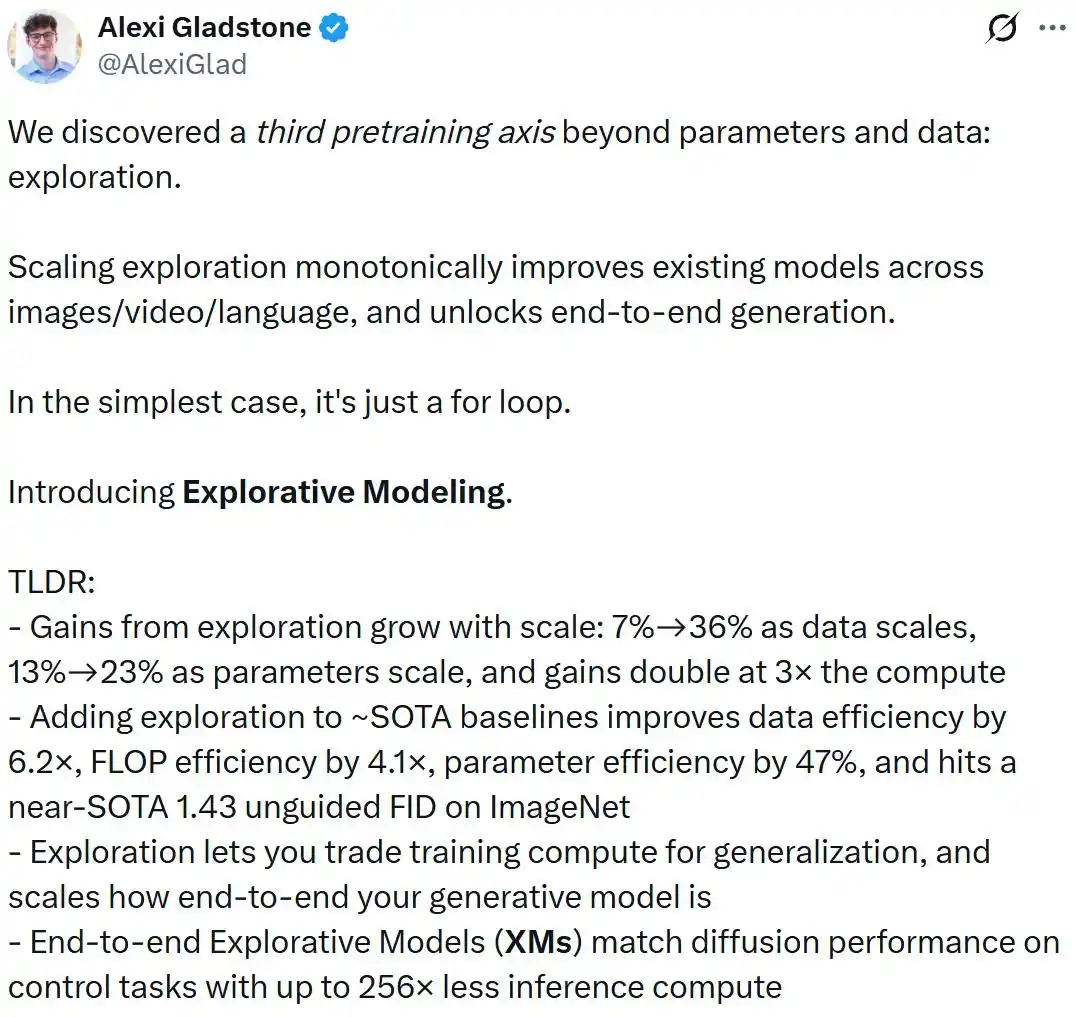
The authors named this new paradigm Explorative Modeling, abbreviated as XM. Its idea is so simple it borders on naive, yet points to a bold conclusion: Beyond parameters and data, generative models actually have a third axis that can be scaled.
Project Website: https://explorative-modeling.github.io

Paper: https://arxiv.org/abs/2607.27372

Code Repository: https://github.com/alexiglad/XM

The Root Problem: Models Only Know How to "Take the Average"

To understand what this paper solves, one must first understand why generation is hard.

In ordinary supervised learning (e.g., classification), each input essentially has only one correct answer; the model learns a deterministic mapping.

But generation is different. When you ask a model to "generate a dog," there can be infinitely many correct answers. These valid outputs are the many modes (i.e., distinct peaks) within the data distribution. Generation is difficult precisely because it must capture all these modes simultaneously.

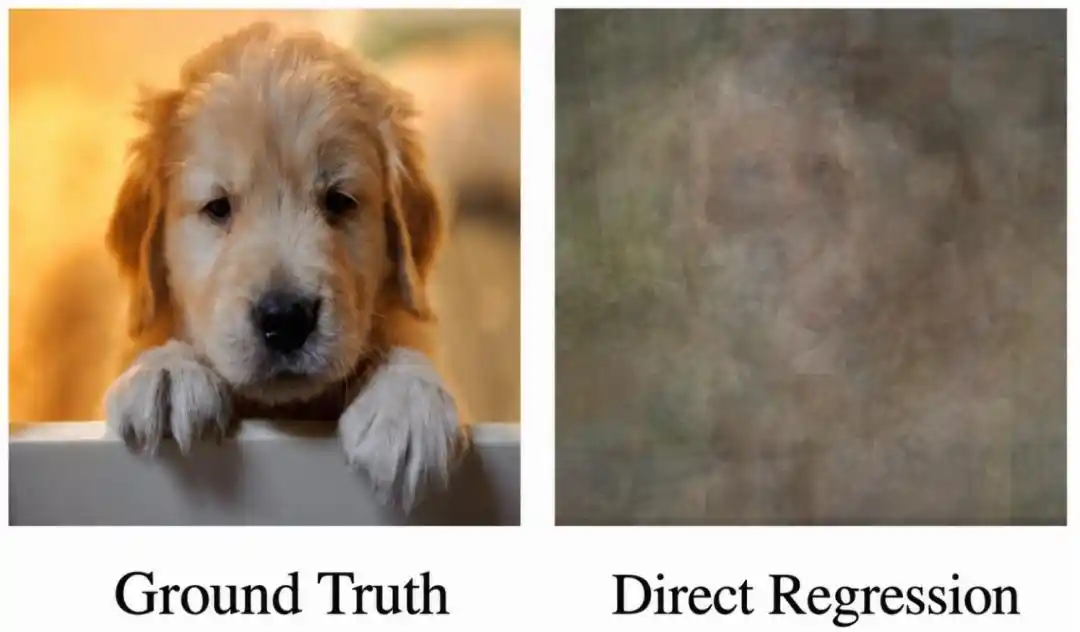
The trouble is, mainstream generative models are trained with reconstruction losses (e.g., squared error). When an input is paired with many different valid targets at random, the optimal solution for a reconstruction loss is the average of those targets. For most real-world data, this average does not lie on the data manifold but falls between modes, resembling none of them.

A figure in the paper illustrates this clearly: when asked to regress directly end-to-end without any tricks, three clusters of points would be predicted as a single point in the middle, a photo of a dog would blur into a smudge, and a sentence would degenerate into endless repetitions of "the." This is "mode blurring," where the optimal solution is precisely the answer least resembling real data.
How do existing models circumvent this? By breaking the "generation" process into tiny pieces. Autoregressive models predict only one element at a time; diffusion models remove a little noise at each step. Each small-step target is sliced until it contains essentially a single mode, preventing the reconstruction loss from averaging.

This strategy of "splitting the generative process" is precisely why diffusion and autoregressive models can produce high-quality samples, but it is also why they cannot be end-to-end.

The authors thus pose a crucial question: A generative model has only two things that can be broken down—how it generates and how it trains.

Since breaking the generation process destroys end-to-end capability, why not break the training instead?
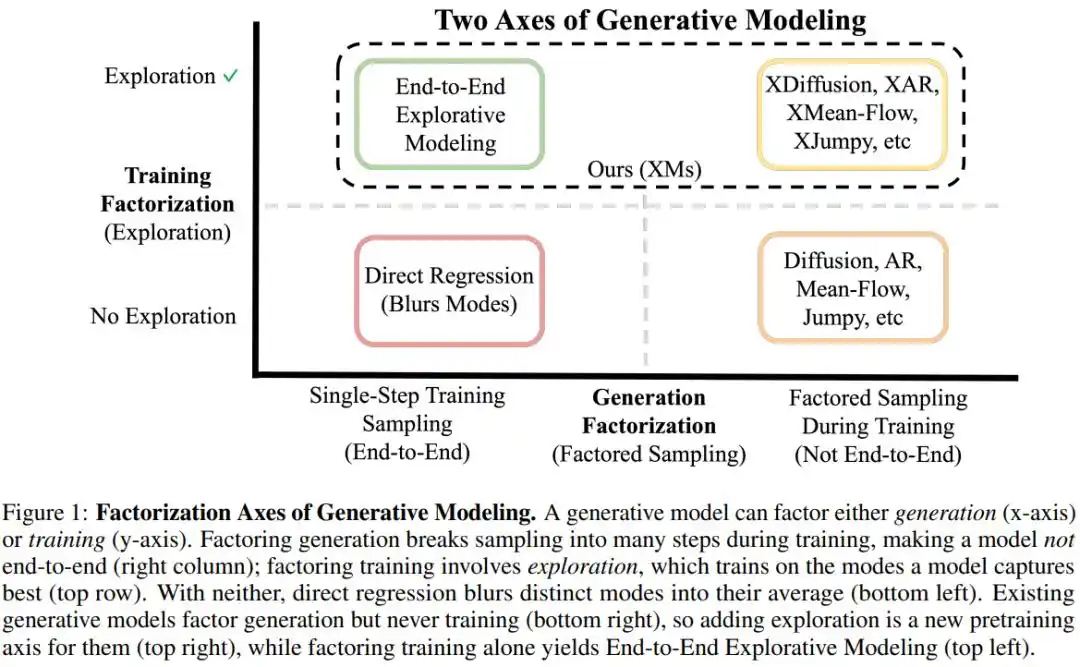
A For Loop: The Entire Essence of Explorative Modeling

Explorative Modeling breaks down the training loop itself.

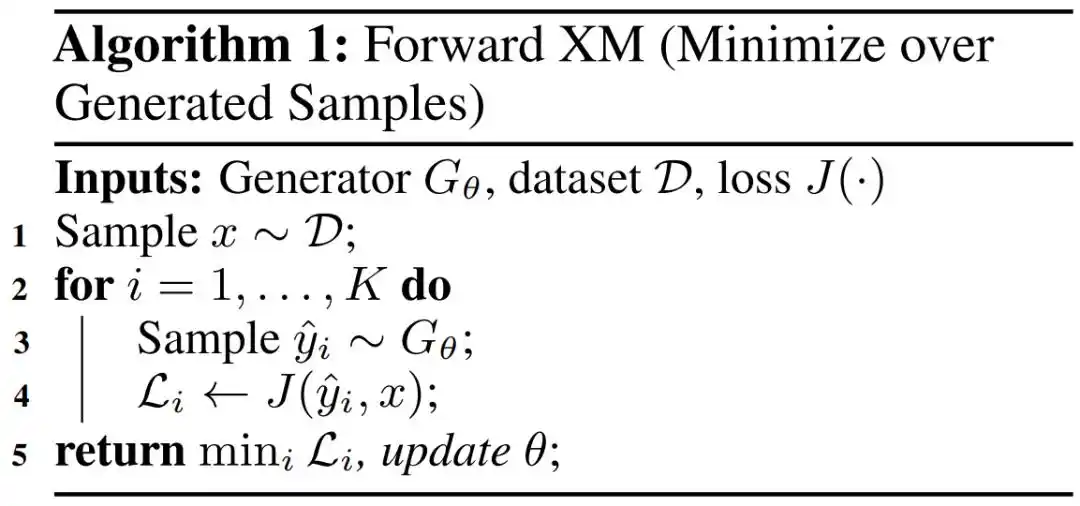
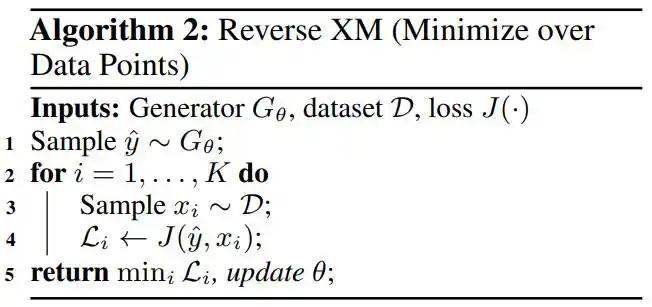
Its mechanism can be stated in one sentence: In each training step, instead of generating one sample to fit the target, the model generates K candidates and then selects only the one closest to the real data for training and gradient backpropagation. The paper implements this as a 3-5 line for loop, so simple it's almost suspicious (Algorithm 1).
Why does this solve mode blurring?

Think of a real-life analogy: guessing dart landing positions. If you are only allowed one guess, your optimal strategy is to guess the average position of all darts—but that's often a spot on the board where few darts actually land. However, if you are allowed K guesses and are scored only on your closest guess, the optimal strategy immediately changes: you would spread your guesses, letting each cover a different cluster of landing points.
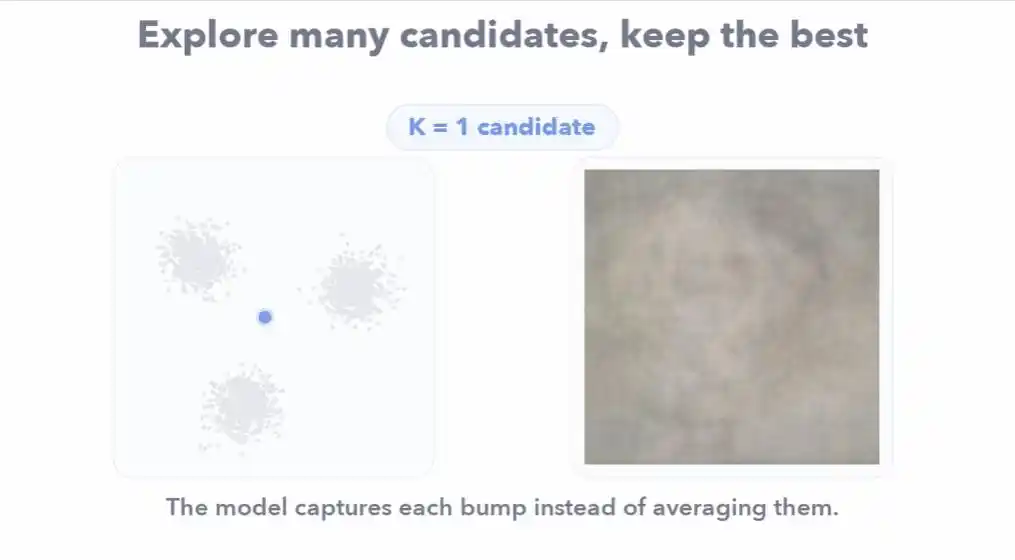
The model behaves similarly. When allowed to explore K candidates, different input noises will "claim" different modes, instead of all crowding towards the middle to take the average. The number of explorations directly determines how many modes the model can stably capture.
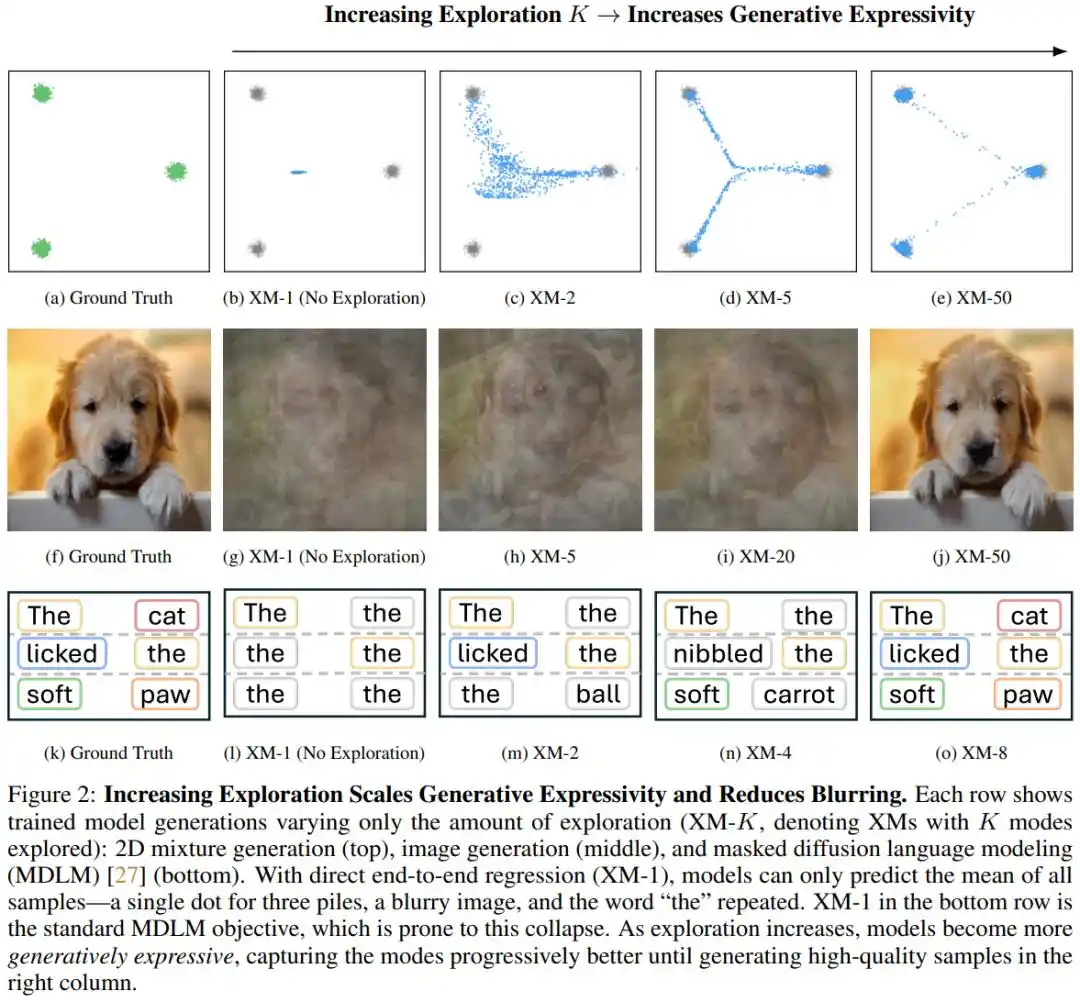
The authors name this long-overlooked capability "generative expressivity," noting that it is determined by the training objective itself—no matter how much you scale parameters and data, it won't increase on its own.

This also explains a phenomenon long observed in the field: why today's best models are so reliant on "guidance" techniques.

Classifier-free guidance essentially "pushes" the prediction away from that blurry average. But if the model itself weren't blurry, why push it? The usefulness of guidance stems precisely from the lingering disease of mode blurring.

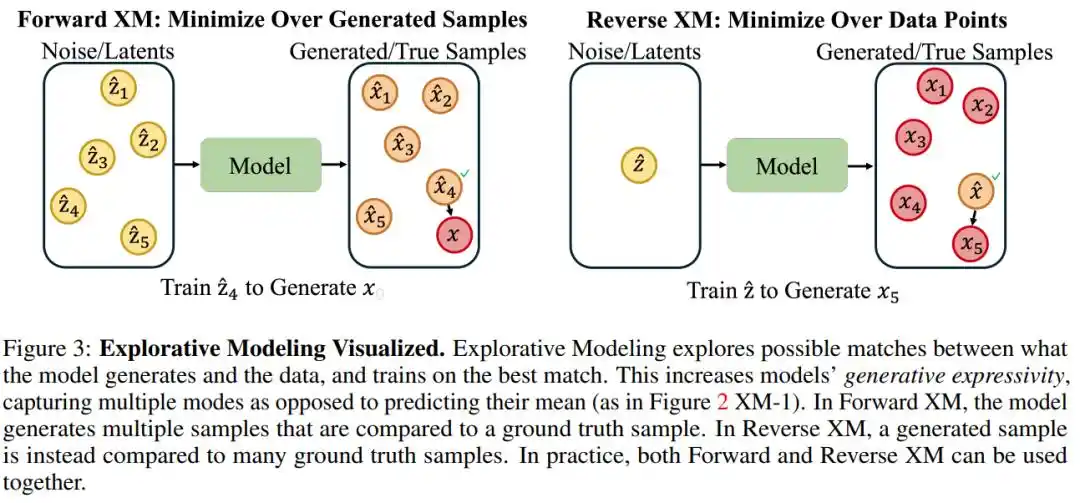
The paper also introduces Forward and Reverse exploration directions. Forward fixes a real target and searches among its own generations for the closest one, favoring "recall" (covering all modes). Reverse fixes a generation and searches among real data for the closest one, favoring "precision," and incurs almost no additional computational cost, at the risk of collapsing to a few modes. The two are complementary and can be used in combination.
The Third Axis: Greater Gains as You Scale

The most substantial conclusion of this paper is that it validates "exploration" as a genuine scaling axis.

The authors applied exploration to diffusion/flow models, Jumpy models, and even masked diffusion language models, observing consistent, monotonic performance improvements across image, video, and language modalities. More importantly, the trend of gains with scale: the bigger you go, the greater the benefit.

The numbers reported in the paper show: as data scale increases, gains from exploration rise from 7% to 36%; as model size grows, from 13% to 23%; when compute is tripled, efficiency gains more than double.

Specifically in efficiency, exploration improved FLOP efficiency by 4.1x, sample efficiency by 6.2x, and parameter efficiency by 47%. In image generation, it pushed the current strongest RAE formulation to an unguided FID of 1.43 on ImageNet, nearing the state-of-the-art.
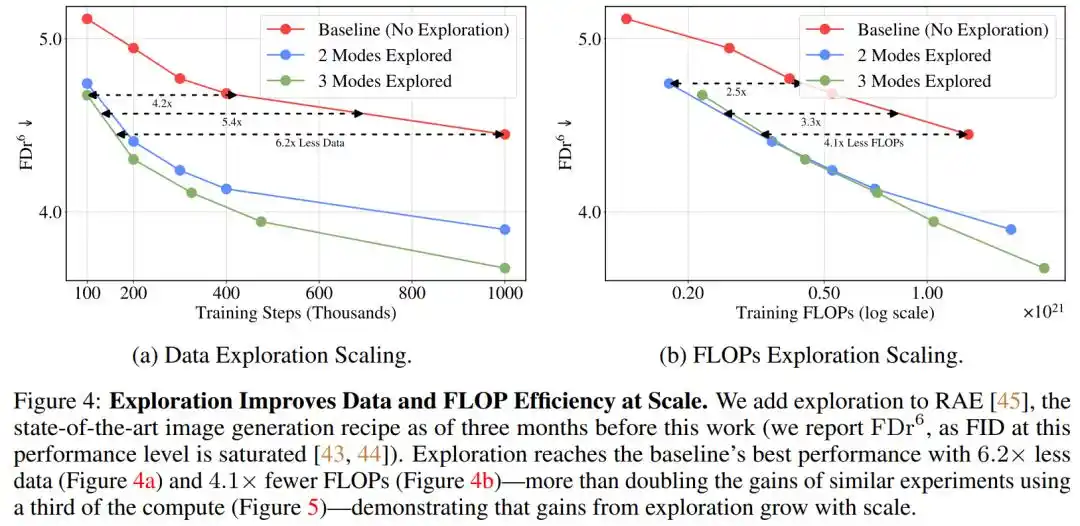
A Large model exploring 5 modes can even outperform an XLarge model with 47% more parameters but no exploration.
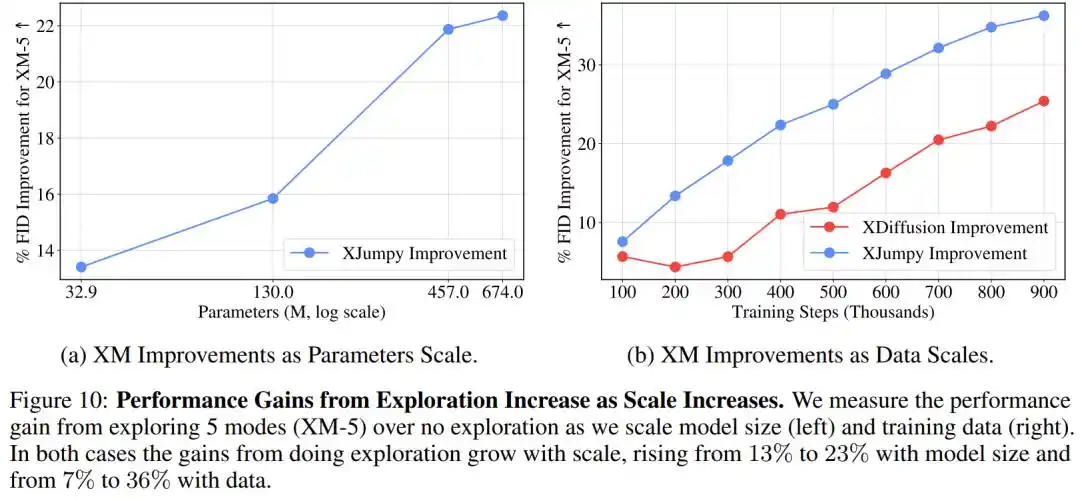
The implications of this trend are significant. The authors explain: at small scale, models are primarily bottlenecked by parameters and data; generative expressivity isn't the limiting factor yet. But once parameters and data are scaled to the point where they are "no longer the limit," generative expressivity increasingly becomes the real bottleneck. And that is exactly what exploration directly scales.

Considering that true foundation model training today uses roughly four orders of magnitude more compute than the largest experiment in this paper, the authors believe the reported numbers likely represent only a lower bound for the gains at larger scales.

Truly End-to-End Generation

If exploration is pushed to the extreme, what happens? The answer circles back to the opening suspense: Generative models can finally be end-to-end.

The authors used XM as a standalone end-to-end model for robot control tasks. In Behavior Cloning, their Explorative Policy matched or even surpassed Diffusion Policy (which requires 100 forward passes) using only a single network forward pass. In goal-directed world modeling, the Explorative World Model achieved better average performance than Diffuser, using 16 to 256 times less inference compute.
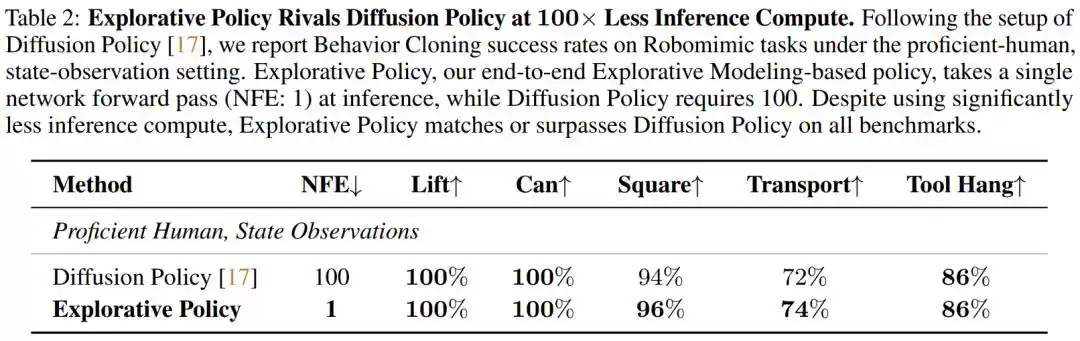
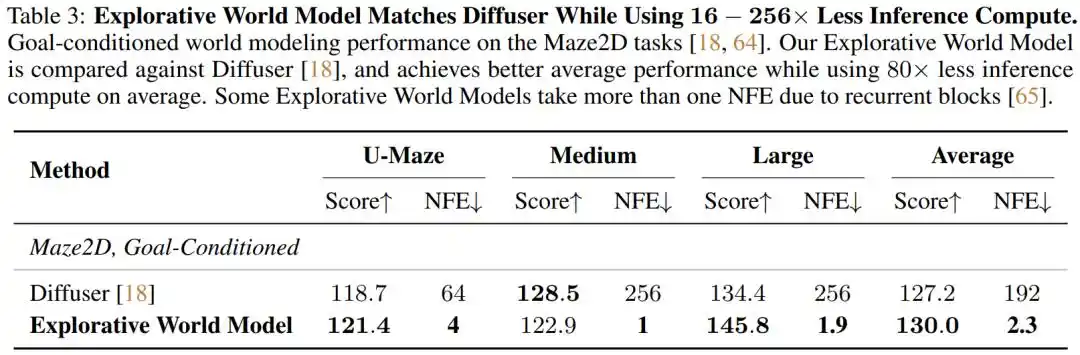
The source of this gap is clear: diffusion models trade hundreds of inference steps for expressivity, while end-to-end XM shifts this cost to exploration during training, allowing inference with just one forward pass. "Handling multi-modality"—the same thing—can be done either by breaking it down slowly during inference or by exploring it thoroughly once during training; this paper chooses the latter.

About the Authors

The first author of this paper, Alexi Gladstone, is not a newcomer. As recently as July 2025, his work on Energy-Based Transformers (EBT) sparked considerable discussion on social platforms.

That work claimed to "beat" the scaling curve of standard feedforward Transformers on multiple dimensions for the first time and attempted to generalize "System 2 thinking" to arbitrary modes. See the Machine Heart report: "New Paradigm Arrived! New Energy Model Breaks Transformer++ Scaling Limits, Training Scaling Rate 35% Faster."
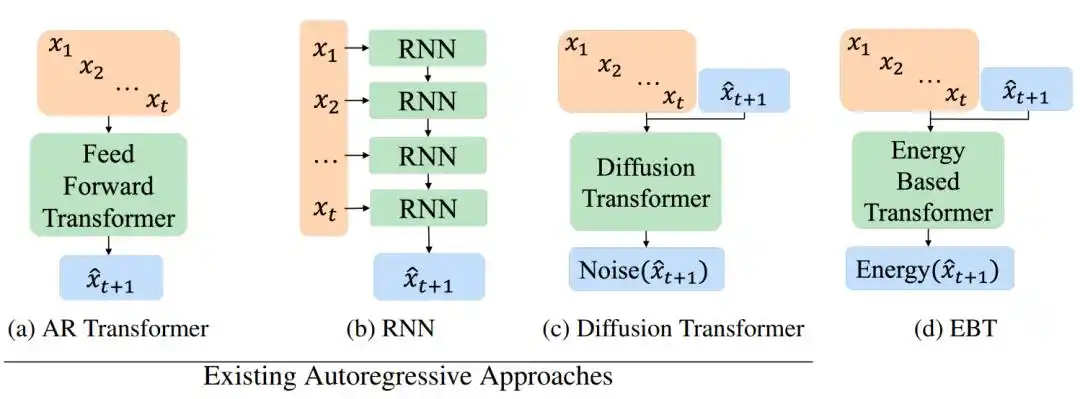
Explorative Modeling aligns with his consistent line of thinking: questioning "whether a model can, through some form of search or exploration, achieve what a single forward pass cannot." Furthermore, this paper builds upon another theory, Mode Forcing, by him and his collaborators (Yilun Du and Heng Ji). The paper candidly states that because of that prior theoretical foundation, most of XM's results were theoretically predicted first and then experimentally verified, which is relatively rare in the deep learning field, where the norm is often "run experiments first, explain later."
The authors are also frank about limitations: the best-of-K idea itself is not new and has been tried many times before; their real contribution is clarifying what this simple loop actually does: it directly amplifies generative expressivity without breaking down the generative process.

Additionally, autoregressive language models remain the toughest challenge, and pure end-to-end Forward XM is still too expensive for highly multi-modal distributions (like image generation), leaving room for future work.

For over a decade, we've grown accustomed to tuning generative models with two knobs: making them bigger and feeding them more data.

The third knob proposed in this paper is remarkably simple: let the model guess multiple times and keep only the best one. But if the trend it reveals holds true, then as scale continues to expand, the first two knobs will eventually be maxed out, while the third has only just begun to turn.

Reference Links

https://x.com/AlexiGlad/status/2083230922196107288

This article is from the WeChat public account "Machine Heart" (ID: almosthuman2014), author: Panda


Cryptos en tendance

Questions liées

QWhat is the core idea behind 'Explorative Modeling (XM)' as described in the article?

AThe core idea is to modify the training loop by having the model generate K candidate samples for each training step and then backpropagate gradients only from the candidate closest to the real data. This simple 'best-of-K' for-loop strategy helps the model capture multiple modes of the data distribution, solving the 'mode blurring' problem that plagues direct end-to-end generative modeling.

QAccording to the article, what is the 'third axis' for scaling generative models introduced by Explorative Modeling?

AThe 'third axis' is 'generative expressivity,' which is the inherent ability of a model to capture multiple modes in a data distribution. The paper argues that this expressivity is determined by the training objective itself and does not automatically scale with more parameters or data. Explorative Modeling directly amplifies this axis by increasing the exploration factor K during training.

QWhat problem do current powerful generative models (like autoregressive and diffusion models) have that prevents them from being truly end-to-end?

ACurrent powerful generative models are not truly end-to-end because they train to predict only 'one small step' (e.g., the next token or a denoising step), but during inference, they must unroll this step hundreds or thousands of times iteratively. This creates a mismatch between training and inference distributions, leading to the 'exposure bias' problem where errors accumulate step-by-step.

QWhat key advantage does an end-to-end Explorative Model (XM) demonstrate in the robotics control tasks mentioned in the article?

AIn robotics control tasks like Behavior Cloning, the Explorative Policy, using a single network forward pass, matched or exceeded the performance of Diffusion Policy, which required 100 forward passes. For goal-directed world modeling, the Explorative World Model achieved better average performance using 16 to 256 times less inference compute than a Diffuser model, highlighting its efficiency gains from shifting the computational cost from inference to training-time exploration.

QWho is the first author of the Explorative Modeling paper, and what was their related prior work mentioned in the article?

AThe first author is Alexi Gladstone. His related prior work is 'Energy-Based Transformers (EBT),' which claimed to surpass the scaling curves of standard feedforward Transformers across multiple dimensions. His research consistently explores how models can use search or exploration mechanisms to achieve what a single forward pass cannot.

Lectures associées

SEC et CFTC poursuivent Goliath le même jour : une arnaque pyramidale cryptographique de 400 millions de dollars exposée, plus d'angles morts pour les plateformes attirant les clients avec des intérêts élevés

L'autorité des marchés financiers américaine (SEC) et la commission du commerce à terme (CFTC) ont intenté des poursuites civiles contre Goliath Ventures et son fondateur, Christopher Delgado, pour une arnaque de type Ponzi d'environ 400 millions de dollars. La société promettait aux investisseurs des rendements mensuels de 3 à 10%, garantis, via une prétendue participation à des pools de liquidités cryptos. En réalité, aucune activité réelle n'a eu lieu : les fonds des nouveaux investisseurs servaient à payer les rendements des anciens, et Delgado a détourné au moins 51 millions de dollars pour des dépenses personnelles. L'escroquerie, reposant sur des rémunérations pour le recrutement de nouveaux clients, a impliqué plus de 1300 personnes avant de s'effondrer fin 2025 par manque d'afflux de fonds frais. Bien que Delgado ait plaidé coupable à des accusations pénales en juin et accepté la confiscation de ses biens, les quelque 250 millions de dollars de pertes pourraient ne jamais être récupérés par les victimes. La particularité de cette affaire réside dans l'action simultanée et coordonnée de la SEC et de la CFTC, couvrant respectivement les aspects liés aux titres financiers et aux produits de base. Cette approche marque un signal fort : les plateformes cryptos promettant des rendements élevés, garantis et basés sur un système de recrutement ne pourront plus facilement exploiter les failles entre les deux régulateurs.

marsbitIl y a 8 mins

SEC et CFTC poursuivent Goliath le même jour : une arnaque pyramidale cryptographique de 400 millions de dollars exposée, plus d'angles morts pour les plateformes attirant les clients avec des intérêts élevés

marsbitIl y a 8 mins

Wall Street commence à douter du récit de l'IA des géants de la la tech

Wall Street commence à douter du récit de l'IA des géants technologiques. Alors que les bénéfices semblent solides, les investisseurs scrutent désormais les tableaux de trésorerie et les flux de liquidités disponibles (FCF). La récente annonce de Nvidia concernant une plateforme de financement de 5000 milliards de dollars pour l'infrastructure IA a suscité des interrogations sur la capacité des entreprises à financer seules cette expansion coûteuse. Les réactions boursières divergentes après les publications de résultats du deuxième trimestre 2026 illustrent ce nouveau prisme d'analyse. Alphabet (Google) a vu son action chuter malgré une forte croissance de son chiffre d'affaires, en raison de son premier FCF trimestriel négatif (-58,55 milliards de dollars), conséquence d'énormes dépenses en capital. Microsoft, en revanche, a bondi car il a généré un FCF positif de 196 milliards de dollars tout en affichant une croissance robuste du cloud Azure et un carnet de commandes record. Le marché ne remet plus en cause la demande pour l'IA, mais évalue la vitesse à laquelle les investissements massifs (centres de données, puces, énergie) se traduiront par des revenus, des bénéfices et des liquidités. Les investisseurs distinguent désormais les entreprises dont la trésorerie opérationnelle existante peut couvrir les dépenses, de celles qui dépendent de financements externes. La question centrale est de savoir si le retour sur capital investi (ROIC) justifiera les coûts initiaux, compte tenu des risques de l'obsolescence technologique rapide et de l'évolution des prix de l'énergie. Le « microscope financier » se concentre sur le flux de trésorerie disponible comme premier filtre critique.

marsbitIl y a 9 mins

Wall Street commence à douter du récit de l'IA des géants de la la tech

marsbitIl y a 9 mins

Un compétiteur inattendu fait son entrée dans la course aux machines de lithographie

Au printemps 2026, Elon Musk a dévoilé son plan de fabrication de puces TeraFab, visant une capacité de calcul d'1 térawatt pour SpaceX et Tesla. Il semble désormais parier sur la lithographie, avec des spéculations pointant vers une technologie de source lumineuse FEL (laser à électrons libres) pour concurrencer la technologie EUV dominante d'ASML. ASML, quasi-monopoliste des machines de lithographie EUV, utilise la technologie LPP (laser-produced plasma), mais celle-ci présente des limites d'efficacité énergétique, de pollution par les débris d'étain et de plafond de puissance. Le FEL, exploré par des acteurs comme la startup xLight et potentiellement par TeraFab, est présenté comme une alternative prometteuse. Il pourrait offrir une longueur d'onde plus courte (bande Blue-X), une puissance beaucoup plus élevée (dépassant 10 kW), une absence de contamination et un principe "plug-and-play" pour les fonderies. Le secteur de la lithographie évolue sur trois axes : l'itération progressive des machines EUV par ASML (reste dominante), l'innovation sur les sources lumineuses (comme le FEL), et les solutions alternatives non-EUV comme la nano-impression (NIL) ou la lithographie par faisceau d'électrons (EBL). Le plan de Musk représente un pari audacieux sur la capacité du FEL à passer du laboratoire à la production, sur la possibilité de contourner les brevets d'ASML et sur l'existence d'une demande suffisante pour justifier une nouvelle chaîne d'approvisionnement. Bien qu'ASML reste extrêmement solide, l'entrée de nouveaux acteurs pourrait commencer à redéfinir les règles du jeu dans l'industrie des machines de lithographie.

marsbitIl y a 11 mins

Un compétiteur inattendu fait son entrée dans la course aux machines de lithographie

marsbitIl y a 11 mins

Le Bitcoin Policy Institute appelle les développeurs d'IA à donner aux défenseurs des infrastructures crypto un accès aux modèles avancés

Le Bitcoin Policy Institute (BPI) a lancé un appel aux développeurs d'intelligence artificielle (IA) de pointe, les exhortant à fournir un accès privilégié à leurs modèles les plus avancés aux équipes chargées de sécuriser l'infrastructure cryptographique open-source. Les analystes du BPI estiment que ces systèmes d'IA, capables d'analyser d'immenses bases de code et d'identifier des vulnérabilités, pourraient transformer la recherche en sécurité, mais aussi les cyberattaques. Ils craignent que ces capacités ne soient d'abord exploitées par des acteurs malveillants, exposant à un risque accru les portefeuilles, les bibliothèques cryptographiques, les logiciels de nœuds, les bourses et les réseaux de paiement qui gèrent des milliers de milliards de dollars en actifs numériques. Le BPI souligne un déséquilibre d'accès : tandis que les laboratoires d'IA et leurs partenaires bénéficient en premier de ces outils, des développeurs essentiels comme ceux de Bitcoin Core en sont exclus. L'institut propose la création de programmes d'accès de confiance permanents, offrant aux chercheurs et développeurs qualifiés un accès anticipé et supervisé aux modèles puissants, des ressources de calcul suffisantes, des environnements sécurisés pour l'analyse de code privé, et des canaux directs pour la divulgation des vulnérabilités. L'objectif est de permettre aux défenseurs de l'écosystème open-source de corriger les failles avant qu'elles ne soient exploitées. Le BPI encourage également l'industrie cryptographique à aider les laboratoires d'IA à identifier les participants fiables à ces programmes et à coordonner les réponses aux menaces.

cryptonews.ruIl y a 31 mins

Le Bitcoin Policy Institute appelle les développeurs d'IA à donner aux défenseurs des infrastructures crypto un accès aux modèles avancés

cryptonews.ruIl y a 31 mins

Trading

Spot

Articles tendance

Comment acheter CORE

Bienvenue sur HTX.com ! Nous vous permettons d'acheter CORE (CORE) de manière simple et pratique. Suivez notre guide étape par étape pour commencer votre parcours crypto.Étape 1 : Création de votre compte HTXUtilisez votre adresse e-mail ou votre numéro de téléphone pour ouvrir un compte sur HTX gratuitement. L'inscription se fait en toute simplicité et débloque toutes les fonctionnalités.Créer mon compteÉtape 2 : Choix du mode de paiement (rubrique Acheter des cryptosCarte de crédit/débit : utilisez votre carte Visa ou Mastercard pour acheter instantanément CORE (CORE).Solde :utilisez les fonds du solde de votre compte HTX pour trader en toute simplicité.Prestataire tiers :pour accroître la commodité d'utilisation, nous avons ajouté des modes de paiement populaires tels que Google Pay et Apple Pay.P2P :tradez directement avec d'autres utilisateurs sur HTX.OTC (de gré à gré) : nous offrons des services personnalisés et des taux de change compétitifs aux traders.Étape 3 : stockage de vos CORE (CORE)Après avoir acheté vos CORE (CORE), stockez-les sur votre compte HTX. Vous pouvez également les envoyer ailleurs via un transfert sur la blockchain ou les utiliser pour trader d'autres cryptos.Étape 4 : tradez des CORE (CORE)Tradez facilement CORE (CORE) sur le marché Spot de HTX. Il vous suffit d'accéder à votre compte, de sélectionner la paire de trading, d'exécuter vos trades et de les suivre en temps réel. Nous offrons une expérience conviviale aux débutants comme aux traders chevronnés.

519 vues totalesPublié le 2024.12.13Mis à jour le 2026.06.02

Comment acheter CORE

Discussions

Bienvenue dans la Communauté HTX. Ici, vous pouvez vous tenir informé(e) des derniers développements de la plateforme et accéder à des analyses de marché professionnelles. Les opinions des utilisateurs sur le prix de CORE (CORE) sont présentées ci-dessous.

活动图片