How to Make Yourself Irreplaceable by AI Forever

marsbitPublié le 2026-08-02Dernière mise à jour le 2026-08-02

Résumé

This article argues that the primary threat from AI is not job replacement, but remaining trapped in "wage slavery"—financial dependence on employers. The path to becoming irreplaceable is not resisting AI, but becoming an "unemployable" individual who builds their own meaningful enterprise. The author identifies five key elements for this: Agency (acting without permission), Taste (judging what's worthwhile), Persuasion, Persistence, and Iteration. The solution is to stop being a "pawn" in someone else's game. To start, you must fundamentally change your identity and environment, then engage in rapid, real-world trial and error. While both coding and creating media (content) are powerful, content is more crucial. AI can generate assets, but true value lies in subjective, human-driven content that builds trust and narrative. The actionable advice is to carve out 15 minutes to answer foundational questions: 1) Uncover your "raw material"—what you know deeply or solve effortlessly. 2) Define your contrarian perspective—what common beliefs you think are wrong. The intersection of these answers is your direction. Finally, you must launch by publishing your first core idea immediately, using the feedback to iterate and develop the skills needed for a self-directed life and career.

Translation Agency is a translation team under 36Kr, focusing on technology, business, workplace, and life, primarily introducing new technologies, new perspectives, and new trends from abroad.

Editor's Note: Instead of lamenting on social media about jobs being taken over by AI, become an 'unemployable' super-individual and turn the tables outside others' chessboards with your content. The article is from a translation.

Unfortunately, all jobs will probably disappear within the next 5 seconds.

At least, that's what it feels like if you take the alarmists on social media too seriously.

You might even adopt an 'anti-AI' ideology as your new label, shouting 'Screw AI!' to make yourself feel like you're changing the world. But in reality, you haven't made any behavioral changes, expanded your skill set, or adapted to this new world—after all, who would bother changing when you can stick to the status quo and cry about being a poor victim?

AI is not the threat you think it is.

The real threat remains the same as always:

For survival and well-being, you rely on everyone except yourself. Your employer and government have their own survival issues to consider, and when something threatens that, their thinking narrows, and they quickly try to neutralize the threat. It's human nature. You can argue they 'should' care about your well-being, but if you blindly believe they'll take care of you, you're destined to be very, very disappointed.

AI's momentum is too strong to control by complaining.

Venting on social media about how much you hate AI won't stop jobs from being replaced, nor will it halt the evolution of the skills needed for success.

The purpose of this article is to offer you a perspective and a potential solution (one that has existed since ancient times).

I have 4 points to share with you, covering wage slavery, becoming a person of high agency, and why none of this matters if you don't fundamentally change yourself.

At the end of the article, I've also prepared a short exercise with 6 questions that might open the door to a whole new way of life—even if it seems deceptively simple.

1. How to Escape Wage Slavery

Wage slavery is doing meaningless, boring drudgery for someone else—work you didn't voluntarily choose—just to survive.

I'm not against having a job.

I think work is a valuable springboard for gaining practical experience and mastering skills.

But whenever I talk about work in a somewhat 'negative' light, some people inevitably jump in and say, 'You idiot! I actually love my job!'

That's great. But I'm not talking to you (and to some extent, I think you're lying to avoid confronting your potential, and you might not even realize it).

I'm talking to those who understand the psychology of true happiness and can't stand the vision: for over 40 years, one-third of life spent on work they didn't choose, one-third mentally exhausted and unable to do anything valuable, and the remaining third sleeping...
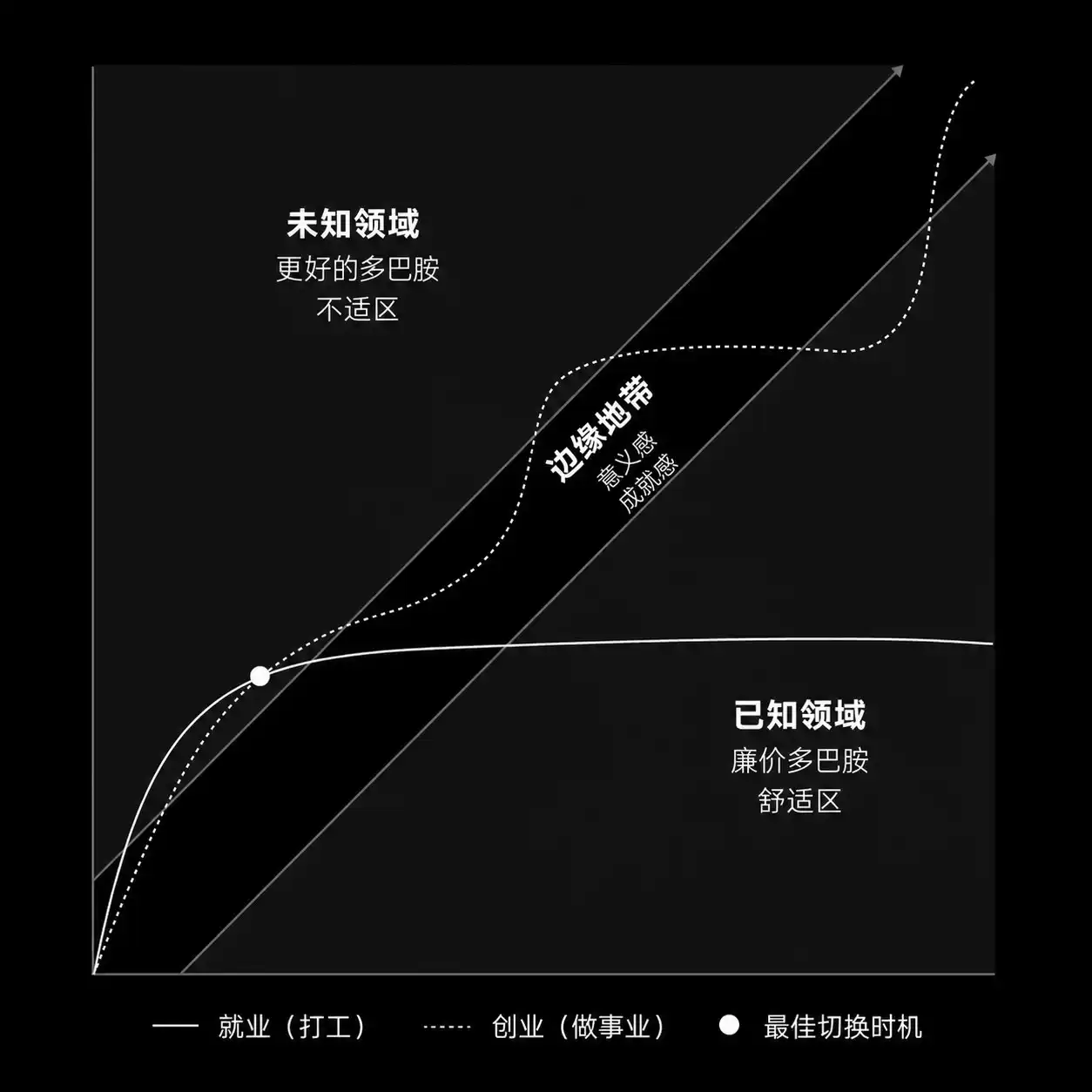
You see, happiness, meaning, and a sense of accomplishment come from testing the limits of your abilities. The research on this is clear. No, I won't cite it. Happiness comes from pursuing a challenge that is just slightly above your current skill level. It can't be so hard it causes anxiety, nor so easy it's boring. Video games exploit this. The tasks you take on are often just the right difficulty because if a level 1 character tackled a level 100 quest, you'd die instantly and hate the game. This is the single biggest driver of entering a flow state. If you can structure your life to increase the probability of triggering this flow, happiness becomes a continuous stream.

The problem with work is that after a few months, you've learned everything you need to know. You just clock in, complete the tasks, clock out. You start getting bored. This goes against your nature. You can feel it. Your attention is no longer immersed in the task; it shifts to: 'What else can I do for fun?' For most people, that 'something else' doesn't involve meaningful goals. It's just opening their phones and letting their brains rot. Very few jobs require you to continuously improve your skills to meet greater challenges.

Climbing the corporate ladder might help, but again, you don't control the difficulty level. You're not working on your own projects. Curiosity, passion, purpose, autonomy, and mastery are destined to be missing—precisely the five key drivers of flow.

What does this have to do with wage slavery?

It can be said that human civilization is built on tribes enslaving other tribes. This dynamic has never disappeared. Instead, it evolved into employment relationships, laws, and culture. Society is essentially a pyramid scheme (Ponzi scheme). There are always more people at the bottom than at the top; mathematically, it's impossible for everyone to reach the top. One boss, many employees, and employees depend on the boss for survival.

Most of us grew up indoctrinated with industrial standards.

Become a specialist. Dive deep into one field. Get a high-paying job so my friends think my son/daughter is successful. And because you did the same, you are blind to most of how the system operates. You mastered only one skill for your job but never tried to understand the system that pays you. You didn't invest time in other areas, so you don't know how to build your own business. All you know is how to be a pawn in someone else's game.

Unknowingly, your ability to think is stifled, even if you were considered 'smart' in your chosen skill. You earn a decent salary but don't feel financially secure, falling into a vicious cycle of stress. Stress narrows your perspective. This makes it even harder to imagine a life where you truly create your own business.

You don't have the capital to do what you want. You don't have time to develop yourself. And you're probably too tired (mentally, not physically) to re-educate yourself because most of your waking life is spent contributing to someone else's vision.

By the way, this is precisely how you survive a massive upheaval: by diving headfirst into your own business.

The problem is, slaves don't know they are slaves.

This goes far beyond wage slavery. To some extent, we are all slaves, often trapped in some ideology and belief system.

Slavery is often associated with coercion, and when we hear the word, we think of physical confinement. But wage slavery is financial confinement. If not working leads to disaster, and you have no skills to create alternative income, then you perfectly fit the definition of a slave—no matter how your 'feelings' deny it.

Worse, if you've fused your identity with your job, you might perceive this as a direct attack. You'll become defensive. You'll want to argue with me. That's fine, but it further proves my point.

You get the idea.

It sucks. It disgusts me just thinking about it.

Now, let's talk about what's possible now and what you can do about it.

2. The Five Elements of Success

If you don't set your own routine, someone will assign you one.

Most people spend the majority of their lives being trained to learn things they don't want to learn, to get a job they don't care about, working for people they'd never want anything to do with in daily life.

While I think AI, technology, and social media have accelerated our awareness that school and a 9-to-5 aren't the only paths, I also believe people are simply tired of the utter emptiness and meaninglessness of the world around them.

For those tired of the conventional path, there are five elements that make you invincible, allowing you to engage in meaningful work even if all jobs are replaced:

  1. Agency — The ability to 'just do it' without permission. To spot opportunities and act decisively when no one asked you to.

  2. Taste — The wisdom, through experience, of what's worth putting out into the world.

  3. Persuasion — The skill of getting people to pay attention to and value what you do, distinct from manipulation.

  4. Persistence — The profound understanding that making mistakes doesn't equal death, and that errors are part of the journey.

  5. Iteration — The process of continuously correcting mistakes and moving toward a goal based on feedback (if something doesn't work, learn the lesson and pivot until it does).

Now everyone is obsessed with becoming a 'high-agency' person.

I get it. It's important. You need the ability to initiate action toward a goal yourself. This is one of the core differences between an entrepreneur and a regular employee. Entrepreneurs are those who bring into the world things no one asked for.

But this is just one piece of the entrepreneurial puzzle.

The five elements above really boil down to two core abilities: problem-solving and the experience to know what to do.

So far, AI is very good at 'asset creation' (content generation), but creating a 'hit' is not the same as ordinary asset creation. Asset creation is a necessary but not sufficient condition for a hit.

Last week, anyone could make a video game, just like anyone could 5 years ago. The technology is available, commoditized, democratized. Do you know how many mobile games are released in a year? Thousands. Do you know how many hits are generated in a year? 0 to 5.

— Strauss Zelnick

Now anyone can build anything, which means the barrier to entry for entrepreneurship (the antidote to wage slavery) is continuously lowering, but that's actually not the important part:
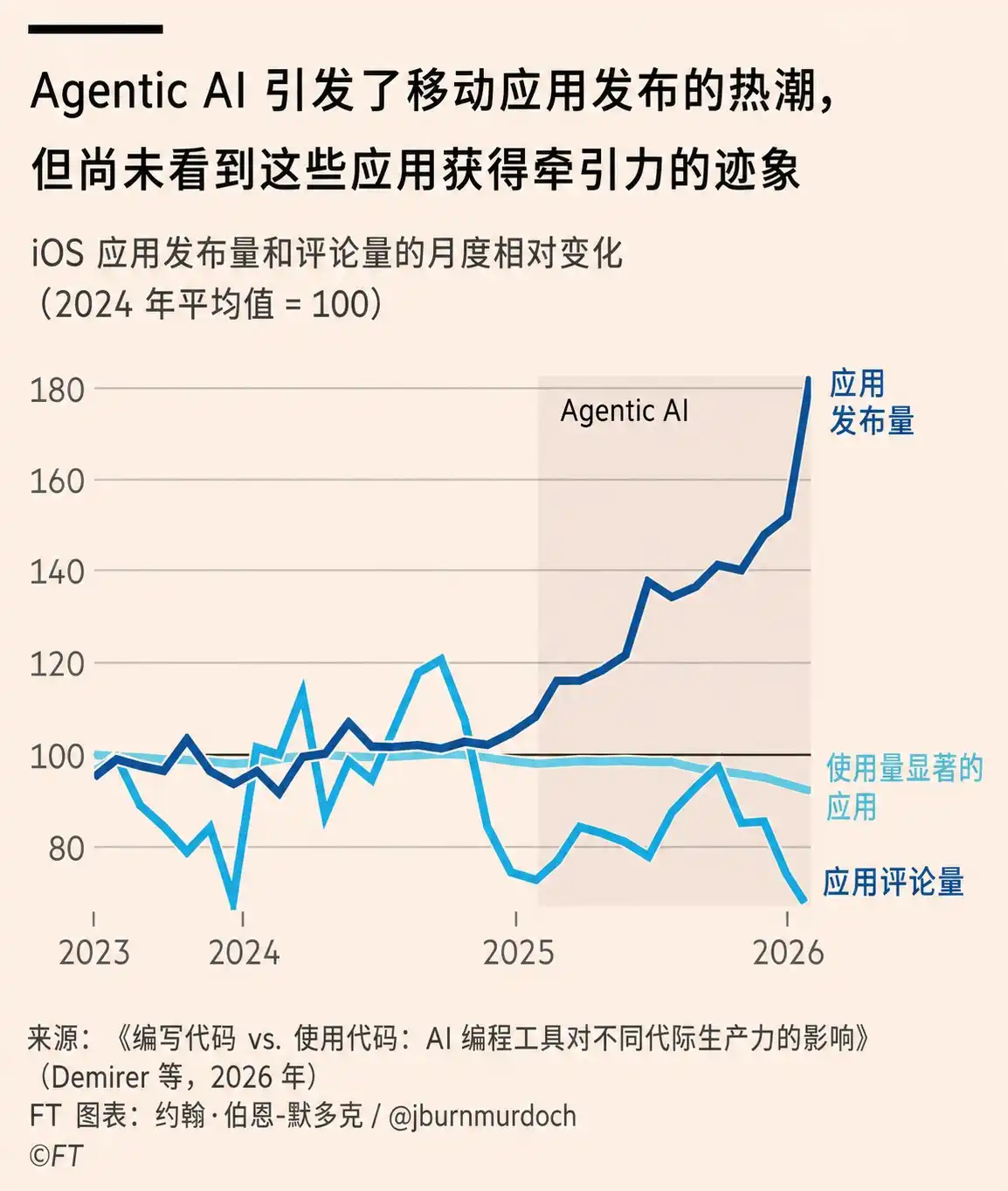
You, right now, can go build an app.

Not the next Notion, but a manageable-scale app or tool focused on something people can genuinely benefit from. Something that doesn't need to be a super-hit to be immensely valuable.

I highly recommend doing this. I think software will become the next 'information product.' What I mean is, building software will become the default choice for creators, soloists (solopreneurs), and other one-person businesses. Information products have been popular for so long because anyone can make them, but of course, that doesn't mean everyone succeeds.

The problem is the picture above (the current state).

You can build anything, but that doesn't mean: (1) it's worth building; (2) people will care; (3) you have the ability to iterate based on feedback and persist until it becomes something truly worth building and that people care about.

If you can truly internalize this sentence, you will thrive.

The second problem is that agency, taste, persuasion, persistence, and iteration are not typical 'high-value skills' you can just learn by watching a few YouTube videos.

Spouting theory and Twitter threads about how to become high-agency won't make you more agential.

The only way to practice them is to start making your own things.

3. The Antidote to Being Employed is to Make Yourself 'Unemployable'

I still remember the day I got my first web design client.

I remember they paid me $300 for an ugly static site I hand-coded. It was a local mattress company that just wanted a webpage where people could see their mattresses.

That's it.

$300.

That was the moment a light bulb went off. I knew that if I could replicate, improve, and continuously iterate the actions I just used to earn that money, I could somehow have more control over my future lifestyle and destiny. It made me 'unemployable.' It planted a deep belief in me: I could never accept going to work again; I would fight for my own survival!

But the number '$300' alone doesn't explain all the precursors to that moment—the identity shift and the initial self-belief that this could work. Nor does it encompass everything I learned in the subsequent 7 years.

I want to give you two things: a catalyst for an identity shift to become truly unwilling and unemployable, not just someone who 'likes the idea'; and an action plan that everyone can execute in their own unique way.

1) Throw yourself into an environment that forces you to grow

The fastest way to change your life is to physically and digitally rip yourself out of your current environment. Change everything overnight. The places you go, the accounts you follow, the information you consume, etc. It's hard, but it absolutely works.

Behavior change = Identity change.

You can try to diet and lose 30 pounds, but if you're not someone who intrinsically values health and enjoys a healthy lifestyle, you'll always feel like you're swimming upstream. Unless you fundamentally change your character, you'll eventually regain all the weight, just like most people.

How do you do it?

First, understanding how you became who you are today helps.

  • You were born into a family and culture with specific values.

  • You were indoctrinated with these values, even if your parents didn't force them on you.

  • You went to a school with specific values, taught by teachers with specific values.

  • You were exposed to a barrage of information that may have subtly nudged your values toward rebellion, laziness, and victimhood.

  • You got a phone, and with the help of social media and our primal 'monkey brain' that simply can't self-regulate, this subtle conditioning process began to amplify exponentially.

Sure, there's more nuance, but you get the core idea.

This isn't necessarily bad; it's somewhat essential.

I've heard many 'authentic' guys say they hate 'copying' or imitating, yet they still walk on two feet and speak English—because that's how you grow up. You must imitate; it's called learning.

But it becomes a problem when your behavior starts blocking the life you truly, deeply desire. The one that whispers, 'You're meant for more.'

To start this re-conditioning, re-creation process, begin with your environment.

You must be hyper-aware of all external stimuli because they are all subtly shaping who you are now.

Here's what you do:

Flip the old switches off overnight.

Wake up tomorrow and, for at least that day, do nothing you normally do.

Set your alarm for a completely different time. Plan every step after you wake up precisely. Eat different food. Talk to different people. Consume different content. Change everything.

As we go deeper, you'll gradually understand which direction to deliberately construct your surroundings.

2) Choose a medium where feedback is as close to reality as possible

The most dangerous way to live is to be completely detached from continuous trial and error.

Being detached from the process of correcting errors means you're detached from challenge, exploration, and the hard-won wisdom that comes from struggle—the very wisdom that brings growth and, subsequently, a sense of accomplishment.

This applies not only to jobs where the challenge plateaus rapidly once you're proficient but also to business and entrepreneurship, even to those who bring an 'employee mindset' into their ventures: always needing someone to tell them what to do or an employee handbook to take confident steps.

I want to ask you a question:

Before the internet, how did people figure things out? Before the flood of 'hand-holding' tutorials and step-by-step guides, how was the first rocket built?

By trying. By facing failure. But they didn't let failure convince them 'it's impossible,' nor did they let it derail them into instant gratification. They adjusted their course based on the information reality fed back to them. Eventually, they found the needle in the haystack.

They were wise.

Because the hallmark of a wise system is its ability to correct its course based on feedback. They had a lighthouse in their minds, and when storms blew them off course, they never gave up.

Whenever I talk about entrepreneurship, this is what I truly mean.

I mean returning to your most natural state. Immersing yourself in creation. Pursuing unknown goals that can only be achieved through failure.

This is the only common trait among most successful people.

For them, failure is never a negative concept; it's an essential, normal part of a good life.

This all sounds fantastic, but in today's world, how do you actually put this into practice?

3) If you want to thrive in the future, learn one of these two skills

Code and media are permissionless leverage. They are the super-leverage behind the new rich. You can create software and media that earn money for you while you sleep.

— Naval

As a novice, an individual, you have no idea how much leverage you have at your fingertips, especially with AI now.

I'm not talking about low-level AI use, like casual ChatGPT chatters or artists furious that AI 'stole' their work.

I'm talking about a higher-order understanding—knowing you can build almost anything because AI plunges you into a torrent of trial and error and rapid feedback. Sure, the initial output may be largely unsatisfactory, but if you have agency, if you know how to iterate, if you're persistent, if you cultivate taste, you can build almost anything, and it only gets easier over time. Then, if you can persuade others, what you build can earn you consistent income while you sleep.

Of course, this was possible before AI. The core issue is that most people don't understand that given a long enough time horizon and possessing these five elements of success, anything is possible. AI just lets you do more, faster, and grants you capabilities you couldn't access before—like software development and a supercharged way to learn and research.

That said, I think Media is more important than Code.

And when we talk about media, we're really talking about Content.

Posts, videos, podcasts, or articles that you publish once and can be seen by thousands, even millions. In my view, this is the most valuable core skill to have, especially in an era where more and more people are trying to rely entirely on AI for all creation.

Because with content, you must have an eye for what's truly 'good.'

You still need the discernment and judgment that AI can't directly give you because you haven't personally embarked on the journey of trial and error. You don't even know what questions to ask.

The value of content is subjective. Everyone who reads any sentence in it will interpret it differently. In other words, there is no single correct path to achieving results.

In contrast, the value of code is relatively objective. As long as it produces the desired outcome, how you write it isn't that important. As we saw earlier, there are more mobile game apps than ever, but their downloads and actual usage are declining.

Why?

Because they lack Distribution. They don't understand media and content. They can't attract people to use their creations, nor can they make people care enough to pay for them.

By the way, I'm not talking about the kind of content that hypes on Instagram, like 'I gave my social media permissions to Claude, and it grew my account by 100k followers overnight.' That content is almost worthless unless you can build genuine trust and loyalty through narrative and authority.

As JK Molina says: Likes don't pay bills.

Truly smart content creators operate on a much larger scale than posting clickbait or rage-bait just for likes and follows.

Also, as you might have guessed, exposing yourself to an environment of people, places, and habit triggers aligned with the life you aspire to is a crucial part of completing the identity shift.

4. How to Start — Take 15 Minutes to Change Your Life Trajectory

You've changed your environment.

You've chosen your medium.

You know media trumps code because the value of content is entirely subjective to the audience, making AI-generated content rapidly homogenized and commoditized as it becomes ubiquitous, thereby opening up massive space for true creative talent to grow wildly—whether they use AI or not, because I'll say it again, AI itself was never the problem.

Now, you need to answer the only truly important question:

What is your life's work?

This is what we're going to build. A lifelong pursuit worth dedicating yourself to, not a cold 'personal brand.'

Peterson, Huberman, Watts—they all have so-called 'personal brands,' but these brands are deeply congruent with their life missions. They know exactly what they want and use social media as a tool to achieve it. Because in the current environment, it's the best technological means for you as an individual, amplified by AI, to make a breakthrough, especially if you're starting from scratch—it's hard to make a dent on TV, radio, or with traditional publishers.

(Sure, Alan Watts didn't deliberately build a 'personal brand' back then, but he effectively formed one, so the point still stands.)

Their personal brand is their lived self.

That's their identity tag.

Most people aspire to this but get stuck quickly. They crave instant dopamine hits, constantly searching online for 'what's the most profitable niche for making 6 figures with content creation,' instead of excavating the immensely valuable experience and stories already accumulated over years within themselves—often dismissing them as worthless because they seem too ordinary to them.

The raw material for your life's work is already buried deep within you, just layered over by years of conditioning to 'specialize,' 'be practical,' and 'stop asking so many questions.' The process of discovery isn't about stuffing you with novel, strange ideas. Instead, it's about revealing the treasure you already possess.

Take this seriously.

Close all browser tabs. Open a blank document. Set a 15-minute timer. Answer the following questions in writing one by one. Do not skip the questions that make you uncomfortable.

Step 1: Mine Your Raw Material

Most of what makes you interesting has been ground out of you through past growth and training. Your curiosity was seen as distraction. Your broad interests were labeled as lack of focus. Because the old system only needed a compliant cog.

The only way your content can resonate is if it originates from genuinely authentic material that is truly yours.

Answer these questions. If an answer doesn't come immediately, skip it and let it simmer in your subconscious:

  • What do you know so well it absolutely couldn't be an accident? What topic have you devoured countless materials on, studying relentlessly for years, even when no one was paying you?

  • What problem have you solved for yourself that you previously blindly assumed everyone else had already solved? What comes effortlessly to you as instinct yet seems to frustrate everyone around you?

  • What 'transgressive' thing were you criticized for as a child that was actually the seed of your early unique taste? What were you obsessed with before someone jumped in to tell you 'it's not practical'?

Now, circle one answer. The one that truly stirs something, creates a ripple inside you. This is your core raw material.

Don't worry about niche, content pillars, or other operational jargon. Focus on the depth of your core idea, because in the end, winning comes down to depth of thought.

Step 2: Establish Your 'Contrarian Thesis'

The world doesn't need another person repackaging common sense and dumping it back out. Your content must have a unique perspective only you can see. And this perspective comes precisely from what you firmly believe the mainstream society has gotten wrong.

Taste isn't about knowing what's good. It's about seeing what's flawed, what's broken, and being unable to let it slide.

Answer these questions:

  • What conventional workplace or life advice, widely accepted as gospel, has actually messed up your life? What deep-seated beliefs did you have to 'uninstall' to get back on track and feel alive again?

  • In your field of expertise, what ideas do you hold that might be laughed at as naive by so-called experts, but you can't be shaken from them?

  • What is the 'emperor's new clothes' in your entire industry that everyone tacitly agrees to ignore?

Examine the answers from Step 1 and Step 2 together. Where they intersect is the direction you should go full speed ahead.

Your answers to these questions are the perfect material for your first post.

The world's top brands are essentially the public, open exploration of one living person's inner world.

Step 3: Publish Your First Core Idea Tomorrow

This is a long article, but not a comprehensive course.

I wish I could list 20 detailed modules here, but I can't. That's what a bootcamp is for.

The final element—use it as your starting point to formally bid farewell to dependence on handouts and step into a new era of financial independence—is to actually do it. And actually doing it starts with publishing your first post.

Literally, you just wrote excellent post material in black and white in the previous step.

Pick one.

Think about how to write the opening line (the hook) to instantly grab attention.

Refine the wording of the body to make it most penetrating and impactful.

Accept that your first version might be terrible—remember, you can't optimize something that doesn't exist.

If you need a little help, here's a small trick/prompt to help you brainstorm and draft a few versions from different angles, giving you a feel for what 'good' content is. These are all based on market-validated methodologies.

Your mission is clear.

Pick one answer from Step 1 and one from Step 2. Fuse them organically into a single, highly distinctive sentence that only you could write. Then publish it tomorrow as your first piece of work. A post, a short video, or a long article. The medium is irrelevant at this stage.

At this point, you'll get real feedback from the real world.

If it doesn't make a splash, great, it means you need to learn. You need to research and find a persuasion strategy to try in your next or next-next post until you master this skill—because mastering a skill is essentially the cumulative process of stacking tactical solutions as you continuously run into new problems.

If you're the type currently thinking, 'I wish this were more practical and actionable,' you're really missing the point. Because I just gave you the universal ultimate underlying formula that can be extrapolated to accomplish anything.

And that complaint that just flashed through your mind is a mental error you failed to catch and correct in time.

Alright, that's it for today. Talk next time.

Translator: boxi.

Cryptos en tendance

Questions liées

QAccording to the article, what are the five key elements that make someone 'unstoppable' and able to do meaningful work even if all jobs are replaced?

AThe five key elements are Agency (the ability to act without permission), Taste (knowing what is worth presenting to the world through experience), Persuasion (the skill to get people to care about what you do), Persistence (understanding that mistakes are part of the journey), and Iteration (the process of course-correcting based on feedback).

QWhat two core skills does the author recommend learning to thrive in the future?

AThe author recommends learning either Code or Media (Content). While code is important, the author argues that media (creating content like posts, videos, or articles) is more crucial as it allows for subjective value creation, distribution, and building genuine connection in a world where AI-generated content becomes homogenous.

QWhat is the proposed first practical step to begin the journey of becoming 'unemployable' and building one's own life's work?

AThe first practical step is a 15-minute exercise to answer specific questions that dig into one's 'raw materials' (unique experiences and deep knowledge) and 'contrarian thesis' (strongly held beliefs that go against mainstream advice). The goal is to combine these answers into a core idea and publish it as your first piece of content the next day.

QHow does the author define 'wage slavery' in the context of the article?

AThe author defines 'wage slavery' as being financially trapped in a situation where you have to do boring, meaningless work you didn't choose to do, for someone else, just to survive. It's the state of being dependent on an employer with no alternative skills to create replacement income, making you a slave to the wage.

QWhat does the author suggest is the real threat, as opposed to AI itself?

AThe real threat is not AI, but the individual's continued dependence on others (employers, the government) for survival and well-being. The author argues these entities will act in their own self-interest when threatened. The other core threat is the individual's own failure to fundamentally change their mindset, build agency, and develop the skills necessary to create their own work and income.

Lectures associées

Intervention conjointe américano-japonaise : le début d'un nouvel « accord du Plaza » et du système de Bretton Woods 2.0, et la fin de l'ère du carry trade sur le yen

Intervention conjointe historique des États-Unis et du Japon pour soutenir le yen, marquant un tournant potentiel dans le carry trade sur yen et les flux de capitaux mondiaux. Les secrétaire au Trésor américain Bestent et le président Trump ont confirmé l'implication active des États-Unis, évoquant des achats coordonnés de 5 à 10 milliards de dollars de yens. Cette action a provoqué un rebond significatif du yen face au dollar. Les analystes y voient la fin possible d'une ère de financement mondial à bas coût via le yen, un pilier des marchés depuis les années 1980. La nécessité pour le Japon de vendre potentiellement des réserves de devises (comme les Treasuries américains) pour défendre sa monnaie pourrait faire remonter les rendements obligataires à long terme et restructurer la liquidité globale. Cette pression sur les crédits n'est pas uniquement liée à l'inflation, mais aussi au changement de rôle des géants technologiques, qui émettent désormais des obligations pour financer l'IA, et à un ajustement structurel mondial. Certains interprètent cette coordination comme le signe d'un nouvel ordre monétaire international naissant, un "Bretton Woods 2.0", où les politiques se recentreraient sur la croissance et la productivité. L'événement force les marchés à réévaluer les dépendances établies de longue date.

marsbitIl y a 2 mins

Intervention conjointe américano-japonaise : le début d'un nouvel « accord du Plaza » et du système de Bretton Woods 2.0, et la fin de l'ère du carry trade sur le yen

marsbitIl y a 2 mins

Des TPU aux agents auto-évolutifs : comment Jeff Dean envisage la prochaine étape de l'IA

Lors d’une intervention à la YC Startup School 2026, Jeff Dean a partagé sa vision de l’évolution de l’IA au-delà des simples modèles de grande taille. Il souligne que la prochaine étape ne consiste pas seulement à créer des modèles plus puissants, mais à les intégrer dans des systèmes capables de fonctionner de manière autonome, d’apprendre par essais et erreurs, et d’exécuter des tâches complexes sur de longues périodes. Dean insiste sur l’importance de l’ingénierie du contexte, des outils spécialisés et des boucles de rétroaction pour permettre aux agents IA d’agir efficacement, comme des ingénieurs juniors. Il met en lumière les défis techniques sous-jacents, tels que la latence, la consommation énergétique et le coût du déplacement des données, qui conditionnent la faisabilité des applications pratiques. Pour les startups, il conseille de se concentrer sur des problèmes où les modèles génériques actuels échouent (taux de succès proche de 0–1%), en exploitant des données propriétaires, des évaluateurs spécialisés ou des flux de travail métier. Il anticipe également une automatisation croissante de la recherche scientifique et du développement de l’IA elle-même, accélérant le cycle hypothèse-expérience-évaluation. Enfin, Dean rappelle que la clé reste de bien définir les problèmes, de remettre en cause les hypothèses établies et de privilégier les solutions qui auront un impact réel, tout en travaillant avec des équipes complémentaires et collaboratives.

marsbitIl y a 1 h

Des TPU aux agents auto-évolutifs : comment Jeff Dean envisage la prochaine étape de l'IA

marsbitIl y a 1 h

Trading

Spot

Articles tendance

Qu'est ce que GROK AI

Grok AI : Révolutionner la technologie conversationnelle à l'ère du Web3 Introduction Dans le paysage en évolution rapide de l'intelligence artificielle, Grok AI se distingue comme un projet remarquable qui fait le lien entre les domaines de la technologie avancée et de l'interaction utilisateur. Développé par xAI, une entreprise dirigée par l'entrepreneur renommé Elon Musk, Grok AI cherche à redéfinir notre engagement avec l'intelligence artificielle. Alors que le mouvement Web3 continue de prospérer, Grok AI vise à tirer parti de la puissance de l'IA conversationnelle pour répondre à des requêtes complexes, offrant aux utilisateurs une expérience à la fois informative et divertissante. Qu'est-ce que Grok AI ? Grok AI est un chatbot IA conversationnel sophistiqué conçu pour interagir dynamiquement avec les utilisateurs. Contrairement à de nombreux systèmes d'IA traditionnels, Grok AI embrasse une gamme plus large de questions, y compris celles généralement jugées inappropriées ou en dehors des réponses standard. Les objectifs principaux du projet incluent : Raisonnement fiable : Grok AI met l'accent sur le raisonnement de bon sens pour fournir des réponses logiques basées sur une compréhension contextuelle. Surveillance évolutive : L'intégration de l'assistance par outils garantit que les interactions des utilisateurs sont à la fois surveillées et optimisées pour la qualité. Vérification formelle : La sécurité est primordiale ; Grok AI intègre des méthodes de vérification formelle pour améliorer la fiabilité de ses résultats. Compréhension à long terme : Le modèle IA excelle dans la rétention et le rappel d'une vaste histoire de conversation, facilitant des discussions significatives et conscientes du contexte. Robustesse face aux adversaires : En se concentrant sur l'amélioration de ses défenses contre les entrées manipulées ou malveillantes, Grok AI vise à maintenir l'intégrité des interactions des utilisateurs. En essence, Grok AI n'est pas seulement un dispositif de récupération d'informations ; c'est un partenaire conversationnel immersif qui encourage un dialogue dynamique. Créateur de Grok AI Le cerveau derrière Grok AI n'est autre qu'Elon Musk, une personne synonyme d'innovation dans divers domaines, y compris l'automobile, le voyage spatial et la technologie. Sous l'égide de xAI, une entreprise axée sur l'avancement de la technologie IA de manière bénéfique, la vision de Musk vise à remodeler la compréhension des interactions avec l'IA. Le leadership et l'éthique fondatrice sont profondément influencés par l'engagement de Musk à repousser les limites technologiques. Investisseurs de Grok AI Bien que les détails spécifiques concernant les investisseurs soutenant Grok AI restent limités, il est publiquement reconnu que xAI, l'incubateur du projet, est fondé et soutenu principalement par Elon Musk lui-même. Les précédentes entreprises et participations de Musk fournissent un soutien solide, renforçant encore la crédibilité et le potentiel de croissance de Grok AI. Cependant, à l'heure actuelle, les informations concernant d'autres fondations d'investissement ou organisations soutenant Grok AI ne sont pas facilement accessibles, marquant un domaine à explorer potentiellement à l'avenir. Comment fonctionne Grok AI ? Les mécanismes opérationnels de Grok AI sont aussi innovants que son cadre conceptuel. Le projet intègre plusieurs technologies de pointe qui facilitent ses fonctionnalités uniques : Infrastructure robuste : Grok AI est construit en utilisant Kubernetes pour l'orchestration de conteneurs, Rust pour la performance et la sécurité, et JAX pour le calcul numérique haute performance. Ce trio garantit que le chatbot fonctionne efficacement, évolue efficacement et sert les utilisateurs rapidement. Accès aux connaissances en temps réel : L'une des caractéristiques distinctives de Grok AI est sa capacité à puiser dans des données en temps réel via la plateforme X—anciennement connue sous le nom de Twitter. Cette capacité permet à l'IA d'accéder aux dernières informations, lui permettant de fournir des réponses et des recommandations opportunes que d'autres modèles d'IA pourraient manquer. Deux modes d'interaction : Grok AI offre aux utilisateurs un choix entre le « Mode Amusant » et le « Mode Régulier ». Le Mode Amusant permet un style d'interaction plus ludique et humoristique, tandis que le Mode Régulier se concentre sur la fourniture de réponses précises et exactes. Cette polyvalence garantit une expérience sur mesure qui répond à diverses préférences des utilisateurs. En essence, Grok AI marie performance et engagement, créant une expérience à la fois enrichissante et divertissante. Chronologie de Grok AI Le parcours de Grok AI est marqué par des jalons clés qui reflètent ses étapes de développement et de déploiement : Développement initial : La phase fondamentale de Grok AI a eu lieu sur une période d'environ deux mois, au cours de laquelle l'entraînement initial et le réglage du modèle ont été réalisés. Lancement de la version bêta de Grok-2 : Dans une avancée significative, la bêta de Grok-2 a été annoncée. Ce lancement a introduit deux versions du chatbot—Grok-2 et Grok-2 mini—chacune équipée des capacités de discussion, de codage et de raisonnement. Accès public : Après son développement bêta, Grok AI est devenu accessible aux utilisateurs de la plateforme X. Ceux ayant des comptes vérifiés par un numéro de téléphone et actifs depuis au moins sept jours peuvent accéder à une version limitée, rendant la technologie disponible pour un public plus large. Cette chronologie encapsule la croissance systématique de Grok AI depuis sa création jusqu'à son engagement public, soulignant son engagement envers l'amélioration continue et l'interaction utilisateur. Caractéristiques clés de Grok AI Grok AI englobe plusieurs caractéristiques clés qui contribuent à son identité innovante : Intégration des connaissances en temps réel : L'accès à des informations actuelles et pertinentes différencie Grok AI de nombreux modèles statiques, permettant une expérience utilisateur engageante et précise. Styles d'interaction polyvalents : En offrant des modes d'interaction distincts, Grok AI répond à des préférences variées des utilisateurs, invitant à la créativité et à la personnalisation dans la conversation avec l'IA. Infrastructure technologique avancée : L'utilisation de Kubernetes, Rust et JAX fournit au projet un cadre solide pour garantir fiabilité et performance optimale. Considération du discours éthique : L'inclusion d'une fonction de génération d'images met en avant l'esprit innovant du projet. Cependant, elle soulève également des considérations éthiques concernant le droit d'auteur et la représentation respectueuse de figures reconnaissables—une discussion en cours au sein de la communauté IA. Conclusion En tant qu'entité pionnière dans le domaine de l'IA conversationnelle, Grok AI encapsule le potentiel d'expériences utilisateur transformantes à l'ère numérique. Développé par xAI et guidé par l'approche visionnaire d'Elon Musk, Grok AI intègre des connaissances en temps réel avec des capacités d'interaction avancées. Il s'efforce de repousser les limites de ce que l'intelligence artificielle peut accomplir tout en maintenant un accent sur les considérations éthiques et la sécurité des utilisateurs. Grok AI incarne non seulement l'avancement technologique mais aussi un nouveau paradigme de conversation dans le paysage Web3, promettant d'engager les utilisateurs avec à la fois une connaissance experte et une interaction ludique. Alors que le projet continue d'évoluer, il se dresse comme un témoignage de ce que l'intersection de la technologie, de la créativité et de l'interaction humaine peut accomplir.

589 vues totalesPublié le 2024.12.26Mis à jour le 2024.12.26

Qu'est ce que GROK AI

Qu'est ce que ERC AI

Euruka Tech : Un aperçu de $erc ai et de ses ambitions dans le Web3 Introduction Dans le paysage en évolution rapide de la technologie blockchain et des applications décentralisées, de nouveaux projets émergent fréquemment, chacun avec des objectifs et des méthodologies uniques. L'un de ces projets est Euruka Tech, qui opère dans le vaste domaine des cryptomonnaies et du Web3. L'objectif principal d'Euruka Tech, en particulier de son token $erc ai, est de présenter des solutions innovantes conçues pour exploiter les capacités croissantes de la technologie décentralisée. Cet article vise à fournir un aperçu complet d'Euruka Tech, une exploration de ses objectifs, de sa fonctionnalité, de l'identité de son créateur, de ses investisseurs potentiels et de son importance dans le contexte plus large du Web3. Qu'est-ce qu'Euruka Tech, $erc ai ? Euruka Tech est caractérisé comme un projet qui tire parti des outils et des fonctionnalités offerts par l'environnement Web3, en se concentrant sur l'intégration de l'intelligence artificielle dans ses opérations. Bien que les détails spécifiques sur le cadre du projet soient quelque peu évasifs, il est conçu pour améliorer l'engagement des utilisateurs et automatiser les processus dans l'espace crypto. Le projet vise à créer un écosystème décentralisé qui facilite non seulement les transactions, mais qui intègre également des fonctionnalités prédictives grâce à l'intelligence artificielle, d'où la désignation de son token, $erc ai. L'objectif est de fournir une plateforme intuitive qui facilite des interactions plus intelligentes et un traitement efficace des transactions dans la sphère Web3 en pleine expansion. Qui est le créateur d'Euruka Tech, $erc ai ? À l'heure actuelle, les informations concernant le créateur ou l'équipe fondatrice derrière Euruka Tech restent non spécifiées et quelque peu opaques. Cette absence de données soulève des préoccupations, car la connaissance des antécédents de l'équipe est souvent essentielle pour établir la crédibilité dans le secteur de la blockchain. Par conséquent, nous avons classé cette information comme inconnue jusqu'à ce que des détails concrets soient rendus disponibles dans le domaine public. Qui sont les investisseurs d'Euruka Tech, $erc ai ? De même, l'identification des investisseurs ou des organisations de soutien pour le projet Euruka Tech n'est pas facilement fournie par les recherches disponibles. Un aspect crucial pour les parties prenantes potentielles ou les utilisateurs envisageant de s'engager avec Euruka Tech est l'assurance qui découle de partenariats financiers établis ou du soutien d'entreprises d'investissement réputées. Sans divulgations sur les affiliations d'investissement, il est difficile de tirer des conclusions complètes sur la sécurité financière ou la pérennité du projet. Conformément aux informations trouvées, cette section se trouve également au statut de inconnue. Comment fonctionne Euruka Tech, $erc ai ? Malgré le manque de spécifications techniques détaillées pour Euruka Tech, il est essentiel de considérer ses ambitions innovantes. Le projet cherche à exploiter la puissance de calcul de l'intelligence artificielle pour automatiser et améliorer l'expérience utilisateur dans l'environnement des cryptomonnaies. En intégrant l'IA avec la technologie blockchain, Euruka Tech vise à fournir des fonctionnalités telles que des transactions automatisées, des évaluations de risques et des interfaces utilisateur personnalisées. L'essence innovante d'Euruka Tech réside dans son objectif de créer une connexion fluide entre les utilisateurs et les vastes possibilités offertes par les réseaux décentralisés. Grâce à l'utilisation d'algorithmes d'apprentissage automatique et d'IA, il vise à minimiser les défis rencontrés par les utilisateurs pour la première fois et à rationaliser les expériences transactionnelles dans le cadre du Web3. Cette symbiose entre l'IA et la blockchain souligne l'importance du token $erc ai, agissant comme un pont entre les interfaces utilisateur traditionnelles et les capacités avancées des technologies décentralisées. Chronologie d'Euruka Tech, $erc ai Malheureusement, en raison des informations limitées dont nous disposons concernant Euruka Tech, nous ne sommes pas en mesure de présenter une chronologie détaillée des développements majeurs ou des étapes importantes dans le parcours du projet. Cette chronologie, généralement inestimable pour tracer l'évolution d'un projet et comprendre sa trajectoire de croissance, n'est pas actuellement disponible. À mesure que des informations sur des événements notables, des partenariats ou des ajouts fonctionnels deviennent évidentes, des mises à jour amélioreront sûrement la visibilité d'Euruka Tech dans la sphère crypto. Clarification sur d'autres projets “Eureka” Il est à noter que plusieurs projets et entreprises partagent une nomenclature similaire avec “Eureka”. Des recherches ont identifié des initiatives comme un agent IA de NVIDIA Research, qui se concentre sur l'enseignement de tâches complexes aux robots en utilisant des méthodes génératives, ainsi que Eureka Labs et Eureka AI, qui améliorent l'expérience utilisateur dans l'éducation et l'analyse du service client, respectivement. Cependant, ces projets sont distincts d'Euruka Tech et ne doivent pas être confondus avec ses objectifs ou ses fonctionnalités. Conclusion Euruka Tech, aux côtés de son token $erc ai, représente un acteur prometteur mais actuellement obscur dans le paysage du Web3. Bien que les détails concernant son créateur et ses investisseurs restent non divulgués, l'ambition centrale de combiner l'intelligence artificielle avec la technologie blockchain constitue un point d'intérêt focal. Les approches uniques du projet pour favoriser l'engagement des utilisateurs grâce à une automatisation avancée pourraient le distinguer à mesure que l'écosystème Web3 progresse. Alors que le marché des cryptomonnaies continue d'évoluer, les parties prenantes devraient garder un œil attentif sur les avancées concernant Euruka Tech, car le développement d'innovations documentées, de partenariats ou d'une feuille de route définie pourrait présenter des opportunités significatives dans un avenir proche. En l'état, nous attendons des informations plus substantielles qui pourraient révéler le potentiel d'Euruka Tech et sa position dans le paysage concurrentiel des cryptomonnaies.

610 vues totalesPublié le 2025.01.02Mis à jour le 2025.01.02

Qu'est ce que ERC AI

Qu'est ce que DUOLINGO AI

DUOLINGO AI : Intégration de l'apprentissage des langues avec l'innovation Web3 et IA À une époque où la technologie redéfinit l'éducation, l'intégration de l'intelligence artificielle (IA) et des réseaux blockchain annonce une nouvelle frontière pour l'apprentissage des langues. Entrez dans DUOLINGO AI et sa cryptomonnaie associée, $DUOLINGO AI. Ce projet aspire à fusionner la puissance éducative des principales plateformes d'apprentissage des langues avec les avantages de la technologie décentralisée Web3. Cet article explore les aspects clés de DUOLINGO AI, en examinant ses objectifs, son cadre technologique, son développement historique et son potentiel futur tout en maintenant une clarté entre la ressource éducative originale et cette initiative de cryptomonnaie indépendante. Vue d'ensemble de DUOLINGO AI Au cœur de DUOLINGO AI, l'objectif est d'établir un environnement décentralisé où les apprenants peuvent gagner des récompenses cryptographiques pour atteindre des jalons éducatifs en matière de compétence linguistique. En appliquant des contrats intelligents, le projet vise à automatiser les processus de vérification des compétences et d'attribution de jetons, en respectant les principes de Web3 qui mettent l'accent sur la transparence et la propriété des utilisateurs. Le modèle s'écarte des approches traditionnelles de l'acquisition des langues en s'appuyant fortement sur une structure de gouvernance pilotée par la communauté, permettant aux détenteurs de jetons de suggérer des améliorations au contenu des cours et à la distribution des récompenses. Parmi les objectifs notables de DUOLINGO AI, on trouve : Apprentissage ludique : Le projet intègre des réalisations basées sur la blockchain et des jetons non fongibles (NFT) pour représenter les niveaux de compétence linguistique, favorisant la motivation grâce à des récompenses numériques engageantes. Création de contenu décentralisée : Il ouvre des voies pour que les éducateurs et les passionnés de langues contribuent à leurs cours, facilitant un modèle de partage des revenus qui bénéficie à tous les contributeurs. Personnalisation alimentée par l'IA : En utilisant des modèles d'apprentissage automatique avancés, DUOLINGO AI personnalise les leçons pour s'adapter aux progrès d'apprentissage individuels, semblable aux fonctionnalités adaptatives trouvées dans les plateformes établies. Créateurs du projet et gouvernance À partir d'avril 2025, l'équipe derrière $DUOLINGO AI reste pseudonyme, une pratique fréquente dans le paysage décentralisé des cryptomonnaies. Cette anonymat est destiné à promouvoir la croissance collective et l'engagement des parties prenantes plutôt qu'à se concentrer sur des développeurs individuels. Le contrat intelligent déployé sur la blockchain Solana note l'adresse du portefeuille du développeur, ce qui signifie l'engagement envers la transparence concernant les transactions malgré l'identité inconnue des créateurs. Selon sa feuille de route, DUOLINGO AI vise à évoluer vers une Organisation Autonome Décentralisée (DAO). Cette structure de gouvernance permet aux détenteurs de jetons de voter sur des questions critiques telles que les mises en œuvre de fonctionnalités et les allocations de trésorerie. Ce modèle s'aligne avec l'éthique de l'autonomisation communautaire que l'on trouve dans diverses applications décentralisées, soulignant l'importance de la prise de décision collective. Investisseurs et partenariats stratégiques Actuellement, il n'y a pas d'investisseurs institutionnels ou de capital-risqueurs identifiables publiquement liés à $DUOLINGO AI. Au lieu de cela, la liquidité du projet provient principalement des échanges décentralisés (DEX), marquant un contraste frappant avec les stratégies de financement des entreprises de technologie éducative traditionnelles. Ce modèle de base indique une approche pilotée par la communauté, reflétant l'engagement du projet envers la décentralisation. Dans son livre blanc, DUOLINGO AI mentionne la formation de collaborations avec des “plateformes d'éducation blockchain” non spécifiées visant à enrichir ses offres de cours. Bien que des partenariats spécifiques n'aient pas encore été divulgués, ces efforts collaboratifs laissent entrevoir une stratégie visant à mélanger l'innovation blockchain avec des initiatives éducatives, élargissant l'accès et l'engagement des utilisateurs à travers diverses voies d'apprentissage. Architecture technologique Intégration de l'IA DUOLINGO AI intègre deux composants majeurs alimentés par l'IA pour améliorer ses offres éducatives : Moteur d'apprentissage adaptatif : Ce moteur sophistiqué apprend des interactions des utilisateurs, similaire aux modèles propriétaires des grandes plateformes éducatives. Il ajuste dynamiquement la difficulté des leçons pour répondre aux défis spécifiques des apprenants, renforçant les points faibles par des exercices ciblés. Agents conversationnels : En utilisant des chatbots alimentés par GPT-4, DUOLINGO AI offre une plateforme permettant aux utilisateurs de s'engager dans des conversations simulées, favorisant une expérience d'apprentissage des langues plus interactive et pratique. Infrastructure blockchain Construit sur la blockchain Solana, $DUOLINGO AI utilise un cadre technologique complet qui comprend : Contrats intelligents de vérification des compétences : Cette fonctionnalité attribue automatiquement des jetons aux utilisateurs qui réussissent des tests de compétence, renforçant la structure d'incitation pour des résultats d'apprentissage authentiques. Badges NFT : Ces jetons numériques signifient divers jalons que les apprenants atteignent, tels que la complétion d'une section de leur cours ou la maîtrise de compétences spécifiques, leur permettant d'échanger ou de montrer leurs réalisations numériquement. Gouvernance DAO : Les membres de la communauté dotés de jetons peuvent participer à la gouvernance en votant sur des propositions clés, facilitant une culture participative qui encourage l'innovation dans les offres de cours et les fonctionnalités de la plateforme. Chronologie historique 2022–2023 : Conceptualisation Les bases de DUOLINGO AI commencent avec la création d'un livre blanc, mettant en avant la synergie entre les avancées de l'IA dans l'apprentissage des langues et le potentiel décentralisé de la technologie blockchain. 2024 : Lancement Beta Un lancement beta limité introduit des offres dans des langues populaires, récompensant les premiers utilisateurs avec des incitations en jetons dans le cadre de la stratégie d'engagement communautaire du projet. 2025 : Transition vers la DAO En avril, un lancement complet sur le mainnet a lieu avec la circulation de jetons, suscitant des discussions communautaires concernant d'éventuelles expansions vers les langues asiatiques et d'autres développements de cours. Défis et orientations futures Obstacles techniques Malgré ses objectifs ambitieux, DUOLINGO AI fait face à des défis significatifs. La scalabilité reste une préoccupation constante, en particulier pour équilibrer les coûts associés au traitement de l'IA et le maintien d'un réseau décentralisé réactif. De plus, garantir la qualité de la création et de la modération de contenu au sein d'une offre décentralisée pose des complexités pour maintenir des normes éducatives. Opportunités stratégiques En regardant vers l'avenir, DUOLINGO AI a le potentiel de tirer parti de partenariats de micro-certification avec des institutions académiques, fournissant des validations vérifiées par blockchain des compétences linguistiques. De plus, une expansion inter-chaînes pourrait permettre au projet de toucher des bases d'utilisateurs plus larges et d'autres écosystèmes blockchain, améliorant son interopérabilité et sa portée. Conclusion DUOLINGO AI représente une fusion innovante de l'intelligence artificielle et de la technologie blockchain, présentant une alternative axée sur la communauté aux systèmes d'apprentissage des langues traditionnels. Bien que son développement pseudonyme et son modèle économique émergent présentent certains risques, l'engagement du projet envers l'apprentissage ludique, l'éducation personnalisée et la gouvernance décentralisée éclaire une voie à suivre pour la technologie éducative dans le domaine de Web3. Alors que l'IA continue d'avancer et que l'écosystème blockchain évolue, des initiatives comme DUOLINGO AI pourraient redéfinir la manière dont les utilisateurs s'engagent dans l'éducation linguistique, autonomisant les communautés et récompensant l'engagement grâce à des mécanismes d'apprentissage innovants.

645 vues totalesPublié le 2025.04.11Mis à jour le 2025.04.11

Qu'est ce que DUOLINGO AI

Discussions

Bienvenue dans la Communauté HTX. Ici, vous pouvez vous tenir informé(e) des derniers développements de la plateforme et accéder à des analyses de marché professionnelles. Les opinions des utilisateurs sur le prix de AI (AI) sont présentées ci-dessous.

活动图片