Only 153 Venture Capital Firms Invested in July: Is the Crypto VC Industry Experiencing a 'Mass Extinction'?

marsbitPublié le 2026-07-31Dernière mise à jour le 2026-07-31

Résumé

In July 2026, only 153 unique venture capital firms participated in disclosed crypto funding rounds, marking the lowest monthly count since November 2020. This figure represents an 87% decline from the peak of 1,177 firms in 2022. Overall, the first seven months of 2026 saw crypto projects raise approximately $11.78 billion across 481 rounds. This crypto VC contraction contrasts sharply with the broader venture capital landscape, where global VC investment reached a record $560.4 billion in H1 2026, heavily fueled by major AI company financings. This shift in capital allocation has drawn funds away from the crypto sector. Within crypto, funding is highly concentrated. Trading platforms, prediction markets, and payment sectors absorbed 53% of the total capital. While early-stage deals remain frequent, the largest sums flow to a few late-stage rounds and mergers & acquisitions, which surged to $7.23 billion in Q2 2026. The market is consolidating around top funds like a16z crypto and Dragonfly, which successfully raised new multi-billion dollar funds, while many smaller firms have retreated. Analysts describe this as a "great extinction" for crypto VCs, where capital is becoming more selective, favoring proven business models and assets over early-stage speculation. This raises the bar for project quality, funding efficiency, and viable exit paths.

CryptoRank recorded 153 distinct venture capital firms participating in crypto funding rounds for the month up to July 31, the lowest monthly level since November 2020. This statistic counts the number of unique, deduplicated institutions that participated in at least one disclosed crypto funding round; it does not mean only 153 VC firms remain in the market.

This number peaked at 1,177 firms monthly in 2022, subsequently decreasing by about 87%. A total of 651 institutions participated in crypto funding in Q2 2026, a drop of roughly 75% compared to the 2,564 firms in Q2 2022.

CryptoRank data shows this metric reached 395 firms in March 2026, briefly rebounded to 314 in May, and then fell again to 244 in June.
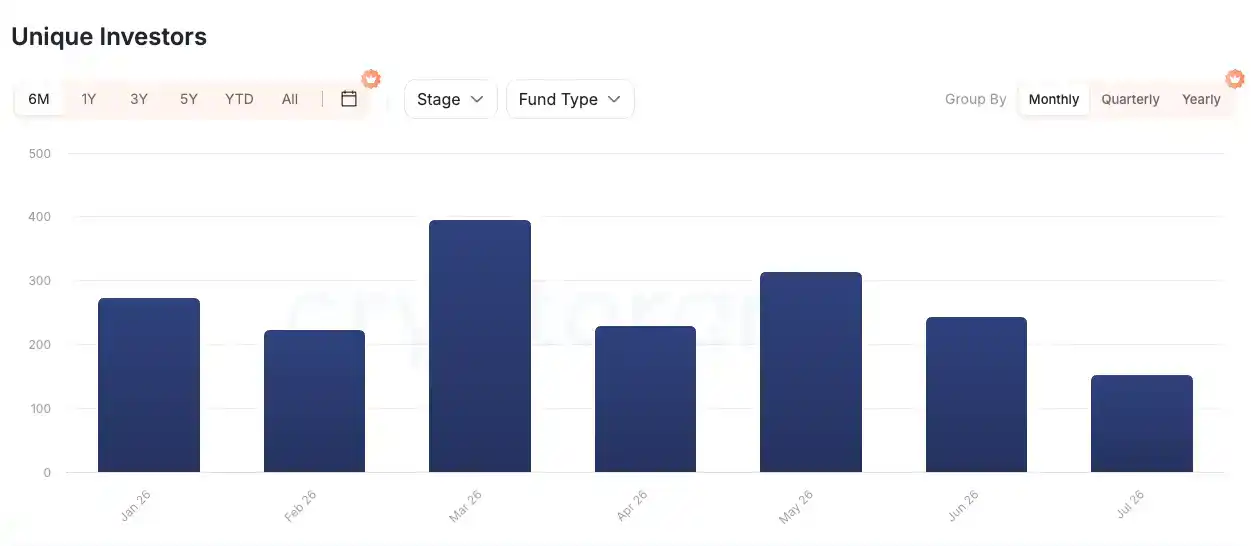
CryptoRank: Monthly Deduplicated Investor Count in 2026

On the other hand, this reduction in crypto venture capital activity is occurring during a phase of expansion in the global venture capital landscape. Global venture capital investment reached $227.4 billion across 8,440 deals in Q2 2026, marking the second-highest quarter on record; the total for the first half of the year reached $560.4 billion, second only to the same period in 2021. Large funding rounds for AI companies like Anthropic, Prometheus, and DeepSeek were the primary drivers.

According to KPMG statistics, by the end of Q2, global VC funds had raised approximately $98.8 billion in the year to date, involving 727 funds. Among these, 19 funds that raised over $1 billion each collectively absorbed $53.2 billion, accounting for more than half of the total. The number of deals remains relatively weak, with large sums primarily flowing to AI and mature companies with proven business models.

Bleeding off this enthusiasm, both capital and deal count in the crypto market have retreated simultaneously. Galaxy Research statistics show that in Q1 2026, crypto and blockchain startups completed 355 funding rounds, raising approximately $4.0 billion, representing quarterly declines of 16% and about 50%, respectively. Only 8 new crypto VC funds completed fundraising in that quarter, raising a total of around $1.1 billion, the lowest since Q3 2020.

Galaxy attributed the fundraising difficulties to multiple factors, including pressure from historical returns due to industry turbulence in 2022-2023, the macro environment, competition for limited partner funds from AI, and the availability of more liquid crypto exposure through spot crypto ETFs and digital asset treasury companies. Global capital remains abundant, but the focus of allocation and the list of favored managers are narrowing.

First 7 Months Funding: $11.778 Billion, May Alone Contributed One-Third

According to CryptoRank's public dashboard as of July 31, crypto projects completed 481 funding rounds in the first 7 months of 2026, with a disclosed total of approximately $11.778 billion.
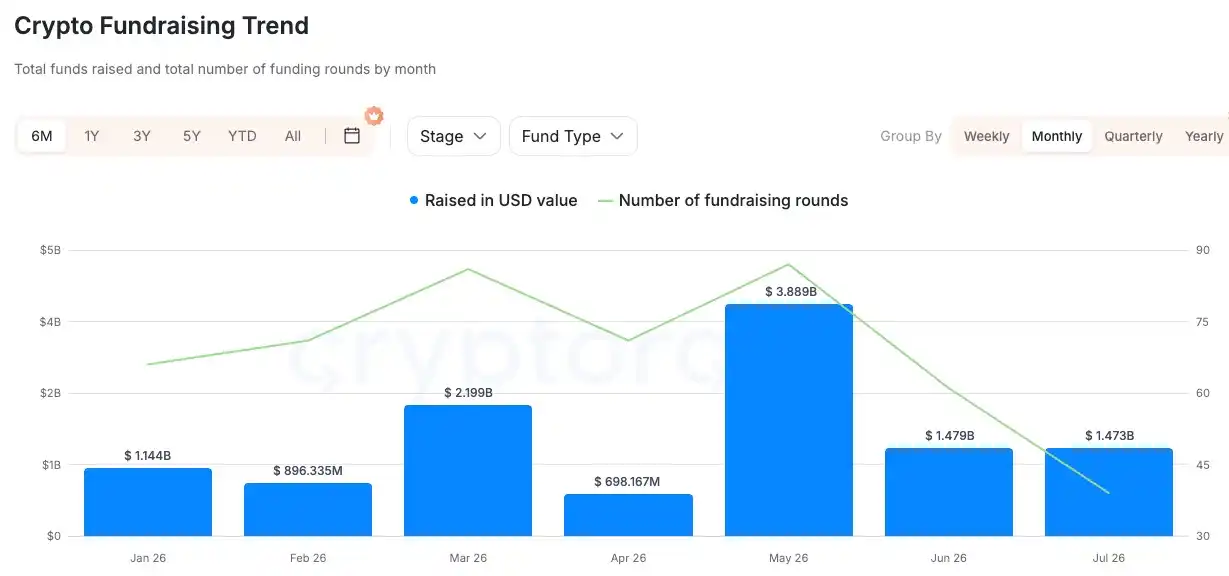
CryptoRank: Monthly Crypto Funding Amount and Number of Rounds in 2026

May, with $3.889 billion across 87 rounds, was the year's high point, accounting for about 33% of the total for the first 7 months. April saw only $698 million across 71 rounds. May's funding amount surged to 5.6 times that of the previous month, while the number of rounds increased by only about 23%. Projects of a similar quantity scale can correspond to vastly different total funding amounts, indicating that a few large deals still dominate the monthly curves.

March and May together absorbed approximately $6.088 billion, accounting for about 52% of the year-to-date total. Funding amounts fell to $1.479 billion in June and $1.473 billion in July, while the number of publicly disclosed rounds dropped from 61 to 39.

Trading Platforms, Prediction Markets, and Payments Absorb 53% of Capital

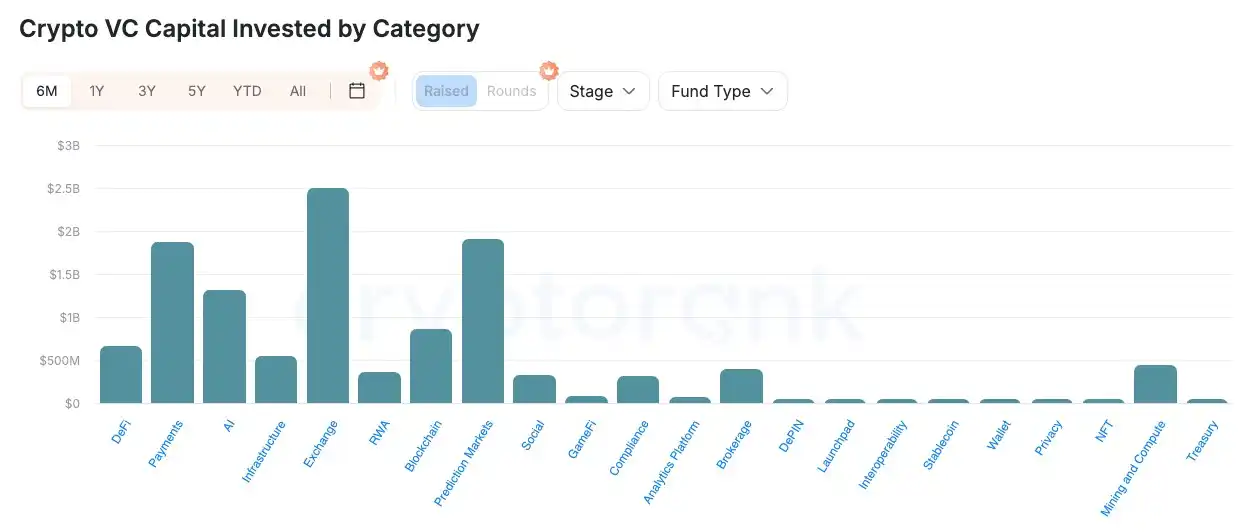
According to CryptoRank's project category classification, Trading Platforms, Prediction Markets, and Payments ranked top three in terms of funding amount for the year to date, raising $2.490 billion, $1.897 billion, and $1.861 billion respectively. Combined, this totals approximately $6.247 billion, representing 53% of the funding for the first 7 months. AI ranked fourth with $1.305 billion.
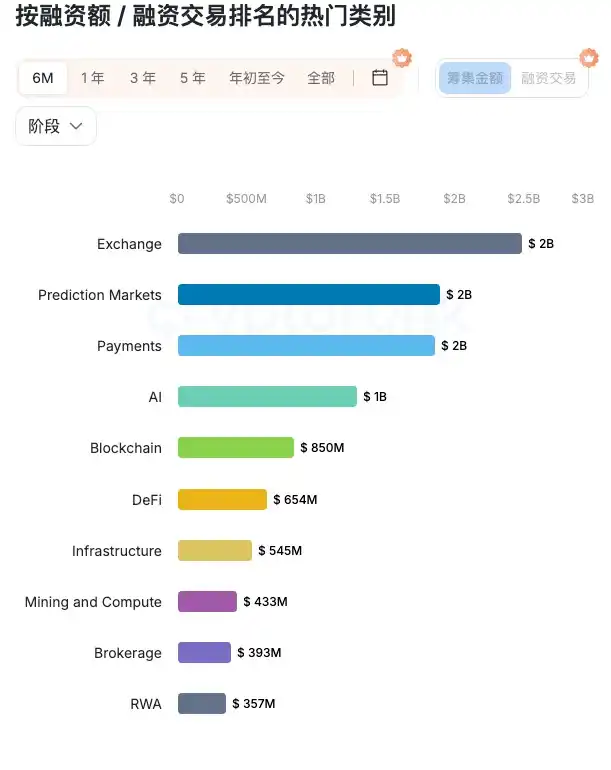
Interestingly, DeFi ranked first with 78 rounds but secured only about $654 million; Payments and AI completed 73 and 65 rounds respectively. High-frequency early-stage funding still exists, but capital is more concentrated in sectors like trading platforms and prediction markets, which can accommodate large later-stage transactions.
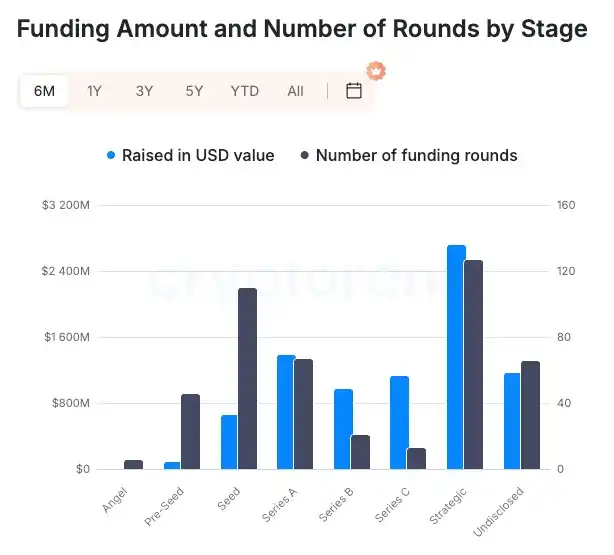
The funding stage further amplifies this disparity. CryptoRank recorded only 20 Series C and later rounds, but they absorbed approximately $3.333 billion. The seed stage, including Pre-Seed and extension rounds, comprised 156 rounds with a disclosed amount of about $750 million. Strategic funding rounds totaled 127, raising about $2.718 billion. Rounds are mainly distributed across early-stage and strategic funding, while the peaks in amount are driven by a handful of late-stage projects.
The value of mergers and acquisitions (M&A) in the crypto industry surged from $272 million in Q4 2025 to $7.23 billion in Q2 2026, expanding over 26-fold in six months. This amount is not included in the aforementioned $11.778 billion funding figure but indicates that capital is also flowing through M&A to companies that have already established business operations and assets.

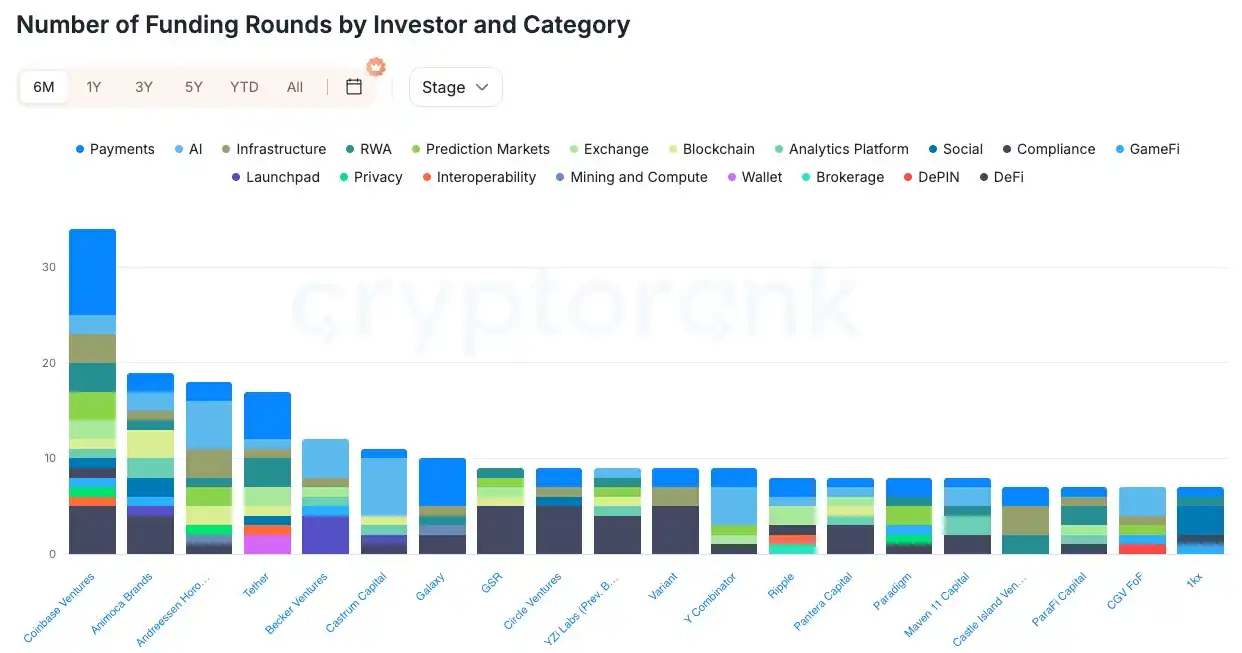
The investor leaderboard also shows a concentration trend. Coinbase Ventures participated in 34 rounds year-to-date, while Animoca Brands, a16z crypto, and Tether participated in 19, 18, and 17 rounds respectively. Repeated investments by a single institution increase the transaction count but do not increase the deduplicated investor metric, explaining the concurrent state where funding activity continues while the total number of active institutions keeps declining.
Top Funds Can Still Raise Capital; Long-Tail Institutions Exiting Reduces Project Options

Dragonfly completed its $650 million fourth fund in February, and a16z crypto announced raising a $2.2 billion fifth fund in June. In contrast, Galaxy Research statistics show that in Q1 2026, only 8 new crypto VC funds completed fundraising, raising a total of approximately $1.1 billion, the lowest since Q3 2020. Top-tier managers can still secure substantial capital, but the list of institutions capable of sustainable fundraising is shrinking.

Rob Hadick, a partner at Dragonfly, previously described in an interview with Fortune magazine that the crypto VC industry is experiencing a "mass extinction." The number of active institutions has shrunk by nearly 90% from its peak, diverging from the concurrent expansion of the global venture capital total. This indicates that this contraction is more a shift in capital allocation. The AI sector and secondary market instruments are simultaneously diverting capital that would have otherwise flowed into primary crypto projects, a trend unlikely to reverse in the short term.

However, early-stage projects can still maintain a certain frequency of transactions, albeit with limited individual deal sizes; large sums of capital are concentrated in a few later-stage sectors like trading platforms and prediction markets, as well as in M&A transactions. This means the crypto primary market has not vanished, but risk appetite has clearly converged, favoring projects with proven business models and accumulated assets.

While top funds complete large fundraises, numerous small and medium-sized institutions are no longer participating in new funding rounds. This landscape has practical implications for startup teams: the pool of potential investors is shrinking, negotiation space on terms is narrowing, and project selection criteria are rising. The decline in the number of institutions, capital scale, and transaction frequency may not necessarily be a negative signal, but it does signify rising industry barriers, with stricter requirements on project quality, capital efficiency, and exit paths than before.


Cryptos en tendance

Questions liées

QAccording to the article, what was the lowest monthly number of unique venture capital firms participating in crypto funding since November 2020?

AAccording to the article, in July, 153 different venture capital firms participated in crypto funding, which was the lowest monthly level since November 2020.

QWhat are the top three project categories in terms of funding received in the first seven months of 2026 according to CryptoRank's data?

AAccording to CryptoRank's data, the top three project categories for funding in the first seven months of 2026 were Trading Platforms, Prediction Markets, and Payments. They received $2.49 billion, $1.897 billion, and $1.861 billion respectively, accounting for 53% of the total.

QHow does the article explain the concurrent situation of decreasing unique crypto investors while the number of funding deals is still ongoing?

AThe article explains this by pointing out that top-tier firms like Coinbase Ventures, Animoca Brands, a16z crypto, and Tether are repeatedly participating in multiple funding rounds. This increases the deal count but does not increase the unique investor count, as the same firms are counted multiple times in deal statistics but only once in the unique investor metric.

QWhat major factor is identified as diverting capital away from the crypto venture sector, according to the analysis in the article?

AThe article identifies the AI sector as a major factor diverting capital. It states that large-scale funding for AI companies like Anthropic, Prometheus, and DeepSeek, along with the expansion of global venture capital, has created significant competition for limited partner funds, drawing investment away from crypto projects.

QWhat term does Dragonfly partner Rob Hadick use to describe the current state of the crypto venture capital industry, and what key evidence supports this description?

ADragonfly partner Rob Hadick describes the current state as a 'mass extinction' for the crypto venture capital industry. The key evidence supporting this is that the number of active investing institutions has shrunk by nearly 90% from its peak of 1,177 in 2022 to just 153 in July, even while global venture capital as a whole is expanding.

Lectures associées

Une transformation majeure de la Fed ? Rapport : Walsh envisage de réduire la fréquence des réunions sur les taux, rompant avec une tradition de 40 ans

Le président de la Fed, Walsh, envisage de réduire la fréquence des réunions du Comité fédéral de l'open market (FOMC), ce qui constituerait un changement majeur dans son fonctionnement, en rupture avec la routine établie depuis 1981 de huit réunions par an. Selon des informations du New York Times, Walsh a évoqué cette idée lors de la réunion cette semaine. Un nouvel horaire pourrait être arrêté avant la prochaine réunion de septembre, bien que les changements concrets interviendraient plus tard. Réduire le nombre de réunions diminuerait les opportunités de voter sur les taux et pourrait affaiblir la capacité de réaction de la Fed face à l'évolution de l'économie, tout en réduisant la transparence de sa politique, inversant une tendance de plusieurs décennies. La loi bancaire de 1935 n'exige qu'un minimum de quatre réunions par an. Walsh avait précédemment déclaré au Congrès que quatre réunions étaient insuffisantes, ce qui contraste avec la direction actuelle des discussions. Le système actuel de huit réunions, instauré sous Paul Volcker, fournit un cadre prévisible. Moins de réunions signifierait moins d'occasions pour le marché de comprendre la trajectoire des taux. Cette initiative s'inscrit dans la volonté plus large de Walsh de réformer l'institution depuis sa prise de fonction en mai, notamment en réduisant la longueur des communiqués et en repensant les conférences de presse. Historiquement, la fréquence des réunions a varié, avec jusqu'à 19 réunions en 1956. Une évaluation interne de 1988 avait conclu que le rythme de huit réunions restait approprié. Le projet de Walsh irait à l'encontre de cette conclusion, et son impact potentiel sur la communication de la Fed et la flexibilité de sa politique sera surveillé de près.

marsbitIl y a 22 mins

Une transformation majeure de la Fed ? Rapport : Walsh envisage de réduire la fréquence des réunions sur les taux, rompant avec une tradition de 40 ans

marsbitIl y a 22 mins

Sélections hebdomadaires de la rédaction (25-31 juillet)

**Résumé éditorial hebdomadaire (25-31 juillet)** Face au flux incessant d'informations, cette sélection met en avant des analyses de fond pour filtrer le bruit et offrir des insights. **Marchés & Investissement :** La Réserve Fédérale américaine a maintenu ses taux lors d'une réunion jugée très incertaine, tiraillée entre des données inflationnistes en baisse et des positions d'hawks. Dans la cryptosphère, Real Vision réfléchit à la valeur à long terme des crypto-monnaies, soulignant l'importance de la conviction face à la volatilité. Une tendance se dessine : les marchés actions globaux, notamment technologiques, adoptent des dynamiques narratives similaires à celles des cryptos. Par ailleurs, la divergence entre la croissance des revenus des protocoles DeFi et la performance de leurs tokens est analysée. **AI & Stockage :** Les marchés s'interrogent sur les risques de crédit liés à l'expansion de l'infrastructure cloud IA, dont Nvidia est un acteur clé. Le secteur du stockage mémoire a connu une forte volatilité, les investisseurs anticipant dès maintenant un risque de surcapacité pour 2027. Le trimestre record de SK Hynix a été jugé « inférieur aux attentes », reflétant la pression sur les valorisations des leaders du secteur. **Politique & Règlementation :** Le Clarity Act, loi crypto américaine cruciale, est dans la dernière ligne droite mais bute sur des désaccords politiques, notamment sur les clauses d'éthique. Son adoption avant la fin de l'année apparaît incertaine. **CeFi, DeFi & Ethereum :** La plateforme TradeXYZ a démontré une précision remarquable pour le prix d'introduction de la société chinoise Changxin Technology. Du côté d'Ethereum, le protocole Lido a entamé une migration massive de plus de 8 millions d'ETH vers une nouvelle architecture de validateurs, un changement structurel pour le staking. **Points chauds de la semaine :** La Fed maintient ses taux ; le règlement MiCA entre en vigueur en Europe ; Sam Altman promet qu'OpenAI va « étonner le monde » dans l'année ; SpaceX a perdu 1 200 milliards de dollars de valorisation depuis son pic ; Apple rejoint le club des 5 000 milliards de dollars de capitalisation.

marsbitIl y a 39 mins

Sélections hebdomadaires de la rédaction (25-31 juillet)

marsbitIl y a 39 mins

Ne pas investir n'est pas un laissez-passer pour Apple

Face aux géants technologiques comme Meta et Google qui font face à des critiques pour leurs dépenses d'investissement massives dans l'IA, Apple, bien qu'en retard dans ce domaine, se distingue par sa retenue budgétaire. Cette approche lui a même permis de retrouver brièvement la première place mondiale en termes de valorisation boursière. Le rapport trimestriel (T3 2026) d'Apple affiche des performances solides, avec un chiffre d'affaires en hausse de 16,4% et un bénéfice net en progression de 27,1%. L'iPhone et le Mac sont les principaux moteurs de cette croissance, compensant les résultats plus modestes de l'iPad (en baisse) et des services (ralentissement de la croissance). Cependant, le marché réagit négativement après la publication des résultats, en raison des perspectives prudentes pour le trimestre suivant. Apple anticipe des contraintes d'approvisionnement majeures, notamment pour les puces et la mémoire, entraînant des hausses de prix sur ses produits. Contrairement à ses concurrents qui investissent des milliards dans l'infrastructure IA, Apple maintient des dépenses d'investissement (capex) faibles, privilégiant les dépenses de R&D. Malgré cela, l'entreprise n'échappe pas aux répercussions de la frénésie de l'IA, qui exacerbe les tensions sur sa chaîne d'approvisionnement. Ce rapport marque la dernière conférence téléphonique de Tim Cook en tant que PDG, avant son départ prévu en septembre. Il exprime sa confiance dans l'avenir de l'entreprise.

marsbitIl y a 1 h

Ne pas investir n'est pas un laissez-passer pour Apple

marsbitIl y a 1 h

PA Figure | Une infographie pour comprendre les grands événements de l'écosystème Web3 en août 2026

Août 2026 s'annonce chargé pour l'écosystème Web3, marqué par plusieurs événements clés susceptibles d'influencer les marchés. L'agenda macroéconomique sera déterminant, avec la publication des données américaines sur l'emploi (non-farm payrolls) et l'inflation (CPI) de juillet, ainsi que les comptes-rendus de la Réserve Fédérale et le symposium annuel de Jackson Hole. Sur le front réglementaire, des développements majeurs sont attendus : le Sénat américain doit dévoiler un nouveau projet de loi (*CLARITY Act*), tandis que l'interdiction des transactions cryptos de l'UE envers la Biélorussie entre en vigueur. Les marchés devront également absorber des déblocages massifs de jetons (**ENA, AVAX, CONX, ZRO, KAITO**, etc.), susceptibles de créer de la volatilité. Par ailleurs, l'industrie continuera son consolidation, avec l'arrêt ou la refonte prévus de plusieurs services comme Exchange Art, Ctrl Wallet, Zapper, NFTfi et Summer.fi, incitant les utilisateurs à gérer leurs actifs en conséquence. Du côté des entreprises, les résultats du Q2 de **SpaceX, Circle et Nvidia** seront publiés, et des levées de fonds importantes sont au programme, notamment pour la société chinoise Moonshot AI (pré-IPO). Enfin, des événements sectoriels majeurs comme **Bitcoin Asia 2026** et le **China Digital Expo 2026** se tiendront. En résumé, le mois d'août sera structuré autour des anticipations macroéconomiques, de l'évolution réglementaire, des déblocages de tokens et de la consolidation continue du secteur.

marsbitIl y a 1 h

PA Figure | Une infographie pour comprendre les grands événements de l'écosystème Web3 en août 2026

marsbitIl y a 1 h

Trading

Spot

Articles tendance

Comment acheter F

Bienvenue sur HTX.com ! Nous vous permettons d'acheter Synfutures (F) de manière simple et pratique. Suivez notre guide étape par étape pour commencer votre parcours crypto.Étape 1 : Création de votre compte HTXUtilisez votre adresse e-mail ou votre numéro de téléphone pour ouvrir un compte sur HTX gratuitement. L'inscription se fait en toute simplicité et débloque toutes les fonctionnalités.Créer mon compteÉtape 2 : Choix du mode de paiement (rubrique Acheter des cryptosCarte de crédit/débit : utilisez votre carte Visa ou Mastercard pour acheter instantanément Synfutures (F).Solde :utilisez les fonds du solde de votre compte HTX pour trader en toute simplicité.Prestataire tiers :pour accroître la commodité d'utilisation, nous avons ajouté des modes de paiement populaires tels que Google Pay et Apple Pay.P2P :tradez directement avec d'autres utilisateurs sur HTX.OTC (de gré à gré) : nous offrons des services personnalisés et des taux de change compétitifs aux traders.Étape 3 : stockage de vos Synfutures (F)Après avoir acheté vos Synfutures (F), stockez-les sur votre compte HTX. Vous pouvez également les envoyer ailleurs via un transfert sur la blockchain ou les utiliser pour trader d'autres cryptos.Étape 4 : tradez des Synfutures (F)Tradez facilement Synfutures (F) sur le marché Spot de HTX. Il vous suffit d'accéder à votre compte, de sélectionner la paire de trading, d'exécuter vos trades et de les suivre en temps réel. Nous offrons une expérience conviviale aux débutants comme aux traders chevronnés.

339 vues totalesPublié le 2024.12.21Mis à jour le 2026.06.02

Comment acheter F

Discussions

Bienvenue dans la Communauté HTX. Ici, vous pouvez vous tenir informé(e) des derniers développements de la plateforme et accéder à des analyses de marché professionnelles. Les opinions des utilisateurs sur le prix de F (F) sont présentées ci-dessous.

活动图片