Now the Greatest Regret Is to My Family: Crypto Experts Took a Stumble in the Stock Market

marsbitPublié le 2026-07-30Dernière mise à jour le 2026-07-30

Résumé

Summary: This article examines the significant losses recently suffered by cryptocurrency traders and influencers who ventured into the stock market, specifically by heavily investing in AI-related and semiconductor storage stocks. The narrative centers on the dramatic reversal in the Korean and US equity markets in late July, with stocks like SK Hynix and related leveraged ETFs experiencing historic plunges, erasing massive gains. The analysis highlights several key factors behind the "flip." Traders, accustomed to crypto's high volatility and frustrated by a stagnant market, chased the apparent momentum in AI-themed equities. Many made fatal mistakes: applying high-leverage strategies common in crypto (e.g., 2x ETFs, on-chain perpetual contracts) to stocks, and failing to understand the distinct rules of different stock markets (like Korean pre-market trading). This led to widespread liquidations, especially when a thin Korean pre-market trade triggered a cascading flash crash on a decentralized exchange. Post-crash reflections from prominent figures reveal deep regret and self-criticism. They acknowledge misjudging their expertise, overestimating their edge against sophisticated institutional players, and the dangers of leverage. The article concludes that while such setbacks are part of trading, surviving long-term requires recognizing one's limitations and the inherent risks of cross-market strategies.

"Now, the greatest regret is to my family."

Lately, the frequency of hearing this phrase is no less than that of "Do you believe in the light?" and "You should stand in the light, not let the light stand there" from two months ago.

These two short sentences encapsulate a 180-degree reversal in the market and a landscape of shattered hearts.

According to public data, South Korean stock SK Hynix has halved from its June high, erasing over 1,000 trillion won (approximately $800 billion) in market capitalization. The KOSPI index has retreated about 30% from its peak and has experienced 9 trading halts this year.

On July 28th, SK Hynix fell over 10%. U.S. memory stocks also plunged collectively, with SanDisk, Western Digital, Seagate, and Micron dropping 8% to 13% in a single day.

On July 29th, SK Hynix fell sharply again, dropping nearly 20% intraday, while a 2x long Hynix ETF plummeted over 30%, both setting their largest single-day declines in history.
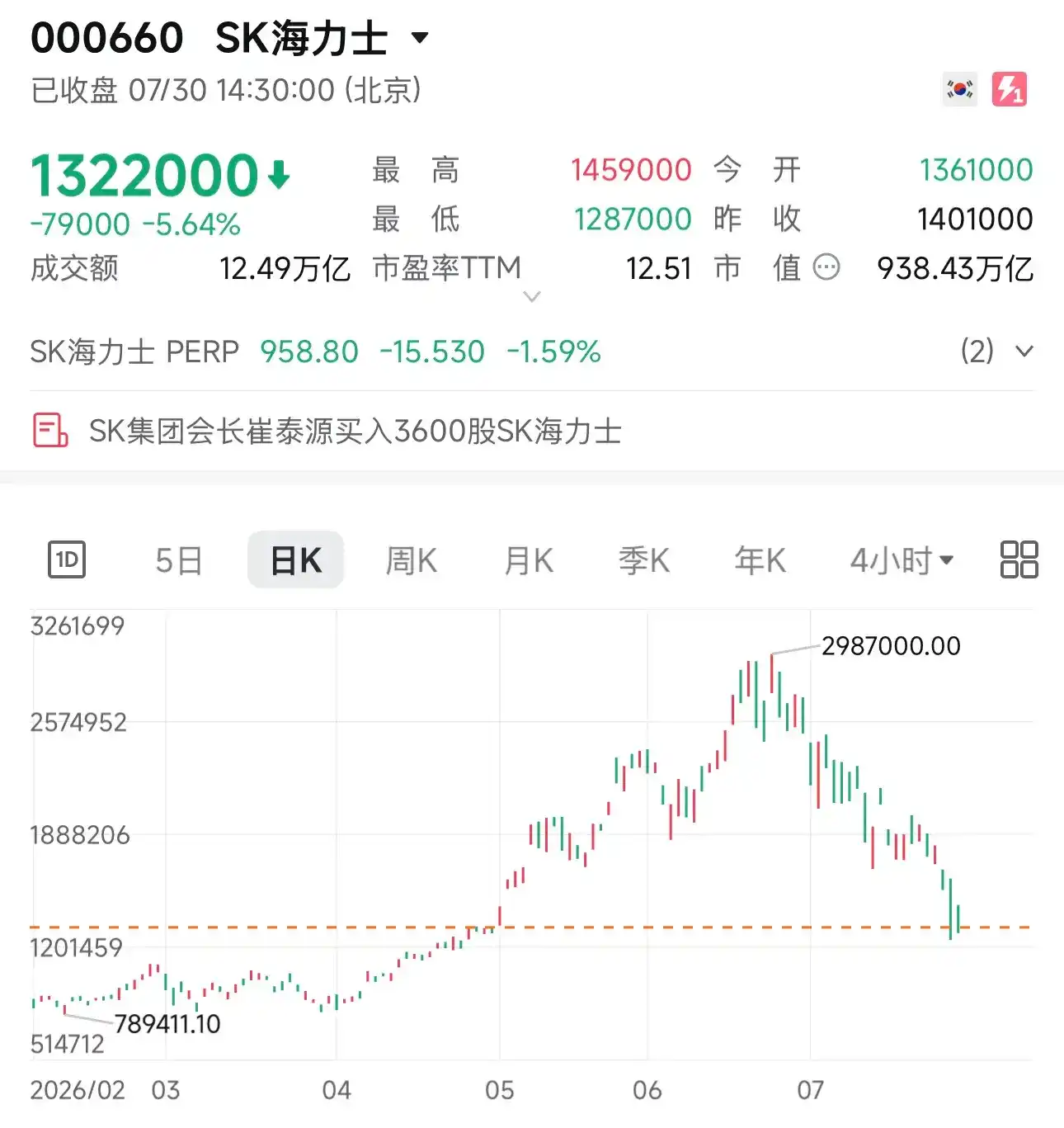
A cross-market bloodbath thus unfolded. The extreme volatility flushed out numerous big V's and traders from the crypto circle. Among them were those who had earned their first pot of gold in the crypto market and those who had already achieved financial freedom. Now, all that's left are reflections and declarations of leaving the scene.
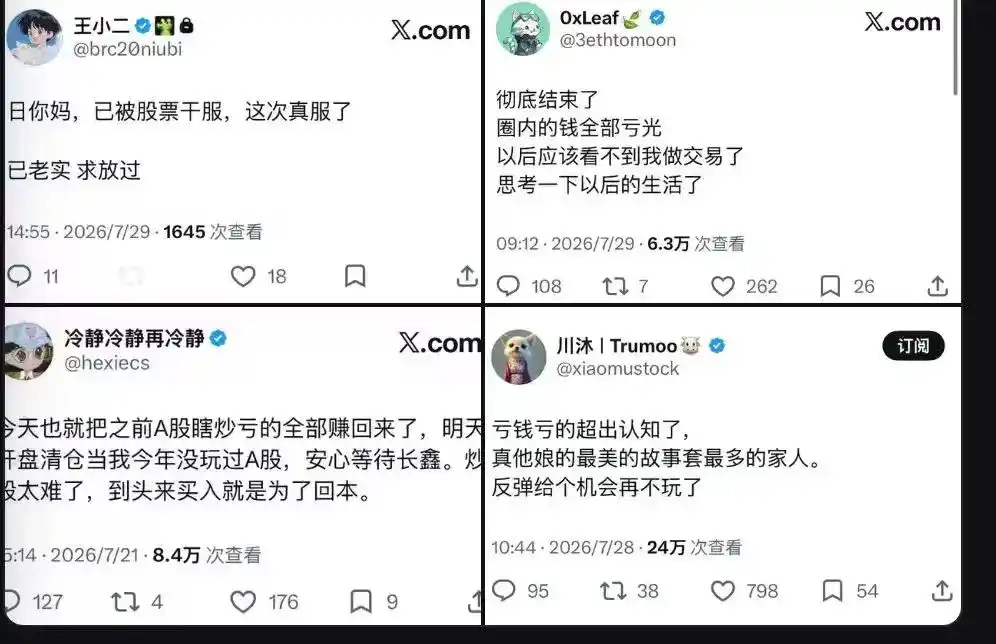
Half Market Conditions, Half Human Nature

Perhaps because the crypto market had been too quiet for too long, memory stocks became the best destination for active capital.

Dp Dapeng (@Dp520888) posted that from the end of last year to the first half of this year, the crypto market was in a constant downtrend. Bitcoin barely caught its breath around $60,000, while South Korean and U.S. stock markets soared on the AI narrative during the same period. Major exchanges, in their efforts to expand markets, had also opened up stock trading access.

He noted that he saw many crypto peers painfully cut losses on their crypto assets and go all-in on Micron and SanDisk at highs, only to lose over 30% subsequently. Had this money stayed in crypto, they could have at least held on until Bitcoin fell to $40,000.

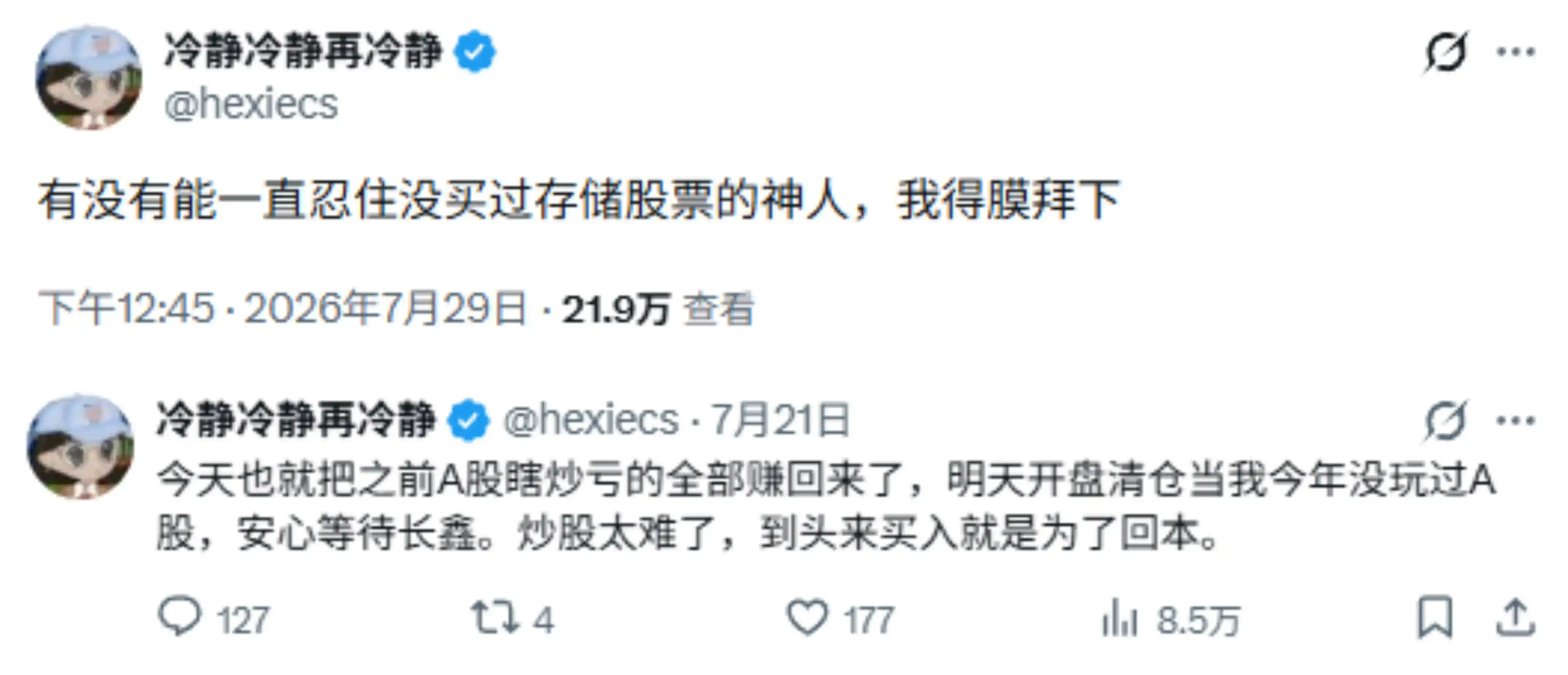
People accustomed to high volatility and tormented by the lack of profit-making opportunities for over half a year found it hard to resist chasing the market that seemed more lucrative. As @hexiecs posted, "Is there any god who has always resisted buying memory stocks? I need to worship them."
However, narratives like AI, GPU, and storage come and go quickly in capital markets. Nvidia's stock price peaked in May and has already wiped out this year's gains, with its total market cap recently overtaken again by Apple. Now it's just storage's turn.

So, the starting point of this crash is half market conditions, half human nature.

Why the Crash This Time?

People transitioning from the crypto circle to the stock market are prone to culture shock.

On one hand, it's the leverage habit. Many start with 2x long positions or add even higher leverage via on-chain perpetual contracts. The same bearish candle that represents a mere pullback in a spot account becomes a liquidation event in a leveraged account.

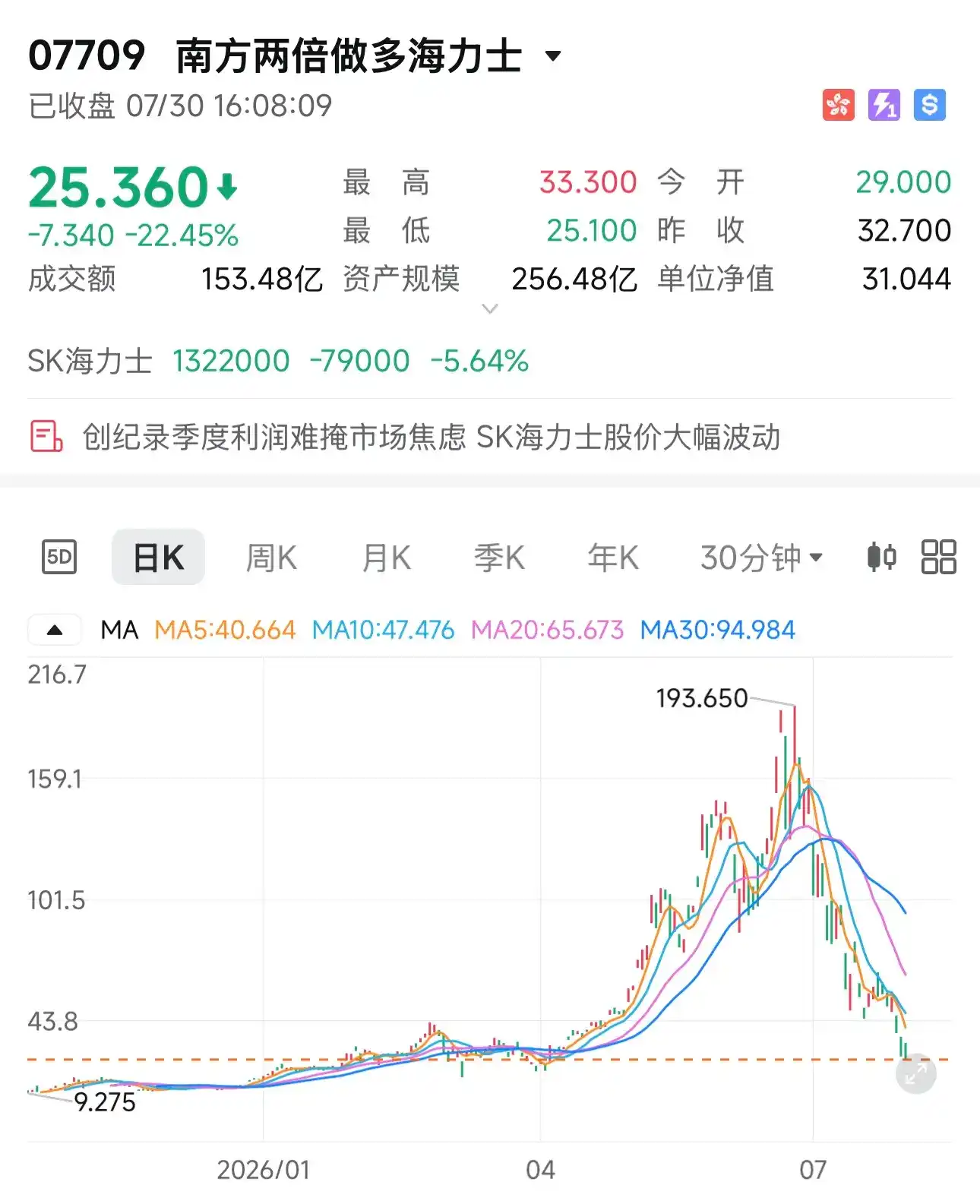
How severe the damage to leveraged products was this round can be seen by looking at the South Korean 2x Long Hynix ETF. This fund was once the world's largest single-stock leveraged product, with peak assets around 130 billion HKD. Its cumulative decline since July has exceeded 80%, with assets now down to 25.6 billion HKD. Another 2x Long Samsung Electronics ETF also fell about 70% this month.
According to Hyperliquid data, on July 29th, the combined 24-hour trading volume for Hynix-related contracts SKHX and SKHY on the platform reached $1.765 billion, becoming the most actively traded asset on the platform, with heat and volume even surpassing BTC.

On the other hand, it's the rule differences. The stock market itself has several sets of rules: U.S. stocks have after-hours trading, South Korean stocks have NXT pre-market, A-shares have price limits, Hong Kong stocks have another set, each with its own trading hours, price bands, and settlement rhythms.

When these underlying assets are packaged into on-chain perpetual contracts, the extreme rules of other markets are bundled in as well. The wick on Hyperliquid on July 28th is a living example.

It is reported that on that day, only one lot of SK Hynix traded in the South Korean pre-market at around $868, about 30% lower than the previous close, right near the lower limit of the price band. This less than $900 real transaction was fed into the chain via the oracle, causing the SKHX perpetual contract to flash crash about 18% in one minute.

According to on-chain data, approximately $80 million was liquidated in the subsequent four hours, with open interest evaporating about $150 million.
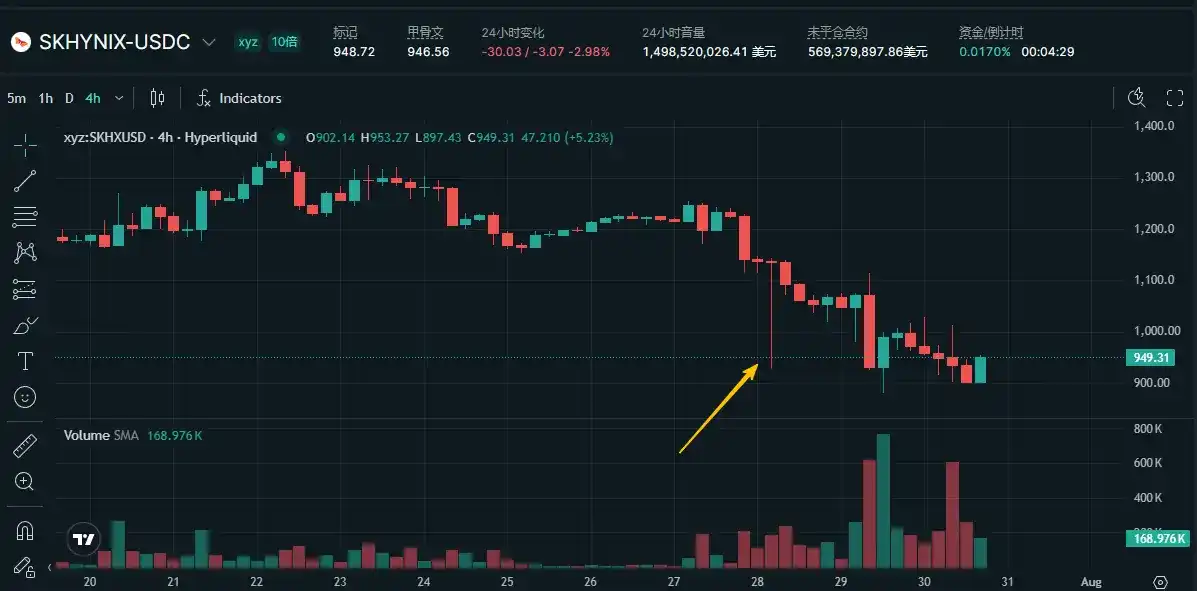
Trade.xyz announced that this price was synchronized from that real transaction in the South Korean pre-market, with the oracle operating according to specifications and no technical error. Although Trade.xyz decided to fully compensate for the liquidation losses this time, it specifically stated this does not constitute a guarantee for similar situations in the future.

Reflections After the Bloodbath

After this bloodbath, many big V's on X began to reflect. Their review focus largely fell on whether the methods they had relied on to make money over the years were still effective after switching markets.

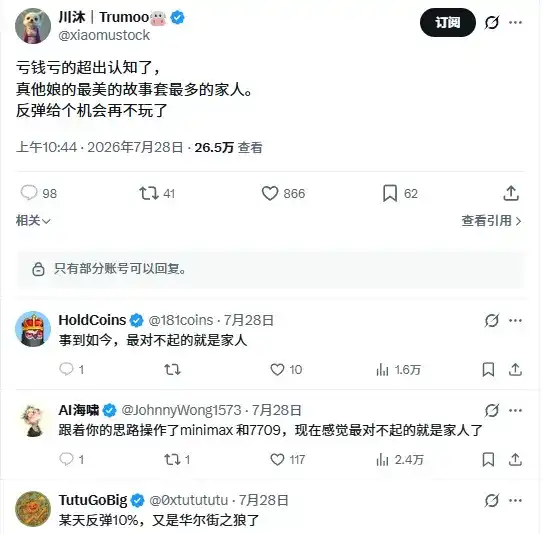
Chuanmu (@xiaomustock) stated that he made and lost money on storage stocks this year. The reason Buffett has survived in the capital market for so long is inseparable from his style of avoiding leverage, not going all-in, and always holding significant idle cash. Ordinary people either lose sleep from anxiety over using leverage to get rich quickly, or continue using leverage after making money, anxious in both profit and loss.
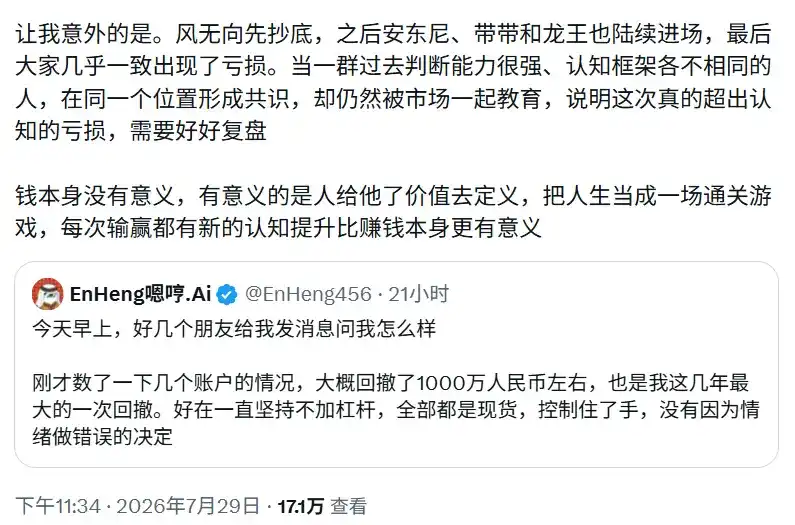
KOL En Heng (@EnHeng456) recounted his three major losses since entering the industry, with this storage wave being the heaviest, resulting in a combined drawdown of over ten million across several accounts, but fortunately, it was all spot trading with no leverage.

He also pointed out that multiple traders with consistently strong judgment and different cognitive frameworks successively entered the market, yet almost all ended up losing. When such a group forms a consensus at the same position but is collectively taught a lesson by the market, it indicates that this loss indeed exceeded their original understanding.
Zishi (@silverfang888), who claimed to have been liquidated for $20 million in semiconductors, also said his biggest regret was moving from crypto to trading stocks. In his view, he is merely a crypto player with limited insight, sitting across from people in the U.S. stock market arena whose cognition and capital far surpass his own.

After being liquidated, many fell into intense self-negation, attributing the losses of these months to their own shallow insight and low cognition. The concentrated outbreak of such emotions also serves as a reminder to everyone using leverage as an amplifier: what the market takes is never just the principal.

Some offered comfort, saying whose trading career hasn't experienced a few such drawdowns? Money lost can be treated as tuition paid. As long as one is still here with spirit intact, there will always be another journey ahead.

In truth, there are very few who can consistently win in the market. Those who can journey a bit further are often those who can still see their own boundaries at different stages.


Cryptos en tendance

Questions liées

QAccording to the article, what is the main reason behind the significant losses of crypto traders in the stock market?

AThe main reasons are a combination of market conditions and human nature. Crypto traders, accustomed to high volatility, moved to the AI-driven stock market for better returns. However, they faced issues like improper use of leverage and unfamiliarity with the different trading rules of stock markets (like pre-market sessions and price bands), which led to severe losses when the storage sector crashed.

QHow did the specific event on Hyperliquid on July 28th cause major liquidations?

AOn July 28th, a single SK Hynix share traded for around $868 in the Korean pre-market, about 30% lower than the previous close. This price, fed into the chain via an oracle, caused the SKHX perpetual contract on Hyperliquid to flash-crash by about 18% in one minute. This led to approximately $80 million in liquidations and a $150 million drop in open interest over the next four hours.

QWhat is one key trading habit from the crypto world that proved detrimental in the stock market?

AOne key detrimental habit was the immediate use of high leverage. Many traders started with 2x leveraged ETFs or even higher leverage on perpetual contracts. This meant that a price decline that would be a simple drawdown in a spot account resulted in margin calls and liquidations in leveraged positions.

QWhat major reflection did trader '川沐' (@xiaomustock) share after the losses?

ATrader '川沐' reflected that his gains and losses this year both came from the storage sector. He noted that Warren Buffett's longevity in the market is tied to his style of avoiding leverage, not going all-in, and always keeping a large amount of cash on hand. In contrast, ordinary people either lose sleep over leverage-driven anxiety to get rich or continue using leverage after profits, leading to anxiety in both winning and losing.

QWhat was the final attitude or lesson some traders expressed after the market crash?

AAfter the crash, some traders expressed a lesson in humility and recognizing one's boundaries. They acknowledged that moving from the crypto circle to the stock market meant competing against players with far superior knowledge and capital. While some fell into self-doubt, others offered comfort, stating that such drawdowns are part of a trading career, and as long as one's spirit remains, there will always be another opportunity.

Lectures associées

Bitcoin en août : les experts s'attendent à une vérification de la fourchette de prix, et non à un retournement rapide

Le Bitcoin pourrait rester sous pression en août, estiment les analystes. Après le rebond de juillet, le marché ne semble pas prêt pour une hausse soutenue et le risque d'une baisse sous les 60 000 $ persiste. La principale cryptomonnaie, négociée autour de 63 500 $ fin juillet, reste dans le couloir 60 000-65 000 $ observé depuis juin. Les experts citent un environnement macroéconomique difficile : des taux d'intérêt américains élevés, une inflation tenace et un dollar fort pèsent sur l'appétit pour les actifs risqués. Les ETF américains sur Bitcoin ont connu des sorties nettes record au premier semestre, reflétant un intérêt institutionnel modéré. Historiquement, août est un mois faible pour le marché crypto. Les scénarios pour le mois à venir vont d'un mouvement latéral (58 000-68 000 $, probabilité de 50%) à une baisse vers 50 000-55 000 $ (probabilité de 30%) ou une hausse vers 71 000-75 000 $ (probabilité de 20%). Les niveaux clés à surveiller sont le support à 60 000-61 000 $ et une résistance à 67 000 $. Bien que certains experts voient les niveaux actuels comme intéressants pour un investissement à long terme, ils conseillent la prudence, estimant qu'un cycle haussier plus significatif ne pourrait intervenir qu'au quatrième trimestre. Les investisseurs sont invités à surveiller les taux d'intérêt, l'inflation, les flux des ETF et le sentiment général envers le risque.

cryptonews.ruIl y a 2 h

Bitcoin en août : les experts s'attendent à une vérification de la fourchette de prix, et non à un retournement rapide

cryptonews.ruIl y a 2 h

Portefeuille matériel Coldcard piraté : les hackers ont retiré 594 bitcoins en 25 minutes

Les portefeuilles matériels, comme le Coldcard de Coinkite, ont subi une faille majeure : une erreur de codage vieille de cinq ans a compromis la génération sécurisée des phrases de récupération (seed). Au lieu d'utiliser un véritable générateur de nombres aléatoires, les appareils produisaient des clés à partir de données prédictibles (numéro de série et horloge interne), réduisant drastiquement l'entropie (environ 40 à 72 bits contre 128 requis). Le 30 juillet 2026, des pirates ont exploité cette vulnérabilité pour extraire 594,5 bitcoins (environ 40 millions de dollars) en seulement 25 minutes, via une attaque hors ligne par force brute. Coinkite a reconnu que tous les appareils utilisant les micrologiciels affectés étaient vulnérables. La société a publié des mises à jour de sécurité (versions 4.2.0 pour Mk3, 5.6.0 pour Mk4/Mk5, 1.5.0Q pour le modèle Q) mais exclut toute compensation financière. Pour se protéger, les utilisateurs doivent impérativement : installer la mise à jour, générer une **nouvelle** phrase de récupération sur l'appareil mis à jour, et transférer **tous** leurs fonds vers de nouvelles adresses dérivées de cette nouvelle seed. Une phrase secrète BIP-39 peut compléter la sécurité, mais ne remplace pas cette migration. Cet incident, similaire à une faille passée dans OpenSSL/Debian, souligne que même le matériel spécialisé n'est pas infaillible et nécessite des audits indépendants continus, notamment pour les fonctions cryptographiques. Il remet en question la frontière perçue entre la sécurité matérielle et logicielle.

cryptonews.ruIl y a 2 h

Portefeuille matériel Coldcard piraté : les hackers ont retiré 594 bitcoins en 25 minutes

cryptonews.ruIl y a 2 h

Circle atteint une étape importante en matière de régulation, obtenant une licence d'activité fiduciaire du Département des Services Financiers de l'État de New York (NYDFS)

Circle, une société de services financiers et de stablecoins, a atteint une étape importante en obtenant une licence d'activité fiduciaire limitée du Département des services financiers de l'État de New York (NYDFS). Cette licence permet à Circle d'élargir ses activités dans l'État, notamment en offrant des services de garde d'actifs, en émettant des stablecoins approuvés par l'État et en gérant les réserves qui les soutiennent. La société est enregistrée en tant que fiduciaire à champ d'activité limité, tandis que sa division financière détient déjà une licence BitLicense. Circle devient ainsi l'une des entreprises les plus réglementées du secteur des cryptomonnaies. Le cofondateur et PDG Jeremy Allaire a salué cette réalisation, soulignant que la licence était un objectif de longue date pour Circle, offrant une clarté réglementaire. Il a qualifié le NYDFS d'autorité internationale fixant les normes pour les actifs numériques et a affirmé que cette licence positionnait le stablecoin USDC de Circle au sein d'un système solide et respecté. Cette approbation fait suite à l'autorisation précédente de l'OCC pour la création de Circle National Trust, plaçant les activités de stablecoins de la société sous supervision fédérale et visant un nouveau standard de transparence et de gouvernance.

cryptonews.ruIl y a 3 h

Circle atteint une étape importante en matière de régulation, obtenant une licence d'activité fiduciaire du Département des Services Financiers de l'État de New York (NYDFS)

cryptonews.ruIl y a 3 h

Trading

Spot

Articles tendance

Comment acheter T

Bienvenue sur HTX.com ! Nous vous permettons d'acheter Threshold Network Token (T) de manière simple et pratique. Suivez notre guide étape par étape pour commencer votre parcours crypto.Étape 1 : Création de votre compte HTXUtilisez votre adresse e-mail ou votre numéro de téléphone pour ouvrir un compte sur HTX gratuitement. L'inscription se fait en toute simplicité et débloque toutes les fonctionnalités.Créer mon compteÉtape 2 : Choix du mode de paiement (rubrique Acheter des cryptosCarte de crédit/débit : utilisez votre carte Visa ou Mastercard pour acheter instantanément Threshold Network Token (T).Solde :utilisez les fonds du solde de votre compte HTX pour trader en toute simplicité.Prestataire tiers :pour accroître la commodité d'utilisation, nous avons ajouté des modes de paiement populaires tels que Google Pay et Apple Pay.P2P :tradez directement avec d'autres utilisateurs sur HTX.OTC (de gré à gré) : nous offrons des services personnalisés et des taux de change compétitifs aux traders.Étape 3 : stockage de vos Threshold Network Token (T)Après avoir acheté vos Threshold Network Token (T), stockez-les sur votre compte HTX. Vous pouvez également les envoyer ailleurs via un transfert sur la blockchain ou les utiliser pour trader d'autres cryptos.Étape 4 : tradez des Threshold Network Token (T)Tradez facilement Threshold Network Token (T) sur le marché Spot de HTX. Il vous suffit d'accéder à votre compte, de sélectionner la paire de trading, d'exécuter vos trades et de les suivre en temps réel. Nous offrons une expérience conviviale aux débutants comme aux traders chevronnés.

677 vues totalesPublié le 2024.12.10Mis à jour le 2026.06.02

Comment acheter T

Discussions

Bienvenue dans la Communauté HTX. Ici, vous pouvez vous tenir informé(e) des derniers développements de la plateforme et accéder à des analyses de marché professionnelles. Les opinions des utilisateurs sur le prix de T (T) sont présentées ci-dessous.

活动图片












