In the Second Half of 2026, Commodities Enter an Era of 'High-Frequency Black Swans'

marsbitPublié le 2026-07-24Dernière mise à jour le 2026-07-24

Résumé

Heading into the second half of 2026, Citigroup warns that the commodities market is entering an era of "High-Frequency Black Swans," where extreme, paradigm-shifting events are becoming increasingly common. The report outlines major tail-risk scenarios beyond its baseline forecasts. The highest-impact scenario is a prolonged US-Iran conflict disrupting Gulf energy infrastructure and key shipping chokepoints, potentially causing a sustained 5-10 million barrel per day oil supply deficit and pushing crude prices above $200/barrel. Other geopolitical risks include stricter sanctions on Russian energy, which would hit gas markets harder than oil, particularly liquefied natural gas (LNG). A high-probability risk is a global scramble by governments to stockpile critical minerals. Large-scale strategic buying, particularly of copper, could drive prices above $20,000/ton. For gold, Citigroup sees near-term downside risk towards $3,800/ounce before a potential long-term rally to $6,000/ounce, supported by central bank demand and de-dollarization trends. An extreme El Niño weather pattern poses a medium-probability, high-impact threat to agriculture, potentially sending cocoa prices back to $10,000/ton and sugar above 20 cents/pound. The AI boom presents a dual-sided risk: a bust would hurt metals and power demand, while sustained growth would exacerbate structural deficits in copper and aluminum. Two other significant scenarios are the finalization of Russia's Power of Siberia 2 ...

Original Author: Bao Yilong

Original Source: Wall Street Insights

Amidst the interweaving of geopolitics, climate, and technological shocks, Citigroup believes that "black swan" events in the commodity markets are evolving from once-a-decade occurrences to a near-normal state.

Zhuifeng Trading Desk News, July 23 – Citigroup Research’s Eric G Lee team released a report, outlining potential extreme risk scenarios for the second half of 2026 and beyond, with price shocks large enough to render traditional supply-demand analysis frameworks obsolete.

The tail-risk scenarios covered by Citigroup Research include: U.S.-Iran conflict evolving from a temporary shock into a multi-year persistent disturbance; a key mineral stockpiling race; gold falling 15-20% first and then doubling; extreme El Niño weather impacting agricultural products; AI bubble bursting or sustained boom triggering two-way volatility, etc.

Since 2020, the commodity markets have already experienced unprecedented density of extreme events: the COVID-19 pandemic, Russia-Ukraine conflict, trade wars, central bank gold-buying waves, and repeatedly flaring Middle East conflicts.
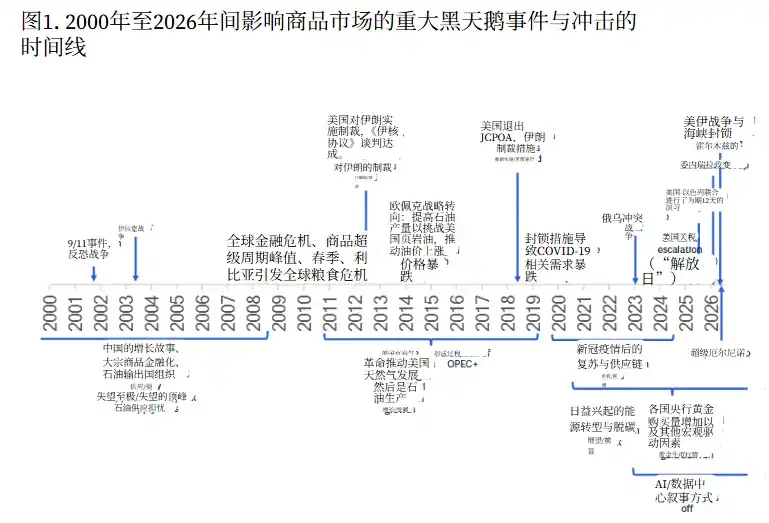
The report points out that these risk scenarios are not baseline forecasts, but rather "plausible events with high impact should they occur" tail scenarios, intended to supplement Citigroup's existing baseline forecast framework.

Highest Risk: U.S.-Iran Conflict Evolving into a Multi-Year Supply Crisis

Citigroup ranks the escalation of the U.S.-Iran conflict as the most impactful tail scenario, though its probability of occurrence is assessed as "low."

The report notes that from the "12-day war" in June 2025 when the U.S. and Israel jointly struck Iranian nuclear facilities, to the conflict resuming in February 2026, a fragile ceasefire agreement signed in June 2026, and renewed military escalation in July 2026, oil and refined product prices have already experienced multiple rounds of severe volatility.

If the conflict expands further, Iran could attack energy infrastructure in Gulf oil-producing countries. Combined with prolonged closures of the Strait of Hormuz and disruptions in the Bab el-Mandeb Strait, the world could face a sustained supply deficit of 5 to 10 million barrels per day.

Citigroup estimates that, assuming a demand elasticity of approximately -0.05, supply losses of this magnitude would drive oil prices up 100% to 200%, meaning flat price crude oil surpassing $200/barrel, with U.S. retail gasoline prices persistently remaining above $6/gallon.

Citing historical data, the report states, if global oil inventories excluding China fall below 70 days of consumption coverage, the corresponding actual Brent price has reached above $150/barrel.
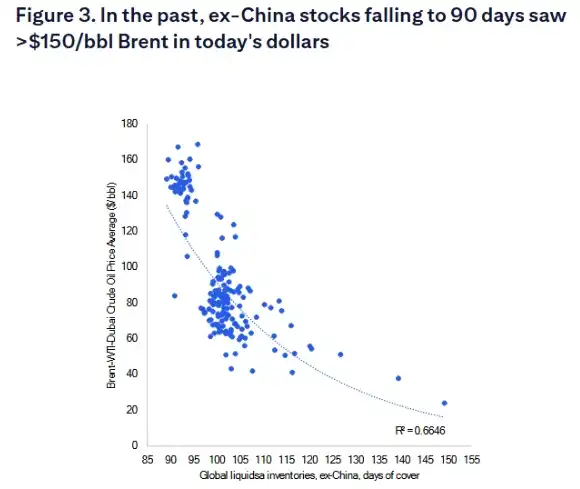
(Historically, if crude oil inventories in regions excluding China fell to the 90-day low point, Brent once reached above $150/barrel)

If the oil & gas expenditure's share of GDP were to repeat the 8% peak of the second oil crisis in the 1970s, the required oil price level would exceed $200/barrel.
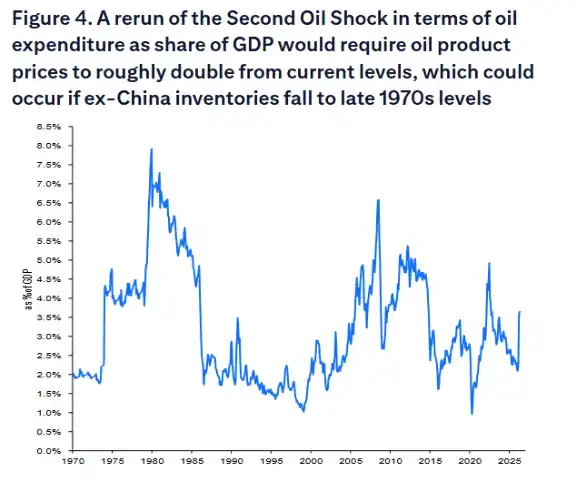
(If inventories outside China fall to levels seen in the late 1970s, oil product prices roughly double from current levels)

As of July 2026, total global oil inventories excluding China remain around 94 days of consumption. However, Citigroup predicts that if a global deficit of 7 to 8 million barrels per day persists, this metric could fall below 70 days by early 2027.

Russia-Ukraine Escalation: Natural Gas Market Impact Expected to Exceed Crude Oil

Citigroup rates the possibility of stricter restrictions on Russian energy exports as "medium probability," emphasizing its impact on the natural gas market would be greater than on crude oil.

For liquefied natural gas (LNG), Russia exported about 44 billion cubic meters (bcm) in 2025, accounting for approximately 7% of global LNG supply, mainly from the Yamal LNG and Sakhalin-2 projects.
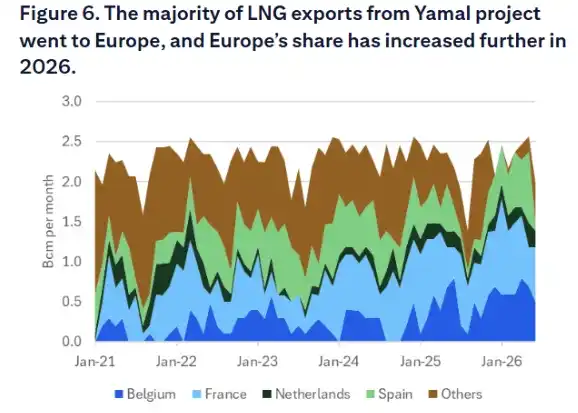
(Most LNG from the Yamal project is exported to Europe, with Europe's share set to rise further in 2026)

Of this, over 70% of Sakhalin-2 exports go to Japan and South Korea; around 90% of Yamal project exports are directed to Europe as of mid-2026.
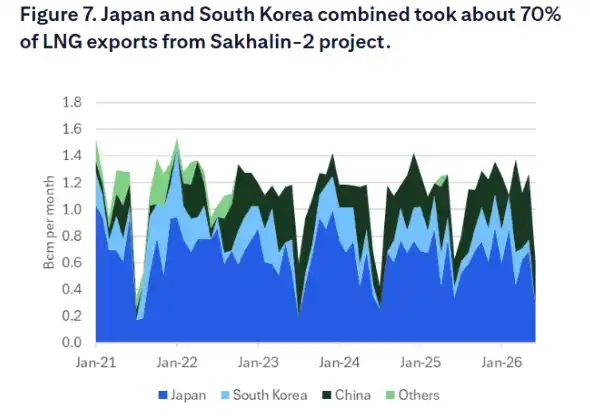
(Japan and South Korea together account for about 70% of LNG export share from the Sakhalin-2 project)

If a global ban on Russian LNG purchases were implemented, over 30 bcm of annual supply would need to be relocated. However, due to shipping and contractual limitations, the global LNG market would face a significant supply gap.

For pipeline gas, the damage from banning purchases of Russian pipeline gas would be even greater due to the physical constraints of pipelines limiting flexible redirection of gas flows.

Russia exports over 70 bcm of pipeline gas annually to markets outside China, with Europe and Turkey alone importing about 37 bcm combined.

Key Mineral Stockpiling: Copper Prices Could Break Through $20,000/Ton

Citigroup rates the probability of a key mineral stockpiling race as "high," with its impact varying by commodity and stockpiling scale. If governments engage in large-scale accumulation of strategic mineral stockpiles, copper prices could be pushed above $20,000 per ton.

The report points out that policy signals have emerged among major global economies such as the U.S. and the EU.

The U.S. "Project Vault" proposal plans to allocate $12 billion for stockpiling key industrial commodities, and the EU has announced a €3 billion fund for critical raw material security.

Citigroup uses the copper market as an example for calculation: if global refined copper inventories were to increase from the current ~1.3 months of consumption to 3 months, approximately 4 million tons of copper would need to be accumulated within two years.

Based on historical scrap copper supply elasticity, this would require copper prices to rise to around $23,000/ton. Citigroup's current benchmark scenario price for copper is around $13,500/ton.
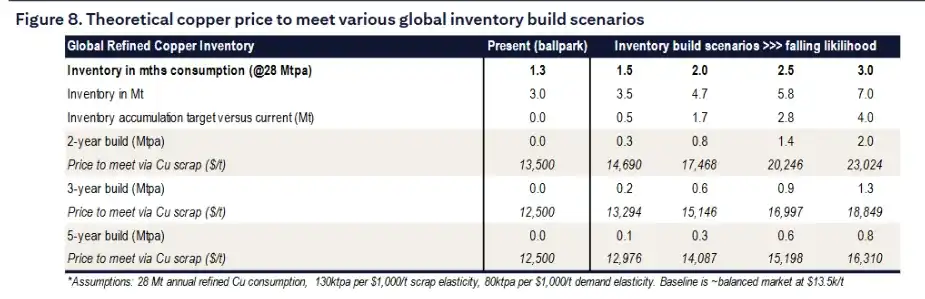
(Theoretical copper prices under various global inventory increase scenarios)

Gold: Could Fall Another 15-20% Short-Term, Then Double Later

Citigroup rates gold's tail risk as low probability, low direct impact, but highly significant within the scenario analysis framework.

Gold prices surged from $2,500/oz in January 2025 to a peak of $5,500/oz in February 2026, and have since retreated to around $4,000/oz.

The report believes the risk of a larger-than-expected decline is most concentrated in the next 4 to 6 weeks. Once prices fall below $3,800/oz, liquidation pressure from ETFs and leveraged positions could be triggered on a large scale.

Potential triggers include: a worsening Middle East situation pushing up real interest rates and the dollar, and equity/bond market adjustments triggering liquidity squeezes.

However, the report remains highly optimistic about gold's medium to long-term trend.

China's trade surplus exceeding $1.3 trillion, continued central bank purchases, global fiscal sustainability concerns, and de-dollarization trends constitute multiple supports for long-term gold demand.

Citigroup expects that, driven by major inflation declines and a new round of investor buying, gold has the potential to rise to $6,000/oz in the coming years, nearly doubling from current levels.

Extreme El Niño: Cocoa Prices Could Return to $10,000/Ton

The U.S. National Oceanic and Atmospheric Administration's (NOAA) updated July forecast raised the probability of a very strong El Niño event to 81%, with a 97% chance of persistence until Spring 2027. Citigroup rates this as a "medium probability, high impact" tail scenario.
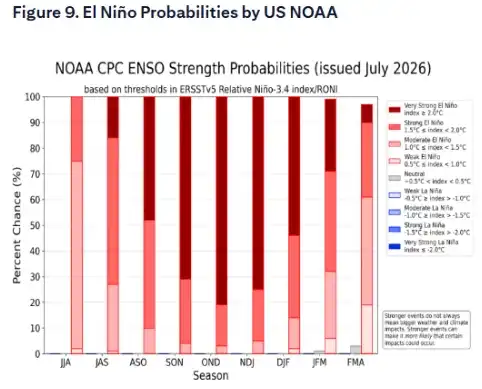
(NOAA's El Niño probability forecast)

The report notes that extreme El Niño impacts different agricultural products significantly. Cocoa, sugar, and Robusta coffee are most affected; soybeans are next; corn and wheat are relatively less affected.

If West Africa experiences a Harmattan wind season similar to 2023-2024, cocoa supply would be severely impacted. Cocoa prices could return to $10,000/ton or higher, having previously reached record highs in 2024-2025.

For sugar, below-average rainfall in India in June, coupled with potential dual risks of monsoon deficiency in Thailand and floods in Brazil, global sugar prices could rise above 20 cents/pound.

Corn and soybean prices may find some support because El Niño typically boosts yields in U.S. producing regions, though European heatwaves and a weaker Indian monsoon remain key downside risk sources.

AI Boom & Bust: Bidirectional Shocks Diverge Commodity Landscape

Citigroup characterizes the impact of AI scenarios on commodities as "low to medium probability, highly divergent impact."

AI infrastructure expansion is becoming a significant driver of demand for electricity, natural gas, uranium, and grid metals like copper and aluminum. The report projects U.S. data center power consumption will roughly double by 2030.

If the AI bubble bursts, data center construction will contract sharply. Actual and expected demand for copper, natural gas, and uranium would be simultaneously damaged, while a decline in global risk appetite would further trigger a contraction in commodity demand.

However, simultaneously, a weaker dollar could provide passive support for commodity prices, and significant Fed rate cuts would also cushion the market to some extent.

If AI productivity dividends materialize, accelerating energy consumption and advancing grid investment would further strengthen the structural deficit narrative for copper and aluminum. Citigroup views this as one pathway for copper prices to reach $17,000/ton in a bull scenario.

Gold is seen as the most asymmetric hedge instrument under AI scenarios, benefiting from logic in both boom and bust cycles.

Power of Siberia 2 & LNG Oversupply: 2030s Prices Could Fall Below $6/MMBtu

Citigroup rates the signing of a final agreement between Russia and China on the Power of Siberia 2 pipeline as a "medium probability, high impact" scenario.

The pipeline has an annual capacity of 50 bcm. If operational around 2030, it would significantly reduce China's LNG import needs, exacerbating the global LNG market's expected shift towards looser conditions from 2028 onward.

The report predicts that under this scenario, the JKM Asian LNG benchmark price could fall to $5-6/MMBtu, well below the current forward prices for 2029-2030 above $8, and far below the $7-10 breakeven range for most new LNG supply terminals.

Citigroup notes that the potential 50 bcm/year of new supply between China and Russia is almost equivalent to Russia's existing ~53 bcm/year of pipeline gas exports to Europe. Its impact on the global LNG oversupply situation would far outweigh the debate over whether Russian pipeline gas returns to Europe.

Extremization of the Monroe Doctrine: Blockade of Americas' Oil Could Trigger a 1973 Replay

If the U.S. pushes the "Monroe Doctrine" to an extreme, blockading oil exports from Latin America or even the entire Americas, the global oil price landscape would undergo severe distortion.

The Monroe Doctrine is a core U.S. foreign policy principle articulated in 1823. Its core assertion is that "the Americas are for the Americans," aimed at opposing European powers' interference in American affairs, while declaring U.S. non-interference in European internal matters.

Citigroup lists "U.S. blockade of all oil exports from the Americas" as a low probability, high impact scenario.

Under this assumption, Latin America (including Mexico), with approximately 9.8 million barrels/day of crude oil production (~10% of global total output), would see its exports cut off from global markets. The shock magnitude would match or even exceed the 1973 Arab oil embargo.
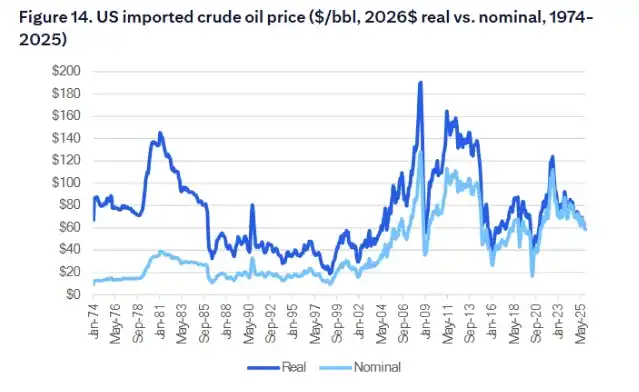
(U.S. imported crude oil price, 2026 real and nominal values, 1974-2025)

Back then, 7 OPEC member countries cut production by about 3.6 million barrels/day (~6% of global output), causing oil prices to surge from around $3/barrel to about $12/barrel in January 1974, a rise of approximately 300%.

Under this scenario, global benchmark crude prices (like Brent, Dubai) could surge above $100/barrel, while intra-Americas crude benchmarks (like WTI, WCS) could experience substantial discounts exceeding $30/barrel due to lack of outlets, creating a sharply divergent cross-regional price structure.


Cryptos en tendance

Questions liées

QAccording to Citi's report, what is the highest-impact tail risk scenario for the commodity market by 2026 H2, and what is its potential effect on oil prices?

AThe highest-impact tail risk scenario is an escalation and prolongation of the US-Iran conflict into a multi-year supply crisis. Citi estimates this could lead to a sustained global supply deficit of 5 to 10 million barrels per day. Assuming a demand elasticity of approximately -0.05, such a supply shock could drive oil prices up by 100% to 200%, pushing crude oil prices above $200 per barrel, with US retail gasoline consistently staying above $6 per gallon.

QWhat impact would a strategic stockpiling race for critical minerals have on copper prices according to Citi's analysis?

ACiti assesses the probability of a critical minerals stockpiling race as 'high'. Should governments undertake large-scale strategic stockpiling, it could push copper prices above $20,000 per tonne. Their modeling suggests that increasing global refined copper inventories from the current ~1.3 months of consumption to 3 months would require accumulating ~4 million tonnes of copper over two years, potentially requiring a price of around $23,000/tonne based on historical scrap supply elasticity.

QWhat is Citi's near-term and long-term outlook for gold prices in their tail risk analysis?

ACiti sees a heightened risk of gold declining by 15% to 20% in the next 4-6 weeks, potentially triggered by a break below $3,800/oz leading to ETF and leveraged position liquidations. However, their long-term outlook remains highly bullish. They expect gold could rise to around $6,000/oz in the coming years, nearly doubling from current levels, driven by factors like China's large trade surplus, sustained central bank buying, global fiscal sustainability concerns, and dedollarization trends.

QHow does Citi assess the potential impact of an extreme El Niño event on agricultural commodities, specifically cocoa and sugar?

ACiti rates an extreme El Niño as a 'medium probability, high impact' tail scenario. For agricultural commodities, cocoa, sugar, and Robusta coffee would be most affected. A severe Harmattan wind event in West Africa, similar to 2023-2024, could severely impact cocoa supply, potentially pushing prices back to $10,000/tonne or higher. For sugar, risks include deficient rainfall in India and potential monsoon issues in Thailand and Brazil, which could drive global sugar prices above 20 cents per pound.

QWhat are the two opposing potential impacts of AI development (boom vs. bust) on commodity markets, as outlined by Citi?

ACiti describes AI's impact as 'low to medium probability, highly differentiated impact'. In an AI boom scenario, infrastructure expansion drives demand for electricity, natural gas, uranium, and grid metals like copper and aluminum, reinforcing structural deficit narratives and potentially pushing copper to $17,000/tonne. In an AI bust scenario, data center construction contracts sharply, damaging actual and expected demand for copper, natural gas, and uranium, while a global risk-off sentiment further reduces commodity demand, though a weaker dollar and Fed rate cuts could provide some support. Gold is seen as an asymmetric hedge, benefiting in either scenario.

Lectures associées

L'affaire de divorce de Chey Tae-won finalisée : Révélations sur les lignes cachées de succession derrière le conglomérat de mille milliards de SK Hynix

L'affaire de divorce de Chey Tae-won, président du groupe SK, s'est conclue par un jugement historique, mettant en lumière les complexités successorales derrière le géant SK Hynix, dont la valorisation a dépassé 1 000 billions de wons. Contrairement aux scénarios traditionnels de succession des chaebols sud-coréens, qui privilégient l'aîné masculin, les trois enfants de Chey Tae-won suivent des trajectoires distinctes et modernes. L'aînée, Chey Yun-jeong, considérée comme la successeure la plus probable, occupe un poste de direction au sein de SK Inc. et dirige des projets stratégiques dans la biopharmacie, alliant formation scientifique et compétences en consulting. La seconde fille, Chey Min-jeong, ancienne officière de marine et ex-employée de SK Hynix aux États-Unis, a fondé une startup dans la santé numérique et épousé un ancien officier du Corps des Marines américain, incarnant les dimensions géopolitiques de l'industrie des semi-conducteurs. Le fils cadet, Chey In-geon, bien que suivant un parcours académique et professionnel classique (Brown University, McKinsey), reste discret et ne détient aucun rôle opérationnel visible au sein du groupe. Leur héritage est marqué par le divorce très médiatisé et coûteux de leurs parents, mais aussi par la transformation de SK Hynix en un acteur mondial de l'ère de l'IA. La succession ne se résume plus à une simple transmission d'actions ou de titre ; elle exige des héritiers qu'ils prouvent leurs compétences dans un paysage où la technologie, la politique internationale et l'innovation disruptive redéfinissent les règles du pouvoir.

marsbitHier 09:14

L'affaire de divorce de Chey Tae-won finalisée : Révélations sur les lignes cachées de succession derrière le conglomérat de mille milliards de SK Hynix

marsbitHier 09:14

2 mois pour passer de 8,8 à 68 milliards d'euros d'évaluation ! La plus grande plateforme de transit d'IA, OpenRouter, sur le point d'être rachetée

**Résumé en français :** Stripe, le géant du paiement en ligne, négocierait l'acquisition d'OpenRouter, une place de marché et couche d'IA de type "routeur" ou "agrégateur", pour près de 100 milliards de dollars. Cette valorisation représente une multiplication par près de sept par rapport à l'évaluation d'OpenRouter il y a deux mois (13 milliards de dollars). Fondée en 2023 par Alex Atallah (cofondateur d'OpenSea), OpenRouter agit comme un intermédiaire crucial pour les développeurs d'applications d'IA. Sa plateforme permet d'accéder via une seule API à plus de 400 grands modèles de langage (comme GPT, Claude, et de nombreux modèles open source) et choisit automatiquement le modèle le plus adapté à chaque tâche en fonction du coût, des performances et de la vitesse. Cela permet aux applications en aval de réduire leurs factures de "réflexion" (inference) sans que l'utilisateur final ne voie la différence. Pour Stripe, cette acquisition stratégique s'inscrit dans une volonté de devenir l'infrastructure de paiement et de gestion de la consommation pour l'économie de l'IA. Fin 2025, Stripe avait déjà acquis Metronome, une plateforme de facturation à l'usage pour l'IA. En combinant OpenRouter (choix du modèle) et Metronome (facturation précise), Stripe cherche à offrir une solution intégrée pour le routage, la mesure et le paiement de la consommation d'IA, consolidant ainsi son rôle de "caisse" et de "centre de régulation" de cette nouvelle économie.

链捕手Hier 09:04

2 mois pour passer de 8,8 à 68 milliards d'euros d'évaluation ! La plus grande plateforme de transit d'IA, OpenRouter, sur le point d'être rachetée

链捕手Hier 09:04

D'OpenSea à OpenRouter : le scénario de la « sortie en haut de cycle » d'Alex Atallah se répète ?

**OpenRouter, la plateforme d'agrégation de modèles d'IA fondée par Alex Atallah, pourrait être rachetée par Stripe pour près de 100 milliards de dollars**, selon le Wall Street Journal. Cette transaction potentielle, si elle se concrétise, marquerait le deuxième succès d'Atallah à construire une entreprise valorisée à des dizaines de milliards, après avoir cofondé la place de marché NFT OpenSea. OpenRouter, décrit comme le "Stripe de l'IA", sert de point d'accès unifié à plus de 400 modèles d'IA pour environ 10 millions d'utilisateurs. Sa croissance a été fulgurante, passant d'une valorisation de 1,3 milliard de dollars en mars 2026 à une évaluation potentielle de 100 milliards aujourd'hui. L'article souligne un parallèle avec le parcours d'Atallah chez OpenSea, qu'il a quittée avant le refroidissement du marché NFT. Aujourd'hui, face à une concurrence croissante dans l'agrégation de modèles d'IA et à une activité essentiellement basée sur des frais de plateforme (5-5,5%), la vente à un géant comme Stripe pourrait apparaître comme un choix stratégique pour "sortir au sommet". La valeur réelle d'OpenRouter pour un acquéreur résiderait moins dans ses revenus actuels que dans les vastes quantités de données d'utilisation réelle de l'IA qu'elle a accumulées. Ces informations sur les performances, les préférences des développeurs et la dynamique du marché sont un atout unique. La transaction, si elle aboutit, pose la question : s'agit-il d'une juste reconnaissance de la valeur des infrastructures d'IA ou d'un possible signal de sommet pour le secteur ?

链捕手Hier 08:47

D'OpenSea à OpenRouter : le scénario de la « sortie en haut de cycle » d'Alex Atallah se répète ?

链捕手Hier 08:47

Trading

Spot

Articles tendance

Comment acheter ERA

Bienvenue sur HTX.com ! Nous vous permettons d'acheter Caldera (ERA) de manière simple et pratique. Suivez notre guide étape par étape pour commencer votre parcours crypto.Étape 1 : Création de votre compte HTXUtilisez votre adresse e-mail ou votre numéro de téléphone pour ouvrir un compte sur HTX gratuitement. L'inscription se fait en toute simplicité et débloque toutes les fonctionnalités.Créer mon compteÉtape 2 : Choix du mode de paiement (rubrique Acheter des cryptosCarte de crédit/débit : utilisez votre carte Visa ou Mastercard pour acheter instantanément Caldera (ERA).Solde :utilisez les fonds du solde de votre compte HTX pour trader en toute simplicité.Prestataire tiers :pour accroître la commodité d'utilisation, nous avons ajouté des modes de paiement populaires tels que Google Pay et Apple Pay.P2P :tradez directement avec d'autres utilisateurs sur HTX.OTC (de gré à gré) : nous offrons des services personnalisés et des taux de change compétitifs aux traders.Étape 3 : stockage de vos Caldera (ERA)Après avoir acheté vos Caldera (ERA), stockez-les sur votre compte HTX. Vous pouvez également les envoyer ailleurs via un transfert sur la blockchain ou les utiliser pour trader d'autres cryptos.Étape 4 : tradez des Caldera (ERA)Tradez facilement Caldera (ERA) sur le marché Spot de HTX. Il vous suffit d'accéder à votre compte, de sélectionner la paire de trading, d'exécuter vos trades et de les suivre en temps réel. Nous offrons une expérience conviviale aux débutants comme aux traders chevronnés.

664 vues totalesPublié le 2025.07.17Mis à jour le 2026.06.02

Comment acheter ERA

Discussions

Bienvenue dans la Communauté HTX. Ici, vous pouvez vous tenir informé(e) des derniers développements de la plateforme et accéder à des analyses de marché professionnelles. Les opinions des utilisateurs sur le prix de ERA (ERA) sont présentées ci-dessous.

活动图片













