Trump Relents on Ethics Provisions, 《CLARITY Act》 Makes Final Push Before Senate Recess

Foresight NewsPublié le 2026-07-21Dernière mise à jour le 2026-07-21

Résumé

U.S. President Donald Trump has reportedly agreed to include ethics provisions in the *CLARITY Act*, a major digital asset market structure bill, resolving a key negotiation obstacle. This paves the way for the bill's text release and a critical Senate vote before the August recess. The legislation aims to establish comprehensive federal digital asset regulation and clarify the regulatory roles of the SEC and CFTC. The ethics clause is designed to restrict federal officials, including the President and Congress members, from profiting from digital assets while in office. A central point of contention involved Trump's own significant crypto holdings. Following this development, prediction market odds for the bill's passage in 2026 saw an uptick. The bill faces a tight timeline for Senate passage before the August 7th recess, with subsequent steps required in the House before reaching the President's desk. Industry lobbyists have emphasized prioritizing the bill's core regulatory framework over the political details of the ethics rules, while some Democratic senators have called for even stronger provisions. Concurrently, market data shows significant Bitcoin accumulation by large holders ("whales") in recent weeks, and a reversal to net inflows for U.S. spot Bitcoin and Ethereum ETFs after an extended period of outflows.


By: Sanqing, Foresight News


July 21 - According to a report by crypto journalist Eleanor Terrett citing sources, U.S. President Donald Trump has agreed to include ethics provisions in the "CLARITY Act" (Digital Asset Market Structure Act). The White House has reached a consensus on the ethics framework for the "CLARITY Act," clearing the last major hurdle for this crypto regulatory legislation that has been debated for months. The bill text could be released as soon as the same day, though it may be slightly delayed; as of the time of reporting, the Democratic side had not yet seen the specific text.
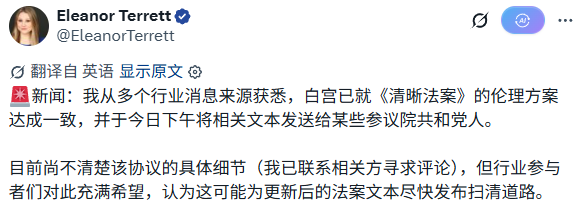


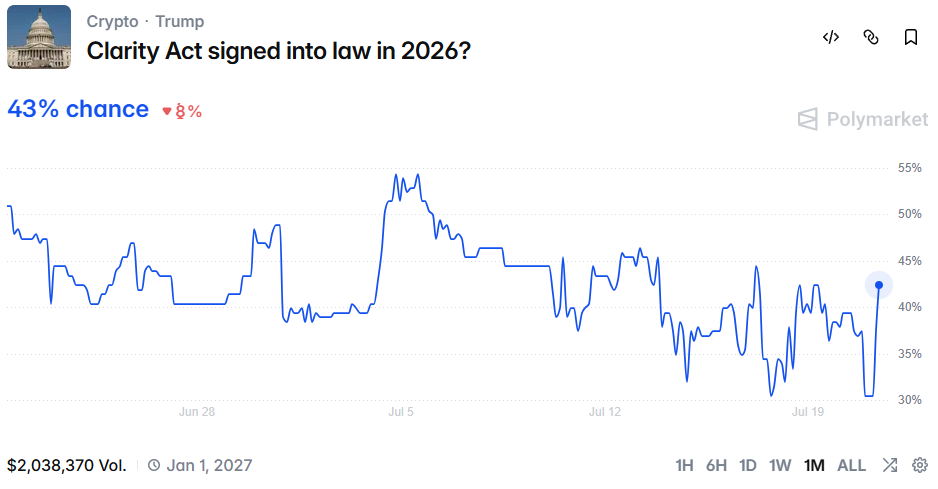
Following the news, the probability of "the 'CLARITY Act' being signed into law in 2026" on Polymarket rebounded to 43%. Research firm Galaxy Research had previously assessed the probability of it passing within 2026 at roughly fifty-fifty.


Previously, on July 16, during a meeting with Republican Senators Bernie Moreno, Cynthia Lummis, and White House crypto advisor Patrick Witt, Trump did not immediately agree. However, the deal was finalized by the President himself on Monday evening. This provision aims to restrict the President, Vice President, members of Congress, and other federal officials from profiting from digital assets during their terms. The core controversy has centered on the Trump family's Meme tokens and World Liberty Financial. Financial documents disclosed last month showed Trump's crypto income was as high as approximately $14 billion, which had once brought negotiations to a standstill.


The Final Stretch Before the August Recess


If ultimately enacted, the "CLARITY Act" would provide the first comprehensive federal-level regulation for the digital asset industry, clarifying the jurisdictional division between the SEC and CFTC.


The U.S. House of Representatives previously passed the bill with bipartisan majority support in 2025 by a vote of 294 to 134. The Senate Banking Committee greenlit it on May 14 this year with a vote of 15 to 9. It is currently stalled in final negotiations before a full Senate vote.


The bill text is expected to be released in the coming days, followed by a full Senate vote. The window only lasts until the recess in the first week of August (the Senate will go into recess on August 7 and return on September 14). If passed, it would need to go back to the House for reconsideration, text reconciliation, etc., before finally reaching the President's desk for signature.


The vote count in the Senate tightened in mid-July. Republican Senator Lindsey Graham of South Carolina died unexpectedly at the age of 71 on the night of July 11 from an aortic dissection after returning from a trip to Ukraine. This temporarily reduced the Republican Senate seats from 53 to 52.


According to the Associated Press, the state's Governor Henry McMaster appointed Graham's sister, Darline Graham Nordone, to succeed him two days later. She was sworn in on July 14, immediately restoring the seat.


However, Republican Senator Mitch McConnell has been absent from votes since being hospitalized on June 14. As of July 12, he himself stated he was not ready to return to the Senate, and there have been no further updates on his potential return since.


According to the cloture procedure under Senate Rule XXII, if Mitch McConnell remains absent at that time, the bill would need at least 8 additional Democratic votes beyond the actual number of Republican votes present to pass.


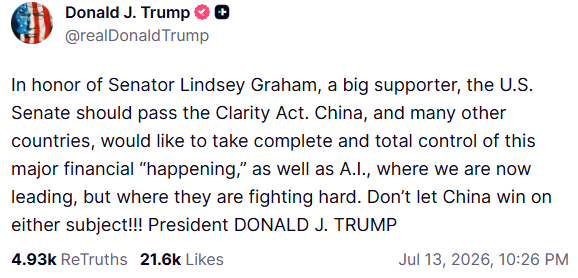
Trump previously posted on Truth Social, urging the Senate to pass the "CLARITY Act" quickly, calling it a tribute to the late Senator Lindsey Graham and emphasizing that it also concerns preventing China from gaining dominance in digital finance and artificial intelligence.


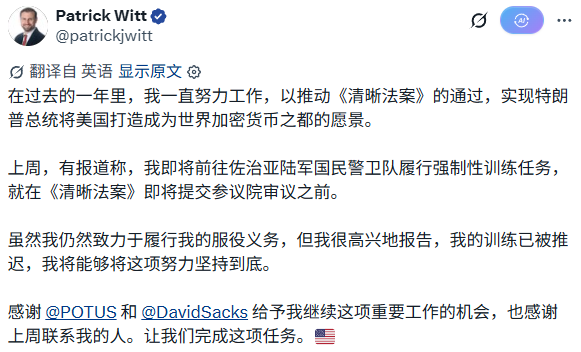
Personnel changes at the White House level also reflect the urgency of the push. Crypto advisor Patrick Witt was originally scheduled to be absent this week due to mandatory training with the Georgia Army National Guard. The training has been postponed, and he will remain in place to advance the legislation. His deputy, Harry Jung, announced his departure in two weeks.


"The Goal Line" or "The Elephant in the Room"?


The stance from industry lobbyists is straightforward. Blockchain Association CEO and former CFTC Commissioner Summer Mersinger said at the Injective Summit in Washington D.C. on July 16 that the core provisions of the bill "are very close to agreement, with only a few details left to iron out." She called the ethics issue "the elephant in the room" and the biggest current obstacle.
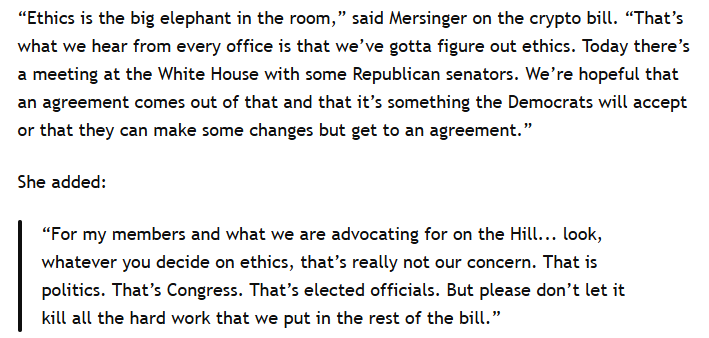


She urged Congress: "Whatever you decide on the ethics provision, that's really not our concern; that's politics, that's Congress, that's elected officials. But please don't let it ruin all the work we've put into the rest of the bill."


Coinbase Vice Chairman and former SEC official Ryan VanGrack was more blunt in a statement on CNBC in mid-July: "The 'CLARITY Act' is at the goal line. The momentum for passage is clear." Senate Majority Leader John Thune offered a more cautious assessment: "There is certainly a path to a deal, but time is running out."


These statements essentially convey the same message: we don't care how the ethics clause is written, just don't let it hinder the rest of the bill.


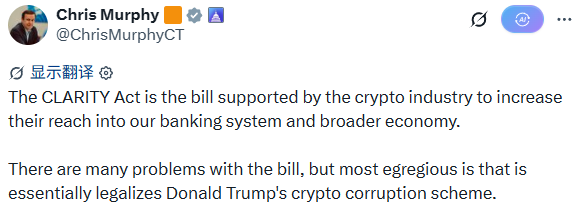
Skepticism comes primarily from the Democratic side and directly targets the inadequacy of the ethics provisions themselves. Senator Chris Murphy criticized in a Facebook post on July 14 that the "CLARITY Act" "is a crypto industry-backed bill designed to expand its influence over the banking system and the broader economy." He explicitly demanded that "the bill must have provisions prohibiting the President and his family members from issuing cryptocurrencies during his term, whether Meme tokens or stablecoins... The ethics provisions must cover the President and his immediate family members."


Senators Warren, Jack Reed, Chris Van Hollen, and others also issued a joint statement in mid-July, stating they "cannot support the current version of the 'CLARITY Act'," citing reasons including the need for stronger consumer protections, stricter conflict-of-interest and ethics rules, and more safeguards against crypto fraud and market manipulation. Senator Mark Warner bluntly said: "I am very pessimistic about the progress."


Whales, ETFs & Crypto Treasury Movements


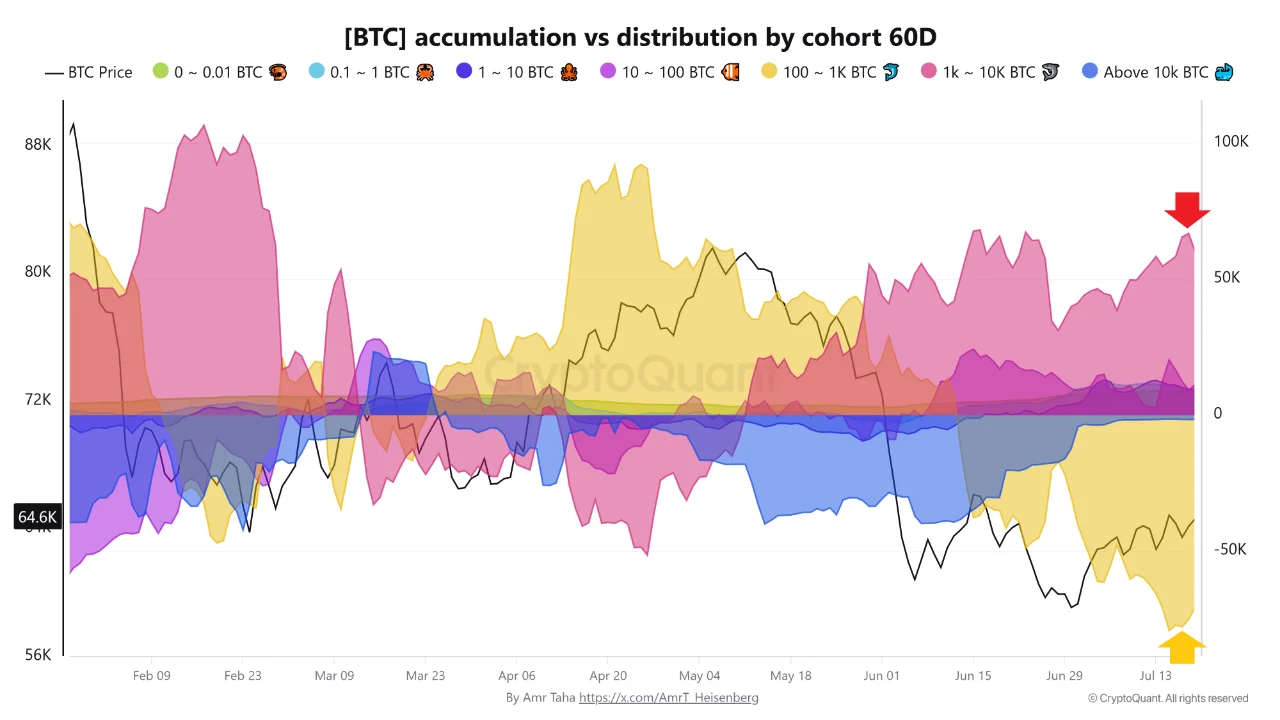
On-Chain Whales: According to CryptoQuant data from July 20, addresses holding 1,000 to 10,000 BTC saw a net increase of approximately 66,700 BTC over 60 days, the strongest wave of buying since mid-February. Meanwhile, addresses holding 100 to 1,000 BTC (medium holdings) sold about 77,800 BTC in the same period. Data provided by Bitfinex analysts to CoinDesk shows that whale addresses collectively added over 270,000 BTC in the first two weeks of July, worth about $16.7 billion.


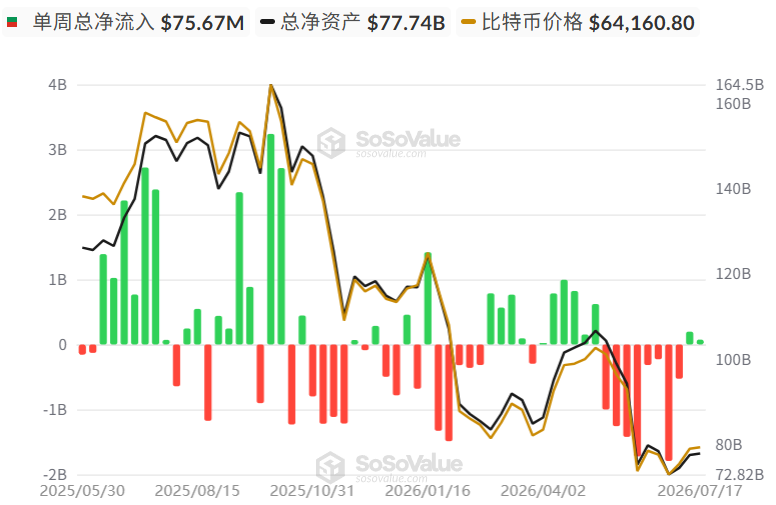
Spot ETFs: According to weekly data from SoSoValue, U.S. spot Bitcoin ETFs saw net outflows for 8 consecutive weeks starting the week of May 15, with the most severe outflow of $1.79 billion occurring the week of June 26. It wasn't until the week of July 10 that flows turned positive with a net inflow of $197 million, followed by another net inflow of $75.67 million the week of July 17.


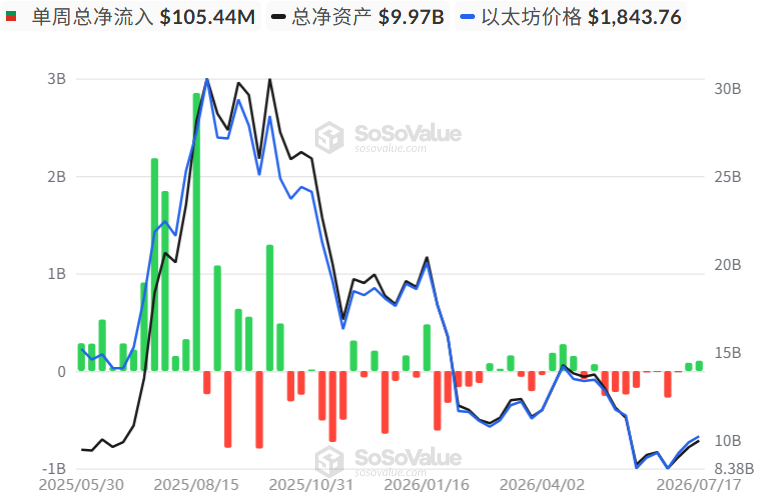
The trend for spot Ethereum ETFs was almost identical: also 8 consecutive weeks of net outflows from May 15 to July 2, turning to net inflows in the weeks of July 10 and July 17, with $84.42 million and $105 million, respectively.


Crypto Treasuries: MicroStrategy's holdings remained at approximately 844,000 BTC, with no Bitcoin purchases for two consecutive weeks. In mid-July, it raised $263.5 million in cash through a stock offering but did not immediately add to its position, instead holding it as a buffer for preferred stock dividends and interest. Japanese-listed company Metaplanet increased its holdings by 2,823 BTC in Q2, bringing its total holdings to 43,000 BTC, ranking third globally among publicly traded companies. Its subsidiary also completed a convertible bond financing of approximately $59.5 million on July 21, with plans to continue buying.


BitMine increased its holdings by 7,430 ETH last week, bringing its total to 5,777,468 ETH, accounting for approximately 4.8% of the total ETH supply. Of this, 85% is staked, with an estimated annual staking yield of about $247 million. The company simultaneously repurchased approximately 5.5 million shares of common stock at an average price of $15.62. Tom Lee stated that the buying pace has slowed due to this, but weekly accumulation has never been interrupted since the reserve strategy was launched on June 30, 2025.


Arthur Hayes: According to monitoring by Yu Jin, BitMEX co-founder Arthur Hayes spent 2.5 million USDC to buy 1,293 ETH at $1,933 on July 15, chasing the rally. On July 20, he bought another 2.5 million USDC worth of ETH via FalconX and Cumberland OTC at $1,876. The two transactions totaled 5 million USDC, purchasing 2,625.7 ETH at an average cost of $1,904. Hayes previously wrote that the AI sector is absorbing market liquidity, putting short-term pressure on BTC, but once liquidity returns, the crypto market still has room for a rebound.


Cryptos en tendance

Questions liées

QWhat was the main hurdle for the CLARITY Act that President Trump's agreement on an ethics clause helped to clear?

AThe main hurdle was the inclusion and agreement on an ethics clause. This clause aims to restrict federal officials, including the President, Vice President, and members of Congress, from profiting from digital assets during their terms. A key point of contention was the Trump family's involvement with Meme coins and World Liberty Financial, which had stalled negotiations.

QWhat are the key regulatory roles defined for the SEC and CFTC under the proposed CLARITY Act?

AThe CLARITY Act, if passed, would establish the first comprehensive federal regulatory framework for the digital asset industry. A key provision is to clearly define the jurisdictional division of responsibilities between the Securities and Exchange Commission (SEC) and the Commodity Futures Trading Commission (CFTC).

QWhat challenge does Mitch McConnell's potential continued absence pose for the CLARITY Act's passage in the Senate?

AIf Senator Mitch McConnell remains absent from voting, it affects the procedural math. According to Senate Rule 22 for ending debate (cloture), the bill would need to secure at least 8 additional Democratic votes beyond the number of Republicans present and voting to overcome a filibuster and proceed to a final vote.

QAccording to industry lobbyists, what was the primary concern regarding the ethics clause during the final negotiations?

AIndustry lobbyists, represented by figures like Summer Mersinger of the Blockchain Association, expressed that while they were not directly concerned with the specifics of the ethics clause (calling it 'politics'), their primary worry was that the contentious debate over this clause could jeopardize or 'destroy' the entire broader legislative effort of the CLARITY Act.

QWhat criticism did Democratic Senators level against the ethics provisions in the CLARITY Act?

ADemocratic Senators, such as Chris Murphy, Elizabeth Warren, and others, criticized the ethics provisions as insufficient. They demanded stronger rules, specifically calling for clauses that would prohibit the President and their immediate family members from issuing cryptocurrencies (like Meme tokens or stablecoins) while in office. They also cited a need for stronger consumer protections and safeguards against fraud and market manipulation.

Lectures associées

UBS décrypte : les positions technologiques des fonds communs de placement atteignent un niveau record, l'électronique devient le cœur des augmentations au deuxième trimestre

Selon le dernier rapport de stratégie d'UBS sur les actions chinoises, au deuxième trimestre 2026, les fonds d'investissement publics ont porté leur allocation aux technologies fondamentales (hard tech) en actions A à un niveau historique. Les secteurs de l'électronique, des télécoms, ainsi que les plateformes STAR Market et ChiNext ont été les principales destinations des rachats. Le point le plus marquant est que le poids des grandes technologies (électronique, télécoms, informatique et défense) dans les portefeuilles des fonds a atteint 57,3%, avec un surpoids de 18,5%, deux records. Selon UBS, l'allocation au secteur électronique a augmenté de 20,2 points de pourcentage sur le trimestre, en faisant la plus forte progression. Les télécoms et la mécanique ont respectivement gagné 4,4 et 0,8 points. Ce mouvement est renforcé par le retour des capitaux étrangers. Les flux nets nordbound (via Stock Connect) sont estimés entre 2193 et 2230 milliards de yuans pour le T2, contre une sortie nette au T1. Selon la classification sectorielle d'UBS, l'industrie et les technologies de l'information (IT) ont été les principales bénéficiaires de ces entrées. L'engouement ne se limite pas à un simple rééquilibrage de portefeuille. La part des actifs gérés par les fonds actifs axés sur les technologies (définis comme ayant au moins 7 de leurs 10 principales positions dans ce secteur) a atteint 27,5% de l'actif total sous gestion (AUM) des fonds actifs, un nouveau sommet, dépassant les niveaux observés aux pics des thèmes consommation ou énergie nouvelle. Cette concentration pose à la fois une opportunité et un risque. Elle peut soutenir la liquidité et la valorisation des chaînes de valeur liées à l'IA, aux semi-conducteurs et à la fabrication avancée. Cependant, des positions aussi élevées et surpondérées historiquement rendent le secteur plus sensible aux prises de bénéfices, à la volatilité mondiale et aux ajustements de l'effet de levier financier. Le rapport souligne que cette rotation vers les hard techs est soutenue par une perspective d'amélioration des bénéfices (UBS prévoit une croissance du bénéfice de 11% pour l'ensemble du marché A en 2026), par des politiques industrielles favorables et par l'alignement des flux intérieurs et étrangers. La clé pour la pérennité de cette tendance résidera dans la concrétisation de cette reprise des profits, la stabilisation de l'effet de levier et la poursuite des flux de capitaux étrangers.

marsbitIl y a 9 mins

UBS décrypte : les positions technologiques des fonds communs de placement atteignent un niveau record, l'électronique devient le cœur des augmentations au deuxième trimestre

marsbitIl y a 9 mins

Le lauréat de la médaille Fields Wang Hong a également publié à NeurIPS

Le nouveau lauréat de la médaille Fields, Wang Hong, a également publié un article à NeurIPS. Il s'agit d'un travail collaboratif (co-premier auteur) présenté à NeurIPS 2019, intitulé "Column Subset Selection and Nyström Approximation via a New Unified Error Bound under Schatten-p Norm". Cette recherche porte sur une tâche fondamentale en analyse de données et en apprentissage automatique : l'approximation de matrices de faible rang, en particulier via la méthode de sélection de sous-ensembles de colonnes (Column Subset Selection, CSS). L'article améliore significativement la borne d'erreur théorique pour l'algorithme CSS sous la norme de Schatten-p. L'innovation clé réside dans l'application d'un outil classique d'analyse harmonique, le théorème d'interpolation de Riesz-Thorin, pour obtenir des bornes plus strictes pour toutes les valeurs de p, une approche peu courante en informatique théorique à l'époque. Bien que cet article théorique ne présente pas d'expériences à grande échelle, il illustre parfaitement comment des outils mathématiques profonds peuvent résoudre des problèmes fondamentaux en IA. Fait intéressant, cette publication est la seule à ne pas avoir de lien direct sur la page personnelle de Wang Hong. L'article souligne également que les contributions théoriques rigoureuses, comme celle-ci, restent parfaitement alignées avec les critères d'évaluation de NeurIPS, même dans son édition 2026, qui met l'accent sur la rigueur et l'originalité mathématique pour les soumissions de type "Theory". Ce cas démontre que la frontière entre les mathématiques pures et l'intelligence artificielle est poreuse et que des percées peuvent naître de leur intersection.

marsbitIl y a 11 mins

Le lauréat de la médaille Fields Wang Hong a également publié à NeurIPS

marsbitIl y a 11 mins

Cinq indicateurs historiques majeurs s'allument simultanément, le marché baissier du Bitcoin atteint son point bas

Le titre suggère que cinq indicateurs historiques clignotent simultanément, signalant un probable fond du marché baissier du Bitcoin. Les points principaux de l’analyse sont : - Le Bitcoin a chuté de 50 % par rapport à son plus haut historique, et le marché baissier dure depuis plus de 40 semaines. - Deux indicateurs de force relative (RSI) montrent des extrêmes historiques de surachat pour le Nasdaq et l'or par rapport au Bitcoin, ce qui a historiquement précédé des creux de cycle à long terme et une surperformance du Bitcoin sur 1 à 3 ans. - Le prix "réalisé" (coût moyen en chaîne) du Bitcoin est de 53 000 $, soit 18 % de plus que le cours spot. Historiquement, les creux du marché se sont formés en dessous de ce niveau. - Les cycles baissiers historiques ont souvent atteint leur point bas vers la 60e semaine après le pic, ce qui, extrapolé, pointerait vers fin novembre 2026 pour le cycle actuel. - La convergence de ces facteurs indique que la période actuelle jusqu'à décembre 2026 pourrait offrir une opportunité attractive d'accumulation à long terme. L'article souligne également la nécessité d'une approche plus opportuniste face à la diminution des rendements marginaux du Bitcoin. Des scénarios prospectifs suggèrent des rendements positifs et asymétriques sur un horizon de 1 à 3 ans, tout en mettant en garde contre les limites de l'analyse (taille d'échantillon, changements structurels du marché). En conclusion, les signaux suggèrent que le Bitcoin est proche ou au fond de son cycle, avec une reprise haussière attendue par la suite.

marsbitIl y a 15 mins

Cinq indicateurs historiques majeurs s'allument simultanément, le marché baissier du Bitcoin atteint son point bas

marsbitIl y a 15 mins

Trading

Spot

Articles tendance

Comment acheter PUSH

Bienvenue sur HTX.com ! Nous vous permettons d'acheter Push Protocol (PUSH) de manière simple et pratique. Suivez notre guide étape par étape pour commencer votre parcours crypto.Étape 1 : Création de votre compte HTXUtilisez votre adresse e-mail ou votre numéro de téléphone pour ouvrir un compte sur HTX gratuitement. L'inscription se fait en toute simplicité et débloque toutes les fonctionnalités.Créer mon compteÉtape 2 : Choix du mode de paiement (rubrique Acheter des cryptosCarte de crédit/débit : utilisez votre carte Visa ou Mastercard pour acheter instantanément Push Protocol (PUSH).Solde :utilisez les fonds du solde de votre compte HTX pour trader en toute simplicité.Prestataire tiers :pour accroître la commodité d'utilisation, nous avons ajouté des modes de paiement populaires tels que Google Pay et Apple Pay.P2P :tradez directement avec d'autres utilisateurs sur HTX.OTC (de gré à gré) : nous offrons des services personnalisés et des taux de change compétitifs aux traders.Étape 3 : stockage de vos Push Protocol (PUSH)Après avoir acheté vos Push Protocol (PUSH), stockez-les sur votre compte HTX. Vous pouvez également les envoyer ailleurs via un transfert sur la blockchain ou les utiliser pour trader d'autres cryptos.Étape 4 : tradez des Push Protocol (PUSH)Tradez facilement Push Protocol (PUSH) sur le marché Spot de HTX. Il vous suffit d'accéder à votre compte, de sélectionner la paire de trading, d'exécuter vos trades et de les suivre en temps réel. Nous offrons une expérience conviviale aux débutants comme aux traders chevronnés.

401 vues totalesPublié le 2024.12.13Mis à jour le 2026.06.02

Comment acheter PUSH

Discussions

Bienvenue dans la Communauté HTX. Ici, vous pouvez vous tenir informé(e) des derniers développements de la plateforme et accéder à des analyses de marché professionnelles. Les opinions des utilisateurs sur le prix de PUSH (PUSH) sont présentées ci-dessous.

活动图片