Strategy's Accounting Gimmick: The Cap on BTC Sales Far Exceeds $1.25 Billion

Odaily星球日报Publié le 2026-07-10Dernière mise à jour le 2026-07-10

Résumé

The article, originally from Bankless, discusses how MicroStrategy's (MSTR) recent Bitcoin (BTC) sales reveal a much larger potential selling capacity than the widely reported $1.25 billion "reserve-building" cap. On July 7, MicroStrategy disclosed a sale of 3,588 BTC (~$216M) to pay dividends for its STRAT (STRC) preferred shares and replenish its USD Reserve. Crucially, the company stated this sale did not count against its stated $1.25 billion "reserve-building capacity." The analysis explains that MicroStrategy's "BTC Monetization Plan," part of its broader "Digital Credit Capital Framework," actually outlines three main purposes for selling BTC, only one of which has the $1.25B cap: 1. **Building the USD Reserve** (capped at $1.25B). 2. **Covering preferred share/ debt costs** (replenishing the reserve after payments). 3. **Funding buybacks** (up to $10B for preferred shares and $10B for MSTR common stock). The key nuance is the accounting distinction between "building" the reserve (selling BTC before making payments) and "replenishing" it (selling BTC after using reserve funds for payments). While functionally the same—converting BTC to cash for obligations—only "building" counts against the publicized $1.25B limit. This means sales for "replenishing" and the $20B+ buyback pool allow for total potential sales exceeding $30B. The article frames this as part of MicroStrategy's shift from a simple "buy and hold" Bitcoin narrative to an "active capital management" mo...

This article is from:Bankless

Compiled by|Odaily Planet Daily (@OdailyChina); Translator|Azuma (@azuma_eth)

On July 7th, Strategy disclosed that the company sold 3,588 BTC between June 29th and July 5th, worth approximately $216 million.

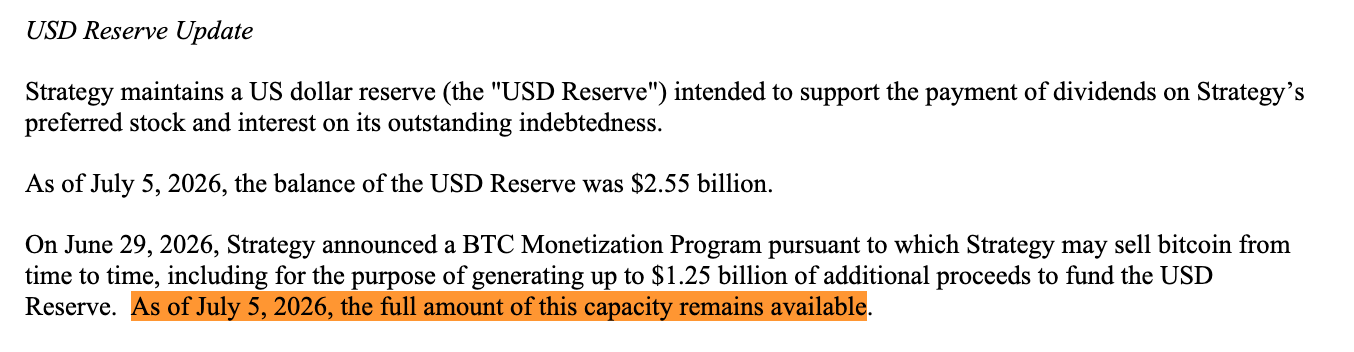
These funds were used to pay STR C dividends and replenish the USD Reserve previously used for dividend payments. Despite completing this sale, Strategy stated that its full $1.25 billion reserve-building capacity remains intact.

  • Odaily Note: In the "self-help plan" announced last week, Strategy had indicated it authorized the company to sell BTC to build a USD reserve of up to $1.25 billion.

In other words, the $216 million worth of BTC sold to replenish the reserve is not counted against the previously disclosed reserve-building capacity.

Strictly speaking, there is a technical distinction: one is "replenishing," and the other is "building." However, in practice, both types of sales ultimately flow into the same reserve pool for the same purpose, just categorized for different uses.

From another perspective, the previously disclosed "BTC Monetization Program" never limited Strategy to selling only $1.25 billion worth of Bitcoin in total; it only capped one specific funding pool — the sale of BTC to "build" the USD reserve.

The plan also permits Strategy to sell BTC for other purposes, which is exactly what we are seeing now.
Three Funding Pools

On June 29th, after weeks of pressure on MSTR and STR C, Strategy launched the aforementioned BTC "Monetization Program" as part of its broader "Digital Credit Capital Framework."

This plan allows Strategy to sell Bitcoin and actually mentions three primary uses:

  • First, to Build the reserve: Sell up to $1.25 billion worth of BTC to establish a USD Reserve.
  • Second, to Cover the preferreds: Sell BTC to cover Strategy's fixed dividend and interest obligations on its preferred shares and debt. If management deems it "more advantageous to sell BTC than issue common stock," they may also sell BTC to replenish reserve funds previously used to cover these obligations.
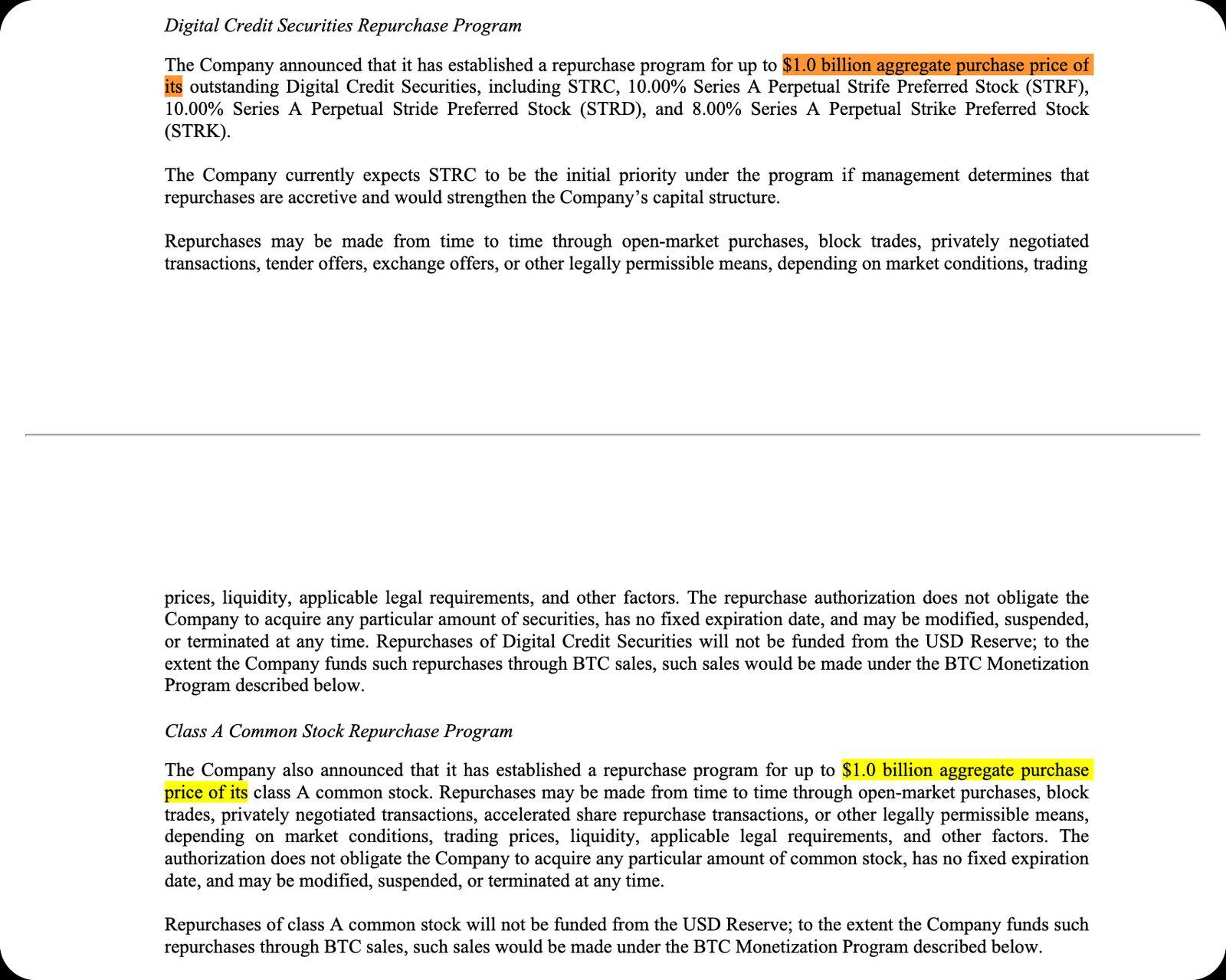
  • Third, to Fund buybacks: Sell BTC to repurchase up to $1 billion worth of preferred shares and up to $1 billion worth of MSTR common stock. Additionally, proceeds from BTC sales may also cover related taxes, fees, and other expenses.

At the time, the entire market discussion focused on the $1.25 billion cap for the first funding pool, but the reality is far more complex.

Looking solely at the third pool, it adds an additional $2 billion in potential sales. Therefore, even calculating only the parts with explicit caps, Strategy's currently designed BTC sale plan already exceeds $3 billion. This does not include the funding pool for paying dividends, interest, and replenishing the reserve — for which there is no disclosed cap.
Building vs. Replenishing

This is where it gets truly subtle.

The purpose of the USD Reserve is to pay these preferred share dividends and debt interest obligations. Under the current policy framework, it cannot be used for stock buybacks.

As of June 28th, Strategy's USD Reserve stood at $2.55 billion, sufficient to cover the company's annual obligations of approximately $1.76 billion for debt and preferred shares, providing about 17 months of coverage. The board has set a minimum requirement to maintain 12 months of coverage unless board-approved reductions occur.

This is why the distinction between "building" and "replenishing" the reserve is noteworthy.

  • Selling BTC before paying dividends to add cash to the reserve: This is defined as "building."
  • Using the reserve to pay dividends, then selling BTC to refill the reserve: This is defined as "replenishing."

The plan treats these as different categories, but they essentially accomplish the same thing — converting BTC into cash to cover preferred share dividends and interest payments.

These details were already disclosed in the documents, but the recent sale made this categorical distinction more apparent. Strategy sold $216 million worth of BTC, using the funds to pay dividends and replenish the reserve, while simultaneously announcing that its $1.25 billion reserve-building capacity remains intact.

Now, the market needs to start understanding Strategy's "proprietary language": "Building" and "replenishing" are essentially accounting classifications, but they determine whether Strategy's BTC sales count against the "public cap" the market sees.

From Hoarding to Active Capital Management

In the June 29th announcement, Michael Saylor stated that this framework reflects Strategy's need for "liquidity, discipline, and active capital management."

Strategy CEO Phong Le was more direct: "Strategy is shifting from a one-way capital issuance model to an active capital management model."

As Matt Walsh and Jeff Dorman from Castle Island explained in a podcast last week, Strategy has essentially evolved into an actively managed hedge fund.

The past Strategy narrative was simple: sell MSTR stock → buy Bitcoin → provide investors with leveraged BTC exposure. But the logic has now changed.

Today, Strategy is buying and selling different components within its own capital structure to manage the pressures between common stock (MSTR), preferred shares, the USD Reserve, and Bitcoin assets (BTC).

This dynamic also introduces new conflicts of interest. Walsh and Dorman pointed out:

  • Selling common stock can support preferred share dividends but depress MSTR's premium relative to its underlying BTC holdings.
  • Selling Bitcoin can extend the cash runway but further erode the core "never sell" narrative.
  • Supporting the preferred share system can maintain market confidence but depletes cash reserves.
  • Cutting preferred share dividends can protect liquidity but may cause preferred share prices to crash.

The so-called "reserve loophole" is an embodiment of this shift. Bitcoin is no longer just an asset for Strategy to accumulate; it is becoming a balance-sheet lever used to keep the preferred share system operational.

What We Will Ultimately See

Now, investors must assess Saylor's ability to operate this "machine" — each adjustment to one lever in the capital structure helps one part while potentially threatening another.

This is the most significant takeaway following the July 6th filing disclosure. Strategy is not out of options. It likely has more room to maneuver than what is apparent on the surface.

Don't continue to mistakenly believe that the $1.25 billion cap represents the total ceiling for Strategy's Bitcoin sales.

Today, Strategy has become an institution that the market must relearn to understand. Now, every proprietary term matters more:

  • Build
  • Replenish
  • Issue
  • Repurchase
  • Defend

Just as Fed watchers parse every punctuation mark in policy statements, the market must also deconstruct every term Strategy uses to gauge what it implies for future BTC sales.

By rolling out this plan, Strategy has secured greater flexibility for itself, but the underlying contradictions persist. This is no longer a simple "leveraged Bitcoin play." It has now become a bet on active capital management prowess.

Can Strategy consistently manage to "sell BTC," "replenish reserves," "issue securities," "repurchase stock," and "maintain the capital structure" without any one action undermining the others?

Personally, I wouldn't want to bet on it.

Cryptos en tendance

Questions liées

QWhat are the three main purposes for which MicroStrategy's BTC Monetization Program allows the company to sell Bitcoin, according to the article?

AAccording to the article, MicroStrategy's BTC Monetization Program allows the company to sell Bitcoin for three main purposes: 1) To build a USD reserve (up to $1.25 billion). 2) To cover the costs of preferred shares and debt (covering fixed dividend and interest obligations). 3) To fund buyback programs (up to $1 billion for preferred shares and up to $1 billion for MSTR common stock).

QWhat is the key difference between 'building' and 'replenishing' the USD reserve, and why is this distinction important in understanding MicroStrategy's potential Bitcoin sales?

AThe key difference is an accounting classification. 'Building' refers to selling BTC and adding cash to the USD reserve *before* using it to pay obligations. 'Replenishing' refers to using the reserve cash to pay obligations (like dividends) first and *then* selling BTC to refill the reserve. This distinction is crucial because the publicly announced $1.25 billion cap applies only to 'building' the reserve. Sales for 'replenishing' do not count against this public limit, meaning the total potential BTC sales for reserve purposes is effectively uncapped.

QAccording to the article, what is the new narrative for MicroStrategy, shifting away from its previous simple model?

AThe article states that MicroStrategy's narrative has shifted from a simple model of 'selling MSTR stock → buying Bitcoin → providing leveraged BTC exposure' to becoming an 'actively managed hedge fund.' It is now actively buying and selling different components of its capital structure (common stock, preferred shares, USD reserve, Bitcoin assets) to manage the pressure and conflicts between them.

QWhat core conflict or dilemma does the article highlight regarding MicroStrategy's use of Bitcoin as a 'balance-sheet lever'?

AThe article highlights that Bitcoin is no longer just an asset for perpetual accumulation but has become a 'balance-sheet lever' used to maintain the preferred share system. This creates a core conflict: selling Bitcoin can extend cash flow and support the preferred share system, but it simultaneously weakens the foundational 'never sell' narrative that was central to the company's original investment thesis.

QWhat is the main conclusion or warning the article provides to investors regarding the $1.25 billion reserve-building capacity?

AThe main conclusion and warning is that investors should not mistake the $1.25 billion reserve-building capacity as the total upper limit for MicroStrategy's Bitcoin sales. When including the other authorized purposes (like funding buybacks and covering obligations without a stated cap), the designed potential sales exceed $3 billion, and sales for 'replenishing' the reserve are effectively unlimited within the framework. The company has given itself far more flexibility to sell BTC than the headline $1.25 billion figure suggests.

Lectures associées

L'affaire de divorce de Chey Tae-won finalisée : Révélations sur les lignes cachées de succession derrière le conglomérat de mille milliards de SK Hynix

L'affaire de divorce de Chey Tae-won, président du groupe SK, s'est conclue par un jugement historique, mettant en lumière les complexités successorales derrière le géant SK Hynix, dont la valorisation a dépassé 1 000 billions de wons. Contrairement aux scénarios traditionnels de succession des chaebols sud-coréens, qui privilégient l'aîné masculin, les trois enfants de Chey Tae-won suivent des trajectoires distinctes et modernes. L'aînée, Chey Yun-jeong, considérée comme la successeure la plus probable, occupe un poste de direction au sein de SK Inc. et dirige des projets stratégiques dans la biopharmacie, alliant formation scientifique et compétences en consulting. La seconde fille, Chey Min-jeong, ancienne officière de marine et ex-employée de SK Hynix aux États-Unis, a fondé une startup dans la santé numérique et épousé un ancien officier du Corps des Marines américain, incarnant les dimensions géopolitiques de l'industrie des semi-conducteurs. Le fils cadet, Chey In-geon, bien que suivant un parcours académique et professionnel classique (Brown University, McKinsey), reste discret et ne détient aucun rôle opérationnel visible au sein du groupe. Leur héritage est marqué par le divorce très médiatisé et coûteux de leurs parents, mais aussi par la transformation de SK Hynix en un acteur mondial de l'ère de l'IA. La succession ne se résume plus à une simple transmission d'actions ou de titre ; elle exige des héritiers qu'ils prouvent leurs compétences dans un paysage où la technologie, la politique internationale et l'innovation disruptive redéfinissent les règles du pouvoir.

marsbitIl y a 2 jours 09:14

L'affaire de divorce de Chey Tae-won finalisée : Révélations sur les lignes cachées de succession derrière le conglomérat de mille milliards de SK Hynix

marsbitIl y a 2 jours 09:14

2 mois pour passer de 8,8 à 68 milliards d'euros d'évaluation ! La plus grande plateforme de transit d'IA, OpenRouter, sur le point d'être rachetée

**Résumé en français :** Stripe, le géant du paiement en ligne, négocierait l'acquisition d'OpenRouter, une place de marché et couche d'IA de type "routeur" ou "agrégateur", pour près de 100 milliards de dollars. Cette valorisation représente une multiplication par près de sept par rapport à l'évaluation d'OpenRouter il y a deux mois (13 milliards de dollars). Fondée en 2023 par Alex Atallah (cofondateur d'OpenSea), OpenRouter agit comme un intermédiaire crucial pour les développeurs d'applications d'IA. Sa plateforme permet d'accéder via une seule API à plus de 400 grands modèles de langage (comme GPT, Claude, et de nombreux modèles open source) et choisit automatiquement le modèle le plus adapté à chaque tâche en fonction du coût, des performances et de la vitesse. Cela permet aux applications en aval de réduire leurs factures de "réflexion" (inference) sans que l'utilisateur final ne voie la différence. Pour Stripe, cette acquisition stratégique s'inscrit dans une volonté de devenir l'infrastructure de paiement et de gestion de la consommation pour l'économie de l'IA. Fin 2025, Stripe avait déjà acquis Metronome, une plateforme de facturation à l'usage pour l'IA. En combinant OpenRouter (choix du modèle) et Metronome (facturation précise), Stripe cherche à offrir une solution intégrée pour le routage, la mesure et le paiement de la consommation d'IA, consolidant ainsi son rôle de "caisse" et de "centre de régulation" de cette nouvelle économie.

链捕手Il y a 2 jours 09:04

2 mois pour passer de 8,8 à 68 milliards d'euros d'évaluation ! La plus grande plateforme de transit d'IA, OpenRouter, sur le point d'être rachetée

链捕手Il y a 2 jours 09:04

D'OpenSea à OpenRouter : le scénario de la « sortie en haut de cycle » d'Alex Atallah se répète ?

**OpenRouter, la plateforme d'agrégation de modèles d'IA fondée par Alex Atallah, pourrait être rachetée par Stripe pour près de 100 milliards de dollars**, selon le Wall Street Journal. Cette transaction potentielle, si elle se concrétise, marquerait le deuxième succès d'Atallah à construire une entreprise valorisée à des dizaines de milliards, après avoir cofondé la place de marché NFT OpenSea. OpenRouter, décrit comme le "Stripe de l'IA", sert de point d'accès unifié à plus de 400 modèles d'IA pour environ 10 millions d'utilisateurs. Sa croissance a été fulgurante, passant d'une valorisation de 1,3 milliard de dollars en mars 2026 à une évaluation potentielle de 100 milliards aujourd'hui. L'article souligne un parallèle avec le parcours d'Atallah chez OpenSea, qu'il a quittée avant le refroidissement du marché NFT. Aujourd'hui, face à une concurrence croissante dans l'agrégation de modèles d'IA et à une activité essentiellement basée sur des frais de plateforme (5-5,5%), la vente à un géant comme Stripe pourrait apparaître comme un choix stratégique pour "sortir au sommet". La valeur réelle d'OpenRouter pour un acquéreur résiderait moins dans ses revenus actuels que dans les vastes quantités de données d'utilisation réelle de l'IA qu'elle a accumulées. Ces informations sur les performances, les préférences des développeurs et la dynamique du marché sont un atout unique. La transaction, si elle aboutit, pose la question : s'agit-il d'une juste reconnaissance de la valeur des infrastructures d'IA ou d'un possible signal de sommet pour le secteur ?

链捕手Il y a 2 jours 08:47

D'OpenSea à OpenRouter : le scénario de la « sortie en haut de cycle » d'Alex Atallah se répète ?

链捕手Il y a 2 jours 08:47

Trading

Spot

Articles tendance

Comment acheter CAP

Bienvenue sur HTX.com ! Nous vous permettons d'acheter Cap (CAP) de manière simple et pratique. Suivez notre guide étape par étape pour commencer votre parcours crypto.Étape 1 : Création de votre compte HTXUtilisez votre adresse e-mail ou votre numéro de téléphone pour ouvrir un compte sur HTX gratuitement. L'inscription se fait en toute simplicité et débloque toutes les fonctionnalités.Créer mon compteÉtape 2 : Choix du mode de paiement (rubrique Acheter des cryptosCarte de crédit/débit : utilisez votre carte Visa ou Mastercard pour acheter instantanément Cap (CAP).Solde :utilisez les fonds du solde de votre compte HTX pour trader en toute simplicité.Prestataire tiers :pour accroître la commodité d'utilisation, nous avons ajouté des modes de paiement populaires tels que Google Pay et Apple Pay.P2P :tradez directement avec d'autres utilisateurs sur HTX.OTC (de gré à gré) : nous offrons des services personnalisés et des taux de change compétitifs aux traders.Étape 3 : stockage de vos Cap (CAP)Après avoir acheté vos Cap (CAP), stockez-les sur votre compte HTX. Vous pouvez également les envoyer ailleurs via un transfert sur la blockchain ou les utiliser pour trader d'autres cryptos.Étape 4 : tradez des Cap (CAP)Tradez facilement Cap (CAP) sur le marché Spot de HTX. Il vous suffit d'accéder à votre compte, de sélectionner la paire de trading, d'exécuter vos trades et de les suivre en temps réel. Nous offrons une expérience conviviale aux débutants comme aux traders chevronnés.

122 vues totalesPublié le 2026.06.26Mis à jour le 2026.06.26

Comment acheter CAP

Discussions

Bienvenue dans la Communauté HTX. Ici, vous pouvez vous tenir informé(e) des derniers développements de la plateforme et accéder à des analyses de marché professionnelles. Les opinions des utilisateurs sur le prix de CAP (CAP) sont présentées ci-dessous.

活动图片