Completely Free, Open-Source Alternative to Claude Science, Use DeepSeek/GLM as You Like

marsbitPublié le 2026-07-07Dernière mise à jour le 2026-07-07

Résumé

Free, Open-Source Alternative to Claude Science: OpenScience Lets Researchers Use Any AI Model Like DeepSeek or GLM Shortly after Anthropic launched Claude Science, a specialized AI workbench for scientific research, the open-source community responded with its own solution: OpenScience. Developed by YC-backed Synthetic Sciences, this platform offers a full AI research workflow covering literature review, hypothesis generation, code experimentation, and paper writing. Unlike Claude Science, which is restricted to macOS/Linux, paid users, and only Claude models, OpenScience is model-agnostic and free. Researchers can use any AI model—DeepSeek, GLM, Claude, GPT, or local models via Ollama—simply by providing their own API keys, keeping data private. OpenScience features over 250 editable research skill packs, more than four times Claude Science's initial offering, and supports one-command installation. It emphasizes openness, arguing that scientific AI tools should not be controlled by a single company. The project includes a clear disclaimer of no affiliation with Anthropic, reflecting caution in the open-source community.

Researchers are ecstatic!!

Less than a week after Anthropic's Claude Science launched, the open-source community has presented its own answer.

An AI research team incubated by YC, has delivered 'the open-source alternative to Claude Science' — OpenScience.

It's also a full-process AI research workbench covering literature search, hypothesis generation, code experiments to paper writing, but it is not tied to any single model provider.

DeepSeek, GLM, Claude, GPT... regardless of domestic or international, use whichever one you want.

Moreover, the project adopts the developer-friendly Apache 2.0 license and can be installed with just one command.

Once the news broke, the project directly trended on X. People bluntly stated:

This is what scientific AI should look like. (Anthropic: Just say my name.)

Claude Science is powerful, but it's unusable...

About 5 days ago, Anthropic officially launched Claude Science at a closed-door event by MIT Technology Review.

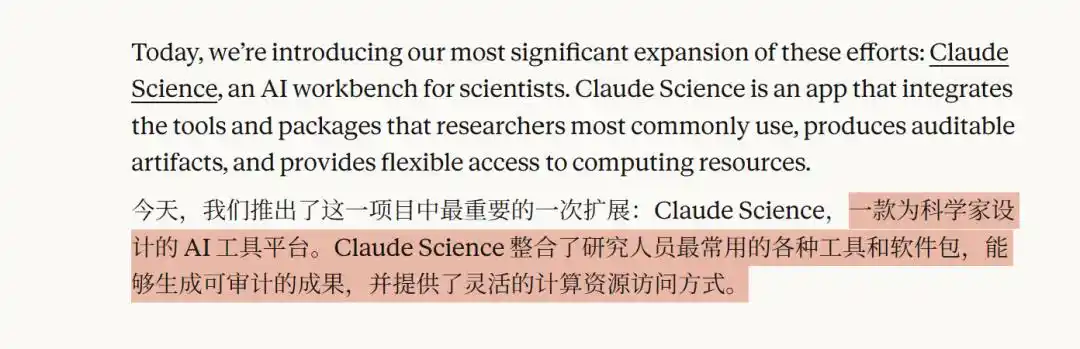
This is an AI workbench specifically for scientists, providing various tools and software packages most commonly used by researchers.
For example, previously, a researcher completing a study had to search literature on PubMed, write code in Jupyter, run statistics in R, connect to a cluster via SSH to submit tasks, and then use various tools to create charts and write papers.

Switching between a dozen windows, the mere 'transitions' between tools consumed a huge amount of energy.

What Claude Science aims to do is bundle all of this into the same workbench.

Specifically, it achieves several key integrations:

At the database and toolchain level, it comes with built-in connectors to over 60 scientific databases and pre-configured skill packages, covering common research fields like genomics, single-cell analysis, proteomics, structural biology, chemoinformatics, etc.

You ask in natural language, and specialized Agents automatically perform cross-database queries — no need to manually search databases like UniProt, PDB, Ensembl, ChEMBL, GEO one by one.

It also integrates with NVIDIA's BioNeMo Agent Toolkit, allowing direct connection to life science models like Evo 2, Boltz-2, OpenFold3.
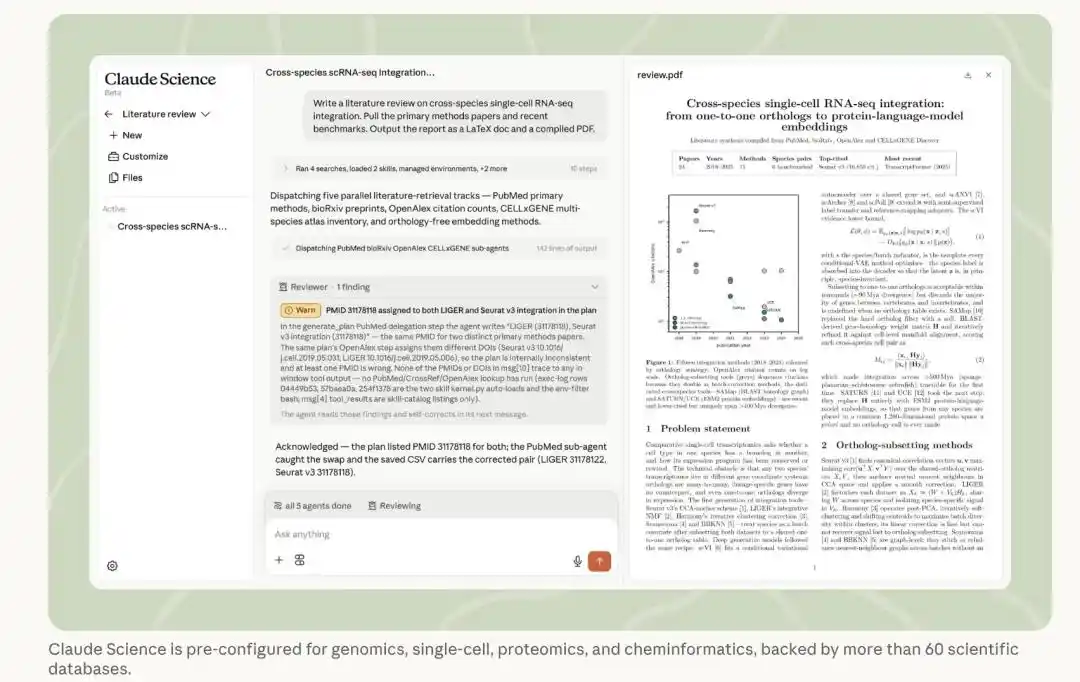
At the execution level, it introduces a multi-agent architecture.

The main Agent handles overall planning, sub-agents process different tasks in parallel, and there is a Reviewer Agent specifically responsible for fact-checking, such as verifying citations, validating calculation results, and flagging potential errors.

The generated output is not just text. It can natively render content like 3D protein structures, genome browser tracks, chemical structure formulas.

Moreover, each chart retains the generation code, runtime environment, natural language description, and complete conversation history.

In some scenarios, scientists can even modify charts with a single sentence, and the system automatically rewrites the underlying code.

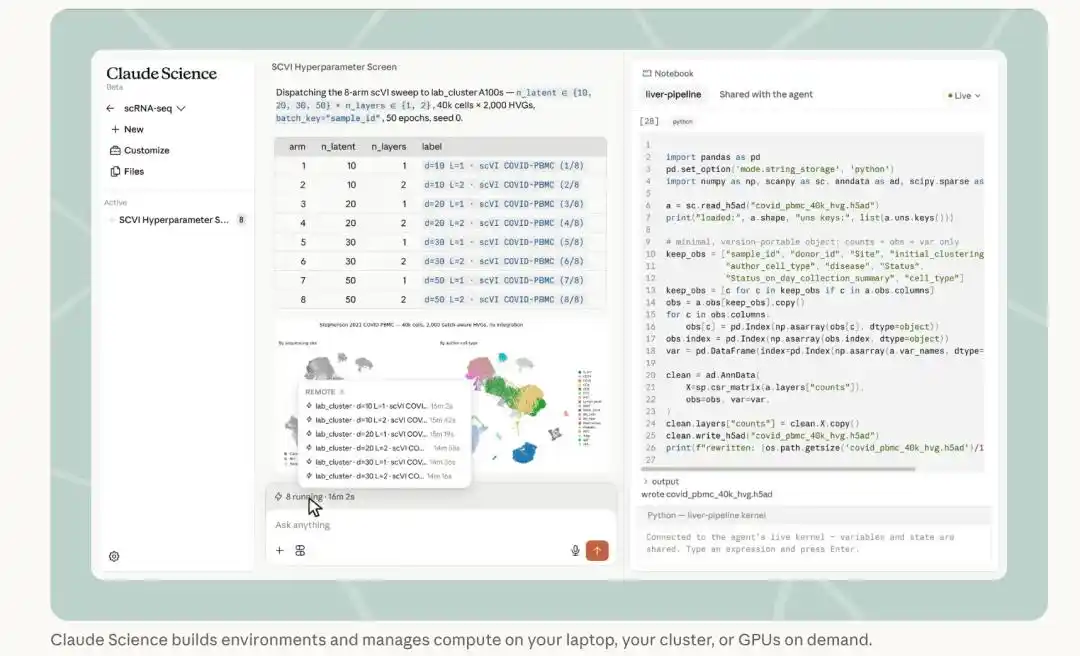
At the computing power level, Claude Science can directly interface with your lab's existing infrastructure.

Be it notebooks, Linux servers, or HPC cluster login nodes, it can connect via SSH or use a Modal account to call cloud GPUs on demand, scaling from a single GPU to hundreds.

Large-scale datasets only need to be loaded once; sensitive data never leaves your own system. Only the context needed for each step of analysis is sent to Claude.
Early beta users have already produced some practical cases.

Jerome Lecoq, a neuroscientist at the Allen Institute, used it to build a multi-agent 'computational review template' containing about 20 custom skills, letting sub-agents read thousands of papers, extract core viewpoints and quantitative data, and then generate review chapters one by one.

To put it simply, writing a review used to take two years; now he has about 10 drafts in hand —

Many exceed 100 pages, and all citations have been verified by the Reviewer Agent.

Stephen Francis from the UCSF Brain Tumor Center used it for molecular epidemiological studies of glioma, running germline variant analysis.

He said Claude Science compressed the previously required time to one-tenth, and his team independently validated the results, confirming the analysis was both fast and reliable.

Combined with the evaluation of AI research capabilities by Harvard physicist Matthew Schwartz this past March, Claude's current level is roughly equivalent to a second-year graduate student.

He published a guest post titled "Vibe Physics: The AI Grad Student" on the Anthropic official blog, documenting his entire process of using Claude Opus 4.5 to complete a theoretical physics paper.

His conclusion at the time was:

Current AI research capability is roughly equivalent to a second-year grad student — can work, doesn't complain about being tired, but needs a supervisor to monitor every step.

This assessment was later incorporated by Anthropic into the Claude Science technical documentation as a calibration point for the product's positioning.

However, Claude Science currently has several hard limitations:

Only supports macOS and Linux

Only available to Pro/Max/Team/Enterprise paying users

Only Claude's own models can be used on the platform

These thresholds stacked together, especially for domestic research teams in China, make Claude Science something "visible but out of reach."

Good News: An Open-Source Alternative is Here

Targeting the above limitations, the open-source project OpenScience emerged.

The team behind it is called Synthetic Sciences, founded in San Francisco in 2025, and just graduated from the YC Winter 2026 batch this year.

The founding team's ambition is not small: to build a platform that lets scientists directly delegate complex research tasks to "AI co-scientists," enabling AI to autonomously run the entire chain from literature review to hypothesis generation to experiment execution to paper writing.

They have an internal core belief:

Scientific foundation models need to possess genuine 'research taste,' and this taste cannot be achieved by simply scaling parameters. It must be a two-pronged approach: product and model. Use the product to collect high-quality scientific process data, then use this data to train models with taste.

OpenScience is the first product landing on this path.
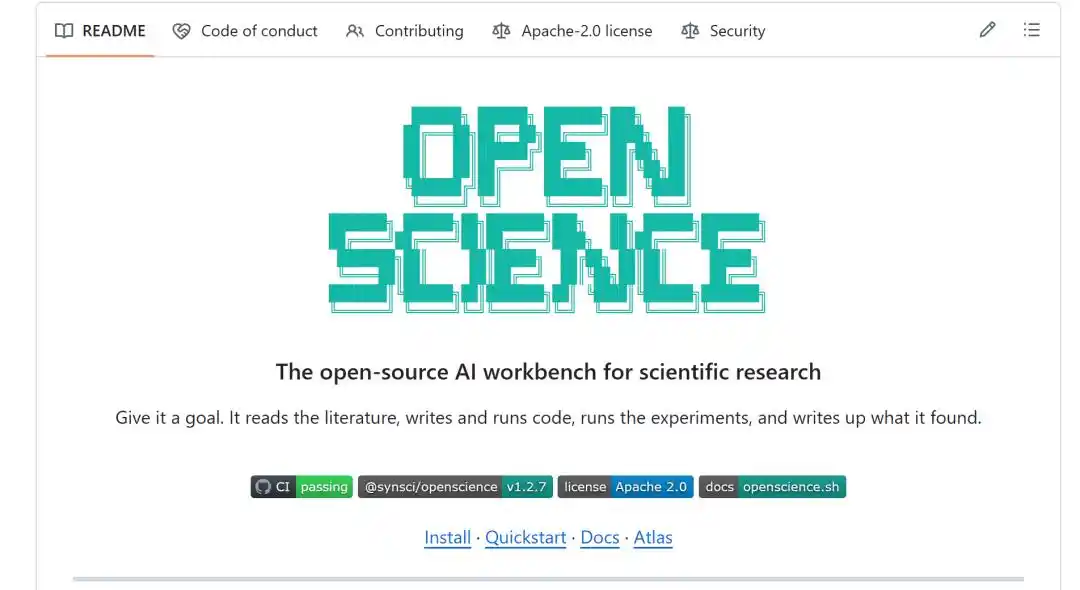
Although OpenScience's mission is the same as Claude Science's, they have a fundamental difference:

Model-agnostic.

In Synthetic Sciences' own words:

Scientific AI should be open. The tools humans use for exploration and discovery should not be monopolized by one company, nor should that company decide who is qualified to use them.

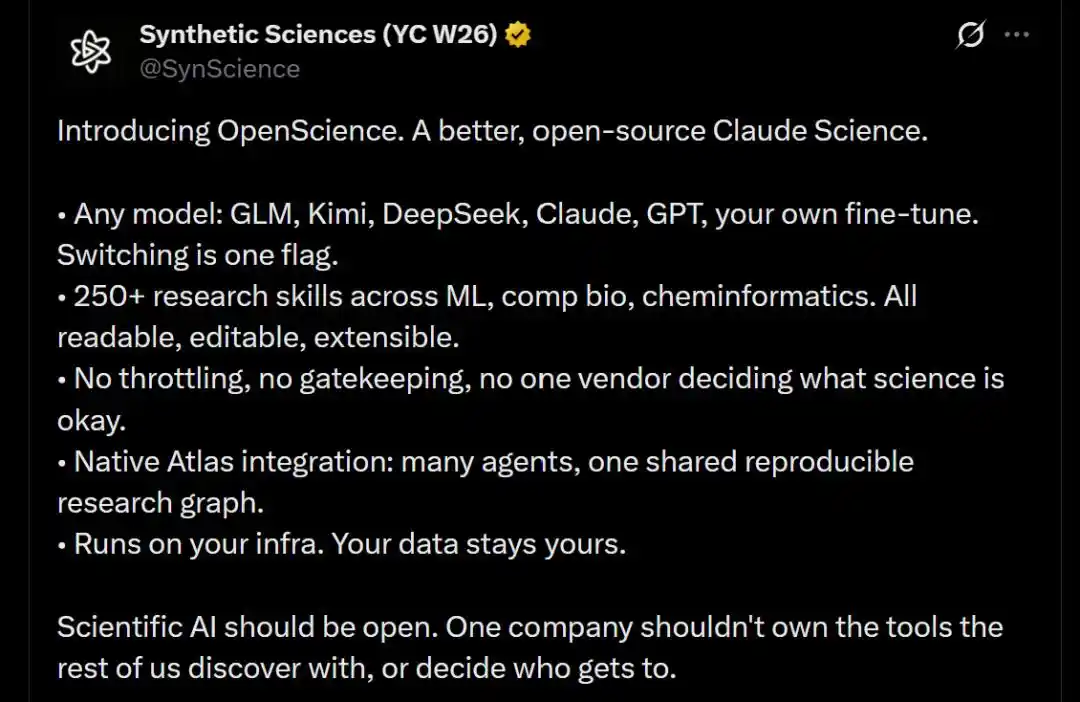
Therefore, on this platform, Anthropic, OpenAI, Google, DeepSeek, GLM... as long as you have an API Key, you can connect directly.

You can even run local models, deploy via Ollama, without a single byte of your data leaving your machine.

Your Key stays locally, requests go directly to the model provider, not passing through any intermediate server.

Moreover, OpenScience supports switching models per request.

Within the same workbench, you can use Claude for this step, then switch to DeepSeek for the next, without changing any configuration.
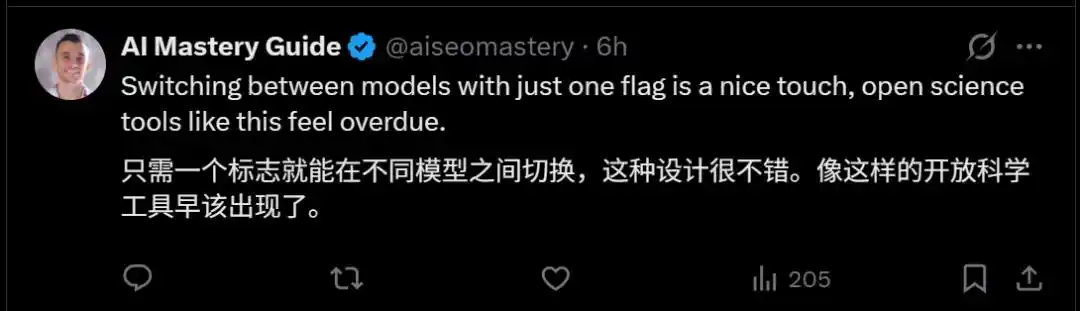
Feature-wise, OpenScience is even more aggressive than Claude Science —

Built-in with over 250 research skill packages, more than 4 times that of Claude Science, covering ML, computational biology, chemoinformatics, etc., and all are readable, editable, and extensible.
Installation is also simple, just one command in the terminal:

Open and use immediately, the workbench automatically pops up in the browser. On first run, select a model source, fill in the API Key, and you can start working.

You can also install it globally:

If configuring Keys is troublesome, the team also provides a hosted platform called Atlas —

Top up a wallet to directly call various cutting-edge models without configuring Keys one by one, plus persistent research graphs and cloud computing power.

But Atlas is not mandatory. You can use OpenScience fully for free with your own Keys, no barrier.

One More Thing

Interestingly, if you scroll to the very bottom of OpenScience's GitHub page, you'll see a statement added specifically:

OpenScience is an independent project. It is not affiliated with, endorsed by, or sponsored by Anthropic. “Claude” is a trademark of Anthropic, PBC, used here only to describe compatibility.
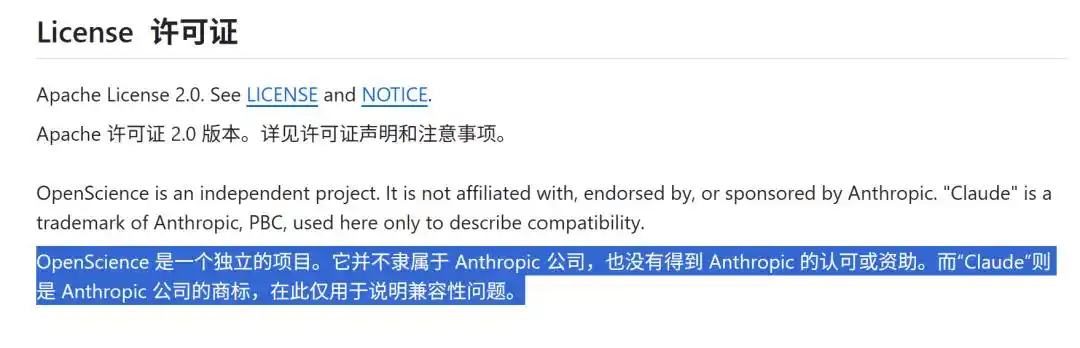
Translation: We are an independent project, with no relation to Anthropic whatsoever. Mentioning "Claude" is purely about describing compatibility, don't read too much into it.

It seems the impression left by the "lobster" incident on the entire open-source community is still too profound.

With OpenClaw changing names several times before, OpenScience this time directly welded the disclaimer onto the first version of the README.

Nothing else — survive first, then talk about being an alternative (doge).

Open-source address:

https://x.com/i/trending/2073904804829741364?s=20

Reference links:

[1]https://x.com/SynScience/status/2073829478393086311?s=20

[2]https://x.com/i/trending/2073904804829741364?s=20

[3]https://www.openscience.sh/

[4]https://www.anthropic.com/news/claude-science-ai-workbench

This article is from WeChat official account "QbitAI", author: Yi Shui

Cryptos en tendance

Questions liées

QWhat is OpenScience and how does it compare to Claude Science?

AOpenScience is an open-source AI scientific research workbench that serves as a free alternative to Anthropic's Claude Science. Unlike Claude Science, which is proprietary and limited to Claude models for paid users, OpenScience is model-agnostic, allowing users to freely choose and switch between various AI models like DeepSeek, GLM, Claude, or GPT via API keys or local deployments. It is released under the Apache 2.0 license and offers more than 250 research skill packages, significantly more than Claude Science's 60+.

QWhat are the key limitations of Claude Science mentioned in the article?

AClaude Science has several key limitations: 1) It only supports macOS and Linux operating systems. 2) It is exclusively available to Pro, Max, Team, and Enterprise paying users. 3) Users are restricted to using only Anthropic's proprietary Claude models on the platform. These restrictions, especially the payment requirement and model lock-in, make it inaccessible to many researchers, particularly in certain regions.

QHow does OpenScience address data privacy and local deployment?

AOpenScience prioritizes data privacy and flexibility by supporting local model deployment. Users can run models locally using tools like Ollama, ensuring that sensitive research data never leaves their own machines. API keys are also stored locally, and requests are sent directly to the model provider without passing through any intermediate servers, giving researchers full control over their data and computational environment.

QWhat was the early user feedback on Claude Science's capabilities?

AEarly internal testers reported positive results. A neuroscientist at the Allen Institute used Claude Science to create a multi-agent computational review template, enabling the generation of lengthy, citation-verified review papers in a fraction of the traditional time (e.g., producing ~10 papers over 100 pages each that previously would have taken years). A researcher at UCSF's Brain Tumor Center used it for molecular epidemiology studies, reducing the required time for germline variant analysis to one-tenth while maintaining result accuracy verified by his team.

QWhat is the stated long-term vision of the Synthetic Sciences team behind OpenScience?

AThe Synthetic Sciences team aims to build a platform where scientists can delegate complex research tasks to 'AI co-scientists' that autonomously handle the entire research pipeline from literature review to hypothesis generation, experiment execution, and paper writing. They believe that truly capable scientific foundation models require 'research taste,' which cannot be achieved by merely scaling model parameters. Instead, it requires a product-model co-development approach, where the product collects high-quality research process data to train models with genuine scientific intuition.

Lectures associées

Récapitulatif de Zoomex X Space avec David James et le panel de trading de la Coupe du Monde

Zoomex a organisé le troisième épisode de son X Space Édition Coupe du Monde, dans le cadre de son engagement caritatif, réunissant le gardien anglais David James et un panel de traders. La discussion a exploré les parallèles entre le gardien de but et le trader, en se concentrant sur la préparation, la psychologie et l'exécution. David James a partagé sa philosophie : la vraie pression pour un gardien survient lors des moments d'inactivité, nécessitant une concentration maximale. Il a comparé cela au trader préparé qui n'a pas peur du prochain mouvement de marché. Sur les penalties, il a distingué deux modes : la préparation pure (analyse des tendances) et l'instinct, affirmant que le premier affine le second. Ce principe a été directement relié au trading par le panel. James a souligné l'importance de transformer les erreurs en données apprenables plutôt qu'en fantômes mentaux. Évoquant l'évolution du poste, il a noté que les changements de règles, plus que la tactique, ont révolutionné le rôle, exigeant désormais une distribution précise. Concernant les équipes, il a pointé la menace statistique de la France, avec huit joueurs dépassant les 35 km/h, et la "fragilité" potentielle des équipes invaincues comme le Mexique et l'Espagne, qui n'ont pas encore appris à réagir après avoir encaissé. Interrogé sur l'Angleterre, James a maintenu sa conviction qu'elle peut tout gagner, chaque argument pour les autres favoris s'appliquant aussi à son équipe. La session s'est conclue sur le fil conducteur unissant le gardien et le trader : une préparation approfondie réduit l'inconnu et les nerfs, remplaçant l'anxiété par un plan, que le résultat soit favorable ou non. L'engagement caritatif de Zoomex se poursuit, avec 1000 USDT promis à la fondation UEFA choisie par James si l'Angleterre l'emporte.

TheNewsCryptoIl y a 40 mins

Récapitulatif de Zoomex X Space avec David James et le panel de trading de la Coupe du Monde

TheNewsCryptoIl y a 40 mins

La folle course en Bourse d'Unitree : le véritable enjeu, c'est comment elle va dépenser les 4,2 milliards qu'elle a levés

Le constructeur chinois de robots humanoïdes Unitree a vu sa demande d'introduction en Bourse approuvée par la Chine, visant à lever environ 4,2 milliards de yuans. Fondée par Wang Xingxing en 2016, l'entreprise s'est d'abord fait connaître avec des robots quadrupèdes avant de lancer en 2023 son premier robot humanoïde grandeur nature, le H1, suivie d'une gamme de produits à prix agressifs. Ses revenus sont passés de 159 millions de yuans en 2023 à 1,71 milliard en 2025, avec une part de marché mondiale dépassant 60% pour ses quadrupèdes. Environ 40% de son chiffre d'affaires provient de l'étranger, notamment d'un projet pilote avec Japan Airlines à l'aéroport de Tokyo Haneda. Les fonds levés serviront à renforcer la R&D, le développement de produits et la construction de nouvelles usines. Unitree fait face à une concurrence intense, avec des acteurs comme Ubtech (axé sur l'accompagnement émotionnel), Tesla Optimus, ou Fourier. Ses défis seront de consolider sa position au-delà des quadrupèdes, de maintenir son avantage de prix tout en améliorant la fiabilité, et de faire progresser l'intelligence incarnée, comme avec son modèle H2 Plus développé avec Nvidia. Sa stratégie semble privilégier la vente en volume de modèles d'entrée de gamme pour les développeurs, couplée à des projets phares dans des secteurs industriels, misant sur l'expansion future du marché des robots humanoïdes.

marsbitIl y a 1 h

La folle course en Bourse d'Unitree : le véritable enjeu, c'est comment elle va dépenser les 4,2 milliards qu'elle a levés

marsbitIl y a 1 h

Décortiquer la liste des partenaires d'Open USD : Suivre les entrées pour comprendre où vont les capitaux

L'article examine le vaste partenariat de l'Open USD, un nouveau stablecoin lancé avec plus de 140 partenaires fondateurs, en soulignant que cette liste révèle plus que le projet lui-même. Elle inclut des géants comme BlackRock, Stripe, Visa, Mastercard, Shopify, Google, IBM, ainsi que des banques (BNY Mellon, Bank of America) et des entreprises crypto (Coinbase, Ripple, Aave). L'analyse par catégories montre les motivations stratégiques : BlackRock vise la gestion des réserves lucratives ; Shopify cherche à réduire les coûts de transaction et à monétiser les soldes ; les banques adoptent une position défensive pour retenir les dépôts et les flux ; les entreprises technologiques comme Google anticipent les paiements programmables ; les acteurs crypto apportent liquidité et infrastructure. La présence simultanée de concurrents directs (Visa/Mastercard, Coinbase/Ripple) indique une peur commune d'être exclus d'une future infrastructure financière partagée, surpassant leurs rivalités. Cette alliance représente une évolution du stablecoin, d'un produit vendu par une seule entreprise (comme Circle ou Tether) vers une infrastructure collective. L'absence de ces derniers et des grandes banques de détail américaines est tout aussi significative. Le défi sera une gouvernance collective potentiellement lente, mais la liste des partenaires démontre une conviction partagée : posséder collectivement ce canal est préférable à le louer ou à en être absent.

Foresight NewsIl y a 1 h

Décortiquer la liste des partenaires d'Open USD : Suivre les entrées pour comprendre où vont les capitaux

Foresight NewsIl y a 1 h

Trading

Spot

Articles tendance

Comment acheter GLM

Bienvenue sur HTX.com ! Nous vous permettons d'acheter Golem (GLM) de manière simple et pratique. Suivez notre guide étape par étape pour commencer votre parcours crypto.Étape 1 : Création de votre compte HTXUtilisez votre adresse e-mail ou votre numéro de téléphone pour ouvrir un compte sur HTX gratuitement. L'inscription se fait en toute simplicité et débloque toutes les fonctionnalités.Créer mon compteÉtape 2 : Choix du mode de paiement (rubrique Acheter des cryptosCarte de crédit/débit : utilisez votre carte Visa ou Mastercard pour acheter instantanément Golem (GLM).Solde :utilisez les fonds du solde de votre compte HTX pour trader en toute simplicité.Prestataire tiers :pour accroître la commodité d'utilisation, nous avons ajouté des modes de paiement populaires tels que Google Pay et Apple Pay.P2P :tradez directement avec d'autres utilisateurs sur HTX.OTC (de gré à gré) : nous offrons des services personnalisés et des taux de change compétitifs aux traders.Étape 3 : stockage de vos Golem (GLM)Après avoir acheté vos Golem (GLM), stockez-les sur votre compte HTX. Vous pouvez également les envoyer ailleurs via un transfert sur la blockchain ou les utiliser pour trader d'autres cryptos.Étape 4 : tradez des Golem (GLM)Tradez facilement Golem (GLM) sur le marché Spot de HTX. Il vous suffit d'accéder à votre compte, de sélectionner la paire de trading, d'exécuter vos trades et de les suivre en temps réel. Nous offrons une expérience conviviale aux débutants comme aux traders chevronnés.

114 vues totalesPublié le 2024.12.10Mis à jour le 2026.06.02

Comment acheter GLM

Discussions

Bienvenue dans la Communauté HTX. Ici, vous pouvez vous tenir informé(e) des derniers développements de la plateforme et accéder à des analyses de marché professionnelles. Les opinions des utilisateurs sur le prix de GLM (GLM) sont présentées ci-dessous.

活动图片