Finding the Next Wang Tao

marsbitPublié le 2026-07-07Dernière mise à jour le 2026-07-07

Résumé

Hong Kong's deep-tech startups are crossing the Shenzhen River to scale up. On July 2nd, six university spin-off teams presented at the "X-Day" Xili Lake Roadshow in Nanshan, Shenzhen. Their projects spanned next-gen battery materials, quantum dot displays, robotics AI, digital sports, smart airports, and AI-powered fall prevention for the elderly. This reflects a growing trend: Hong Kong's academic research is increasingly seeking industrial application and commercialization within the Greater Bay Area, with Shenzhen being a primary destination. These startups exemplify the "fusion+" model—leveraging Hong Kong's strengths in fundamental, globally-connected research ("0 to 1") and Shenzhen's robust manufacturing ecosystem and market access for scaling ("1 to 100"). Examples include SuFang New Energy (high-energy-density battery materials), PuLang Quantum (quantum dot films in high-end displays and vehicles), and BuGu Health (AI-based fall risk screening). Platforms like the HKU Youth Innovation Academy and HKUST BlueBay are establishing physical bridges for this cross-border innovation. The discussion highlights a clear division of labor: Hong Kong provides the seeding ground for cutting-edge technology, while Shenzhen offers the pathway to产业化. As these connections strengthen through initiatives like the Xili Lake Roadshow, the region aims to foster the next generation of global tech leaders like DJI's Wang Tao.

A group of Hong Kong tech startup teams cross the Shenzhen River.

July 1st marked the 29th anniversary of Hong Kong's return. The next afternoon, six startup teams with backgrounds from Hong Kong universities appeared in Nanshan, Shenzhen. At the "X-Day" Xili Lake Roadshow Hong Kong Tech Special Event, they presented projects in lithium battery materials, quantum dot displays, robot intelligent control, digital sports, smart airports, and healthcare.

In fact, scenes like this have become increasingly common in recent years. Research achievements from Hong Kong universities continue to enter the Greater Bay Area, searching for the next stop for industrialization. So, they come to Shenzhen.

The journey from the laboratory to the industry unfolds from here, a much longer path.

A Group of Hong Kong University Entrepreneurs Gather in Shenzhen

Starting from a Roadshow

The first to take the stage was Sufang New Energy, founded in October 2023 and led by City University of Hong Kong Tenured Professor Liu Qi. Headquartered in Shenzhen, the company focuses on the R&D and industrialization of lithium-rich manganese-based cathode materials.

Voltage decay is a hurdle that lithium-rich manganese-based materials have struggled to overcome for years in industrialization. The team disclosed that Sufang New Energy is the only enterprise globally capable of synthesizing ultra-low voltage decay lithium-rich manganese-based materials. A production line with an annual capacity of 300 tons has been built in Shenzhen's Pingshan district, and samples have been sent to leading battery manufacturers for testing. "Driving 1000 kilometers on a single charge is no problem," stated Sufang New Energy's R&D Vice President Wang Bo.

Coincidentally, an existing investor was sitting in the audience. ZStone Partners had previously invested in this team. Founding Partner Zhong Qiankai noted that Sufang New Energy's progress was even faster than anticipated.

Next up was Pulang Quantum. Founder Zhang Zhikuan holds a PhD from the Hong Kong University of Science and Technology, with bachelor's and master's degrees from Peking University. He previously served as CTO of Refond Optoelectronics before co-founding the company with Professor Sun Xiaowei, Chair Professor at Southern University of Science and Technology and Foreign Academician of the Russian Academy of Sciences. The company provides full-process integrated supply of high-end quantum dot materials.

Products from this company have actually already appeared in many people's daily lives - the screens of Lenovo Legion 9000K and ASUS ROG series laptops contain Pulang's quantum dot films. In the most demanding automotive field, Pulang is the first company globally to achieve mass production of front-installed automotive quantum dot films, starting with the Zeekr 7X and gradually entering models from NIO, Audi, and others, holding over 70% of the global market share for automotive quantum dot films.
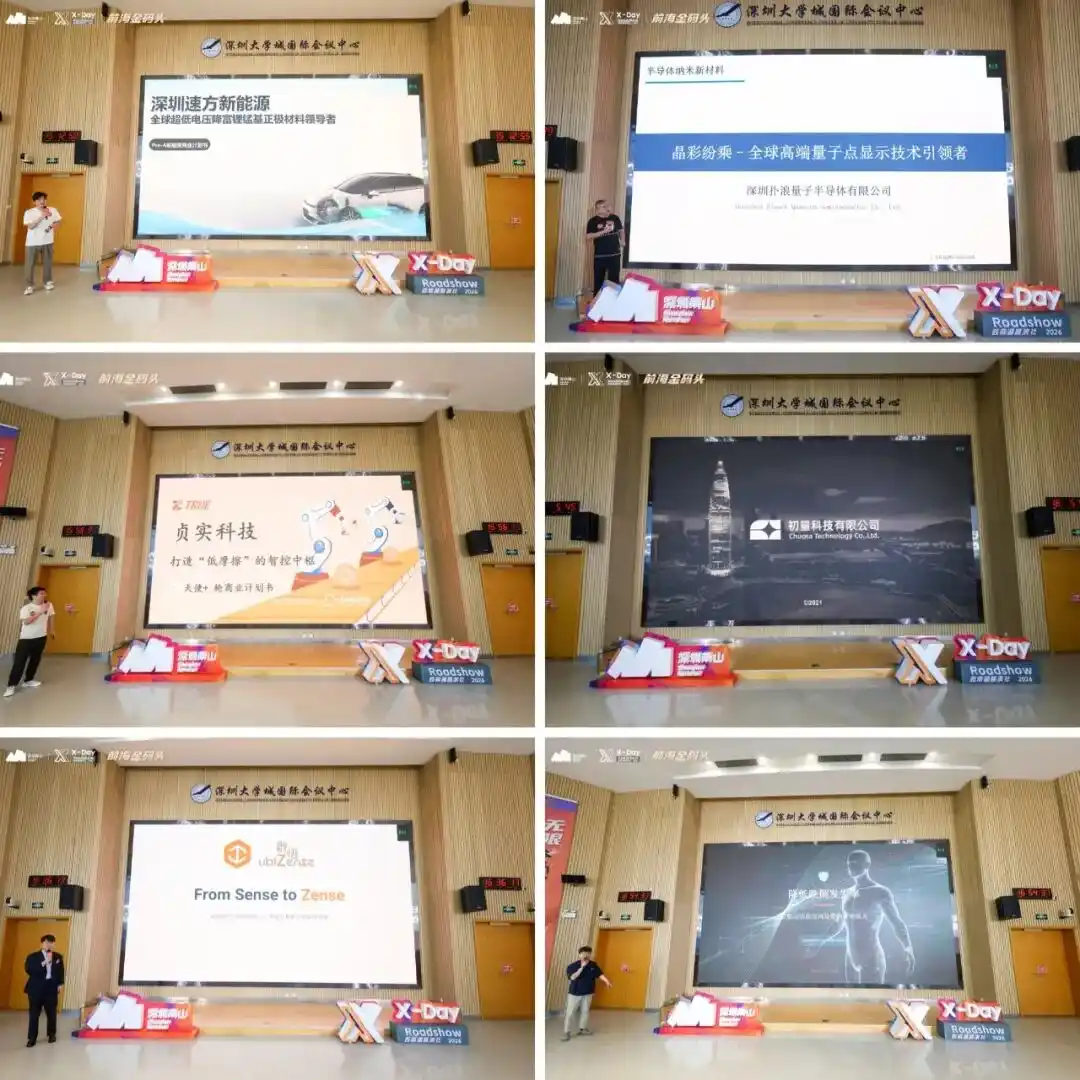
Zhenshi Technology followed, presenting a "ready-to-use" robotic embodied intelligent control system, emphasizing "vision, control, and AI integration," targeting non-standard industrial scenarios with small batches and multiple varieties. The founders are a pair of brothers: CEO Gui Kai handles the market and "cerebellum" control, while his younger brother Gui Shun, a PhD from The Hong Kong Polytechnic University, is responsible for the AI "brain." The company is headquartered in Nanjing and just established a research center this year in Shenzhen's Qianhai, joining The Hong Kong Polytechnic University Qianhai Advanced Technology Research Centre.

From there, the technology began to enter more specific life and industry scenarios.

Chuliang Technology has built the digital sports brand PARTYDAY, using self-developed hardware-software integrated devices like skiing simulators and miniature racing cars to create indoor sports and entertainment spaces. It has currently opened 7 stores in Xi'an, Shenzhen, Wuhan, Hangzhou, and Shanghai, serving over 3 million cumulative visitors. The company has settled in the University of Hong Kong Youth Science and Innovation Institute located in Qianhai, leveraging cross-border incubation platforms from Hong Kong universities to foster bidirectional development of technology and innovation between Shenzhen and Hong Kong.

Inspired by the Asian Institute of Supply Chain and Logistics at The Chinese University of Hong Kong, Qiwu Technology (Ubizense) brings AI and IoT into airports. Its apron collaborative decision-making system has been deployed and running at Hong Kong International Airport for 8 years.

Now, the team is migrating this system from the two-dimensional apron to three-dimensional airspace, developing a drone collaborative decision management system targeting the low-altitude economy. The first stop in their landing plan is Shenzhen. Co-founder Xu Shenghao stated they aim to establish roots in Shenzhen first, striving to launch a pilot at Bao'an Airport.

The final presentation was from Bugoo Health, focusing on an easily overlooked issue: falls among the elderly. According to General Manager Xu Hongyuan, the annual incidence of falls among those aged 60 and above is about 30%, while most existing solutions focus on post-fall alerts and protection.

The company originates from Hong Kong Baptist University and was incubated at the Hong Kong Science Park. It uses wearable sensors combined with AI movement analysis to screen for fall risks in advance from balance, strength, and gait data, followed by exercise interventions. Currently, nearly 20 large public hospitals and over half of community health centers in Hong Kong are its users. The product has obtained U.S. FDA certification and is preparing to enter the mainland Chinese market.

Six teams with backgrounds from Hong Kong universities came to Xili Lake in Shenzhen. With technology stepping out of the lab, the next question to answer is how to truly integrate into the industry.

From Hong Kong to Shenzhen, Searching for the Next Wang Tao

An unavoidable question is: Why are Hong Kong tech startups flocking to Shenzhen? Before the roadshow began, four investors long involved in Hong Kong tech investments discussed this matter.
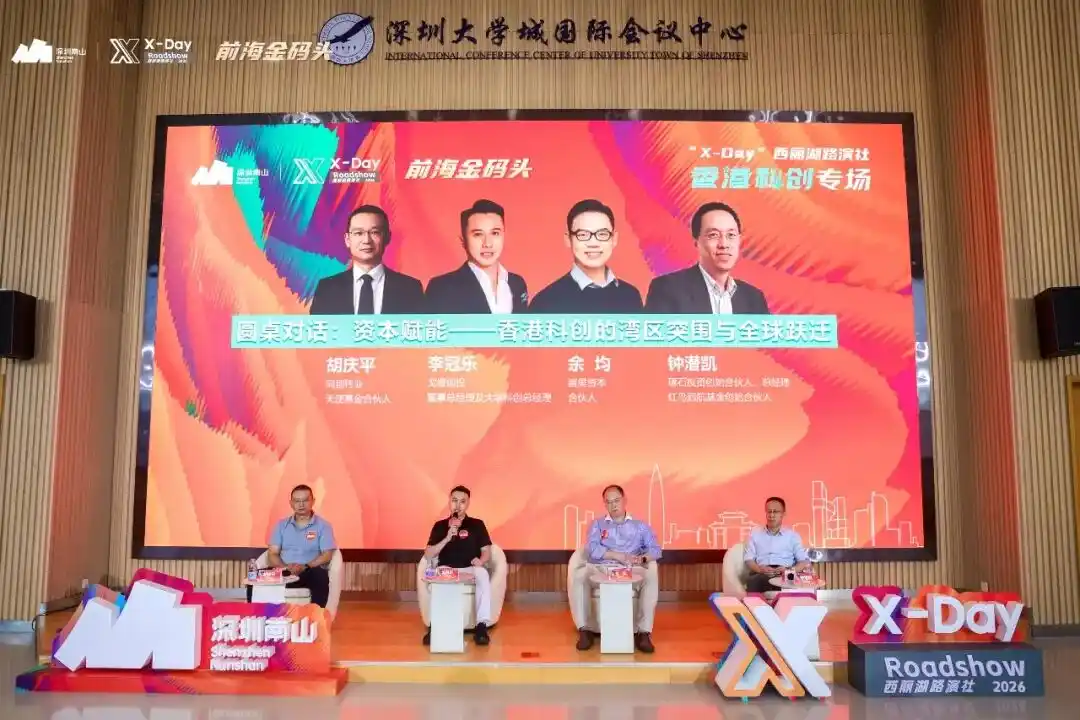
Junhao Capital Partner Yu Jun mentioned a detail: On roughly 1100 square kilometers of land in Hong Kong, there is a high-density concentration of universities and research resources, which is itself a scarce advantage.

For a technology to leave the lab, it must cross pilot-scale testing, find customers, and undergo real market validation. Yu Jun repeatedly mentioned "real demand": No matter how cutting-edge the technology, it must ultimately land on a business model.

Gobi Partners Managing Director Li Guanle feels this more deeply. Having long invested in university tech projects, he observed that many overseas scientists returning to China often choose Hong Kong as their first stop. The English-speaking environment, global academic networks, and dense university resources give Hong Kong teams a natural international perspective.

"Hong Kong teams excel at going from 0 to 1, while the Greater Bay Area can provide the engineering and industrial support to go from 1 to 100," Li Guanle stated.

ZStone Partners Founding Partner Zhong Qiankai calls it "Fusion+". Over the years, he has encountered many semiconductor, AI, and materials projects from HKUST. The technology often stands at the threshold of industrialization; the next step is to truly connect Hong Kong's research with the mainland's industry.

Shenzhen happens to be at this stage.

In fact, a Shenzhen-Hong Kong tech channel is gradually becoming clear. Platforms like the City University of Hong Kong Shenzhen Research Institute, the University of Hong Kong Youth Science and Innovation Institute, and the Hong Kong University of Science and Technology Blue Bay Qianhai Innovation Port have successively landed in Shenzhen. Beyond university labs, industry and markets are getting closer.

The six roadshow projects that day also reflected this trajectory. Separated by a river, the two cities are each taking on the parts they excel at. As Tongchuang Weiye Angel Fund Partner Hu Qingping said, from the angel stage onwards, entrepreneurial interaction between Shenzhen and Hong Kong has become increasingly close, and what's needed in the future is "two-way" collaboration.

The Xili Lake Roadshow makes this connection more concrete. Since its launch, "X-Day" has held 18 themed roadshows, attracting over 520 project applications. 53 companies have received equity investments totaling over 2.096 billion yuan, and 32 companies have obtained new bank credit lines exceeding 1.145 billion yuan. Additionally, 8 non-local roadshow projects have established entities in Nanshan.

Hong Kong has the source innovation; Shenzhen receives the next stage of industrialization. The Shenzhen River is narrow, and the distance in tech and innovation between Shenzhen and Hong Kong is getting shorter.

Perhaps the next entrepreneur like DJI's Wang Tao, who takes a product global, is setting out from here.

This article is from the WeChat public account "Investment Community" (ID: pedaily2012), by Wang Lu


Cryptos en tendance

Questions liées

QWhat is the main theme of the article 'Finding the Next Wang Tao'?

AThe main theme is the increasing trend of Hong Kong's university-based scientific research and entrepreneurial teams crossing into Shenzhen, within the Greater Bay Area, to industrialize their technological innovations. It highlights the complementary strengths of Hong Kong's academic research and Shenzhen's industrial ecosystem.

QWho is Wang Tao, and why is he referenced in the article's title?

AWang Tao (Frank Wang) is the founder of DJI, the world's leading consumer drone company. He is a prominent example of a successful entrepreneur who leveraged Hong Kong's academic resources (he studied at Hong Kong University of Science and Technology) and the manufacturing/industrial ecosystem of Shenzhen to build a global product. The article uses him as a benchmark, suggesting the search for the next major innovator emerging from this Hong Kong-Shenzhen collaboration model.

QWhat are some specific challenges that Hong Kong's tech startups face in moving from the lab to the market, as mentioned in the article?

AThe challenges include bridging the gap from laboratory research to pilot-scale production (pilot testing), finding initial customers, and validating their technology in the real market. The article emphasizes that even cutting-edge technology must eventually establish a viable business model based on genuine market demand.

QHow does the X-Day Xili Lake Roadshow Club event, described in the article, facilitate Hong Kong-Shenzhen collaboration?

AThe X-Day Xili Lake Roadshow Club provides a platform for Hong Kong university-based tech startups to pitch their projects to investors and the industry in Shenzhen (Nanshan District). It acts as a concrete connector, helping projects gain funding, bank credit, and facilitating the establishment of business entities in Shenzhen. The event specifically mentioned has attracted over 520 projects and helped secure significant investment and credit.

QWhat are some of the key advantages Shenzhen offers to Hong Kong's tech entrepreneurs, according to the investors cited in the article?

AAccording to the investors, Shenzhen offers critical advantages for the '1 to 100' phase of growth. These include robust engineering capabilities, complete industrial supply chains, and proximity to a vast market for pilot testing and commercialization. While Hong Kong excels at foundational '0 to 1' research with international perspective, Shenzhen provides the manufacturing, scaling, and deep market integration necessary for产业化 (industrialization).

Lectures associées

L'Inde maintient sa position ferme sur les cryptomonnaies alors que la RBI renouvelle son avertissement contre les actifs numériques

L'Inde maintient une position stricte sur les cryptomonnaies alors que la Reserve Bank of India (RBI) renouvelle ses mises en garde contre les actifs numériques. Les autorités évaluent la politique à long terme, et des documents internes révèlent que la RBI réitère sa recommandation de restrictions, notamment pour éviter un risque de contagion financière au sein du système bancaire. La banque centrale s'inquiète particulièrement des stablecoins, affirmant que ceux adossés à des devises étrangères menacent la souveraineté monétaire du pays, tandis que ceux liés à la roupie pourraient réduire les revenus gouvernementaux issus de la masse monétaire. Par ailleurs, les autorités fiscales indiennes rencontrent des difficultés de contrôle : moins d'un quart des environ 645 000 traders de crypto auraient déclaré leurs transactions pour l'exercice clos en mars 2023. Les échanges offshore, les portefeuilles privés et les transactions pair-à-pair compliquent l'identification des propriétaires bénéficiaires et la collecte des impôts. À partir de janvier 2026, les plateformes devront conserver des données détaillées pour les transactions dépassant 10 000 USD. Malgré l'absence de législation claire et un cadre réglementaire encore en discussion, l'Inde reste l'un des principaux marchés mondiaux, avec près de 39 millions de détenteurs d'actifs numériques évalués à 2,1 milliards de dollars fin mai.

TheNewsCryptoIl y a 40 mins

L'Inde maintient sa position ferme sur les cryptomonnaies alors que la RBI renouvelle son avertissement contre les actifs numériques

TheNewsCryptoIl y a 40 mins

Ethereum maintient ses gains du T3 alors que Tether brûle 2,5 milliards de dollars – Mais CE catalyseur demeure

Le réseau Ethereum maintient ses gains du troisième trimestre malgré une réduction de 2,5 milliards de dollars de l'offre d'USDT par Tether. L'attention se porte désormais sur la mise à niveau majeure "Glamsterdam", prévue pour la seconde moitié de 2026 et actuellement en phase de tests finaux. Cette amélioration vise à augmenter considérablement l'évolutivité du réseau en introduisant le traitement parallèle des transactions et en relevant progressivement la limite de gaz. Cependant, l'écosystème Ethereum fait face à des défis en matière de liquidités. Les activités DeFi sont en difficulté, comme en témoigne la baisse significative de la valeur totale verrouillée (TVL) sur des protocoles majeurs comme Aave. La capitalisation totale du marché des stablecoins a également reculé, et le récent retrait d'USDT par Tether a encore réduit les liquidités stables disponibles sur Ethereum. Ainsi, la trajectoire d'Ethreum pour le second semestre semble se jouer entre deux forces : un catalyseur haussier potentiel offert par les améliorations techniques de Glamsterdam, et la pression baissière exercée par la faible activité on-chain et le resserrement des liquidités. La question centrale est de savoir si la mise à niveau pourra stimuler une reprise fondamentale suffisante pour soutenir une tendance haussière durable.

ambcryptoIl y a 1 h

Ethereum maintient ses gains du T3 alors que Tether brûle 2,5 milliards de dollars – Mais CE catalyseur demeure

ambcryptoIl y a 1 h

L’intelligence incarnée en épreuve suprême : les modèles les plus puissants ne font que 12,8%, quand l’humain atteint 100

L'évaluation RoboDojo, un nouveau benchmark unifié pour l'intelligence incarnée en robotique, révèle l'écart considérable entre les modèles actuels et une capacité opérationnelle générale et fiable. Ce "Mont Everest de l'incarnation" évalue 30 stratégies robotiques principales sur 42 tâches en simulation et 18 tâches en monde réel, couvrant la généralisation, la mémoire, la précision, les tâches à long horizon et la compréhension sémantique ouverte. Les résultats sont sévères : dans l'environnement simulé, la meilleure stratégie, Hy-Embodied-0.5-VLA, n'atteint qu'un taux de réussite moyen de 8,80%. Dans le monde réel, le modèle le plus performant, π0.5, n'atteint que 12,8% de réussite. En comparaison, un expert humain atteint 76,03% en simulation et 100% sur les tâches réelles. RoboDojo se distingue en standardisant également l'évaluation sur robots physiques (RoboDojo-RealEval) avec des protocoles reproductibles, exposant ainsi les défis de l'incertitude physique, du bruit des capteurs et de la dérive des actionneurs. La plateforme XPolicyLab facilite l'intégration et la comparaison équitable des modèles. Le benchmark met en lumière les limites actuelles : aucune approche n'est compétente sur toutes les capacités, et les performances chutent drastiquement face à des instructions sémantiques ouvertes (environ 1,67% de réussite). RoboDojo établit ainsi une référence communautaire et ouverte, essentielle pour mesurer les progrès vers des robots polyvalents véritablement capables de comprendre et d'agir dans le monde physique.

marsbitIl y a 1 h

L’intelligence incarnée en épreuve suprême : les modèles les plus puissants ne font que 12,8%, quand l’humain atteint 100

marsbitIl y a 1 h

Derrière le triplement d'ANSEM en une semaine : la renaissance et les pièges des Meme sur Solana

L'article examine la résurgence des memecoins sur Solana, menée par ANSEM dont le prix a explosé de près de 300% en une semaine. Cette hausse a relancé l'activité sur les plateformes de lancement comme Pump.fun, avec des volumes hebdomadaires dépassant à nouveau 50 milliards de dollars et une part des memecoins dans le volume total de Solana remontant au-dessus de 20%. Cependant, cette reprise met en lumière les pièges structurels du secteur. L'environnement de trading ultra-rapide, avec une durée moyenne de détention de seulement 100 secondes, favorise massivement les robots et les gros portefeuilles. Des études citées révèlent que les bots achètent systématiquement les nouveaux jetons dans les premières secondes, que de nombreux projets présentent des signes de manipulation (faux trading, lavage de transactions) et que la majorité sont considérés comme à haut risque, entraînant des pertes importantes pour les petits investisseurs. La question centrale est de savoir si cette vague de chaleur, bien qu'excellente pour attirer de nouveaux utilisateurs sur le réseau Solana, peut échapper au cycle ancien où les retail investors servent finalement de liquidité aux initiés. L'avenir du segment dépendra de sa capacité à maintenir une dynamique de croissance organique avec des volumes durables, plutôt que de retomber dans un schéma de phénomène isolé et éphémère.

Foresight NewsIl y a 2 h

Derrière le triplement d'ANSEM en une semaine : la renaissance et les pièges des Meme sur Solana

Foresight NewsIl y a 2 h

Trading

Spot

Articles tendance

Comment acheter RIVER

Bienvenue sur HTX.com ! Nous vous permettons d'acheter River (RIVER) de manière simple et pratique. Suivez notre guide étape par étape pour commencer votre parcours crypto.Étape 1 : Création de votre compte HTXUtilisez votre adresse e-mail ou votre numéro de téléphone pour ouvrir un compte sur HTX gratuitement. L'inscription se fait en toute simplicité et débloque toutes les fonctionnalités.Créer mon compteÉtape 2 : Choix du mode de paiement (rubrique Acheter des cryptosCarte de crédit/débit : utilisez votre carte Visa ou Mastercard pour acheter instantanément River (RIVER).Solde :utilisez les fonds du solde de votre compte HTX pour trader en toute simplicité.Prestataire tiers :pour accroître la commodité d'utilisation, nous avons ajouté des modes de paiement populaires tels que Google Pay et Apple Pay.P2P :tradez directement avec d'autres utilisateurs sur HTX.OTC (de gré à gré) : nous offrons des services personnalisés et des taux de change compétitifs aux traders.Étape 3 : stockage de vos River (RIVER)Après avoir acheté vos River (RIVER), stockez-les sur votre compte HTX. Vous pouvez également les envoyer ailleurs via un transfert sur la blockchain ou les utiliser pour trader d'autres cryptos.Étape 4 : tradez des River (RIVER)Tradez facilement River (RIVER) sur le marché Spot de HTX. Il vous suffit d'accéder à votre compte, de sélectionner la paire de trading, d'exécuter vos trades et de les suivre en temps réel. Nous offrons une expérience conviviale aux débutants comme aux traders chevronnés.

873 vues totalesPublié le 2026.01.16Mis à jour le 2026.06.02

Comment acheter RIVER

Discussions

Bienvenue dans la Communauté HTX. Ici, vous pouvez vous tenir informé(e) des derniers développements de la plateforme et accéder à des analyses de marché professionnelles. Les opinions des utilisateurs sur le prix de RIVER (RIVER) sont présentées ci-dessous.

活动图片