Who is the Most Profitable Man in the Crypto World? Trump Rakes in Over $1.427 Billion in 2025

Foresight NewsPublié le 2026-07-01Dernière mise à jour le 2026-07-01

Résumé

Who is the most profitable man in crypto? President Trump's 2025 financial disclosure, filed with the Office of Government Ethics, reveals crypto-related earnings exceeding $1.427 billion, starkly contrasting the broader market downturn. The bulk of this wealth stems not from passive investment but from his entities' roles as issuers and licensors. CIC Digital LLC, his memecoin operation, generated approximately $636 million in 2025, primarily from "Celebration Coins" royalty fees. DT Marks Defi LLC, a stakeholder in World Liberty Financial, earned about $594 million from asset sales and token distribution proceeds. Other entities held significant Bitcoin, Ethereum, and various altcoin wallets, along with substantial income from stablecoin ventures and his wife's NFT sales. This "issuer model" shields him from market downturns. While his namesake memecoin plummeted from ~$74 to ~$1.68, leaving many retail investors at a loss, his royalty income remained unaffected. The disclosure emerges as the U.S. Senate debates the CLARITY Act, which includes contentious ethics provisions aimed at preventing officials from profiting from the crypto sector they regulate. Critics argue Trump's earnings exemplify a critical conflict of interest, fueling demands for stricter rules to separate regulatory power from personal financial gain in the industry.


Author: Sanqing, Foresight News


On July 1, the U.S. Office of Government Ethics (OGE) released President Trump's 2025 annual financial disclosure report (OGE Form 278e), his first annual filing since his second term, spanning 927 pages. The OGE is a federal agency within the executive branch established by the Ethics in Government Act of 1978. It oversees the conduct of over 4 million federal officials and employees, preventing conflicts of interest, with annual financial disclosures being a core regulatory tool. Foresight News has tallied all identifiable cryptocurrency holdings and cash flow items from the original disclosure, with the total accountable income amounting to approximately $1.427 billion.


This report was released against the backdrop of a downturn in the crypto market—Bitcoin prices have fallen over 50% from last autumn's all-time high, putting widespread pressure on the industry. The President's personal crypto wealth expanded against the trend, forming a stark contrast with the industry's overall contraction. Vice President Vance's (JD Vance) concurrently disclosed personal assets also included, for the first time, a Bitcoin holding, with a disclosed value range of $250,000 to $500,000.


The Crypto Ledger in the Disclosure


Trump's crypto assets are scattered across four related entities, with each holding and cash flow recorded down to the single digit in the original report. All details below are from the original OGE Form 278e.


CIC Digital LLC (the operating entity for the memecoin business, 100% held by the "Donald J. Trump Revocable Trust"): The books show holdings include a USDC cold wallet valued between $5 million and $25 million, an Ethereum cold wallet valued between $5 million and $25 million, and a Bitcoin cold wallet valued at over $50 million. In 2025, this entity received $635,068,835 in royalties through the "Celebration Coins" token licensing agreement, $493,846 through a sub-licensing agreement with JBCZ Group LLC, $510,808 from Ethereum staking rewards, and $45,932 in USDC cold wallet interest, totaling approximately $636 million.


DT Marks Defi LLC (formerly DT Tower II LLC, holds a 38.25% stake in WLF Holdco LLC, the controlling entity of World Liberty Financial, with the Trump family collectively holding 30%): The books show holdings include an Ethereum cold wallet valued at over $50 million, a Bitcoin cold wallet valued at over $50 million, and multi-currency cold wallets including Chainlink (LINK) valued between $500,000 and $1 million, Aave (AAVE) valued between $1 million and $5 million, among others.


In 2025, this entity received a net gain of $65,625,000 from the sale of WLF Holdco equity and received cash and various token proceeds from World Liberty Financial's token sales: the Ethereum wallet received $150,606,931, the USDC wallet received $56,036,445, USD cash received $42,250,000, the Bitcoin wallet received $33,462,160, and long-tail tokens like LINK, AAVE, ENA, MOVE, ONDO collectively received $8,204,785, with an additional $1,821,628 from Ethereum staking rewards and $6,995 in USDC interest. This entity's total annual income reached approximately $594 million.


DTTM Operations LLC: Directly holds 15.75 billion World Liberty Financial governance tokens, recorded under the Ethereum wallet item, with a disclosed value range of "over $50 million".


DT Marks SC LLC: Holds a 38.25% stake in Stablecoin Holdco LLC, receiving $196,875,000 in dividends in 2025. Investors in this stablecoin company include Abu Dhabi's Sheikh Tahnoon bin Zayed Al Nahyan.


Beyond directly held tokens and tokenized income, Trump also holds Coinbase (COIN) Class A shares through multiple personal investment accounts, with purchase frequency noticeably higher than sales in 2025, with a single highest purchase amount reaching the $250,000 to $500,000 range; he also holds shares in Coreweave, a Bitcoin miner transitioning into an AI company.


He also holds shares in other crypto-involved enterprises like CME, Block Inc., Intercontinental Exchange (parent company of NYSE), Robinhood, Strategy, and Bitcoin miner CleanSpark. Among these, the Robinhood holding is the largest, reaching the $250,000 to $500,000 range in a single account.


Additionally, associated with Trump is an NFT income under First Lady Melania's name. Her MKT World LLC, through a licensing agreement with Designers Manager selling NFTs and other collectibles, had a net income of $6,011,259 in 2025; this income is registered under "Part 5: Spouse's Assets" on the disclosure form, separate from the crypto assets held by Trump himself.


In contrast, Vance's disclosure is much simpler. His personal asset list includes only one crypto holding—a Coinbase account holding Bitcoin, with a disclosed value range of $250,000 to $500,000, generating no other crypto-related income for the year.


Issuers Reap Profits in All Conditions, Retail Investors Bear the Losses Alone


Trump's crypto wealth does not come from passive holding but from his direct position as an issuer. CIC Digital LLC is both the licensor of the memecoin and the direct recipient of royalties; DT Marks Defi LLC is both a shareholder in World Liberty Financial's controlling entity and the direct beneficiary of token sale cash flows.


He is not "investing" in cryptocurrency; he is "issuing" cryptocurrency.


This issuer-position revenue model bears almost no downside risk. The Trump-named token was issued on the Solana blockchain just days before his January 2025 inauguration, once surging to around $74 before falling continuously, currently trading around $1.68.


According to data cited by the X platform account MeidasTouch, approximately 764,000 wallet addresses have incurred losses on this token. Trump himself, from royalty income alone, received $635 million.
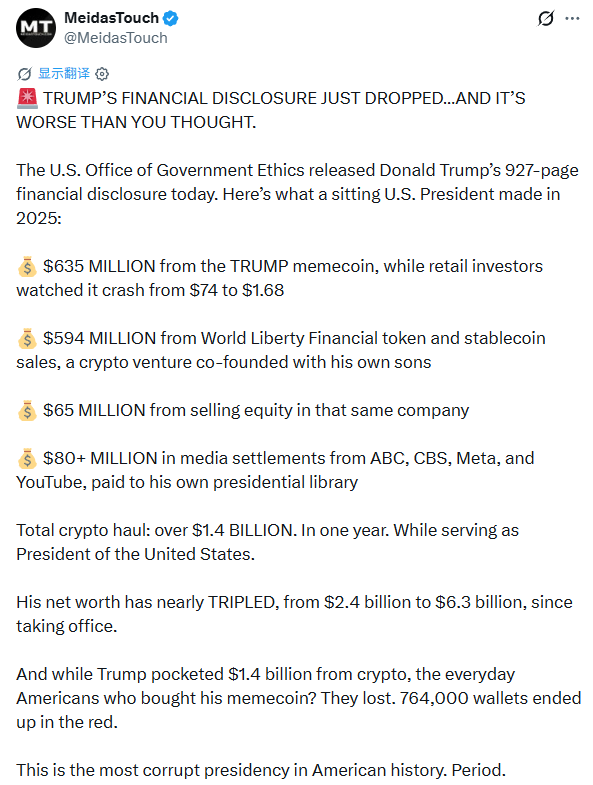


MeidasTouch called it "the most corrupt presidential term in American history," a statement carrying strong political bias, but it points to a real issue. When the issuer's income comes from the trading activity itself rather than the project's long-term value, retail investors are naturally at a disadvantage.


Regulator and Beneficiary as One


The timing of this disclosure coincides with a critical phase of negotiations in the Senate for the most important legislative process in the U.S. crypto industry, the "CLARITY Act." This bill aims to clarify the standards for determining the security status of assets like Bitcoin and Ethereum, but the ethics provision prohibiting the President, Vice President, members of Congress, and their families from holding or benefiting from crypto businesses has yet to be resolved in the negotiations.


Democratic lawmakers have been pushing to include this clause in the final text, citing the issues exposed by this disclosure. Incumbent high-ranking officials should not simultaneously be the biggest beneficiaries of the industry they regulate.


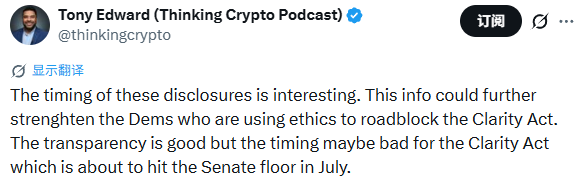
According to comments by Thinking Crypto podcast host Tony Edward on X, the timing of this disclosure's release is "rather delicate," potentially further strengthening the Democrats' leverage to block the bill's progress on ethical grounds; organizations like Transparency International have also consistently criticized the bill for lacking conflict-of-interest provisions.


In contrast, Vance's disclosed $250,000 to $500,000 Bitcoin holding is closer to the level of an ordinary high-net-worth individual investor. The controversy illustrates that the core issue is not "whether officials can hold crypto assets," but "whether the President's family directly operates, issues, and extracts fees from the entities under regulation."


Whether the "CLARITY Act" can incorporate conflict-of-interest provisions within the remaining window will directly determine whether the model of "regulator and beneficiary as one" is merely a unique case of the Trump administration or will become the norm for the long-term coexistence of the crypto industry and power structures in the future.


Questions liées

QAccording to the financial disclosure report, what is the total approximate crypto-related income for President Trump in 2025?

AAccording to the report, the total identifiable crypto-related income for President Trump in 2025 is approximately $1.427 billion.

QWhich entity is the primary operator of Trump's memecoin business and generated significant royalties?

ACIC Digital LLC is the primary operator of the memecoin business. It generated around $635 million in 2025, primarily from royalties for the 'Celebration Coins' token license agreement.

QWhat is the core ethical issue highlighted in the article regarding Trump's crypto wealth and the CLARITY Act?

AThe core ethical issue is the conflict of interest where the President, as a key regulator, is also the largest beneficiary of the industry being regulated through his direct control and income from issuing cryptocurrencies. The article questions the lack of strong ethics clauses in the CLARITY Act to prevent this.

QHow does the article describe the financial outcome for retail investors who bought the Trump-themed memecoin compared to Trump's own earnings?

AThe article states that while President Trump earned approximately $635 million in royalties from the memecoin, around 764,000 wallet addresses are reportedly at a loss as the token's price fell from a high of about $74 to around $1.68.

QWhat is the main difference between the crypto holdings disclosed by Vice President Vance and those of President Trump?

AVice President Vance's disclosure shows a single Bitcoin holding valued between $250,000 and $500,000 with no other crypto income, resembling a typical high-net-worth investor. In contrast, President Trump's wealth stems from operating and issuing cryptocurrencies through controlled entities, generating billions in income from royalties, token sales, and dividends.

Lectures associées

Tous les grands altcoins sont en hausse. Les 5 principales monnaies par croissance sur sept jours

Tous les principaux altcoins affichent une performance positive. Voici le top 5 des cryptomonnaies ayant le plus progressé sur sept jours, du 14 au 21 août. Le marché a connu une tendance haussière générale, initiée le 17 août et accentuée par une rencontre à la Maison Blanche entre l'ancien président américain Donald Trump et des dirigeants de l'industrie crypto. **Top 5 des gains :** 1. **Ethena (ENA) : +65%** La plateforme de stablecoins a bénéficié de l'annonce d'une ligne de crédit de 1 milliard de dollars avec FalconX, utilisant les réserves de son stablecoin USDe. 2. **SPX6900 ($SPX) : +40%** Ce memecoin a vu son cours augmenter sans partenariat spécifique, potentiellement influencé par l'annonce de Coinbase de suspendre ses contrats à terme sur $SPX. 3. **XRP ($XRP) : +40%** Ripple a enregistré une excellente semaine, stimulée par l'adoption de son service de paiements par une banque sud-coréenne et un placement privé réussi de 275 millions de dollars. 4. **Venice Token ($VVV) : +35%** Le jeton d'un protocole IA axé sur la confidentialité a progressé après que ses cofondateurs aient révélé un chiffre d'affaires annuel dépassant 100 millions de dollars. Un mécanisme de rachat et de destruction des jetons soutient également son économie. 5. **Pump.fun ($PUMP) : +35%** La plateforme de lancement de memecoins a atteint un chiffre d'affaires hebdomadaire record de 23,5 millions de dollars. Comme pour $VVV, une partie des revenus est utilisée pour racheter et détruire des jetons $PUMP. *Disclaimer : Ces informations sont fournies à titre éducatif uniquement et ne constituent pas un conseil en investissement. Les cryptomonnaies sont des actifs volatiles.*

cryptonews.ruIl y a 13 mins

Tous les grands altcoins sont en hausse. Les 5 principales monnaies par croissance sur sept jours

cryptonews.ruIl y a 13 mins

Fin de la liberté d'installer des APK ? Non, les restrictions de Google ne toucheront pas tout le monde et partout

Google introduit de nouvelles règles pour l'installation de fichiers APK tiers via son "Advanced Flow", mais ces restrictions ne s'appliqueront pas à tous et ne bloqueront pas complètement les installations depuis des sources non officielles. Le déploiement est progressif et limité. Géographiquement, les premières restrictions obligatoires débuteront en septembre 2026 au Brésil, en Indonésie, à Singapour et en Thaïlande. Un déploiement mondial n'est prévu qu'en 2027. Techniquement, le mécanisme ne fonctionne que sur les appareils certifiés avec les services Google Mobile (GMS) préinstallés. Les appareils chinois (sans GMS complets), les ROM personnalisées et les appareils sans GMS ne sont pas concernés et conservent une installation libre. Pour les utilisateurs concernés, un protocole de confirmation existe. L'installation via ADB reste libre. Via l'interface standard, les utilisateurs devront activer le mode développeur, suivre une procédure de confirmation (incluant une attente d'un jour) pour obtenir une autorisation valable 7 jours ou indéfiniment. Google justifie ces mesures par la lutte contre la fraude. L'analyse souligne que la fonction, fournie via les services Google Play, pourrait être modifiée à distance. La question reste de savoir si ce mécanisme restera un véritable moyen de contournement ou deviendra une simple formalité après 2027.

cryptonews.ruIl y a 18 mins

Fin de la liberté d'installer des APK ? Non, les restrictions de Google ne toucheront pas tout le monde et partout

cryptonews.ruIl y a 18 mins

L'IA ne peut plus sauver les cours boursiers des grands groupes technologiques

Ces derniers jours, après la publication des résultats financiers des grands groupes Internet chinois, un phénomène notable est apparu : les actions de Tencent, Alibaba, Baidu, Kuaishou et NetEase ont toutes chuté, Xiaomi faisant figure d'exception. Pourtant, toutes ces entreprises ont un récit autour de l'IA : Baidu a Kunlunxin et son cloud IA, Kuaishou a Kling, Alibaba a Qwen et Alibaba Cloud, Tencent a Hunyuan et WorkBuddy, Xiaomi a MiMo, et NetEase utilise massivement l'IA dans le développement de jeux. Le paradoxe est que plus le consensus sur l'importance de l'IA est fort, plus il est difficile d'en tirer une prime de valorisation en Bourse. Auparavant, annoncer "All in AI" suffisait. Aujourd'hui, le marché pose une question plus difficile : **qu'est-ce que l'IA change réellement à l'entreprise ?** L'analyse révèle six situations distinctes : * **Tencent** : Son modèle générateur de trésorerie (jeux, publicité) est renforcé par l'IA, mais celle-ci dégrade son retour sur capital en nécessitant d'énormes investissements (dépenses en capital en hausse de 176%). * **Alibaba** : Construit une chaîne claire (Qwen, cloud, infrastructure IA) avec une croissance forte, mais cela ramène le groupe dans un cycle de réinvestissement massif, questionnant son identité fondamentale. * **Baidu** : Confronté à un problème de **vitesse de remplacement**. Sa croissance dans l'IA (+25% pour le cœur IA) ne compense pas encore le déclin rapide de son moteur historique, la publicité sur le moteur de recherche (-19%). * **Kuaishou** : Possède un produit IA à succès, Kling (revenus en hausse de plus de 200%), mais ce dernier n'est pas encore assez important pour inverser la faible croissance globale du groupe (+1,4%). * **Xiaomi** : Pour lui, l'IA n'est pas un business indépendant mais un **ciment pour son écosystème** ("homme-voiture-foyer"). Son pari est que l'IA pourra unifier ses appareils (smartphones, véhicules, IoT). Sa principale croissance vient actuellement de l'automobile. * **NetEase** : Adopte une approche utilitaire. L'IA est un outil pour améliorer l'efficacité de création de jeux, mais ne redéfinit pas l'entreprise, dont la valeur réside toujours dans le contenu, le gameplay et l'exploitation. En conclusion, l'IA ne redistribue pas les cartes de manière uniforme. Elle agit plutôt comme une **loupe**, amplifiant les forces, les faiblesses, les modèles économiques et les contraintes historiques de chaque entreprise. Le marché évalue finalement la capacité à transformer l'IA en revenus, profits ou efficacité supérieure, et le coût pour y parvenir. Ainsi, une même ère de l'IA produit six destins très différents.

marsbitIl y a 20 mins

L'IA ne peut plus sauver les cours boursiers des grands groupes technologiques

marsbitIl y a 20 mins

Trading

Spot
活动图片