After Rising 11 Times in a Year, Micron's Earnings Report Becomes a Stress Test for the AI Memory Market

marsbitPublié le 2026-06-22Dernière mise à jour le 2026-06-22

Résumé

**Micron's Upcoming Earnings: A Crucial Test for the AI Memory Rally** Investors in AI memory stocks face a critical moment on June 24th, when Micron Technology reports quarterly earnings. The stock, having surged approximately 11-fold from $103 to $1,134 over the past year, carries immense market expectations. Wall Street consensus forecasts a staggering ~932% year-over-year jump in EPS to around $19.72 and ~270% revenue growth to ~$345 billion, largely driven by sold-out HBM (High Bandwidth Memory) capacity through 2026. Analysts have aggressively revised estimates upward over the last 90 days, with EPS expectations rising 68%. This creates a high bar: even strong results risk a sell-off if they fail to meet these elevated projections. Notably, price forecasts from institutions like Citi (predicting ~200% DRAM price increases in 2026) are already among the most bullish on Wall Street, not conservative. The key metric to watch is gross margin, guided to a record ~81%. Such peak profitability raises questions about sustainability in the historically cyclical memory sector. While management has signaled continued strength, the stock's direction post-earnings will likely hinge more on forward guidance for the next quarter and details on HBM capacity expansion for 2027, rather than the already-anticipated stellar past results. The report represents a major pressure test for the high-flying AI memory trade.

Author: Claude, Deep Tide TechFlow

Deep Tide Intro: Those betting on AI memory face a crucial test on June 24. Micron will announce its quarterly earnings after the market closes that day. Its stock price has soared from $103 a year ago to $1,134, roughly an 11-fold increase, with a market cap of $1.28 trillion. The market is betting on continued growth, with the Wall Street consensus expecting earnings per share (EPS) to skyrocket by about 932% year-over-year and revenue to grow by about 270% for the quarter. The higher the climb, the higher the expectations the earnings report must meet. This report is the moment to validate this bet and represents the toughest hurdle for this year's AI memory market rally.

If you hold Micron stock or are watching the AI, chip, or memory sector, this earnings report after the close on June 24 is worth paying attention to.

Micron's stock price has risen from $103 to $1,134 over the past year, an increase of about 11 times. Its market cap is $1.28 trillion, up about 297% year-to-date. At this level, anyone buying further up is certainly thinking "how much longer can this rally last?" The earnings report is the moment to validate this bet.

Currently, the market consensus remains bullish.

According to cryptobriefing, Wall Street expects Micron's EPS for this fiscal quarter to be around $19.72, compared to just $1.91 in the same period last year, a year-over-year increase of about 932%; revenue is expected to be around $34.5 billion, a year-over-year increase of about 270%. These numbers are supported by High Bandwidth Memory (HBM, specialized high-speed memory chips for AI accelerators). Micron's HBM production capacity for the full year 2026 is already completely sold out, with orders booked through the end of the year.

Analysts Have Been Revising All Year, Expectations Keep Chasing Higher

This rally didn't come out of thin air. Over the past three months, Wall Street has been consistently raising its profit forecasts for Micron, and doing so urgently.

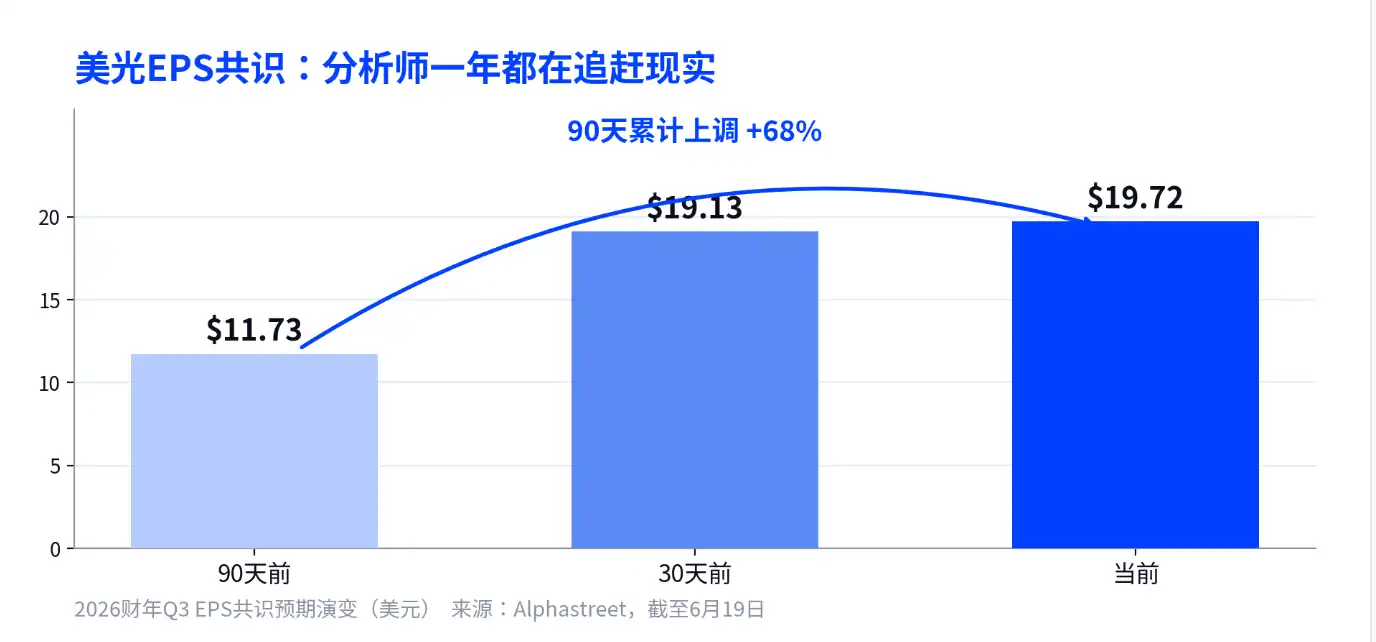
According to Alphastreet data, the consensus EPS for Micron this fiscal quarter was $11.73 90 days ago, rose to $19.13 30 days ago, and is now at $19.72, a cumulative increase of 68%. Wall Street's assessment of the company three months ago was nearly half of what it is now.

The 31 analysts' EPS forecasts range from $7.53 to $24.08, and revenue forecasts range from $19.7 billion to $40.1 billion, a huge gap. The steepness of this inflection point is something analysts themselves haven't fully figured out, forcing them to constantly revise estimates upwards based on actual data.

For the average investor, this is a double-edged signal.

Repeatedly raised expectations indicate that fundamentals are indeed exceeding expectations; but even if the earnings are good on report day, if they fall short of this pushed-to-the-limit consensus, the stock price could still fall.
Don't Believe "Citi Is Too Conservative," That's Actually One of the Most Aggressive Forecasts

There's a narrative on social platforms suggesting that Citi's assumptions on memory prices are too conservative, and that Micron's earnings will therefore significantly exceed expectations. This judgment has the direction wrong, and basing decisions on it could lead to pitfalls.

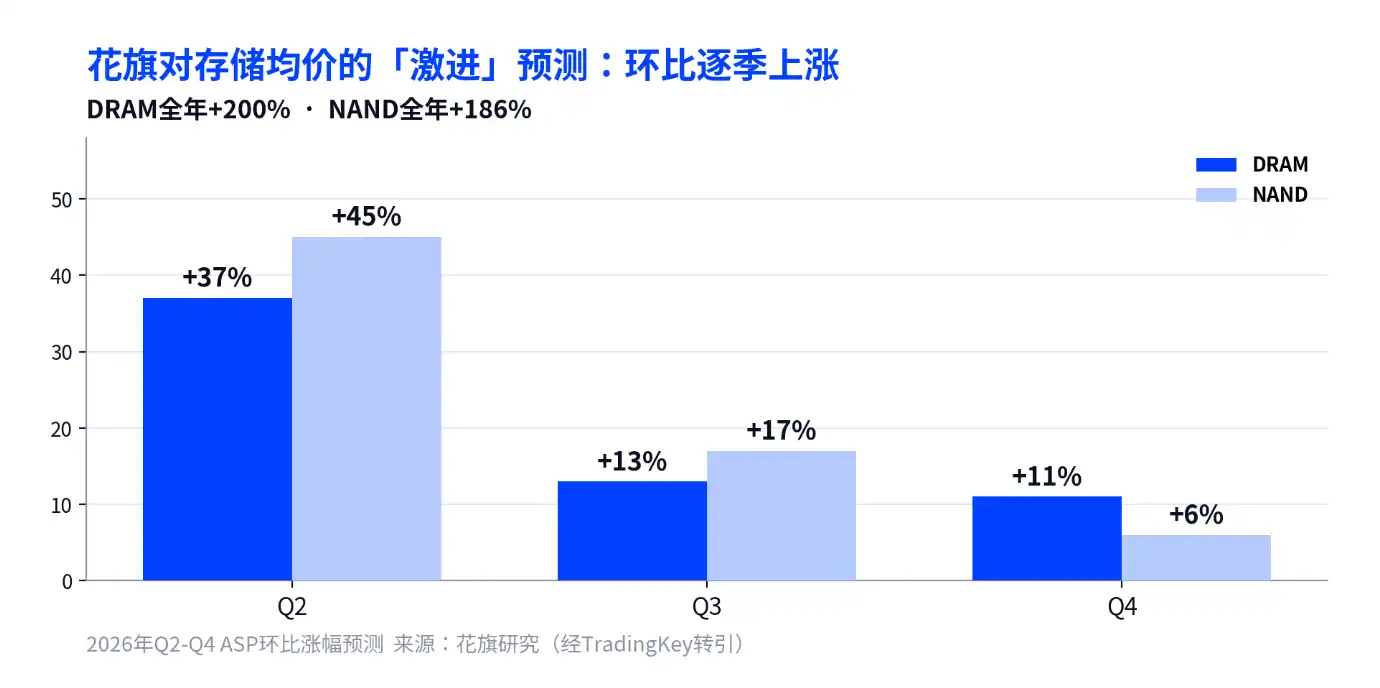
According to TradingKey, Citi forecasts DRAM average selling prices to rise about 200% for the full year 2026, with sequential increases of 37%, 13%, and 11% in Q2 to Q4, respectively; NAND flash prices to rise about 186% for the year, with sequential increases of 45%, 17%, and 6%. A 200% full-year increase is among the most aggressive forecasts on Wall Street for memory prices, not conservative. Based on this, Citi raised its price target to $1,200, while Deutsche Bank gave a target of $1,500; both extended their judgment of a memory shortage through 2028.
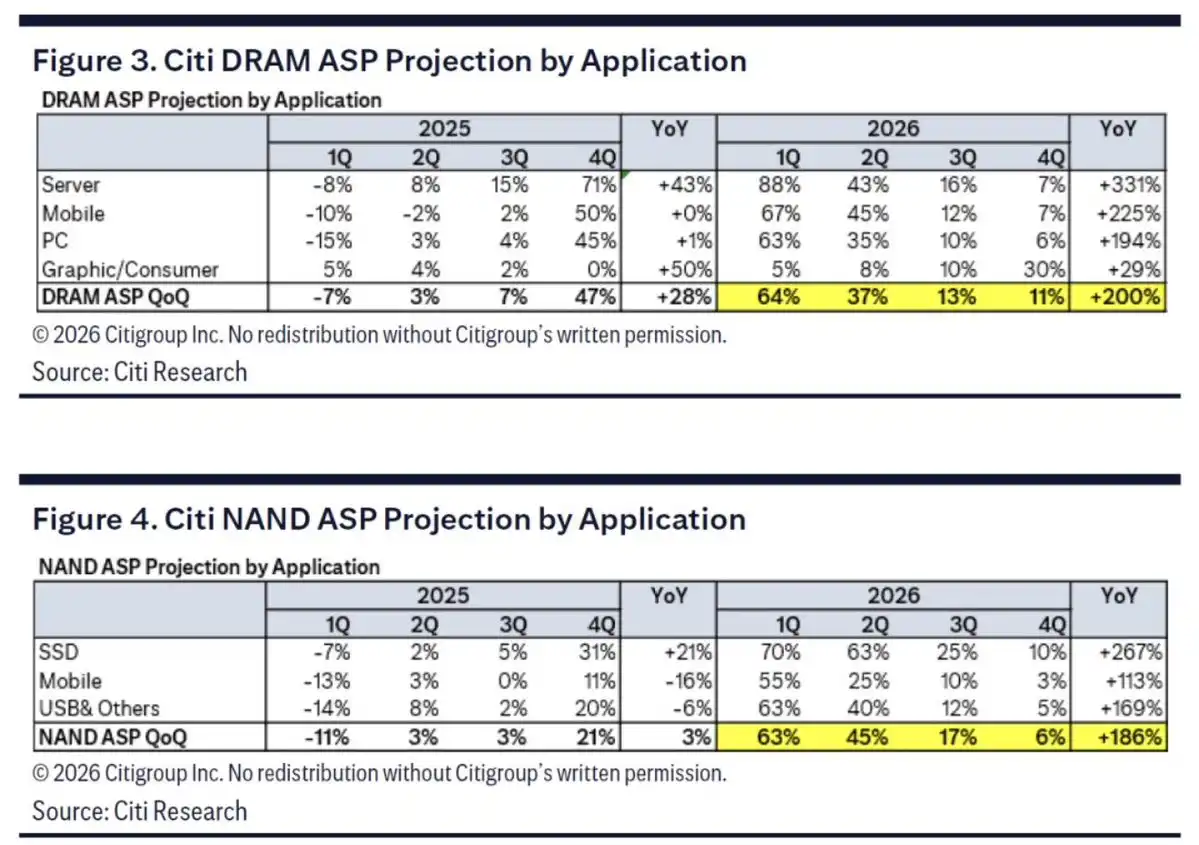
The risk lies here: even the most aggressive institutions have built their forecasts on "200% increases." The earnings report must surpass a bar that has already been repeatedly raised. Expecting to bet on an upside surprise based on "Citi underestimated" is not a solid logical foundation.
Gross Margin Around 81% is the Historical High, and Also the Day's Biggest Suspense

The figure to watch most closely in the earnings report is the gross margin.

According to TradingKey, Micron's own guidance is for revenue of $33.5 billion plus or minus $750 million, EPS around $19.15, and a gross margin around 81%. This is the company's highest historical gross margin and ranks among the top in the semiconductor industry. The net margin was 23.4% in the same period last year and 58.8% last quarter—more than doubling profitability in a year, a magnitude rarely seen in semiconductors.

The higher the gross margin, the more prominent the question of sustainability becomes. Micron has historically been one of the most cyclical tech stocks; everyone knows the boom and bust cycles of memory. On earnings day, any signs suggesting margins have peaked or that prices for mainstream memory categories are starting to soften, even if revenue numbers are impressive, will put pressure on the stock price.

According to TIKR, Micron's Executive Vice President of Global Operations, Manish Bhatia, said at a J.P. Morgan conference that the company's financial outlook is stronger than during the last earnings call, and this quarter is expected to set another free cash flow record; supply tightness for HBM, DRAM, and NAND will persist beyond 2026, and the ramp-up speed for HBM4 capacity is twice that of HBM3E last year. These statements are relatively optimistic, but they are all pre-earnings commentary; their truth will be verified by the day's data.

What Determines the Stock Price Direction is the Guidance, Not This Quarter's Performance

This quarter's revenue and profits are highly likely to be impressive—the market already expects that.

Which way the stock moves on the day depends more on Micron's guidance for the fourth fiscal quarter—for example, whether sequential growth can continue—that's the watershed. Next are the progress of HBM volume ramp and capacity allocation for 2027, as these two items determine whether the story for next year remains viable.

In the history of the memory industry, the easiest time to get caught is not when performance is worst, but when expectations are fullest. Micron is currently at the point of fullest expectations. If you plan to act after the earnings report, look at the guidance and HBM first, then at total revenue.


Cryptos en tendance

Questions liées

QWhat is the primary risk for Micron's stock price following its June 24th earnings report, according to the article?

AThe primary risk is failing to meet or exceed the extremely high market expectations that have been built up. Even if the reported earnings are excellent, the stock price could still fall if the results do not surpass the elevated consensus estimates, which have been revised upwards multiple times. Furthermore, any sign in the guidance of peaking margins or a loosening in pricing for commodity memory could pressure the stock.

QWhy does the article state that the view 'Citigroup's forecast is too conservative' is incorrect?

AThe article argues this view is incorrect because Citigroup's forecast of a ~200% full-year price increase for DRAM is actually one of the most aggressive predictions on Wall Street, not a conservative one. Therefore, expecting Micron to significantly beat earnings based on the idea that Citigroup underestimated price growth is flawed logic.

QWhat specific financial metric is highlighted as the most critical to watch in Micron's earnings report, and why?

AThe gross margin is highlighted as the most critical metric. Micron's guidance points to a gross margin of approximately 81%, which would be a record high for the company and among the best in the semiconductor industry. The sustainability of this extremely high profitability is a major focus, as any indication that margins have peaked could negatively impact the stock despite strong revenue.

QWhat is the more important factor for determining Micron's stock price direction on earnings day: the Q3 results or the Q4 guidance?

AThe more important factor is the guidance for the fourth fiscal quarter (Q4). While the Q3 results are expected to be strong, the market has already largely priced this in. The stock's direction will depend more on whether Micron's forward-looking guidance indicates continued growth, particularly regarding HBM progress and 2027 capacity planning, which are crucial for sustaining the investment narrative.

QWhat evidence does the article provide to show that Wall Street expectations for Micron have been rising rapidly?

AThe article cites data from Alphastreet showing that the consensus earnings per share (EPS) estimate for Micron's current quarter was $11.73 ninety days ago, rose to $19.13 thirty days ago, and is now $19.72. This represents a cumulative upward revision of 68% over just three months, demonstrating how analysts have been chasing the actual performance data with increasingly higher forecasts.

Lectures associées

Les ETF ont connu des sorties nettes continues, les institutions se retirent-elles ?

Lors des six dernières semaines, les ETF Bitcoin spot américains ont enregistré des sorties nettes d’environ 6 milliards de dollars, soit la plus longue série hebdomadaire de retraits depuis leur lancement en 2024. Le fonds IBIT de BlackRock est particulièrement touché, ayant représenté plus de 70 % des sorties sur une semaine récente. Les données on-chain indiquent que les détenteurs à long terme (plus de 155 jours) ne vendent pratiquement pas, détenant encore environ 83 % de l’offre en circulation. Les ventes proviennent principalement des investisseurs institutionnels ou de configuration ayant acheté via des comptes de courtage, qui utilisent désormais la même facilité pour sortir. Cette vague de ventes ressemble à une réduction des risques face au durcissement de la Fed, à une inflation persistante et à la concurrence d’autres actifs (infrastructure IA, introductions en bourse), plutôt qu’à un rejet du Bitcoin. Les pertes réalisées ont bondi de 78 %, de nombreux vendeurs ayant acheté entre 55 000 et 68 000 dollars. Le rythme des sorties ralentit cependant, passant de 1,72 milliard début juin à 226,8 millions mi-juin, suggérant que la panique de vente pourrait s’épuiser. Néanmoins, la taille d’IBIT en fait une source structurelle de pression : ses sorties pèsent directement sur le marché spot, d’autant plus que les nouveaux acheteurs et les volumes sont actuellement faibles. Les prochaines sessions seront déterminantes : si les sorties d’IBIT se calment et que le Bitcoin dépasse 60 000 dollars, le marché pourrait se stabiliser. En revanche, si les rachats massifs reprennent et que le prix tombe sous 58 000 dollars, la pression de vente institutionnelle devra être absorbée par les acheteurs spot non-ETF, ce qui pourrait marquer un tournant.

marsbitIl y a 44 mins

Les ETF ont connu des sorties nettes continues, les institutions se retirent-elles ?

marsbitIl y a 44 mins

Introduction au Concept de Modèle du Monde : Une Histoire de la Psychologie à l'AI

Le concept de "modèle du monde" (World Model) est aujourd'hui central en IA, bien que sa définition reste floue. Il s'agit de doter les machines d'un "sandbox mental" interne, capable de prédire et de simuler les conséquences d'actions avant leur exécution réelle, à l'instar de la réflexion humaine. Cette capacité est cruciale pour des applications comme la conduite autonome, la robotique ou la création de contenus. L'idée puise ses racines dans les travaux du psychologue Kenneth Craik (1943) et a été reprise en IA par des pionniers comme Marvin Minsky. Le terme a été remis au goût du jour en 2018 par David Ha et Jürgen Schmidhuber. Aujourd'hui, les approches divergent. Des chercheurs comme Yann LeCun (avec son architecture JEPA) privilégient la prédiction en espace abstrait pour comprendre la physique. D'autres, comme Fei-Fei Li, proposent une taxonomie distinguant les modèles qui *rendent* (pixels), *simulent* (états physiques) ou *planifient* (actions). OpenAI (Sora), Google DeepMind (Genie 3) et NVIDIA (Cosmos) développent des "simulateurs du monde" génératifs basés sur des vidéos. Dans l'industrie, les acteurs chinois (Alibaba, Tencent, constructeurs automobiles) développent leurs propres solutions, souvent centrées sur des cas d'usage concrets comme la conduite autonome. Techniquement, trois voies coexistent : la génération de pixels (comme Sora), la prédiction en espace latent (comme JEPA), et la création d'environnements 3D paramétriques (comme Omniverse). La tendance est à leur convergence vers un modèle unifié. Un paradigme émergent en 2026 est le "World Action Model" (WAM), qui intègre directement la génération d'actions et la prédiction de l'état futur en un seul système, visant une meilleure "unité de la pensée et de l'action" pour les robots. Malgré la confusion des définitions, un consensus se dégage sur l'objectif final : créer pour les machines une représentation interne du monde, exploitable pour raisonner, planifier et agir de manière plus sûre et générale. Cette période de flou terminologique est typique des phases de rupture technologique et signale l'entrée du concept sur le champ de bataille principal de l'IA.

marsbitIl y a 1 h

Introduction au Concept de Modèle du Monde : Une Histoire de la Psychologie à l'AI

marsbitIl y a 1 h

IBIT a connu une sortie de 1,3 milliard de dollars en une semaine, le plus grand ETF sur Bitcoin devient un mur de vente que les haussiers doivent franchir

L'ETF bitcoin de BlackRock, iShares Bitcoin Trust (IBIT), a enregistré des sorties nettes de 1,3 milliard de dollars sur la semaine du 22 au 26 juin, représentant environ 73% des sorties totales des ETF spot américains sur Bitcoin. Cette concentration des rachats sur le plus grand ETF du marché transforme ce qui était un canal majeur d'entrée de capitaux institutionnels en une source potentielle de pression vendeuse structurelle. Alors que le Bitcoin lutte pour maintenir le seuil des 60 000 dollars, ces flux inversés soumettent le marché à un test critique. La narration initiale d'une "demande institutionnelle" via les ETF se retourne : le même véhicule qui facilitait l'accès peut désormais faciliter la sortie des investisseurs sensibles au prix. La taille de l'IBIT rend ses mouvements de trésorerie marginaux particulièrement significatifs pour la structure du marché. L'interprétation de cette pression dépendra des prochaines sessions. Si les sorties de l'IBIT ralentissent et que le Bitcoin se stabilise au-dessus de 59 000 dollars, cette semaine pourra être vue comme un épisode d'assainissement. En revanche, si les rachats importants se poursuivent et empêchent une reprise ferme, la thèse du "mur de vente" lié aux ETF gagnera en crédibilité, obligeant les acheteurs hors ETF à supporter seuls le poids des sorties. Les prochains jours seront déterminants pour savoir si cette pression est passagère ou le début d'une tendance plus durable.

marsbitIl y a 2 h

IBIT a connu une sortie de 1,3 milliard de dollars en une semaine, le plus grand ETF sur Bitcoin devient un mur de vente que les haussiers doivent franchir

marsbitIl y a 2 h

Le « roi de l'appel d'offres » Hayes frappe à nouveau, cette fois-ci il a Deribit dans le viseur

BitMEX cofondateur Arthur Hayes a acheté environ 6,16 millions de jetons SYN, d'une valeur de 2,2 millions de dollars, via une plateforme OTC. Il a ensuite déclaré sur X que SYN représentait l'une des opportunités d'investissement les plus asymétriques qu'il ait vues depuis HYPE, et a annoncé que le DEX d'options Hypercall était désormais prêt à défier la plateforme dominante Deribit. Le prix de SYN a augmenté de plus de 40% en 24 heures, poursuivant une hausse explosive débutée en juin 2026. Synapse Protocol, initialement un réseau de messagerie inter-chaînes et de liquidités lancé en 2021, a développé Hypercall, un protocole de négociation d'options on-chain. Déployé sur HyperEVM de Hyperliquid, Hypercall vise à être une bourse d'options pour tout type d'actif, mettant en avant l'absence de liquidation, un risque limité à la prime et des transactions 24h/24. Deribit, fondé en 2016, domine le marché des options crypto avec environ 85% de part de marché. Ses forces résident dans sa liquidité profonde et ses outils professionnels, mais il présente les limites inhérentes au modèle centralisé : risques de custode, KYC et complexité pour les petits utilisateurs. Hayes mise sur le potentiel de décentralisation et de transparence d'Hypercall pour concurrencer Deribit, notamment sur les actifs émergents. Cependant, Deribit bénéficie d'un effet de réseau solide, et Hypercall, encore en phase Alpha, devra développer sa liquidité. Les antécédents récents de Hayes en matière de recommandations (comme avec HYPE et CARDS) ont été mitigés, suscitant des critiques sur l'impact de ses prises de position publiques sur le marché.

Foresight NewsIl y a 2 h

Le « roi de l'appel d'offres » Hayes frappe à nouveau, cette fois-ci il a Deribit dans le viseur

Foresight NewsIl y a 2 h

Trading

Spot

Articles tendance

Comment acheter F

Bienvenue sur HTX.com ! Nous vous permettons d'acheter Synfutures (F) de manière simple et pratique. Suivez notre guide étape par étape pour commencer votre parcours crypto.Étape 1 : Création de votre compte HTXUtilisez votre adresse e-mail ou votre numéro de téléphone pour ouvrir un compte sur HTX gratuitement. L'inscription se fait en toute simplicité et débloque toutes les fonctionnalités.Créer mon compteÉtape 2 : Choix du mode de paiement (rubrique Acheter des cryptosCarte de crédit/débit : utilisez votre carte Visa ou Mastercard pour acheter instantanément Synfutures (F).Solde :utilisez les fonds du solde de votre compte HTX pour trader en toute simplicité.Prestataire tiers :pour accroître la commodité d'utilisation, nous avons ajouté des modes de paiement populaires tels que Google Pay et Apple Pay.P2P :tradez directement avec d'autres utilisateurs sur HTX.OTC (de gré à gré) : nous offrons des services personnalisés et des taux de change compétitifs aux traders.Étape 3 : stockage de vos Synfutures (F)Après avoir acheté vos Synfutures (F), stockez-les sur votre compte HTX. Vous pouvez également les envoyer ailleurs via un transfert sur la blockchain ou les utiliser pour trader d'autres cryptos.Étape 4 : tradez des Synfutures (F)Tradez facilement Synfutures (F) sur le marché Spot de HTX. Il vous suffit d'accéder à votre compte, de sélectionner la paire de trading, d'exécuter vos trades et de les suivre en temps réel. Nous offrons une expérience conviviale aux débutants comme aux traders chevronnés.

297 vues totalesPublié le 2024.12.21Mis à jour le 2026.06.02

Comment acheter F

Discussions

Bienvenue dans la Communauté HTX. Ici, vous pouvez vous tenir informé(e) des derniers développements de la plateforme et accéder à des analyses de marché professionnelles. Les opinions des utilisateurs sur le prix de F (F) sont présentées ci-dessous.

活动图片