LIT Token Hits Six-Month High: How Long Can the Buyback Flywheel Keep Burning Fuel?

Foresight NewsPublié le 2026-06-18Dernière mise à jour le 2026-06-18

Résumé

The LIT token of decentralized perpetual exchange Lighter surged to a six-month high above $1.90 on June 18th, with a market cap of $425 million. After a price correction earlier this year, the recent rebound is attributed to its core "buyback flywheel" mechanism. All protocol fee revenue is used for programmatic, hourly market buybacks of LIT. Since its TGE in December 2025, approximately 15 million LIT (6% of circulating supply) has been repurchased for around $21 million. Additional price support comes from the LLP (Lighter Liquidity Pool), where providers must stake LIT worth 10% of their deposited USDC, locking significant token supply. However, challenges persist. Trading volume has declined amidst a sluggish market, with total volume at $1.68 trillion, significantly lower than leading competitor Hyperliquid's $4.37 trillion. While Lighter focuses on perpetual contracts, RWA, and Pre-IPO markets, Hyperliquid has expanded into prediction markets and boasts a U.S. spot ETF, attracting institutional investment and influencer endorsements like from Arthur Hayes. In contrast, LIT currently lacks similar high-profile backing. With 75% of LIT's total 1 billion supply still locked (team and investor tokens begin a 3-year linear unlock in December 2026), there is no immediate unlock selling pressure. The token's future performance hinges on sustaining trading volume growth, successful product iteration, and executing its transparent buyback strategy against a dominant competit...


Written by: Ma He, Foresight News


On June 18th, Lighter's token LIT broke through $1.9, reaching a new high since January of this year. Its current market cap is $425 million with an FDV of $1.7 billion. The token price has since retreated and is fluctuating around $1.6.
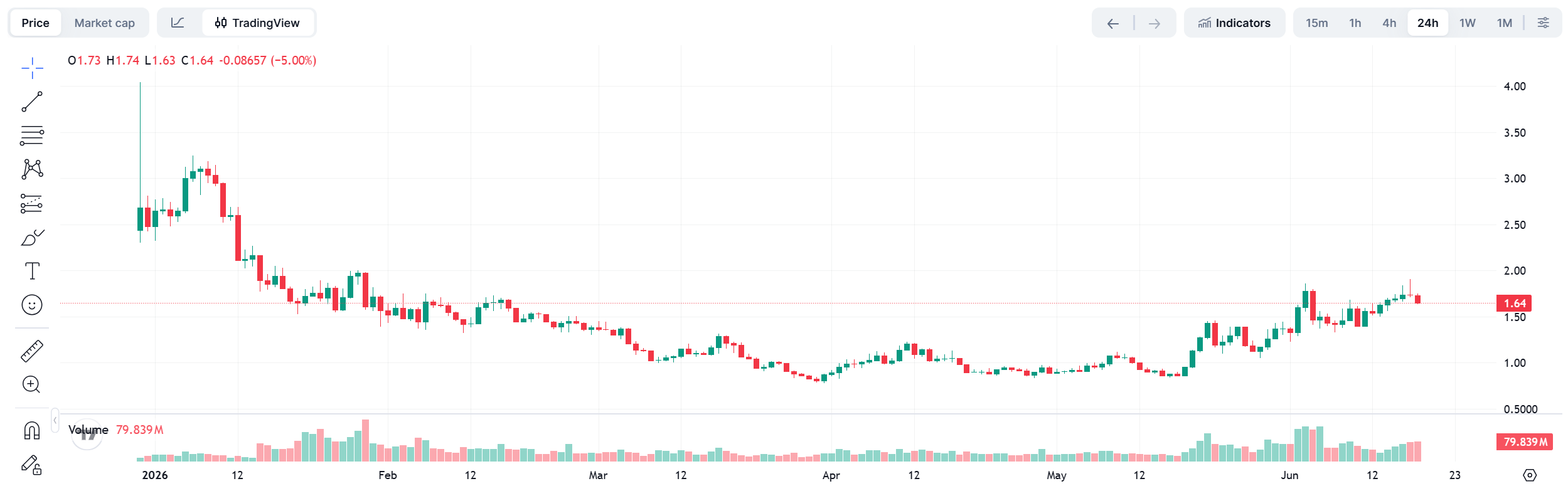


In 2026, Hyperliquid gained significant market attention through its buyback flywheel and expansion into multiple sectors, with its token price surging from $20 to a peak of $76, setting a new all-time high. After adjusting at the beginning of the year, the price of Lighter's token has rebounded significantly recently. So, what factors are currently driving this?


Lighter is a decentralized perpetual contracts exchange. In December 2025, its native token LIT officially underwent Token Generation Event (TGE), accompanied by a large-scale airdrop. The total fixed supply is 1 billion tokens. Specifically, within the ecosystem portion, 25% was automatically airdropped to early users via points seasons at TGE, with the remaining 25% reserved for future incentives, partners, and growth. The team holds 26%, and investors hold 24%. The airdrop portion was released 100% at TGE.


The team and investor portions have a 1-year cliff (starting unlocking on December 30, 2026), followed by a 3-year linear unlock.
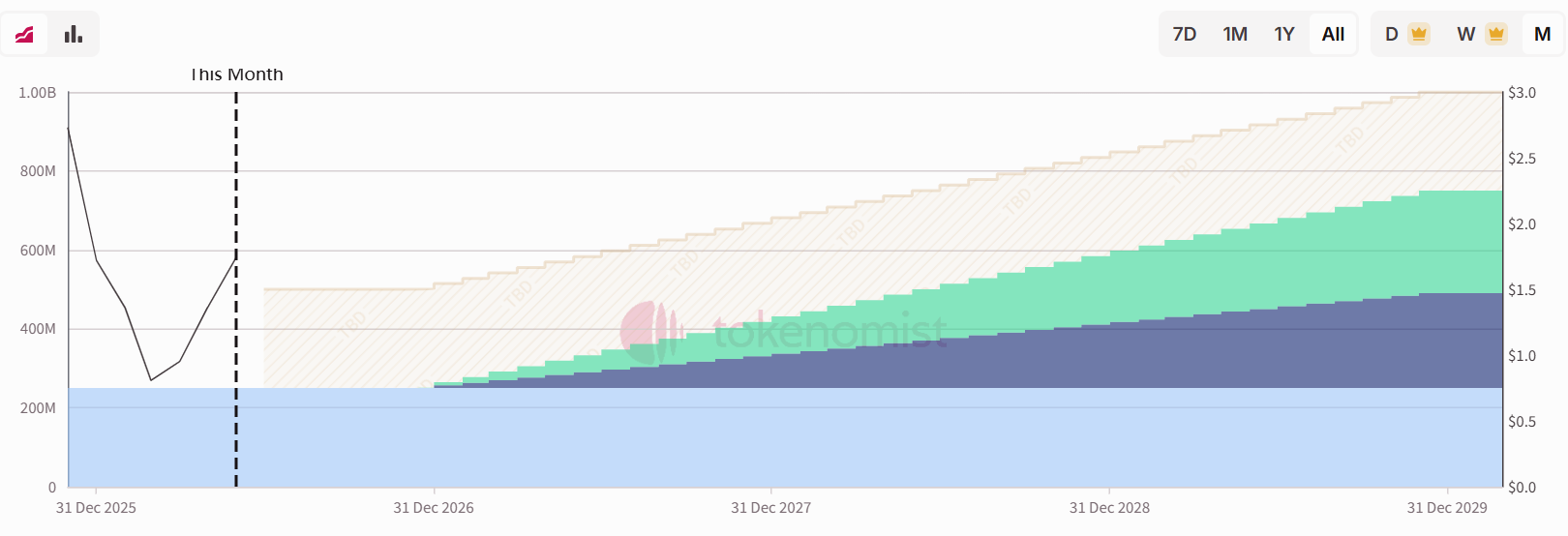


To date, the circulating supply remains at approximately 250 million tokens (25% of total supply), with the remaining 75% still locked. This means there is temporarily no VC and team unlock selling pressure in the second half of this year.


Buyback, LLP & Staking Pool


The buyback mechanism is the core of Lighter's value capture. The protocol uses all fee income generated from products like perpetual trading to buy back LIT tokens on the open market. Official disclosures show this buyback is fully programmatic: the protocol automatically aggregates all fee income hourly and places 100 limit buy orders from the current market price down to a -10% range.
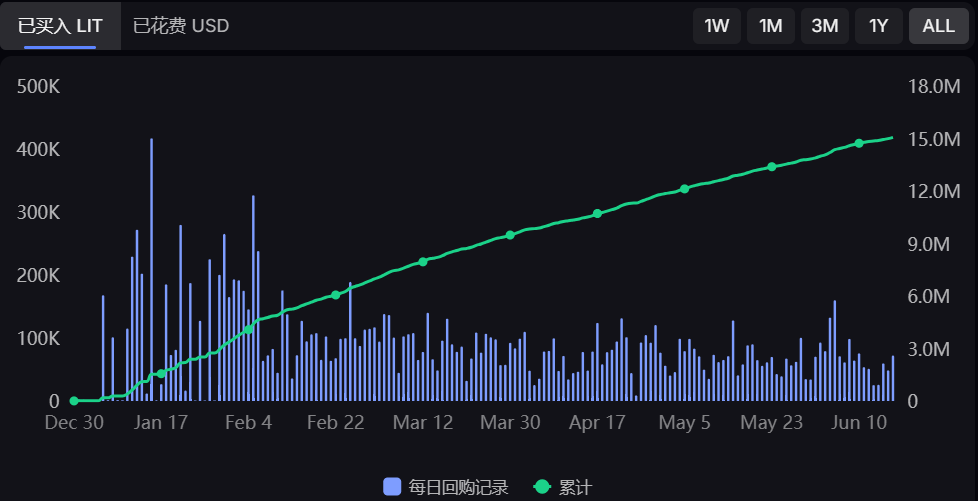


According to the latest data from Lighter, since TGE, the protocol has programmatically bought back approximately 15 million LIT, accounting for about 6% of the circulating supply, with a buyback amount of around $21 million, representing 1.51% of the total supply. These buybacks directly convert protocol revenue into continuous on-chain buy-side pressure.


So, how is Lighter currently performing in the market?


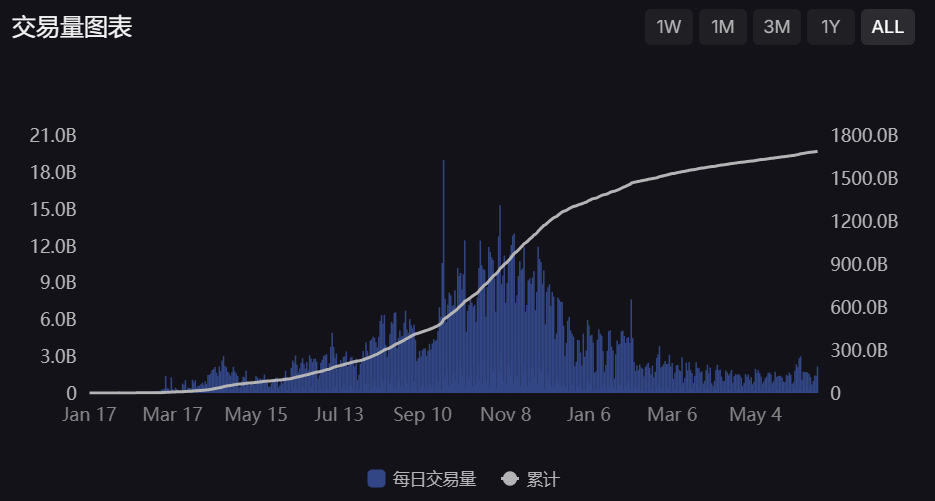
Data from the official website shows its total trading volume has exceeded $1.68 trillion. However, its trading volume has been declining this year due to factors like sluggish market conditions.


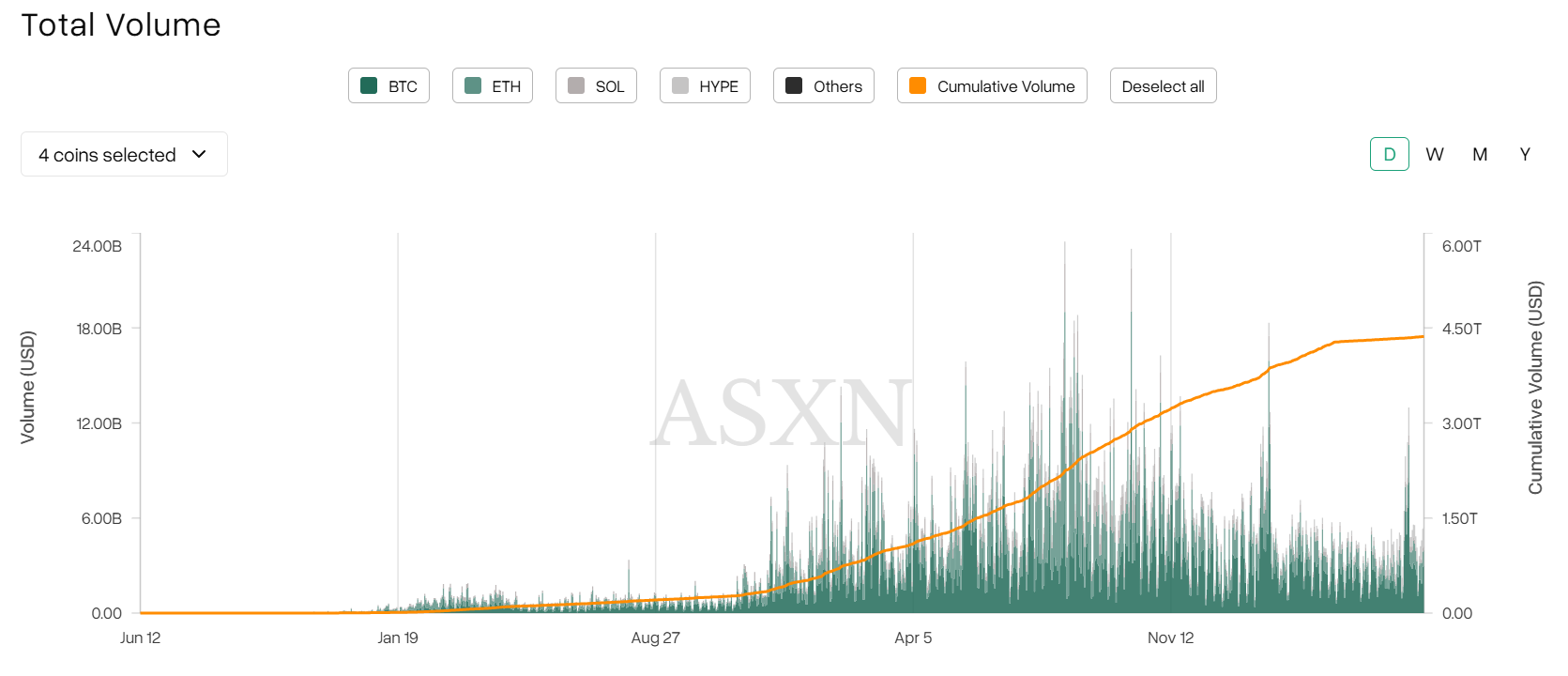
In comparison, Hyperliquid's total trading volume has surpassed $4.37 trillion, nearly three times that of Lighter, and its volume has remained stable since September-October 2025.


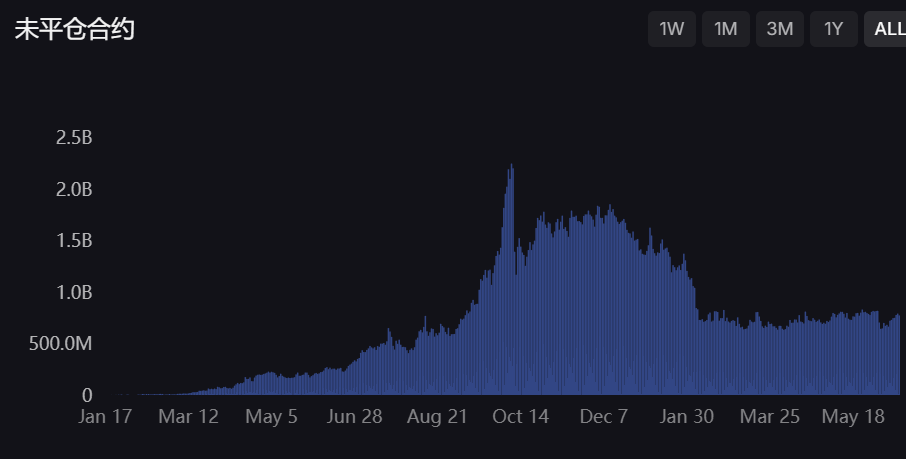
However, turning our attention to open interest, Lighter's open interest data from November 2025 was $1.6 billion, while the current data is $750 million, which isn't drastically low. Hyperliquid's open interest peaked at $9.64 billion and currently remains at $5.06 billion.


Meanwhile, Lighter continues to iterate on the product side. In May, it partnered with Insilico Terminal to introduce a professional-grade execution management system, attracting systematic traders and deepening order book liquidity. The platform has launched a Pre-IPO perpetual contracts market and introduced features like LIT fee points, expanding trading scenarios and user engagement. These actions complement the buyback flywheel, amplifying protocol revenue and buy-side effects under macro event drivers.


Simply put, the Lighter Liquidity Pool (LLP) is the market maker capital pool for the Lighter exchange. In a centralized exchange, when a user goes long, the counterparty is typically a market maker (institution) or another user going short. However, in a decentralized exchange, the underlying logic changes: the "common counterparty" for all traders' positions across the entire exchange is the LLP. In other words, if users profit from going long, the LLP pays them; if users incur losses, those losses are directly absorbed into the LLP.


According to historical big data statistics, retail traders are highly likely to lose money over long periods. Therefore, large players depositing their USDC into the LLP to act as the casino's bankroll are essentially "acting as the house," passively profiting from retail traders' losses and the exchange's fees.



According to the latest official website data, its TVL has risen to $98.42 million, with an annualized rate reaching 11.47%. According to Lighter's official rules, entering the LLP requires staking LIT tokens equivalent to 1/10th of the deposited capital amount. This design makes many large players one of the biggest spot buyers of LIT in the secondary market. The more USDC they deposit, the more LIT tokens are locked in the market.


It's important to note that the LLP liquidity pool is not shared with the staking pool; they are separate pools.


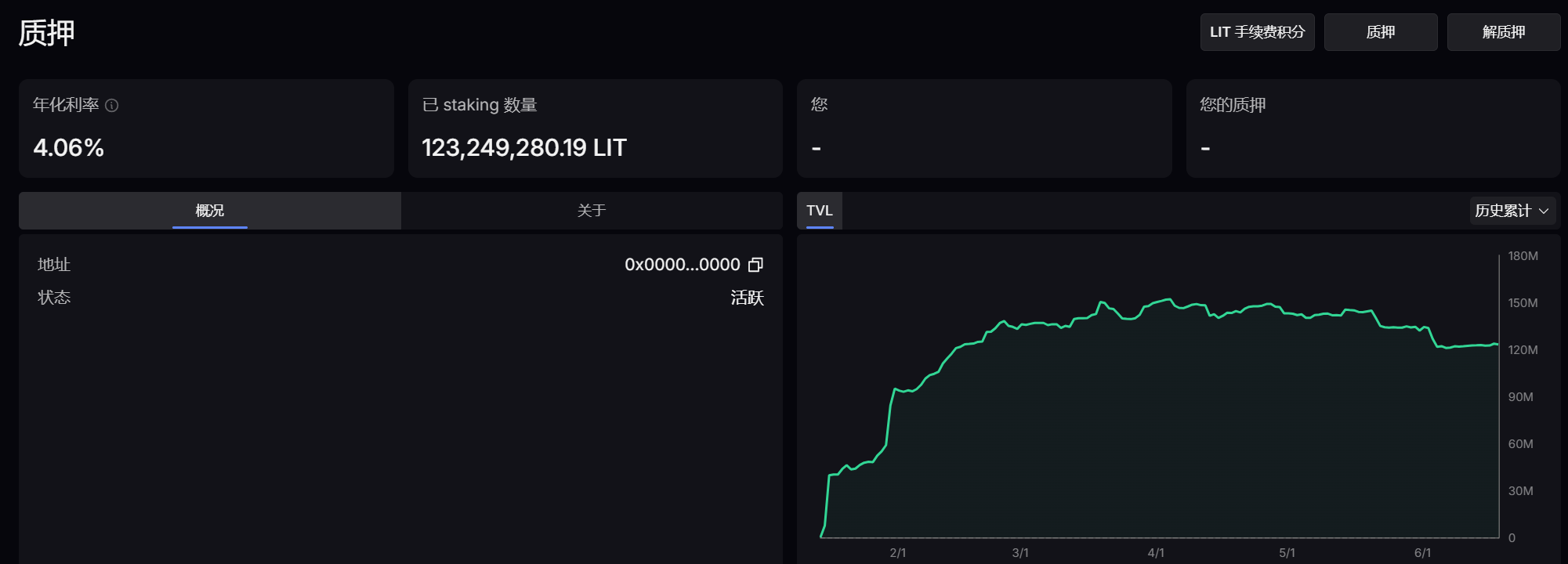
According to the latest official website data, its annualized yield is 4.06%, with 123.23 million LIT tokens staked, totaling over $204.6 million in value.


Compared to Hyperliquid, Concerns Remain


In the perpetual contracts DEX sector, Hyperliquid, with its first-mover advantage and scale effect, is the current recognized leader, while Lighter has established a unique position through technical differentiation and product focus.


Hyperliquid also implements an aggressive revenue buyback strategy with considerable scale. However, combined with staking gas fees and ecosystem incentives, it forms a more comprehensive token utility system. Lighter's buyback execution has certain advantages in transparency and predictability, while Hyperliquid's buyback is matched with a higher base of protocol revenue.


Furthermore, Hyperliquid has broader coverage: beyond perpetual contracts, it continues to expand into RWA and a more complete DeFi ecosystem, even prediction markets (e.g., Bitcoin, Ethereum price predictions). As of June 16th, the World Cup-related section within the HIP-4 prediction markets on Hyperliquid saw its 7-day trading volume surge 202% week-over-week. Continuous business expansion broadens its audience and trading volume, which in turn further boosts the buy-side pressure for the HYPE token. In contrast, Lighter is still focusing on RWA and Pre-IPO layouts and hasn't ventured into areas like prediction markets.


Institutions are also increasingly buying HYPE. According to on-chain analyst Ai Yi's monitoring, since June 1st, wallets related to a16z have withdrawn 1,229,524 HYPE ($85.54 million) and deposited them for staking. Even the prominent endorser Arthur Hayes tweeted, "Looking at the current crypto market cap rankings, most are shitcoins. I believe HYPE should at least surpass SOL before this bull cycle ends."


US institutions have also launched a HYPE spot ETF, providing stable support for its price. According to SoSoValue data, the cumulative net inflow for US HYPE spot ETFs is currently $182.56 million. In contrast, LIT still relies solely on secondary market activity and buybacks for price support.
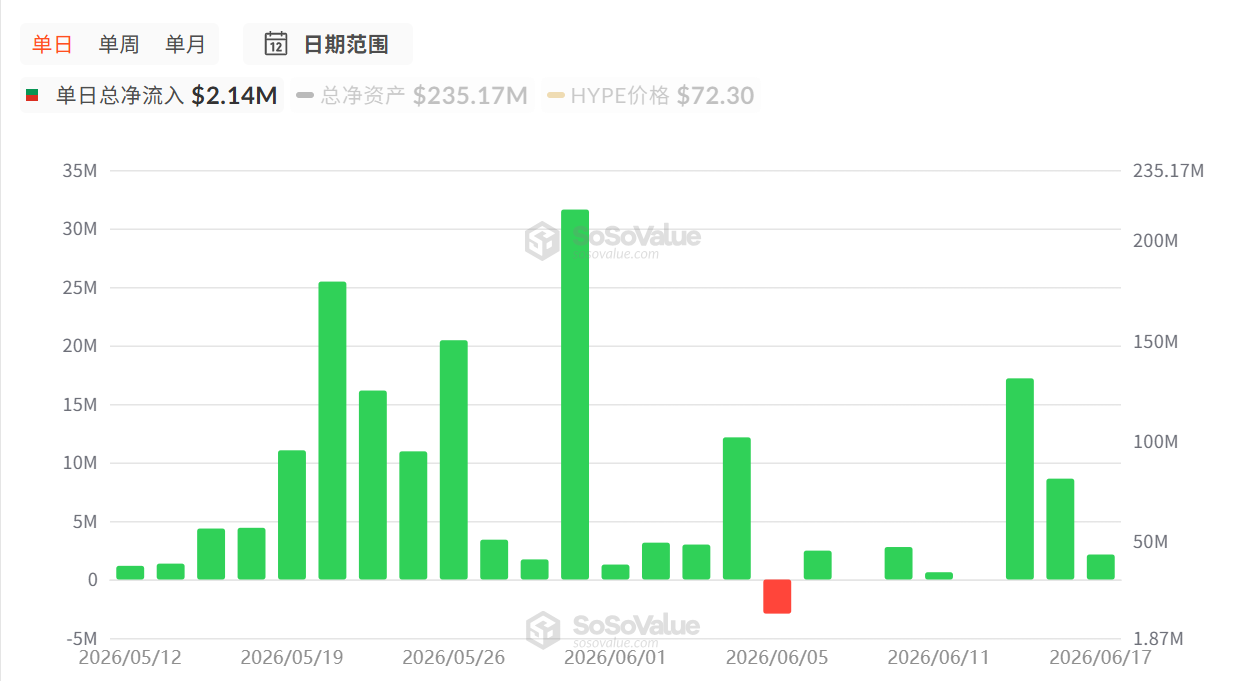


Currently, LIT lacks both influential figure endorsements and public, continuous buying by large institutions, leaving a hint of concern for its token price.


Overall, Hyperliquid currently dominates in scale, liquidity, and ecosystem breadth, while Lighter is building its competitive advantages through its ZK tech stack, transparent buyback mechanism, zero fees for retail users, and differentiated tools for institutional players.


The future relative performance of both will depend on their execution in trading volume growth, product iteration, and market adoption.


Cryptos en tendance

Questions liées

QWhat is the core mechanism driving LIT's value appreciation, and how does it work?

AThe core mechanism is a repurchase (buyback) flywheel. Lighter uses all protocol fee revenue generated from its perpetual contracts and other products to programmatically repurchase LIT tokens on the open market. This happens hourly, placing 100 limit buy orders at prices from the current market price down to -10%, directly converting protocol income into continuous on-chain buy pressure for LIT.

QWhat is the Lighter Liquidity Pool (LLP), and what is its role in the ecosystem?

AThe Lighter Liquidity Pool (LLP) is essentially the counterparty for all traders on the Lighter exchange. It acts as the "house" or market maker in a decentralized setting. When traders profit, the LLP pays them; when traders lose, the losses flow into the LLP. This allows large liquidity providers to deposit USDC into the LLP to earn profits from overall trader losses and fees. A key rule is that providers must stake LIT tokens equal to 10% of their USDC deposit, which creates significant buy-and-lock demand for LIT in the secondary market.

QHow does Lighter's current market performance and data compare to its main competitor, Hyperliquid?

ALighter trails Hyperliquid in key metrics. As of the article's data, Lighter's total trading volume is over $1.68 trillion, while Hyperliquid's is over $4.37 trillion, nearly three times larger. Lighter's Open Interest stands at $750 million, significantly lower than Hyperliquid's $5.06 billion. Furthermore, Hyperliquid benefits from broader ecosystem expansion (like RWA and prediction markets), public endorsements from figures like Arthur Hayes, institutional buying, and a US spot ETF, which Lighter currently lacks.

QWhat is the current status of LIT's token supply and upcoming unlocks?

ALIT has a fixed total supply of 1 billion tokens. Currently, the circulating supply is approximately 250 million tokens (25% of the total). The remaining 75% are locked. The allocations for the team (26%) and investors (24%) have a 1-year cliff starting on December 30, 2026, followed by a 3-year linear vesting schedule. This means there is no unlock selling pressure from these major holders until the end of 2026.

QAccording to the article, what are the potential concerns or hidden worries for LIT's price sustainability?

AThe main concerns are its relative lack of broader market catalysts compared to Hyperliquid. Specifically, LIT lacks influential public endorsements (like Arthur Hayes' support for HYPE), visible large-scale institutional buying, and products like a US spot ETF that provide stable demand. Its price is currently supported primarily by the secondary market and the internal repurchase mechanism, making it potentially more vulnerable if trading volumes and protocol fees decline.

Lectures associées

BIT Recherche : MicroStrategy passe du plus grand acheteur au vendeur, comment les 75 milliards de dollars de pression de vente potentielle affecteront-ils le Bitcoin ?

L'entreprise Strategy (anciennement MicroStrategy), autrefois l'un des acheteurs les plus agressifs de Bitcoin avec une politique de « ne jamais vendre », a commencé à vendre ses actifs en Bitcoin. Ces ventes visent à renforcer ses réserves en dollars, payer des dividendes et intérêts sur actions privilégiées, et racheter ses titres de crédit numériques (Digital Credit Securities). Cette inversion de rôle, d'acheteur structurel à vendeur, constitue une pression à la baisse pour le marché du Bitcoin à court terme. Les estimations indiquent que Strategy pourrait devoir vendre environ 4,5 milliards de dollars de Bitcoin dans les deux à quatre prochains mois, principalement pour réduire le volume de ses titres de crédit numériques. Au-delà de cette société, la pression de vente potentielle pourrait être plus large. Parmi 109 entreprises détenant des réserves de Bitcoin, 28 ont une capitalisation boursière inférieure à la valeur de leur portefeuille Bitcoin (ratio mNAV < 1.0). Pour ces sociétés, vendre une partie de leur Bitcoin et racheter leurs actions pourrait être un moyen de réduire cette décote et de créer de la valeur. Le potentiel de vente combiné de l'ensemble de ces entreprises réservistes pourrait atteindre environ 7,5 milliards de dollars. Cette évolution remet en question le modèle économique antérieur de ces sociétés, qui reposait sur une prime de leur action par rapport à la valeur liquidative de leurs actifs en Bitcoin (NAV). Avec la disparition, voire l'inversion de cette prime, leur capacité à lever des fonds pour acheter davantage de Bitcoin est compromise. Elles pourraient devoir se tourner vers des stratégies génératrices de revenus réels, comme la vente d'options couvertes ou le prêt de BTC. Malgré ces pressions de vente à court terme qui pourraient limiter les rebonds, l'analyse suggère que le Bitcoin est toujours en phase de consolidation basse, avec un creux de cycle possible d'ici la fin du mois ou le mois prochain. Les facteurs clés à surveiller seront l'épuisement des ventes de Strategy, le retour éventuel des achats via les ETF Bitcoin, et la capacité des entreprises réservistes à ajuster leur stratégie pour résorber la décote de leur NAV.

marsbitIl y a 21 mins

BIT Recherche : MicroStrategy passe du plus grand acheteur au vendeur, comment les 75 milliards de dollars de pression de vente potentielle affecteront-ils le Bitcoin ?

marsbitIl y a 21 mins

Elon Musk construit Terafab : la plus grande usine de puces pour l'IA, les robots et les centres de données spatiaux

Elon Musk lance Terafab, une méga-usine de puces pour l'IA, les robots et les data centers spatiaux. SpaceX et Tesla ont lancé le projet Terafab, une usine de semi-conducteurs de plus de 9,3 millions de m² au Texas. La première phase nécessitera 16,8 milliards de dollars d'investissements pour produire des équipements de calcul dépassant 1 térawatt par an, destinés aux robots Optimus, aux véhicules autonomes Cybercab et aux data centers orbitaux. Le gouverneur du Texas, Greg Abbott, a confirmé le projet, promettant 3 000 emplois et un financement de 30 millions de dollars. Elon Musk a souligné l'importance stratégique de regrouper sous un même toit la conception de logique, la production de mémoire et l'assemblage de puces. Il a décrit le complexe comme potentiellement "le plus grand et le plus précieux bâtiment sur Terre", avec une capacité de production allouée à 25% pour la robotique Tesla et 75% pour les systèmes d'IA spatiaux de SpaceX. Intel est le partenaire technologique clé, fournissant son procédé de fabrication 14A. Ce choix vise à diversifier la chaîne d'approvisionnement face à la domination de TSMC. Le projet s'inscrit dans le cadre de l'initiative "Pax Silica" des États-Unis, visant à sécuriser les chaînes d'approvisionnement en semi-conducteurs. D'un point de vue analytique, la réalisation d'un projet de cette envergure reste un défi, comme le montre les retards rencontrés par des projets similaires (ex: Intel en Ohio). Le succès de Terafab dépendra de nombreux facteurs externes et ne sera pas confirmé avant la fin de la décennie.

cryptonews.ruIl y a 1 h

Elon Musk construit Terafab : la plus grande usine de puces pour l'IA, les robots et les centres de données spatiaux

cryptonews.ruIl y a 1 h

La faillite du "Dieu de l'IA" entraîne des pertes de 15 milliards de dollars pour Jane Street en juillet, sa première perte mensuelle depuis dix ans

"Jane Street, l'un des géants du trading proprietary les plus secrets et rentables de Wall Street, a subi une perte rare d'environ 15 milliards de dollars au mois de juillet, sa première perte mensuelle depuis environ dix ans. Cette perte est principalement liée à deux facteurs : des investissements dans le fonds spéculatif axé sur l'IA, Situational Awareness, qui a fait face à des appels de marge et a dû liquider massivement ses positions, ainsi que des pertes sur des positions longues sur des actions non liées à l'IA en Asie. Il s'agit essentiellement d'un revers brutal pour des stratégies de trading qui avaient très bien performé au deuxième trimestre, notamment sur les actions technologiques, semiconducteurs et IA, avant un renversement soudain du marché en juillet. Malgré ce choc, Jane Street maintient une rentabilité globale solide, avec un revenu net de trading dépassant 400 milliards de dollars depuis le début de l'année. La société a réagi en réduisant activement son exposition au risque, fermant une partie des positions problématiques et abaissant le niveau de risque sur d'autres stratégies. Parallèlement, Jane Street procède à une importante restructuration de sa dette, d'environ 14,6 milliards de dollars, pour transférer une partie de son financement du marché public vers des investisseurs privés, acceptant des coûts plus élevés pour plus de confidentialité. L'incident met en lumière les risques de la chaîne du prime brokerage moderne, où des fonds très endettés partageant des expositions similaires (comme à l'IA) et des sources de financement communes peuvent amplifier les crises via des ventes forcées. Pour Jane Street, cet épisode représente un ajustement significatif mais ciblé de sa prise de risque, plutôt qu'une remise en cause de son modèle central."

marsbitIl y a 1 h

La faillite du "Dieu de l'IA" entraîne des pertes de 15 milliards de dollars pour Jane Street en juillet, sa première perte mensuelle depuis dix ans

marsbitIl y a 1 h

Trading

Spot

Articles tendance

Comment acheter LIT

Bienvenue sur HTX.com ! Nous vous permettons d'acheter Lighter (LIT) de manière simple et pratique. Suivez notre guide étape par étape pour commencer votre parcours crypto.Étape 1 : Création de votre compte HTXUtilisez votre adresse e-mail ou votre numéro de téléphone pour ouvrir un compte sur HTX gratuitement. L'inscription se fait en toute simplicité et débloque toutes les fonctionnalités.Créer mon compteÉtape 2 : Choix du mode de paiement (rubrique Acheter des cryptosCarte de crédit/débit : utilisez votre carte Visa ou Mastercard pour acheter instantanément Lighter (LIT).Solde :utilisez les fonds du solde de votre compte HTX pour trader en toute simplicité.Prestataire tiers :pour accroître la commodité d'utilisation, nous avons ajouté des modes de paiement populaires tels que Google Pay et Apple Pay.P2P :tradez directement avec d'autres utilisateurs sur HTX.OTC (de gré à gré) : nous offrons des services personnalisés et des taux de change compétitifs aux traders.Étape 3 : stockage de vos Lighter (LIT)Après avoir acheté vos Lighter (LIT), stockez-les sur votre compte HTX. Vous pouvez également les envoyer ailleurs via un transfert sur la blockchain ou les utiliser pour trader d'autres cryptos.Étape 4 : tradez des Lighter (LIT)Tradez facilement Lighter (LIT) sur le marché Spot de HTX. Il vous suffit d'accéder à votre compte, de sélectionner la paire de trading, d'exécuter vos trades et de les suivre en temps réel. Nous offrons une expérience conviviale aux débutants comme aux traders chevronnés.

662 vues totalesPublié le 2026.01.15Mis à jour le 2026.06.02

Comment acheter LIT

Discussions

Bienvenue dans la Communauté HTX. Ici, vous pouvez vous tenir informé(e) des derniers développements de la plateforme et accéder à des analyses de marché professionnelles. Les opinions des utilisateurs sur le prix de LIT (LIT) sont présentées ci-dessous.

活动图片