How Difficult is Chip Making? A Division Error Costs 475 Million Dollars

marsbitPublié le 2026-06-15Dernière mise à jour le 2026-06-15

Résumé

How Hard Is It to Make a Chip? A Division Error Cost $475 Million Chip expert Shi Kan, a researcher at the Chinese Academy of Sciences and a popular tech creator, explains the immense challenges of chip development. Chips are foundational to modern technology, but their creation is extraordinarily difficult. The journey from sand to a functional chip involves complex design and manufacturing, but a critical bottleneck is verification—ensuring the design works flawlessly before costly production. A single, undetected bug can have catastrophic consequences, as illustrated by the infamous 1994 Intel Pentium FDIV bug. A flaw in the floating-point division unit forced a recall costing $475 million. Unlike software, chips cannot be easily patched after manufacture, making "first-time success" paramount. However, industry surveys show only 24% of chip projects achieve this; over three-quarters require at least one costly re-spin due to design flaws. Verification has thus become the dominant phase, consuming up to 70% of the design cycle. The core challenge is a "verification impossible triangle" between high performance, good debuggability, and low cost. Exhaustively verifying a modern CPU core could take 15,000 years with software simulation, or 30 years with advanced hardware emulation—timeframes utterly impractical for development. Despite being essential, verification is often seen as unglamorous "dirty work," receiving less academic attention than fields like AI. Shi and hi...

Hello everyone, I'm Shi Kan from the Institute of Computing Technology at the Chinese Academy of Sciences, a 'slash technology worker'. I have over a decade of experience in the chip industry, and currently, I conduct academic research related to chips at the Chinese Academy of Sciences; at the same time, I am also a science and technology Bilibili UP host 'Lao Shi Tan Xin', and my viewers call me 'Lao Shi'.

Chips: The Cornerstone of Modern Society

When it comes to chips, everyone surely knows their importance.
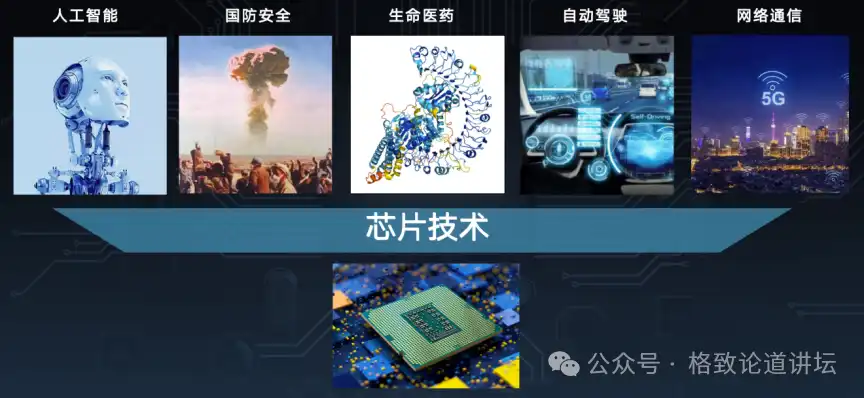
Whether it's the currently hot artificial intelligence, life sciences and medicine, autonomous driving, network communications, and so on, almost all the technologies of modern society you can imagine are inseparable from chips—this foundational technology of the information age.

I have been involved in chip work for a long time, and the chip development process is actually a very interesting one, mainly due to two aspects.

Firstly, the applications of chips are extremely wide-ranging. Once you enter this industry, you probably don't have to worry about unemployment because many industries require chip technology.

The second reason might be more important: chip development is a very difficult endeavor. As chip engineers, we need to constantly learn and enrich ourselves to face and embrace this era full of opportunities and challenges.

So the question arises: what exactly makes chip technology so difficult?

Why Are Chips So Difficult?

Completed: 10%//////////

Everyone might know that the manufacturing process of a chip is essentially an evolution journey of a grain of sand. Sand might be something inexhaustible and abundant on this planet; but turning low-value sand into high-value chips adds up to nothing but human intelligence.
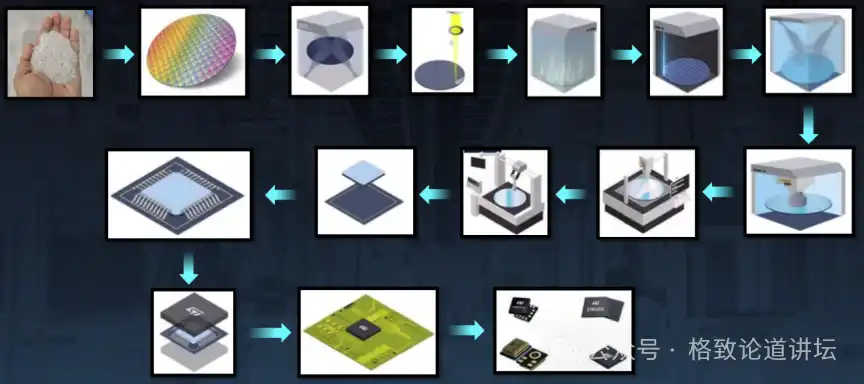
Starting from sand, we need to purify it to obtain wafers. Then, through a series of steps such as photolithography, ion implantation, etching, packaging, and so on, the abundant, inexhaustible sand is transformed into the final tiny chip.

So, having said all that, with so many steps, chip manufacturing is actually only part of the entire chip development process; it does not equal chip development itself.
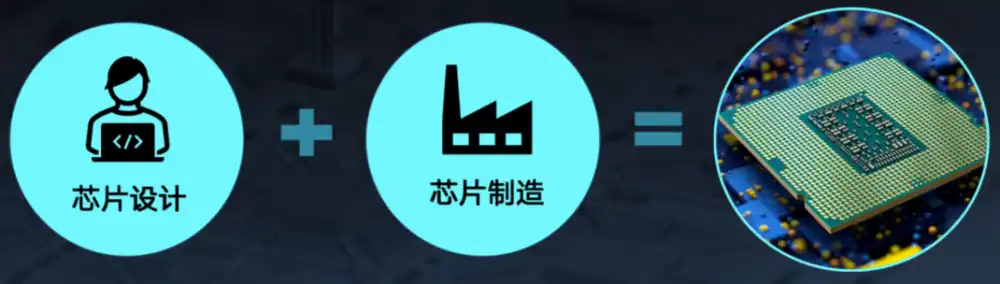
There is another crucial step, which is chip design. It refers to completing the circuit design according to requirements and making the circuit function properly. Then, we hand over the designed circuit to chip manufacturers for the later stages of manufacturing, ultimately obtaining the physical chip.

But there is another question here: how do you ensure that the chip's functionality matches your initial design?
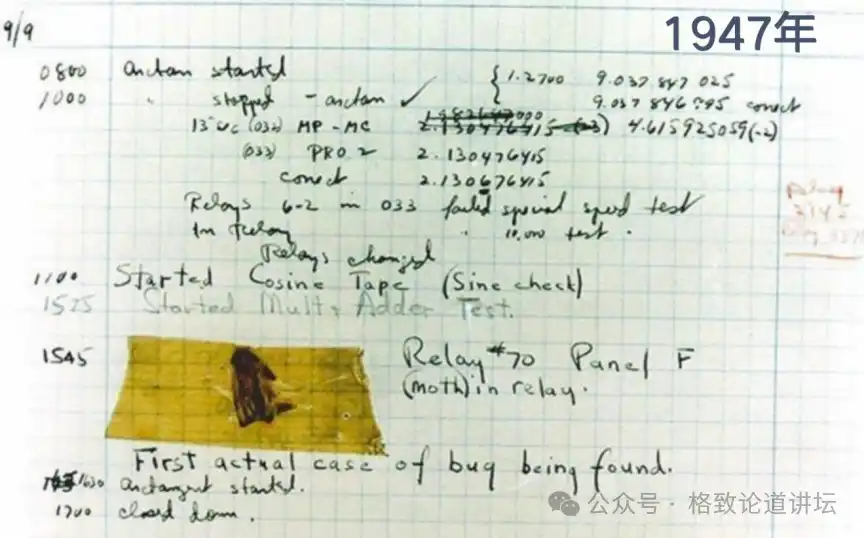
There is an interesting little story here. In 1947, a very famous female programmer named Grace Hopper found her computer wasn't working. After careful investigation and exploration, she discovered that a moth had flown into a relay of the computer. So, she carefully used tweezers to remove this moth and taped it onto a piece of paper.

This might be the first 'bug' discovered in the entire history of computer development, meaning a vulnerability.

If the previous example seems too distant, we actually have more examples. Here's a math problem for everyone: What is the final result of this expression? Actually, this problem is simple because the numerator and denominator in the later part are the same and can cancel out; then the numbers before and after the minus sign are also the same, so subtracting the same number should result in 0. However, in actual computers and chips, the result might not be this.
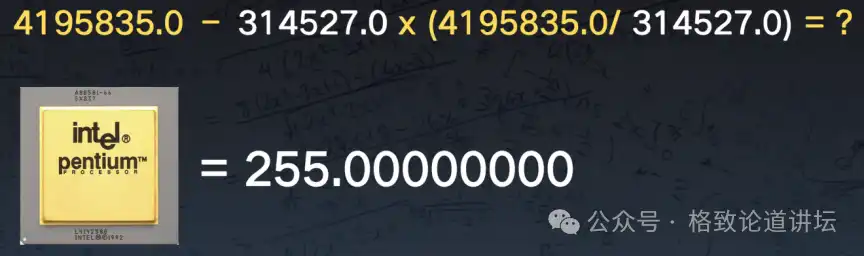
For example, in an Intel Pentium chip, the result was 255.00000000. What happened? It turned out that when an American scientist was conducting scientific research, he kept getting incorrect calculations when running this expression. Finally, he discovered that there was an undetected design flaw in a floating-point division unit of this chip.

Don't underestimate this design flaw; its consequences were actually very serious. In the 1990s, Intel spent $475 million to recall all problematic Pentium chips worldwide.

So, returning to the earlier question: what exactly makes chip technology so difficult?

In my view, the difficulty of chips lies in the need to succeed on the first try. Making chips is not like software, where you can patch and fix various problems later. In contrast, once a chip completes the evolution journey from sand to chip, you may have already spent tens of thousands, millions, or even hundreds of millions to complete the tape-out and manufacturing, making it very difficult to modify afterwards.

Then, the next question is: how many chip projects today can achieve success on the first try?

The 'Bottleneck' of Chip Verification

Completed: 40%//////////

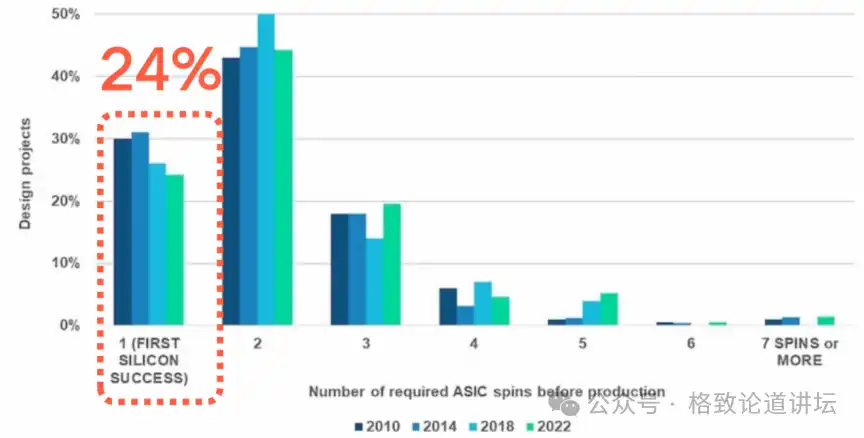
According to survey data, only 24% of chip projects can achieve success on the first try. That is to say, 3/4 of chip projects, due to various major and minor undetected design flaws, require at least one more tape-out, which consumes a lot of time and money.
Therefore, the key question is: how can we ensure, as much as possible, that chips have as few or no bugs/design flaws as possible before tape-out and manufacturing? This is the direction I have been dedicated to researching over the past few years.
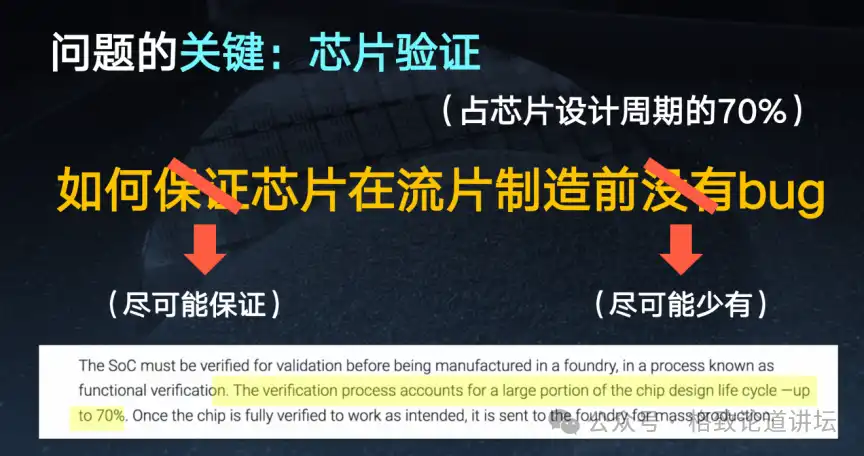
Also according to this research data, throughout the entire chip development process, especially with the current development of AI and various high-tech fields, chips are becoming increasingly complex. As a result, chip verification has become a very high proportion of the entire chip development cycle, even exceeding half, reaching 70% of the entire chip design cycle.

But unfortunately, chip verification is also a difficult task. I list some astronomical numbers here, such as the Earth's circumference, the possible number of stars in the Milky Way, or the length of a light-year.

In chip verification, there is also an astronomical number, which is the number of cycles needed to fully verify a CPU core. What exactly does this astronomical number represent?

If we use the most advanced software simulation technology available today to fully verify a CPU core, it would take at least 15,000 years. Using the most advanced hardware emulation technology can slightly reduce this time to 30 years. But we all know that developing a chip cannot wait 15,000 years, nor can it wait 30 years.
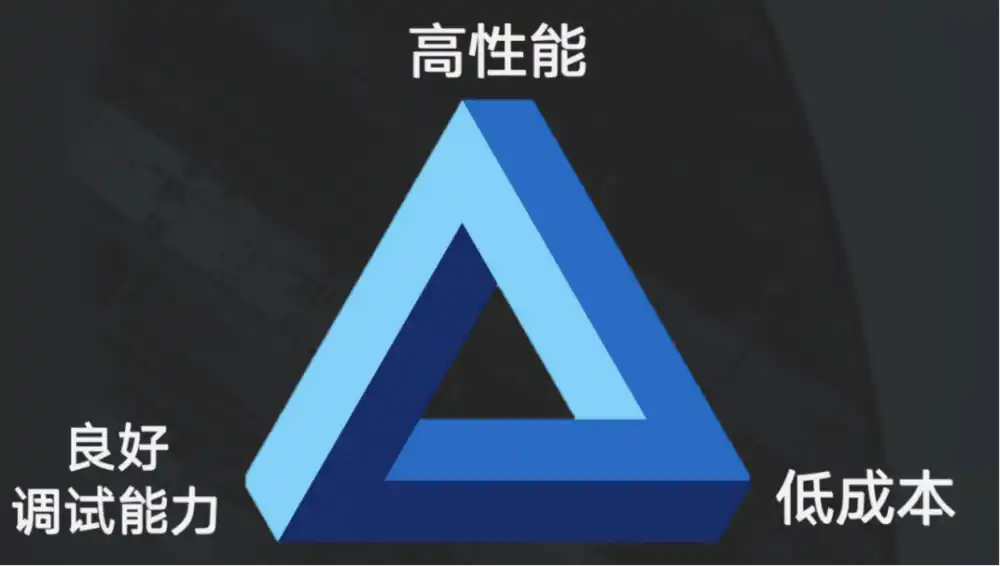
So, what is the essence of the problem? We have actually been researching this over the past few years. We found that in chip verification, there exists a so-called 'impossible triangle', namely the high performance of chip verification, good debugging capability, and low cost; these three factors crucial to chip verification cannot be satisfied simultaneously. For current mainstream research or methods, at most, two out of the three can be achieved, and this is the fundamental reason for the low efficiency of chip verification.

Someone Must Do Something Different

Completed: 60%//////////

Due to these reasons, chip verification has not seen significant development over the past period.

In chip companies, chip engineers may spend more time writing test cases and running regression verification. Essentially, it's dirty and tiring work. The same goes for academia; very few scholars are devoted to chip verification research, especially compared to current hot fields like artificial intelligence, research related to chip verification is very scarce.

So, an academic leader once told me that in the same amount of time, they could publish three or even more papers in the field of artificial intelligence, but in chip verification, they might not even publish one.

Unfortunately, what they said is true.

However, someone must do something different.

Therefore, over the past few years, I have led a team in conducting research related to chip verification and have built an agile verification research system from scratch. The core of this research system is a verification platform called ENCORE, which is based on a special chip—the Field-Programmable Gate Array (FPGA). ENCORE can significantly improve verification efficiency while achieving good verification debuggability.
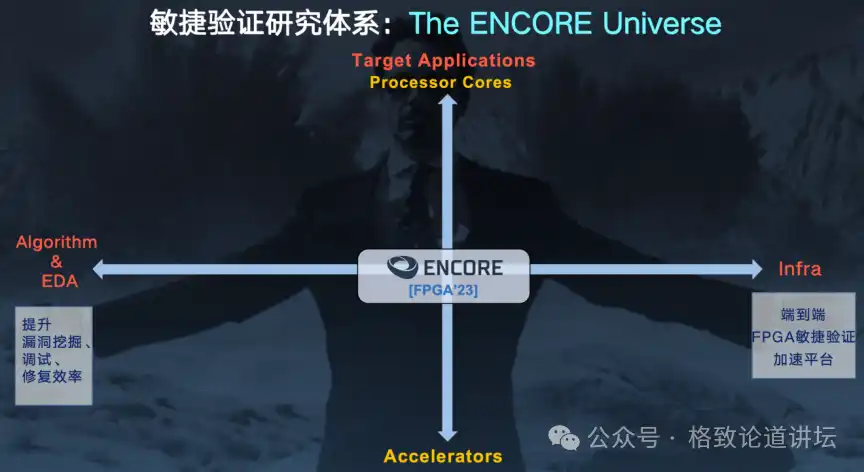
To build this agile verification research system, on one hand, we need to continuously optimize the efficiency of vulnerability mining, debugging, and repair at the algorithmic level; on the other hand, we also hope to build an end-to-end agile verification acceleration platform based on programmable logic chips (FPGAs). At the application level, we hope this platform can be suitable for both general-purpose processor verification, such as CPUs or GPUs, and specialized chip verification, such as the currently very popular AI accelerators.
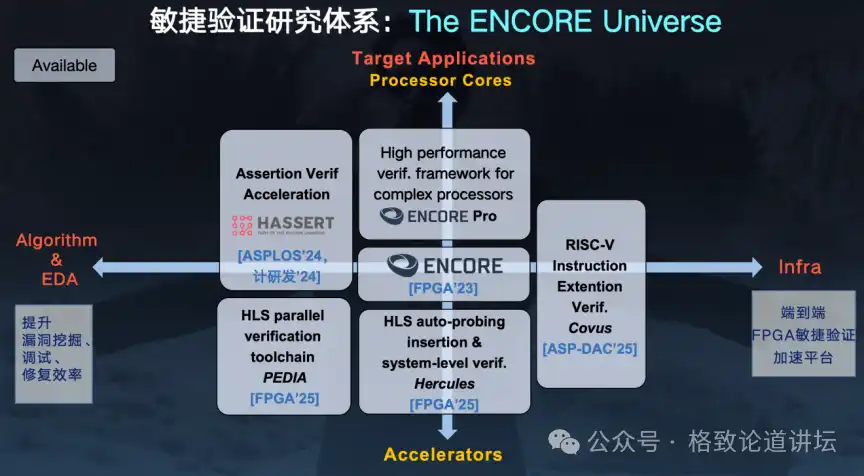
Over the past period, we have done a lot of cutting-edge exploratory work in this field, including the aforementioned ENCORE and many new research projects. We have also published these research results at many internationally renowned academic conferences.
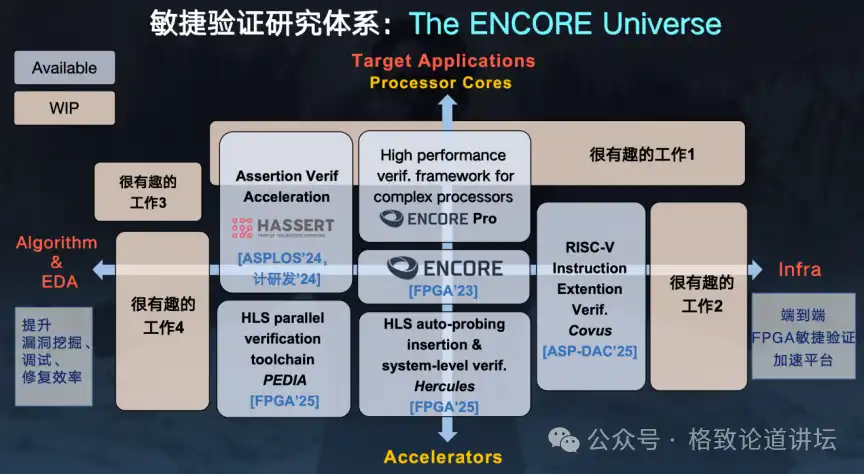
We are actually working on some interesting projects afterwards, but since these works have not been published yet, I won't show them to you one by one for now.

Letting More People Understand Chips

Completed: 80%//////////

However, during the research process, I gradually realized that these scientific or academic achievements are mainly for people within our small circle who only understand chip verification and related fields. So, how can we let more people see our work, understand our research, and even participate in our endeavors?

Naturally, I thought of chip science popularization, which also feels very interesting to me. I have been engaged in science popularization for four or five years, starting from text initially to later making videos on Bilibili. Chip science popularization has not only brought me many gains but also helped me meet many like-minded friends, as well as viewers who like and support me.
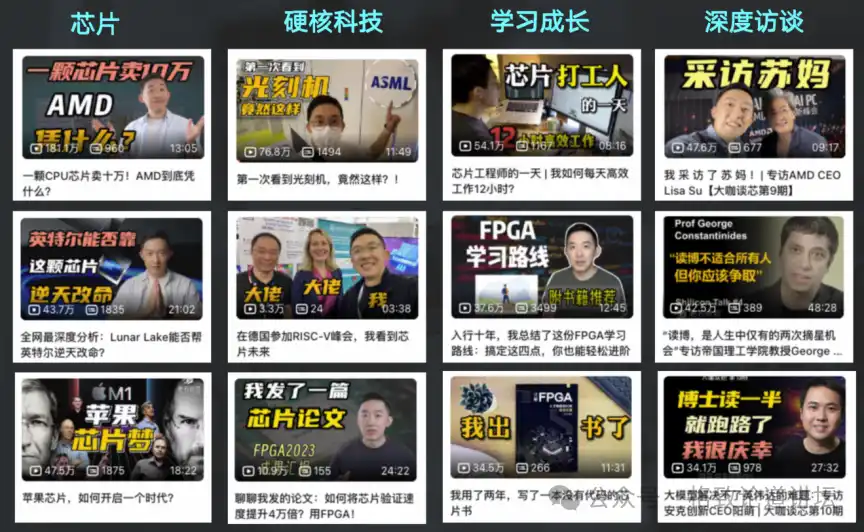
However, making chip science popularization videos is not a simple task, especially in today's era of short video proliferation. A fellow science popularization blogger and leader told me that in the same amount of time it takes me to produce one long, hardcore chip science popularization video, they could make 10 or even more short videos related to hot topics, and the traffic could be many times greater than mine.

Unfortunately, what they said is also true.

But based on this, I think there still needs to be people who persist in doing difficult things. I hope to combine chip science popularization and chip verification—two equally difficult but equally interesting things—and use video and text formats to show everyone what we have done, the papers we have published, and the open-source chip projects our entire large team is researching.

Besides chips, I will also share hardcore technologies like artificial intelligence and computers with everyone, as well as share my growth experiences, the books I have read, and the knowledge I have acquired. I know that I am not a genius myself, nor am I a so-called all-around expert or guru. I would rather be a 'guide' for everyone, sharing the path I have walked.

So, returning to the question I wanted to share with everyone today: chip research and chip science popularization, which one is more interesting? Of course, for me, both are equally interesting. The reason is simple: because they are equally difficult. At the same time, they both require me to persist very long-term and enduringly.

Many people say we need to do difficult and right things. But the problem actually is: how do you judge if something is right before you do it? If something is seen as sitting on a cold bench in others' eyes, or seen as doing dirty, tiring work, would you still persist in doing it?

Therefore, I prefer to do difficult and long-term things, such as academic research in chip verification, or making long hardcore chip science popularization videos. Because if something is difficult and requires long-term persistence, then it is probably right.

That's all I wanted to share with you today. I am Lao Shi, thank you, everyone!

This article comes from the WeChat public account: Gezhi Lundaotan , Author: Shi Kan, Original Title: 'How Difficult is Chip Making? A Division Error Costs 475 Million Dollars | Shi Kan'


Questions liées

QWhat was the main point of the story about the Intel Pentium chip flaw mentioned in the article?

AThe story illustrated a critical design bug in the Pentium chip's floating-point division unit. A calculation that should have resulted in '0' instead produced '255.00000000'. This seemingly minor error forced Intel to spend $475 million on a global recall of the faulty chips in the 1990s, highlighting the high cost of failure in chip development.

QAccording to the article, why is chip development so difficult, especially compared to software development?

AChip development is exceptionally difficult because it requires 'first-time success'. Unlike software, which can be patched and updated after release, a physical chip cannot be easily modified once manufactured (or 'taped out'). The entire expensive process, from sand to finished silicon, costing potentially hundreds of millions, must be redone to fix design flaws.

QWhat percentage of chip projects achieve first-time success according to the survey data cited by the author?

AAccording to the survey data presented by the author, only 24% of chip projects achieve first-time success. This means approximately three-quarters (76%) of projects require at least one re-spin or re-fabrication due to various undetected design bugs, leading to significant extra time and cost.

QWhat is the 'impossible triangle' in chip verification, as explained in the article?

AIn chip verification, the 'impossible triangle' refers to the three crucial factors—high performance, good debuggability, and low cost. The article states that these three factors cannot be satisfied simultaneously with current mainstream methods. Engineers and researchers can only achieve a maximum of two out of these three, which fundamentally limits verification efficiency.

QWhat are the two 'hard but long-term' pursuits that the author, Shi Kan ('Lao Shi'), is committed to?

AThe author is committed to two challenging, long-term endeavors. First, he leads academic research in chip verification, specifically developing an agile verification framework called ENCORE based on FPGAs. Second, he creates hardcore, long-form chip and technology popular science content (like his Bilibili channel videos), aiming to make complex topics accessible to a wider audience beyond academic circles.

Lectures associées

Projection 2029 : Lorsque la cryptomonnaie deviendra « invisible », qui survivra à cette transformation financière ?

**Résumé de l'article : "Prévisions pour 2029 : Quand la cryptomonnaie devient 'invisible', qui reste dans ce changement financier ?"** L'article propose un scénario pour l'industrie cryptographique jusqu'en 2029. Il identifie trois problèmes clés : la valeur des tokens, l'intégration de nouvelles technologies et la transformation en infrastructure financière traditionnelle. Sa thèse centrale est que la principale contrainte du secteur est juridique, et non technique. **Évolution principale :** * **2026 :** La valeur migre vers les actifs réels. Les contrats perpétuels synthétiques sur actions non cotées (ex: SpaceX, OpenAI) sur des plateformes comme Hyperliquid deviennent des références de prix cruciales, démontrant une demande pour des actifs de qualité, contrairement à la plupart des crypto-actifs. * **2026-2027 :** Le secteur se scinde en deux. D'un côté, un marché spéculatif bruyant (paris sur l'IA). De l'autre, un marché institutionnel silencieux où la tokenisation d'actifs (fonds monétaires, crédit privé) se développe dans un cadre réglementaire. Les blockchains généralistes s'orientent majoritairement vers les services institutionnels. * **2028 :** Un événement déclencheur. Une cascade de liquidations sur le marché des contrats perpétuels synthétiques, sans ancrage tangible, révèle ses failles. La réponse réglementaire serait d'autoriser la **publicité et la négociation légales de parts secondaires d'entreprises privées** pour les investisseurs accrédités, fournissant ainsi l'ancrage de prix manquant. * **2029 :** L'industrie atteint sa "fin". Le marché spéculatif se réduit. Une nouvelle forme de "bull market" émerge, alimentée par le trading direct et légal d'actions privées de sociétés technologiques (biotech, robotique, IA) par des investisseurs particuliers accrédités. La valeur des tokens dépendra désormais exclusivement des droits qu'ils confèrent sur des actifs réels. Les fonctions d'infrastructure de règlement (stablecoins, blockchains) deviennent "invisibles", intégrées et banales, comme tout autre service financier de base. L'auteur conclut que l'industrie ne sera plus définie par la spéculation sur des tokens, mais par le **marché qu'elle a construit pour échanger des actifs réels**. Le test décisif de sa prédiction sera l'émergence, ou non, d'un canal légal d'accès pour les investisseurs particuliers aux actifs privés d'ici fin 2028.

marsbitIl y a 38 mins

Projection 2029 : Lorsque la cryptomonnaie deviendra « invisible », qui survivra à cette transformation financière ?

marsbitIl y a 38 mins

Les actions de Zhipu ont bondi de 47 % après l'interdiction américaine de Fable 5

Le 15 juin, l'action de Zhipu AI a grimpé de 47,6% à la Bourse de Hong Kong, clôturant en hausse de 32,82%. Cette forte réaction suit deux annonces récentes. Le 12 juin, Anthropic a suspendu l'accès mondial à ses modèles phares Claude Fable 5 et Claude Mythos 5 suite à une injonction du gouvernement américain sur les contrôles à l'exportation. Le lendemain, Zhipu a annoncé l'ouverture de son dernier modèle open-source, GLM-5.2, à tous les utilisateurs de son Coding Plan, avec une sortie prévue de l'API et des poids du modèle sous licence MIT la semaine suivante. Cet événement met en lumière un changement dans l'industrie de l'IA : au-delà des performances pures, la stabilité, l'accessibilité durable et le contrôle des modèles deviennent des critères essentiels, surtout lorsque l'IA s'intègre dans les flux de travail critiques. La suspension soudaine de Claude a perturbé de nombreux développeurs et entreprises qui en dépendaient, soulignant les risques liés à l'accès à des modèles propriétaires soumis à des juridictions uniques. La réponse du marché valorise ce nouveau paradigme. GLM-5.2, présenté comme un modèle « véritablement utilisable » avec un contexte de 1M de tokens optimisé pour les tâches de codage longues et complexes, représente une alternative ouverte et contrôlable. Les analystes estiment que cet incident pourrait accélérer l'adoption de modèles de base locaux et open-source par les entreprises cherchant à sécuriser leurs capacités d'IA. La concurrence évolue ainsi de « qui est le plus performant » vers « qui est le plus accessible et fiable sur le long terme ».

marsbitIl y a 44 mins

Les actions de Zhipu ont bondi de 47 % après l'interdiction américaine de Fable 5

marsbitIl y a 44 mins

Guide d'inscription et de publication d'articles pour la colonne PANews

**Guide d'inscription et de publication pour les contributeurs de PANews** Cette page explique comment devenir contributeur (créer une colonne) et publier des articles sur PANews. L'accent est mis sur les contenus approfondis liés à la Crypto, au Web3, aux données et aux analyses. Les contenus principalement promotionnels ou générés massivement par IA ne seront pas approuvés. **Pour créer une colonne :** * **Sur le site web :** Allez en bas de la page d'accueil, cliquez sur "申请专栏" (Demander une colonne). Connectez-vous avec votre numéro de téléphone ou e-mail (code de vérification, pas de mot de passe). Remplissez le nom de la colonne, la description, téléchargez un avatar et fournissez des liens vers vos articles déjà publiés. * **Sur mobile :** Dans la section "我的" (Moi), accédez à "投稿与创作" (Soumettre et créer) et suivez les étapes. **Pour publier un article :** 1. Connectez-vous sur le site et allez sur votre page personnelle. 2. Accédez au "创作者中心" (Centre de création). 3. Utilisez l'éditeur pour rédiger et publier votre article. **Ajouter une vidéo :** Seul l'intégration via code embed (iframe) est supportée (ex. : Bilibili). Collez le code dans l'éditeur via le bouton "插入/编辑媒体" (Insérer/modifier un média). Ajustez la taille si nécessaire (largeur 100%, hauteur 560px recommandés). **PANews Skills (Agent IA) :** PANews propose un ensemble d'outils IA (PANews Skills) pour automatiser certaines tâches. L'outil `panews-creator` permet notamment de gérer votre colonne et de publier des articles directement via des agents IA compatibles (comme Cursor, Claude, etc.). Pour l'utiliser, vous devrez récupérer un jeton d'authentification (`sessionid`) depuis les outils de développement de votre navigateur après vous être connecté à votre compte PANews. **Rappel important :** Privilégiez les analyses de fond. Les contenus publicitaires (PR) doivent passer par la voie commerciale.

marsbitIl y a 54 mins

Guide d'inscription et de publication d'articles pour la colonne PANews

marsbitIl y a 54 mins

J'ai construit un poste de travail d'investissement personnel avec l'IA

Ces dernières semaines, j'ai exploré le « Vibe Coding », utilisant des modèles d'IA comme Codex, Claude et DeepSeek pour développer rapidement des outils personnalisés. Frustré par la nécessité de consulter plusieurs applications pour suivre mes actifs (actions, crypto, etc.), j'ai construit un tableau de bord unifié affichant l'ensemble de mon portefeuille et ses performances. Cet outil intègre désormais une surveillance des mouvements brusques, une cartographie des investissements (visualisant les écosystèmes complets) et un journal de réflexion. J'ai également créé un moniteur pour les marchés de prédiction (comme Polymarket), rassemblant les paris sur des événements futurs (valorisations d'entreprises, etc.) pour analyser leurs probabilités face à l'actualité. Un petit back-office pour gérer mes publications et un outil de mise en forme automatique pour différents plateformes complètent cet ensemble. L'essentiel n'est pas la sophistication des outils, mais la capacité nouvelle à matérialiser rapidement une idée. L'IA permet à tout investisseur de construire progressivement ses propres systèmes fondamentaux : observation d'actifs, surveillance de signaux, cartographie de secteurs et analyse rétrospective. Ce cycle rapide « idée → réalisation → utilisation → amélioration » change profondément la façon d'aborder la recherche et la gestion d'investissements pour les particuliers.

marsbitIl y a 1 h

J'ai construit un poste de travail d'investissement personnel avec l'IA

marsbitIl y a 1 h

Trading

Spot
Futures

Articles tendance

Comment acheter CHIP

Bienvenue sur HTX.com ! Nous vous permettons d'acheter USD.AI (CHIP) de manière simple et pratique. Suivez notre guide étape par étape pour commencer votre parcours crypto.Étape 1 : Création de votre compte HTXUtilisez votre adresse e-mail ou votre numéro de téléphone pour ouvrir un compte sur HTX gratuitement. L'inscription se fait en toute simplicité et débloque toutes les fonctionnalités.Créer mon compteÉtape 2 : Choix du mode de paiement (rubrique Acheter des cryptosCarte de crédit/débit : utilisez votre carte Visa ou Mastercard pour acheter instantanément USD.AI (CHIP).Solde :utilisez les fonds du solde de votre compte HTX pour trader en toute simplicité.Prestataire tiers :pour accroître la commodité d'utilisation, nous avons ajouté des modes de paiement populaires tels que Google Pay et Apple Pay.P2P :tradez directement avec d'autres utilisateurs sur HTX.OTC (de gré à gré) : nous offrons des services personnalisés et des taux de change compétitifs aux traders.Étape 3 : stockage de vos USD.AI (CHIP)Après avoir acheté vos USD.AI (CHIP), stockez-les sur votre compte HTX. Vous pouvez également les envoyer ailleurs via un transfert sur la blockchain ou les utiliser pour trader d'autres cryptos.Étape 4 : tradez des USD.AI (CHIP)Tradez facilement USD.AI (CHIP) sur le marché Spot de HTX. Il vous suffit d'accéder à votre compte, de sélectionner la paire de trading, d'exécuter vos trades et de les suivre en temps réel. Nous offrons une expérience conviviale aux débutants comme aux traders chevronnés.

341 vues totalesPublié le 2026.04.21Mis à jour le 2026.06.02

Comment acheter CHIP

Discussions

Bienvenue dans la Communauté HTX. Ici, vous pouvez vous tenir informé(e) des derniers développements de la plateforme et accéder à des analyses de marché professionnelles. Les opinions des utilisateurs sur le prix de CHIP (CHIP) sont présentées ci-dessous.

活动图片