What Kind of People Is Anthropic Actually Hiring? Insights from 1,680 Resumes Provide the Answer

marsbitPublié le 2026-06-15Dernière mise à jour le 2026-06-15

Résumé

Contrary to the common perception of Anthropic as a PhD-heavy AI research lab, an analysis of 1,680 engineer profiles reveals its core talent is experienced "builders." The engineering team, largely assembled in the past 18 months (median tenure 10 months), hires senior engineers with a median of 12.2 years of prior experience. They primarily come from major engineering-focused companies like Google, Meta, Amazon, Microsoft, Stripe, Databricks, Snowflake, and Palantir, not primarily from other AI labs. Their backgrounds are infrastructure-heavy (40%), focusing on backend, distributed systems, databases, and security, with skills like Python, Java, C++, and AWS being common. Only 13.7% hold PhDs. The dominant job title is "Member of Technical Staff." For early-career hires (<6 years experience), entry is not based on standard work history but on prestigious signals: top internships (e.g., at FAANG or quant trading firms), competition rankings, research publications, or AI safety fellowship experience. The key insight for applicants is to present as infrastructure builders, highlighting experience with large-scale systems, not as pure researchers, reflecting Anthropic's identity as a highly engineered infrastructure company.

Editor's Note: Anthropic is often imagined by outsiders as an AI lab composed of PhDs, researchers, and frontier model experts. However, this analysis of 1,680 engineer profiles offers a more realistic answer: the core of Anthropic is not just "research," but "building."


By analyzing 5,306 LinkedIn profiles listing Anthropic as the current employer and further filtering down to 1,680 engineer profiles, this article reaches a counter-intuitive conclusion: the most core talent profile at Anthropic is not the "researcher" imagined by the outside world, but a group of experienced "builders" (people who can truly set up, run, and scale large-scale systems).

Data shows that Anthropic's engineering team was largely formed rapidly in the past 18 months: over half of current engineers joined less than a year ago. However, the new hires are generally very senior, with a median of 12.2 years of work experience before joining. A significant number came from companies renowned for engineering prowess and infrastructure, such as Google, Meta, Amazon, Microsoft, Stripe, Databricks, Snowflake, and Palantir.

This also explains the real focus of Anthropic's engineering organization: compared to the model research that outsiders focus on, it operates more like a highly engineered infrastructure company. Its engineers' backgrounds are concentrated in areas like infrastructure, backend, distributed systems, databases, and security. Only 13.7% hold PhDs; the majority are senior engineers with bachelor's or master's degrees.

Opportunities for early-career talent are not nonexistent, but the bar is equally high: top tech company internships, competition achievements, publications, or experience in AI safety/alignment projects often serve as screening signals in place of years of experience.

The author's final advice is straightforward: if you want to join Anthropic, don't write your resume as if applying to a research lab. Instead, highlight the large-scale systems you have actually built, scaled, and maintained. At its foundation, the competition in frontier AI is increasingly becoming a competition of engineering capability and infrastructure capability.

The original text is below:

Builders, Not Researchers

I scraped all LinkedIn profiles listing Anthropic as the current employer, totaling 5,306 people. I then filtered for the 1,680 individuals in genuine engineering roles and further examined the 7,986 records in their past job descriptions to analyze what they were doing before joining Anthropic.

Here are the results.

The Organization Was Scaled Up Almost Overnight
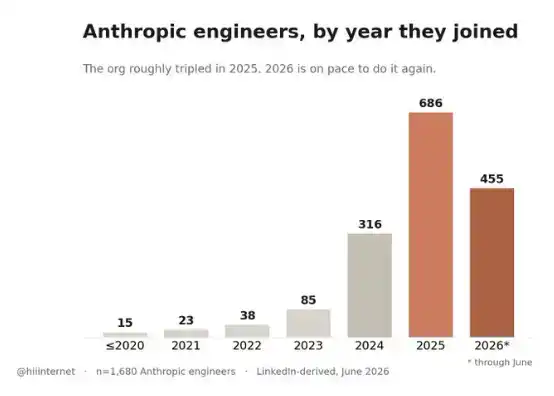
Only 15 engineers who joined Anthropic before 2021 are still employed there today. In 2025, this organization's engineering team nearly tripled in size, adding 686 engineers that year; the hiring pace for 2026 is projected to be similar, with 455 added by June.

Currently, half of the engineering team has been at Anthropic for less than a year. 53% joined within the past 12 months. Median tenure: 10 months.

This is a large-scale organization that was essentially built up in about 18 months.

They Almost Exclusively Hire Senior Engineers
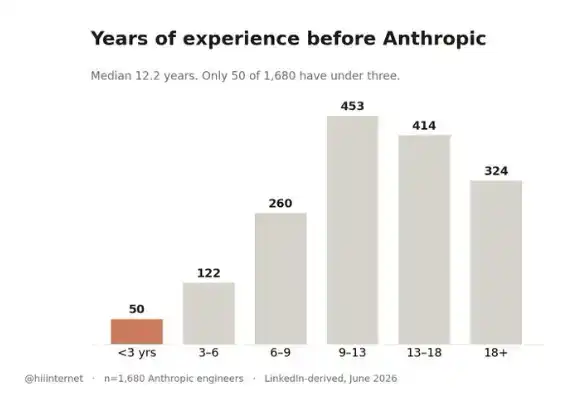
The median years of work experience before joining Anthropic is 12.2 years. The middle 50% have between 8.8 and 16.5 years of experience. Among these 1,680 people, only 50 have less than 3 years of experience. 44% have 13 or more years of experience. New graduate hiring is virtually nonexistent.

In other words, the typical new hire at Anthropic is an engineer with 12 years of experience who has only been at Anthropic for 10 months.

Clear Bias Towards Infrastructure Over Traditional Research
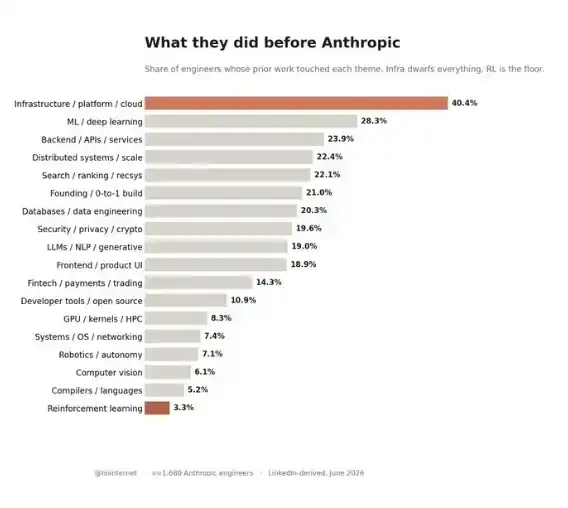
Infrastructure background appears in 40% of the engineers' profiles. Backend, distributed systems, databases, and security each appear in about 20% of profiles. Reinforcement learning, the "RL" in RLHF, appears in only 3.3%.

The typical Anthropic engineer spent the past decade building large-scale production systems at either a hyperscale cloud provider or an infrastructure-heavy startup.

Their self-listed skills tell the same story: Python (585 people), Java (566), C++ (443), JavaScript (376), SQL (302), Linux (230), Distributed Systems (189), AWS (154). The more "sexy"-sounding model training work certainly exists, but it's a low percentage.

The Largest Talent Source Is Not a Lab, It's Google
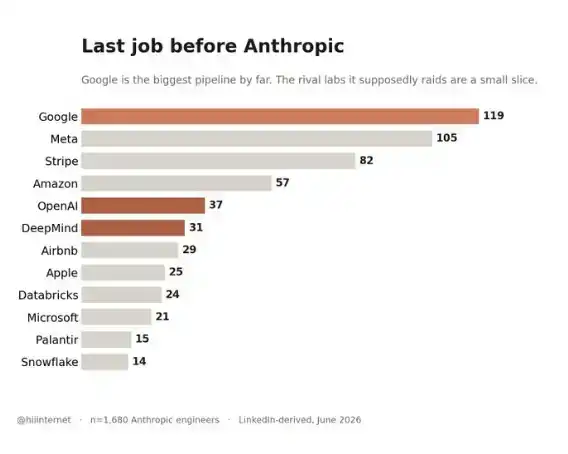
Everyone thinks Anthropic mainly hires from OpenAI and DeepMind. But its largest talent pipeline, by far, is Google. Those competitor labs are just two small bars in the middle of the chart.

Anthropic clearly prefers companies known for engineering rigor: Stripe, Databricks, Snowflake, Palantir, Airbnb.

Looking at where these engineers have worked historically, the ranking is: Google (405 people), Meta (273), Amazon (197), Microsoft (171), Stripe (124), Apple (87), Stanford (68), DeepMind (62), Airbnb (51), OpenAI (48). Half of the current engineering team, 50%, have at least one FAANG company in their career history.

Of course, they also hire from other AI labs. OpenAI is a top-five direct source, and DeepMind is a top-six direct source. About 94 engineers moved directly from other frontier AI labs to Anthropic.

The Myth of the PhD
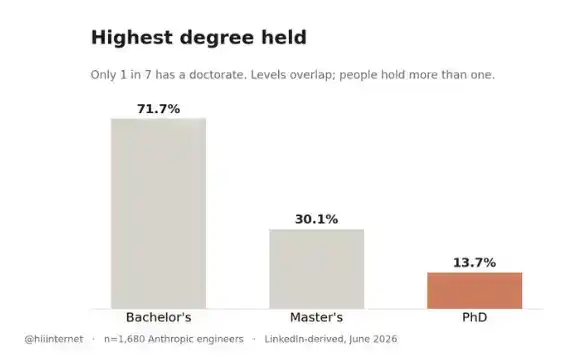
Only 13.7% hold a doctoral degree. That's roughly one in seven people.

The typical Anthropic recruitment target is not a research scientist, but a senior engineer with a bachelor's or master's degree. The image of a "lab full of PhDs" is largely incorrect at the engineering team level.

The distribution of academic majors also perfectly fits the profile of a "building organization": Computer Science (819 people), followed by Mathematics (78), Physics (70), Computer Engineering (69). Philosophy also makes the top 20, with 13 people, likely related to safety.

Stanford Is Clearly the Leading Source by University
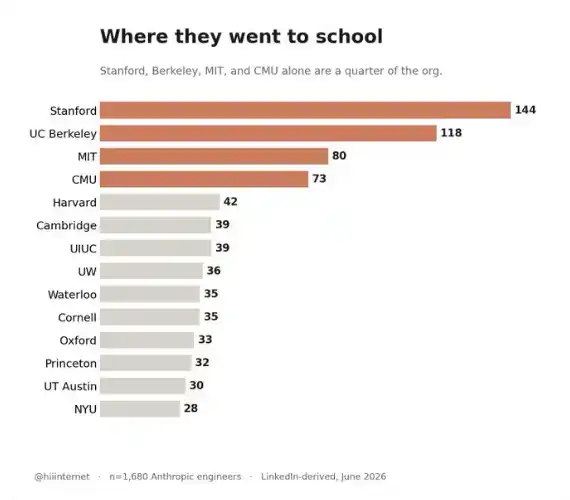
Looking at universities, the historical cumulative ranking is: Stanford (144 people), Berkeley (118), MIT (80), CMU (73), Harvard (42), Cambridge (39), UW (36), Waterloo and Cornell (35 each), Oxford (33), Princeton (32). The top four schools combined account for a quarter of the entire engineering team.

80% of people share the same job title.

"Member of Technical Staff."

A former Instagram CTO, a few former Adept founders, and Stanford faculty at Anthropic all share the title "MoTS." This flattening of job titles is clearly intentional. Seniority and specific function are, by design, hidden.

Where is the One Entry Point for Early-Career People into Anthropic?
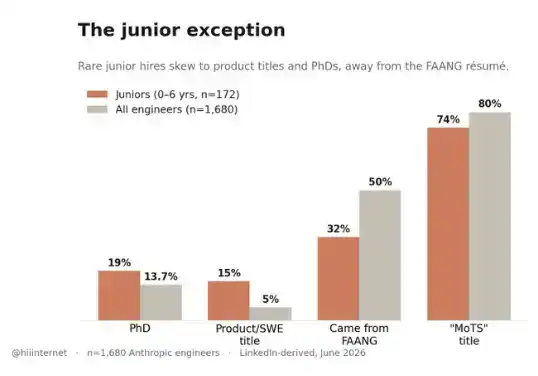
There are 172 engineers with less than 6 years of experience, and 50 of them have less than 3 years. But they are not typical new graduates. They roughly fall into two categories, with almost no ordinary mid-level engineers in between.

Compared to the entire engineering team, they show distinctly different characteristics: a higher PhD rate of 19% vs. 13.7% overall; product/SWE titles are three times more common, at 15% vs. 5% overall; they are also far less likely to have FAANG experience, only 32% vs. 50% overall.

In place of years of experience, they possess a different form of prestige capital:

The Internship Pipeline. 50% of them list internships at these companies: Meta (16 people), Google (10), DeepMind (6), Microsoft (5), Amazon (5), plus Jane Street, Two Sigma, HRT, Optiver, Nvidia.

From Quant Trading to AI Labs. 9% had stints at top trading firms, including Jane Street, Two Sigma, Five Rings, HRT, Optiver, Citadel. This is a group of young math/coding competition talent entering AI labs via the high-frequency trading industry.

Alignment Fellowships. 6% had exposure to MATS, SERI, Redwood, or ARC. This is an entry point that is almost exclusively for early-career talent and virtually absent among the senior cohort.

A very clear profile emerges: MIT, IOI Silver Medalist, Codeforces rating 2900+, entered reinforcement learning and safety directly after four years of work. Their screening criteria aren't years of experience, but competition rankings and publications.

These young engineers are also more international than their senior counterparts. School sources for low-seniority engineers include: Berkeley (15), Stanford (14), Cambridge (10), MIT (7), Tsinghua (7), Oxford (6), plus Imperial, NUS, Shanghai Jiao Tong University, ETH Zürich.

So, How Should You Interpret This?

If you want to join Anthropic as an engineer, don't write your resume as if applying to a research lab. Write it as if applying to an infrastructure company. Show the systems you've actually built and scaled. That's the resume getting hired.

The early-career stage is the only exception. At this stage, the barrier isn't regular work experience, but top internships, competition rankings, or publications.

If you're competing with Anthropic for talent, your target isn't "PhDs" or "lab background" per se, but those senior Builders from hyperscale cloud providers or companies with stellar engineering reputations: they have about 12 years of experience, likely from Stripe, Databricks, Snowflake, Palantir. Anthropic is already fishing heavily in this talent pool.

Questions liées

QWhat is the core talent profile that Anthropic primarily hires for, according to the analysis of engineer resumes?

AThe core talent profile at Anthropic is not 'researchers,' but rather experienced 'builders'—engineers who can build, scale, and maintain large-scale production systems. The majority are senior engineers with a background in infrastructure, backend, distributed systems, databases, and security, not necessarily AI model research.

QWhat does the data say about the experience level of a typical new engineer joining Anthropic?

AThe median prior work experience for engineers joining Anthropic is 12.2 years. The middle 50% have between 8.8 and 16.5 years of experience. New hires are predominantly senior engineers, with nearly zero recent graduate hiring.

QWhich company is the largest direct source of engineering talent for Anthropic, and what does this indicate about their hiring preference?

AGoogle is by far the largest direct source of engineering talent for Anthropic. This indicates a strong preference for candidates from companies renowned for engineering rigor and infrastructure capabilities (like Meta, Amazon, Microsoft, Stripe, Databricks), rather than exclusively from AI research labs like OpenAI or DeepMind.

QWhat is the percentage of engineers at Anthropic with a PhD, and what is the most common educational background?

AOnly 13.7% of the engineers analyzed hold a PhD. The most common educational background is a Bachelor's or Master's degree in Computer Science (819 people), which aligns with the profile of a 'builder' organization focused on engineering and infrastructure.

QFor early-career individuals with limited work experience, what are the primary pathways to secure an engineering role at Anthropic?

AEarly-career individuals primarily gain entry through alternative prestige signals: top-tier internship experiences (e.g., at Meta, Google, DeepMind), exceptional competition rankings (e.g., IOI medals, high Codeforces scores), research publications, or participation in specialized AI safety/alignment fellowships (e.g., MATS, SERI).

Lectures associées

L'AGI n'est pas l'arrivée, nouveau document de DeepMind : Vers l'ASI, le véritable progrès de l'IA ne fait que commencer

Si l'intelligence artificielle générale (IAG) était atteinte demain, quelle serait la prochaine étape ? Une étude de Google DeepMind suggère que l'IAG n'est pas un point final, mais une étape vers une superintelligence artificielle (ISA) dépassant les collectifs d'experts humains. L'étude distingue trois concepts : l'IAG (niveau médian humain), l'ISA (supérieure aux meilleurs collectifs humains dans presque tous les domaines) et l'IA universelle (limite théorique). Elle propose quatre voies potentielles vers l'ISA : 1. **Extension des ressources** : augmentation de la puissance de calcul, des données et des modèles. 2. **Évolution algorithmique** : améliorations incrémentales ou nouveaux paradigmes (apprentissage continu, utilisation d'outils, modèles du monde). 3. **Auto-amélioration récursive** : des IA plus performantes conçoivent la génération suivante, créant une boucle de rétroaction positive. 4. **Coordination multi-agents** : des systèmes IAG collaborant atteignent une intelligence collective supérieure. L'étude identifie six principaux goulets d'étranglement : 1. **Le mur des données** : les données humaines de haute qualité pourraient s'épuiser. 2. **Pressions économiques et ressources naturelles** : coûts énergétiques et matériels. 3. **Limites des paradigmes neuronaux actuels** : problèmes d'apprentissage continu, de raisonnement robuste, d'hallucinations. 4. **Difficulté croissante de la recherche**. 5. **Barrières à l'abstraction** : difficulté à former de nouveaux concepts fondamentaux. 6. **Régulation, gouvernance et réaction sociale**. Un défi crucial est l'évaluation des capacités de l'IA au-delà du niveau humain, nécessitant de nouveaux benchmarks. L'étude conclut que la progression vers l'ISA reste incertaine, soumise à des contraintes physiques et de ressources, et appelle à un effort de recherche interdisciplinaire pour mieux anticiper cette évolution.

marsbitIl y a 25 mins

L'AGI n'est pas l'arrivée, nouveau document de DeepMind : Vers l'ASI, le véritable progrès de l'IA ne fait que commencer

marsbitIl y a 25 mins

Kraken Lance des Perpétuelles Pré-IPO pour OpenAI et Anthropic avec un Effet de Levier Jusqu'à 5x

Kraken élargit son offre de produits dérivés en lançant des contrats perpétuels pré-IPO sur OpenAI et Anthropic, permettant aux traders éligibles de prendre des positions longues ou courtes sur ces sociétés privées d'intelligence artificielle avant leur introduction en bourse. Ces produits offrent un effet de levier allant jusqu'à 5x. Ces contrats "pre-IPO perps" diffèrent des perpétuels crypto traditionnels car ils s'exposent à des entreprises privées, dont l'évaluation est moins transparente et dépend de tours de financement, de transactions secondaires et des anticipations de calendrier d'IPO. Cette complexité rend la gestion des risques plus délicate, d'autant plus avec l'effet de levier. Ce lancement illustre la tendance des plateformes de trading crypto à s'étendre au-delà des actifs numériques pour offrir une exposition à des marchés alternatifs, comme les entreprises privées, habituellement difficiles d'accès. Bien que cela ouvre de nouvelles opportunités de spéculation sur des thèmes d'investissement porteurs comme l'IA, cela soulève également des questions sur la protection des investisseurs, la liquidité et la source des prix. Kraken met en garde les traders sur les risques spécifiques de ces produits et les invite à bien comprendre l'exposition sous-jacente avant d'utiliser l'effet de levier.

bitcoinistIl y a 32 mins

Kraken Lance des Perpétuelles Pré-IPO pour OpenAI et Anthropic avec un Effet de Levier Jusqu'à 5x

bitcoinistIl y a 32 mins

Prix d'ouverture pour OpenAI : une nouvelle affaire de survie de six mois sur Hyperliquid

L’article explore l’émergence du marché des contrats « pré-IPO » (avant introduction en bourse) sur la blockchain, en prenant l’exemple de deux projets sur Hyperliquid : Trade.xyz et Ventuals. Trade.xyz, une équipe anonyme, a rencontré un grand succès en se concentrant sur des actifs comme SpaceX, dont la date et le prix d’introduction en bourse étaient déjà connus. Cela a permis au marché de converger vers un prix de référence réel au moment de l’IPO. À l’inverse, Ventuals, soutenu par Paradigm, a choisi de proposer des contrats sur des entreprises comme OpenAI et Anthropic, qui n’ont pas de date d’IPO fixée. Son mécanisme de tarification, qui s’appuyait pour moitié sur des transactions privées et pour moitié sur sa propre moyenne de prix, a créé une boucle autoréférente. Les prix, souvent bloqués près de leurs plafonds, reflétaient peu la véritable offre et la demande. Le projet a fermé après neuf mois, avec un règlement final à 1 341,80 $ pour OpenAI et 1 618,90 $ pour Anthropic – des prix considérés comme artificiels. L’article souligne la demande réelle pour ce type de marchés, permettant un accès à des actifs normalement inaccessibles. Cependant, il met en garde contre le défi fondamental : sans un événement de référence comme une IPO, l’établissement d’un prix véritablement juste reste problématique, même lorsque des acteurs établis comme Coinbase entrent sur ce créneau.

marsbitIl y a 34 mins

Prix d'ouverture pour OpenAI : une nouvelle affaire de survie de six mois sur Hyperliquid

marsbitIl y a 34 mins

Entretien avec la directrice de la stratégie numérique de Morgan Stanley : Le Bitcoin à un million de dollars n'est pas impossible, mais je préférerais que cela aille plus lentement

En juin 2026, Amy Oldenburg, responsable de la stratégie des actifs numériques chez Morgan Stanley, a discuté de l'adoption institutionnelle du Bitcoin. Elle a retracé son parcours, des marchés émergents à la finance numérique, soulignant comment les expériences d'infrastructures financières défaillantes et de monnaies mobiles (comme M-Pesa) ont jeté les bases de la logique du Bitcoin. Elle explique que malgré le lancement réussi du fonds MSBT (qui a battu des records), l'adoption par les conseillers financiers reste lente en raison de la volatilité du prix et d'obligations fiduciaires. Les banques comme Morgan Stanley sont également freinées par une réglementation stricte (règles de Bâle III, statut de banque). Oldenburg ne pense pas qu'un catalyseur unique propulsera le Bitcoin, mais plutôt qu'une adoption graduelle se poursuivra. Elle évoque la possibilité d'une crise majeure du système traditionnel qui pourrait révéler la valeur du Bitcoin comme actif refuge. Bien qu'elle estime qu'atteindre 1 million de dollars est possible, elle souhaite une croissance plus stable pour réduire la volatilité. Elle aborde également le fossé éducatif, la confusion entre les différents actifs cryptographiques, et la tension entre l'idéal décentralisé "cypherpunk" et les produits centralisés comme les ETF qui offrent commodité et services (prêts, gestion successorale). Pour elle, les deux approches peuvent coexister, l'écosystème en étant encore à ses débuts.

marsbitIl y a 47 mins

Entretien avec la directrice de la stratégie numérique de Morgan Stanley : Le Bitcoin à un million de dollars n'est pas impossible, mais je préférerais que cela aille plus lentement

marsbitIl y a 47 mins

Trading

Spot
Futures

Articles tendance

Comment acheter PEOPLE

Bienvenue sur HTX.com ! Nous vous permettons d'acheter ConstitutionDAO (PEOPLE) de manière simple et pratique. Suivez notre guide étape par étape pour commencer votre parcours crypto.Étape 1 : Création de votre compte HTXUtilisez votre adresse e-mail ou votre numéro de téléphone pour ouvrir un compte sur HTX gratuitement. L'inscription se fait en toute simplicité et débloque toutes les fonctionnalités.Créer mon compteÉtape 2 : Choix du mode de paiement (rubrique Acheter des cryptosCarte de crédit/débit : utilisez votre carte Visa ou Mastercard pour acheter instantanément ConstitutionDAO (PEOPLE).Solde :utilisez les fonds du solde de votre compte HTX pour trader en toute simplicité.Prestataire tiers :pour accroître la commodité d'utilisation, nous avons ajouté des modes de paiement populaires tels que Google Pay et Apple Pay.P2P :tradez directement avec d'autres utilisateurs sur HTX.OTC (de gré à gré) : nous offrons des services personnalisés et des taux de change compétitifs aux traders.Étape 3 : stockage de vos ConstitutionDAO (PEOPLE)Après avoir acheté vos ConstitutionDAO (PEOPLE), stockez-les sur votre compte HTX. Vous pouvez également les envoyer ailleurs via un transfert sur la blockchain ou les utiliser pour trader d'autres cryptos.Étape 4 : tradez des ConstitutionDAO (PEOPLE)Tradez facilement ConstitutionDAO (PEOPLE) sur le marché Spot de HTX. Il vous suffit d'accéder à votre compte, de sélectionner la paire de trading, d'exécuter vos trades et de les suivre en temps réel. Nous offrons une expérience conviviale aux débutants comme aux traders chevronnés.

562 vues totalesPublié le 2024.12.12Mis à jour le 2026.06.02

Comment acheter PEOPLE

Discussions

Bienvenue dans la Communauté HTX. Ici, vous pouvez vous tenir informé(e) des derniers développements de la plateforme et accéder à des analyses de marché professionnelles. Les opinions des utilisateurs sur le prix de PEOPLE (PEOPLE) sont présentées ci-dessous.

活动图片