Recent On-Chain Review: No Clear Narrative Under U.S. Stock Market Pressure, Just Hype

marsbitPublié le 2026-06-12Dernière mise à jour le 2026-06-12

Résumé

This article analyzes the current state of the Solana meme coin and community token ecosystem, highlighting a market caught between two dominant forces: attention-based PvP and a gradual return to community-centric projects. The first part explores the "Attention PvP" dynamic, where success is driven by celebrity endorsements, viral events, and speed. Examples include $JOTCHUA, which surged after its meme creator's social media activity, and $WORLDCUP, which outperformed a similar Base chain project ($PITCH) largely due to influencer support. The recent "pump.fun GO" feature, allowing bounty tasks for token promotion, is critiqued for fostering sensationalist and often negative stunts—like people getting token tickers tattooed on their bodies for rewards—reminiscent of old internet shock content. In contrast, the article points to a resurgence of organic, community-driven tokens that survive market volatility through strong holder bases and shared ideology, not just hype. Influencer Ansem is cited, arguing that durable meme coins rely on communities willing to endure losses and promote their core message daily. Examples given are older tokens like $neet (anti-work ethos), $troll, $buttcoin, and $triplet, which have maintained relative price stability. A prime example of this community-build model is the new project $KINS, the token for the browser-based MMORPG Kintara. Its success stems not from advanced graphics but from consistently delivering updates, fostering player t...

After the ETH mainnet gradually grew quiet, degens have returned to be active on Solana once again. Despite this, it's hard to say there is a clear main narrative for the activity on Solana. To summarize, it might be fitting to describe it as "oscillating between a return to community and attention PvP."

Attention PvP

Ever since Trump issued a token, the meme coin market has grown accustomed to the playbook of relying on celebrity endorsements, hot events, and competing on speed for a long time.

Everyone is used to it, so even with poor liquidity, people still follow this playbook to find opportunities, thus forming an inertia for this kind of strategy.

$JOTCHUA, a dog meme that became popular in Spanish and English-speaking circles in 2021. On January 24, 2021, Instagram user @_kingorange uploaded an inspirational poster featuring a crudely drawn dog picture with the text "JOTCHUA," which received over 29,000 likes within three months.
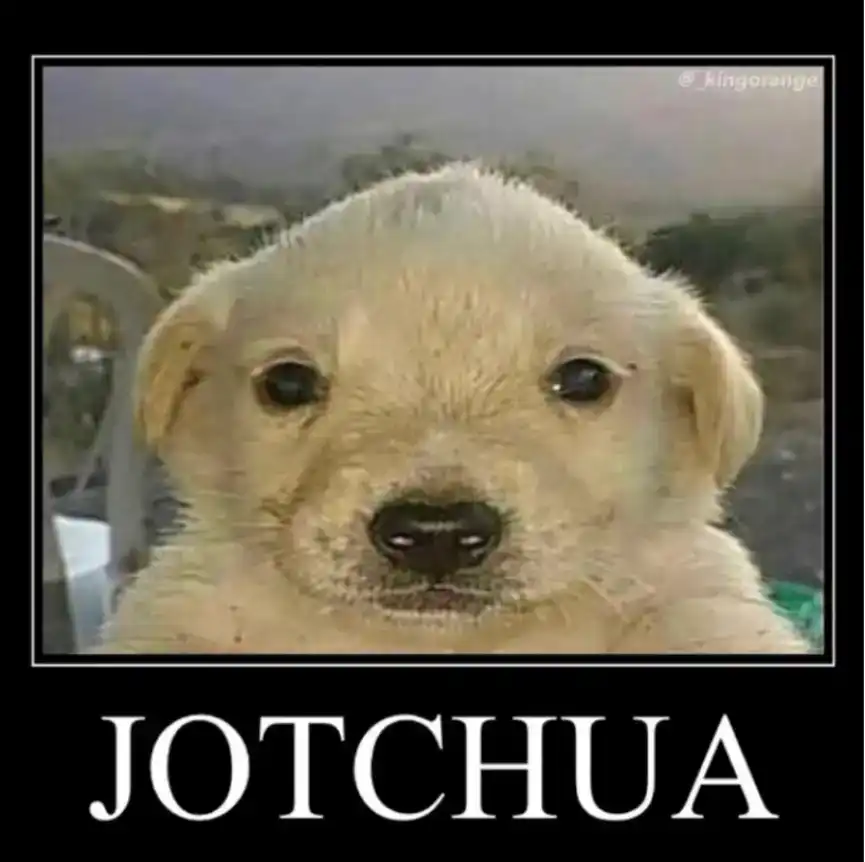
Its market cap once neared $9 million at its peak. The community has significant debates over whether this token is "organic," because its launch did not occur after the meme's creator @_kingorange claimed it, making it almost impossible to say the "claim" was the direct cause of the price surge.

Many players believe this token is another instance of "setting up a play," or attribute it to KOL Ansem sparking market speculation about his purchase being related to this token when he claimed on June 9th that he had returned to buying Solana meme coins for the first time in over a year.

The same concept, even the same ticker, but your coin just doesn't pump. $JOTCHUA on the ETH mainnet was deployed as early as December 2023, and has had consistent content and community, but it couldn't compete with getting the creator to click a few buttons and claim it.

A similar situation happened with the World Cup concept. $WORLDCUP on Solana, due to bonkguy's purchase and detailed analysis, saw its market cap surge from around $5 million to once break $12 million. Meanwhile, the World Cup concept project $PITCH on Base had fallen from a peak market cap of about $7 million to nearly $700,000.

Although $PITCH indeed has its own issues, mainly on the communication front. The project is not inactive, it keeps updating, but the dev rarely speaks up, and their X (Twitter) account got repeatedly suspended and still hasn't sorted out a new one. But admittedly, without any endorsements, similar concepts and playstyles lose out in the battle for attention.

The recent new feature from pump.fun, pump.fun GO, allows anyone to post paid bounty tasks on pump.fun.

This did attract mainstream media attention, but unfortunately, once again in a negative light reaching the masses.

$Bountywork, this token's market cap once approached $2.5 million at its peak. Its dev @ayushquantt's strategy is to continuously post new tasks on pump.fun, creating hype for this token.

He certainly succeeded—by offering a bounty of 40 SOL to have someone tattoo $bountywork on their forehead.

An Indian man actually got it tattooed, and strictly followed a typo the dev made in the description—missing an 'n', incorrectly writing the ticker as $boutywork.
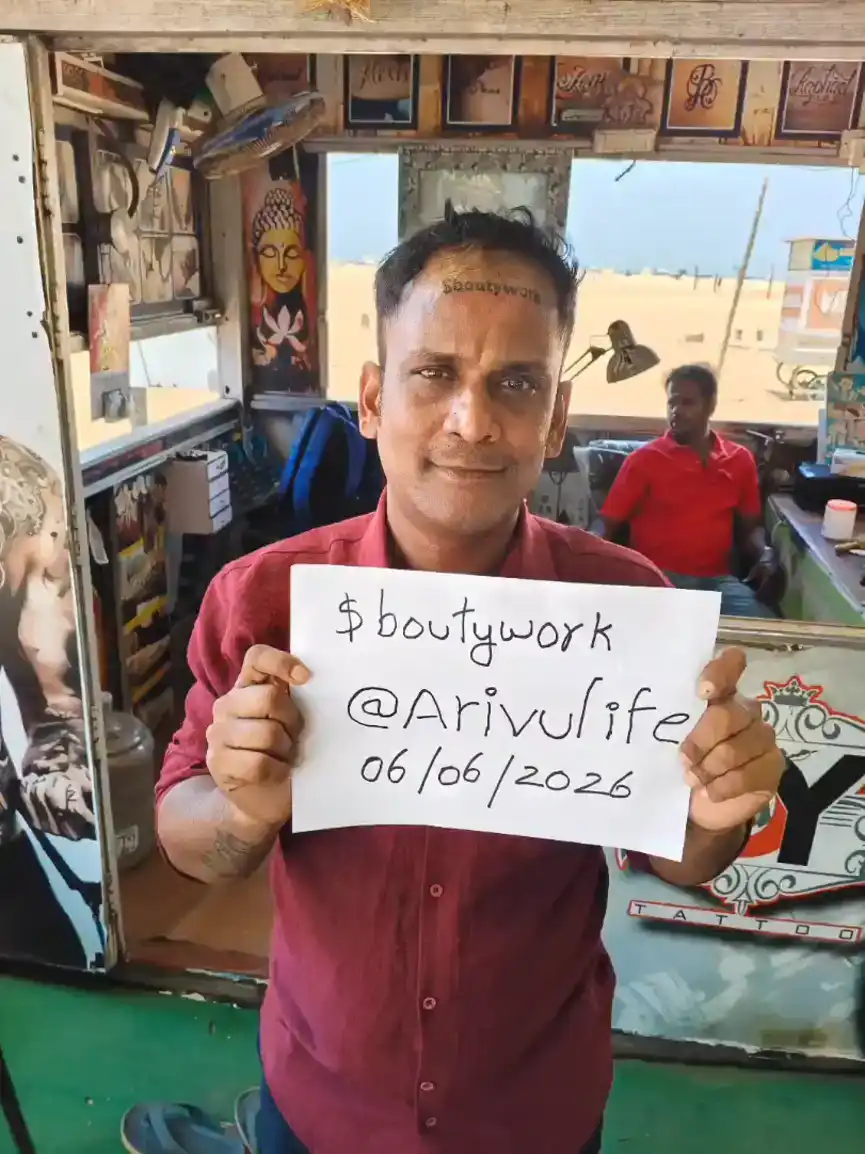
Initially, his bounty application was rejected because the tattoo was missing the letter 'n', and the dev demanded he correct the tattoo. Then, someone launched a new token using the incorrect tattoo as the ticker, $boutywork.

Finally, the 40 SOL bounty reward was still given to him, and the creator revenue from the new token was also given to him, earning him a total of about $48,000.

Then, as the hype faded, $boutywork has essentially gone to zero. The dev of $Bountywork is still continuously posting new bounties trying to replicate this "success," for example, having someone eat 3 insects on camera while wearing a $Bountywork t-shirt.
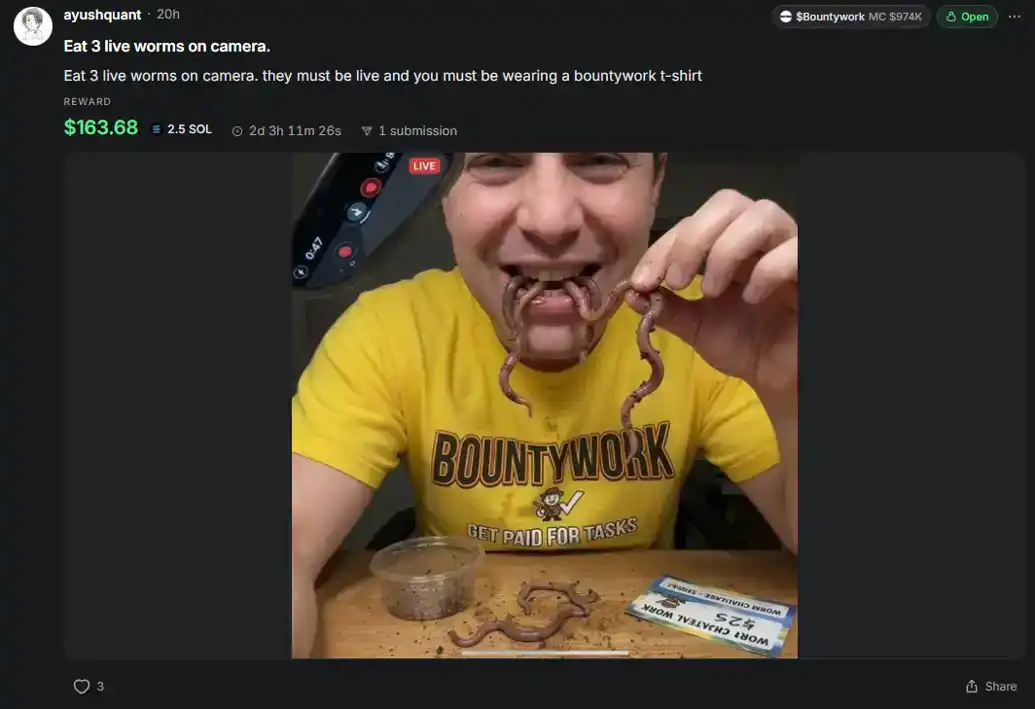
There are quite a few tattoo-related tasks on pump.fun; some have received up to 200 SOL in return for tattooing their own face.
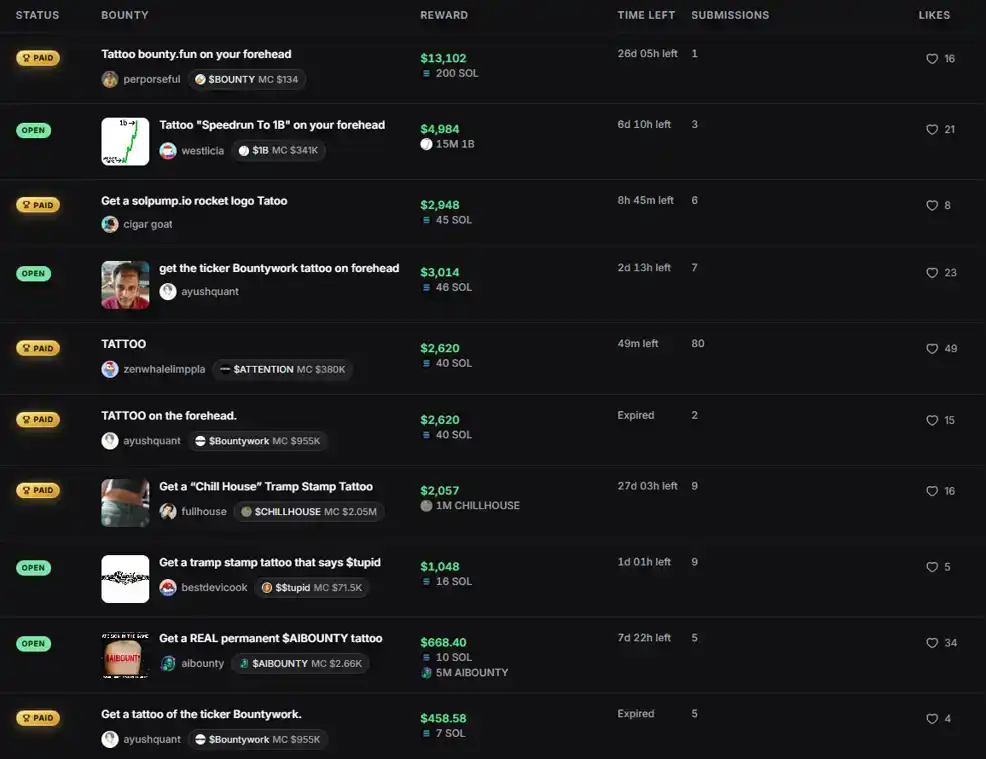
Honestly, this isn't much different from the days when big brothers on Kuaishou tipped people to eat raw eggs or gulp down white liquor...

The Return of Community

Let's continue the discussion around pump.fun's new feature. Almost all bounty tasks are related to generating attention-hype for specific tokens. The only one not treated as a joke might be this bounty task for $neet—organizing a gathering in New York for people who resist work.
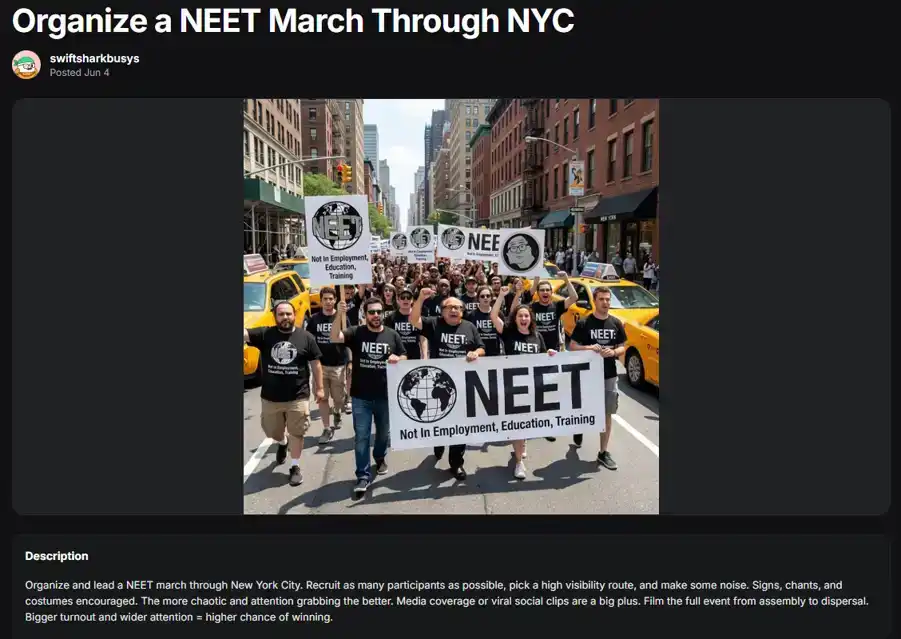
The reward for this bounty is paid in $neet, equivalent to over $15,000. The $neet community has previously self-organized 2 offline "anti-work gatherings" in the US; if this bounty is completed, it will be the 3rd.

Although it's unclear what pump.fun's intention is in supporting community-type meme coins, their official Twitter always features promotions for such community tokens. Although the performance of these tokens varies—for instance, $chillhouse's price has been sluggish for a while—the ones pump.fun officially picks out are generally quite community-driven and organic.

Currently, those with relatively stable visibility and price performance, besides $neet, include $troll, $buttcoin, and $triplet. A brief introduction to the survival status and themes of these community-type tokens:

- $neet: Deployed 410 days ago, peak market cap ~$51 million, current market cap ~$27 million. The community's mission is to make more people realize that dedicating most of one's life to work means losing one's own life.

- $troll: Deployed 416 days ago, holds the copyright to the classic meme Troll, listed on Coinbase. Peak market cap ~$290 million, current market cap ~$65 million.

- $triplet: Deployed 107 days ago, an abbreviation for "Tung Tung Tung Sahur," the hottest breakout character from last year's viral "Italian Classic of Mountains and Seas." Peak market cap ~$13.6 million, current market cap ~$6.6 million.

- $buttcoin: Deployed 153 days ago, originated from a 2011 joke on the Bitcoin forum, a pun on Bitcoin as "Buttcoin" (Butt coin). Peak market cap ~$68.6 million, current market cap ~$27 million.

Mentioning these tokens and the return of community-type coins brings us back to Ansem. After he mentioned returning to buy Solana memes, someone told him to just post the CA (contract address), and if he did, they would aggressively buy 1% to add to their position.
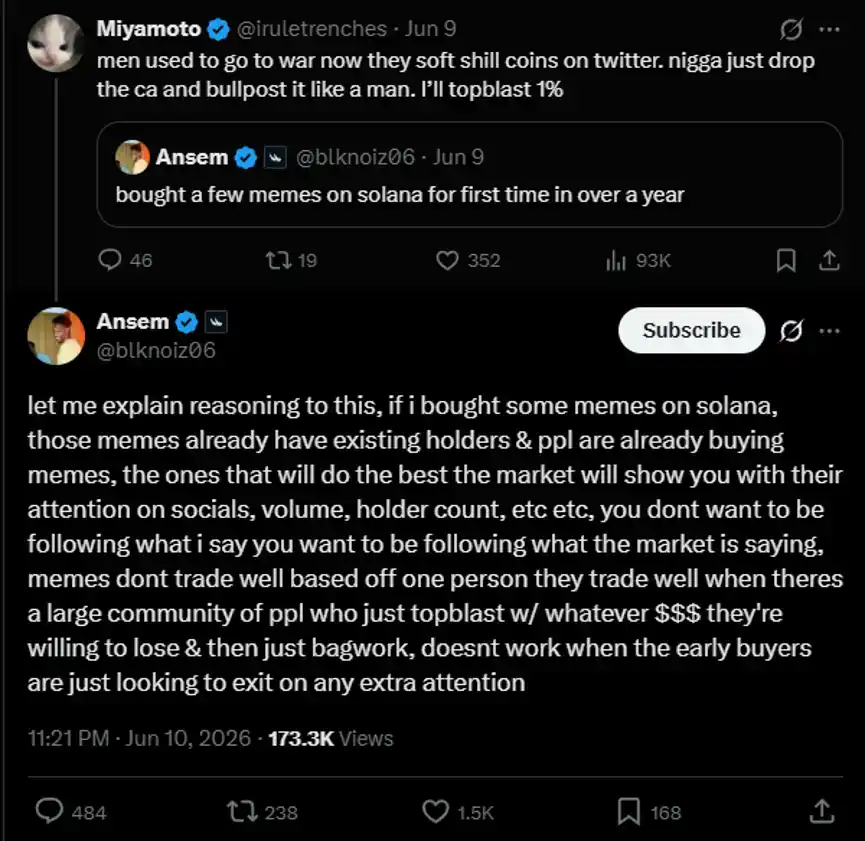
Ansem's response sparked much discussion:

"Let me explain why I don't post CAs. If I buy some Solana meme coins, and these coins already have good holders, the market will tell you which ones are good through social media performance, trading volume, holder count, etc. You shouldn't listen to me, but to the market. Meme coins relying on a group of holders who just compete on speed, wait for endorsements to dump, won't be good. Only tokens with a large community, where people within the community are willing to endure losses and promote their beliefs day after day, will succeed. Tokens dependent on a single celebrity won't do well."

Besides the older tokens mentioned above that have survived long and maintained relatively stable prices, there are indeed new tokens emerging that align with Ansem's view, such as $KINS.

$KINS is the token for Kintara, which is a blockchain game. Interestingly, Kintara hasn't led the Solana gaming sector because its rise wasn't due to the game's polish, but rather its step-by-step actions to earn community trust.

A brief introduction to $KINS' mechanism. This is an MMORPG playable in a browser; to play, your wallet needs 1,000 $KINS. Once in, you can chop wood, mine, fish, buy houses, fight monsters and bosses, and PvP.
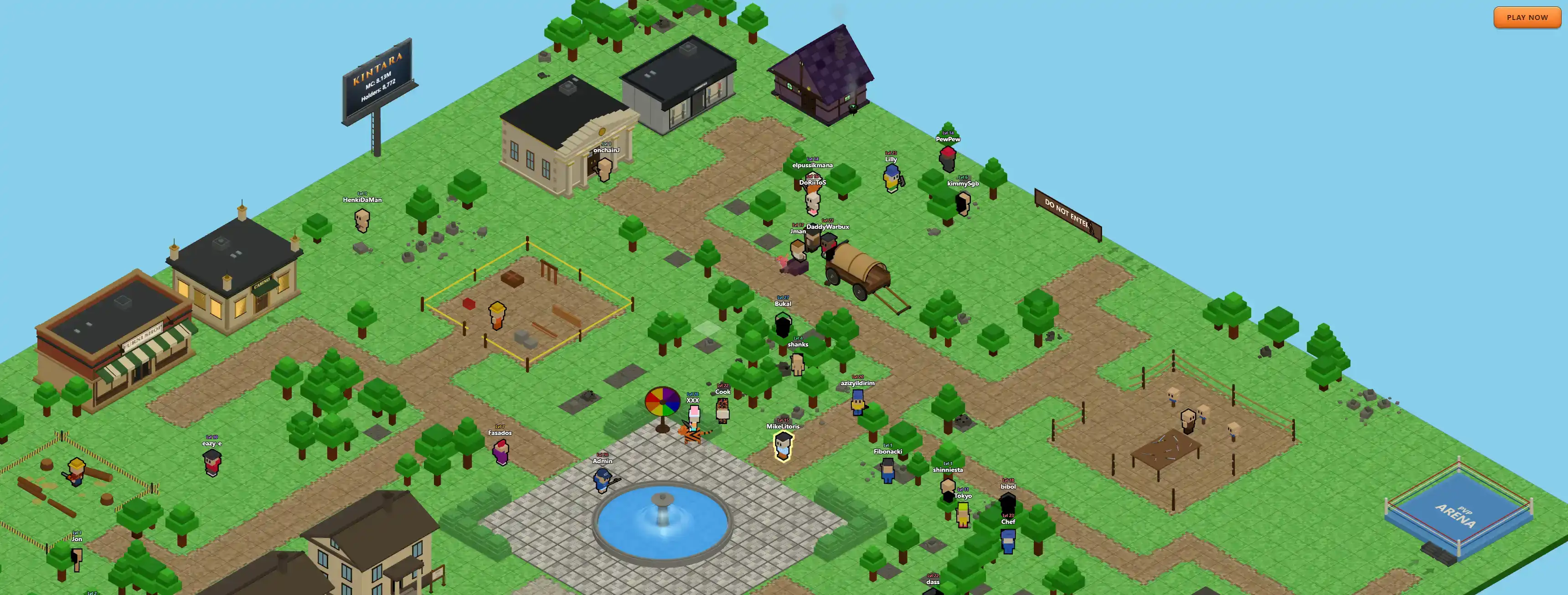
The game has no other pay-to-win options, only a reward wheel. If players don't want to spin only once a day, they can spend $3 worth of $KINS to continue spinning. 50% of this revenue is used for token buyback and burn, 50% for project maintenance and development.

The core gameplay loop is roughly: gather resources -> craft items -> challenge tougher monsters. If players lack resources, they need to use the in-game currency "Gold" to buy from other players. Players can sell "Gold" in the game priced in $KINS, with 5% going to the treasury and 95% to the player.

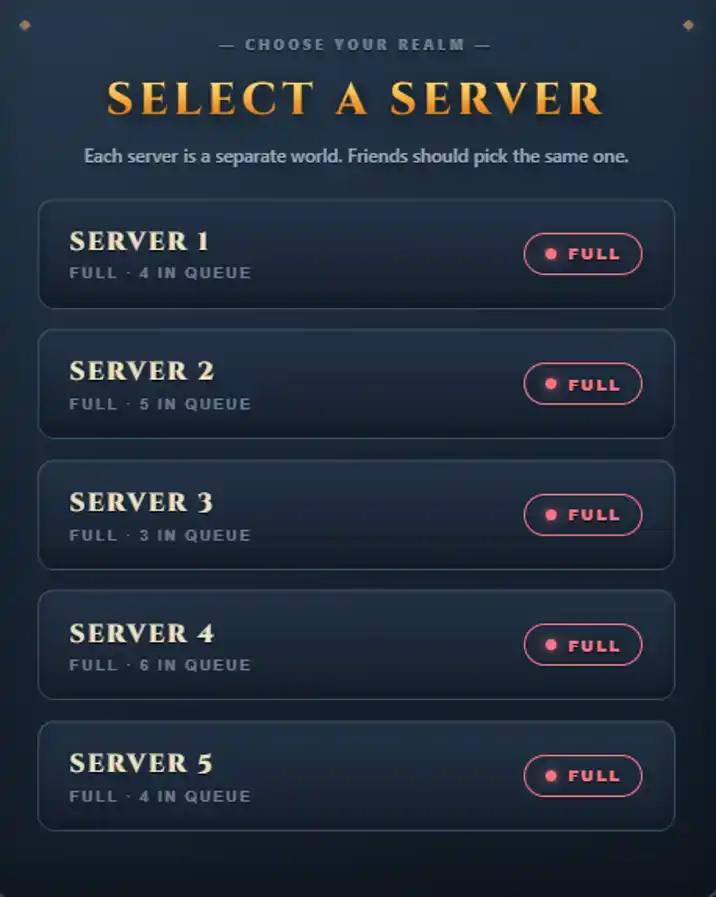
It sounds fairly ordinary, and the data isn't particularly impressive either (so far, 0.5% of $KINS has been repurchased), but the project's consistent delivery has built solid trust. Perhaps because the market is so disheartening, many players have genuinely gotten into it. The number of people fishing in the game daily is increasing. The project has expanded to 5 servers, but there's still a queue...
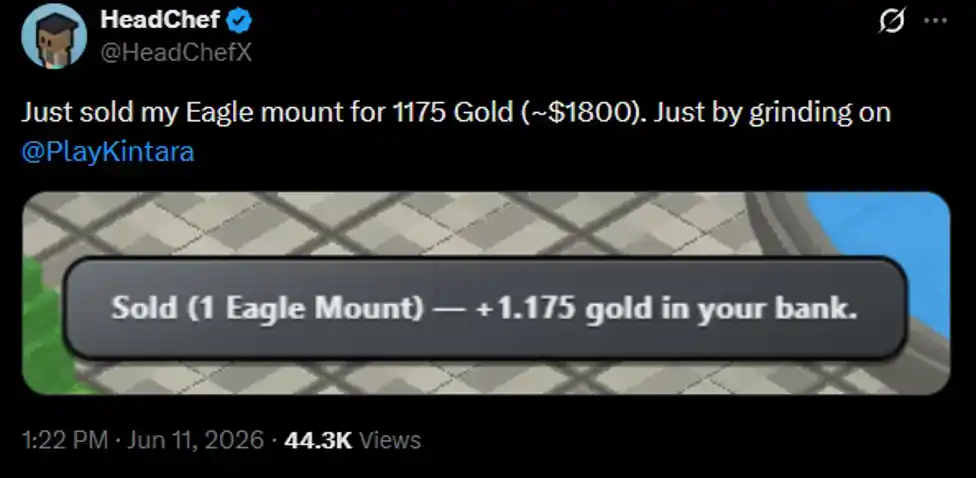
A player successfully sold a rare mount obtained from fishing and earned $1,800:
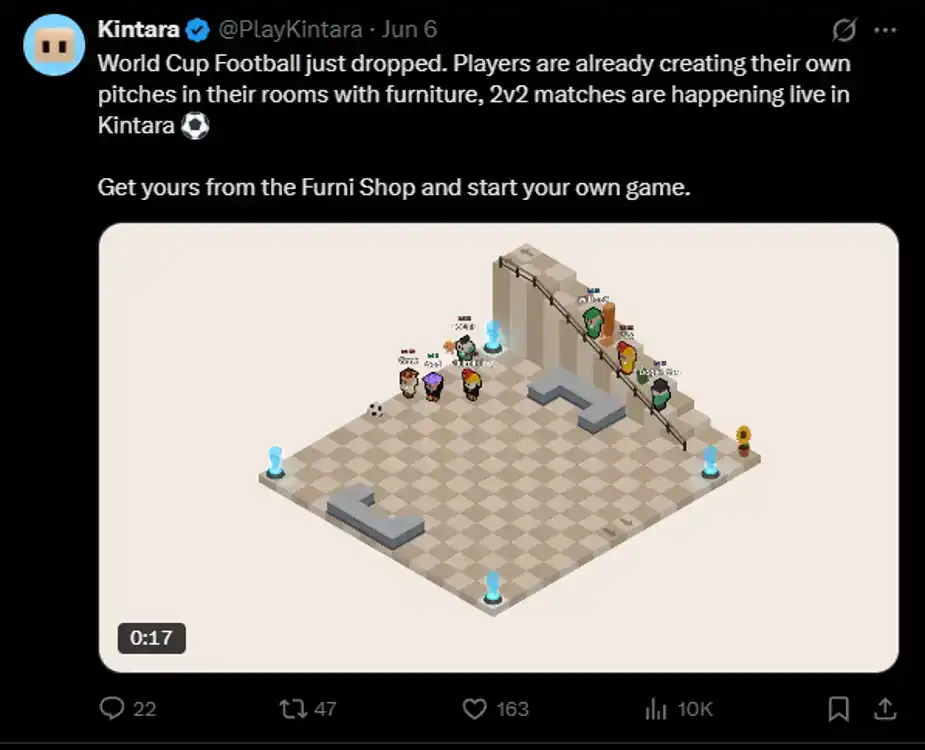
The project team of this game almost "doesn't promote play-to-earn," instead focusing heavily on "how to build network effects and a sense of player belonging." For example, integrating various Solana community meme coins or newly hot tokens into game elements, such as auctioning mansions in the game.

Or, promoting people organizing World Cup football matches in their houses:
When it was still obscure, with less than $40,000 market cap and 243 holders, this early phase of "unheard of and unknown" was written on the stats board in the game's main map. Everyone watched Kintara persistently and rapidly update game content, slowly gaining people's trust, gradually attracting KOLs like Gake and Ansem to become part of the game as players.
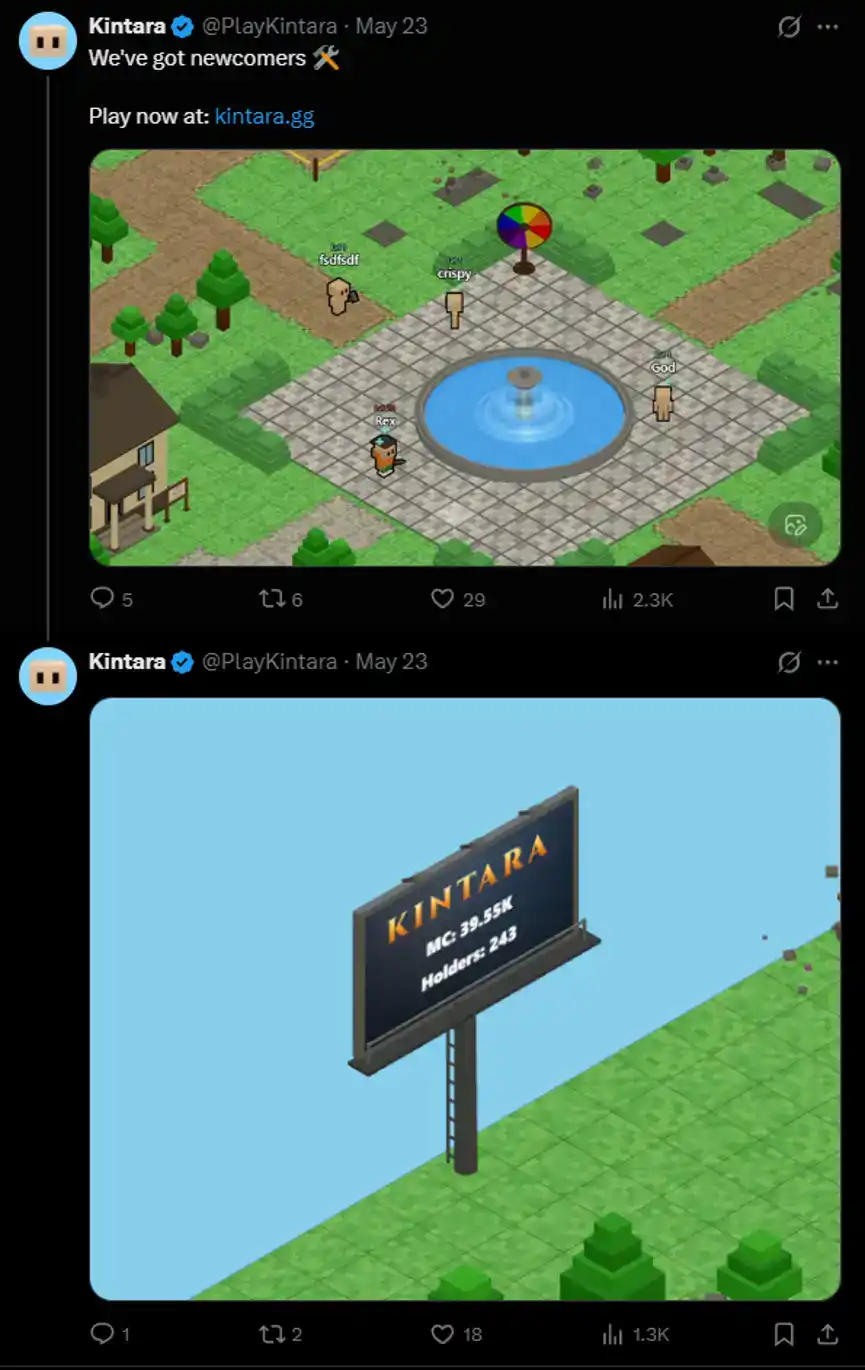
So no one calls this kind of project a "set-up play."

"What are we constantly chasing after all along? A game of mutual trust, or a game of mutual deception?"

This is a recent question Zhàn Háo has been asking himself.

Hopefully, such questioning can persist and ultimately lead to a healthier market.

Questions liées

QWhat are the two main competing themes or approaches observed in the current Solana meme coin market, according to the article?

AThe two main competing themes are 'Attention PvP' and the 'Return of the Community'. Attention PvP relies on quick, hype-driven plays involving celebrity endorsements, hot events, and speed-based speculation. The Return of the Community focuses on meme coins with organic, long-term communities built around a shared culture or purpose, where members are willing to endure price fluctuations and consistently promote their project's ideals.

QHow did the $JOTCHUA meme coin benefit from the 'Attention PvP' dynamic, and what controversy surrounded its success?

AThe $JOTCHUA coin gained attention and its price surged largely after the meme's creator, @_kingorange, 'claimed' the coin on social media. However, its success is controversial because the coin's launch and initial pump did not happen after the creator's claim. Many believe the surge was due to market speculation triggered by KOL Ansem announcing his return to buying Solana meme coins, suggesting it was another 'pump group' setup rather than an organic community-driven event.

QWhat is the core mission of the $neet community, and how does it distinguish itself from typical 'Attention PvP' coins?

AThe core mission of the $neet community is to promote the idea that dedicating most of one's life to work means losing one's own life. It distinguishes itself from 'Attention PvP' coins by being a long-term, community-driven project. The community has organically organized offline 'anti-work' gatherings in the U.S. and focuses on a shared cultural belief rather than relying on short-term hype or celebrity endorsements for price action.

QAccording to Ansem's statement quoted in the article, what are the key characteristics of a successful meme coin that does not rely on a single influencer?

AAccording to Ansem, a successful meme coin that doesn't rely on a single influencer should have a large, genuine community. Members of this community should be willing to endure losses and consistently promote the project's underlying philosophy or culture day after day. Success should be indicated by market data like social media activity, trading volume, and holder count, not by the endorsement of any single key opinion leader (KOL).

QHow did the project behind the $KINS token (Kintara) build trust and a sustainable community, as described in the article?

AThe Kintara project ($KINS) built trust and a sustainable community through consistent delivery and focusing on player engagement rather than financial speculation. Key strategies included: rapidly updating game content, integrating other community meme coins into the game, organizing in-game community events (like house auctions and soccer tournaments), and having a transparent tokenomics model where 50% of optional spin revenue is used for token buyback/burns. This approach fostered a sense of belonging and network effect, attracting genuine players and even respected KOLs who became part of the community.

Lectures associées

Révision à la hausse de 50 % des expéditions de TPU de Google

Récemment, plusieurs institutions étrangères ont discrètement révisé à la hausse leurs prévisions d'expédition des unités de traitement Tensor (TPU) de Google, ajustant l'estimation pour 2027 de 10 millions à 15 millions d'unités, soit une augmentation de 50%. Cette révision positive impacte directement toute la chaîne d'approvisionnement en infrastructure de calcul pour l'IA. Les composants clés tels que les moteurs optiques NPO (associés 1:1 aux TPU), les modules optiques 1.6T, les commutateurs optiques OCS, les alimentations serveur, la fibre optique & les connecteurs MPO, et surtout le refroidissement liquide, bénéficient de cette dynamique. Le refroidissement liquide entre dans une phase d'accélération cruciale, car les nouvelles TPU à haute puissance rendent le refroidissement par air obsolète. Les prévisions indiquent un déploiement massif à partir de 2026. Les fabricants chinois, avec leur rapidité d'itération et leur capacité de production, saisissent cette opportunité pour pénétrer la chaîne d'approvisionnement de Google, remodelant le paysage concurrentiel. Parallèlement, la fibre optique, essentielle pour les interconnexions dans les centres de données d'IA, voit sa logique transformée : la demande explose tandis que l'offre (dépendante d'un cycle de production long de 18-24 mois pour les préformes) est tendue, conduisant à des contrats à long terme et une stabilisation des prix. Les exportations chinoises de fibre devraient capturer une part significative de ce marché. En résumé, la hausse des prévisions pour les TPU de Google renforce la visibilité sur la croissance pour les deux prochaines années, déplaçant l'accent des investissements vers les infrastructures de soutien au calcul, dont le refroidissement liquide et la fibre optique sont des bénéficiaires majeurs, aux côtés des composants optiques et des alimentations serveur.

marsbitIl y a 44 mins

Révision à la hausse de 50 % des expéditions de TPU de Google

marsbitIl y a 44 mins

Une fois l'effervescence autour des cryptomonnaies retombée, que veut vraiment Wall Street ?

Lorsque la frénésie autour des cryptomonnaies s’est dissipée, Wall Street a clairement montré ce qu’elle cherchait vraiment : non pas des récits de décentralisation, mais une infrastructure financière contrôlable, génératrice de rendements et conforme à la réglementation, construite sur des registres distribués. Le mouvement est mené par des acteurs comme BlackRock et Securitize. Le fonds BUIDL de BlackRock, un fonds de bons du Trésor américains à court terme tokenisés, a atteint une taille stable de 25 à 28 milliards de dollars, devenant un actif refuge sur la chaîne. Securitize, valorisé à 12,5 milliards de dollars, s’apprête à être coté au NYSE, qui prévoit de construire avec lui un système de règlement et de compensation d’actions fonctionnant 24h/24 sur une blockchain. Parallèlement, des produits structurés comme le futur ETF BITA de BlackRock transforment la volatilité du Bitcoin en un revenu stable, en vendant systématiquement des options d’achat couvertes sur son propre ETF spot IBIT. Ce mécanisme convertit un actif spéculatif en un produit de revenu standardisé, attirant ainsi les investisseurs institutionnels prudents. Dans le domaine des paiements, les stablecoins sont repensés comme de purs outils de transaction. Des entreprises comme Stripe et Mastercard intègrent des stablecoins conformes (USDC, PYUSD) pour permettre des règlements transfrontaliers instantanés et réduire les fonds gelés dans le système bancaire traditionnel. La législation GENIUS de 2025 a conforté ce modèle en interdisant les dividendes sur les stablecoins et en renforçant la surveillance du blanchiment d'argent. En résumé, Wall Street adopte la technologie blockchain pour reproduire et améliorer ses propres systèmes : titres traditionnels tokenisés, produits de revenu dérivés, et réseaux de paiement efficaces. L’objectif n’est pas de remplacer la finance traditionnelle, mais de la rendre plus efficace, plus liquide et entièrement intégrée au crédit souverain du dollar.

marsbitIl y a 1 h

Une fois l'effervescence autour des cryptomonnaies retombée, que veut vraiment Wall Street ?

marsbitIl y a 1 h

S’attacher au char de SpaceX : comment Cursor a atteint 60 milliards de dollars

L'article retrace l'ascension fulgurante de Cursor, une licorne de l'IA pour la programmation, fondée par le jeune prodige Michael Truell et ses camarades du MIT. De ses débuts comme simple éditeur de code alternatif, Cursor a explosé en 2023 en intégrant l'IA, atteignant des revenus annuels de plusieurs milliards de dollars et des millions d'utilisateurs. Cette croissance s'est accompagnée de défis structurels. Cursor était initialement très dépendant des modèles d'Anthropic, un partenaire qui est ensuite devenu un concurrent direct avec le lancement de Claude Code. Pour survivre, Cursor a déclaré l'état d'urgence et accéléré le développement de son propre modèle, Composer. Cependant, développer un modèle de pointe nécessite une puissance de calcul colossale. Pour y parvenir, Cursor s'est tourné vers SpaceX d'Elon Musk au printemps 2025, formant un partenariat stratégique. En échange de l'accès aux supercalculateurs de SpaceX, Cursor contribue à améliorer les capacités de programmation de Grok, le modèle d'IA de Musk. Cet accord inclut une option d'acquisition potentielle de Cursor par SpaceX pour 600 milliards de dollars. L'article souligne les tensions entre l'ambition de Cursor de devenir une entreprise indépendante de classe mondiale et les réalités de la dépendance aux fournisseurs de modèles et à la guerre des puces. La culture interne exigeante, avec ses processus de recrutement controversés incluant des essais de travail non rémunérés, reflète cette intensité. L'histoire de Cursor pose une question centrale : deviendra-t-elle l'éditeur de code de référence de la nouvelle génération, ou sera-t-elle finalement absorbée comme une pièce dans l'échiquier stratégique des géants de l'IA ?

marsbitIl y a 1 h

S’attacher au char de SpaceX : comment Cursor a atteint 60 milliards de dollars

marsbitIl y a 1 h

Trading

Spot
Futures

Articles tendance

Comment acheter HYPE

Bienvenue sur HTX.com ! Nous vous permettons d'acheter Hyperliquid (HYPE) de manière simple et pratique. Suivez notre guide étape par étape pour commencer votre parcours crypto.Étape 1 : Création de votre compte HTXUtilisez votre adresse e-mail ou votre numéro de téléphone pour ouvrir un compte sur HTX gratuitement. L'inscription se fait en toute simplicité et débloque toutes les fonctionnalités.Créer mon compteÉtape 2 : Choix du mode de paiement (rubrique Acheter des cryptosCarte de crédit/débit : utilisez votre carte Visa ou Mastercard pour acheter instantanément Hyperliquid (HYPE).Solde :utilisez les fonds du solde de votre compte HTX pour trader en toute simplicité.Prestataire tiers :pour accroître la commodité d'utilisation, nous avons ajouté des modes de paiement populaires tels que Google Pay et Apple Pay.P2P :tradez directement avec d'autres utilisateurs sur HTX.OTC (de gré à gré) : nous offrons des services personnalisés et des taux de change compétitifs aux traders.Étape 3 : stockage de vos Hyperliquid (HYPE)Après avoir acheté vos Hyperliquid (HYPE), stockez-les sur votre compte HTX. Vous pouvez également les envoyer ailleurs via un transfert sur la blockchain ou les utiliser pour trader d'autres cryptos.Étape 4 : tradez des Hyperliquid (HYPE)Tradez facilement Hyperliquid (HYPE) sur le marché Spot de HTX. Il vous suffit d'accéder à votre compte, de sélectionner la paire de trading, d'exécuter vos trades et de les suivre en temps réel. Nous offrons une expérience conviviale aux débutants comme aux traders chevronnés.

670 vues totalesPublié le 2024.12.11Mis à jour le 2026.06.02

Comment acheter HYPE

Discussions

Bienvenue dans la Communauté HTX. Ici, vous pouvez vous tenir informé(e) des derniers développements de la plateforme et accéder à des analyses de marché professionnelles. Les opinions des utilisateurs sur le prix de HYPE (HYPE) sont présentées ci-dessous.

活动图片