Capturing 15 Top-Tier Zero-Day Vulnerabilities: A Consensus Protocol Debug Agent Framework Built by 0G Lab in Collaboration with Teams from NUS, PKU, and BUPT

marsbitPublié le 2026-06-11Dernière mise à jour le 2026-06-11

Résumé

"Agents Capture 15 Critical Zero-Day Bugs: 0G Lab's Multi-Agent Framework Automates Debugging in Consensus Protocols" Distributed consensus protocols are notoriously difficult to debug due to complex, intertwined states. A novel framework, Agora, developed by 0G Labs with researchers from NUS, Peking University, and Beijing University of Posts and Telecommunications, tackles this by fusing deep domain expertise with a collaborative multi-agent LLM architecture. Agora moves beyond the limitations of single LLMs and traditional testing like fuzzing. It employs three specialized agents: an Orchestrator for global state, a Strategy agent for generating attack scenarios using distributed systems knowledge, and a TestGen agent that creates executable tests. A core innovation is its efficient "Succinct Memory & Communication" mechanism and a dynamic test harness. This allows the system to translate abstract hypotheses into concrete tests across languages like Go and Rust, run them, capture failures, and refine the approach in a closed loop—all with minimal token overhead. In rigorous evaluations on production-level protocols including Raft, EPaxos, and components from etcd and Sui, Agora discovered 15 previously unknown deep logic bugs (e.g., execution divergence, liveness violations). In stark contrast, powerful standalone LLMs like GPT-5.2 and Claude 4.5 found zero such bugs. Agora achieved this with a high precision of 73.9% and at an average cost of only about $40 per bug fou...

The "Holy Grail" of distributed systems—consensus protocols—has long been a "Bug Hell" for top-tier infrastructure engineers. Due to their extremely complex states and intertwined multi-node interactions, traditional testing and monolithic LLMs are almost powerless against hardcore Deep Bugs (deep logical vulnerabilities).

Recently, in a paper accepted at the upcoming ICML 2026, researchers from 0G Labs and top academic-industry teams including the National University of Singapore, Peking University, and Beijing University of Posts and Telecommunications proposed Agora—the first automated testing framework that deeply integrates domain knowledge with large language model multi-agent collaboration.

Through an innovative architecture that directly tackles the pain points of protocols, this framework has successfully captured 15 previously unknown protocol-level Deep Bugs in industrial and academic core protocols such as Raft, EPaxos, HotStuff, and BullShark! In stark contrast, top native large models like GPT-5.2 and Claude 4.5 all failed, scoring zero. As multi-agent systems and "Agentic Quality Control" become the hottest tracks in 2026, Agora delivers not just a paper, but a practical, industrial-grade solution.

Paper: "Agora: Toward Autonomous Bug Detection in Production-Level Consensus Protocols with LLM Agents"

1. Background: A Powerful Alliance between 0G and NUS, Merging Long-Term System Knowledge with the Cross-Generational Multi-Agent Paradigm

The evolution of distributed consensus protocols is both a history of genius innovation and a bloody chronicle of pitfalls encountered by countless top engineers. As Turing Award winner Lamport stated, ensuring the correctness of distributed protocol implementations is as challenging as navigating a constantly shaking maze blindfolded. On this "hellish" track, the market is quietly shifting: According to Gartner observations, enterprise consulting demand for multi-agent systems has surged over tenfold in just over a year, and the multi-agent platform market is entering a period of rapid expansion, nearly doubling annually—using "multi-agent collaboration" for the most hardcore low-level system verification is transforming from a frontier concept to an industry necessity.

Facing this hellish challenge, tech giants with halos were the first to embark on heavy-asset exploration. For example, industry leader Anthropic's recent internal Glasswing project within Claude Code attempted to use agents for low-level infrastructure testing, but its architecture still heavily relies on top-tier commercial large models, with vague project details and closed-door collaborations limited to a handful of large institutions and multinational corporations. More critically, such giant-led solutions may exhibit terrifying token consumption during operation. This high computational barrier and heavy-asset approach directly shut out startups and SMEs with limited budgets.

Are smaller companies and open-source communities doomed to be unable to afford top-tier automated vulnerability auditing tools?

Engineers from 0G Labs, collaborating with Xiang Liu from the National University of Singapore, Sa Song and Yong Sun from Beijing University of Posts and Telecommunications, and Ph.D. student Zhao-wei Zhang and researcher Ce-yao Zhang from Peking University's School of Intelligence, leveraged their profound knowledge in the agent domain to empower systems, launching a disruptive "David vs. Goliath" innovation. Their work has been accepted at the 2026 AI top conference ICML.

The academic world's "long-term accumulation of system knowledge" meets the industry's "pain points and keen insight." How can this ignite the next revolution in system security?

The 0G team has accumulated extremely rich production-level attack and defense experience in implementing blockchain consensus protocols; while the academic team has profound expertise in high-performance distributed systems, low-level concurrency control, and formal verification. They are keenly aware that traditional methods (like fuzzing) often struggle with state-space explosion when facing industrial-scale codebases. The researchers decided to infuse the "soul"—their long-accumulated knowledge of global invariant logical deduction in distributed systems—into the cutting-edge multi-agent collaboration paradigm and automated harness architecture, launching the open-source and accessible Agora framework.

Simultaneously, as a leader in modular AI infrastructure and high-performance decentralized data availability networks, the 0G team has accumulated extremely rich production-level attack/defense experience and real-world protocol defect samples in the industrial implementation of blockchain consensus protocols and high-concurrency BFT (Byzantine Fault Tolerance) architectures.

This cross-domain fusion fundamentally changes the game: it is neither blind brute-force testing nor large models "fumbling in the dark" without domain knowledge. Instead, through specialized agent roles, it transforms the decades of logical deduction intuition from seasoned system experts into strategic interaction and collaboration among agents, thereby acquiring the hardcore capability to outperform traditional testing tools.

Unlike Glasswing's heavy-asset approach, which voraciously consumes expensive top-tier tokens, Agora presents a highly accessible alternative for SMEs—it proves that even with a "slightly inferior" base model and higher cost-effectiveness, a cleverly designed domain-aware multi-agent collaborative architecture can still unearth hardcore Deep Bugs!

2. Pain Point: Monolithic LLMs Struggle to Break Through, Distributed Systems Hang Under the "Damocles' Sword" of Deep Logic

In today's world dominated by big data, blockchain, and distributed databases, consensus protocols (like Paxos, Raft, PBFT, etc.) form the foundational bedrock of the entire digital world. However, implementing consensus protocols is notoriously "hellishly difficult." Even industrial-grade benchmark projects like etcd, honed by countless top engineers worldwide over years of operation, still harbor Deep Bugs (deep logical vulnerabilities) that send chills down one's spine.

These vulnerabilities differ from ordinary low-level implementation bugs like memory leaks or integer overflows. They span multiple execution phases and depend on complex concurrent states. If maliciously triggered, they can not only cause core data corruption but also lead to catastrophic financial-level losses.

While Large Language Models (LLMs), hugely popular in recent years, have shown promise in general code analysis, they appear "intellectually challenged" when facing distributed consensus. They can at best find shallow defects in local code. When confronted with protocol-level logical vulnerabilities dependent on global state, monolithic LLMs often get stuck in the mud of local code, completely unable to perform global temporal reasoning.

3. The Breakthrough: Agora's Three-Agent Paradigm and Core Harness Architecture

To break this deadlock, Agora is the first to introduce the classic academic paradigm of Hypothesis-Driven Testing (HDT) into large model agent systems. To achieve efficient global reasoning, Agora completely abandons the traditional "lone wolf" mode, elegantly decoupling the workflow into three highly specialized agents with distinct roles:

Orchestrator Agent: Responsible for maintaining global state and performing "vulnerability exploitation" by extrapolating from known bugs.

Strategy Agent: Responsible for injecting distributed domain knowledge and generating highly aggressive anomalous scenarios tailored for CFT and BFT protocols.

TestGen Agent: The practical executor. The key that truly enables Agora to be operational and generate effective tests in a closed loop lies in its core automated testing architecture.

The architecture is illustrated in the following diagram:
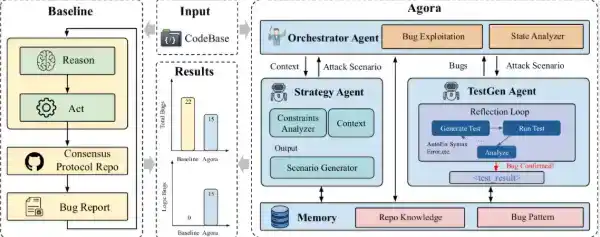
In Agora's overall design, this "David vs. Goliath" accessible magic does not come out of thin air; it stems from the deep integration of its ingenious agent interaction mechanisms and the testing harness architecture.

The research team specially designed an extremely succinct and efficient communication and memory mechanism (Succinct Memory & Communication) within the system framework. While ensuring each agent focuses on its core tasks, it minimizes redundant context transmission overhead to the lowest level. Under this extreme communication constraint, the Orchestrator Agent (responsible for global coordination and state control), the Strategy Agent (responsible for generating distributed anomalous environments and scenarios), and the TestGen Agent (responsible for code testing and dynamic evaluation) are perfectly interwoven, collectively driving and fulfilling the Harness architecture:

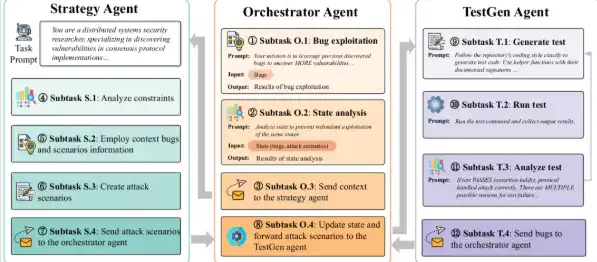
Automated Closed-Loop Synergy: When the Strategy Agent deduces an abstract distributed attack scenario, relying on the highly decoupled interaction framework, the TestGen Agent can immediately launch the underlying test harness. This architecture not only possesses strong environmental adaptability, capable of spanning different programming language environments like Go and Rust to translate attack hypotheses into real, runnable unit tests, but also incorporates efficient reflection-loop technology.

Once a test throws an error during execution in the environment, the system precisely and real-time captures the call stack and execution logs, concisely feeding them back to the agents for targeted self-correction. This organic combination of "multi-agent minimal interaction + dynamic harness closed-loop" not only allows Agora to capture the most elusive deep logical bugs with extremely low token costs but also produces detailed analysis reports with very low false-positive rates.

The final operational overview is illustrated in the following diagram:
4. Results: Capturing 15 Top-Tier Zero-Day Deep Bugs, Baseline Large Models Score Zero

The evaluation results are astounding. The research team conducted a comprehensive assessment on four well-known consensus protocol libraries (including production-grade etcd and the underlying components of the emerging public chain core, Sui), comparing against top-tier models like GPT-5.2, Gemini 3.0 Pro Preview, Claude Sonnet 4.5, and Qwen3 Coder.

The outcome not only made 0G's own operational consensus systems more secure but also demonstrated overwhelming superiority:

15 New Logic Deep Bugs Uncovered: Agora successfully discovered 15 previously unknown protocol-level deep logical vulnerabilities. These span high-risk areas such as execution divergence, monotonicity violations, topology flaws, and signature vulnerabilities.

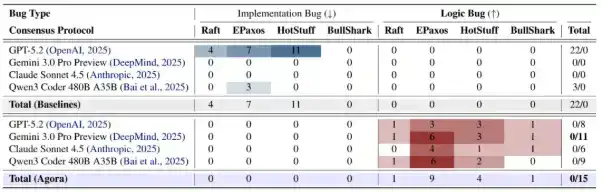
Native Large Models All Score Zero: In contrast, baseline models (even equipped with advanced ReAct dynamic toolchains) completely failed (0/15) against these deep logical vulnerabilities. They consumed massive amounts of tokens but could only find low-level code implementation bugs.

Extremely Low False-Positive Rate and High Cost-Effectiveness: Among all bug reports generated by Agora, genuine logical vulnerabilities accounted for a high 73.9% (false-positive rate only 26.1%). Even more impressive, it costs only about 5.32M tokens (approximately $40) on average to unearth one top-tier logical bug that would make seasoned architects lose their hair, demonstrating extremely high cost-effectiveness.

Results across multiple LLMs are shown below:
5. The Future: High Generalizability, Advancing into More Hardcore "Uncharted Territories"

Agora's success not only injects confidence into the security of distributed systems but also points the way for large model applications in vertical, industrial-grade scenarios.

Critically, Agora's architectural design demonstrates high generalizability and universality. The research team emphasizes that Agora can also be quickly reproduced and used by a broad user base in the form of plugins or skills. Our code (github.com/0gfoundation/agora) provides corresponding skills to aid reproduction. Furthermore, Agora's "Large Model + Multi-Agent Collaboration + Hypothesis-Driven" paradigm is not limited to consensus protocols. Due to the deep decoupling between its underlying workflow control and the upper-layer domain knowledge base and testing harness, the architecture means it can not only help numerous users quickly debug consensus protocols but can also be rapidly extended to other hardcore fields similarly plagued by "deep logical vulnerability hell" in a "plug-and-play" manner:

Database Concurrency Control: For testing complex transaction conflict defects in distributed databases under extreme isolation levels (like Serializable).

Operating System Kernels / Concurrent Systems: For deeply discovering hidden deadlocks and race conditions in multi-threaded infrastructure.

Web3 Smart Contract Auditing: For in-depth security boundary exploration of cross-chain protocols and DeFi logic involving complex economic models. The blockchain security market is projected to reach about $8.5 billion by 2026, and commercial products using "multi-agent security systems" for smart contract auditing, compressing audit cycles from weeks to hours, are already emerging. Market demand is exploding.

The era of AI-automated security for industrial-grade low-level infrastructure may have been officially inaugurated by Agora and its harness architecture.

We have reason to believe that Agora can help better test the capabilities of coding LLMs by discovering more deep bugs across various domains, and the deep bug use cases it finds can also help enhance coding LLMs' code comprehension abilities.

Agora can significantly improve the security of code repositories that form the foundation for financial secure transactions, such as consensus protocols, concurrency control, and smart contracts. Moreover, Agora can help more tech companies discover deeper logic bugs while consuming fewer tokens, saving funds and being more efficient!

More importantly, this precisely aligns with the two hottest current trends: First, multi-agent systems are transitioning from experimentation to production—Gartner predicts that by 2028, over 30% of enterprise software will have agentic AI built-in, and the multi-agent platform market size is expected to surge from the tens of billions to hundreds of billions of dollars within a few years. Second, "using agents to audit agents"—Agentic Quality Control—is becoming the industry standard for 2026.

Against the backdrop where the Veracode 2025 report indicates approximately 45% of AI-generated code contains security vulnerabilities and the agentic AI security market is growing at a ~42% CAGR, Agora enables tech companies to unearth deeper Logic Bugs with lower token costs, upgrading security auditing from a "human-powered task billed by the week" to an "automated capability delivered by the hour."

And as the landscape of this track becomes clearer, those who truly seize the early advantage are often not the loudest giants, but the team that first operationalizes the methodology and can consistently replicate it.

Cryptos en tendance

Questions liées

QWhat is the core innovation of the Agora framework presented in the article?

AThe core innovation of the Agora framework is the first integration of deep domain knowledge with a large language model (LLM) multi-agent collaboration paradigm for autonomous bug detection in consensus protocols. It specifically uses a hypothesis-driven testing (HDT) approach with three specialized agents (Orchestrator, Strategy, and TestGen) coordinated within an automated test harness architecture to find deep logic bugs.

QHow does Agora's approach differ from traditional methods or using a single large language model (LLM) for bug detection in consensus protocols?

ATraditional methods like fuzzing struggle with state space explosion in industrial codebases. Single LLMs are limited to finding shallow, local implementation bugs and fail at global state and temporal reasoning required for protocol-level deep logic bugs. Agora overcomes this by decomposing the task into specialized agents that collaboratively perform global reasoning, hypothesis generation, and automated test execution with a reflection loop, enabling it to find complex, cross-stage vulnerabilities.

QWhat were the key experimental results of the Agora framework's evaluation on real consensus protocol codebases?

AIn evaluations on four major consensus protocol libraries (including etcd and Sui's components), Agora discovered 15 previously unknown protocol-level deep logic bugs across categories like execution divergence and monotonicity violations. In stark contrast, state-of-the-art single LLM baselines (GPT-5.2, Claude 4.5, etc.) equipped with advanced toolchains found zero such bugs (0/15). Agora achieved this with a high true positive rate (73.9%) and high cost-efficiency, averaging about 5.32M tokens (~$40) per deep bug found.

QWhat is the significance of Agora's design in terms of cost and accessibility compared to other industry approaches mentioned, like Anthropic's Glasswing project?

AAgora's design provides a cost-effective and accessible alternative to heavyweight, proprietary industry approaches. Unlike projects like Glasswing which rely on top-tier commercial models and incur high computational/token costs, Agora uses a streamlined multi-agent architecture with succinct communication. This allows it to achieve state-of-the-art bug detection using more cost-efficient base models, making advanced automated security auditing feasible for startups, SMEs, and open-source communities.

QBeyond consensus protocols, what other hardcore system domains does the article suggest the Agora framework's methodology could be applied to?

AThe article suggests that Agora's plug-and-play architecture, which decouples the core workflow from domain knowledge, can be generalized to other domains plagued by deep logic bugs. These include database concurrency control (e.g., testing transaction conflicts), operating system kernels/concurrent systems (e.g., for deadlocks and race conditions), and Web3 smart contract auditing (e.g., for complex cross-chain or DeFi protocol logic).

Lectures associées

Correction violente du marché de l'IA, le moment DeepSeek de Zhipu AI ?

Mardi, le marché de l'intelligence artificielle a subi une violente correction. Les actions coréennes, portées par Samsung Electronics et SK Hynix, ont chuté brutalement, entraînant un effet de contagion sur les marchés américains où les valeurs technologiques, notamment les semi-conducteurs et le matériel lié à l'IA, ont été fortement vendues. Cette pression est en partie attribuée par certains analystes au « moment DeepSeek » de Zhipu AI. Le lancement du puissant modèle open source chinois GLM-5.2, classé parmi les trois meilleurs mondiaux, ravive les inquiétudes sur la domination américaine en IA. Les investisseurs s'interrogent sur la soutenabilité des dépenses en capital faramineuses des géants tech américains pour leurs centres de données, face à la concurrence de modèles open source performants et moins coûteux. Le repli reflète une réévaluation du secteur : la question n'est plus de savoir si la croissance de l'IA aura lieu, mais à quel prix et pour quels bénéfices. Les marchés ajustent la valorisation des entreprises les plus exposées aux investissements infrastructurels lourds (Alphabet, Amazon, Meta) et examinent leur capacité à transformer ces dépenses en flux de trésorerie. Des facteurs spécifiques, comme des décisions réglementaires en Corée du Sud et l'attente des résultats de Micron, ont également joué. Globalement, de nombreux observateurs voient cette correction comme un test de résistance nécessaire après une forte hausse, et non comme la fin du cycle de l'IA, considéré comme encore à un stade précoce.

marsbitIl y a 6 mins

Correction violente du marché de l'IA, le moment DeepSeek de Zhipu AI ?

marsbitIl y a 6 mins

850 millions d'USDT s'enfuient dans la nuit, peut-on encore faire confiance aux coffres de stablecoins à haut rendement ?

Un retrait massif de 8,5 millions d’USDT en 24 heures a touché Altura, une plateforme de produits à rendement sur stablecoins, déclenchant la fermeture ordonnée de ses coffres. Cet événement, lié à une crise de confiance générale dans le secteur après la rupture de l’audit de MainStreet par la société Accountable, montre que même sans exposition directe aux actifs problématiques, les produits similaires peuvent subir des pressions de retrait. Le cœur du problème réside dans la liquidité : bien qu’Altura affirme ne détenir aucun actif lié à MainStreet et que ses fonds propres soient sains, ses investissements (crédits privés, actifs réels RWA) ont des cycles de liquidation plus longs que les retraits instantanés attendus par les utilisateurs en DeFi. La simple perception d’un risque de liquidité peut ainsi provoquer une ruée, les premiers retirants étant servis immédiatement tandis que les autres doivent attendre. Cet épisode souligne un défi clé pour les produits à rendement sur stablecoins : l’écart entre la promesse de liquidité immédiate et la réalité des actifs sous-jacents, qui nécessitent des délais de désinvestissement. La confiance du marché, fragile, peut rapidement s’éroder, rendant cruciale la transparence sur les réserves et les périodes de liquidation, au-delà de la simple santé des actifs.

marsbitIl y a 18 mins

850 millions d'USDT s'enfuient dans la nuit, peut-on encore faire confiance aux coffres de stablecoins à haut rendement ?

marsbitIl y a 18 mins

Conversation avec Jason Huang, fondateur de NDV : Perce la bulle de l'IA et le mythe de MicroStrategy, à la recherche de l'atout ultime du marché crypto

Dans cet épisode du podcast Wu Shuo, Jason Huang, fondateur de NDV, analyse la récente baisse du Bitcoin. Il attribue la correction à la pression de vente cyclique quadriennale, accentuée par le recul des marchés actions, la contraction de la liquidité et les difficultés financières de MicroStrategy. Selon lui, le marché n'a pas encore touché le fond, car un vrai creux baissier nécessite généralement un événement majeur de type "FTX", générant un sentiment de désespoir généralisé. Il explique que la vente symbolique de 32 bitcoins par MicroStrategy a déclenché une réaction en chaîne, le marché anticipant une pression de vente plus importante sur les 800 000 BTC détenus par l'entreprise. Son fonds a généré environ 20% de rendement cette année, en surperformance par rapport au Bitcoin, grâce à des positions courtes et des investissements dans les matières premières (pétrole, or, argent). Bien qu'utilisateur intensif d'IA, Jason Huang évite d'investir dans les actions du secteur, par manque d'avantage informationnel, et considère que les transactions sur les semi-conducteurs sont trop concentrées. Il reste prudent sur les marchés actions en général, pointant des signes de surchauffe. À long terme, il est optimiste sur les stablecoins, qu'il considère comme l'innovation la plus utile et tangible de la cryptosphère, avec un potentiel de croissance encore important. Pour le Bitcoin, il prévoit une possible baisse supplémentaire (en dessous de 48 000$), suivie d'un rebond, mais estime que le vrai fond sera atteint lors d'un événement catastrophique provoquant une panique généralisée. Il se montre en revanche très pessimiste quant à l'Ethereum.

marsbitIl y a 37 mins

Conversation avec Jason Huang, fondateur de NDV : Perce la bulle de l'IA et le mythe de MicroStrategy, à la recherche de l'atout ultime du marché crypto

marsbitIl y a 37 mins

Entretien avec Jason Huang, fondateur de NDV : Percer la bulle de l'IA et le mythe de MicroStrategy, à la recherche de l'atout ultime sur le marché des cryptomonnaies

Dans ce podcast, Jason Huang, fondateur de NDV, analyse la récente baisse du Bitcoin. Il attribue la correction à la pression de vente cyclique quadriennale, combinée au recul des marchés actions, à la contraction des liquidités et aux difficultés financières de MicroStrategy (MSTR). Huang estime que le marché n'a pas encore touché le fond, un véritable creux nécessitant généralement un événement majeur de type "FTX" pour provoquer une capitulation totale. Il explique que la vente symbolique de 32 BTC par MSTR a déclenché une course anticipative des investisseurs, craignant une pression de vente massive sur ses 80 000+ BTC. Pour résoudre ses dettes et dividendes, MSTR devra probablement vendre davantage ou trouver un acheteur privé, ce qui pourrait marquer un plancher temporaire. Son fonds a généré environ 20% de rendement cette année, en surperformance face au BTC, grâce à des positions courtes et des investissements dans les matières premières (pétrole, or, argent). Il évite délibérément les actions AI par manque d'avantage informationnel et perçoit des bulles dans les semi-conducteurs et le récit autour de SpaceX. Malgré son pessimisme à court terme, Huang reste optimiste sur la valeur à long terme des stablecoins, qu'il considère comme l'innovation la plus utile et tangible de la crypto. Pour le Bitcoin, il prévoit une baisse potentielle en dessous de 48 000 $ avant un rebond, tandis qu'il se montre très sceptique quant à l'avenir de l'Ethereum. Le véritable fond, selon lui, sera atteint lorsque le désespoir sera généralisé et que plus personne ne voudra parler du marché.

链捕手Il y a 43 mins

Entretien avec Jason Huang, fondateur de NDV : Percer la bulle de l'IA et le mythe de MicroStrategy, à la recherche de l'atout ultime sur le marché des cryptomonnaies

链捕手Il y a 43 mins

Tendances du marché boursier américain (24 juin) : La chute du marché coréen ébranle les puces mondiales, Micron chute de plus de 10%, la certitude de l'offre à long terme soumise à un 'test brutal'

**Titre : Les marchés américains sous pression (24 juin) : La chute du marché coréen secoue les puces mondiales, Micron chute de plus de 10%, la certitude de l'offre à long terme mise à rude épreuve** **Résumé en français :** Le marché sud-coréen a subi un choc majeur lundi, le KOSPI plongeant de 10%, entraîné par les titres de SK Hynix et Samsung (-12%). Cette chute, attribuée à des rumeurs d'un ralentissement potentiel de l'expansion de la production de HBM4 par SK Hynix, s'est propagée aux valeurs technologiques américaines. Le secteur des semi-conducteurs a été le plus durement touché à Wall Street. Micron Technology a chuté de plus de 13%, SanDisk de près de 14%, et l'indice Philadelphia Semiconductor a reculé de 7.87%. Le Nasdaq a perdu 2.21%, tandis que le Dow Jones résistait mieux (-0.09%). Les valeurs défensives (IBM, Walmart, Johnson & Johnson) ont affiché des performances positives. La pression sur les actions ne semble pas liée à une remise en cause de la demande d'IA elle-même, mais plutôt à une réévaluation des anticipations trop optimistes concernant les capacités de production de puces mémoires, en particulier la mémoire HBM essentielle pour l'IA. L'annonce potentielle d'un ralentissement chez un acteur clé a semé le doute sur la solidité du cycle d'investissement en infrastructure IA. Les regards se tournent désormais vers deux événements clés de jeudi : les données sur l'inflation PCE aux États-Unis, qui influenceront les anticipations de politique monétaire de la Fed, et les résultats trimestriels de Micron. Les investisseurs scruteront les marges de la division HBM de Micron et ses prévisions de capacité pour 2027. Toute prudence dans les commentaires pourrait déclencher une nouvelle vague de vente. Cette correction marque un tournant vers une tarification plus rationnelle du cycle de l'IA. La certitude d'une offre à long terme suffisante, jusque-là intégrée dans les valorisations, est désormais fortement remise en question, transformant la perception d'entreprises comme Micron, de "garant de l'infrastructure IA" en valeur plus cyclique.

marsbitIl y a 59 mins

Tendances du marché boursier américain (24 juin) : La chute du marché coréen ébranle les puces mondiales, Micron chute de plus de 10%, la certitude de l'offre à long terme soumise à un 'test brutal'

marsbitIl y a 59 mins

Trading

Spot
Futures

Articles tendance

Comment acheter 0G

Bienvenue sur HTX.com ! Nous vous permettons d'acheter 0G (0G) de manière simple et pratique. Suivez notre guide étape par étape pour commencer votre parcours crypto.Étape 1 : Création de votre compte HTXUtilisez votre adresse e-mail ou votre numéro de téléphone pour ouvrir un compte sur HTX gratuitement. L'inscription se fait en toute simplicité et débloque toutes les fonctionnalités.Créer mon compteÉtape 2 : Choix du mode de paiement (rubrique Acheter des cryptosCarte de crédit/débit : utilisez votre carte Visa ou Mastercard pour acheter instantanément 0G (0G).Solde :utilisez les fonds du solde de votre compte HTX pour trader en toute simplicité.Prestataire tiers :pour accroître la commodité d'utilisation, nous avons ajouté des modes de paiement populaires tels que Google Pay et Apple Pay.P2P :tradez directement avec d'autres utilisateurs sur HTX.OTC (de gré à gré) : nous offrons des services personnalisés et des taux de change compétitifs aux traders.Étape 3 : stockage de vos 0G (0G)Après avoir acheté vos 0G (0G), stockez-les sur votre compte HTX. Vous pouvez également les envoyer ailleurs via un transfert sur la blockchain ou les utiliser pour trader d'autres cryptos.Étape 4 : tradez des 0G (0G)Tradez facilement 0G (0G) sur le marché Spot de HTX. Il vous suffit d'accéder à votre compte, de sélectionner la paire de trading, d'exécuter vos trades et de les suivre en temps réel. Nous offrons une expérience conviviale aux débutants comme aux traders chevronnés.

189 vues totalesPublié le 2025.09.22Mis à jour le 2026.06.02

Comment acheter 0G

Discussions

Bienvenue dans la Communauté HTX. Ici, vous pouvez vous tenir informé(e) des derniers développements de la plateforme et accéder à des analyses de marché professionnelles. Les opinions des utilisateurs sur le prix de 0G (0G) sont présentées ci-dessous.

活动图片