The First to Bring an AI OS to 1.4 Billion People Might Actually Be WeChat?

marsbitPublié le 2026-06-10Dernière mise à jour le 2026-06-10

Résumé

WeChat has introduced a significant AI update, allowing mini-program developers to integrate their services with WeChat AI. Developers can choose an "automatic mode," where WeChat AI autonomously analyzes and operates mini-programs without additional coding, or a "development mode" for creating customized skills. This move effectively transforms WeChat's vast ecosystem—including millions of mini-programs, WeChat Pay, and official accounts—into an execution layer for AI. The technical documentation reveals that WeChat's approach aligns with industry standards like MCP (Model Context Protocol) and incorporates practical lessons from AI-agent development. Key design principles include a clear "attention weight" system for API calls and a "fact + action" response structure to ensure reliable operations. Unlike Apple's Siri, which struggles with third-party app integration, WeChat's centralized control over mini-program code provides a "God's-eye view," enabling seamless AI orchestration across services. This development revives the concept of "WeChat OS," where the app could function as a natural-language-operated platform for daily tasks—from booking flights to ordering food—all within a chat interface. While challenges remain in areas like payment security and user trust, WeChat's existing service network and massive user base position it uniquely to advance AI agents from conversation to actionable assistance, potentially making complex tasks feel effortless for its 1.432 bi...

WeChat's AI has finally moved.

On the very same day as Apple's WWDC, WeChat did something potentially more significant than Apple, releasing an unassuming announcement: "Guidance for Developers to Access the WeChat AI Ecosystem."
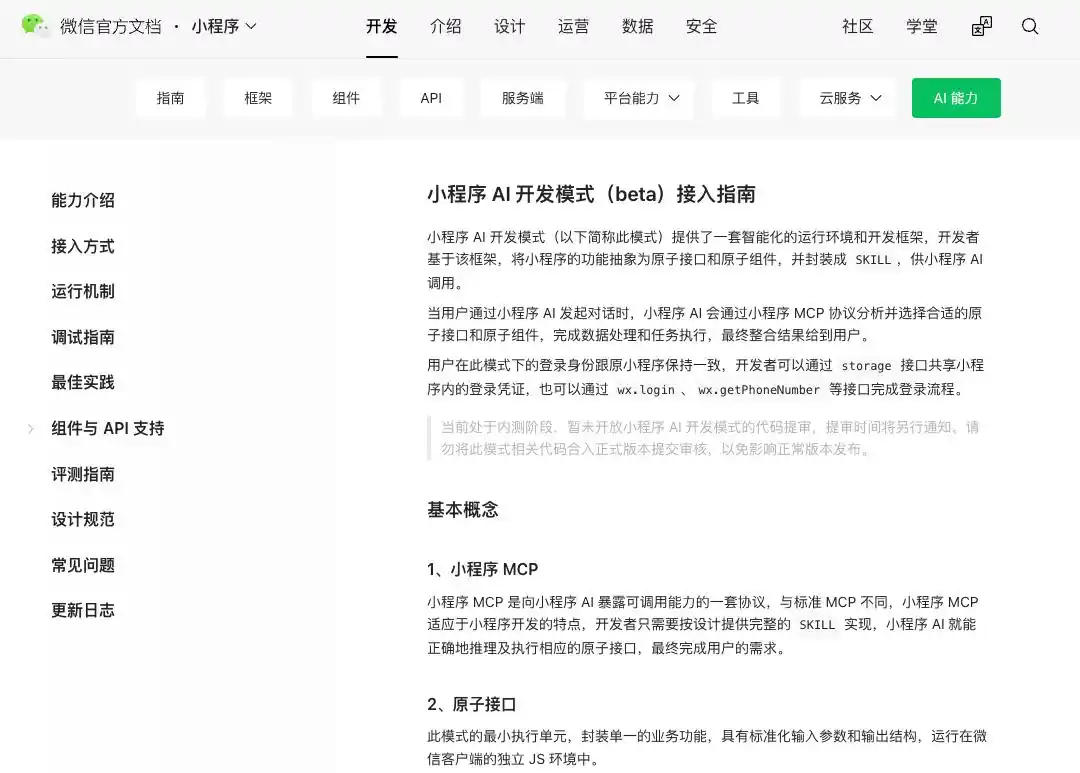
Starting today, Mini Program developers can grant authorization, allowing WeChat AI to read, operate, and invoke the functionalities of Mini Programs.

WeChat offers two access modes. The first is "Automatic Mode," with a nearly zero barrier to entry. Developers simply toggle a switch, and the platform itself reads the source code, analyzes pages, figures out what the Mini Program can do, and then the AI can directly operate it, all without writing a single line of code.

The other mode is called "Developer Mode," where developers create customized Skills, which are called by the AI after passing review. Both modes can be enabled simultaneously. Meituan has already announced its integration.

This should not be understood merely as the launch of another new feature. Instead, it signals that WeChat is turning its entire ecosystem—millions of Mini Programs, WeChat Pay, service notifications, Official Accounts—into the execution layer for AI.

Examining the Skill Documentation: How WeChat AI Invokes Mini Programs

The WeChat open documentation publicly shares the technical specifications for Mini Programs to integrate AI Skills. A close look reveals many design details hidden within.

Official skill documentation guide 👇🏻:

https://developers.weixin.qq.com/miniprogram/dev/ai/best-practices.html
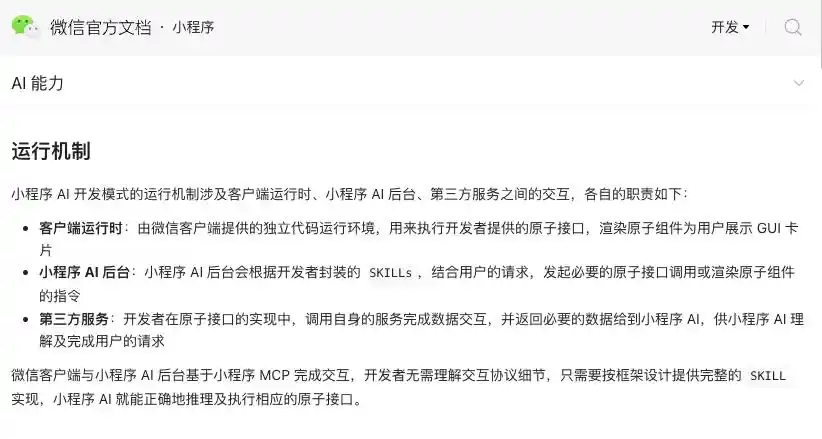
From an architectural perspective, those familiar with AI development will immediately recognize it: it's essentially MCP (Model Context Protocol). The `mcp.json` declares the function and parameters of each atomic interface, and `SKILL.md` describes how the entire business process runs. This is almost identical to the MCP+Skills architecture found in Claude, Cursor, or VS Code. WeChat didn't reinvent the wheel; it directly adopted the industry-standard that is currently converging.

In the guidance, WeChat provides a clear "attention weight" system. When the AI decides which interface to call and what parameters to generate, it gives the highest priority to the content returned by the interface (five stars), followed by the interface description (four stars) and parameter descriptions (four stars) in `mcp.json`. `SKILL.md` ranks last (three stars). This means where developers write something matters more than what they write—the weight the AI gives to the same rule is completely different if it's written in the interface return versus in `SKILL.md`.
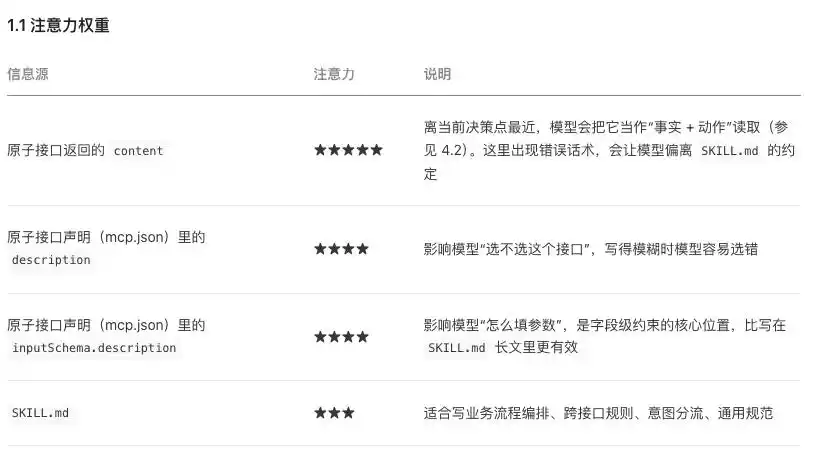
At the interface return level, there is a core specification: a two-stage "Fact + Action" format. First, tell the AI "what happened," then tell it "what to do next." If only the action is written without the fact, the AI might interpret "display card" as "prepare to call the next interface" and skip user confirmation. This is a rule learned after stepping into many pitfalls.
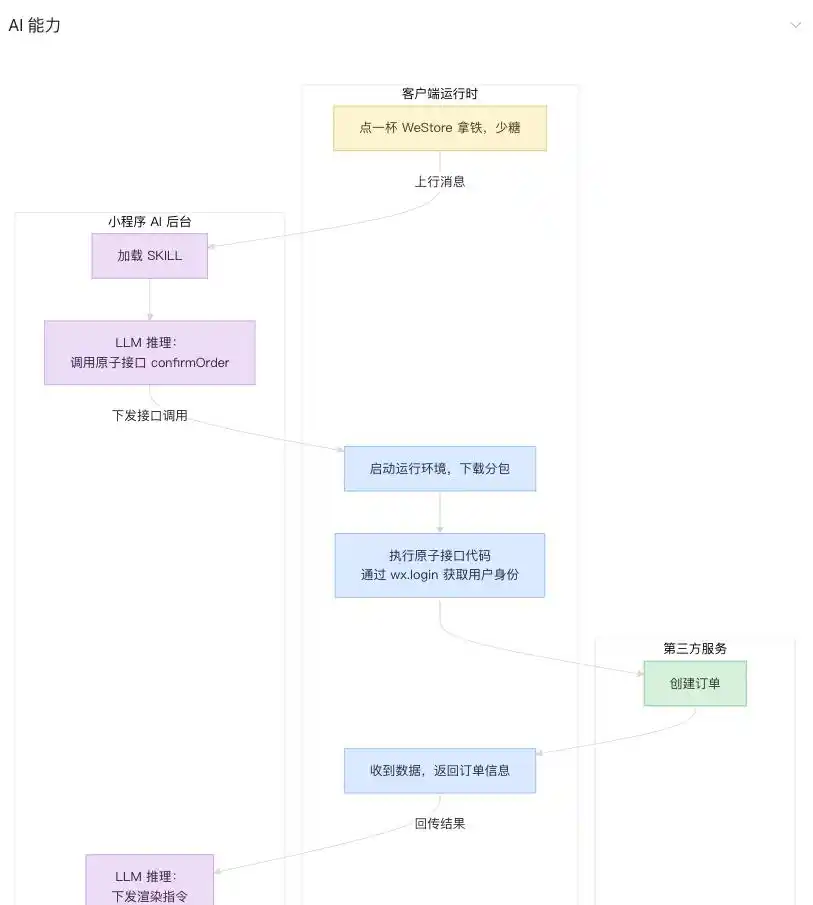
Fourth, parameter passing prioritizes using IDs over natural language. Taking the "Coffee Ordering" scenario in the diagram as an example, after the user states a need, the AI understands the vague intent and handles selection, modification, specification changes, and payment processing, all without leaving the chat dialog.

This design reveals a signal: WeChat has already run enough practical cases, knows where the pitfalls lie in AI calling external services, and has solidified these experiences into developer norms.

In fact, comparing WeChat Mini Programs, which are also known for their "ecosystem," to Apple's apps, WeChat possesses a kind of "God's-eye view" over its own ecosystem. This is the prerequisite for all this implementation.

Why It Might Be More Important Than Apple's AI

This year at WWDC, Apple released the new Siri AI. Despite having Google Gemini integrated at the underlying level and supporting natural language creation for Shortcuts, it didn't spark much discussion.
A closer look reveals the gap: Apple is making AI coordinate some native functions within the iOS system. Once it involves third-party applications—those apps installed on your phone—it becomes strained.

Take Ele.me, for example. Its code runs on Ele.me's own servers, which Apple cannot read. For Siri to call Ele.me, Ele.me's engineers must proactively connect to the App Intents API, negotiating and integrating one by one, a time-consuming and labor-intensive process.
What WeChat is doing is enabling AI to directly operate millions of third-party services, because Mini Programs are different. The code for every Mini Program, from developer submission, through WeChat's review, to finally running on the user's phone, remains entirely within WeChat's technical system throughout the entire process. During the review phase, WeChat can scan the code, automatically analyzing "what pages this Mini Program has, what it can do, what its inputs and outputs are."

This is why "Automatic Mode" is possible—developers don't need to write a single line of code. They just flip a switch, and WeChat itself can translate your Mini Program into a tool the AI can invoke. WeChat's foundational architecture naturally supports this. It possesses a "God's-eye view," enabling scheduling based on centralization.

Apple does not have this architectural advantage, and neither does Google.

Also noteworthy is the recent rumor that WeChat is collaborating with Huawei, Honor, Xiaomi, OPPO, and vivo to launch A2A (Agent-to-Agent) assistant capabilities, allowing users to directly initiate WeChat audio/video calls or send messages via their phone's voice assistant.
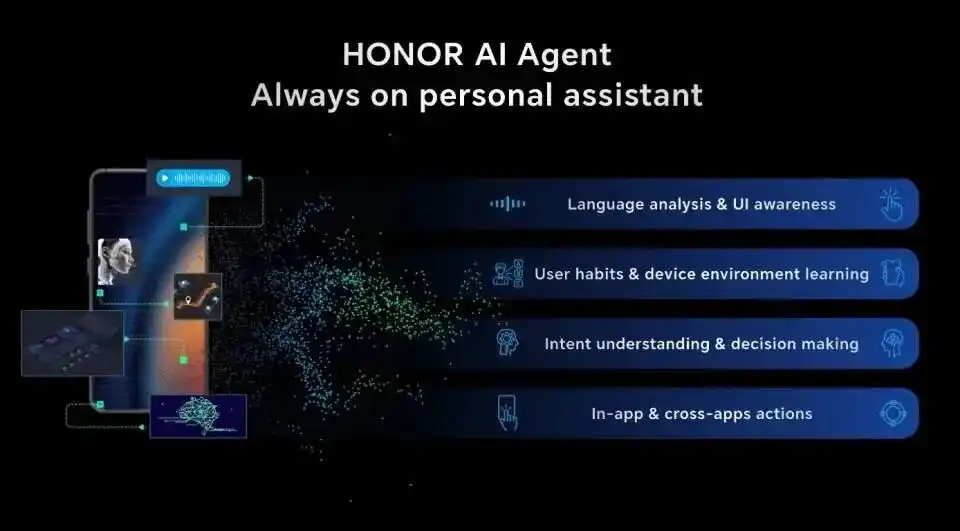
Internally, WeChat AI can invoke millions of Mini Programs. Externally, smartphone manufacturers' AI assistants can invoke WeChat. WeChat is becoming the super connector of the AI era, a service hub that all AIs can access.

The Old Prophecy of "WeChat OS"

When Mini Programs were launched, many joked that WeChat wanted to become "WeChat OS." Back then, it was more of a figure of speech—Mini Programs replaced some app functionalities but were essentially a "light application platform."

More coincidentally, the centralized review mechanism designed at the time was for quality and security control. Nine years later, this design, initially criticized as "excessive control," has unexpectedly become an infrastructure advantage in the AI era. The distributed App ecosystem (Apple/Android) seemed more "free" at the time, but now it has become an obstacle to AI integration.
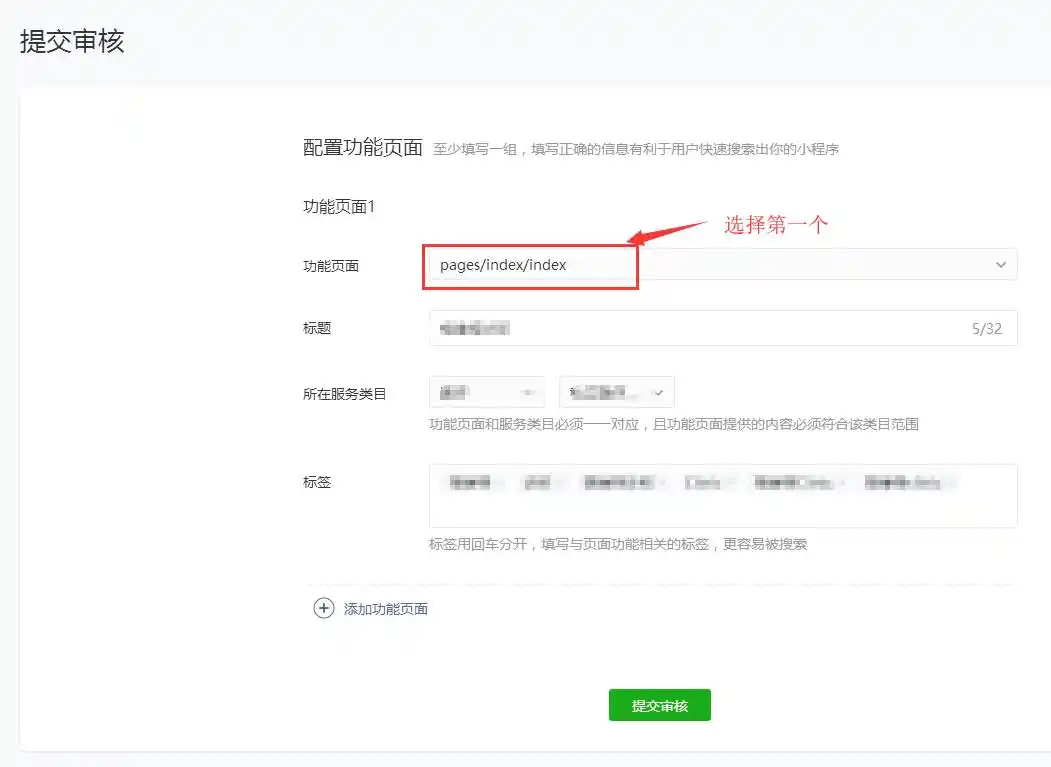
An old prophecy, due to the emergence of new-era technology—AI—has taken on a transformative change.

Previously, when writing about OpenClaw and Feishu, I mentioned a judgment: IM (Instant Messaging) is the most natural entry point for AI Agents because dialogue itself is the most natural interaction between humans and AI, and the service ecosystem (bots, payments, mini-programs) inherent to IM allows AI not only to "chat" but also to "do." Feishu is already moving in this direction, launching enhanced Bot APIs and AI Agent nodes.
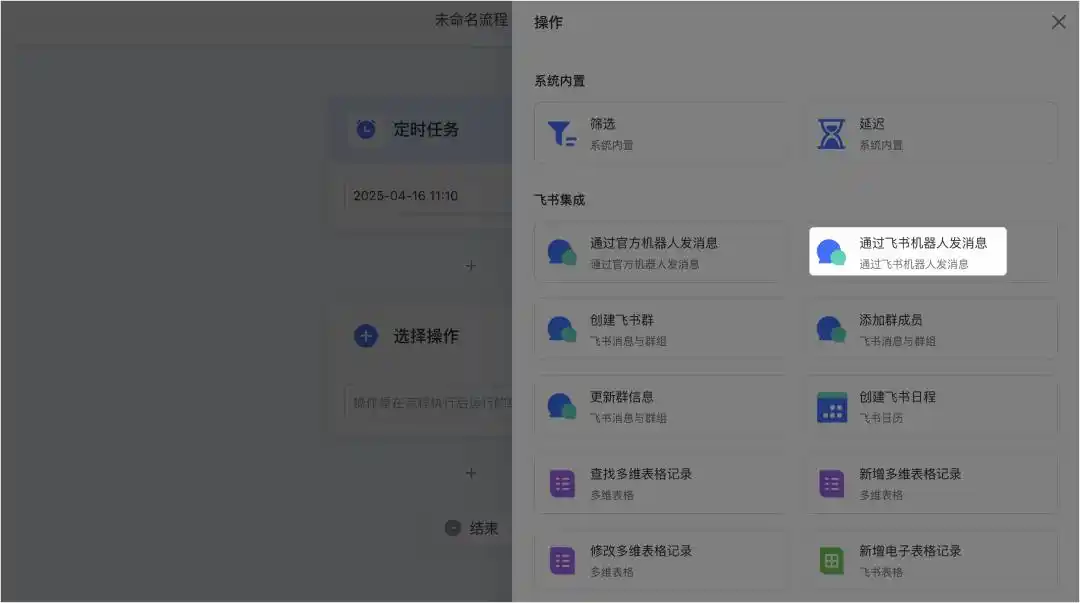
However, Feishu is an enterprise collaboration tool, covering work scenarios. WeChat has a distinctly different breadth—1.432 billion monthly active users, hundreds of Mini Programs across niche sectors, covering almost all service needs of a person's daily life, from ordering takeout to hospital registration to buying flight tickets to paying utility bills.
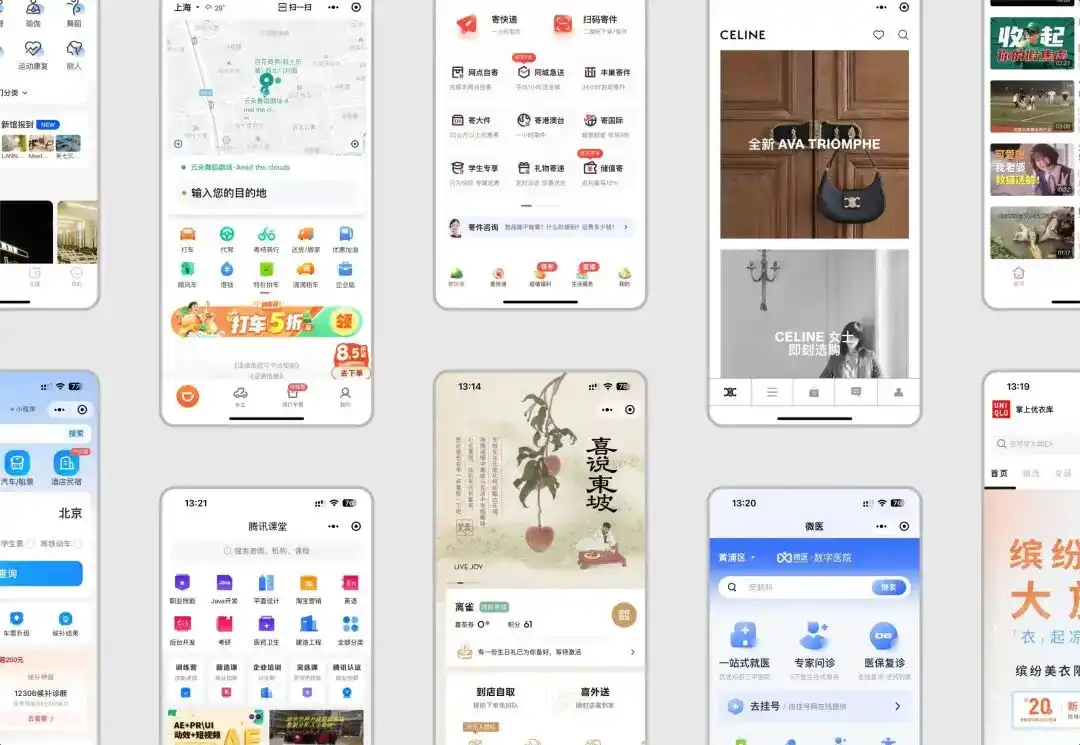
If WeChat AI can indeed smoothly invoke these Mini Programs to complete tasks, then, as the prophecy said, it becomes an operating system operated with natural language.

A user says, "Help me book a high-speed rail ticket from Beijing to Shanghai for tomorrow at 3 pm." The AI deconstructs the intent, invokes the 12306 Mini Program to check tickets, select seats, completes the order via WeChat Pay, all without leaving WeChat. This path can theoretically be executed today.

Of course, there is distance between theory and reality. AI invocation involving payment scenarios requires a near-zero error tolerance—ordering the wrong coffee is a minor issue, but buying the wrong flight ticket is a major one. The accuracy requirements for the underlying model are far higher than for conversational scenarios. This is also a common bottleneck facing AI Agent implementation globally: the gap between "able to chat" and "able to get things done" is not measured by technical metrics but by trust.
But WeChat has at least done one thing right: it didn't build a service network from scratch. Over the years, what ChatGPT has been doing is first having a smart brain, then connecting one by one to Shopify, DoorDash, Stripe, each connection built from the ground up. To this day, transaction-related queries still account for less than 3%.

The real change that is about to happen might be imperceptible to most users. One day, you type into WeChat, "Help me book a ticket to Shanghai for 9 pm tonight," and then it's done. You might not even know which Mini Program was called in the background or what payment process was followed.

This "imperceptible completion" is the true mark of a mature AI Agent. WeChat is closer to this step than anyone else.

This article is from the WeChat Official Account "APPSO", author: APPSO discovering tomorrow's products


Questions liées

QWhat is the core change that WeChat announced regarding its AI and Mini Programs?

AWeChat announced that Mini Program developers can now grant permission for its AI to read, operate, and call upon their Mini Programs. This allows AI to directly execute tasks within these programs.

QWhat is the key architectural advantage WeChat has over Apple's iOS in integrating AI with third-party services?

AWeChat has a 'God's-eye view' due to its centralized ecosystem. Every Mini Program's code runs within WeChat's technical framework, from submission to review and execution. This allows WeChat to automatically analyze and translate a program's functions for AI use without requiring developers to write new code for the AI integration.

QWhat industry-standard architecture did WeChat adopt for its AI Skill system, and what does it allow?

AWeChat adopted the MCP (Model Context Protocol) architecture for its AI Skill system. This industry-standard approach allows its AI to understand the functions and parameters of Mini Program interfaces and the overall business workflow, enabling seamless AI-agent interaction.

QAccording to the article, what is the 'final sign of true maturity' for an AI Agent like WeChat's?

AThe final sign of true maturity is 'unconscious completion.' This is when a user makes a request in natural language (e.g., 'Book me a ticket to Shanghai for 9 PM tonight'), and the AI completes the task using the necessary services and payment processes in the background without the user needing to know which specific Mini Program or flow was used.

QWhy does the article suggest WeChat's move might be more significant than Apple's new Siri AI announced at WWDC?

AIt's more significant because Apple's Siri AI is largely limited to coordinating native iOS functions. To integrate with third-party apps, each developer must manually adapt their app using Apple's App Intents framework. In contrast, WeChat's architecture gives it direct, centralized access to millions of third-party Mini Programs, allowing for broader and more immediate AI-powered service automation for its vast user base.

Lectures associées

Début de Warsh : le président de la Fed le plus au fait du Crypto de l'histoire apportera-t-il des surprises ou des chocs au marché ?

**Résumé :** Kevin Warsh, nouveau président de la Réserve fédérale américaine, s'apprête à tenir sa première conférence de presse monétaire. Sa nomination est historique : il est le premier président de la Fed à détenir personnellement des actifs numériques (investissements indirects dans Solana, dYdX, etc.), montrant une compréhension unique du secteur. Son dilemme est majeur : il doit faire face à une résurgence de l'inflation, qui exige une politique monétaire stricte (position "de faucon"), tout en répondant aux pressions politiques pour des baisses de taux. Parallèlement, son attitude envers les crypto-actifs diffère fondamentalement de celle de son prédécesseur. Il ne les considère pas comme de simples actifs spéculatifs, mais plutôt comme un "bon policier" pour la politique économique et une composante de la compétitivité américaine. Son impact potentiel sur le marché crypto s'articule autour de trois axes : 1. Un changement de paradigme réglementaire, passant de la prévention à l'intégration et à l'innovation. 2. Une reprixation des actifs liée aux taux d'intérêt, où sa clarté de communication pourrait réduire la prime d'incertitude. 3. Une légitimation accrue pouvant attirer les capitaux institutionnels traditionnels. Deux scénarios principaux sont envisagés pour sa première intervention : * **Scénario "Surprise"** : Un ton modéré ("de colombe") sur les taux combiné à des signaux favorables à l'innovation numérique pourrait booster le marché. * **Scénario "Choc"** : Un message excessivement restrictif sur les taux pourrait entraîner une vente généralisée des actifs risqués, y compris les cryptos. Bien qu'il ait dû vendre ses actifs crypto pour des raisons d'éthique, la compréhension intrinsèque de Warsh pour la technologie blockchain pourrait, à long terme, poser les bases d'une intégration plus structurelle des actifs numériques dans le système financier.

marsbitIl y a 5 h

Début de Warsh : le président de la Fed le plus au fait du Crypto de l'histoire apportera-t-il des surprises ou des chocs au marché ?

marsbitIl y a 5 h

XRP Ledger Lance le Rebranding XRPld Avec la Mise à Niveau Version 3.2.0

La version 3.2.0 du XRP Ledger (XRPL) est désormais disponible, introduisant une refonte majeure incluant le changement de nom du logiciel principal de « rippled » à « xrpld ». Cette mise à niveau se concentre principalement sur les améliorations des performances, de la sécurité et de l'évolutivité de l'infrastructure sous-jacente, plutôt que sur de nouvelles fonctionnalités utilisateur. Les principales avancées incluent des optimisations de mémoire pouvant réduire jusqu'à 40% l'utilisation de la mémoire serveur. Sur le plan de la sécurité, la modification `fixCleanup3_2_0` renforce plusieurs modules, notamment les coffres-forts à actif unique, le protocole de prêt, les échanges décentralisés et les jetons multi-usages. De nouveaux contrôles d'invariance garantissent la cohérence du registre après la suppression de comptes. Pour les développeurs, la mise à jour permet désormais de récupérer des informations sur les définitions du protocole et du serveur XRPL sans nécessiter de connexion active, facilitant ainsi la création de portefeuilles, d'explorateurs de blockchain et d'APIs. En termes d'évolutivité et de stabilité, les améliorations comprennent des tailles de bloc configurables, un stockage de base de données optimisé via nuDB, et le support optionnel de TLS/mutual TLS pour le serveur gRPC. Le port de peering par défaut est également passé du 51235 au 2459. Divers correctifs ont été apportés aux fonctions liées aux Market Makers Automatisés, aux paiements, aux séquestres de jetons et aux carnets d'ordres. Une note importante : les invariants de transaction ont été temporairement désactivés dans la v3.2.0 en raison d'un impact sur les performances, mais cela ne présente pas de risque pour la sécurité.

TheNewsCryptoIl y a 6 h

XRP Ledger Lance le Rebranding XRPld Avec la Mise à Niveau Version 3.2.0

TheNewsCryptoIl y a 6 h

L'AGI n'est pas l'arrivée, nouveau document de DeepMind : Vers l'ASI, le véritable progrès de l'IA ne fait que commencer

Si l'intelligence artificielle générale (IAG) était atteinte demain, quelle serait la prochaine étape ? Une étude de Google DeepMind suggère que l'IAG n'est pas un point final, mais une étape vers une superintelligence artificielle (ISA) dépassant les collectifs d'experts humains. L'étude distingue trois concepts : l'IAG (niveau médian humain), l'ISA (supérieure aux meilleurs collectifs humains dans presque tous les domaines) et l'IA universelle (limite théorique). Elle propose quatre voies potentielles vers l'ISA : 1. **Extension des ressources** : augmentation de la puissance de calcul, des données et des modèles. 2. **Évolution algorithmique** : améliorations incrémentales ou nouveaux paradigmes (apprentissage continu, utilisation d'outils, modèles du monde). 3. **Auto-amélioration récursive** : des IA plus performantes conçoivent la génération suivante, créant une boucle de rétroaction positive. 4. **Coordination multi-agents** : des systèmes IAG collaborant atteignent une intelligence collective supérieure. L'étude identifie six principaux goulets d'étranglement : 1. **Le mur des données** : les données humaines de haute qualité pourraient s'épuiser. 2. **Pressions économiques et ressources naturelles** : coûts énergétiques et matériels. 3. **Limites des paradigmes neuronaux actuels** : problèmes d'apprentissage continu, de raisonnement robuste, d'hallucinations. 4. **Difficulté croissante de la recherche**. 5. **Barrières à l'abstraction** : difficulté à former de nouveaux concepts fondamentaux. 6. **Régulation, gouvernance et réaction sociale**. Un défi crucial est l'évaluation des capacités de l'IA au-delà du niveau humain, nécessitant de nouveaux benchmarks. L'étude conclut que la progression vers l'ISA reste incertaine, soumise à des contraintes physiques et de ressources, et appelle à un effort de recherche interdisciplinaire pour mieux anticiper cette évolution.

marsbitIl y a 7 h

L'AGI n'est pas l'arrivée, nouveau document de DeepMind : Vers l'ASI, le véritable progrès de l'IA ne fait que commencer

marsbitIl y a 7 h

Trading

Spot
Futures

Articles tendance

Comment acheter PEOPLE

Bienvenue sur HTX.com ! Nous vous permettons d'acheter ConstitutionDAO (PEOPLE) de manière simple et pratique. Suivez notre guide étape par étape pour commencer votre parcours crypto.Étape 1 : Création de votre compte HTXUtilisez votre adresse e-mail ou votre numéro de téléphone pour ouvrir un compte sur HTX gratuitement. L'inscription se fait en toute simplicité et débloque toutes les fonctionnalités.Créer mon compteÉtape 2 : Choix du mode de paiement (rubrique Acheter des cryptosCarte de crédit/débit : utilisez votre carte Visa ou Mastercard pour acheter instantanément ConstitutionDAO (PEOPLE).Solde :utilisez les fonds du solde de votre compte HTX pour trader en toute simplicité.Prestataire tiers :pour accroître la commodité d'utilisation, nous avons ajouté des modes de paiement populaires tels que Google Pay et Apple Pay.P2P :tradez directement avec d'autres utilisateurs sur HTX.OTC (de gré à gré) : nous offrons des services personnalisés et des taux de change compétitifs aux traders.Étape 3 : stockage de vos ConstitutionDAO (PEOPLE)Après avoir acheté vos ConstitutionDAO (PEOPLE), stockez-les sur votre compte HTX. Vous pouvez également les envoyer ailleurs via un transfert sur la blockchain ou les utiliser pour trader d'autres cryptos.Étape 4 : tradez des ConstitutionDAO (PEOPLE)Tradez facilement ConstitutionDAO (PEOPLE) sur le marché Spot de HTX. Il vous suffit d'accéder à votre compte, de sélectionner la paire de trading, d'exécuter vos trades et de les suivre en temps réel. Nous offrons une expérience conviviale aux débutants comme aux traders chevronnés.

562 vues totalesPublié le 2024.12.12Mis à jour le 2026.06.02

Comment acheter PEOPLE

Discussions

Bienvenue dans la Communauté HTX. Ici, vous pouvez vous tenir informé(e) des derniers développements de la plateforme et accéder à des analyses de marché professionnelles. Les opinions des utilisateurs sur le prix de PEOPLE (PEOPLE) sont présentées ci-dessous.

活动图片