Anthropic Cries Wolf: Is the AGI Threat Real, or Just an IPO Story?

marsbitPublié le 2026-06-05Dernière mise à jour le 2026-06-05

Résumé

Anthropic has published an article titled "When AI builds itself," discussing the emerging concept of "recursive self-improvement," where AI begins to actively participate in designing, training, testing, and optimizing its own subsequent versions. The company presents internal data showing that by May 2026, over 80% of code merged into its codebase was written by Claude, its AI model. Claude's capabilities have expanded to handling complex, open-ended engineering tasks, achieving a 76% success rate in such areas, and even contributing to research processes, such as optimizing code performance and conducting AI safety experiments. Anthropic outlines an evolution from human-driven development to AI-assisted workflows, culminating in the current stage where AI agents can autonomously write, run, and delegate code. The company cautions that the path toward a "closed loop," where AI continuously improves itself, is becoming visible. It calls for coordinated global mechanisms to potentially slow or pause frontier AI development to allow safety research and societal structures to catch up. However, the timing of this warning coincides with Anthropic's preparations for an IPO, framing the narrative not just as a safety concern but also as a demonstration of Claude's advanced capabilities and its integral role in accelerating Anthropic's own R&D—creating a potential "flywheel" effect for competitive advantage. This contrasts with OpenAI's recent, more policy-oriented discussion of ...

By | Alphabet AI

Anthropic published a lengthy article last night titled "When AI builds itself," which sounds like a science fiction novel by Asimov, and indeed deals with a sci-fi concept: recursive self-improvement.
Simply put, in the past, human researchers wrote code, ran experiments, and trained models to make AI stronger. But if AI starts to participate in designing, training, testing, and optimizing its own successors, then the speed of AI progress is no longer driven solely by humans—it may begin to "self-evolve."

To this end, Anthropic made a plea:

"We believe it would be beneficial for the world if there were an option to slow down or temporarily pause frontier AI development, allowing societal structures and alignment research to catch up with technological progress."

This statement sounds like a safety warning, but in the context of Anthropic preparing for an IPO, it's hard not to see it as another kind of narrative setup: Claude is so good, it's even starting to create the next generation of Claude itself.

A New Storm Has Emerged

To illustrate that AI is increasingly involved in AI research and development itself, Anthropic presented substantial internal data.

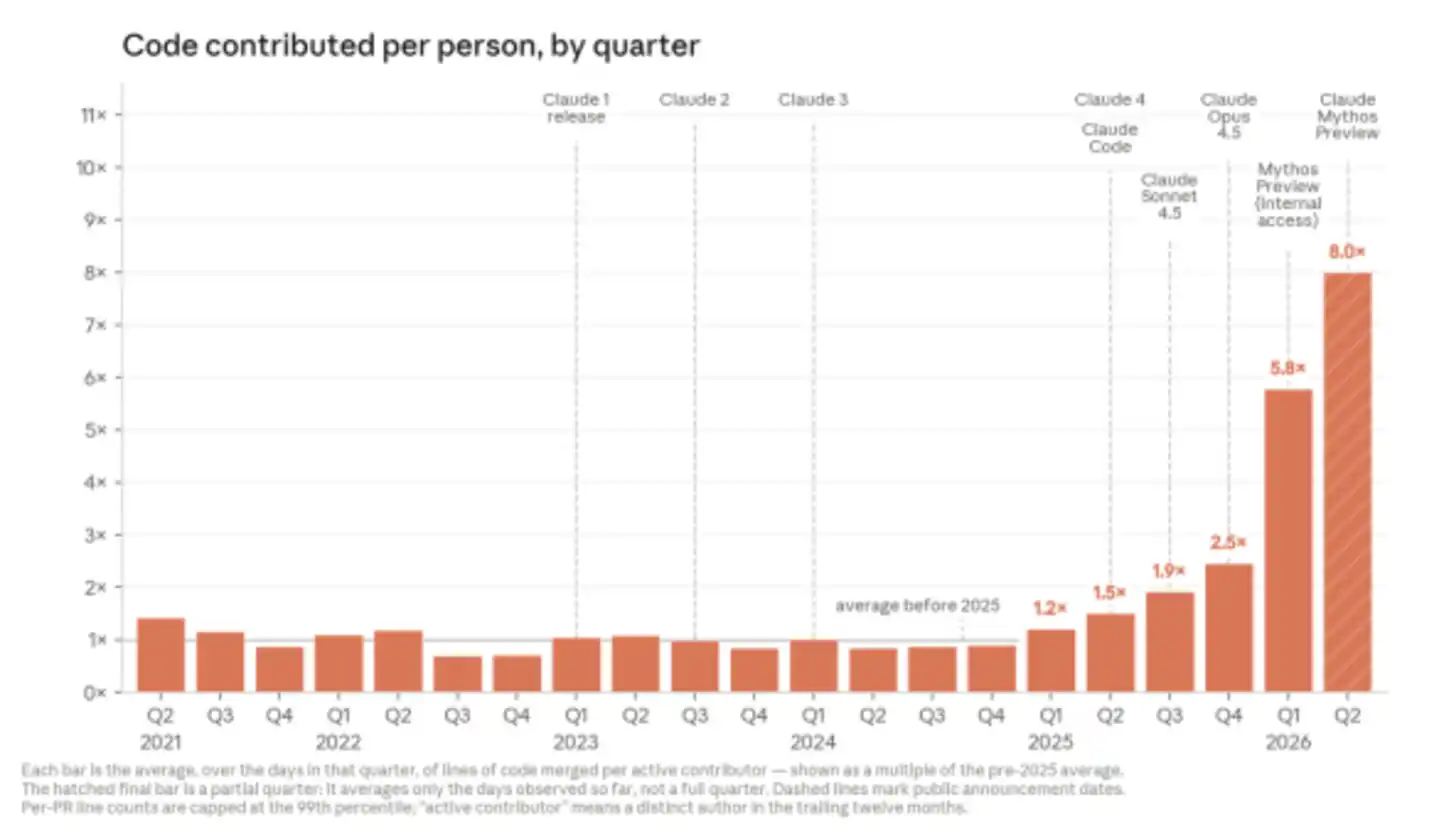
For instance, as of May 2026, over 80% of the code merged into Anthropic's codebase was written by Claude. Before the release of Claude Code, this number was only in the single digits.

By the second quarter of 2026, according to Anthropic's statistics, the daily volume of code merged by engineers was about 8 times higher than in 2024.
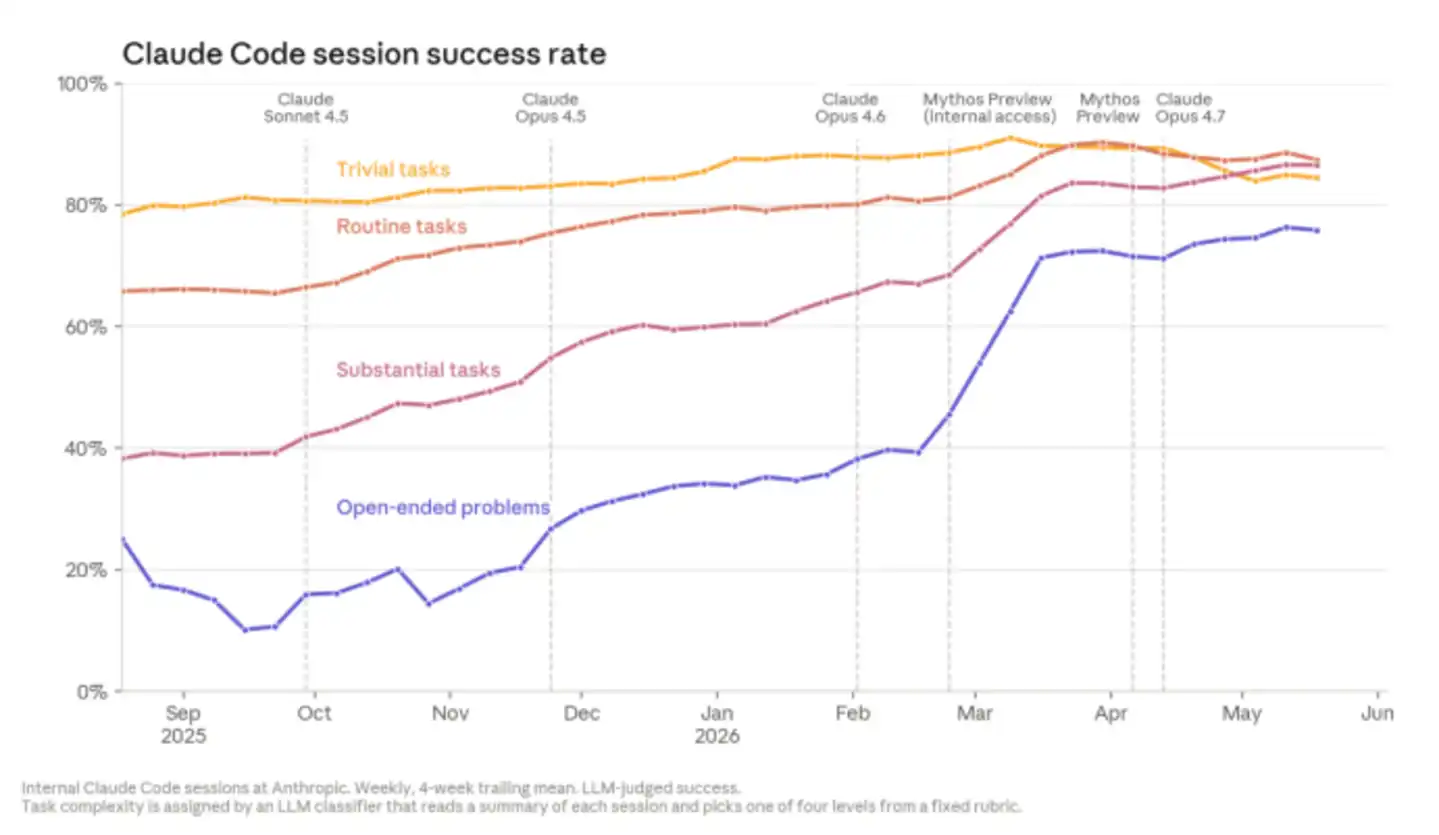
More notable than the code volume is that Claude is handling more open-ended engineering problems.

Anthropic stated in the article that over the past year, the frequency with which employees had to correct Claude, steer it back on track, or take over tasks mid-way has been steadily declining. This change is happening not only for simple tasks but also for the most complex, open-ended tasks.

So-called open-ended tasks are problems without clear instructions. For example, a system crash, a training task failure—issues where even engineers themselves don't know what the solution looks like initially and have to troubleshoot and make judgments on the fly.

These types of tasks historically relied most heavily on human experience. Yet, in those most open-ended tasks, Claude's success rate reached 76% by May 2026, a 50 percentage point increase within six months.
Not just writing code, Anthropic also uses Claude for code review—checking for bugs, security vulnerabilities, and other defects. Their retrospective analysis found that if every code change in the past had undergone automated review by Claude, approximately one-third of the bugs that caused incidents on claude.ai could have been caught before deployment.

Going a step further, Claude has begun to participate in the research process.

Anthropic has a standard test: give Claude code for training a small model and ask it to make the code run faster without altering the results. In May 2025, Claude Opus 4 could achieve about a 3x speedup; by April 2026, Claude Mythos Preview had pushed that number to approximately 52x.

Anthropic also mentioned an open-ended AI safety research case. They posed a question to a Claude-powered agent: Can a weaker model reliably supervise a stronger model?

This process involved proposing hypotheses, testing them, sharing findings with parallel agents, and iterating repeatedly.

Two human researchers spent a week bridging about 23% of the gap; Claude, with roughly 800 cumulative hours and about $18,000 in compute costs, bridged 97%.

This result certainly has limitations—the problem was chosen by humans, the scoring criteria were human-defined, and the findings haven't been fully migrated to production-scale models. But it still illustrates that Claude can now, within a research framework defined by humans, design experiments, execute them, and iterate on its own.

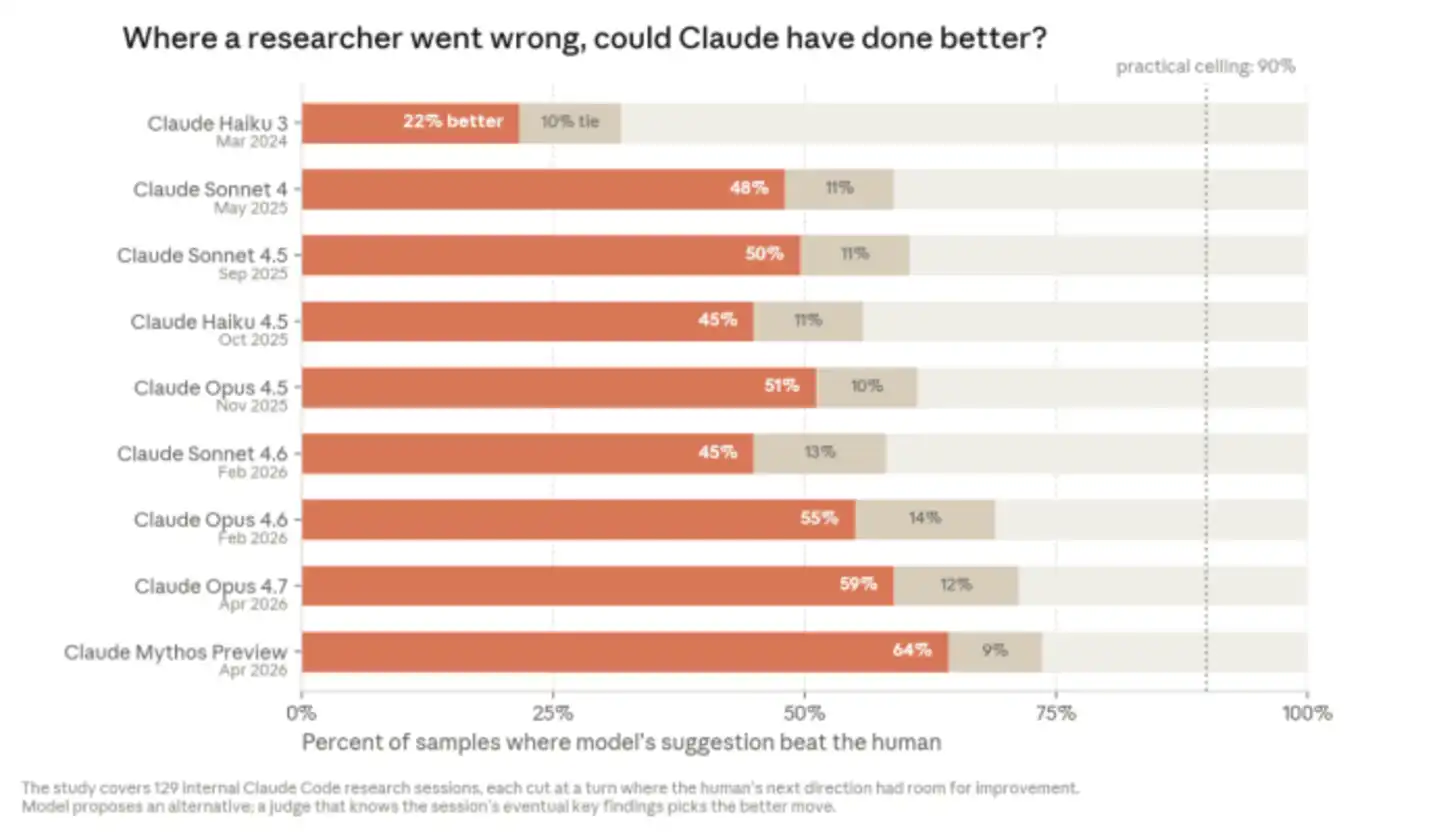
Furthermore, when human researchers "go down the wrong path," Claude can suggest a better next step.

Anthropic took 129 internal Claude Code research sessions where human researchers and Claude worked together on open-ended research problems. Anthropic identified points where "the human later proved to have taken a detour," gave the context up to that point to different versions of Claude, and asked it what it would suggest doing next. Then, another Claude judge, aware of the full session outcome, judged which was better: the model's suggestion or the human's choice at the time.

The results showed that at those points where the human researcher was later shown to have had room for improvement, Claude became increasingly able to propose a better next step.
In the past, AI model progress was primarily driven by human researchers and engineers. Humans decided what experiments to run, wrote the code, trained the models, and pushed forward AI's capabilities.

Now, more and more links in this chain are being taken over by Claude.

Anthropic presented a very intuitive stage diagram:
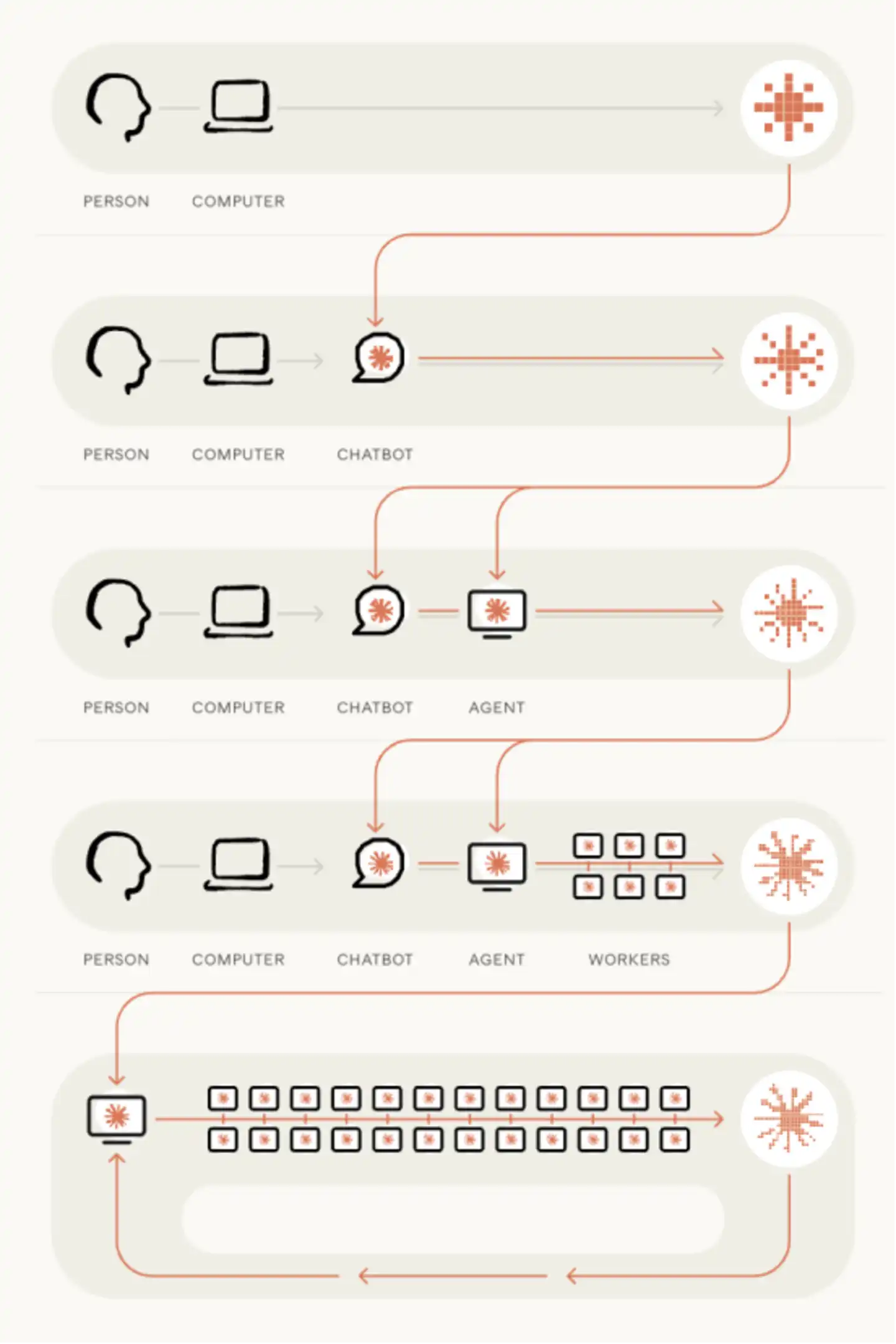
From 2021 to 2023, Anthropic was no different from a typical tech company—humans writing code and documentation on laptops.

From 2023 to 2025, chatbots began entering workflows. Engineers had models generate code snippets, then copied them into editors.

From 2025 to 2026, programming agents emerged. Claude began autonomously writing and modifying code, sometimes even completing entire files independently.

Today, agents can run code on their own and delegate hours-long work to other agents.

Looking ahead is the stage Anthropic is genuinely concerned about: the closed loop.

If this day arrives, subsequent versions of Claude might be continuously improved by Claude itself—this is recursive self-improvement.

Anthropic phrased it cautiously: we haven't reached that point yet, and recursive self-improvement isn't inevitable. But it still emphasizes that the path leading to that step is beginning to become visible.

That's why Anthropic discusses slowing down, even pausing, at the end of the article. Its meaning isn't that all AI companies should shut down immediately, but rather that if the risks of AI self-improvement continue to rise in the future, frontier labs need a coordinated, verifiable deceleration mechanism.

In other words, the "singularity" is approaching, and humanity must impose controls.

Unstoppable Claude

On the surface, this is a very forward-looking safety document. Anthropic is talking about recursive self-improvement, about AI potentially improving itself faster and faster, and about the need for human society to prepare deceleration and pause mechanisms in advance.

But placed in the context of Anthropic preparing for an IPO, this article takes on another layer of meaning.

In a way, Anthropic's recent moves resemble that annoyingly smug top student in class—it genuinely has the skills, but it's also quite pretentious.

What it wants to say isn't just "we have a very strong Claude"; a step beyond that, it wants to say "Claude is helping us build an even stronger Claude."

If Anthropic were merely selling a model or a tool, it would struggle to completely escape horizontal comparisons: Anthropic has Claude, OpenAI has GPT; Anthropic has Claude Code, OpenAI has Codex; Anthropic competes for enterprise clients, OpenAI competes for enterprise clients. The competition between the two companies is very tight, seeing who can tell the bigger story to the market.

It's worth noting that just three days ago, OpenAI wrote in a document about frontier AI governance:

"We are already seeing early signs of recursive self-improvement in today's systems: AI development itself is being accelerated by AI.

This will intensify competitive pressures among developers and nations, and create governance challenges that existing institutions are not equipped to handle."

Three days later, Anthropic says: The path for Claude towards recursive self-improvement is beginning to become visible.
If Claude develops as it hopes, this wouldn't be an ordinary product narrative—it would become a research and development flywheel.

Claude writes code, runs experiments, optimizes training processes, which in turn reduces incidents in Anthropic's own products… Once this system is up and running, Claude isn't just a product from Anthropic; it's a crucial production tool for Anthropic itself.

Users see the Claude product; enterprise customers buy Claude's capabilities. But what Anthropic truly wants the capital markets to notice is: Claude is already embedded in the underlying processes of frontier model development; it's been placed inside Anthropic's engine room.

Capital markets love flywheel stories, promising endless prosperity: A stronger Claude allows Anthropic's engineers to merge more code; more code enables faster product and infrastructure iteration; faster iteration allows researchers to run more experiments; more experiments in turn help the next generation of Claude become stronger. Once the next generation Claude is stronger, it continues to accelerate Anthropic's R&D.

Claude's iteration pace also supports this flywheel. Looking at public release timelines, from 2023 to early 2025, Claude's major model updates were mostly on a three-to-four month cycle. But with Claude 4, Anthropic's model updates have noticeably intensified.

Claude 4 was released in May 2025, Opus 4.1 in August, Sonnet 4.5 in September, Haiku 4.5 in October, Opus 4.5 in November.

In 2026, Opus 4.6 was released on February 5, Sonnet 4.6 on February 17, Opus 4.7 on April 15, and Opus 4.8 on May 28. The gap between Opus 4.7 and Opus 4.8 was only 42 days.

Anthropic, on the surface, is saying "this could be very dangerous, we need to prepare the brakes in advance," but it's simultaneously implying: "We've seen what happens when the accelerator is pressed."

The subtlety of the IPO narrative lies here. It describes the risks as significant while also elevating its own technological position.

Not every AI company is qualified to discuss recursive self-improvement. You first need to make the outside world believe your AI is already part of the AI R&D process to have the standing to say this might require global coordination.

OpenAI: How Could This Happen?

As mentioned earlier, just before Anthropic published this lengthy article, OpenAI had already put recursive self-improvement on the table.

But the two companies' narratives are quite different.

OpenAI's document, "Democratic Governance of Frontier AI," is a policy blueprint for Washington. It's concerned not with "how models get stronger," but with how to constrain frontier AI if it continues to surge ahead.

Most of the content in that report isn't suitable for detailed discussion here, but one key line stands out: OpenAI said that in today's systems, early signs of recursive self-improvement are already visible.

This line and Anthropic's lengthy article point in the same direction.

It's just that OpenAI talks about institutions, while Anthropic talks about itself.

OpenAI's point is: AI development is too fast; existing governance structures may not keep up, so a new set of rules is needed.

Anthropic directly showcases that system, telling the market: Claude is already in our R&D process, so we see the path to AI self-acceleration.

This move is quite clever. One imagines the grumbling inside OpenAI—this is practically idea theft! We were here first!

Just joking, but OpenAI really needs to step up its game and quickly bring GPT 5.6 to the table.

Questions liées

QWhat is the core concern of Anthropic's article 'When AI builds itself'?

AThe article's core concern is the potential for recursive self-improvement in AI, where AI begins to design, train, test, and optimize its own successor versions, potentially leading to an AI evolution that is no longer solely driven by human effort.

QWhat significant performance statistic does Anthropic cite to show Claude's growing role in AI development?

AAnthropic states that as of May 2026, over 80% of the code merged into its codebase is written by Claude.

QHow does the author interpret the timing of Anthropic's publication on AI risks?

AThe author suggests that the article, coming at the time when Anthropic is preparing for an IPO, can be seen as a narrative prelude to highlight their technological advantage, framing it as both a safety warning and a display of a powerful 'virtuous cycle' where Claude helps build a stronger Claude.

QWhat is the key difference between OpenAI's and Anthropic's approach to discussing 'recursive self-improvement'?

AOpenAI's recent document framed it as a broad governance challenge requiring new institutional rules. Anthropic's article, however, presented it through the specific lens of its own development process with Claude, showcasing internal data to illustrate the visible path towards such a capability.

QWhat future stage in AI development is Anthropic particularly worried about, as described in the article?

AAnthropic is particularly concerned about the potential arrival of a 'closed loop' stage, where a future version of Claude could continuously improve itself, leading to true recursive self-improvement.

Lectures associées

Les 43 minutes de Trump : la narration du leader fort déraille, la guerre médiatique s'intensifie

Lors de sa première apparition publique après plus d'une semaine d'absence, le président américain Donald Trump a tenu une conférence de presse de 43 minutes, marquée par des attaques répétées contre des journalistes, des villes américaines et des adversaires politiques. Plutôt que d'aborder directement les questions urgentes concernant sa santé, l'Iran ou les fissures au sein de son parti, il a longuement parlé d'un projet de rénovation d'un bassin d'ornement, comparé la taille de ses rassemblements à celui de Martin Luther King, et signé un décret affaiblissant les protections d'emploi de milliers de hauts fonctionnaires fédéraux. L'article décrit un président apparaissant irritable, défensif et incontrôlé, interrompant soudainement l'événement avant d'être rapidement conduit hors de la salle par son personnel. Il analyse cette performance comme le symptôme d'une concentration du pouvoir personnel et d'un affaiblissement des contraintes institutionnelles, où la loyauté prime sur la compétence. La seconde partie se concentre sur les attaques contre la presse, illustrées par l'échange hostile avec une journaliste de CNN et le licenciement d'un vétéran de CBS qui dénonçait des ingérences éditoriales. L'auteur soutient que la pression du pouvoir politique et des intérêts commerciaux menace l'indépendance des médias traditionnels, faisant des journalistes et créateurs indépendants des acteurs cruciaux pour préserver les faits. Il appelle à soutenir financièrement ces voix indépendantes comme forme de résistance face à un exécutif qui cherche à saper la confiance dans l'information et à récompenser l'obéissance. L'article se conclut sur une note d'espoir, notant que des élus républicains ont commencé à se distancer de Trump, votant symboliquement contre ses actions militaires en Iran.

marsbitIl y a 3 h

Les 43 minutes de Trump : la narration du leader fort déraille, la guerre médiatique s'intensifie

marsbitIl y a 3 h

Kalshi, MTS et l'ambition de a16z

Le marché des prédictions, illustré par des plateformes comme Kalshi, connaît un regain d'intérêt en 2025, suscitant l'enthousiasme des investisseurs, des acteurs de la cryptomonnaie et des médias. Cet engouement dépasse les simples opportunités de régulation ou de revenus, touchant à une dimension philosophique plus profonde. L'article retrace l'évolution intellectuelle du concept, depuis les théories de Hayek sur la connaissance dispersée dans la société, jusqu'aux mécanismes incitatifs comme le LMSR de Robin Hanson, conçus pour révéler l'information. Cependant, c'est l'entrée en jeu du géant du capital-risque a16z, avec son investissement massif dans Kalshi, qui marque un tournant. a16z voit dans le marché des prédictions bien plus qu'un produit financier : un nouvel outil médiatique fondamental. Il répondrait au désir contemporain de "présence" et d'action face à un monde de plus en plus médiatisé et déterministe. En pariant de l'argent réel sur des événements mondiaux, l'utilisateur passerait du statut de spectateur passif à celui d'observateur actif et impliqué, recouvrant un sentiment d'agency. Cette capacité à générer de l'engagement et à définir la réalité par les prix du marché (établissant la véracité et l'importance des événements) en ferait une pièce maîtresse de l'empire des "nouveaux médias" qu'a16z cherche à construire. Cet empire, illustré par des acteurs comme MTS, se caractérise par une production et une diffusion d'information extrêmement rapides et intenses, visant à "s'approprier la timeline". La valeur ultime de Kalshi résiderait ainsi dans son puissant "champ de distorsion de la réalité" : sa capacité, via le poids de l'argent engagé par la foule, à influencer la perception collective du futur et à s'imposer comme un arbitre de la vérité, conférant à une entreprise privée une influence historique rare.

marsbitIl y a 5 h

Kalshi, MTS et l'ambition de a16z

marsbitIl y a 5 h

Changement de cap mondial chez a16z : Le capital-risque devient le « moteur » de l'alliance technologique américaine

L’annonce de Ben Horowitz marque un virage stratégique majeur dans la globalisation d’a16z. Le fonds ne se contente plus de rechercher des projets à l’étranger, mais s’inscrit dans un cadre plus large de compétition technologique et de coopération entre alliés, explicitement lié au leadership technologique des États-Unis et de leurs partenaires. Dans un contexte où l’IA, la robotique, la cybersécurité et les chaînes d’approvisionnement deviennent des enjeux de compétition nationale, le rôle des VC évolue. A16z renforce ses capacités pour aider ses startups à naviguer dans des environnements complexes, mêlant marchés, régulations et géopolitique. Les initiatives clés incluent : l’ouverture d’un bureau à Tokyo, la nomination d’Anne Neuberger (ancienne responsable gouvernementale) comme associée chargée des affaires mondiales pour conseiller sur la politique et la géopolitique, et la transformation de l’équipe relations investisseurs en une équipe « Partenaires Mondiaux » pour faciliter les connexions et le déploiement international des entreprises. L’objectif reste de soutenir les meilleures entreprises technologiques partout dans le monde (plus de 100 investissements internationaux à ce jour), mais avec une mission élargie : être un organisateur reliant les startups aux capacités nationales, aux ressources industrielles et au réseau des alliés, contribuant ainsi à la compétitivité technologique des États-Unis et de leurs alliés.

marsbitIl y a 5 h

Changement de cap mondial chez a16z : Le capital-risque devient le « moteur » de l'alliance technologique américaine

marsbitIl y a 5 h

Kalshi, MTS et les ambitions d'a16z

Les marchés prédictifs, représentés par Kalshi, émergent comme un domaine clé en 2025, attirant fonds d'investissement, acteurs de la cryptomonnaie et médias. Leur importance dépasse la simple spéculation. Leur évolution conceptuelle remonte à Hayek (l'utilisation de la connaissance dans la société) et à Robin Hanson (mécanisme LMSR pour inciter à la révélation d'informations), avec l'idée utopique d'une « futarchie ». L'intérêt de a16z, qui a investi dans Kalshi (évalué à 220 milliards de dollars), va au-delà du modèle économique. Leur thèse centrale est que les marchés prédictifs offrent un « sentiment de présence » et une forme d'« anti-cynisme » dans un monde moderne où les individus se sentent déconnectés. En pariant sur des événements mondiaux, l'utilisateur devient un « observateur superlatif », investi et influençant la perception collective. Cela s'inscrit dans la vision de « nouveaux médias » de a16z : un écosystème médiatique complet et rapide qui « s'approprie la timeline », comme le démontre MTS (Monitoring The Situation), un média en continu sur Twitter. Kalshi ajoute à ce dispositif une autorité unique car ses prix reflètent des paris en argent réel, lui conférant un pouvoir de « distorsion de la réalité » pour définir la vérité et l'importance des événements. C'est ce pouvoir, rarement détenu par une entreprise privée, qui justifierait sa valorisation faramineuse et en ferait une pièce maîtresse de l'empire médiatique de a16z.

链捕手Il y a 5 h

Kalshi, MTS et les ambitions d'a16z

链捕手Il y a 5 h

Trading

Spot
Futures

Articles tendance

Comment acheter NIGHT

Bienvenue sur HTX.com ! Nous vous permettons d'acheter Midnight (NIGHT) de manière simple et pratique. Suivez notre guide étape par étape pour commencer votre parcours crypto.Étape 1 : Création de votre compte HTXUtilisez votre adresse e-mail ou votre numéro de téléphone pour ouvrir un compte sur HTX gratuitement. L'inscription se fait en toute simplicité et débloque toutes les fonctionnalités.Créer mon compteÉtape 2 : Choix du mode de paiement (rubrique Acheter des cryptosCarte de crédit/débit : utilisez votre carte Visa ou Mastercard pour acheter instantanément Midnight (NIGHT).Solde :utilisez les fonds du solde de votre compte HTX pour trader en toute simplicité.Prestataire tiers :pour accroître la commodité d'utilisation, nous avons ajouté des modes de paiement populaires tels que Google Pay et Apple Pay.P2P :tradez directement avec d'autres utilisateurs sur HTX.OTC (de gré à gré) : nous offrons des services personnalisés et des taux de change compétitifs aux traders.Étape 3 : stockage de vos Midnight (NIGHT)Après avoir acheté vos Midnight (NIGHT), stockez-les sur votre compte HTX. Vous pouvez également les envoyer ailleurs via un transfert sur la blockchain ou les utiliser pour trader d'autres cryptos.Étape 4 : tradez des Midnight (NIGHT)Tradez facilement Midnight (NIGHT) sur le marché Spot de HTX. Il vous suffit d'accéder à votre compte, de sélectionner la paire de trading, d'exécuter vos trades et de les suivre en temps réel. Nous offrons une expérience conviviale aux débutants comme aux traders chevronnés.

530 vues totalesPublié le 2025.12.08Mis à jour le 2026.06.02

Comment acheter NIGHT

Discussions

Bienvenue dans la Communauté HTX. Ici, vous pouvez vous tenir informé(e) des derniers développements de la plateforme et accéder à des analyses de marché professionnelles. Les opinions des utilisateurs sur le prix de NIGHT (NIGHT) sont présentées ci-dessous.

活动图片