HYPE Spot ETF Continuously Accumulates 1% in 14 Days: Is the $75 New High Just the Starting Point?

Odaily星球日报Publié le 2026-06-03Dernière mise à jour le 2026-06-03

Résumé

Hyperliquid (HYPE) has surged to a new all-time high of $75 amid strong institutional and ETF-driven buying pressure. The article highlights several key bullish factors. First, the HYPE spot ETFs from 21Shares and Bitwise have seen 14 consecutive days of net inflows, totaling over $136 million and absorbing nearly 1% of HYPE's market cap—a faster initial pace than BTC or ETH ETFs. This ETF demand provides a solid price floor. Second, the protocol's own Assistance Fund (AF) mechanism, which uses 99% of fees to buy back and burn HYPE, has already removed over $1.1 billion worth of tokens, creating a dual support system alongside ETF inflows. This combined buying power is expected to counter potential selling pressure from upcoming team token unlocks. Institutionally, venture firm a16z is now considered one of the largest external holders of HYPE, with multiple addresses accumulating millions of tokens. Galaxy Digital is also actively buying. Analysts and firms like Bitwise and Grayscale are framing HYPE not as a mere meme coin but as a "second-generation" crypto with real value capture and infrastructure potential. Furthermore, Hyperliquid Strategies (PURR), a publicly traded company holding a large HYPE treasury, is set to join the Russell 3000 Index, potentially unlocking further passive investment flows. The ongoing feud between prominent backers like Arthur Hayes (pro-HYPE) and Kyle Samani (pro-SOL) underscores the intense market debate, with Hayes famously betting HYPE wil...

Original |Odaily Planet Daily(@OdailyChina)

Author|Golem(@web3_golem)

"HYPE should at least surpass SOL before the end of this bull market", BitMEX Co-Founder and the most devoted "H Guard" Arthur Hayes was the first to publicly voice this expectation in late May, having previously stated multiple times that HYPE would rise to $150.

The reason Arthur Hayes "stepped on one to praise another" stemmed from Multicoin Capital former Co-Founder and "S Guard" Kyle Samani first attacking Hyperliquid in the community, after which the "verbal sparring" between the two escalated, ultimately ending with a $100,000 bet. The wager was that HYPE would outperform all top-ten tokens by market cap for the remainder of the year(For details on their feud, read:Solana and Hyperliquid's Most Devoted Guards Got into a Spat).

In recent days, HYPE has continued to rally, reaching a new all-time high of $75. Investors looking to get in are experiencing "fear of heights," with some even beginning to try shorting. This article by Odaily Planet Daily will analyze the changes in HYPE's fundamentals from the perspective of market buying and selling pressure for readers' reference.

The Strongest Altcoin ETF in History Debuts

There are currently two HYPE spot ETFs on the market. On May 12th, 21Shares launched the first Hyperliquid ETF (THYP) on Nasdaq; on May 15th, Bitwise also launched a Hyperliquid ETF (BHYP) on the NYSE.

HYPE Spot ETF Records 14 Consecutive Days of Net Inflows

As of June 2nd, the HYPE spot ETF has achieved net inflows for 14 consecutive days since its launch, with cumulative net inflows exceeding $136 million, absorbing approximately 0.9% of HYPE's total market capitalization. Among them, Bitwise's BHYP had net inflows of $82.96 million, becoming the world's largest HYPE ETF.

The performance of the HYPE spot ETF post-launch clearly indicates the enthusiasm of traditional capital for Hyperliquid. Among the 12 US crypto spot ETFs, ranked by cumulative total net inflows, the HYPE spot ETF has become the 5th largest crypto spot ETF, trailing only BTC, ETH, XRP, and SOL spot ETFs, far surpassing other crypto spot ETFs that launched earlier.

Comparing the performance of BTC and ETH spot ETFs since May further highlights the market's divergence trend; capital for crypto asset ETFs is being reallocated.

BTC spot ETFs have seen net outflows for 12 consecutive days since May 15th, with May outflows exceeding $2.43 billion, breaking the record of 8 consecutive days of net outflows set in early 2025. ETH spot ETFs have seen net outflows for 16 consecutive days since May 11th, with May outflows exceeding $540 million. Meanwhile, the BNB ETF (VBNB) launched by VanEck on Nasdaq on May 28th has even recorded no net inflows for 4 consecutive days.

In this cycle, institutional and traditional capital's demand for exposure to BTC and ETH ETFs has noticeably cooled, while HYPE's attractiveness to them has gradually increased, with the FOMO level even surpassing the initial data from the launch of BTC and ETH spot ETFs.

Within two weeks of launch, the HYPE spot ETF has absorbed nearly 1% of HYPE's market cap. Calculated by market cap proportion, this exceeds the launch performance of BTC and ETH spot ETFs over the same period. According to SoSoValue data, BTC spot ETFs had net inflows of $1.46 billion in the first two weeks, absorbing only about 0.2% of BTC's market cap at the time; ETH spot ETFs even saw net outflows of about $400 million in the first two weeks; while SOL spot ETFs had net inflows of about $380 million in the first two weeks, absorbing only about 0.47% of SOL's market cap at the time.

The continuous inflows into the HYPE spot ETF have formed a solid foundation of support for HYPE's price.

Dual Support for HYPE Buying Pressure, Offsetting Unlock Selling Pressure

Besides ETFs, Hyperliquid's protocol revenue is also a crucial support for HYPE's buying pressure.

As early as the beginning of 2025, Hyperliquid introduced the Assistance Fund (AF) mechanism, stipulating that 97% of protocol transaction fees (perps + spot, etc.) automatically go into the AF system address for continuous HYPE buybacks. The fee ratio was later adjusted to 99%. This mechanism allows HYPE to effectively capture Hyperliquid's protocol value and also serves as a key support for HYPE's price.

Hyperliquid's daily protocol revenue ranges between $1-3 million. Since the AF mechanism's implementation, it has cumulatively bought back over $1.1 billion worth of HYPE. Although the cumulative net inflows of the HYPE spot ETF are not as high as the AF's buybacks, their growth rate is fast. In just half a month, net inflows have caught up to one-tenth of the AF's buyback volume, with the single-day peak net inflow reaching $31.62 million on May 29th.

Now, with the addition of HYPE spot ETFs, HYPE will form dual support, thereby offsetting the selling pressure brought by team token unlocks.

Since January 2026, the official rule for team token unlocks has adopted a monthly one-time unlock method, fixed on the 6th of each month. On June 6th, tokens worth $38.7 million will be unlocked at once, but this may not create significant selling pressure in the market.

Another important characteristic of ETF buying is that the investors behind them may not understand tokenomics or even have directly operated DeFi protocols; they simply want exposure to HYPE. Therefore, ETF investors are also less sensitive to token unlocks. As long as the project's fundamentals don't change drastically, token unlocks will not suppress buying power.

Simultaneously, more HYPE spot ETFs will be launched in the future. On June 2nd, Grayscale submitted a revised S-1 filing for a Hyperliquid Staking ETF, providing approximately 2 million HYPE as seed capital investment. The Hyperliquid ETF code is Grayscale Hyperliquid Staking ETF (HYPG), and it is set to officially begin trading on June 4th.

HYPE will welcome deeper liquidity, stronger institutional participation, and continuously generated incremental buying pressure.

Are Institutions More FOMO Than Retail?

Institutions' FOMO towards HYPE is no less than that of retail investors. They publicly express bullish views on HYPE while using real money to fuel HYPE's rise.

a16z May Have Become the Largest External HYPE Holding Institution

Starting in August 2025, a16z began its large-scale accumulation mode for HYPE. According to monitoring by crypto analyst Ai Yi @ai_9684xtpa, a16z may have become the sixth-largest holding entity on the HYPE chain and the largest external holding entity. The top 5 addresses on the HYPE chain belong to Hyperliquid's own ecosystem projects (the fifth being the Kinetiq staking protocol), while the sixth address is under a16z's control. This address holds 3.095 million HYPE, worth over $223 million.
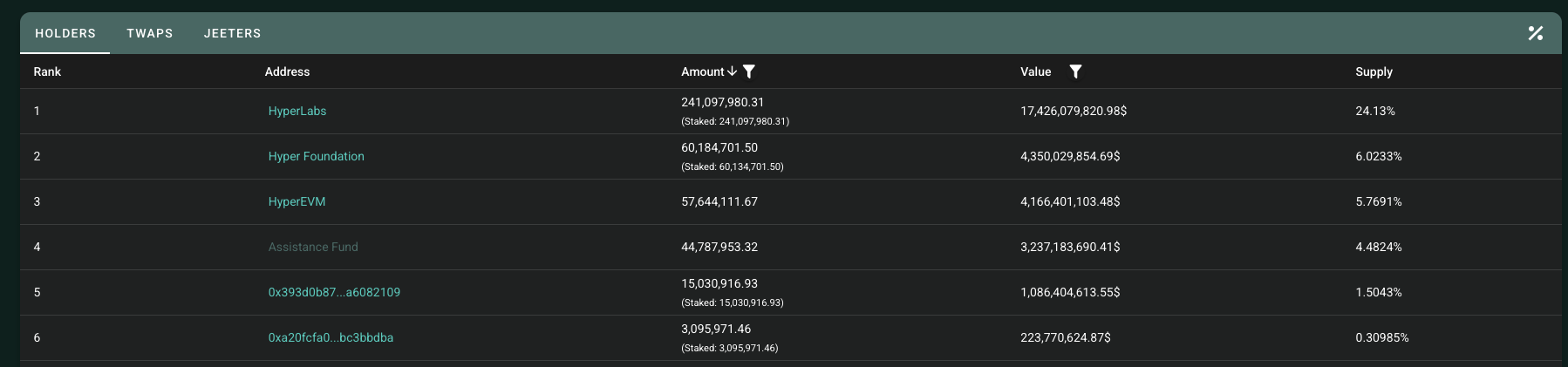
However, this is not a16z's only HYPE holding address. On-chain data shows a16z has also been continuously buying and accumulating HYPE through multiple associated addresses.

On May 28th, crypto analyst Ai Yi @ai_9684xtpa monitored that the 0x4c6... address associated with a16z withdrew a cumulative 253,947.43 HYPE from multiple exchanges and market maker addresses, with an average withdrawal price of approximately $59.2. On May 30th, Lookonchain monitored that another a16z-associated address, 0xb5E..., bought another 226,121 HYPE. Since April 14th, this address has cumulatively bought 3.9 million HYPE with an average purchase price of approximately $49.4.

Besides a16z, Galaxy Digital is also accumulating HYPE. On June 3rd, according to Lookonchain monitoring, Galaxy Digital withdrew 179,000 HYPE from Coinbase, worth approximately $12.62 million. On May 21st, another associated wallet also bought 158,100 HYPE, worth approximately $8.8 million.

Institutions have long stopped viewing HYPE as an ordinary meme/shitcoin. Bitwise Chief Investment Officer Matt Hougan stated that HYPE is not just another altcoin, but a "second generation" cryptocurrency because it possesses real value capture, buybacks, and institutional demand.

Simultaneously, institutions have elevated Hyperliquid's positioning from a Perp DEX to a blockchain financial infrastructure platform. Grayscale's mid-year report stated that Hyperliquid might even challenge traditional derivatives trading and exchange systems in the future and grow into a "financial services giant."

HYPE DAT Company Selected for Russell 3000 Index

While the DAT concept in US stocks cooled down and the sector leader Strategy also began selling coins, DAT companies betting on HYPE continued to float in profits as HYPE's price rose. (Related reading:DAT Failed? Public Company Betting on HYPE Sees $1.25 Billion Floating Profit)

The most notable among them is Hyperliquid Strategies (NASDAQ:PURR). According to official website data, it currently holds 22.3 million HYPE, with a holding value of $1.617 billion. Hyperliquid Strategies' financial report released in early May also disclosed that as of Q1 2026, they invested $10.5 million to repurchase approximately 3 million shares of stock, with an average cost of $3.42 per share.

On May 22nd, FTSE Russell announced the preliminary list for the June 2026 Russell 3000 Index reconstitution. PURR appeared on the addition list for the Russell 3000 Index and is expected to take effect on June 26th.
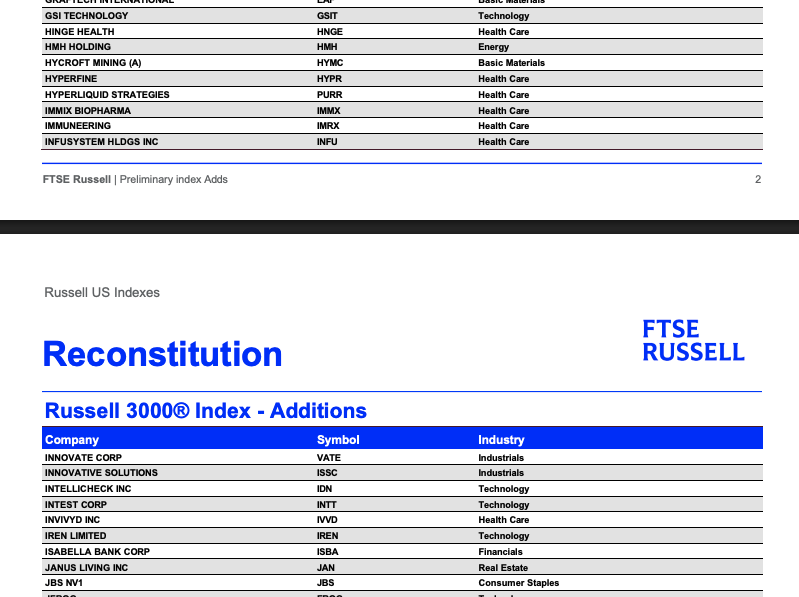
PURR appears on the addition list for the Russell 3000 Index

The Russell 3000 Index is also one of the broadest US stock market indices, covering approximately the 3000 largest publicly listed companies in the US, essentially encompassing the entire US stock market. It undergoes a major adjustment every June. Currently, a large number of index funds, pension funds, and ETFs track this index. FTSE Russell discloses that approximately $10.6 trillion in assets use Russell US indices as a benchmark.

If PURR is indeed included in the Russell 3000 Index, it will not only receive passive allocation from funds but also gain significantly higher visibility. To help investors obtain more HYPE exposure, they might also emulate Strategy's "financing to buy coins" model in the future, thereby becoming another solid source of buying pressure for HYPE.


Questions liées

QAccording to the article, what is the unique performance of HYPE spot ETFs in terms of continuous net inflows, and how does this compare to the initial performance of BTC and ETH spot ETFs?

AAccording to the article, HYPE spot ETFs have achieved continuous net inflows for 14 consecutive days since their launch, accumulating over $136 million. This absorbed approximately 0.9% of HYPE's total market capitalization at the time. In contrast, BTC spot ETFs absorbed only about 0.2% of BTC's market cap in their first two weeks, and ETH spot ETFs even experienced net outflows of around $400 million in their first two weeks.

QWhat two major sources form the dual support for HYPE's buying pressure, as mentioned in the article, to offset the selling pressure from token unlocks?

AThe two major sources forming the dual support for HYPE's buying pressure are: 1) HYPE spot ETF inflows from traditional finance, and 2) The protocol's Assistance Fund (AF) mechanism, which automatically uses 99% of Hyperliquid's protocol transaction fees to buy back and burn HYPE tokens.

QWhich venture capital firm is identified in the article as potentially the largest external institutional holder of HYPE, and what evidence is provided for their accumulation?

AThe article identifies a16z (Andreessen Horowitz) as potentially the largest external institutional holder of HYPE. Evidence includes a specific a16z-linked address holding 3.095 million HYPE (worth over $223 million), making it the sixth-largest on-chain holder, and mentions of other associated addresses continuously buying HYPE from exchanges and market makers in large quantities.

QWhat significant US stock market index is the HYPE-focused DAT company 'Hyperliquid Strategies (PURR)' expected to be added to, and what is the potential implication of this inclusion?

AHyperliquid Strategies (PURR) is expected to be added to the Russell 3000 Index, with the inclusion expected to take effect on June 26, 2026. The implication is that it could lead to passive buying from index-tracking funds and ETFs (which benchmark against this index), increase the company's visibility, and potentially provide another source of buying pressure for HYPE if the company seeks more exposure to the token.

QWhat bet did Arthur Hayes and Kyle Samani make regarding HYPE's performance, and what was the catalyst for their disagreement?

AArthur Hayes and Kyle Samani made a $100,000 bet on whether HYPE would outperform all tokens in the top 10 by market capitalization for the remainder of the year. The catalyst for their disagreement was Kyle Samani (a strong Solana supporter) initially criticizing the Hyperliquid project in the community, which led to a public argument between the two, with Hayes being a prominent supporter of HYPE.

Lectures associées

Début de Warsh : le président de la Fed le plus au fait du Crypto de l'histoire apportera-t-il des surprises ou des chocs au marché ?

**Résumé :** Kevin Warsh, nouveau président de la Réserve fédérale américaine, s'apprête à tenir sa première conférence de presse monétaire. Sa nomination est historique : il est le premier président de la Fed à détenir personnellement des actifs numériques (investissements indirects dans Solana, dYdX, etc.), montrant une compréhension unique du secteur. Son dilemme est majeur : il doit faire face à une résurgence de l'inflation, qui exige une politique monétaire stricte (position "de faucon"), tout en répondant aux pressions politiques pour des baisses de taux. Parallèlement, son attitude envers les crypto-actifs diffère fondamentalement de celle de son prédécesseur. Il ne les considère pas comme de simples actifs spéculatifs, mais plutôt comme un "bon policier" pour la politique économique et une composante de la compétitivité américaine. Son impact potentiel sur le marché crypto s'articule autour de trois axes : 1. Un changement de paradigme réglementaire, passant de la prévention à l'intégration et à l'innovation. 2. Une reprixation des actifs liée aux taux d'intérêt, où sa clarté de communication pourrait réduire la prime d'incertitude. 3. Une légitimation accrue pouvant attirer les capitaux institutionnels traditionnels. Deux scénarios principaux sont envisagés pour sa première intervention : * **Scénario "Surprise"** : Un ton modéré ("de colombe") sur les taux combiné à des signaux favorables à l'innovation numérique pourrait booster le marché. * **Scénario "Choc"** : Un message excessivement restrictif sur les taux pourrait entraîner une vente généralisée des actifs risqués, y compris les cryptos. Bien qu'il ait dû vendre ses actifs crypto pour des raisons d'éthique, la compréhension intrinsèque de Warsh pour la technologie blockchain pourrait, à long terme, poser les bases d'une intégration plus structurelle des actifs numériques dans le système financier.

marsbitIl y a 5 h

Début de Warsh : le président de la Fed le plus au fait du Crypto de l'histoire apportera-t-il des surprises ou des chocs au marché ?

marsbitIl y a 5 h

XRP Ledger Lance le Rebranding XRPld Avec la Mise à Niveau Version 3.2.0

La version 3.2.0 du XRP Ledger (XRPL) est désormais disponible, introduisant une refonte majeure incluant le changement de nom du logiciel principal de « rippled » à « xrpld ». Cette mise à niveau se concentre principalement sur les améliorations des performances, de la sécurité et de l'évolutivité de l'infrastructure sous-jacente, plutôt que sur de nouvelles fonctionnalités utilisateur. Les principales avancées incluent des optimisations de mémoire pouvant réduire jusqu'à 40% l'utilisation de la mémoire serveur. Sur le plan de la sécurité, la modification `fixCleanup3_2_0` renforce plusieurs modules, notamment les coffres-forts à actif unique, le protocole de prêt, les échanges décentralisés et les jetons multi-usages. De nouveaux contrôles d'invariance garantissent la cohérence du registre après la suppression de comptes. Pour les développeurs, la mise à jour permet désormais de récupérer des informations sur les définitions du protocole et du serveur XRPL sans nécessiter de connexion active, facilitant ainsi la création de portefeuilles, d'explorateurs de blockchain et d'APIs. En termes d'évolutivité et de stabilité, les améliorations comprennent des tailles de bloc configurables, un stockage de base de données optimisé via nuDB, et le support optionnel de TLS/mutual TLS pour le serveur gRPC. Le port de peering par défaut est également passé du 51235 au 2459. Divers correctifs ont été apportés aux fonctions liées aux Market Makers Automatisés, aux paiements, aux séquestres de jetons et aux carnets d'ordres. Une note importante : les invariants de transaction ont été temporairement désactivés dans la v3.2.0 en raison d'un impact sur les performances, mais cela ne présente pas de risque pour la sécurité.

TheNewsCryptoIl y a 6 h

XRP Ledger Lance le Rebranding XRPld Avec la Mise à Niveau Version 3.2.0

TheNewsCryptoIl y a 6 h

L'AGI n'est pas l'arrivée, nouveau document de DeepMind : Vers l'ASI, le véritable progrès de l'IA ne fait que commencer

Si l'intelligence artificielle générale (IAG) était atteinte demain, quelle serait la prochaine étape ? Une étude de Google DeepMind suggère que l'IAG n'est pas un point final, mais une étape vers une superintelligence artificielle (ISA) dépassant les collectifs d'experts humains. L'étude distingue trois concepts : l'IAG (niveau médian humain), l'ISA (supérieure aux meilleurs collectifs humains dans presque tous les domaines) et l'IA universelle (limite théorique). Elle propose quatre voies potentielles vers l'ISA : 1. **Extension des ressources** : augmentation de la puissance de calcul, des données et des modèles. 2. **Évolution algorithmique** : améliorations incrémentales ou nouveaux paradigmes (apprentissage continu, utilisation d'outils, modèles du monde). 3. **Auto-amélioration récursive** : des IA plus performantes conçoivent la génération suivante, créant une boucle de rétroaction positive. 4. **Coordination multi-agents** : des systèmes IAG collaborant atteignent une intelligence collective supérieure. L'étude identifie six principaux goulets d'étranglement : 1. **Le mur des données** : les données humaines de haute qualité pourraient s'épuiser. 2. **Pressions économiques et ressources naturelles** : coûts énergétiques et matériels. 3. **Limites des paradigmes neuronaux actuels** : problèmes d'apprentissage continu, de raisonnement robuste, d'hallucinations. 4. **Difficulté croissante de la recherche**. 5. **Barrières à l'abstraction** : difficulté à former de nouveaux concepts fondamentaux. 6. **Régulation, gouvernance et réaction sociale**. Un défi crucial est l'évaluation des capacités de l'IA au-delà du niveau humain, nécessitant de nouveaux benchmarks. L'étude conclut que la progression vers l'ISA reste incertaine, soumise à des contraintes physiques et de ressources, et appelle à un effort de recherche interdisciplinaire pour mieux anticiper cette évolution.

marsbitIl y a 7 h

L'AGI n'est pas l'arrivée, nouveau document de DeepMind : Vers l'ASI, le véritable progrès de l'IA ne fait que commencer

marsbitIl y a 7 h

Trading

Spot
Futures

Articles tendance

Comment acheter HYPE

Bienvenue sur HTX.com ! Nous vous permettons d'acheter Hyperliquid (HYPE) de manière simple et pratique. Suivez notre guide étape par étape pour commencer votre parcours crypto.Étape 1 : Création de votre compte HTXUtilisez votre adresse e-mail ou votre numéro de téléphone pour ouvrir un compte sur HTX gratuitement. L'inscription se fait en toute simplicité et débloque toutes les fonctionnalités.Créer mon compteÉtape 2 : Choix du mode de paiement (rubrique Acheter des cryptosCarte de crédit/débit : utilisez votre carte Visa ou Mastercard pour acheter instantanément Hyperliquid (HYPE).Solde :utilisez les fonds du solde de votre compte HTX pour trader en toute simplicité.Prestataire tiers :pour accroître la commodité d'utilisation, nous avons ajouté des modes de paiement populaires tels que Google Pay et Apple Pay.P2P :tradez directement avec d'autres utilisateurs sur HTX.OTC (de gré à gré) : nous offrons des services personnalisés et des taux de change compétitifs aux traders.Étape 3 : stockage de vos Hyperliquid (HYPE)Après avoir acheté vos Hyperliquid (HYPE), stockez-les sur votre compte HTX. Vous pouvez également les envoyer ailleurs via un transfert sur la blockchain ou les utiliser pour trader d'autres cryptos.Étape 4 : tradez des Hyperliquid (HYPE)Tradez facilement Hyperliquid (HYPE) sur le marché Spot de HTX. Il vous suffit d'accéder à votre compte, de sélectionner la paire de trading, d'exécuter vos trades et de les suivre en temps réel. Nous offrons une expérience conviviale aux débutants comme aux traders chevronnés.

670 vues totalesPublié le 2024.12.11Mis à jour le 2026.06.02

Comment acheter HYPE

Discussions

Bienvenue dans la Communauté HTX. Ici, vous pouvez vous tenir informé(e) des derniers développements de la plateforme et accéder à des analyses de marché professionnelles. Les opinions des utilisateurs sur le prix de HYPE (HYPE) sont présentées ci-dessous.

活动图片