
From Suppliers to Shareholders: The Big Three Memory Chip Giants Jointly Invest in Anthropic, AI Supply Chain Power Structure Undergoing Reshuffle

marsbitPublié le 2026-05-30Dernière mise à jour le 2026-05-30

Résumé

For the first time, memory chip giants Micron, Samsung, and SK hynix have jointly invested in the same AI company, Anthropic, as part of its massive $65 billion Series H funding round. This strategic move, positioning the three rival HBM suppliers as "strategic infrastructure partners," highlights a fundamental shift in the AI industry's power dynamics. With HBM (High Bandwidth Memory) being a critically scarce resource essential for AI model training and inference, securing a stable supply has become a key competitive differentiator. By making these chipmakers shareholders, Anthropic aims to lock in this vital component for its rapid expansion, which includes securing major compute commitments from Amazon, Google, and others. For the memory trio, this investment represents a strategic bet on defining the future of AI hardware. Each company gains: SK hynix reinforces its dominant position in the NVIDIA supply chain; Samsung diversifies its client base beyond NVIDIA; and Micron leverages its geopolitical significance as the sole US-based HBM maker. Their collective move signals that competition in AI is evolving beyond model capability to encompass control over the entire compute supply chain—from chips and memory to power and networking. This vertical integration trend, where infrastructure providers become direct stakeholders in AI firms, marks the industry's maturation as AI transforms from a research project into essential global infrastructure, setting the stage for a ne...

Micron, Samsung, and SK hynix have made a historic first joint appearance on the same AI company's funding list.

On May 28 local time, Anthropic announced the completion of its Series H funding round, raising a total of $65 billion at a post-money valuation of $965 billion. This officially surpasses OpenAI's previous valuation of $852 billion, making Anthropic the world's most valuable AI company.

The scale of this funding round is staggering in itself. However, what truly made the industry stop and take notice is an unprecedented combination on the list of investors: Micron, Samsung, and SK hynix—currently the world's only three manufacturers of high-bandwidth memory (HBM)—appeared simultaneously as shareholders in the same AI company for the first time.

These three companies have historically been each other's most direct competitors, vying for the same orders from NVIDIA, AMD, and Google, fighting inch by inch for market share in each generation of HBM. Yet now, they sit at the same table, endorsing the same AI company.

The Logic of "Strategic Lock-in" for the Supply Chain

In its official announcement, Anthropic referred to Micron, Samsung, and SK hynix as "strategic infrastructure partners," not ordinary financial investors. The specific investment amounts from the three companies were not disclosed. However, being officially singled out as "strategic infrastructure partners" itself signifies a status exceeding that of most follow-on investment institutions on the list, indicating that the logic of this investment lies not in financial returns but in supply chain synergy. The official wording states: These relationships will help Anthropic "reliably scale compute capacity at the pace our customers need."

The meaning of this statement needs to be understood within the current industry context.

By 2026, HBM is no longer a commodity that can be restocked at any time; it is one of the scarcest strategic resources in the global AI arms race. The annual production capacity of the three suppliers was already fully booked in Q1 2026, with an estimated supply-demand gap between 20% and 50%. The shortage is expected to persist until 2028. SK hynix holds approximately 50% market share, while Samsung and Micron hold about 28% and 22%, respectively.

In such an environment of extreme supply constraints, whoever secures enough HBM can support the training and inference of large-scale AI models. This funding round by Anthropic has disclosed commitments including $50 billion from Amazon and a total of $150 billion from other hyperscale cloud service providers, along with locking in a new 5 GW compute agreement with Amazon, 5 GW of next-generation TPU compute from Google and Broadcom, and access rights to the SpaceX Colossus GPU cluster.

The issue of compute supply has a preliminary solution, but HBM, the core raw material for compute, remains a bottleneck. Having the three memory chip giants invest simultaneously essentially builds a competitive barrier at the supply chain level: not paying for goods, but making upstream manufacturers direct stakeholders in a community of interest.

Why the Three Giants Are Willing to Place a Joint Bet

From the perspective of the three companies, this investment also aligns with their respective strategic logic.

SK hynix is the primary supplier of HBM4 for NVIDIA's Rubin platform, accounting for about 70% of supply. HBM revenue already exceeds 50% of its total revenue, with gross margins estimated at 55% to 60%—about double that of regular DRAM. For SK hynix, deep alignment with Anthropic means establishing a stable, long-term demand anchor on the AI inference side. Anthropic's compute expansion drives cloud providers to purchase GPUs, and the bottleneck in GPU production capacity lies with HBM. This transmission chain is precisely the link where SK hynix, as NVIDIA's primary HBM4 supplier, holds the strongest control.

Samsung, between 2024 and 2025, was denied supply by NVIDIA due to HBM3E yield issues, only returning to the market in February 2026 with HBM4 mass production. Previously, Samsung secured the primary supply qualification for HBM4 on AMD's MI455X platform and captured over 60% share in Google TPU orders. Betting on Anthropic is a crucial step for Samsung in building a diversified customer portfolio in the "post-NVIDIA era."

Micron is the smallest of the three in size but possesses the most unique strategic value. As the only U.S.-based HBM manufacturer, Micron enjoys approximately $6.1 billion in subsidies under the CHIPS Act, giving it an irreplaceable "domestic attribute" in the increasingly complex geopolitical global compute landscape. Its HBM annualized revenue run rate reached $8 billion in Q4 FY2025.

For these three companies, jointly investing in Anthropic is a way to "actively participate in defining the future form of AI." The compute demand specifications of large AI models will be transmitted up the supply chain from GPUs to memory chips, directly influencing the evolution of memory architecture, bandwidth specifications, and packaging technology. Becoming a shareholder means gaining the opportunity to grasp these demand signals earlier, thereby influencing the direction of next-generation HBM specifications.

Rewriting the Underlying Ecology

Viewed in isolation, this funding round could easily be interpreted as an exceptionally large-scale venture capital investment. But when placed within the broader context of the AI industry over the past 18 months, a larger picture emerges.

Anthropic's annualized revenue surged from $30 billion in early April to $47 billion currently, in less than two months—a growth rate that insiders describe as "never seen before." Claude has become the world's first frontier AI model simultaneously available on the three major platforms: Amazon Web Services, Google Cloud, and Microsoft Azure. The explosive growth of Claude Code is reshaping the enterprise development tools market. Anthropic anticipates its first profitable quarter, which, for an AI company just a few years old, marks a new stage of business model maturity.

Simultaneously, the investment focus of the entire AI industry is shifting. A few years ago, capital mainly focused on the model capability race; now, the key variables determining the competitive landscape are increasingly concentrated at the infrastructure layer: compute, storage, networking, and power. Hyperscale cloud service providers, chip manufacturers, and energy companies are starting to enter AI company shareholder structures directly. This trend of "vertical integration" essentially reflects the supply chain being reconfigured as an ecosystem moat.

From OpenAI backed by Microsoft, to Google betting on in-house TPUs, and now the three major memory chip suppliers simultaneously investing in Anthropic, the dimensions of competition in the AI industry have expanded from "whose model is better" to "who controls a more complete compute supply chain."

This restructuring didn't happen suddenly, but it appears particularly clear at this moment in 2026: AI large models have evolved from lab products to critical production infrastructure, and the supporting upstream hardware supply chain is completing its deep integration with the model layer through equity stakes.

The Series H funding will build a broad moat for Anthropic before its IPO. Yet more noteworthy than the funding scale itself is the industrial logic revealed by this investor list: when the three memory chip giants set aside market competition and take seats as shareholders in the same AI company, they are essentially casting a vote with real money for the entire industry. AI's dependence on underlying hardware has reached a level significant enough to reshape strategic supply chain relationships.

This is not the end of AI, but the starting point for a new round of ecosystem game theory after AI becomes infrastructure. (This article was first published on the Titanium Media APP, written by | Silicon Valley Tech_news, edited by | Qin Conghui)

Questions liées

QWhat is the significance of Micron, Samsung, and SK hynix all investing in Anthropic's funding round?

AIt is historically significant as it marks the first time the three major HBM manufacturers, who are direct competitors, have jointly invested in the same AI company. This indicates a strategic shift where AI infrastructure, particularly securing HBM supply, has become so critical that it is reshaping traditional competitive dynamics and supply chain relationships.

QWhat strategic purpose does the investment serve for Anthropic, beyond financial backing?

AThe primary purpose is to secure a reliable, high-priority supply of HBM (High Bandwidth Memory), the most scarce strategic resource in the AI arms race. By making the HBM suppliers strategic shareholders and partners, Anthropic aims to build a competitive moat at the supply chain level, ensuring it can scale its computing power reliably to meet demand.

QWhat are the individual strategic motivations for SK hynix, Samsung, and Micron to invest in Anthropic?

ASK hynix, as Nvidia's primary HBM4 supplier, seeks to anchor long-term demand from the AI inference side. Samsung, which faced supply issues with Nvidia previously, aims to diversify its customer base beyond Nvidia (e.g., with AMD and Google). Micron, the only US-based HBM maker, leverages its geopolitical 'local' advantage and aims to participate in defining future AI hardware needs.

QAccording to the article, what broader trend in the AI industry does this investment highlight?

AIt highlights a shift in the AI industry's competitive focus from solely 'whose model is better' to 'who can control a more complete compute supply chain.' The investment center of gravity is moving to the infrastructure layer (compute, storage, network, power), leading to vertical integration where hardware giants and cloud providers are becoming direct stakeholders in AI companies to build ecosystem moats.

QWhat milestone did Anthropic achieve with this funding round in terms of valuation?

AAnthropic achieved a post-money valuation of $965 billion, which officially surpasses OpenAI's previous valuation of $852 billion, making Anthropic the world's highest-valued artificial intelligence company.

Lectures associées

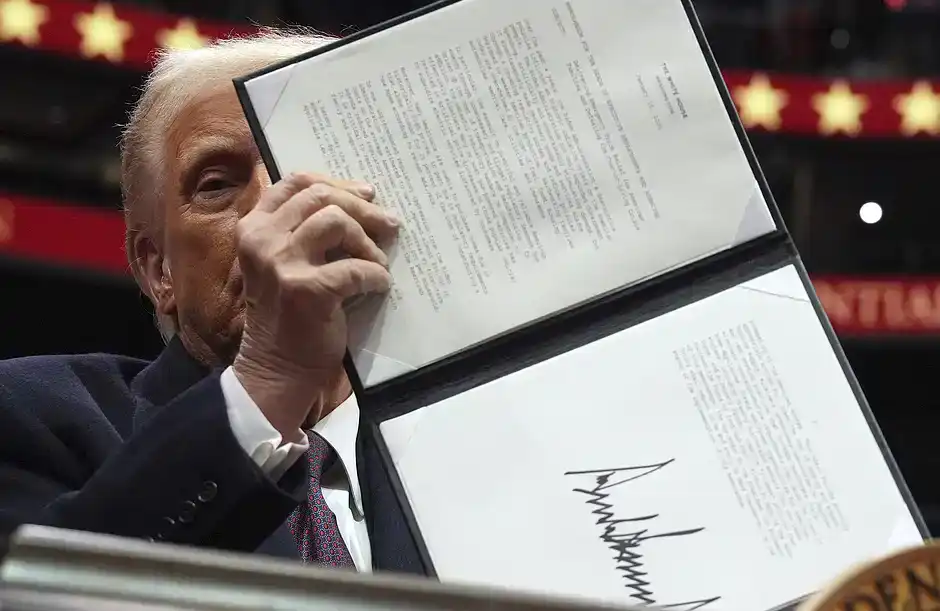
Les 43 minutes de Trump : la narration du leader fort déraille, la guerre médiatique s'intensifie

Lors de sa première apparition publique après plus d'une semaine d'absence, le président américain Donald Trump a tenu une conférence de presse de 43 minutes, marquée par des attaques répétées contre des journalistes, des villes américaines et des adversaires politiques. Plutôt que d'aborder directement les questions urgentes concernant sa santé, l'Iran ou les fissures au sein de son parti, il a longuement parlé d'un projet de rénovation d'un bassin d'ornement, comparé la taille de ses rassemblements à celui de Martin Luther King, et signé un décret affaiblissant les protections d'emploi de milliers de hauts fonctionnaires fédéraux. L'article décrit un président apparaissant irritable, défensif et incontrôlé, interrompant soudainement l'événement avant d'être rapidement conduit hors de la salle par son personnel. Il analyse cette performance comme le symptôme d'une concentration du pouvoir personnel et d'un affaiblissement des contraintes institutionnelles, où la loyauté prime sur la compétence. La seconde partie se concentre sur les attaques contre la presse, illustrées par l'échange hostile avec une journaliste de CNN et le licenciement d'un vétéran de CBS qui dénonçait des ingérences éditoriales. L'auteur soutient que la pression du pouvoir politique et des intérêts commerciaux menace l'indépendance des médias traditionnels, faisant des journalistes et créateurs indépendants des acteurs cruciaux pour préserver les faits. Il appelle à soutenir financièrement ces voix indépendantes comme forme de résistance face à un exécutif qui cherche à saper la confiance dans l'information et à récompenser l'obéissance. L'article se conclut sur une note d'espoir, notant que des élus républicains ont commencé à se distancer de Trump, votant symboliquement contre ses actions militaires en Iran.

marsbitIl y a 4 h

Les 43 minutes de Trump : la narration du leader fort déraille, la guerre médiatique s'intensifie

marsbitIl y a 4 h

Kalshi, MTS et l'ambition de a16z

Le marché des prédictions, illustré par des plateformes comme Kalshi, connaît un regain d'intérêt en 2025, suscitant l'enthousiasme des investisseurs, des acteurs de la cryptomonnaie et des médias. Cet engouement dépasse les simples opportunités de régulation ou de revenus, touchant à une dimension philosophique plus profonde. L'article retrace l'évolution intellectuelle du concept, depuis les théories de Hayek sur la connaissance dispersée dans la société, jusqu'aux mécanismes incitatifs comme le LMSR de Robin Hanson, conçus pour révéler l'information. Cependant, c'est l'entrée en jeu du géant du capital-risque a16z, avec son investissement massif dans Kalshi, qui marque un tournant. a16z voit dans le marché des prédictions bien plus qu'un produit financier : un nouvel outil médiatique fondamental. Il répondrait au désir contemporain de "présence" et d'action face à un monde de plus en plus médiatisé et déterministe. En pariant de l'argent réel sur des événements mondiaux, l'utilisateur passerait du statut de spectateur passif à celui d'observateur actif et impliqué, recouvrant un sentiment d'agency. Cette capacité à générer de l'engagement et à définir la réalité par les prix du marché (établissant la véracité et l'importance des événements) en ferait une pièce maîtresse de l'empire des "nouveaux médias" qu'a16z cherche à construire. Cet empire, illustré par des acteurs comme MTS, se caractérise par une production et une diffusion d'information extrêmement rapides et intenses, visant à "s'approprier la timeline". La valeur ultime de Kalshi résiderait ainsi dans son puissant "champ de distorsion de la réalité" : sa capacité, via le poids de l'argent engagé par la foule, à influencer la perception collective du futur et à s'imposer comme un arbitre de la vérité, conférant à une entreprise privée une influence historique rare.

marsbitIl y a 5 h

Kalshi, MTS et l'ambition de a16z

marsbitIl y a 5 h

Changement de cap mondial chez a16z : Le capital-risque devient le « moteur » de l'alliance technologique américaine

L’annonce de Ben Horowitz marque un virage stratégique majeur dans la globalisation d’a16z. Le fonds ne se contente plus de rechercher des projets à l’étranger, mais s’inscrit dans un cadre plus large de compétition technologique et de coopération entre alliés, explicitement lié au leadership technologique des États-Unis et de leurs partenaires. Dans un contexte où l’IA, la robotique, la cybersécurité et les chaînes d’approvisionnement deviennent des enjeux de compétition nationale, le rôle des VC évolue. A16z renforce ses capacités pour aider ses startups à naviguer dans des environnements complexes, mêlant marchés, régulations et géopolitique. Les initiatives clés incluent : l’ouverture d’un bureau à Tokyo, la nomination d’Anne Neuberger (ancienne responsable gouvernementale) comme associée chargée des affaires mondiales pour conseiller sur la politique et la géopolitique, et la transformation de l’équipe relations investisseurs en une équipe « Partenaires Mondiaux » pour faciliter les connexions et le déploiement international des entreprises. L’objectif reste de soutenir les meilleures entreprises technologiques partout dans le monde (plus de 100 investissements internationaux à ce jour), mais avec une mission élargie : être un organisateur reliant les startups aux capacités nationales, aux ressources industrielles et au réseau des alliés, contribuant ainsi à la compétitivité technologique des États-Unis et de leurs alliés.

marsbitIl y a 6 h

Changement de cap mondial chez a16z : Le capital-risque devient le « moteur » de l'alliance technologique américaine

marsbitIl y a 6 h

Kalshi, MTS et les ambitions d'a16z

Les marchés prédictifs, représentés par Kalshi, émergent comme un domaine clé en 2025, attirant fonds d'investissement, acteurs de la cryptomonnaie et médias. Leur importance dépasse la simple spéculation. Leur évolution conceptuelle remonte à Hayek (l'utilisation de la connaissance dans la société) et à Robin Hanson (mécanisme LMSR pour inciter à la révélation d'informations), avec l'idée utopique d'une « futarchie ». L'intérêt de a16z, qui a investi dans Kalshi (évalué à 220 milliards de dollars), va au-delà du modèle économique. Leur thèse centrale est que les marchés prédictifs offrent un « sentiment de présence » et une forme d'« anti-cynisme » dans un monde moderne où les individus se sentent déconnectés. En pariant sur des événements mondiaux, l'utilisateur devient un « observateur superlatif », investi et influençant la perception collective. Cela s'inscrit dans la vision de « nouveaux médias » de a16z : un écosystème médiatique complet et rapide qui « s'approprie la timeline », comme le démontre MTS (Monitoring The Situation), un média en continu sur Twitter. Kalshi ajoute à ce dispositif une autorité unique car ses prix reflètent des paris en argent réel, lui conférant un pouvoir de « distorsion de la réalité » pour définir la vérité et l'importance des événements. C'est ce pouvoir, rarement détenu par une entreprise privée, qui justifierait sa valorisation faramineuse et en ferait une pièce maîtresse de l'empire médiatique de a16z.

链捕手Il y a 6 h

Kalshi, MTS et les ambitions d'a16z

链捕手Il y a 6 h

Trading

Spot
Futures

Articles tendance

Comment acheter CHIP

Bienvenue sur HTX.com ! Nous vous permettons d'acheter USD.AI (CHIP) de manière simple et pratique. Suivez notre guide étape par étape pour commencer votre parcours crypto.Étape 1 : Création de votre compte HTXUtilisez votre adresse e-mail ou votre numéro de téléphone pour ouvrir un compte sur HTX gratuitement. L'inscription se fait en toute simplicité et débloque toutes les fonctionnalités.Créer mon compteÉtape 2 : Choix du mode de paiement (rubrique Acheter des cryptosCarte de crédit/débit : utilisez votre carte Visa ou Mastercard pour acheter instantanément USD.AI (CHIP).Solde :utilisez les fonds du solde de votre compte HTX pour trader en toute simplicité.Prestataire tiers :pour accroître la commodité d'utilisation, nous avons ajouté des modes de paiement populaires tels que Google Pay et Apple Pay.P2P :tradez directement avec d'autres utilisateurs sur HTX.OTC (de gré à gré) : nous offrons des services personnalisés et des taux de change compétitifs aux traders.Étape 3 : stockage de vos USD.AI (CHIP)Après avoir acheté vos USD.AI (CHIP), stockez-les sur votre compte HTX. Vous pouvez également les envoyer ailleurs via un transfert sur la blockchain ou les utiliser pour trader d'autres cryptos.Étape 4 : tradez des USD.AI (CHIP)Tradez facilement USD.AI (CHIP) sur le marché Spot de HTX. Il vous suffit d'accéder à votre compte, de sélectionner la paire de trading, d'exécuter vos trades et de les suivre en temps réel. Nous offrons une expérience conviviale aux débutants comme aux traders chevronnés.

325 vues totalesPublié le 2026.04.21Mis à jour le 2026.06.02

Comment acheter CHIP

Discussions

Bienvenue dans la Communauté HTX. Ici, vous pouvez vous tenir informé(e) des derniers développements de la plateforme et accéder à des analyses de marché professionnelles. Les opinions des utilisateurs sur le prix de CHIP (CHIP) sont présentées ci-dessous.

活动图片