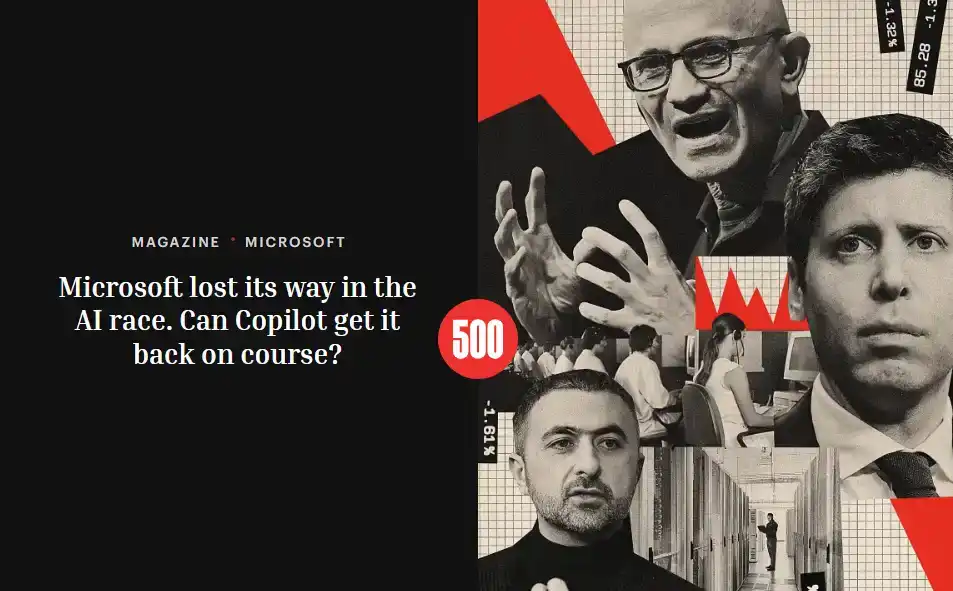
Has Microsoft Lost Its Way in the AI Race, and Can Copilot Bring It Back on Track?

marsbitPublié le 2026-05-23Dernière mise à jour le 2026-05-23

Résumé

Microsoft, once seen as an early AI frontrunner due to its investment in OpenAI, is navigating a strategic shift amid increased competition. Its initial reliance on OpenAI’s GPT models has been complicated by OpenAI’s growing ambitions as a direct competitor, rapid advancements from rivals like Claude and Gemini, and the disruptive rise of AI agents, which challenge its traditional SaaS business model. These factors contributed to stock declines and slower-than-expected adoption of its flagship Copilot products. In response, CEO Satya Nadella has taken a hands-on role in product development, signaling the urgency of change. Microsoft is pivoting from a model-centric strategy to a "model-agnostic" enterprise platform approach. It aims to become the foundational layer connecting various AI models—from OpenAI, Anthropic, or its own new "Superintelligence" team—with enterprise workflows, data, security, and cloud services. Recent organizational changes merged consumer and enterprise Copilot teams to accelerate innovation, exemplified by new products like Copilot Tasks and Copilot Cowork. However, this transformation comes at a high cost. Microsoft faces massive capital expenditures, potentially reaching ~$190 billion by 2026, to support AI infrastructure. While its platform strategy shows early signs of traction with growing Azure AI revenue, it must balance startup-like agility with the reliability expected by enterprise clients. The core challenge is no longer being the sole ...

Editor's Note: Microsoft was once one of the first tech giants to place a winning bet on OpenAI in the generative AI wave. Thanks to its investment in OpenAI and exclusive cloud partnership, Microsoft was initially seen as the most certain winner of the AI era: Azure gained model advantages, and its Office, Bing, GitHub, and enterprise software lines were fully integrated with Copilot. Satya Nadella, like he did leading Microsoft's shift to the cloud, was expected to orchestrate another platform-level migration.

But two years later, Microsoft's advantages have become more complicated. OpenAI is no longer just Microsoft's technology supplier, but also a direct competitor vying for enterprise customers. Models like Claude and Gemini have rapidly caught up, diminishing the sense of lead brought by GPT's exclusivity. The emergence of AI Agents further challenges the long-term SaaS business model that Microsoft relies on. Stock price pullbacks, slower-than-expected Copilot paid adoption rates, and GitHub Copilot being overtaken by Cursor and Claude Code have forced Microsoft to re-evaluate its AI strategy.

The most noteworthy aspect of this article is not whether Microsoft can catch up to OpenAI, Anthropic, or Google in model capabilities, but that Microsoft is attempting to redefine its position: it is no longer betting entirely on a single model, but shifting towards an "model-agnostic" enterprise AI platform strategy. In other words, Microsoft wants to become the foundational layer connecting models, data, security, workflows, cloud computing, and enterprise software. Models can come from OpenAI, Anthropic, or even in the future from Microsoft's own Superintelligence team. What truly stays within Microsoft's ecosystem is the enterprise customer's work platform, data assets, development environment, and security framework.

This is also the context for Nadella personally getting involved in Copilot product development. For Microsoft, the AI competition is no longer just a model race between labs, but a systematic competition about organizational speed, product form, customer relationships, and capital expenditure. Claude Code and Claude Cowork have shown that AI Agents could reshape software development and office workflows; open-source projects like OpenClaw indicate that an "always-on" AI assistant is moving from concept to reality. What Microsoft must do is package these more radical AI-native experiences within the security, compliance, and governance frameworks acceptable to enterprise clients.

However, the cost of this path is not low. To catch up with cutting-edge models and support agent-based products, Microsoft is pushing the AI competition towards "gigawatt-scale" infrastructure investment: more data centers, larger chip clusters, higher capital expenditure. By 2026, Microsoft's capital expenditure is expected to reach about $190 billion. In other words, Microsoft in the AI era must both experiment rapidly like a startup and sustain heavy asset investments like a cloud computing giant.

The real problem Microsoft faces is not whether it can remain the sole winner of the AI era, but whether it can continue to hold the core gateway to enterprise software amid rapidly commoditizing models and ongoing disruption of software business models by Agents. For Nadella, this may not be an ordinary product adjustment, but more like Microsoft's second startup phase during this AI platform migration.

The following is the original text:
Mid-January 2026, Redmond, Washington. The weather was cold, gray, and dark, the kind of morning perfect for hitting the snooze button. But inside Building 92 on Microsoft's sprawling campus, a team of engineers had already arrived early.

They were fighting a tough battle, and they were already behind.

This team was developing a new AI product. It was more of a personal assistant, capable of helping users book flights, reply to emails, even find a reliable local plumber. The team members were well aware that other tech companies were developing similar products. Right at that moment, Microsoft CEO Satya Nadella arrived on the scene. He wanted to show them something.

Nadella opened his laptop and launched an application. It was a system for directing and controlling multiple AI Agents, which he called a "Chain of Debate." Nadella demonstrated it while explaining to the engineers. Team members exchanged knowing glances, like seasoned basketball players suddenly realizing a new teammate actually knew how to play.

Because this application wasn't something Nadella had asked someone else to build for him; he had written it himself using an AI tool called "vibe coding."

"It really set the tone for how hard the team was going to push over the coming weeks," recalls Jacob Andreou, Microsoft Executive Vice President in charge of Copilot design. Nadella was in the same room with them, almost standing behind the engineers, opening his own laptop and participating.

Seeing the CEO so excited about building a new product hands-on energized the team. By late February, the sprint concluded, and Microsoft launched Copilot Tasks—an AI tool that acts as a personal assistant capable of using a computer. The prototype Nadella had built also served as a reference model for a feature called "model council" within Copilot and other components.

But the fact that Nadella is diving this deeply and frequently into AI product teams, even personally building prototypes, itself speaks to Microsoft's current situation. After all, this is a $3 trillion tech giant, not a scrappy startup where the CEO frequently codes alongside developers during sprints.

Nadella's concern about Microsoft's AI strategy is evident enough. Last October, he announced he would step back from some commercial duties to focus more on AI research, product innovation, and AI data center construction.

This concern is not unfounded. Microsoft's stock had gone through a tough period. After hitting an all-time high last October, over the next five months, Microsoft's stock price fell by about 34%. Meanwhile, AI-related revenue for Microsoft's cloud platform Azure more than doubled over the past year.

Microsoft also became a poster child for the so-called "SaaSpocalypse" (SaaS Armageddon sell-off). The emergence of AI coding Agents triggered a collective sell-off of software stocks. Many investors began to believe such products meant companies would no longer buy AI products from SaaS vendors like Microsoft in the future, and might not even buy off-the-shelf software at all.

Between October 28, 2025, and March 27, 2026, Microsoft's stock price fell by 34%. Sales of Microsoft's enterprise Copilot product were also slower than the company expected. Among the 450 million users of the Microsoft 365 office suite, less than 4.5% currently pay for Copilot features. Meanwhile, usage of the consumer-facing Copilot chatbot also lags far behind ChatGPT, Gemini, and Claude. The once-leading AI coding assistant GitHub Copilot was also overtaken by AI startups Cursor and Anthropic's Claude Code.

Two years ago, Microsoft looked like one of the earliest winners of the AI era. Thanks to Nadella's foresighted bet on OpenAI, Microsoft gained exclusive access to the models of this rapidly growing AI startup and could integrate them into its own product suite. If enterprises wanted to use OpenAI's technology, the only cloud service provider they could choose was Microsoft Azure. Microsoft even once believed OpenAI gave it its best chance in years to challenge Google Search.

At that time, Nadella had been at Microsoft's helm for a decade. He had led Microsoft's platform migration from desktop software to the cloud, and now seemed poised to replicate that success in the AI era.

But AI changes too fast. Two years is already a long cycle. The story that follows is how Microsoft missed its early AI lead, and how it is trying to regain the initiative.

What Went Wrong

Microsoft's initial position at the forefront of the AI race was precisely due to its partnership with OpenAI; but what partly put it on the back foot was also this same partnership.

Microsoft spotted this young San Francisco company early, first investing $1 billion in 2019, with total committed investment in OpenAI reaching $13 billion later. Microsoft used OpenAI's technology to launch a series of AI products branded as Copilot across its consumer and enterprise software lines.

But after ChatGPT's release in late 2022, OpenAI's explosive growth and rapidly expanding ambitions quickly strained the relationship. The two companies clashed on multiple issues: on computing resources, OpenAI always wanted more; on intellectual property, Microsoft believed OpenAI wasn't fulfilling contractual obligations to share technological innovations promptly enough; on customer relationships, OpenAI began directly pitching AI models to the same enterprise customers Microsoft was also selling Copilot to; and when OpenAI sought restructuring, they disagreed over how much equity Microsoft should receive in the new for-profit company.

Nadella knew betting Microsoft's AI strategy on a single, not-yet-fully-proven startup was inherently risky. In November 2023, that risk was laid bare: the non-profit board controlling OpenAI's for-profit business fired CEO Sam Altman for "not being consistently candid," notifying Nadella only minutes before announcing the decision publicly.

Nadella had to quickly reassure investors, emphasizing Microsoft still had access to OpenAI's technology; simultaneously, he collaborated with Altman to pressure the board to reverse its decision. Nadella announced Microsoft was prepared to hire Altman and any OpenAI employees willing to follow him to Microsoft. The threat of a mass exodus ultimately forced the board to relent and reinstate Altman.

Within OpenAI, this five-day crisis later became known as "the blip." But according to people familiar with Nadella's thinking, it shook him deeply. He had to find a hedge for Microsoft's AI bets.

"When Nadella joined an AI engineer team's sprint, it really set the tone for how hard the team was going to push over the coming weeks." —Jacob Andreou, Microsoft Copilot Executive Vice President

Microsoft's Plan B was Mustafa Suleyman.

Suleyman is a co-founder of Google DeepMind who later left to start his own AI startup, Inflection. In March 2024, Microsoft hired Suleyman and Inflection's technical team in a $650 million deal, also licensing its technology. Suleyman was then appointed CEO of Microsoft's new AI division, abbreviated as MAI. Its responsibilities were twofold: first, building Microsoft's own cutting-edge models as a hedge against OpenAI risk; second, expanding the user base of Microsoft's Copilot chatbot.

But this step didn't go smoothly. Microsoft's partnership agreement with OpenAI prohibited it from training models beyond a certain size. Suleyman told Fortune: "We were essentially limited to training Microsoft's own native models, and only up to the scale of SLMs, or small language models."

MAI's first publicly tested general-purpose language model, named MAI-1 preview, launched in August 2025 but ranked quite low on various performance leaderboards and was never widely released.

MAI also failed to turn the Copilot chatbot into a consumer hit. According to media reports, a year after Suleyman took over, Copilot usage stagnated at around 20 million weekly active users, while ChatGPT's user base soared, eventually approaching 900 million. In 2025, Microsoft attempted a major upgrade of Copilot to make it more like a personal assistant capable of performing tasks, but this upgrade did not reignite growth. As for the new AI-powered version of Bing search, it also barely dented Google's share of the search market.

Meanwhile, Plan A also began to encounter trouble.

In 2023, OpenAI's GPT models led the industry by a wide margin. But by early 2025, Anthropic's Claude was often topping AI leaderboards, and many enterprises preferred it for complex tasks. Google's Gemini also became increasingly competitive in visual tasks. Yet Microsoft's Copilot products were still entirely powered by GPT. The engine that once underpinned Microsoft's AI strategy was starting to feel like a heavy burden.

Microsoft Commercial CEO Judson Althoff admits the company made several mistakes. First, naming both consumer and enterprise products "Copilot" was inherently confusing. Althoff, who holds a private pilot's license, quipped: "The only thing worse than not having a copilot is having more than one copilot."

Microsoft also incentivized sales reps to promote both free and premium versions of the enterprise M365 Copilot, but only the premium version truly delivered value for enterprise clients. "We got that wrong," he said.

Microsoft was also struggling to keep pace with the speed of AI evolution. A key turning point came in 2025 when Anthropic released Claude Code. Developers simply describe what they want, and it can autonomously write complete programs. This was no longer a "copilot," but "autopilot." Within six months, it reshaped software development.

Then in January this year, Anthropic launched Claude Cowork. This is an Agent capable of using software, including Microsoft productivity tools like Excel and PowerPoint, and autonomously completing tasks.

Claude Cowork poses a serious challenge to M365 Copilot and the AI Agents Microsoft has been pushing clients to adopt. In fact, it threatens not just Microsoft, but most commercial software. It was this realization that triggered the so-called "SaaSpocalypse" software stock sell-off. Ultimately, over $2 trillion was wiped from tech market value, including a single-day $357 billion plunge in Microsoft's market cap.

How Microsoft is Correcting Course

By the fall of 2025, Nadella realized Microsoft had to reboot its AI strategy. Since then, the company's actions reflect a difficult balancing act: on one hand, it must innovate quickly like an AI startup; on the other, it must still reliably serve investors and enterprise clients like the steady Microsoft of old.

Nadella handed off many commercial and day-to-day operational duties to Microsoft veteran Althoff so he could focus on AI product development. Althoff says he handles "Horizon Zero and Horizon One," while Nadella handles "Horizon Two and Horizon Three." Meanwhile, Nadella began breaking down internal silos, making Microsoft faster, flatter, and more agile.

In March this year, Nadella merged the consumer and enterprise Copilot teams. Suleyman no longer oversees consumer AI products, instead leading a renamed model development project: the Superintelligence team. Suleyman says the name reflects the team's ambition and helps attract top researchers.

Jacob Andreou joined Microsoft in 2025, previously at Snap and venture firm Greylock. He now oversees both consumer and enterprise Copilot Experience and reports directly to Nadella. Joining Suleyman and Andreou on the Copilot leadership team are three other Microsoft Executive Vice Presidents: Charles Lamanna, responsible for Copilot, AI Agents, and platform; Ryan Roslansky, responsible for Microsoft Office and LinkedIn; Perry Clarke, serving as Applications Chief Technology Officer.

Lamanna says: "We want it to be a back end, a brain, driving both the consumer side and the work side." Nadella himself attends the Copilot leadership team's weekly stand-up and participates in a dedicated Teams channel discussing Copilot development progress.

Microsoft faces a delicate balance: it must innovate fast enough to catch up with AI rivals like Anthropic and Google, yet must remain a reliable partner in the eyes of large enterprise customers.

Andreou points to two new products as evidence the unified Copilot team is operating as Nadella envisioned: one is Copilot Tasks for consumers, the product Nadella personally helped prototype in January; the other is Copilot Cowork for enterprise clients.

He says: "Both of those are basically frontier-level experiences, one for consumers, one for enterprise users. And they were both put together by our team pulling resources together and building them in a matter of weeks."

Microsoft has also agreed to OpenAI's long-pending restructuring, with significantly less restrictive terms. The software giant received a 27% equity stake in OpenAI. If OpenAI goes public as widely expected, this provides potential upside. But the exclusivity arrangements in the old agreement have been abandoned: OpenAI can now partner with other cloud providers, and Microsoft can use models from other AI companies.

Suleyman says the new agreement finally allows Microsoft to build larger, more capable frontier AI models and ultimately achieve self-sufficiency. But he adds it will still take Microsoft two to three years to catch up with top AI labs.

The reshaped partnership also allows Microsoft to embrace OpenAI's main rival, Anthropic. Last November, Microsoft pledged up to $5 billion in investment in Anthropic and began offering its models on Azure. The ability to power Copilot with Claude has proven popular with enterprise clients and helped Microsoft build Copilot Cowork.

"You've got to give credit: OpenAI and Anthropic are helping us go faster." —Judson Althoff, Microsoft Commercial CEO

But Microsoft isn't simply swapping dependence on one loss-making AI startup for another. The investment in Anthropic reflects Microsoft's judgment about industry direction: AI models will become increasingly commoditized. At least in the enterprise market, the real value won't concentrate solely in the AI "brain," but will shift to the tools, data, security, cloud computing, and workflow systems surrounding that brain.

This is precisely where Microsoft believes it can win.

It already possesses many key assets: software tools, security systems, data warehouses, and cloud computing capabilities. Microsoft has also built a series of products branded with "IQ" to help companies create customized workflows, aggregate their own data, and build, deploy, and monitor Agents running those workflows based on any AI model from any supplier.

Althoff says: "We don't believe enterprises will change their information work platform, their development environment, their security environment every time a new model drops."

This strategic pivot also brings a new business model.

Previously, Microsoft typically charged per-user licensing fees, such as $30 per user per month for Copilot. Customers liked this model because budgets were easier to plan. But if the AI Agents within these products use models Microsoft doesn't own, Microsoft must pay corresponding token usage fees to the AI supplier.

Therefore, Microsoft has begun shifting to a hybrid pricing model: a base portion still charged per user license, including a limited token quota; any excess is billed per token. This is to avoid the "model-agnostic" strategy eroding profit margins.

For cost control, Microsoft has also started streamlining its workforce. In April this year, Microsoft announced its first-ever voluntary employee severance program, primarily targeting its longest-tenured employees. The company said about 7% of its U.S. workforce, roughly 8,750 employees, were eligible for the program, with an expected cost of $900 million.

There are signs Microsoft's adjusted enterprise strategy is working. As of the end of March, Azure revenue grew 40% year-over-year, and Microsoft's overall AI business reached $37 billion in annualized sales, up 123% year-over-year. Currently, 20 million M365 users pay for Copilot, a quarter of whom signed up in the first four months of 2026. Althoff says adoption is accelerating.

UBS analyst Karl Keirstead says more Microsoft customers are telling him they're starting to see Copilot's value. But overall user numbers remain unsatisfactory. He says: "I don't think they're at a penetration rate yet that Wall Street would be happy with."

Microsoft's "model-agnostic" strategy may also have a vulnerability: what if those high-profile AI startups also begin building Microsoft-style enterprise tools and connective systems?

This is no longer hypothetical. In February this year, OpenAI launched its Frontier platform for enterprises, offering many capabilities Microsoft is building into its new tools. Anthropic is also moving in this direction, launching Claude Managed Agents service.

Microsoft's argument is that decades of enterprise customer relationships, reputation for reliability and security, and deep integration with customers' existing software systems give it an advantage. Althoff says he welcomes the competition. "You've got to give credit: OpenAI and Anthropic are helping us go faster," he says.

But some question whether a company of Microsoft's size can truly match the agility of AI-native startups. UBS's Keirstead says: "Microsoft, and frankly all software companies, are facing something they haven't faced in over a decade: highly innovative, brand-new competitors. Expecting a large incumbent like Microsoft to pivot as quickly as OpenAI and Anthropic is probably asking too much."

Bank of America analyst Tal Liani sides with "Team Nadella." He believes AI companies are unlikely to build the full suite of products Microsoft offers. This means Microsoft doesn't necessarily have to win the AI race; it just needs to not lose it.

He says: "It doesn't have to be the best, as long as it's good enough, and when you bundle it you get a high value, that's really Microsoft's value proposition."

Yet, even just "not losing" comes at a high cost.

Like other hyperscale cloud providers, Microsoft is spending huge sums on data centers and specialized chips. In fiscal year 2025, Microsoft's capital expenditure reached $88.2 billion, roughly on par with peers like Google Cloud and Amazon AWS. But in hindsight, this was still too conservative. Surging demand left Microsoft short on computing power and unable to recognize signed AI revenue as actual revenue at the expected pace.

"I thought we would catch up," CFO Amy Hood admitted on last October's earnings call. "We have not."

Now, Microsoft is doubling down. The company expects capital expenditure in 2026 could reach about $190 billion, more than triple its 2024 spending. Wall Street, once nervous about such spending levels, now seems willing to tolerate these massive investments. But if investor sentiment reverses, Microsoft will be more exposed to risk than ever before.

In November 2025, an independent developer named Peter Steinberger released OpenClaw. This is a free, open-source system that can turn any AI model into a long-running, autonomous, always-on Agent: it can develop software, act as a virtual executive assistant, even manage inventory for an online store.

OpenClaw became popular among developers and AI power users. Reportedly, Nadella is one of them.

But OpenClaw, while popular, has a clear problem: to truly function, it needs access to systems, data, payment information, and passwords, making it extremely risky. It also consumes tokens at a staggering rate.

Nadella said at a tech conference in San Francisco in March: "I can't launch OpenClaw at Microsoft. I don't have the authority to do that, because it would be considered Microsoft releasing a virus. But at the same time, it is an incredible innovation."

Nadella has tasked the unified Copilot team with building Microsoft's version of OpenClaw: one that retains the fun and ease-of-use of a consumer-grade product while having the security and governance capabilities enterprises require. Andreou sees this as a test for the new organization: "That's what we call winning here."

Lamanna believes this could be the key to igniting Copilot growth. He says: "The hardest problem has always been: how do you help people change the way they work?"

If a perpetually running AI assistant is truly feasible, it will make that change easier to happen. It also means the basic unit of AI will shift from "model" to "always-on Agent." This is precisely the kind of paradigm shift that will test whether Microsoft's "connective tissue" strategy can hold when the core form factor changes. Lamanna says an enterprise-grade Microsoft version of OpenClaw is not far off.

"Gigawatt" Scale

The week of March 30, Suleyman gathered the new Superintelligence team in Miami for a three-day offsite. The team, about 500 people from around the world, met to chart a roadmap for achieving "gigawatt-scale" AI training runs. Training at this scale would enable Microsoft to compete directly with OpenAI, Anthropic, Google DeepMind, Meta, and xAI.

Suleyman says this is crucial for Microsoft to achieve self-sufficiency by 2030. Microsoft will lose access to OpenAI's technology in 2032.

The entire team gathered in a large ballroom to hear keynote speeches from Suleyman and Nadella and participate in an "Ask Me Anything" session. According to Suleyman, Nadella described this moment as Microsoft's "refounding of the company" in response to the AI platform shift.

This is a telling statement.

After the keynote, the meeting broke into different workstreams. Teams huddled around 40 whiteboards placed around the ballroom, brainstorming and planning eight-week sprints. Nadella didn't leave; he stayed.

For the next three hours, he moved from table to table, talking with researchers, offering suggestions, sharing ideas.

If this is truly a "refounding," then Nadella is playing the role of startup CEO. He takes no advantage for granted. He knows Microsoft could lose everything, and still has everything to fight for.


Questions liées

QWhat was Microsoft's initial strategy in the generative AI race, and why has it become complicated?

AMicrosoft's initial strategy was to leverage its exclusive partnership and investment in OpenAI, integrating GPT models into its product suite (Azure, Office, Bing, GitHub) under the Copilot brand. This positioned it as an early leader. However, the advantage became complicated because OpenAI started competing directly for enterprise clients, rival models like Claude and Gemini closed the capability gap, and the rise of AI Agents began to challenge Microsoft's core SaaS business model.

QHow is Microsoft redefining its AI strategy to address current challenges?

AMicrosoft is shifting from a model-centric strategy to a 'model-agnostic' enterprise AI platform strategy. It aims to become the foundational layer connecting models, data, security, workflows, and cloud services. The value proposition is no longer just the AI 'brain' (which can be sourced from OpenAI, Anthropic, or its own teams) but the secure, integrated platform where enterprise work, data, and applications reside.

QWhat key challenges and setbacks did Microsoft's Copilot products face according to the article?

AKey challenges and setbacks include: less than 4.5% of Microsoft 365's 450 million users paying for Copilot; consumer Copilot usage lagging far behind ChatGPT, Gemini, and Claude; GitHub Copilot being overtaken by competitors like Cursor and Claude Code; and the broader 'SaaSpocalypse' market sell-off triggered by AI Agents threatening traditional SaaS business models.

QWhat is the significance of Microsoft's increased capital expenditure, particularly the projection for 2026?

AThe projected capital expenditure of approximately $190 billion in 2026 (triple the 2024 spend) signifies the immense cost of staying competitive in the AI era. This 'gigawatt-scale' investment is for data centers and specialized chips needed to train frontier AI models and support agent-based products. It reflects a dual challenge: innovating like a startup while maintaining the massive infrastructure investments of a cloud giant.

QHow does Satya Nadella's direct involvement in AI product development reflect Microsoft's current situation?

ASatya Nadella's hands-on involvement, including personally coding prototypes (like the 'Chain of Debate' system) and participating in engineering sprints, signals a high level of strategic urgency. It reflects that Microsoft is in a fight to catch up and reinvent itself, requiring startup-like speed and agility that is unusual for a $3 trillion corporation. His shift in focus from commercial duties to AI innovation underscores the pivotal nature of this platform transition for the company's future.

Lectures associées

Le PDG de Bit Digital : Pourquoi je continue d'augmenter mes positions en ETH

Le PDG de Bit Digital, Sam Tabar, explique pourquoi il continue d'accumuler de l'ETH. Il base sa décision sur l'analyse des données et non sur les cycles ou les récits du marché, estimant que l'actif est sous-évalué. Il rejette l'idée de considérer l'ETH comme une simple monnaie, un cadre plus adapté au Bitcoin. L'Ethereum, selon lui, a choisi l'utilité en créant une couche de règlement programmable sur laquelle le monde construit activement. Sa valeur réside dans cette utilité institutionnelle concrète : émission de stablecoins, tokenisation de bons du Trésor américain et règlement de transactions d'agents IA. Tabar répond aux critiques sur la fragmentation de l'écosystème en soulignant que le capital institutionnel n'a pas besoin qu'Ethereum gagne une guerre de narration. Il a besoin d'une infrastructure fiable et éprouvée, ce qu'Ethereum fournit déjà à grande échelle, combinant calcul (via des partenariats comme WhiteFiber) et règlement. Il conteste l'idée que le potentiel de l'ETH soit épuisé, arguant que le vrai catalyseur de la revalorisation sera la demande institutionnelle, qui suivra la mise en place des cadres réglementaires et de garde adaptés. Enfin, il justifie son achat par un devoir fiduciaire : l'ETH est un actif générateur de revenus (avec une marge brute de 94,7% pour le staking au premier trimestre) qui sécurise la principale plateforme de contrats intelligents, traitant des milliers de milliards de dollars de transactions. Il n'a pas besoin qu'il devienne une monnaie de réserve mondiale, seulement qu'il continue son travail actuel à un prix qu'il juge attractif.

marsbitIl y a 16 mins

Le PDG de Bit Digital : Pourquoi je continue d'augmenter mes positions en ETH

marsbitIl y a 16 mins

Claude Opus 4.8 est lancé, Anthropic commence à vendre la « fiabilité » comme un argument de vente

Anthropic a publié Claude Opus 4.8, une mise à jour majeure où la « fiabilité » devient un argument central. Si le modèle obtient cinq premières places sur six tests de référence officiels, l'amélioration cruciale concerne sa capacité à signaler ses propres erreurs. Dans les tests d'honnêteté en synthèse de code, son taux de non-déclaration d'erreurs est passé de 19,7% à 3,7%. La version intègre également un flux de travail dynamique dans Claude Code (en préversion), permettant à l'agent d'orchestrer des sous-agents et d'effectuer des vérifications contradictoires avant de livrer un résultat. Cette avancée vise directement le problème des réponses erronées mais apparemment cohérentes, un frein majeur au déploiement de l'IA dans des workflows réels. Le modèle montre des progrès notables en mathématiques (+27 points sur l'USAMO 2026) et dans les tâches à contexte long, tandis que son efficacité token s'est améliorée. Cependant, le rapport système note quelques régressions, comme une légère baisse sur un test scientifique expert (GPQA Diamond). Face aux modèles open-source performants et bien moins chers, Opus 4.8 mise sur sa fiabilité supérieure pour justifier son prix (inchangé). Anthropic positionne cette version comme un prélude au modèle « Mythos », bien plus puissant mais d'accès restreint et coûteux, attendu dans les prochaines semaines. Cette évolution signale un tournant : la compétition entre modèles de pointe se déplace des performances brutes vers la confiance et la vérifiabilité, conditions essentielles pour confier des tâches critiques.

marsbitIl y a 2 h

Claude Opus 4.8 est lancé, Anthropic commence à vendre la « fiabilité » comme un argument de vente

marsbitIl y a 2 h

Trading

Spot
Futures

Articles tendance

Qu'est ce que GROK AI

Grok AI : Révolutionner la technologie conversationnelle à l'ère du Web3 Introduction Dans le paysage en évolution rapide de l'intelligence artificielle, Grok AI se distingue comme un projet remarquable qui fait le lien entre les domaines de la technologie avancée et de l'interaction utilisateur. Développé par xAI, une entreprise dirigée par l'entrepreneur renommé Elon Musk, Grok AI cherche à redéfinir notre engagement avec l'intelligence artificielle. Alors que le mouvement Web3 continue de prospérer, Grok AI vise à tirer parti de la puissance de l'IA conversationnelle pour répondre à des requêtes complexes, offrant aux utilisateurs une expérience à la fois informative et divertissante. Qu'est-ce que Grok AI ? Grok AI est un chatbot IA conversationnel sophistiqué conçu pour interagir dynamiquement avec les utilisateurs. Contrairement à de nombreux systèmes d'IA traditionnels, Grok AI embrasse une gamme plus large de questions, y compris celles généralement jugées inappropriées ou en dehors des réponses standard. Les objectifs principaux du projet incluent : Raisonnement fiable : Grok AI met l'accent sur le raisonnement de bon sens pour fournir des réponses logiques basées sur une compréhension contextuelle. Surveillance évolutive : L'intégration de l'assistance par outils garantit que les interactions des utilisateurs sont à la fois surveillées et optimisées pour la qualité. Vérification formelle : La sécurité est primordiale ; Grok AI intègre des méthodes de vérification formelle pour améliorer la fiabilité de ses résultats. Compréhension à long terme : Le modèle IA excelle dans la rétention et le rappel d'une vaste histoire de conversation, facilitant des discussions significatives et conscientes du contexte. Robustesse face aux adversaires : En se concentrant sur l'amélioration de ses défenses contre les entrées manipulées ou malveillantes, Grok AI vise à maintenir l'intégrité des interactions des utilisateurs. En essence, Grok AI n'est pas seulement un dispositif de récupération d'informations ; c'est un partenaire conversationnel immersif qui encourage un dialogue dynamique. Créateur de Grok AI Le cerveau derrière Grok AI n'est autre qu'Elon Musk, une personne synonyme d'innovation dans divers domaines, y compris l'automobile, le voyage spatial et la technologie. Sous l'égide de xAI, une entreprise axée sur l'avancement de la technologie IA de manière bénéfique, la vision de Musk vise à remodeler la compréhension des interactions avec l'IA. Le leadership et l'éthique fondatrice sont profondément influencés par l'engagement de Musk à repousser les limites technologiques. Investisseurs de Grok AI Bien que les détails spécifiques concernant les investisseurs soutenant Grok AI restent limités, il est publiquement reconnu que xAI, l'incubateur du projet, est fondé et soutenu principalement par Elon Musk lui-même. Les précédentes entreprises et participations de Musk fournissent un soutien solide, renforçant encore la crédibilité et le potentiel de croissance de Grok AI. Cependant, à l'heure actuelle, les informations concernant d'autres fondations d'investissement ou organisations soutenant Grok AI ne sont pas facilement accessibles, marquant un domaine à explorer potentiellement à l'avenir. Comment fonctionne Grok AI ? Les mécanismes opérationnels de Grok AI sont aussi innovants que son cadre conceptuel. Le projet intègre plusieurs technologies de pointe qui facilitent ses fonctionnalités uniques : Infrastructure robuste : Grok AI est construit en utilisant Kubernetes pour l'orchestration de conteneurs, Rust pour la performance et la sécurité, et JAX pour le calcul numérique haute performance. Ce trio garantit que le chatbot fonctionne efficacement, évolue efficacement et sert les utilisateurs rapidement. Accès aux connaissances en temps réel : L'une des caractéristiques distinctives de Grok AI est sa capacité à puiser dans des données en temps réel via la plateforme X—anciennement connue sous le nom de Twitter. Cette capacité permet à l'IA d'accéder aux dernières informations, lui permettant de fournir des réponses et des recommandations opportunes que d'autres modèles d'IA pourraient manquer. Deux modes d'interaction : Grok AI offre aux utilisateurs un choix entre le « Mode Amusant » et le « Mode Régulier ». Le Mode Amusant permet un style d'interaction plus ludique et humoristique, tandis que le Mode Régulier se concentre sur la fourniture de réponses précises et exactes. Cette polyvalence garantit une expérience sur mesure qui répond à diverses préférences des utilisateurs. En essence, Grok AI marie performance et engagement, créant une expérience à la fois enrichissante et divertissante. Chronologie de Grok AI Le parcours de Grok AI est marqué par des jalons clés qui reflètent ses étapes de développement et de déploiement : Développement initial : La phase fondamentale de Grok AI a eu lieu sur une période d'environ deux mois, au cours de laquelle l'entraînement initial et le réglage du modèle ont été réalisés. Lancement de la version bêta de Grok-2 : Dans une avancée significative, la bêta de Grok-2 a été annoncée. Ce lancement a introduit deux versions du chatbot—Grok-2 et Grok-2 mini—chacune équipée des capacités de discussion, de codage et de raisonnement. Accès public : Après son développement bêta, Grok AI est devenu accessible aux utilisateurs de la plateforme X. Ceux ayant des comptes vérifiés par un numéro de téléphone et actifs depuis au moins sept jours peuvent accéder à une version limitée, rendant la technologie disponible pour un public plus large. Cette chronologie encapsule la croissance systématique de Grok AI depuis sa création jusqu'à son engagement public, soulignant son engagement envers l'amélioration continue et l'interaction utilisateur. Caractéristiques clés de Grok AI Grok AI englobe plusieurs caractéristiques clés qui contribuent à son identité innovante : Intégration des connaissances en temps réel : L'accès à des informations actuelles et pertinentes différencie Grok AI de nombreux modèles statiques, permettant une expérience utilisateur engageante et précise. Styles d'interaction polyvalents : En offrant des modes d'interaction distincts, Grok AI répond à des préférences variées des utilisateurs, invitant à la créativité et à la personnalisation dans la conversation avec l'IA. Infrastructure technologique avancée : L'utilisation de Kubernetes, Rust et JAX fournit au projet un cadre solide pour garantir fiabilité et performance optimale. Considération du discours éthique : L'inclusion d'une fonction de génération d'images met en avant l'esprit innovant du projet. Cependant, elle soulève également des considérations éthiques concernant le droit d'auteur et la représentation respectueuse de figures reconnaissables—une discussion en cours au sein de la communauté IA. Conclusion En tant qu'entité pionnière dans le domaine de l'IA conversationnelle, Grok AI encapsule le potentiel d'expériences utilisateur transformantes à l'ère numérique. Développé par xAI et guidé par l'approche visionnaire d'Elon Musk, Grok AI intègre des connaissances en temps réel avec des capacités d'interaction avancées. Il s'efforce de repousser les limites de ce que l'intelligence artificielle peut accomplir tout en maintenant un accent sur les considérations éthiques et la sécurité des utilisateurs. Grok AI incarne non seulement l'avancement technologique mais aussi un nouveau paradigme de conversation dans le paysage Web3, promettant d'engager les utilisateurs avec à la fois une connaissance experte et une interaction ludique. Alors que le projet continue d'évoluer, il se dresse comme un témoignage de ce que l'intersection de la technologie, de la créativité et de l'interaction humaine peut accomplir.

483 vues totalesPublié le 2024.12.26Mis à jour le 2024.12.26

Qu'est ce que GROK AI

Qu'est ce que ERC AI

Euruka Tech : Un aperçu de $erc ai et de ses ambitions dans le Web3 Introduction Dans le paysage en évolution rapide de la technologie blockchain et des applications décentralisées, de nouveaux projets émergent fréquemment, chacun avec des objectifs et des méthodologies uniques. L'un de ces projets est Euruka Tech, qui opère dans le vaste domaine des cryptomonnaies et du Web3. L'objectif principal d'Euruka Tech, en particulier de son token $erc ai, est de présenter des solutions innovantes conçues pour exploiter les capacités croissantes de la technologie décentralisée. Cet article vise à fournir un aperçu complet d'Euruka Tech, une exploration de ses objectifs, de sa fonctionnalité, de l'identité de son créateur, de ses investisseurs potentiels et de son importance dans le contexte plus large du Web3. Qu'est-ce qu'Euruka Tech, $erc ai ? Euruka Tech est caractérisé comme un projet qui tire parti des outils et des fonctionnalités offerts par l'environnement Web3, en se concentrant sur l'intégration de l'intelligence artificielle dans ses opérations. Bien que les détails spécifiques sur le cadre du projet soient quelque peu évasifs, il est conçu pour améliorer l'engagement des utilisateurs et automatiser les processus dans l'espace crypto. Le projet vise à créer un écosystème décentralisé qui facilite non seulement les transactions, mais qui intègre également des fonctionnalités prédictives grâce à l'intelligence artificielle, d'où la désignation de son token, $erc ai. L'objectif est de fournir une plateforme intuitive qui facilite des interactions plus intelligentes et un traitement efficace des transactions dans la sphère Web3 en pleine expansion. Qui est le créateur d'Euruka Tech, $erc ai ? À l'heure actuelle, les informations concernant le créateur ou l'équipe fondatrice derrière Euruka Tech restent non spécifiées et quelque peu opaques. Cette absence de données soulève des préoccupations, car la connaissance des antécédents de l'équipe est souvent essentielle pour établir la crédibilité dans le secteur de la blockchain. Par conséquent, nous avons classé cette information comme inconnue jusqu'à ce que des détails concrets soient rendus disponibles dans le domaine public. Qui sont les investisseurs d'Euruka Tech, $erc ai ? De même, l'identification des investisseurs ou des organisations de soutien pour le projet Euruka Tech n'est pas facilement fournie par les recherches disponibles. Un aspect crucial pour les parties prenantes potentielles ou les utilisateurs envisageant de s'engager avec Euruka Tech est l'assurance qui découle de partenariats financiers établis ou du soutien d'entreprises d'investissement réputées. Sans divulgations sur les affiliations d'investissement, il est difficile de tirer des conclusions complètes sur la sécurité financière ou la pérennité du projet. Conformément aux informations trouvées, cette section se trouve également au statut de inconnue. Comment fonctionne Euruka Tech, $erc ai ? Malgré le manque de spécifications techniques détaillées pour Euruka Tech, il est essentiel de considérer ses ambitions innovantes. Le projet cherche à exploiter la puissance de calcul de l'intelligence artificielle pour automatiser et améliorer l'expérience utilisateur dans l'environnement des cryptomonnaies. En intégrant l'IA avec la technologie blockchain, Euruka Tech vise à fournir des fonctionnalités telles que des transactions automatisées, des évaluations de risques et des interfaces utilisateur personnalisées. L'essence innovante d'Euruka Tech réside dans son objectif de créer une connexion fluide entre les utilisateurs et les vastes possibilités offertes par les réseaux décentralisés. Grâce à l'utilisation d'algorithmes d'apprentissage automatique et d'IA, il vise à minimiser les défis rencontrés par les utilisateurs pour la première fois et à rationaliser les expériences transactionnelles dans le cadre du Web3. Cette symbiose entre l'IA et la blockchain souligne l'importance du token $erc ai, agissant comme un pont entre les interfaces utilisateur traditionnelles et les capacités avancées des technologies décentralisées. Chronologie d'Euruka Tech, $erc ai Malheureusement, en raison des informations limitées dont nous disposons concernant Euruka Tech, nous ne sommes pas en mesure de présenter une chronologie détaillée des développements majeurs ou des étapes importantes dans le parcours du projet. Cette chronologie, généralement inestimable pour tracer l'évolution d'un projet et comprendre sa trajectoire de croissance, n'est pas actuellement disponible. À mesure que des informations sur des événements notables, des partenariats ou des ajouts fonctionnels deviennent évidentes, des mises à jour amélioreront sûrement la visibilité d'Euruka Tech dans la sphère crypto. Clarification sur d'autres projets “Eureka” Il est à noter que plusieurs projets et entreprises partagent une nomenclature similaire avec “Eureka”. Des recherches ont identifié des initiatives comme un agent IA de NVIDIA Research, qui se concentre sur l'enseignement de tâches complexes aux robots en utilisant des méthodes génératives, ainsi que Eureka Labs et Eureka AI, qui améliorent l'expérience utilisateur dans l'éducation et l'analyse du service client, respectivement. Cependant, ces projets sont distincts d'Euruka Tech et ne doivent pas être confondus avec ses objectifs ou ses fonctionnalités. Conclusion Euruka Tech, aux côtés de son token $erc ai, représente un acteur prometteur mais actuellement obscur dans le paysage du Web3. Bien que les détails concernant son créateur et ses investisseurs restent non divulgués, l'ambition centrale de combiner l'intelligence artificielle avec la technologie blockchain constitue un point d'intérêt focal. Les approches uniques du projet pour favoriser l'engagement des utilisateurs grâce à une automatisation avancée pourraient le distinguer à mesure que l'écosystème Web3 progresse. Alors que le marché des cryptomonnaies continue d'évoluer, les parties prenantes devraient garder un œil attentif sur les avancées concernant Euruka Tech, car le développement d'innovations documentées, de partenariats ou d'une feuille de route définie pourrait présenter des opportunités significatives dans un avenir proche. En l'état, nous attendons des informations plus substantielles qui pourraient révéler le potentiel d'Euruka Tech et sa position dans le paysage concurrentiel des cryptomonnaies.

506 vues totalesPublié le 2025.01.02Mis à jour le 2025.01.02

Qu'est ce que ERC AI

Qu'est ce que DUOLINGO AI

DUOLINGO AI : Intégration de l'apprentissage des langues avec l'innovation Web3 et IA À une époque où la technologie redéfinit l'éducation, l'intégration de l'intelligence artificielle (IA) et des réseaux blockchain annonce une nouvelle frontière pour l'apprentissage des langues. Entrez dans DUOLINGO AI et sa cryptomonnaie associée, $DUOLINGO AI. Ce projet aspire à fusionner la puissance éducative des principales plateformes d'apprentissage des langues avec les avantages de la technologie décentralisée Web3. Cet article explore les aspects clés de DUOLINGO AI, en examinant ses objectifs, son cadre technologique, son développement historique et son potentiel futur tout en maintenant une clarté entre la ressource éducative originale et cette initiative de cryptomonnaie indépendante. Vue d'ensemble de DUOLINGO AI Au cœur de DUOLINGO AI, l'objectif est d'établir un environnement décentralisé où les apprenants peuvent gagner des récompenses cryptographiques pour atteindre des jalons éducatifs en matière de compétence linguistique. En appliquant des contrats intelligents, le projet vise à automatiser les processus de vérification des compétences et d'attribution de jetons, en respectant les principes de Web3 qui mettent l'accent sur la transparence et la propriété des utilisateurs. Le modèle s'écarte des approches traditionnelles de l'acquisition des langues en s'appuyant fortement sur une structure de gouvernance pilotée par la communauté, permettant aux détenteurs de jetons de suggérer des améliorations au contenu des cours et à la distribution des récompenses. Parmi les objectifs notables de DUOLINGO AI, on trouve : Apprentissage ludique : Le projet intègre des réalisations basées sur la blockchain et des jetons non fongibles (NFT) pour représenter les niveaux de compétence linguistique, favorisant la motivation grâce à des récompenses numériques engageantes. Création de contenu décentralisée : Il ouvre des voies pour que les éducateurs et les passionnés de langues contribuent à leurs cours, facilitant un modèle de partage des revenus qui bénéficie à tous les contributeurs. Personnalisation alimentée par l'IA : En utilisant des modèles d'apprentissage automatique avancés, DUOLINGO AI personnalise les leçons pour s'adapter aux progrès d'apprentissage individuels, semblable aux fonctionnalités adaptatives trouvées dans les plateformes établies. Créateurs du projet et gouvernance À partir d'avril 2025, l'équipe derrière $DUOLINGO AI reste pseudonyme, une pratique fréquente dans le paysage décentralisé des cryptomonnaies. Cette anonymat est destiné à promouvoir la croissance collective et l'engagement des parties prenantes plutôt qu'à se concentrer sur des développeurs individuels. Le contrat intelligent déployé sur la blockchain Solana note l'adresse du portefeuille du développeur, ce qui signifie l'engagement envers la transparence concernant les transactions malgré l'identité inconnue des créateurs. Selon sa feuille de route, DUOLINGO AI vise à évoluer vers une Organisation Autonome Décentralisée (DAO). Cette structure de gouvernance permet aux détenteurs de jetons de voter sur des questions critiques telles que les mises en œuvre de fonctionnalités et les allocations de trésorerie. Ce modèle s'aligne avec l'éthique de l'autonomisation communautaire que l'on trouve dans diverses applications décentralisées, soulignant l'importance de la prise de décision collective. Investisseurs et partenariats stratégiques Actuellement, il n'y a pas d'investisseurs institutionnels ou de capital-risqueurs identifiables publiquement liés à $DUOLINGO AI. Au lieu de cela, la liquidité du projet provient principalement des échanges décentralisés (DEX), marquant un contraste frappant avec les stratégies de financement des entreprises de technologie éducative traditionnelles. Ce modèle de base indique une approche pilotée par la communauté, reflétant l'engagement du projet envers la décentralisation. Dans son livre blanc, DUOLINGO AI mentionne la formation de collaborations avec des “plateformes d'éducation blockchain” non spécifiées visant à enrichir ses offres de cours. Bien que des partenariats spécifiques n'aient pas encore été divulgués, ces efforts collaboratifs laissent entrevoir une stratégie visant à mélanger l'innovation blockchain avec des initiatives éducatives, élargissant l'accès et l'engagement des utilisateurs à travers diverses voies d'apprentissage. Architecture technologique Intégration de l'IA DUOLINGO AI intègre deux composants majeurs alimentés par l'IA pour améliorer ses offres éducatives : Moteur d'apprentissage adaptatif : Ce moteur sophistiqué apprend des interactions des utilisateurs, similaire aux modèles propriétaires des grandes plateformes éducatives. Il ajuste dynamiquement la difficulté des leçons pour répondre aux défis spécifiques des apprenants, renforçant les points faibles par des exercices ciblés. Agents conversationnels : En utilisant des chatbots alimentés par GPT-4, DUOLINGO AI offre une plateforme permettant aux utilisateurs de s'engager dans des conversations simulées, favorisant une expérience d'apprentissage des langues plus interactive et pratique. Infrastructure blockchain Construit sur la blockchain Solana, $DUOLINGO AI utilise un cadre technologique complet qui comprend : Contrats intelligents de vérification des compétences : Cette fonctionnalité attribue automatiquement des jetons aux utilisateurs qui réussissent des tests de compétence, renforçant la structure d'incitation pour des résultats d'apprentissage authentiques. Badges NFT : Ces jetons numériques signifient divers jalons que les apprenants atteignent, tels que la complétion d'une section de leur cours ou la maîtrise de compétences spécifiques, leur permettant d'échanger ou de montrer leurs réalisations numériquement. Gouvernance DAO : Les membres de la communauté dotés de jetons peuvent participer à la gouvernance en votant sur des propositions clés, facilitant une culture participative qui encourage l'innovation dans les offres de cours et les fonctionnalités de la plateforme. Chronologie historique 2022–2023 : Conceptualisation Les bases de DUOLINGO AI commencent avec la création d'un livre blanc, mettant en avant la synergie entre les avancées de l'IA dans l'apprentissage des langues et le potentiel décentralisé de la technologie blockchain. 2024 : Lancement Beta Un lancement beta limité introduit des offres dans des langues populaires, récompensant les premiers utilisateurs avec des incitations en jetons dans le cadre de la stratégie d'engagement communautaire du projet. 2025 : Transition vers la DAO En avril, un lancement complet sur le mainnet a lieu avec la circulation de jetons, suscitant des discussions communautaires concernant d'éventuelles expansions vers les langues asiatiques et d'autres développements de cours. Défis et orientations futures Obstacles techniques Malgré ses objectifs ambitieux, DUOLINGO AI fait face à des défis significatifs. La scalabilité reste une préoccupation constante, en particulier pour équilibrer les coûts associés au traitement de l'IA et le maintien d'un réseau décentralisé réactif. De plus, garantir la qualité de la création et de la modération de contenu au sein d'une offre décentralisée pose des complexités pour maintenir des normes éducatives. Opportunités stratégiques En regardant vers l'avenir, DUOLINGO AI a le potentiel de tirer parti de partenariats de micro-certification avec des institutions académiques, fournissant des validations vérifiées par blockchain des compétences linguistiques. De plus, une expansion inter-chaînes pourrait permettre au projet de toucher des bases d'utilisateurs plus larges et d'autres écosystèmes blockchain, améliorant son interopérabilité et sa portée. Conclusion DUOLINGO AI représente une fusion innovante de l'intelligence artificielle et de la technologie blockchain, présentant une alternative axée sur la communauté aux systèmes d'apprentissage des langues traditionnels. Bien que son développement pseudonyme et son modèle économique émergent présentent certains risques, l'engagement du projet envers l'apprentissage ludique, l'éducation personnalisée et la gouvernance décentralisée éclaire une voie à suivre pour la technologie éducative dans le domaine de Web3. Alors que l'IA continue d'avancer et que l'écosystème blockchain évolue, des initiatives comme DUOLINGO AI pourraient redéfinir la manière dont les utilisateurs s'engagent dans l'éducation linguistique, autonomisant les communautés et récompensant l'engagement grâce à des mécanismes d'apprentissage innovants.

540 vues totalesPublié le 2025.04.11Mis à jour le 2025.04.11

Qu'est ce que DUOLINGO AI

Discussions

Bienvenue dans la Communauté HTX. Ici, vous pouvez vous tenir informé(e) des derniers développements de la plateforme et accéder à des analyses de marché professionnelles. Les opinions des utilisateurs sur le prix de AI (AI) sont présentées ci-dessous.

活动图片