Following the KelpDAO Hack: $40 Billion in Assets Flee LayerZero, Chainlink Emerges as the Primary 'Beneficiary'

marsbitPublié le 2026-05-19Dernière mise à jour le 2026-05-19

Résumé

Following a major security breach in April where KelpDAO's bridge using LayerZero was attacked for approximately $292 million, a significant shift is underway in the cross-chain infrastructure landscape. An estimated $40 billion in assets is in the process of migrating or has already migrated from LayerZero to Chainlink's Cross-Chain Interoperability Protocol (CCIP). The attack exploited a single-point-of-failure vulnerability due to KelpDAO's 1-of-1 validator configuration within the LayerZero network. Attackers corrupted RPC nodes and used DDoS attacks to force the system to rely on compromised nodes, allowing fraudulent messages. While LayerZero acknowledged a serious error in allowing its validator network to service high-value transactions with such a configuration, the incident highlighted critical security risks. This triggered a rapid migration wave. Starting with KelpDAO on May 6th, several major protocols—including Solv Protocol, Re, Tydro, Kraken, and Lombard—announced switching their cross-chain infrastructure exclusively to Chainlink CCIP. The combined value of these migrations is estimated to be around $40 billion. This movement followed earlier major adoptions by Coinbase (in late 2025) and Circle (in early 2024). Market sentiment reflected this shift, with LINK's price showing relative stability while ZRO (LayerZero's token) declined significantly. Data indicates a net outflow of approximately $20.1 billion from the LayerZero network over 30 days. The migr...

Since the cross-chain bridge of KelpDAO suffered an attack of approximately $292 million in April this year, the security landscape of cross-chain infrastructure has been undergoing a dramatic reshuffle. Statistics show that about $40 billion in assets have completed or are in the process of migrating from LayerZero to Chainlink's Cross-Chain Interoperability Protocol (CCIP).

The attack occurred in the early hours of April 19. The attacker invoked a function of the LayerZero Endpoint V2 contract, triggering the KelpDAO bridging contract to release approximately 116,500 rsETH, worth about $292 million. The protocol's emergency pause mechanism subsequently prevented further losses of around $100 million.

Following the attack, LayerZero issued a statement suggesting that the initial assessment pointed to a highly sophisticated state actor, suspected to be TraderTraitor, a subgroup of the North Korean Lazarus Group.

The core of the attack method involved poisoning the RPC nodes relied upon by the LayerZero decentralized validator network and forcing a system failover to already compromised nodes through a DDoS attack, allowing forged messages to pass through. The central point of controversy is that KelpDAO was using a 1-of-1 single validator configuration at the time, which, once exploited, led to a single point of failure.

LayerZero acknowledged that allowing its official validator network to service high-value transactions with a 1/1 configuration was a serious mistake and announced the cessation of signing messages for single validator setups. KelpDAO pointed out that this configuration had appeared as a default setting in LayerZero's deployment code. Regardless of where the responsibility lies, this attack exposed the vulnerability of cross-chain message verification under specific configurations.

A wave of migrations began shortly after. On May 6, the victim, KelpDAO, took the lead in announcing its abandonment of LayerZero, fully transitioning its rsETH cross-chain facilities to Chainlink CCIP, becoming the first major protocol to leave.

Two days later, the Bitcoin staking protocol Solv Protocol switched the cross-chain infrastructure for its SolvBTC and xSolvBTC, with a total value exceeding $700 million, to CCIP, covering all supported routes.

On the same day, the decentralized reinsurance protocol Re also migrated the cross-chain solution for its deposit token reUSD to CCIP, designating it as the sole cross-chain solution. The non-custodial lending protocol Tydro was also among the first batch to migrate.

On May 14, Kraken announced replacing LayerZero with Chainlink CCIP as the exclusive cross-chain service for its wrapped crypto assets, including wrapped Bitcoin kBTC, covering multiple blockchains such as Ink, Ethereum, and Optimism. On the 16th, Lombard announced abandoning LayerZero, migrating over $1 billion worth of Bitcoin-backed assets to CCIP, adopting a burn-and-mint cross-chain token standard.

According to DefiLlama data, if only counting the current total value locked (TVL) of the main DeFi protocols, the combined scale of these five exceeds $3.4 billion. Factoring in institutional wrapped assets, the overall migration scale reaches approximately $4 billion.

Coinbase had already chosen CCIP as the exclusive interoperability provider for all its wrapped assets as early as December 2025, covering assets like cbBTC, cbETH, cbDOGE, cbLTC, cbADA, and cbXRP, with a total market capitalization of about $7 billion at that time. In January 2024, Circle had also integrated with CCIP to support multi-chain transfers of USDC.

The market's reaction to this shift in trust was directly reflected in token price movements.

According to CoinMarketCap data, LINK has risen 2.73% over the past 30 days, trading at $9.6, with a market cap of $6.98 billion, steadily holding the 16th position in the crypto market. In contrast, ZRO fell 22.63% over the same period, trading at $1.34, with a market cap of $434 million, its ranking slipping to 92nd. LayerZero also faces additional pressure from the unlocking of over 25.71 million ZRO tokens on May 20, worth approximately $34.45 million, accounting for 5.07% of the circulating supply.
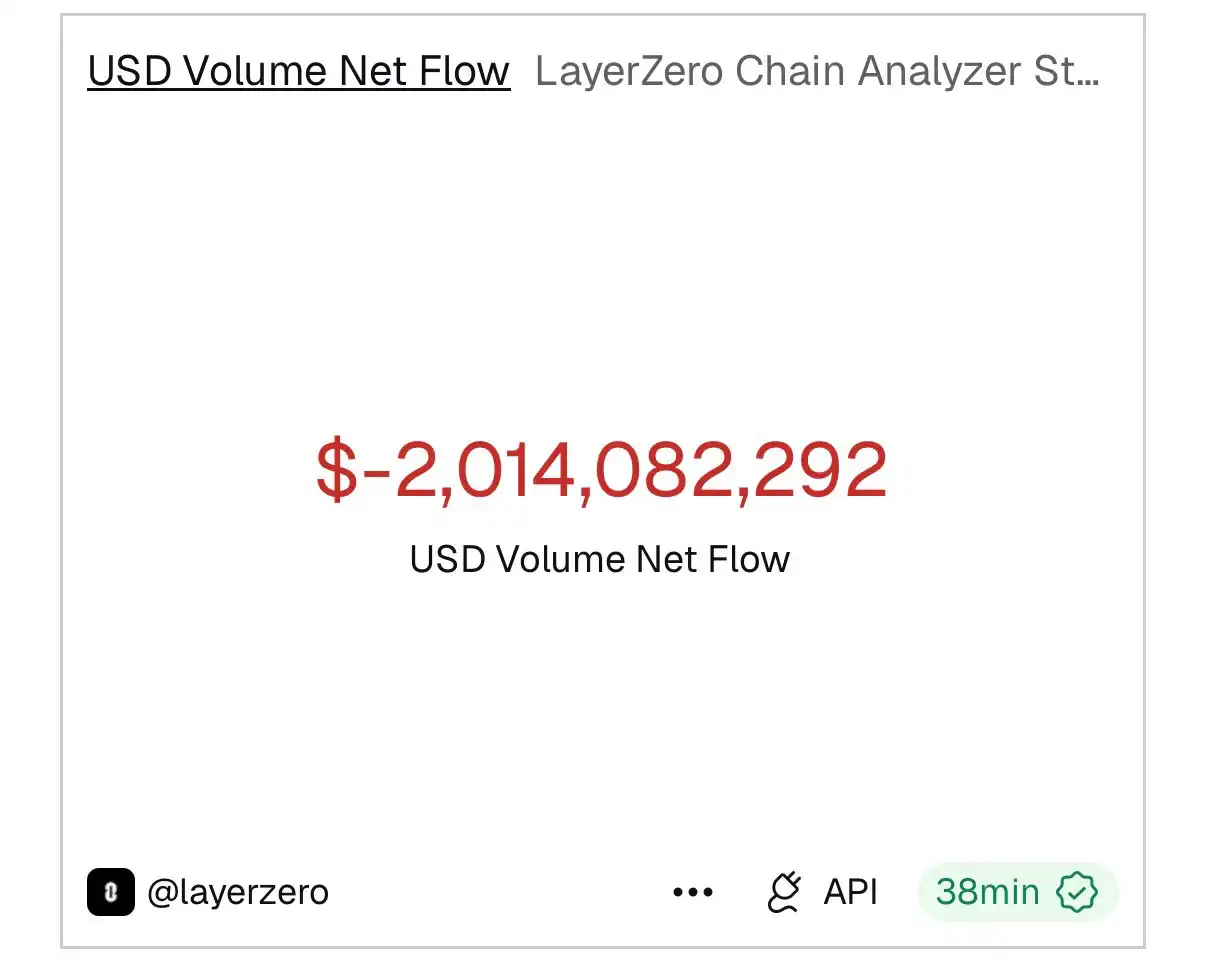
According to Dune data, the LayerZero network has seen a net outflow of approximately $2.01 billion over the past 30 days.
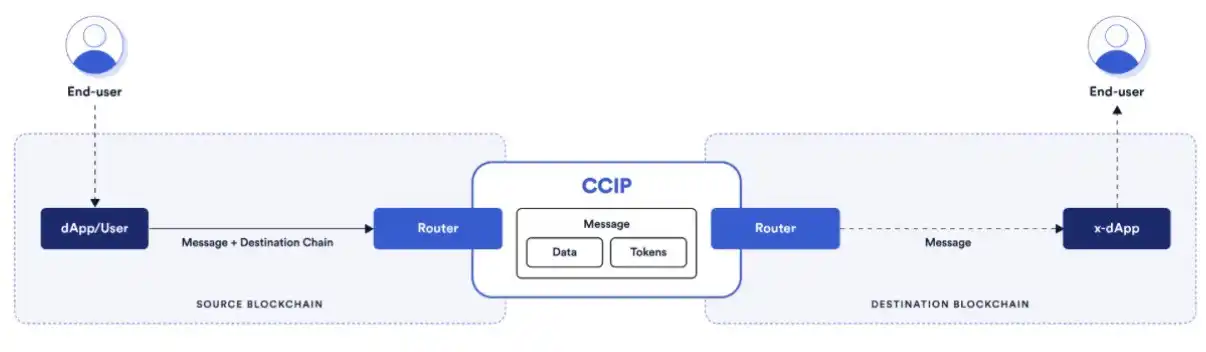
Behind the influx of protocols lies the significant difference in security architecture between Chainlink CCIP and LayerZero. Chainlink previously announced in April 2024 that CCIP had entered general availability, supporting blockchains like Arbitrum, Base, BNB Chain, and Ethereum.

Chainlink CCIP deeply integrates with the decentralized oracle network, consisting of multiple independent node operators forming an off-chain consensus layer to observe, verify, and report cross-chain events, supplemented by an independent risk management network providing additional monitoring and protection. Its token transfer mechanism includes built-in rate limiting and timelock upgrades, forming a defense-in-depth security model.
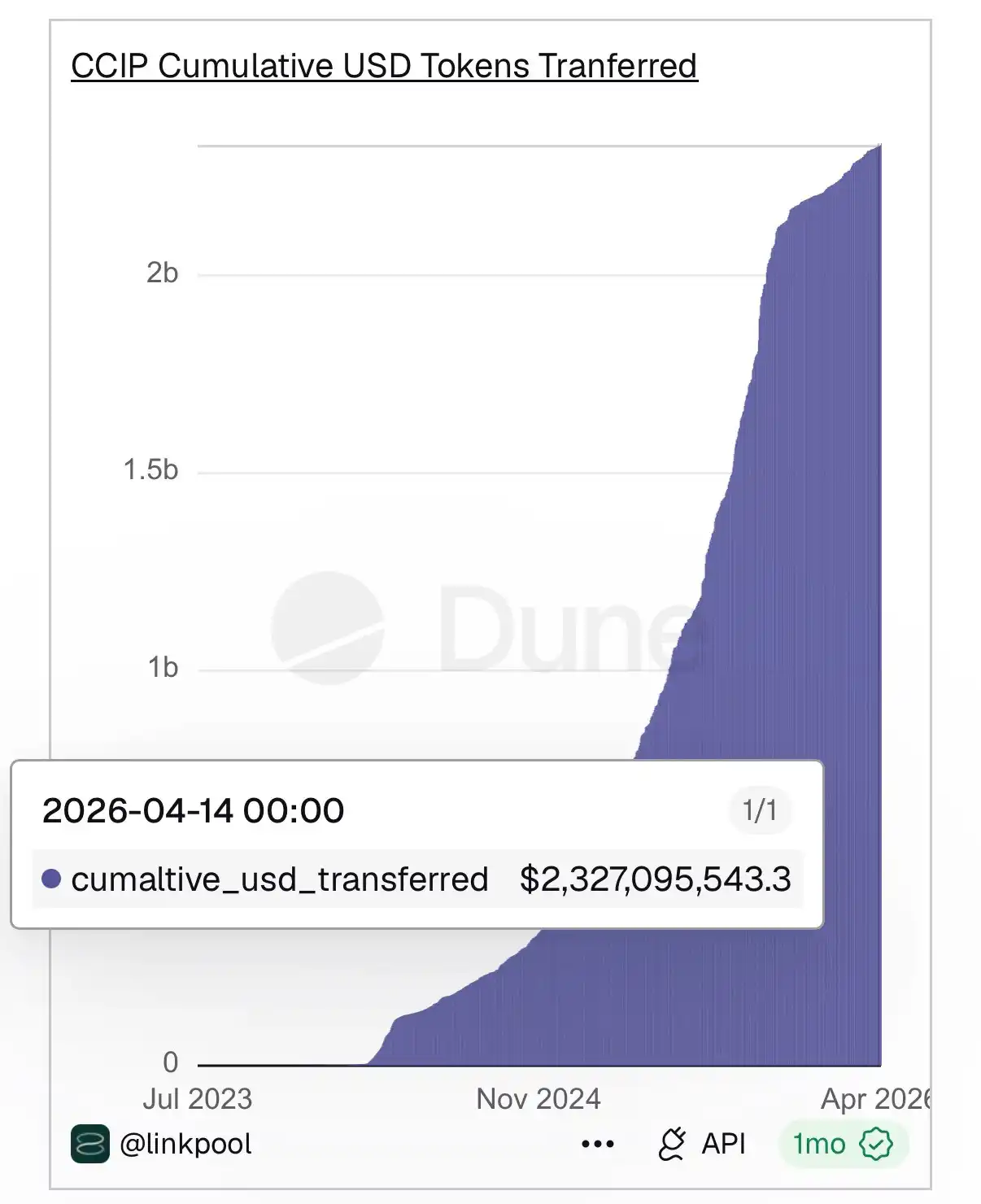
According to Dune data, the cumulative cross-chain token transfer value for Chainlink CCIP has exceeded $2 billion. Among them, the decentralized stablecoin GHO and USDC have the highest shares, reaching 22.4% and 20.2%, respectively, corresponding to amounts of approximately $531 million and $481 million.

In contrast, LayerZero employs a highly modular five-layer architecture, completely separating interfaces, validation, and execution, allowing developers to freely combine decentralized validator networks and configure validation thresholds. This design offers high flexibility but also requires application parties to actively choose and maintain security configurations.

The KelpDAO incident cast a spotlight on the fatal flaw of the single validator configuration. Protocols that had chosen the 1/1 configuration at the time accounted for as much as 47%, prompting many projects to quickly turn to CCIP, which defaults to decentralized validation and offers more comprehensive security controls.

On May 9, LayerZero published a letter of apology, acknowledging mishandling communication over the past three weeks and stating that it should have directly explained the situation earlier rather than prioritizing the completion of a post-mortem analysis report.

LayerZero emphasized that the protocol itself was not affected; rather, the internal RPC used by the LayerZero Labs DVN was poisoned by a data source, while external RPC providers suffered DDoS attacks. It admitted that allowing the Labs DVN to service high-value transactions as a 1/1 configuration was a serious error. The official team will soon release an official post-mortem analysis report in collaboration with external security partners.


Questions liées

QWhat triggered the massive migration of approximately $40 billion in assets from LayerZero to Chainlink's CCIP?

AThe migration was triggered by a major security breach on April 19, where the KelpDAO bridge on LayerZero was exploited for roughly $292 million. The attack exposed vulnerabilities, particularly in the single-validator (1-of-1) configuration, leading to a loss of trust and prompting protocols to seek more secure alternatives.

QWhat was the core vulnerability exploited in the KelpDAO attack on LayerZero?

AThe core vulnerability was the use of a single-validator (1-of-1) configuration for message verification. Attackers poisoned the RPC node relied upon by LayerZero's decentralized validator network and conducted a DDoS attack to force the system to fail over to the compromised node, allowing fraudulent messages to be approved.

QWhich major protocols were mentioned as having migrated from LayerZero to Chainlink CCIP following the attack?

AMajor protocols that migrated include KelpDAO (rsETH), Solv Protocol (SolvBTC, xSolvBTC), Re (reUSD), Tydro, Kraken (for wrapped assets like kBTC), and Lombard (for over $1 billion in Bitcoin-backed assets). Coinbase had already selected CCIP in December 2025 for its wrapped assets.

QHow does Chainlink's CCIP security architecture fundamentally differ from LayerZero's approach?

AChainlink CCIP is built on a decentralized oracle network with multiple independent node operators forming an off-chain consensus layer for validating cross-chain events, complemented by a separate Risk Management Network. It features built-in safeguards like rate limits and timelocks. In contrast, LayerZero offers a highly modular architecture that separates interface, verification, and execution, giving developers flexibility to configure their own validator networks and security thresholds, which can introduce risk if not properly managed.

QWhat was the impact of the KelpDAO incident and subsequent migrations on the market value of LINK and ZRO tokens?

AAccording to the article, LINK (Chainlink's token) rose 2.73% over 30 days to $9.6, with a market cap of $6.98 billion. In contrast, ZRO (LayerZero's token) fell 22.63% to $1.34, with its market cap dropping to $434 million and its rank falling to 92nd. LayerZero also faced additional pressure from a token unlock scheduled for May 20.

Lectures associées

Kalshi, MTS et l'ambition de a16z

Le marché des prédictions, illustré par des plateformes comme Kalshi, connaît un regain d'intérêt en 2025, suscitant l'enthousiasme des investisseurs, des acteurs de la cryptomonnaie et des médias. Cet engouement dépasse les simples opportunités de régulation ou de revenus, touchant à une dimension philosophique plus profonde. L'article retrace l'évolution intellectuelle du concept, depuis les théories de Hayek sur la connaissance dispersée dans la société, jusqu'aux mécanismes incitatifs comme le LMSR de Robin Hanson, conçus pour révéler l'information. Cependant, c'est l'entrée en jeu du géant du capital-risque a16z, avec son investissement massif dans Kalshi, qui marque un tournant. a16z voit dans le marché des prédictions bien plus qu'un produit financier : un nouvel outil médiatique fondamental. Il répondrait au désir contemporain de "présence" et d'action face à un monde de plus en plus médiatisé et déterministe. En pariant de l'argent réel sur des événements mondiaux, l'utilisateur passerait du statut de spectateur passif à celui d'observateur actif et impliqué, recouvrant un sentiment d'agency. Cette capacité à générer de l'engagement et à définir la réalité par les prix du marché (établissant la véracité et l'importance des événements) en ferait une pièce maîtresse de l'empire des "nouveaux médias" qu'a16z cherche à construire. Cet empire, illustré par des acteurs comme MTS, se caractérise par une production et une diffusion d'information extrêmement rapides et intenses, visant à "s'approprier la timeline". La valeur ultime de Kalshi résiderait ainsi dans son puissant "champ de distorsion de la réalité" : sa capacité, via le poids de l'argent engagé par la foule, à influencer la perception collective du futur et à s'imposer comme un arbitre de la vérité, conférant à une entreprise privée une influence historique rare.

marsbitIl y a 46 mins

Kalshi, MTS et l'ambition de a16z

marsbitIl y a 46 mins

Changement de cap mondial chez a16z : Le capital-risque devient le « moteur » de l'alliance technologique américaine

L’annonce de Ben Horowitz marque un virage stratégique majeur dans la globalisation d’a16z. Le fonds ne se contente plus de rechercher des projets à l’étranger, mais s’inscrit dans un cadre plus large de compétition technologique et de coopération entre alliés, explicitement lié au leadership technologique des États-Unis et de leurs partenaires. Dans un contexte où l’IA, la robotique, la cybersécurité et les chaînes d’approvisionnement deviennent des enjeux de compétition nationale, le rôle des VC évolue. A16z renforce ses capacités pour aider ses startups à naviguer dans des environnements complexes, mêlant marchés, régulations et géopolitique. Les initiatives clés incluent : l’ouverture d’un bureau à Tokyo, la nomination d’Anne Neuberger (ancienne responsable gouvernementale) comme associée chargée des affaires mondiales pour conseiller sur la politique et la géopolitique, et la transformation de l’équipe relations investisseurs en une équipe « Partenaires Mondiaux » pour faciliter les connexions et le déploiement international des entreprises. L’objectif reste de soutenir les meilleures entreprises technologiques partout dans le monde (plus de 100 investissements internationaux à ce jour), mais avec une mission élargie : être un organisateur reliant les startups aux capacités nationales, aux ressources industrielles et au réseau des alliés, contribuant ainsi à la compétitivité technologique des États-Unis et de leurs alliés.

marsbitIl y a 1 h

Changement de cap mondial chez a16z : Le capital-risque devient le « moteur » de l'alliance technologique américaine

marsbitIl y a 1 h

Kalshi, MTS et les ambitions d'a16z

Les marchés prédictifs, représentés par Kalshi, émergent comme un domaine clé en 2025, attirant fonds d'investissement, acteurs de la cryptomonnaie et médias. Leur importance dépasse la simple spéculation. Leur évolution conceptuelle remonte à Hayek (l'utilisation de la connaissance dans la société) et à Robin Hanson (mécanisme LMSR pour inciter à la révélation d'informations), avec l'idée utopique d'une « futarchie ». L'intérêt de a16z, qui a investi dans Kalshi (évalué à 220 milliards de dollars), va au-delà du modèle économique. Leur thèse centrale est que les marchés prédictifs offrent un « sentiment de présence » et une forme d'« anti-cynisme » dans un monde moderne où les individus se sentent déconnectés. En pariant sur des événements mondiaux, l'utilisateur devient un « observateur superlatif », investi et influençant la perception collective. Cela s'inscrit dans la vision de « nouveaux médias » de a16z : un écosystème médiatique complet et rapide qui « s'approprie la timeline », comme le démontre MTS (Monitoring The Situation), un média en continu sur Twitter. Kalshi ajoute à ce dispositif une autorité unique car ses prix reflètent des paris en argent réel, lui conférant un pouvoir de « distorsion de la réalité » pour définir la vérité et l'importance des événements. C'est ce pouvoir, rarement détenu par une entreprise privée, qui justifierait sa valorisation faramineuse et en ferait une pièce maîtresse de l'empire médiatique de a16z.

链捕手Il y a 1 h

Kalshi, MTS et les ambitions d'a16z

链捕手Il y a 1 h

Comprendre la réalité du commerce, des paiements et des infrastructures des Agents

**Interprétation de la réalité des agents, des paiements et des infrastructures commerciales** Au cours de l'année passée, l'auteur a travaillé sur l'infrastructure de l'économie des agents, interagissant avec Stripe, Visa, Coinbase, Google et des dizaines de startups. La conclusion est claire : il n'existe pas encore de demande réelle, et les startups font face à des problèmes structurels. Stripe a enregistré peu de transactions d'agents malgré un fort intérêt. Visa impose des seuils de revenus et des processus KYC extrêmement restrictifs, accessibles uniquement aux géants comme Amazon. Les chiffres d'utilisation des agents sur la blockchain (comme via le protocole x402) sont largement gonflés par des transactions de test. **Agent vs Commerçant** : L'expérience d'achat par agent (IA) est souvent inférieure au commerce électronique traditionnel pour les achats visuels (vêtements, électronique). L'interface conversationnelle est un recul par rapport aux interfaces riches. La demande actuelle des marchands est défensive : ils veulent être "trouvables" par les agents par crainte de rater une future tendance. Les cas d'usage convaincants sont limités (commande de nourriture, navigation dans des interfaces complexes), mais nécessitent une distribution de masse détenue par les géants. **Agent vs API** : Les développeurs utilisent déjà massivement des API (calcul, données). Le problème du coût des micro-transactions est souvent résolu par du prépaiement. Le véritable obstacle est que les grands fournisseurs SaaS privilégient les contrats enterprise. Les opportunités pour les nouveaux systèmes de paiement (comme les stablecoins) se situent dans la longue traîne des services, un marché plus restreint. **Agent vs Agent** : Ce modèle est encore théorique, sans volume significatif. Il impliquerait des transactions ultra-rapides entre entités non humaines, avec des montants variables et des règlements multipartites. C'est un pari à long terme sur une infrastructure dédiée, mais ce n'est pas le marché actuel. **Agent vs Finance** : C'est la seule catégorie avec une demande existante et une volonté de payer. Intégrer l'IA dans les workflows financiers existants (gestion de portefeuille, DeFi) est une évolution naturelle et crée de nouvelles capacités. Cependant, la concurrence est rude face aux institutions établies, régulées et bien connectées. **Le véritable enjeu** : Les grandes entreprises construisent par stratégie défensive et ont les moyens d'attendre. Pour les startups, il est crucial de se concentrer sur le marché actuel. Le problème fondamental n'est pas le paiement, mais la **coordination** entre agents et humains : vérifier le travail, s'accorder sur les résultats, puis régler. Le paiement n'est qu'une partie de la solution de coordination. Ce sont les entreprises qui résoudront le problème de la coordination à grande échelle qui domineront, en intégrant le paiement, et non l'inverse. L'expérience de l'auteur l'a conduit vers un autre segment de marché, actif, en croissance et encore mal desservi, en dehors de ces quatre catégories.

marsbitIl y a 1 h

Comprendre la réalité du commerce, des paiements et des infrastructures des Agents

marsbitIl y a 1 h

Trading

Spot
Futures

Articles tendance

Comment acheter LINK

Bienvenue sur HTX.com ! Nous vous permettons d'acheter ChainLink (LINK) de manière simple et pratique. Suivez notre guide étape par étape pour commencer votre parcours crypto.Étape 1 : Création de votre compte HTXUtilisez votre adresse e-mail ou votre numéro de téléphone pour ouvrir un compte sur HTX gratuitement. L'inscription se fait en toute simplicité et débloque toutes les fonctionnalités.Créer mon compteÉtape 2 : Choix du mode de paiement (rubrique Acheter des cryptosCarte de crédit/débit : utilisez votre carte Visa ou Mastercard pour acheter instantanément ChainLink (LINK).Solde :utilisez les fonds du solde de votre compte HTX pour trader en toute simplicité.Prestataire tiers :pour accroître la commodité d'utilisation, nous avons ajouté des modes de paiement populaires tels que Google Pay et Apple Pay.P2P :tradez directement avec d'autres utilisateurs sur HTX.OTC (de gré à gré) : nous offrons des services personnalisés et des taux de change compétitifs aux traders.Étape 3 : stockage de vos ChainLink (LINK)Après avoir acheté vos ChainLink (LINK), stockez-les sur votre compte HTX. Vous pouvez également les envoyer ailleurs via un transfert sur la blockchain ou les utiliser pour trader d'autres cryptos.Étape 4 : tradez des ChainLink (LINK)Tradez facilement ChainLink (LINK) sur le marché Spot de HTX. Il vous suffit d'accéder à votre compte, de sélectionner la paire de trading, d'exécuter vos trades et de les suivre en temps réel. Nous offrons une expérience conviviale aux débutants comme aux traders chevronnés.

904 vues totalesPublié le 2024.12.13Mis à jour le 2026.06.02

Comment acheter LINK

Discussions

Bienvenue dans la Communauté HTX. Ici, vous pouvez vous tenir informé(e) des derniers développements de la plateforme et accéder à des analyses de marché professionnelles. Les opinions des utilisateurs sur le prix de LINK (LINK) sont présentées ci-dessous.

活动图片