Nvidia's Wednesday Earnings Night: The Battle That Decides the Fate of the AI Bull Market is Here

marsbitPublié le 2026-05-18Dernière mise à jour le 2026-05-18

Résumé

NVIDIA is set to report its quarterly earnings after the U.S. market closes on Wednesday, May 20. This event is widely seen as a crucial test for the current AI-driven bull market. The semiconductor sector is exhibiting severe technical overbought conditions, with the Philadelphia Semiconductor Index (SOX) trading approximately 60% above its 200-day moving average—the most extreme deviation since the dot-com bubble peak of 1999/2000. Market sentiment is highly concentrated on a few AI-related stocks, raising concerns about overall market breadth. Analysts highlight a key contradiction: while fundamentals for AI and semiconductors remain strong, significant technical pressures are building. Option market activity reflects this tension. Positions are heavily skewed towards bullish calls, yet there is also notable hedging activity through put options on broad indices and sector ETFs, signaling preparation for potential downside volatility. An unusual pattern of rising stock prices alongside rising implied volatility further underscores the market's expectation for a major move. For NVIDIA specifically, the market's primary focus will be on its forward guidance for the next quarter, which is deemed more critical than the immediate earnings results. Despite a recent seven-day rally adding roughly $1.7 trillion in market cap, historical data shows NVIDIA's stock has often declined the day after its past five earnings reports. The outcome of this report is expected to have a signi...

Original Author: Zhang Yaqi

Original Source: Wall Street Insights

Nvidia is set to release its quarterly report after the US market closes on Wednesday, May 20th (Eastern Time), serving as a crucial stress test for the current AI bull market cycle. The semiconductor sector's technically overbought condition, heavily bullish options positioning, and the rare signal of "stock price and implied volatility rising simultaneously" have significantly amplified the two-way risk around this earnings window compared to the past.

In a briefing titled "Yellow Light" issued on Monday, Peter Callahan, Goldman Sachs' TMT Chief Specialist, pointed out that the Nasdaq 100 Index (NDX) and the Philadelphia Semiconductor Index (SOX) recorded their first weekly decline of the quarter last week; the 10-year Treasury yield rose to around 4.60%, marking its largest weekly increase in over a year; oil prices rebounded to approximately $109 per barrel; and the VIX moved higher concurrently. He noted that the core contradiction currently facing the AI and semiconductor themes is: fundamentals remain robust, while technical pressure continues to accumulate.

Options analytics firm SpotGamma highlighted in a recent report that the market is exhibiting a rare parallel pattern of "rising stock prices alongside climbing volatility"—typically, these two should have an inverse relationship. This signal indicates that traders are chasing gains while simultaneously paying a premium for protection against significant volatility. The implied move around Nvidia's earnings is currently priced at +/-6%, with market attention highly focused on this event.
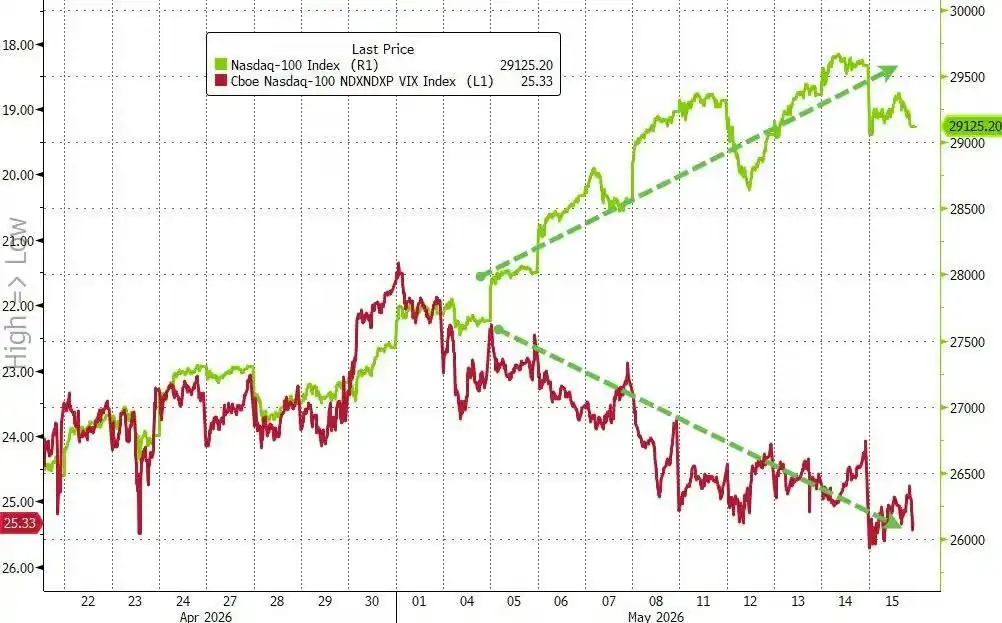
The earnings results and forward guidance will directly test the market's conviction in the AI computing super-cycle thesis. Given Nvidia's high correlation with the semiconductor sector and broader tech market, its earnings performance, whether positive or negative, is expected to trigger widespread ripple effects across the market.

Technical Indicators Flash Most Extreme Warning Since 1999/2000

The magnitude and speed of the recent semiconductor rally have pushed technical indicators to historically overbought extremes.

Goldman Sachs data shows the SOX index has surged approximately 70% from its late March low, adding over $5 trillion in market value along the way. Driving factors include a temporary easing of geopolitical tensions, better-than-expected corporate earnings—such as AMAT raising its full-year guidance more than anticipated and CSCO achieving 35% year-over-year growth in product orders—as well as investor confidence in AI computing demand; earnings expectations for the semiconductor industry have been revised upwards by over 25% year-to-date.

However, Peter Callahan specifically pointed out that the SOX index currently trades about 60% above its 200-day moving average, a deviation not seen since the peak of the 1999/2000 internet bubble. He also noted that Goldman Sachs' high momentum factor portfolio has experienced 12 trading days with daily moves of ±5% or more this year, accounting for nearly 15% of all trading days; the rapid expansion of leveraged ETFs and options products further amplifies this two-way volatility.
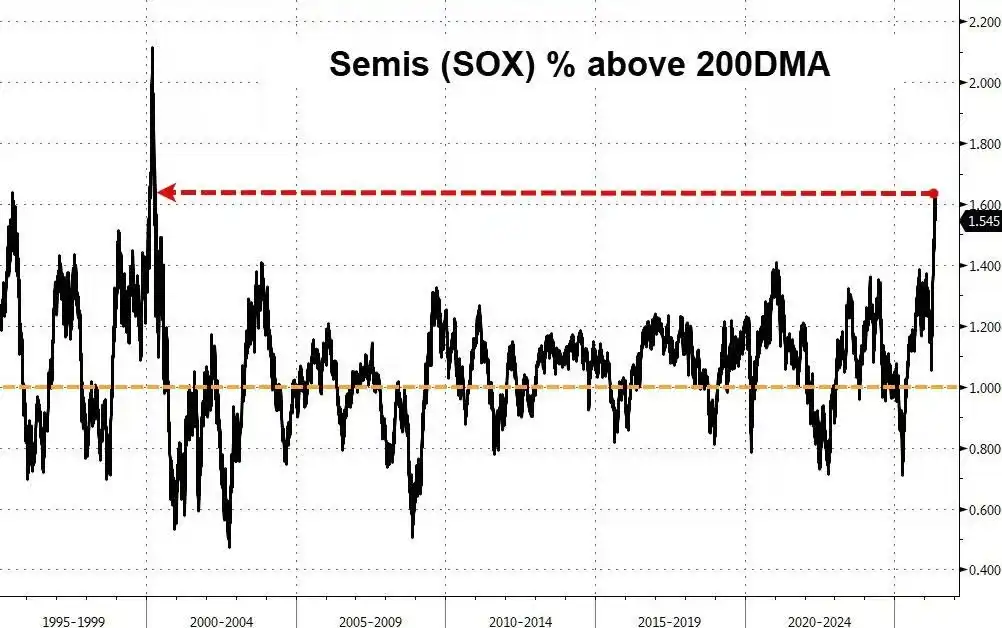
"It's worth keeping these tactical dynamics in mind ahead of the summer trading period, after this week's key earnings event (Nvidia on May 20) concludes," Callahan wrote. While Goldman's trading desk maintains a constructive medium-term view on the AI and semiconductor themes, it tactically advises investors to remain cautious regarding technical headwinds.

Nvidia Earnings: Forward Guidance May Be More Crucial Than Quarterly Results

Market optimism about Nvidia's fundamental prospects remains, but recent stock price movements have already priced in some of these expectations.

According to Goldman Sachs' Nvidia earnings preview, analysts generally expect the company's revenue for this quarter to exceed consensus estimates by approximately $2 billion—its typical historical beat margin has been around 2% to 3%. The market is more focused on forward guidance for the next quarter, with the current analyst consensus around $86 billion, implying a sequential increase of about 9%. Other key areas of focus include: potential for further upward revision to Nvidia's ~$1 trillion cumulative data center revenue target, and the narrative of accelerating Agentic AI inference demand—particularly its pure CPU rack product expected to begin shipments in the second half of 2026.

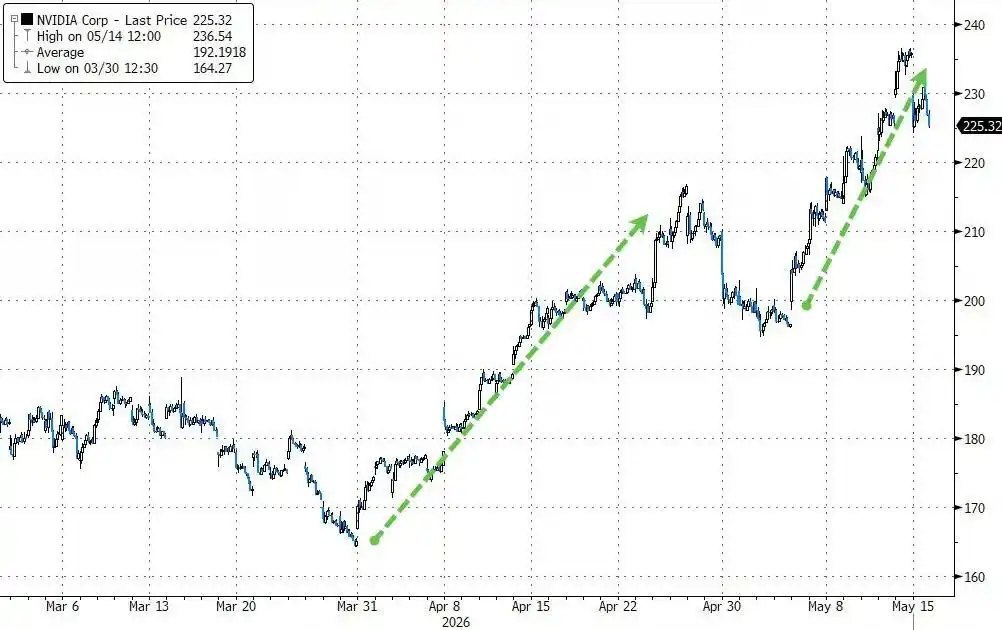
From a recent price action perspective, Nvidia has risen for seven consecutive trading days, gaining 20% during this stretch, marking its longest winning streak in nearly two years; it has added roughly $1.7 trillion in market capitalization since its late March low. However, Goldman data also shows that on the trading day following Nvidia's last five earnings reports (T+1), the stock declined four times. Since May 2022, a single-day surge triggered by earnings has not occurred.
Options Market: Extreme Bullish Bets and Tail Hedging Deployed Simultaneously

Options positioning reveals a set of inherently contradictory signals.

According to SpotGamma data, overall positioning remains heavily skewed towards bullish bets, with traders consistently rolling Nvidia call options to higher strike prices. The call skew remains at the high end of its 90-day historical range, while demand for downside protection is extremely limited. Data cited by 22V Research shows that nominal S&P 500 call option trading volume hit a record $2.6 trillion last Friday, with call volume accounting for 60% of total options activity; the RSI for the Philadelphia Semiconductor Index also rose to its highest level since March 2000.
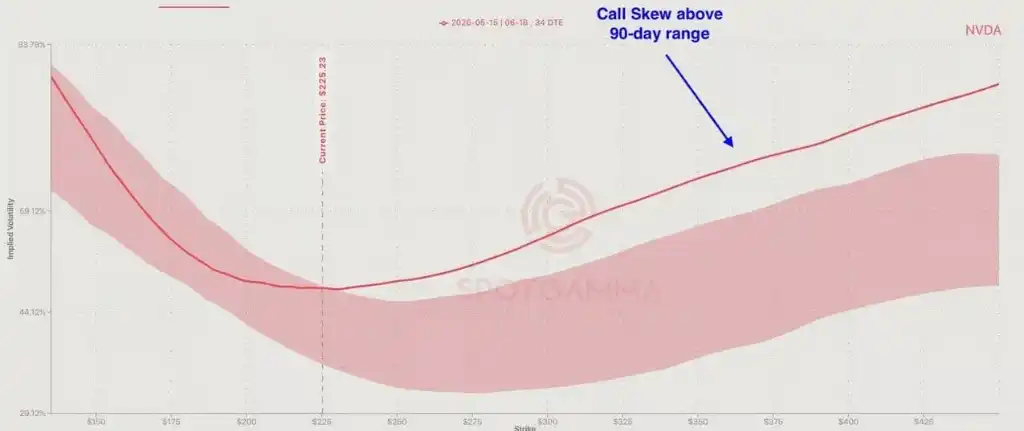
Meanwhile, hedging against downside risks is also quietly underway. SpotGamma points out that significant put option structures and buying activity have increased noticeably around the S&P 500 (SPY), semiconductor ETF (SMH), and DRAM-related assets, concentrated in deep out-of-the-money strike price ranges, indicating their function is more akin to tail risk hedging rather than pure directional bets. "Market participants are not bearish on Nvidia, but preparation for downside scenarios is non-trivial," SpotGamma wrote in its report, "Any directional shift is likely to quickly spill over into the broader market."

SpotGamma adds that Nvidia has rallied over 35% from its March low, and the size of current call option positions implies that disappointing earnings or a large-scale profit-taking event could potentially trigger a significant directional reversal.

Market Breadth Concerns: Rally Supported by a Handful of Stocks

Beneath the strong performance of semiconductor and large-cap tech stocks, the lack of broad market participation is forming a structural worry.

Peter Callahan noted in his report that although the S&P 500 is up about 8% year-to-date, only about 52% of its constituents are in positive territory. Sectors significantly lagging this year include residential real estate, medical devices, engineering & construction without government business exposure, federal IT services, software & services, independent power producers, restaurant chains, commercial real estate brokerage, and insurance brokerage, among others.

Callahan admits that when examining the charts of these sectors, it makes him question whether the current market performance reflects overall "health" or simply a "funding source" effect, where investors are forced to concentrate capital in a few large-cap AI stocks. Oppenheimer's equity derivatives team similarly pointed out that only about one-fifth of S&P 500 constituents have outperformed the index over the past month, with the dispersion index rising to its highest level in over a year, while implied correlation remains near year-to-date lows. Latest data from Goldman Sachs' Prime Brokerage (PB) desk also shows a clear "risk-off" move in the tech sector recently.

Questions liées

QWhy is Nvidia's upcoming earnings report on May 20th considered a critical stress test for the current AI bull market?

ANvidia's earnings report is considered a critical stress test because it directly tests the market's confidence in the AI compute super-cycle. The company is highly correlated with the semiconductor and broader tech sectors, meaning its results will likely trigger significant market-wide reactions regardless of whether they are positive or negative. The market is technically overextended, with extreme bullish positioning in options, making the event a key pressure point that could determine the near-term fate of the AI bull cycle.

QWhat is the core contradiction identified by Goldman Sachs' Peter Callahan regarding the AI and semiconductor theme?

AThe core contradiction is that the fundamentals remain strong (e.g., strong corporate earnings, upward revisions to profit expectations), while technical pressures are continuously accumulating. Key technical pressures include the SOX index trading at its most extreme deviation from its 200-day moving average since the 1999/2000 internet bubble peak and heightened market concentration in a few large-cap stocks.

QWhat is the unusual market signal that SpotGamma reports, and what does it indicate about trader behavior?

ASpotGamma reports the unusual signal of stock prices rising while implied volatility simultaneously climbs. Normally, these two have an inverse relationship. This pattern indicates that while traders are chasing the rally (buying stocks/calls), they are also paying a premium to hedge against significant volatility, preparing for a potential sharp move in either direction around high-stakes events like Nvidia's earnings.

QAccording to the article, what aspect of Nvidia's report might be more crucial than the quarterly results themselves?

AThe forward guidance for the next quarter is potentially more crucial than the immediate quarterly results. While analysts expect quarterly revenue to beat estimates by a significant margin, the market's primary focus is on the guidance for the upcoming quarter (estimated at around $86 billion) and whether there is further upside to Nvidia's cumulative data center revenue target of approximately $1 trillion.

QWhat does the data on market breadth and the 'funding source' effect suggest about the health of the current U.S. stock market rally?

AThe data on market breadth suggests underlying weakness and a lack of broad participation. While the S&P 500 is up year-to-date, only about 52% of its constituents have posted gains. The rally is being driven by a narrow concentration of capital in a few large-cap AI stocks like Nvidia, creating a 'funding source' effect. This raises questions about whether the market's performance reflects overall economic health or is simply a consequence of investors being forced to crowd into a shrinking pool of high-performing names.

Lectures associées

Les 43 minutes de Trump : la narration du leader fort déraille, la guerre médiatique s'intensifie

Lors de sa première apparition publique après plus d'une semaine d'absence, le président américain Donald Trump a tenu une conférence de presse de 43 minutes, marquée par des attaques répétées contre des journalistes, des villes américaines et des adversaires politiques. Plutôt que d'aborder directement les questions urgentes concernant sa santé, l'Iran ou les fissures au sein de son parti, il a longuement parlé d'un projet de rénovation d'un bassin d'ornement, comparé la taille de ses rassemblements à celui de Martin Luther King, et signé un décret affaiblissant les protections d'emploi de milliers de hauts fonctionnaires fédéraux. L'article décrit un président apparaissant irritable, défensif et incontrôlé, interrompant soudainement l'événement avant d'être rapidement conduit hors de la salle par son personnel. Il analyse cette performance comme le symptôme d'une concentration du pouvoir personnel et d'un affaiblissement des contraintes institutionnelles, où la loyauté prime sur la compétence. La seconde partie se concentre sur les attaques contre la presse, illustrées par l'échange hostile avec une journaliste de CNN et le licenciement d'un vétéran de CBS qui dénonçait des ingérences éditoriales. L'auteur soutient que la pression du pouvoir politique et des intérêts commerciaux menace l'indépendance des médias traditionnels, faisant des journalistes et créateurs indépendants des acteurs cruciaux pour préserver les faits. Il appelle à soutenir financièrement ces voix indépendantes comme forme de résistance face à un exécutif qui cherche à saper la confiance dans l'information et à récompenser l'obéissance. L'article se conclut sur une note d'espoir, notant que des élus républicains ont commencé à se distancer de Trump, votant symboliquement contre ses actions militaires en Iran.

marsbitIl y a 40 mins

Les 43 minutes de Trump : la narration du leader fort déraille, la guerre médiatique s'intensifie

marsbitIl y a 40 mins

Kalshi, MTS et l'ambition de a16z

Le marché des prédictions, illustré par des plateformes comme Kalshi, connaît un regain d'intérêt en 2025, suscitant l'enthousiasme des investisseurs, des acteurs de la cryptomonnaie et des médias. Cet engouement dépasse les simples opportunités de régulation ou de revenus, touchant à une dimension philosophique plus profonde. L'article retrace l'évolution intellectuelle du concept, depuis les théories de Hayek sur la connaissance dispersée dans la société, jusqu'aux mécanismes incitatifs comme le LMSR de Robin Hanson, conçus pour révéler l'information. Cependant, c'est l'entrée en jeu du géant du capital-risque a16z, avec son investissement massif dans Kalshi, qui marque un tournant. a16z voit dans le marché des prédictions bien plus qu'un produit financier : un nouvel outil médiatique fondamental. Il répondrait au désir contemporain de "présence" et d'action face à un monde de plus en plus médiatisé et déterministe. En pariant de l'argent réel sur des événements mondiaux, l'utilisateur passerait du statut de spectateur passif à celui d'observateur actif et impliqué, recouvrant un sentiment d'agency. Cette capacité à générer de l'engagement et à définir la réalité par les prix du marché (établissant la véracité et l'importance des événements) en ferait une pièce maîtresse de l'empire des "nouveaux médias" qu'a16z cherche à construire. Cet empire, illustré par des acteurs comme MTS, se caractérise par une production et une diffusion d'information extrêmement rapides et intenses, visant à "s'approprier la timeline". La valeur ultime de Kalshi résiderait ainsi dans son puissant "champ de distorsion de la réalité" : sa capacité, via le poids de l'argent engagé par la foule, à influencer la perception collective du futur et à s'imposer comme un arbitre de la vérité, conférant à une entreprise privée une influence historique rare.

marsbitIl y a 2 h

Kalshi, MTS et l'ambition de a16z

marsbitIl y a 2 h

Changement de cap mondial chez a16z : Le capital-risque devient le « moteur » de l'alliance technologique américaine

L’annonce de Ben Horowitz marque un virage stratégique majeur dans la globalisation d’a16z. Le fonds ne se contente plus de rechercher des projets à l’étranger, mais s’inscrit dans un cadre plus large de compétition technologique et de coopération entre alliés, explicitement lié au leadership technologique des États-Unis et de leurs partenaires. Dans un contexte où l’IA, la robotique, la cybersécurité et les chaînes d’approvisionnement deviennent des enjeux de compétition nationale, le rôle des VC évolue. A16z renforce ses capacités pour aider ses startups à naviguer dans des environnements complexes, mêlant marchés, régulations et géopolitique. Les initiatives clés incluent : l’ouverture d’un bureau à Tokyo, la nomination d’Anne Neuberger (ancienne responsable gouvernementale) comme associée chargée des affaires mondiales pour conseiller sur la politique et la géopolitique, et la transformation de l’équipe relations investisseurs en une équipe « Partenaires Mondiaux » pour faciliter les connexions et le déploiement international des entreprises. L’objectif reste de soutenir les meilleures entreprises technologiques partout dans le monde (plus de 100 investissements internationaux à ce jour), mais avec une mission élargie : être un organisateur reliant les startups aux capacités nationales, aux ressources industrielles et au réseau des alliés, contribuant ainsi à la compétitivité technologique des États-Unis et de leurs alliés.

marsbitIl y a 2 h

Changement de cap mondial chez a16z : Le capital-risque devient le « moteur » de l'alliance technologique américaine

marsbitIl y a 2 h

Kalshi, MTS et les ambitions d'a16z

Les marchés prédictifs, représentés par Kalshi, émergent comme un domaine clé en 2025, attirant fonds d'investissement, acteurs de la cryptomonnaie et médias. Leur importance dépasse la simple spéculation. Leur évolution conceptuelle remonte à Hayek (l'utilisation de la connaissance dans la société) et à Robin Hanson (mécanisme LMSR pour inciter à la révélation d'informations), avec l'idée utopique d'une « futarchie ». L'intérêt de a16z, qui a investi dans Kalshi (évalué à 220 milliards de dollars), va au-delà du modèle économique. Leur thèse centrale est que les marchés prédictifs offrent un « sentiment de présence » et une forme d'« anti-cynisme » dans un monde moderne où les individus se sentent déconnectés. En pariant sur des événements mondiaux, l'utilisateur devient un « observateur superlatif », investi et influençant la perception collective. Cela s'inscrit dans la vision de « nouveaux médias » de a16z : un écosystème médiatique complet et rapide qui « s'approprie la timeline », comme le démontre MTS (Monitoring The Situation), un média en continu sur Twitter. Kalshi ajoute à ce dispositif une autorité unique car ses prix reflètent des paris en argent réel, lui conférant un pouvoir de « distorsion de la réalité » pour définir la vérité et l'importance des événements. C'est ce pouvoir, rarement détenu par une entreprise privée, qui justifierait sa valorisation faramineuse et en ferait une pièce maîtresse de l'empire médiatique de a16z.

链捕手Il y a 2 h

Kalshi, MTS et les ambitions d'a16z

链捕手Il y a 2 h

Trading

Spot
Futures

Articles tendance

Comment acheter NIGHT

Bienvenue sur HTX.com ! Nous vous permettons d'acheter Midnight (NIGHT) de manière simple et pratique. Suivez notre guide étape par étape pour commencer votre parcours crypto.Étape 1 : Création de votre compte HTXUtilisez votre adresse e-mail ou votre numéro de téléphone pour ouvrir un compte sur HTX gratuitement. L'inscription se fait en toute simplicité et débloque toutes les fonctionnalités.Créer mon compteÉtape 2 : Choix du mode de paiement (rubrique Acheter des cryptosCarte de crédit/débit : utilisez votre carte Visa ou Mastercard pour acheter instantanément Midnight (NIGHT).Solde :utilisez les fonds du solde de votre compte HTX pour trader en toute simplicité.Prestataire tiers :pour accroître la commodité d'utilisation, nous avons ajouté des modes de paiement populaires tels que Google Pay et Apple Pay.P2P :tradez directement avec d'autres utilisateurs sur HTX.OTC (de gré à gré) : nous offrons des services personnalisés et des taux de change compétitifs aux traders.Étape 3 : stockage de vos Midnight (NIGHT)Après avoir acheté vos Midnight (NIGHT), stockez-les sur votre compte HTX. Vous pouvez également les envoyer ailleurs via un transfert sur la blockchain ou les utiliser pour trader d'autres cryptos.Étape 4 : tradez des Midnight (NIGHT)Tradez facilement Midnight (NIGHT) sur le marché Spot de HTX. Il vous suffit d'accéder à votre compte, de sélectionner la paire de trading, d'exécuter vos trades et de les suivre en temps réel. Nous offrons une expérience conviviale aux débutants comme aux traders chevronnés.

530 vues totalesPublié le 2025.12.08Mis à jour le 2026.06.02

Comment acheter NIGHT

Discussions

Bienvenue dans la Communauté HTX. Ici, vous pouvez vous tenir informé(e) des derniers développements de la plateforme et accéder à des analyses de marché professionnelles. Les opinions des utilisateurs sur le prix de NIGHT (NIGHT) sont présentées ci-dessous.

活动图片