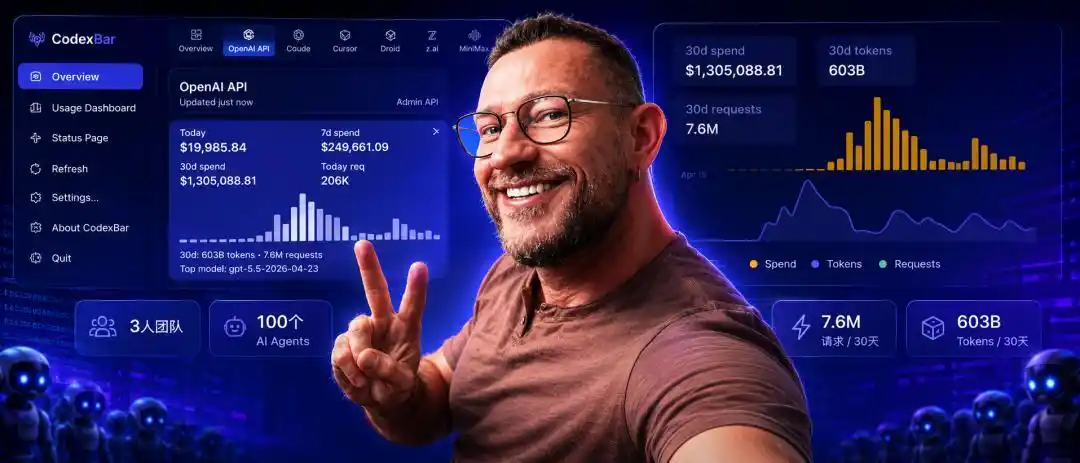
3 People with 100 AI Programmers, Burning Through $1.3 Million a Month! OpenAI: I'll Foot the Bill

marsbitPublié le 2026-05-17Dernière mise à jour le 2026-05-17

Résumé

In a striking demonstration of AI-powered development, Peter Steinberger (creator of OpenClaw) shared that his three-person team spent $1.3 million in one month to run approximately 100 AI agents (primarily Codex instances). OpenAI covered the cost. The expenditure consumed 6.03 trillion tokens across 7.6 million requests. Steinberger argues that, with "fast mode" disabled, the cost falls below that of a single engineer while providing significantly greater output. This "cloud programmer army" handles core but tedious software engineering tasks: reviewing pull requests, finding security vulnerabilities, deduplicating issues, fixing bugs, monitoring benchmarks, and even generating PRs after meetings. This shifts AI's role from merely writing code to maintaining the entire collaborative fabric of a project. Steinberger's tool, CodexBar (a macOS menu bar app), tracks usage and costs across various AI coding services, highlighting how token consumption is becoming a key metric—a new "means of production." The experiment poses a profound question: if token cost ceases to be a barrier, how will software development transform? As model prices fall, the capability for small teams to leverage large numbers of AI agents could become commonplace, fundamentally altering the scale and speed of development. The future, Steinberger suggests, is arriving rapidly.

Peter Steinberger

Editor: Solomon

[New Zhiyuan Report] 3 people, 100 AI agents, burning through $1.3 million a month — The father of OpenClaw has turned software development into an "AI assembly line," with OpenAI picking up the tab.

While others show off their pay stubs, he shows off the bill — $1.3 million a month!

That's nearly 9 million RMB per month. It's left netizens utterly dumbfounded.

OpenClaw father Peter Steinberger casually posted a screenshot on X.
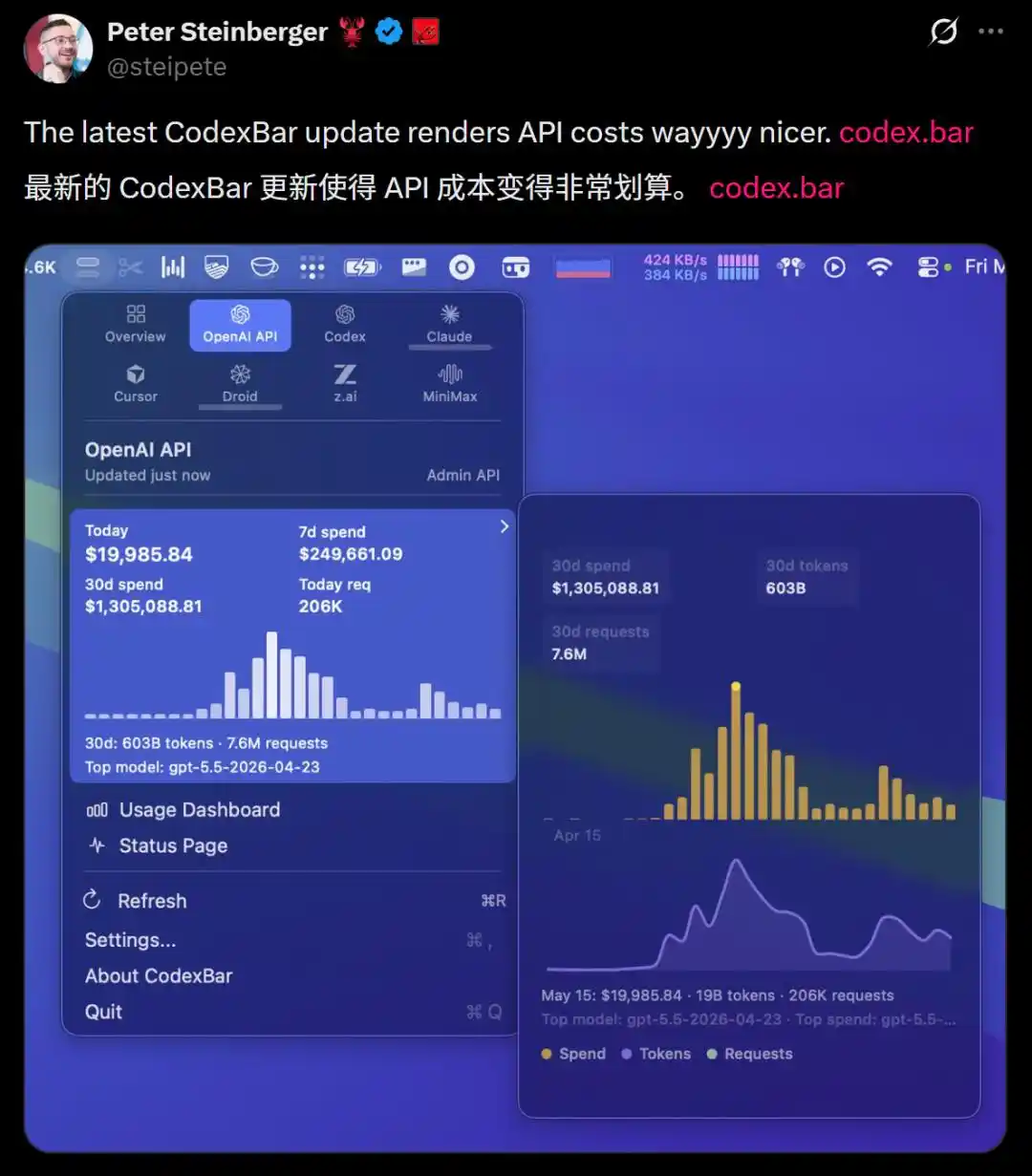
Peter Steinberger

But the numbers on the screenshot were anything but casual:

30-day spend: $1,305,088.81. Consumed 603 billion tokens. Made 7.6 million requests.

You read that right, 1.3 million U.S. dollars. And it's not a quarterly AI budget for some big tech company — it's the monthly usage of a three-person team.

Even more explosive: OpenAI is reimbursing this cost.

The comment section instantly went wild.

Some were amazed, some skeptical, some whipped out their calculators to figure out "how many programmers this equals."

Steinberger himself calmly responded: "With fast mode off, my cost is less than an engineer, and it really helps a lot more."

Translation: — It's genuinely cost-effective!

Other netizens were shocked by the $400k/month engineer — "The San Francisco job market is insane."
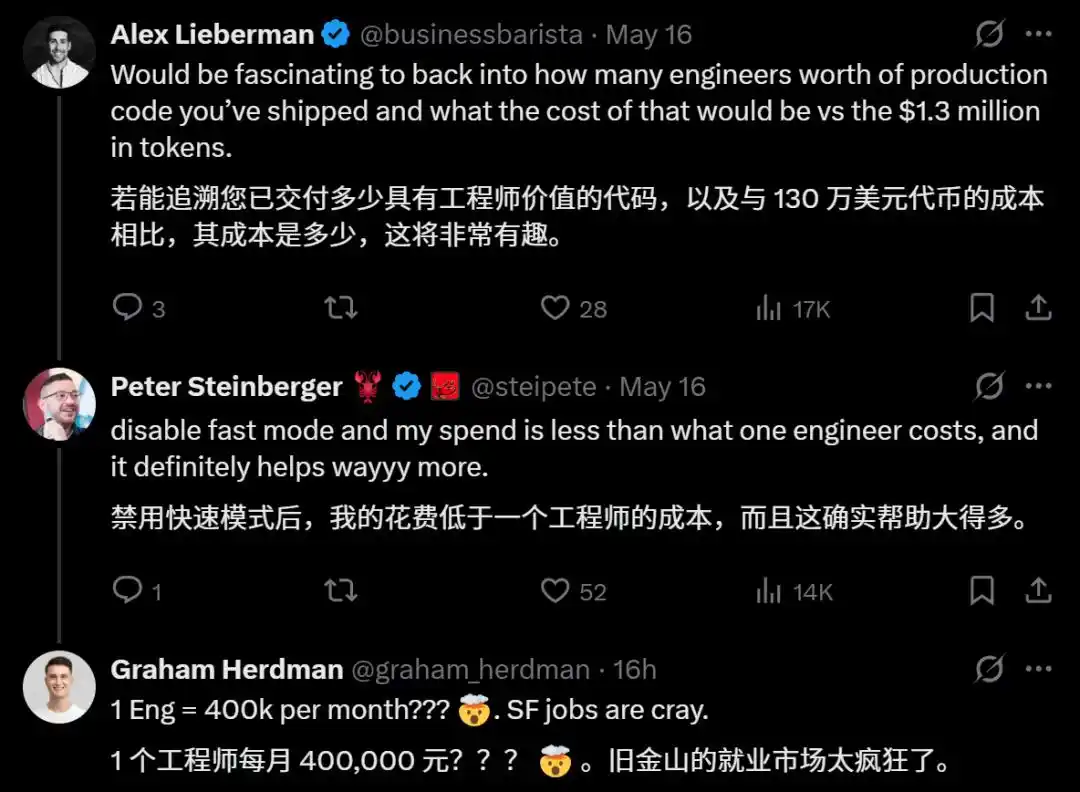
Netizen comment
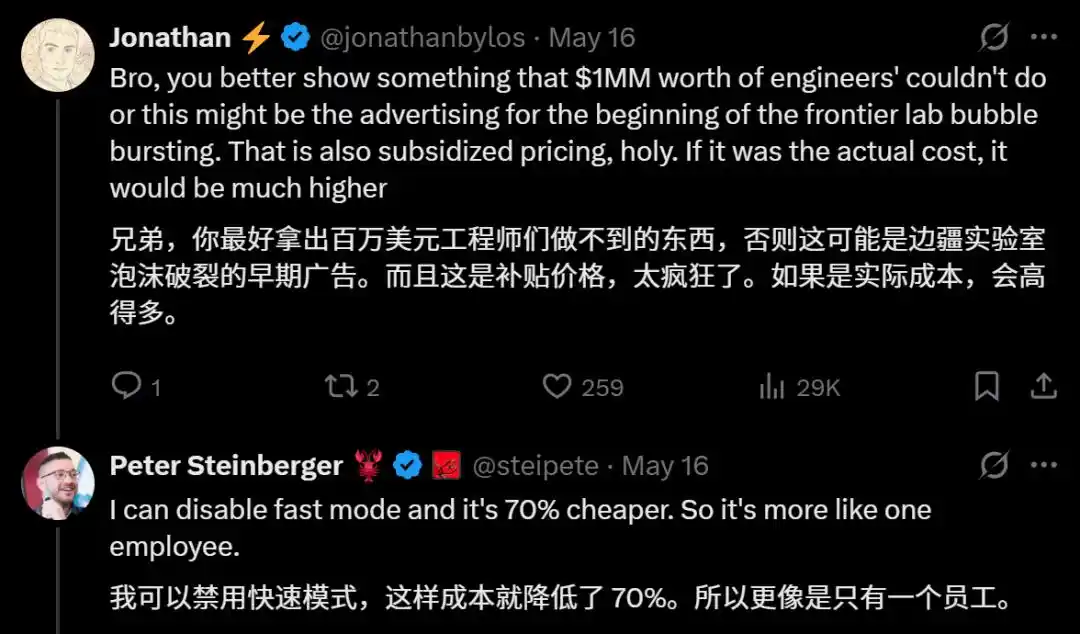
Netizen comment

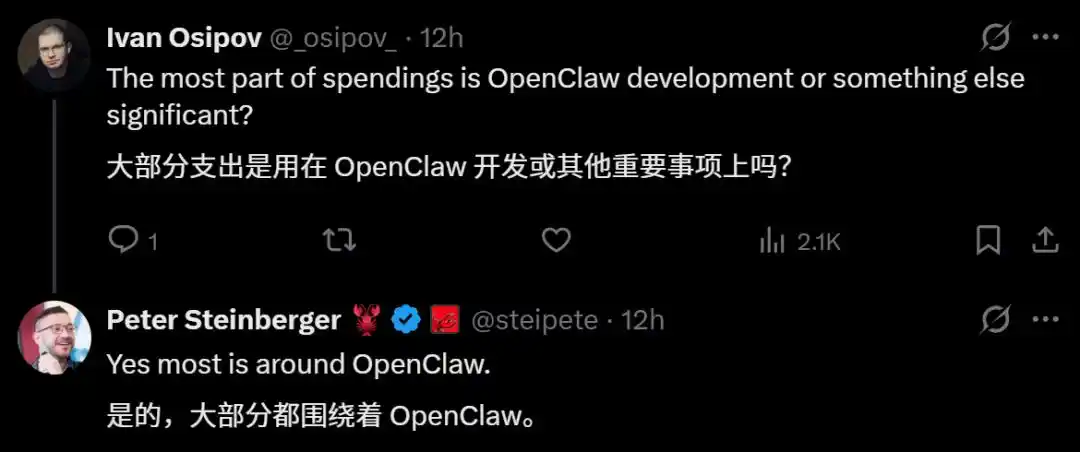
Others were curious about where this massive token usage went.

Peter responded that most was used for OpenClaw development.
Netizen comment

A Cloud-Based Programmer Army

The most outrageous thing is that Pete's small team only has 3 people.

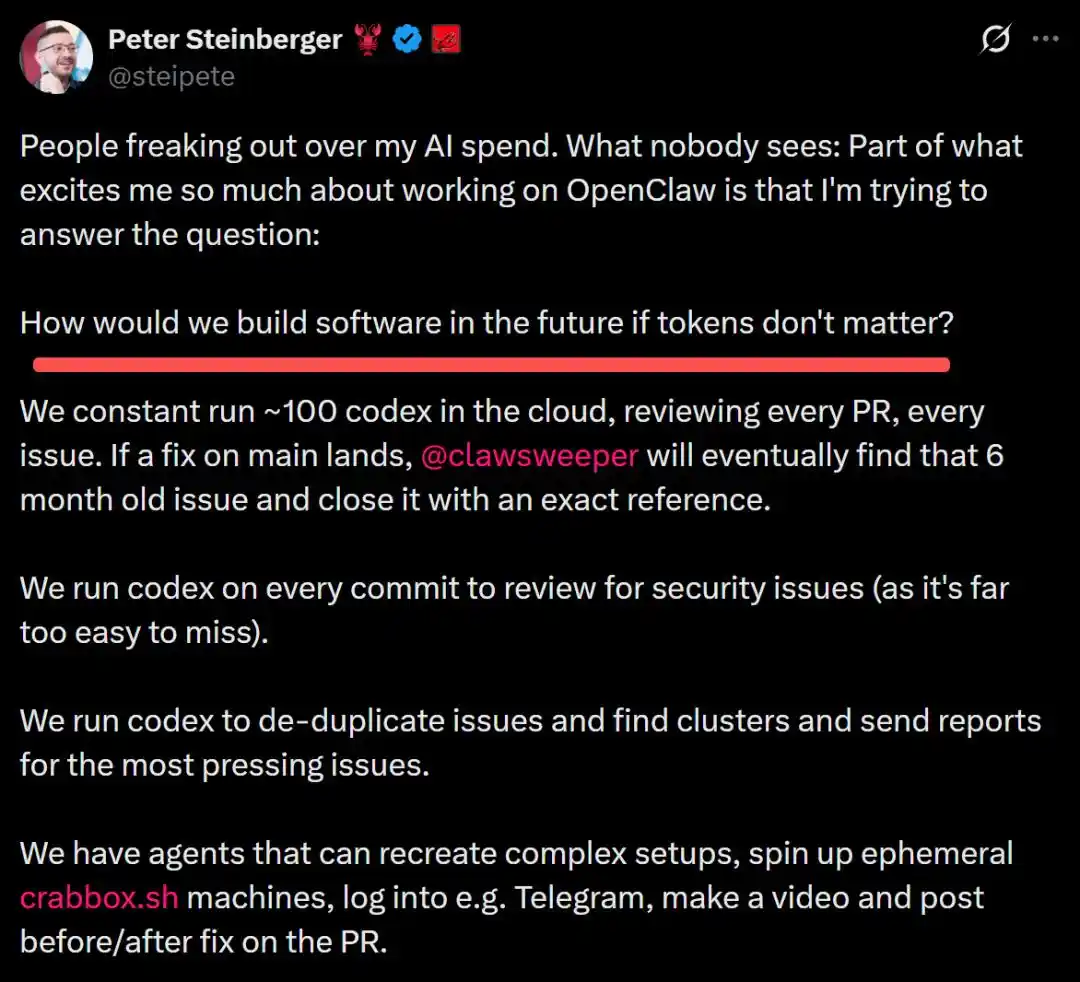
They have about 100 Codex instances running long-term in the cloud, handling the dirtiest, most grueling, most mind-numbing work in software engineering —

Reviewing PRs, finding security vulnerabilities, deduplicating issues, fixing bugs, monitoring benchmarks, posting to Discord upon discovering regressions, even opening PRs directly after listening to meetings.

Thus, AI isn't just "helping you write code," but is infiltrating every crevice of software collaboration.

This is terrifying.

Because what's truly expensive in software development is communication, comprehension, context switching, review, regression, fixes, waiting, and repetitive tasks.

In the past, a team spent a huge amount of time each day on these things that don't seem like "creation" but without which the project would rot.

Now, Peter has tossed all these processes to a bunch of AI agents at once.

This is AI starting to maintain the nervous system of an organization for you.

Illustration

There's another important detail in this screenshot: it's not the OpenAI backend, but CodexBar made by Peter.

CodexBar is a macOS menu bar tool for tracking usage windows, credits, costs, and reset times for various AI programming tools.

It supports a bunch of services like Codex, Claude, Cursor, Gemini, Copilot, etc.

What used to be in a programmer's menu bar? CPU, memory, battery, network speed.

Now there's one more thing: tokens. Tokens are becoming a new "means of production."

CodexBar

A Final Word

$1.3 million a month, 3 people, 100 AI agents.

Ponder this set of numbers — three living humans, leading a hundred digital employees who don't eat, sleep, or demand raises, doing the work of an entire engineering team.

Some felt invigorated after reading this: AI finally isn't just a decorative vase for chatting! Others felt a chill down their spine: Wait, so what do we coders do in the future?

But honestly, what keeps me up at night is Steinberger's casual remark: "I'm exploring what software development would look like if token cost wasn't an issue."
Peter Steinberger

Everyone, he said "if."

The problem is, this "if" is visibly turning into "when" at an astonishing speed.

The work that costs $1.3 million today, after one price cut for models, becomes $130k. Another cut, $13k.

On that day, having 100 AI agents working simultaneously is no longer a game exclusive to Silicon Valley big shots, but a basic operation for any three-person startup team.

Three young people in a garage, holding a hundred tireless AI programmers — this image, just thinking about it is absurd.

Peter Steinberger has revealed the bottom card.

On the card it says: The future is already knocking, and it doesn't plan to wait for you to be ready.

References:

https://the-decoder.com/for-1-3-million-a-month-openclaw-founder-peter-steinberger-runs-100-ai-agents-that-code-review-prs-and-find-bugs/

https://x.com/steipete/status/2055346265869721905

https://developers.openai.com/codex/speed

This article comes from the WeChat public account "New Zhiyuan", author: New Zhiyuan

Questions liées

QHow much money did the three-person team spend on AI development in one month, and who covered the cost?

AThe three-person team spent $1,305,088.81 (approximately 1.3 million USD) in one month on AI development, and the cost was covered by OpenAI.

QWhat is the name of the tool Peter Steinberger created to track AI development costs and usage?

APeter Steinberger created a tool called CodexBar, a macOS menu bar application that tracks usage windows, credits, costs, and reset times for various AI programming tools like Codex, Claude, Cursor, Gemini, and Copilot.

QApproximately how many AI agents (instances) does Peter Steinberger's team run for development tasks?

APeter Steinberger's team runs approximately 100 AI Codex instances to perform various development tasks.

QWhat kinds of software development tasks do the AI agents in the article handle?

AThe AI agents handle tasks such as reviewing pull requests (PRs), finding security vulnerabilities, deduplicating issues, fixing bugs, monitoring benchmarks, reporting regressions to Discord, and even opening PRs after listening to meetings.

QWhat is the core implication Peter Steinberger highlights regarding the future of software development with AI?

APeter Steinberger highlights that the core implication is exploring what software development would look like if token cost were not a limiting factor, suggesting a future where small teams can leverage large numbers of AI agents as a standard practice, dramatically changing the development landscape.

Lectures associées

Trading

Spot
Futures

Articles tendance

Comment acheter BILL

Bienvenue sur HTX.com ! Nous vous permettons d'acheter Billions Network (BILL) de manière simple et pratique. Suivez notre guide étape par étape pour commencer votre parcours crypto.Étape 1 : Création de votre compte HTXUtilisez votre adresse e-mail ou votre numéro de téléphone pour ouvrir un compte sur HTX gratuitement. L'inscription se fait en toute simplicité et débloque toutes les fonctionnalités.Créer mon compteÉtape 2 : Choix du mode de paiement (rubrique Acheter des cryptosCarte de crédit/débit : utilisez votre carte Visa ou Mastercard pour acheter instantanément Billions Network (BILL).Solde :utilisez les fonds du solde de votre compte HTX pour trader en toute simplicité.Prestataire tiers :pour accroître la commodité d'utilisation, nous avons ajouté des modes de paiement populaires tels que Google Pay et Apple Pay.P2P :tradez directement avec d'autres utilisateurs sur HTX.OTC (de gré à gré) : nous offrons des services personnalisés et des taux de change compétitifs aux traders.Étape 3 : stockage de vos Billions Network (BILL)Après avoir acheté vos Billions Network (BILL), stockez-les sur votre compte HTX. Vous pouvez également les envoyer ailleurs via un transfert sur la blockchain ou les utiliser pour trader d'autres cryptos.Étape 4 : tradez des Billions Network (BILL)Tradez facilement Billions Network (BILL) sur le marché Spot de HTX. Il vous suffit d'accéder à votre compte, de sélectionner la paire de trading, d'exécuter vos trades et de les suivre en temps réel. Nous offrons une expérience conviviale aux débutants comme aux traders chevronnés.

80 vues totalesPublié le 2026.05.07Mis à jour le 2026.05.12

Comment acheter BILL

Discussions

Bienvenue dans la Communauté HTX. Ici, vous pouvez vous tenir informé(e) des derniers développements de la plateforme et accéder à des analyses de marché professionnelles. Les opinions des utilisateurs sur le prix de BILL (BILL) sont présentées ci-dessous.

活动图片