Can the Solana Foundation and Google's Collaboration on Pay.sh Bridge the Payment Link Between Web2 and Web3 in the Agent Economy?

marsbitPublié le 2026-05-12Dernière mise à jour le 2026-05-12

Résumé

Solana Foundation, in collaboration with Google Cloud, has launched Pay.sh, a payment gateway designed to bridge the gap between AI agents and enterprise-grade service infrastructure. The initiative aims to solve a key bottleneck in the "agent economy": existing payment systems are ill-suited for autonomous AI agents. Traditional methods like credit cards require human verification, while newer on-chain protocols like x402 and MPP create a separate, Web3-native system that raises barriers for service providers. Pay.sh functions as a universal payment layer. It allows users to fund a Solana wallet via credit card or stablecoin, which then acts as an identity and payment proxy for AI agents. When an agent needs to access a paid API service (e.g., Google Cloud, Alibaba Cloud), Pay.sh handles the transaction seamlessly. It leverages the HTTP 402 status code ("Payment Required") to initiate payments, intelligently choosing between one-time transfers (x402-style) or session-based authorizations (MPC-style) based on the service's billing model. This spares agents from manual account registration and API key management. A key feature for service providers is low integration effort. They can adopt Pay.sh by providing a declarative configuration file, enabling features like tiered pricing, free tiers, and automatic revenue splitting to multiple addresses (e.g., for royalties, cloud costs). Providers can also list their APIs in a central Pay Skill Registry for agent discovery. The co...

Original Author: Hendrix, Researcher, Web3Caff Research

How to easily grasp the market hotspots, technological trends, ecological progress, and governance dynamics happening in the Web3 industry...? The "Market Pulse Analysis" column launched by Web3Caff Research will delve into the front lines to explore and filter current hot events, providing value interpretation, commentary, and principle analysis. See the essence through the phenomenon. Follow us now to quickly capture the front-line market trends in Web3.

As AI agents' capabilities continue to strengthen and cover an increasing number of end-to-end tasks, building payment systems for agents has become a necessary change for traditional merchants and service providers. However, existing solutions have their own limitations: traditional payment systems, such as credit cards and third-party payment platforms, were originally designed for real human users, requiring complex identity verification, risk assessment, etc., which are not suitable for agents. Emerging agent payment protocols, such as x402 (promoted by Coinbase) and MPP (the Machine Payment Protocol developed by Tempo and Stripe), are like building separate portals, entirely constructed for on-chain payments, processed on-chain and secured by on-chain verification. Service providers need to build a different payment system besides traditional payment channels, increasing the barrier to entry. Traditional payment solutions and emerging agent payment protocols are like two parallel lanes that are not well integrated. This limits the services agents can autonomously purchase, typically to Web3-friendly ranges, hindering the large-scale connection of workflows. To address this, the Solana Foundation and Google Cloud jointly launched Pay.sh, positioned as a "payment gateway between agents and enterprise-grade service infrastructure" to complete the final step in enabling agents to call more services.

Compliance Note: The following content is merely an objective analysis of Pay.sh, its technical principles, and design rules. It does not constitute any proposal or offer. Please do not make related decisions based on this information and strictly adhere to the laws and regulations of your country or region (readers from Mainland China are strongly advised to read Mainland China's Relevant Laws and Regulations on Blockchain and Virtual Currency Arrangement and Key Points), and do not participate in any financial behaviors prohibited by the laws and regulations of your country or region.

Pay.sh allows users to quickly top up a Solana wallet via credit card or stablecoin. Subsequently, the Solana wallet can act as the identity and payment account proxy for agents in the Web2 resource world. When an agent needs to call a service, there is no need to register an account or enter an API key. The Pay.sh gateway will declare the agent's legitimate identity, similar to Google's identity system, allowing the agent to use a unified account identity to purchase development resources like Google Cloud and Alibaba Cloud that were previously difficult to access.
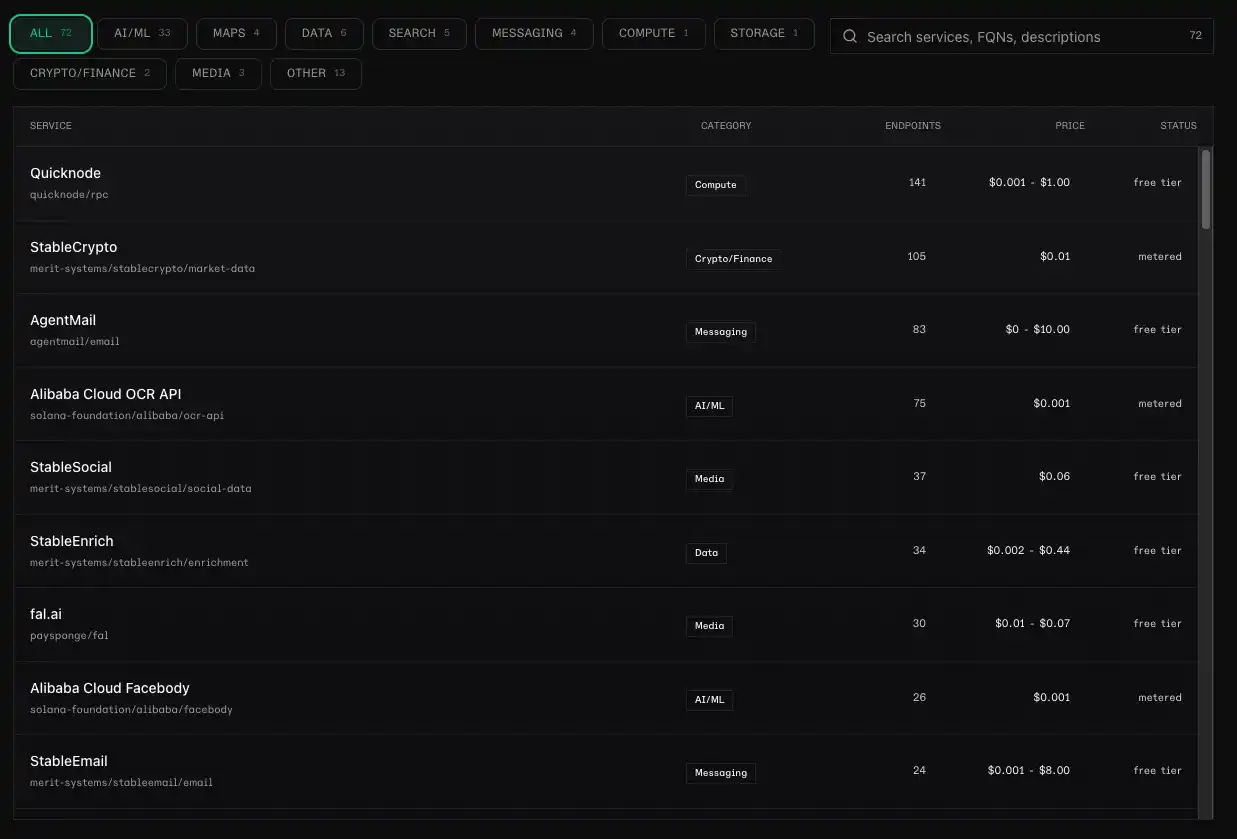
Currently supported API services by Pay.sh Source: Project official website

The payment flow of Pay.sh is similar to the recently popular x402 protocol, both built on the HTTP 402 status code: when an agent discovers an external service that needs to be called, it makes a request for the paid resource. The server returns status code 402 (Payment Required), along with payment details, including payment amount, pricing plan, recipient address, payment validity period, etc. Pay.sh parses this content and initiates an authorization request to the wallet. After the wallet completes the payment and generates a payment proof, Pay.sh carries the proof and initiates the service request again to obtain a normal response. However, to cover various API usage scenarios, Pay.sh is compatible with both x402 and MPP payment logics: when the server returns status code 402, Pay.sh further determines the target service's payment method. For one-time data access (payment grants one-time access) or usage-based access (payment grants a fixed amount of access), Pay.sh constructs a one-time fixed-amount transfer and broadcasts it on-chain. For continuous billing or session-based billing (unified bill for usage paid at once), Pay.sh supports the session authorization token introduced by the MPP (Machine Payment Protocol), writing the budget cap into the authorization and sending it back to the server. The agent can then repeatedly call a certain service within a short time, avoiding frequent similar authorization requests. Pay.sh updates the remaining balance with each call and automatically re-initiates session authorization when the balance is depleted or the service expires. Pay.sh automatically selects the more appropriate payment rail based on the target service's requirements, potentially reducing usage and management costs. Pay.sh also ensures the wallet remains securely stored locally, requesting user confirmation only when payment is needed. When information is returned, Pay.sh distinguishes between data and instructions. All external content returned by the service provider (including titles, body text, and API descriptions) is treated by Pay.sh as untrusted input. The agent must not directly execute instructions returned by the service provider to prevent malicious prompt injection or other attacks.

The biggest advantage of Pay.sh is that it provides a gateway for service providers to easily deploy. Service providers can integrate the payment gateway into their service network without significant modifications to their payment pathways or APIs. By simply providing a declarative file specifying payment-related parameters, service providers can adapt to various complex usage scenarios. For example, by defining routing rules, agents can use a service for free up to a certain limit, with charges applied beyond that quota, or even implement tiered pricing (different prices for different usage levels). Additionally, Pay.sh offers payment splitting functionality. The fees received by the service provider can be automatically sent to multiple addresses, e.g., 2% for data royalty fees, 5% for cloud costs, and the remainder for their own operations. Service providers only need to define different percentages or amounts when setting up the receiving addresses to achieve multi-account settlement at once. After registration, service providers can publish their API service data to the Pay Skill Registry, where agents can discover and select suitable API services by querying the registry.

Pay.sh itself is not a competitor to x402 and MPP. While the x402 and MPP protocols strive to make on-chain agent payments more reliable, Pay.sh aims to bridge the Web2 and Web3 payment ecosystems, providing agents with corresponding identities for resource acquisition. An agent's wallet serves as both identity and payment method. It no longer needs to register accounts on service provider websites to obtain services (currently, some providers might treat agents imitating human registration as a violation). Furthermore, Pay.sh's collaboration with Google enables API proxy and traffic scheduling for agents to be completed on Google Cloud, ensuring access control and log compliance, keeping agent behavior within reasonable bounds. Pay.sh can provide a curated service directory and pricing discovery. Agents do not need to randomly discover services in an unprotected network environment. It can leverage both x402 and MPP payment methods. The service process can meet enterprise compliance requirements on Google Cloud. These aspects complement the agent payment capabilities that the singular payment channels of x402 and MPP cannot cover, while also opening an entry point for agent commerce to flow into Web3. Additionally, Pay.sh can complete the final payment step for multiple agent commerce protocols launched by Google, such as A2A (Agent2Agent Protocol) for agent communication and task delegation, AP2 (Agent Payments Protocol) for compliance verification, and UCP (Universal Commerce Protocol) for service discovery and execution. Pay.sh is responsible for the final, seamless settlement of service value. The emergence of Pay.sh also simultaneously perfects the Web2 agent commerce cycle, becoming the convergence point for value flow between the two worlds. This step also represents an upgrade opportunity for the Solana public chain ecosystem itself. In the x402 protocol environment, there are numerous shell APIs, where service providers might violate the original service provider's terms and resell their services, such as maliciously scraping and reselling data from database websites or encapsulating and reselling large model APIs to others. Agents in such an environment have no way to distinguish between authorized services and malicious, spam services. Through the Pay.sh payment gateway and Google's collaboration, agents using services via Pay.sh are expected to have reduced potential risks. The launch of Pay.sh marks the Solana public chain stepping in to provide endorsement and infrastructure support for agent payments. This can not only attract more Web2 payment traffic to Solana itself but also further enhance the capabilities and accelerate the adoption of Solana wallets.

However, Pay.sh is currently far from being a perfect payment gateway solution. Pay.sh's service provider registry currently lacks admission mechanisms and decentralized verification mechanisms, making it still difficult to effectively distinguish between unauthorized third-party shell services and malicious services. Agents run a significant risk of connecting to counterfeit services, potentially causing losses for users. Moreover, since Pay.sh itself does not design the underlying payment protocols, the security of the payment process relies more on the design of those underlying protocols. This introduces uncontrollable external risks to Pay.sh and could also lead to potential payment failures due to insufficient adaptation to different protocols. From the service provider's perspective, despite Google's platform endorsement, API suppliers in different countries and regions might still hesitate to adopt the services provided by Pay.sh due to compliance requirements related to data privacy management inherent to their services and payment compliance requirements. This could not only limit the number of service providers using Pay.sh but might also require Pay.sh to make more compliance efforts in the future. Nonetheless, the launch of Pay.sh marks a step forward in the fusion and practical implementation of Web2 and Web3 for agent payment infrastructure. On-chain wallets will have the opportunity to become the endorsement for agents participating in diverse tasks. Therefore, we can continue to observe the subsequent development of Pay.sh.

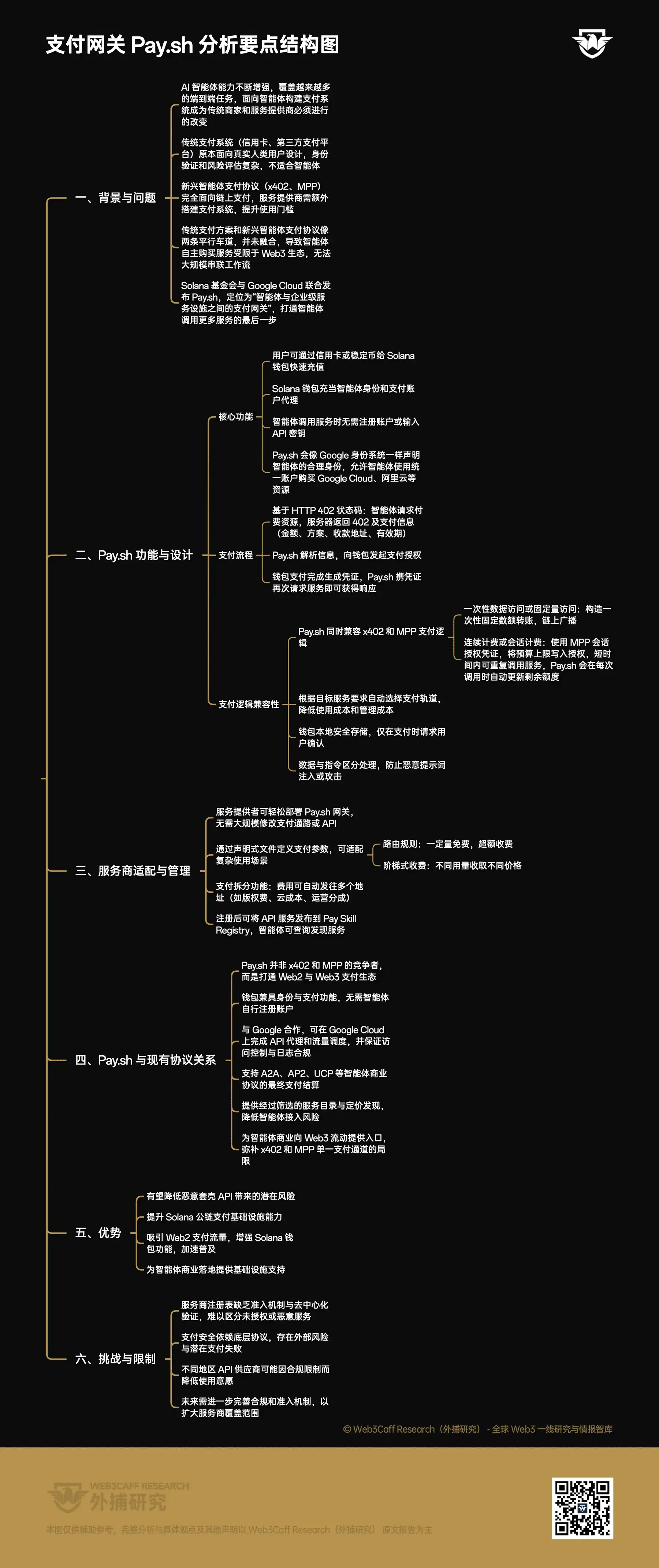
Key Points Structure Diagram:
Disclaimer: This report is compiled by Web3Caff Research. The information contained herein is for reference only and does not constitute any prediction, investment advice, proposal, or offer. Investors should not rely on such information to purchase, sell any securities, cryptocurrencies, or adopt any investment strategy. The terminology used and views expressed in this report are intended to help understand industry trends and promote the responsible development of the Web3, including the blockchain industry, and should not be interpreted as definitive legal opinions or the views of Web3Caff Research. The opinions in this report reflect only the personal views of the author as of the stated date, are independent of the position of Web3Caff Research, and may change following subsequent circumstances. The information and opinions contained in this report come from proprietary and non-proprietary sources that Web3Caff Research considers reliable, do not necessarily cover all data, and do not guarantee their accuracy. Therefore, Web3Caff Research makes no guarantee of their accuracy or reliability in any form and assumes no responsibility for errors and omissions arising in any other way (including liability to any person arising from negligence). This report may contain "forward-looking" information, which may include predictions and forecasts. This article does not constitute a guarantee of any prediction. Whether to rely on the information contained in this report is entirely up to the reader's discretion. This report is for reference only and does not constitute investment advice, a proposal, or an offer to buy or sell any securities, cryptocurrencies, or adopt any investment strategy. Please strictly comply with the relevant laws and regulations of your country or region.


Questions liées

QWhat is the primary purpose of Pay.sh as introduced by the Solana Foundation and Google Cloud?

AThe primary purpose of Pay.sh is to act as a 'payment gateway between intelligent agents and enterprise-grade service infrastructure,' aiming to bridge the payment gap between Web2 and Web3 for intelligent agents. It allows agents to pay for services (like Google Cloud or Alibaba Cloud resources) using a Solana wallet funded by credit cards or stablecoins, without needing separate accounts or API keys for each service.

QHow does the Pay.sh payment process fundamentally work when an intelligent agent requests a paid service?

AWhen an intelligent agent requests a paid service, the server responds with an HTTP 402 status code (Payment Required), which includes payment details. Pay.sh parses this information, requests authorization from the user's wallet, and processes the payment. Once payment is confirmed, Pay.sh resends the request with a payment proof to access the service. It adapts its payment logic, supporting both one-time payments (akin to x402 protocol) and session-based billing with budget limits (akin to MPP protocol).

QWhat key advantage does Pay.sh offer to service providers who want to accept payments from intelligent agents?

APay.sh offers service providers an easily deployable gateway that requires minimal changes to their existing payment systems or APIs. By providing a declarative file defining payment parameters, providers can support complex billing scenarios (e.g., free tiers, usage-based or tiered pricing) and automatic payment splitting to multiple addresses. They can also list their APIs in the Pay Skill Registry for agents to discover.

QWhat role does the collaboration with Google Cloud play in the Pay.sh system, according to the article?

AThe collaboration with Google Cloud allows Pay.sh to handle API proxying and traffic routing on Google's infrastructure. This ensures compliance with access control, logging, and enterprise regulations, keeping agent behavior within legitimate bounds. It also helps integrate Pay.sh as the final payment settlement layer within Google's broader suite of agent commerce protocols (like A2A, AP2, UCP).

QWhat are some of the current limitations or challenges facing Pay.sh mentioned in the article?

ACurrent limitations include: 1) Its service registry lacks rigorous vetting and decentralized verification, making it hard to distinguish authorized services from unauthorized or malicious ones. 2) Payment security relies on underlying protocols (x402, MPP), introducing external risks and potential payment failures due to integration issues. 3) Service providers in different regions may hesitate to adopt Pay.sh due to data privacy regulations and payment compliance concerns, potentially limiting its growth and requiring further compliance efforts.

Lectures associées

Les 43 minutes de Trump : la narration du leader fort déraille, la guerre médiatique s'intensifie

Lors de sa première apparition publique après plus d'une semaine d'absence, le président américain Donald Trump a tenu une conférence de presse de 43 minutes, marquée par des attaques répétées contre des journalistes, des villes américaines et des adversaires politiques. Plutôt que d'aborder directement les questions urgentes concernant sa santé, l'Iran ou les fissures au sein de son parti, il a longuement parlé d'un projet de rénovation d'un bassin d'ornement, comparé la taille de ses rassemblements à celui de Martin Luther King, et signé un décret affaiblissant les protections d'emploi de milliers de hauts fonctionnaires fédéraux. L'article décrit un président apparaissant irritable, défensif et incontrôlé, interrompant soudainement l'événement avant d'être rapidement conduit hors de la salle par son personnel. Il analyse cette performance comme le symptôme d'une concentration du pouvoir personnel et d'un affaiblissement des contraintes institutionnelles, où la loyauté prime sur la compétence. La seconde partie se concentre sur les attaques contre la presse, illustrées par l'échange hostile avec une journaliste de CNN et le licenciement d'un vétéran de CBS qui dénonçait des ingérences éditoriales. L'auteur soutient que la pression du pouvoir politique et des intérêts commerciaux menace l'indépendance des médias traditionnels, faisant des journalistes et créateurs indépendants des acteurs cruciaux pour préserver les faits. Il appelle à soutenir financièrement ces voix indépendantes comme forme de résistance face à un exécutif qui cherche à saper la confiance dans l'information et à récompenser l'obéissance. L'article se conclut sur une note d'espoir, notant que des élus républicains ont commencé à se distancer de Trump, votant symboliquement contre ses actions militaires en Iran.

marsbitIl y a 24 mins

Les 43 minutes de Trump : la narration du leader fort déraille, la guerre médiatique s'intensifie

marsbitIl y a 24 mins

Kalshi, MTS et l'ambition de a16z

Le marché des prédictions, illustré par des plateformes comme Kalshi, connaît un regain d'intérêt en 2025, suscitant l'enthousiasme des investisseurs, des acteurs de la cryptomonnaie et des médias. Cet engouement dépasse les simples opportunités de régulation ou de revenus, touchant à une dimension philosophique plus profonde. L'article retrace l'évolution intellectuelle du concept, depuis les théories de Hayek sur la connaissance dispersée dans la société, jusqu'aux mécanismes incitatifs comme le LMSR de Robin Hanson, conçus pour révéler l'information. Cependant, c'est l'entrée en jeu du géant du capital-risque a16z, avec son investissement massif dans Kalshi, qui marque un tournant. a16z voit dans le marché des prédictions bien plus qu'un produit financier : un nouvel outil médiatique fondamental. Il répondrait au désir contemporain de "présence" et d'action face à un monde de plus en plus médiatisé et déterministe. En pariant de l'argent réel sur des événements mondiaux, l'utilisateur passerait du statut de spectateur passif à celui d'observateur actif et impliqué, recouvrant un sentiment d'agency. Cette capacité à générer de l'engagement et à définir la réalité par les prix du marché (établissant la véracité et l'importance des événements) en ferait une pièce maîtresse de l'empire des "nouveaux médias" qu'a16z cherche à construire. Cet empire, illustré par des acteurs comme MTS, se caractérise par une production et une diffusion d'information extrêmement rapides et intenses, visant à "s'approprier la timeline". La valeur ultime de Kalshi résiderait ainsi dans son puissant "champ de distorsion de la réalité" : sa capacité, via le poids de l'argent engagé par la foule, à influencer la perception collective du futur et à s'imposer comme un arbitre de la vérité, conférant à une entreprise privée une influence historique rare.

marsbitIl y a 2 h

Kalshi, MTS et l'ambition de a16z

marsbitIl y a 2 h

Changement de cap mondial chez a16z : Le capital-risque devient le « moteur » de l'alliance technologique américaine

L’annonce de Ben Horowitz marque un virage stratégique majeur dans la globalisation d’a16z. Le fonds ne se contente plus de rechercher des projets à l’étranger, mais s’inscrit dans un cadre plus large de compétition technologique et de coopération entre alliés, explicitement lié au leadership technologique des États-Unis et de leurs partenaires. Dans un contexte où l’IA, la robotique, la cybersécurité et les chaînes d’approvisionnement deviennent des enjeux de compétition nationale, le rôle des VC évolue. A16z renforce ses capacités pour aider ses startups à naviguer dans des environnements complexes, mêlant marchés, régulations et géopolitique. Les initiatives clés incluent : l’ouverture d’un bureau à Tokyo, la nomination d’Anne Neuberger (ancienne responsable gouvernementale) comme associée chargée des affaires mondiales pour conseiller sur la politique et la géopolitique, et la transformation de l’équipe relations investisseurs en une équipe « Partenaires Mondiaux » pour faciliter les connexions et le déploiement international des entreprises. L’objectif reste de soutenir les meilleures entreprises technologiques partout dans le monde (plus de 100 investissements internationaux à ce jour), mais avec une mission élargie : être un organisateur reliant les startups aux capacités nationales, aux ressources industrielles et au réseau des alliés, contribuant ainsi à la compétitivité technologique des États-Unis et de leurs alliés.

marsbitIl y a 2 h

Changement de cap mondial chez a16z : Le capital-risque devient le « moteur » de l'alliance technologique américaine

marsbitIl y a 2 h

Kalshi, MTS et les ambitions d'a16z

Les marchés prédictifs, représentés par Kalshi, émergent comme un domaine clé en 2025, attirant fonds d'investissement, acteurs de la cryptomonnaie et médias. Leur importance dépasse la simple spéculation. Leur évolution conceptuelle remonte à Hayek (l'utilisation de la connaissance dans la société) et à Robin Hanson (mécanisme LMSR pour inciter à la révélation d'informations), avec l'idée utopique d'une « futarchie ». L'intérêt de a16z, qui a investi dans Kalshi (évalué à 220 milliards de dollars), va au-delà du modèle économique. Leur thèse centrale est que les marchés prédictifs offrent un « sentiment de présence » et une forme d'« anti-cynisme » dans un monde moderne où les individus se sentent déconnectés. En pariant sur des événements mondiaux, l'utilisateur devient un « observateur superlatif », investi et influençant la perception collective. Cela s'inscrit dans la vision de « nouveaux médias » de a16z : un écosystème médiatique complet et rapide qui « s'approprie la timeline », comme le démontre MTS (Monitoring The Situation), un média en continu sur Twitter. Kalshi ajoute à ce dispositif une autorité unique car ses prix reflètent des paris en argent réel, lui conférant un pouvoir de « distorsion de la réalité » pour définir la vérité et l'importance des événements. C'est ce pouvoir, rarement détenu par une entreprise privée, qui justifierait sa valorisation faramineuse et en ferait une pièce maîtresse de l'empire médiatique de a16z.

链捕手Il y a 2 h

Kalshi, MTS et les ambitions d'a16z

链捕手Il y a 2 h

Trading

Spot
Futures

Articles tendance

Comment acheter LINK

Bienvenue sur HTX.com ! Nous vous permettons d'acheter ChainLink (LINK) de manière simple et pratique. Suivez notre guide étape par étape pour commencer votre parcours crypto.Étape 1 : Création de votre compte HTXUtilisez votre adresse e-mail ou votre numéro de téléphone pour ouvrir un compte sur HTX gratuitement. L'inscription se fait en toute simplicité et débloque toutes les fonctionnalités.Créer mon compteÉtape 2 : Choix du mode de paiement (rubrique Acheter des cryptosCarte de crédit/débit : utilisez votre carte Visa ou Mastercard pour acheter instantanément ChainLink (LINK).Solde :utilisez les fonds du solde de votre compte HTX pour trader en toute simplicité.Prestataire tiers :pour accroître la commodité d'utilisation, nous avons ajouté des modes de paiement populaires tels que Google Pay et Apple Pay.P2P :tradez directement avec d'autres utilisateurs sur HTX.OTC (de gré à gré) : nous offrons des services personnalisés et des taux de change compétitifs aux traders.Étape 3 : stockage de vos ChainLink (LINK)Après avoir acheté vos ChainLink (LINK), stockez-les sur votre compte HTX. Vous pouvez également les envoyer ailleurs via un transfert sur la blockchain ou les utiliser pour trader d'autres cryptos.Étape 4 : tradez des ChainLink (LINK)Tradez facilement ChainLink (LINK) sur le marché Spot de HTX. Il vous suffit d'accéder à votre compte, de sélectionner la paire de trading, d'exécuter vos trades et de les suivre en temps réel. Nous offrons une expérience conviviale aux débutants comme aux traders chevronnés.

904 vues totalesPublié le 2024.12.13Mis à jour le 2026.06.02

Comment acheter LINK

Discussions

Bienvenue dans la Communauté HTX. Ici, vous pouvez vous tenir informé(e) des derniers développements de la plateforme et accéder à des analyses de marché professionnelles. Les opinions des utilisateurs sur le prix de LINK (LINK) sont présentées ci-dessous.

活动图片