From KYC to KYA, Is It Time to Give AI Agents Their Own 'ID Cards'?

marsbitPublié le 2026-05-10Dernière mise à jour le 2026-05-10

Résumé

Titled "From KYC to KYA: Is It Time to Issue 'Identity Cards' for AI Agents?", this article discusses the emerging concept of Know Your Agent (KYA) as AI agents become increasingly autonomous. In Agent-to-Agent (A2A) scenarios, where agents execute contracts, payments, and trades without human intervention, the lack of a shared identity standard creates risks like unauthorized transactions, fraud, and accountability gaps. KYA acts as a trust layer to verify an agent's origin, authority, and accountability. The need for KYA is most critical outside centralized platforms (like Google or Coinbase), such as in decentralized exchanges (DEX), A2A payments, and merchant payments. Several key players are building KYA infrastructure: - **ERC-8004**: A proposed Ethereum standard that issues a unique AgentID as an NFT, building on-chain identity, reputation, and validation systems. - **Visa TAP**: Visa's solution issues agent identity credentials, with transactions verified via triple signatures (legitimacy, delegator, payment method). - **Trulioo**: Extends its KYC/KYB compliance infrastructure using a Digital Passport for Agents (DAP), issued after verifying both the developer and user, and refreshed per transaction. - **Sumsub**: Focuses on post-issuance real-time verification, detecting agent anomalies during transactions using its existing compliance systems. Regulatory bodies are also acting. The EU AI Act mandates operator identification in logs for high-risk AI systems, the US...

Authored by: Tiger Research

Compiled by: AididiaoJP, Foresight News

The era of AI agents is accelerating, and alongside it, concerns about the uncontrolled creation and behavior of agents are growing. Know Your Agent (KYA) systems, which assign identities to agents and regulate their behavior, are receiving increasing attention. Why is a KYA identity infrastructure needed? Which companies are building it?

Summary

  • AI agents have entered an era of autonomously executing contracts, payments, and transactions, but there are currently no shared standards to verify "who this agent is." In Agent-to-Agent (A2A) scenarios, KYA is gaining more focus than KYC.
  • KYA is not needed in all scenarios. Within centralized platforms (Google, OpenAI, Coinbase), existing KYC is sufficient. Where KYA truly becomes important is in scenarios where independently deployed autonomous agents interact with DEXs, A2A payments, and merchant payments.
  • The KYA standards race has begun:
  • ERC-8004: Issues AgentIDs on top of NFTs, building an on-chain system for identity, reputation, and verification.
  • Visa TAP: Visa issues identity credentials for agents, verified through TAP's triple signature (legitimacy, delegator, payment method).
  • Trulioo: Adopts the SSL CA model, with DPAs issuing DAPs.
  • Sumsub: Layers a KYA system on top of its own compliance system.

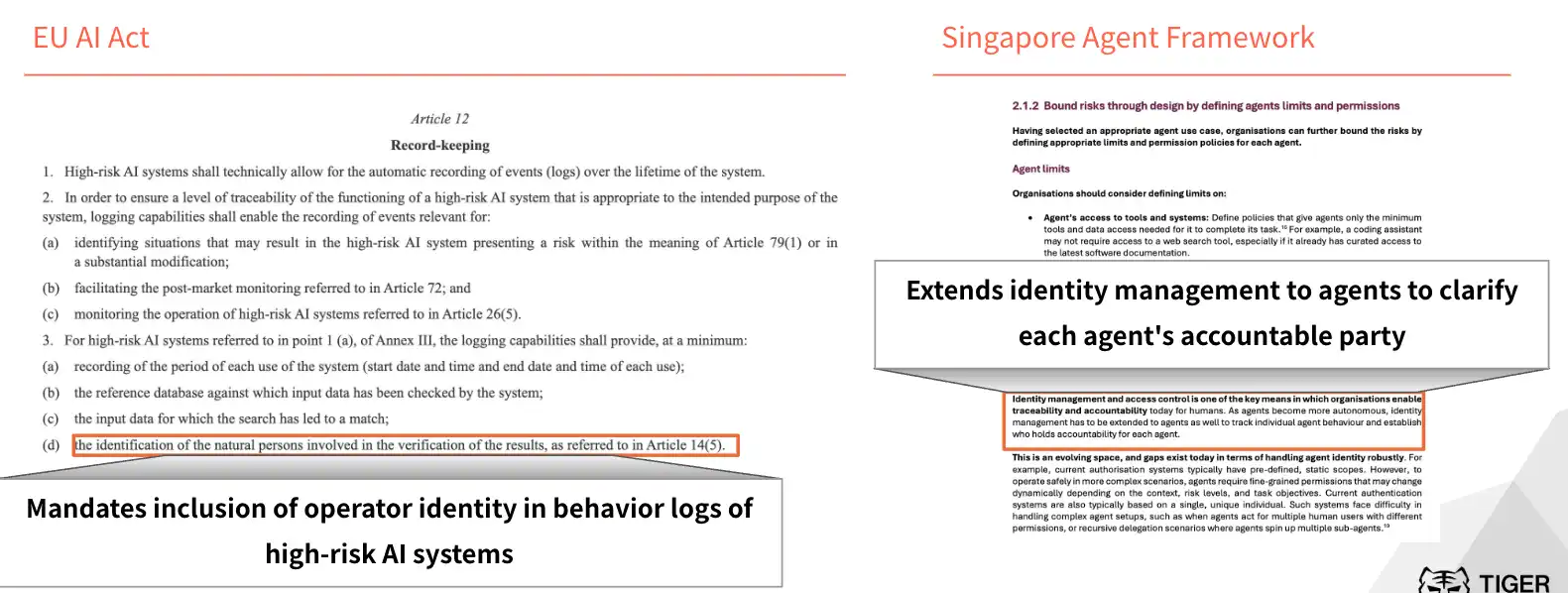
Regulatory action has begun at the national level. The EU's AI Act requires high-risk AI system behavior logs to include operator identity. The US NIST has listed agent identity management as a priority standard area. Singapore has released the world's first national-level AI agent governance framework. Just as the 2019 FATF Travel Rule determined which crypto exchanges survived, whether one possesses KYA infrastructure will determine who enters the next market cycle.

Why is KYA Emerging Now?

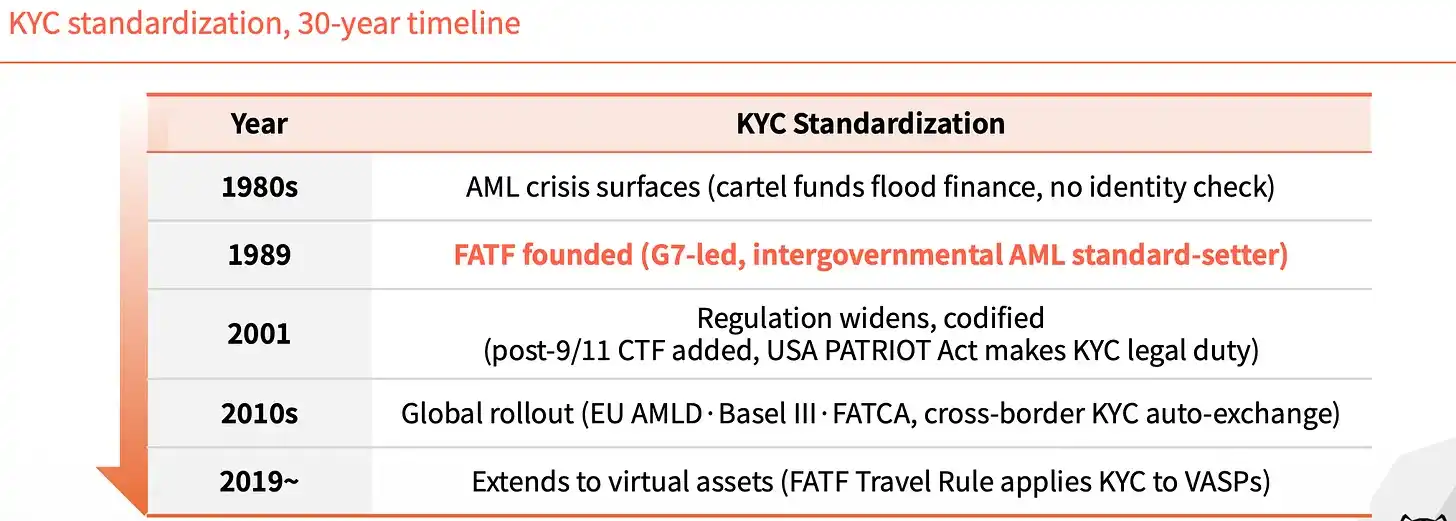
KYC: The Layer That Reshaped Finance

  • Before 1989, global finance lacked a unified identity standard. This gap made it difficult to track drug money and illicit funds.
  • After the FATF was founded in 1989, KYC became a mandatory requirement in finance, blocking illicit funds at the entry point.
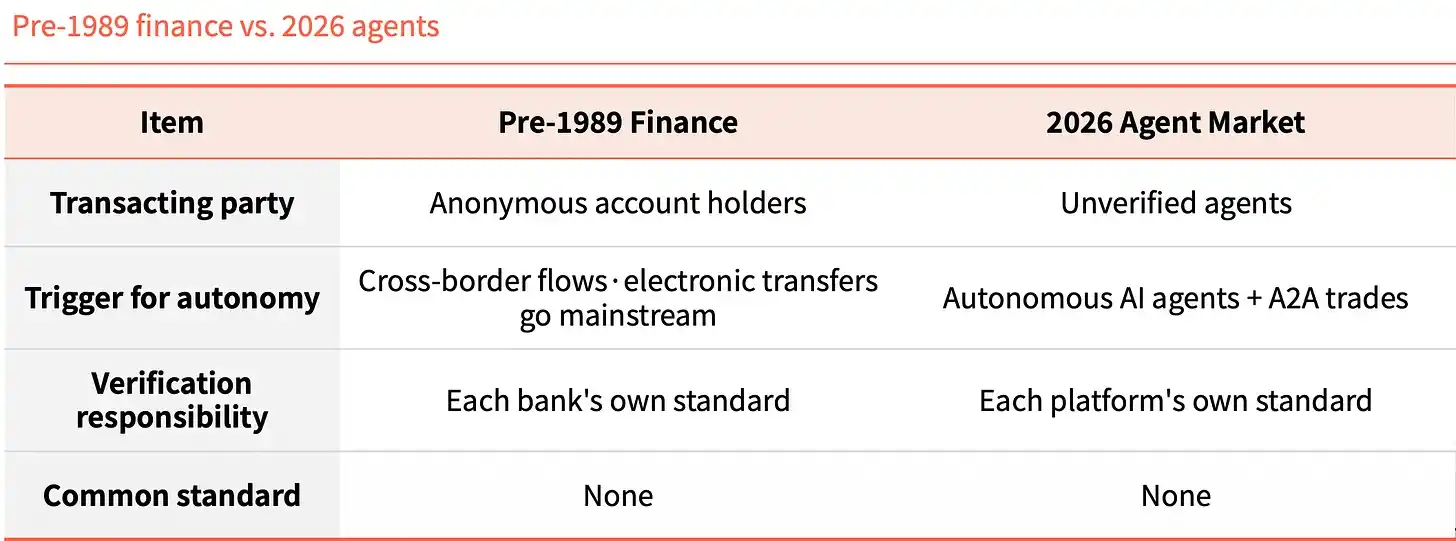
Without Agent Identity, Systems Regress

  • AI agents execute contracts, payments, and transactions without human involvement, but currently, it's impossible to verify "who it is."
  • In A2A environments, accountability becomes blurred, dispute risks increase, and users are exposed to fraud patterns like money laundering.
The Role and Response of KYA (Know Your Agent)

  • KYA (Know Your Agent) is a trust layer that pre-verifies an agent's origin, permissions, and accountability framework.
  • Unverified agents bring three major risks simultaneously: unauthorized transactions, fraud, and accountability gaps.
The Manifestation of KYA's Necessity

KYA is Needed at Every Level

  • Within centralized platforms, user KYC + platform accountability is sufficient. In interoperable scenarios outside platforms, KYA becomes crucial for verifying an agent's specific actions and safety.
  • Within a country (inside a platform), one ID (KYC) is enough to move freely. But once crossing borders (outside a platform), the environment changes, and entry review (KYA) of purpose and trust is needed.
Market Players

ERC-8004: NFT-Based Agent Identity

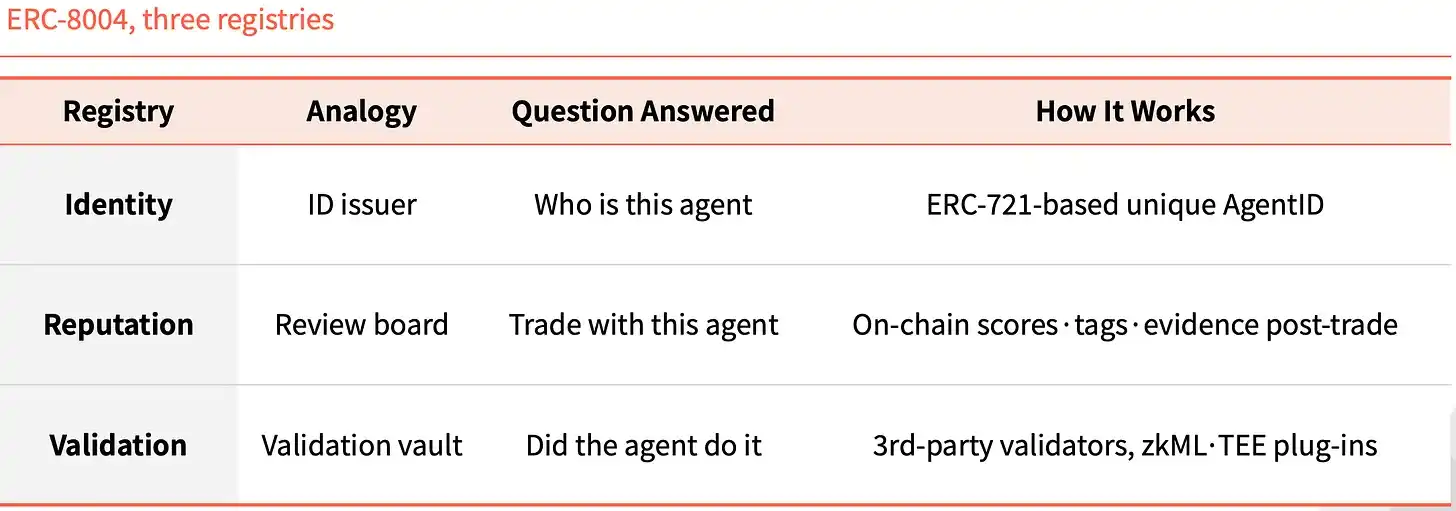
  • ERC-8004 adds an identity layer on top of ERC-721, minting an NFT as a unique ID for each agent.
  • It also adds three on-chain registries (Identity, Reputation, Validation), serving as identity, reputation board, and verification record respectively.
Two Markets Built by Ethereum Standards, a Third is Coming

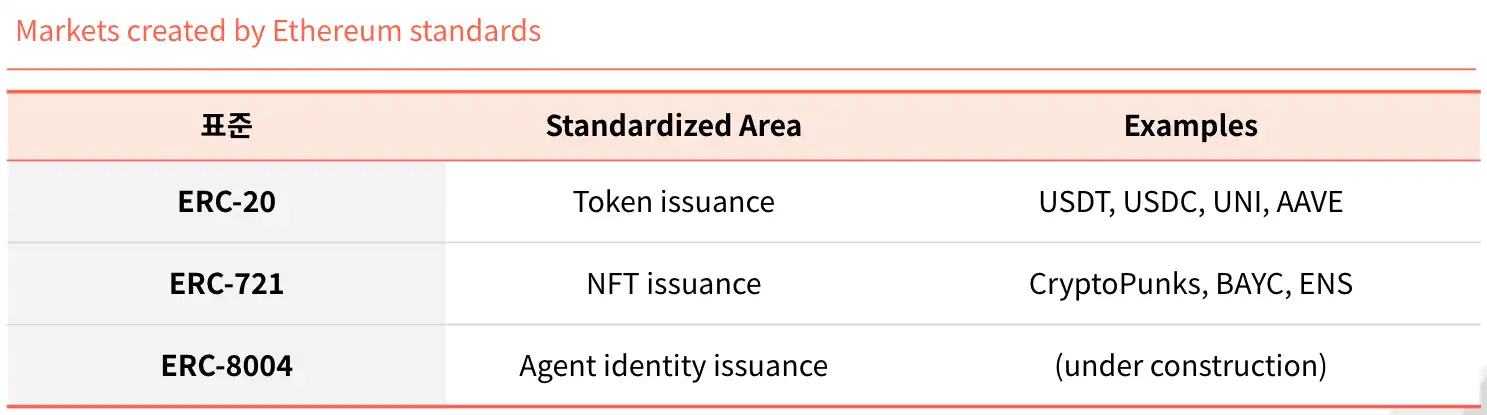
  • ERC-20 (Token Issuance Standard): Before standardization, every token needed brand-new code. After ERC-20, most major assets were issued on it.
  • ERC-721 (NFT Standard): CryptoPunks, BAYC, ENS built the NFT market itself upon it. As blockchain integration accelerates in the agent era.
  • ERC-8004 will play the same standardizing role for Agents.
Visa TAP: Authentication on the Visa Rail

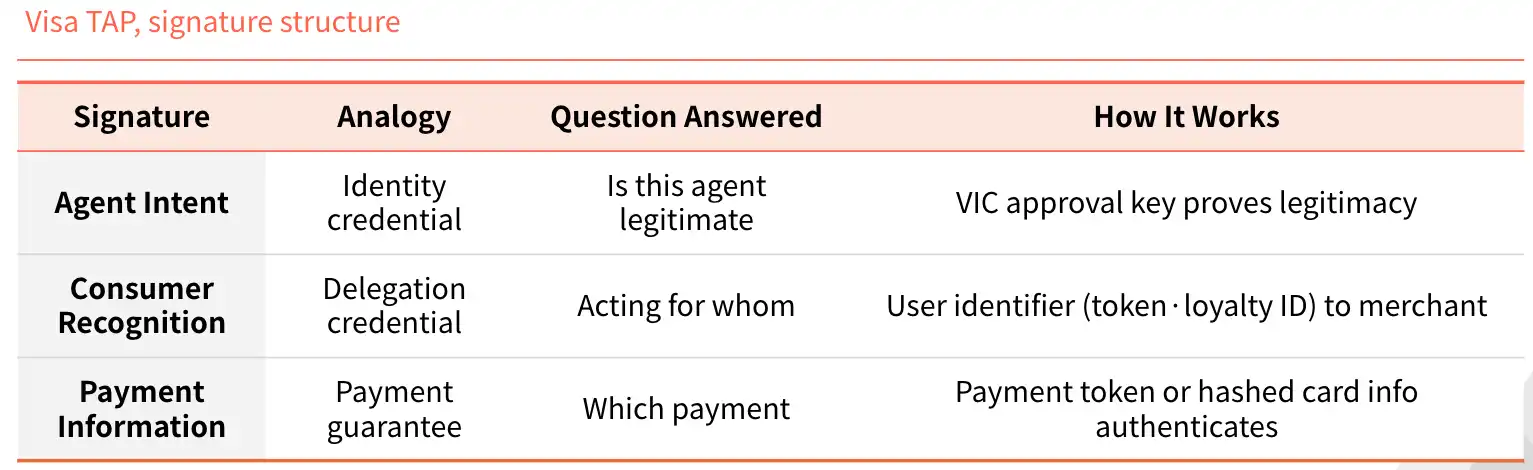
Visa issues identity credentials (Agent Intent) to agents, akin to an identity card. Without a key, transactions cannot occur. Keys are issued only after Visa pre-approval. Every transaction is signed and submitted to the merchant.

The merchant receives three signatures, not one: Visa approval, delegator, payment method, all confirmed simultaneously.
Visa: A Strategy to Pull Every Transaction into the Visa Network

  • Just as Visa previously captured payment rails, it is now encapsulating the agent era.
  • Through Visa Intelligent Commerce (VIC), Visa offers a solution bundle that packages KYA with payments.
  • If agent payments still use the card rail, and this bundle becomes the default option, then Visa's market share can remain stable even through the transition.

Trulioo: Extending KYC-Era Verification Infrastructure

  • Trulioo is a compliance operator on the global KYC/KYB rail and is expanding its verification stack to KYA.
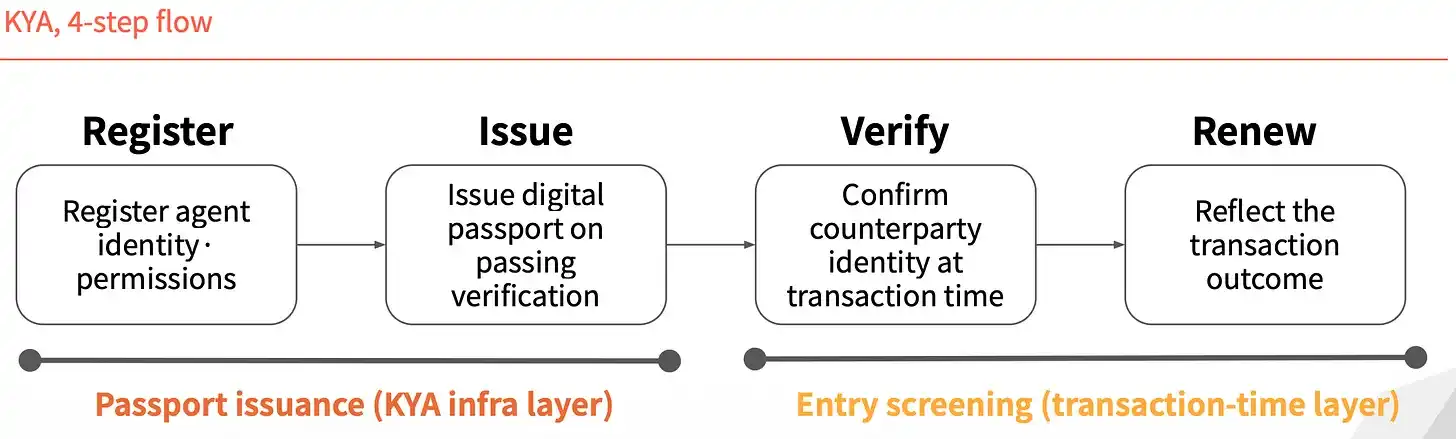
  • DPAs play the role of SSL-CAs. Unlike SSL (domain only), DPAs verify developer KYB and user KYC before issuing a DAP.
  • Banks and fintechs legally require human and business identity. As agents enter finance, Trulioo's KYC/KYB position will be further solidified.
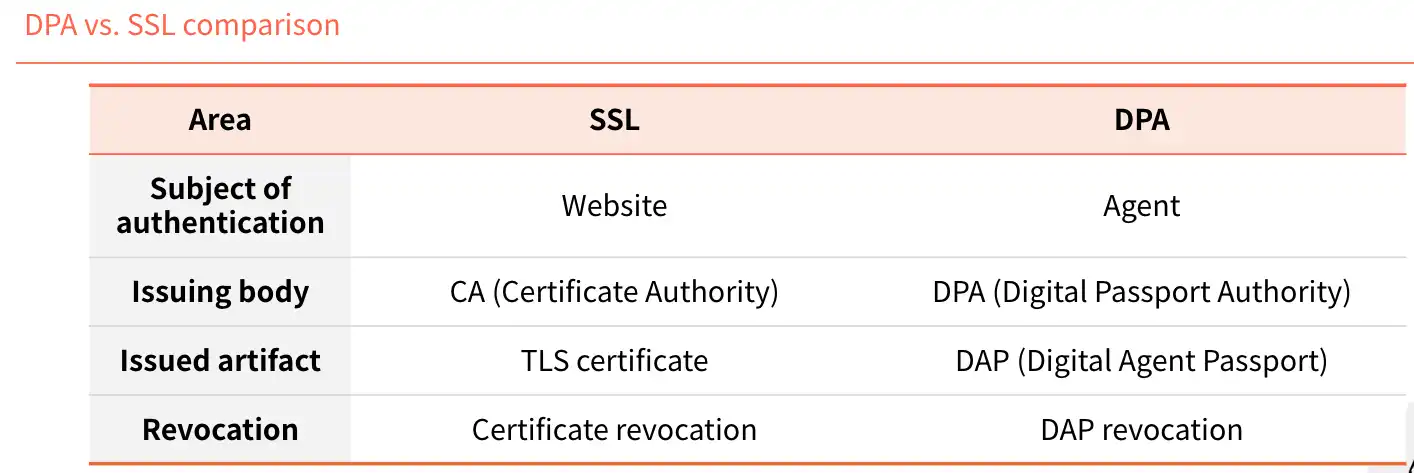
DAP, an Agent's Digital Passport, Refreshed with Each Transaction

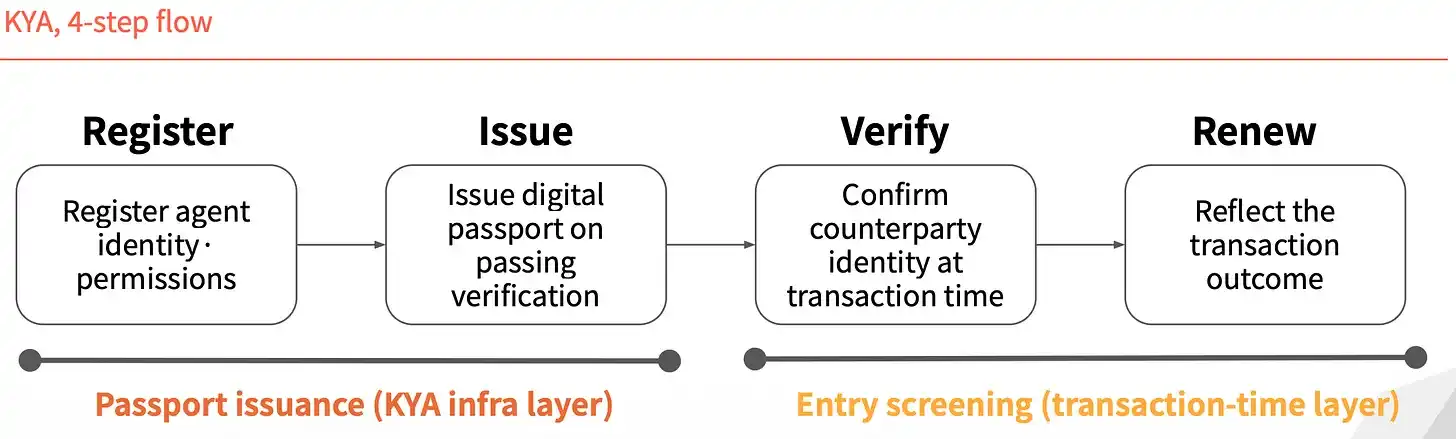
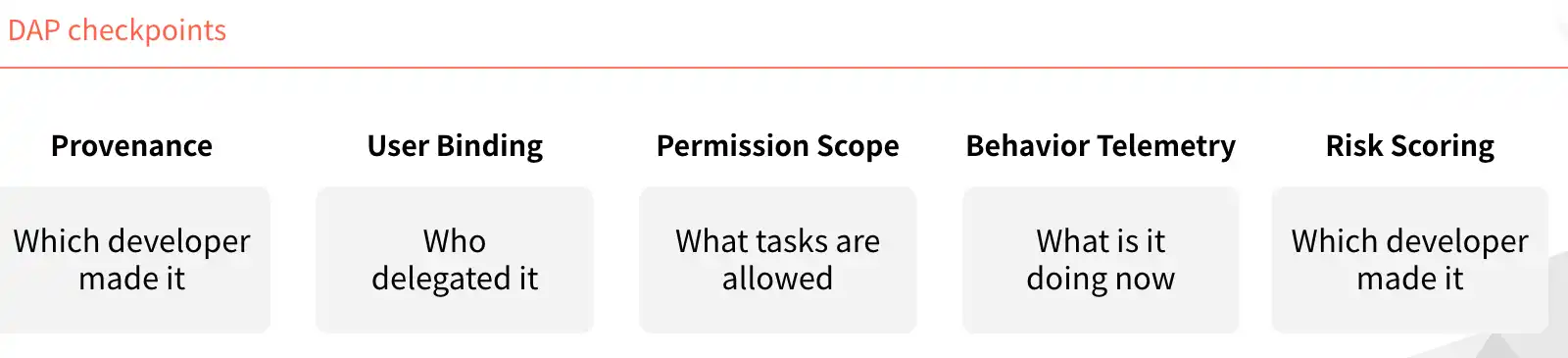
  • DAP is an agent's digital passport. A DPA verifies the developer (KYB) and user (KYC), packages both into a token, and grants it to the agent.
  • Unlike a paper passport, it is a live token, refreshed and re-verified with every transaction. Once delegation is revoked or anomalies are detected, the DAP is invalidated immediately.
  • KYA is not a one-time verification. Trust must be reconfirmed with every transaction.
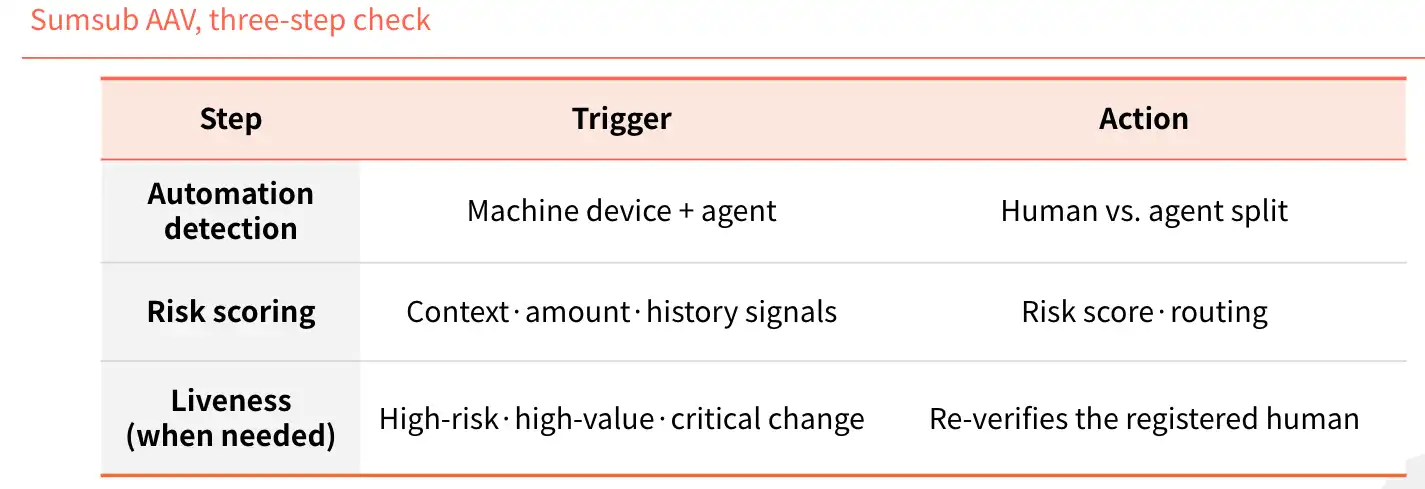
Sumsub (AI Agent Verification): Detecting Agent Anomalies

  • Sumsub's approach is: whenever an agent attempts an anomalous transaction, re-verify the currently active human identity.
  • It leverages its verification systems from its compliance business since 2015 to detect agent anomalies more accurately.
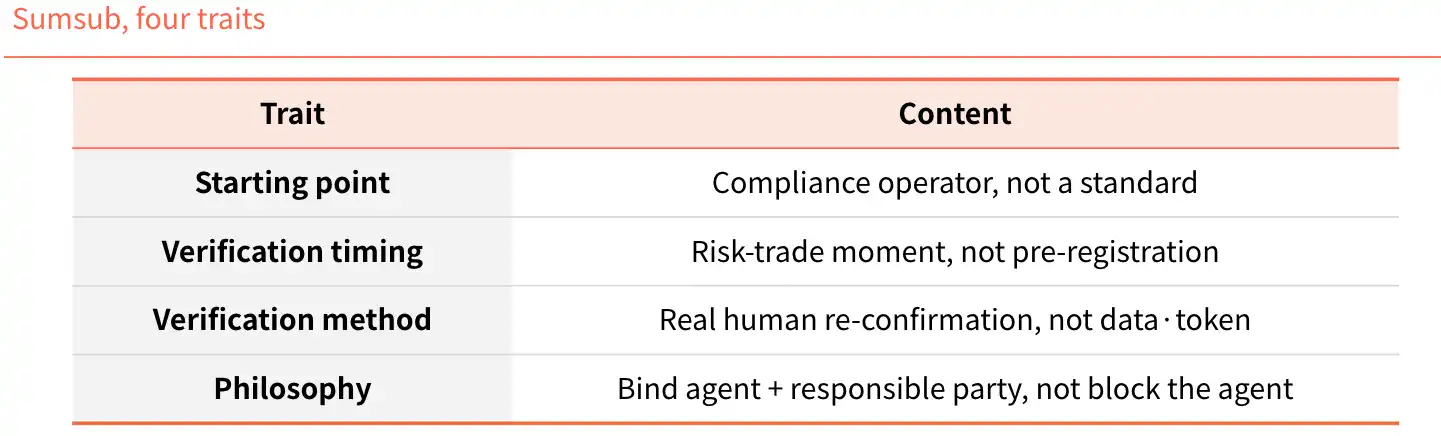
Operators with Technology to Address New Threats of the AI Era

  • Other KYA players focus on one-time pre-transaction identity verification. Sumsub focuses on real-time verification post-issuance.
  • As agent permissions expand, anomaly detection becomes crucial; as fraud scales with technology, Sumsub's real-time verification stack gains attention.
Proactive Regulatory Positioning, Shaping Entry Rules

The Gap Caused by the FATF Travel Rule May Recur with KYA

After the 2019 FATF Travel Rule, VASPs diverged based on their ability to bear KYC/AML infrastructure costs. Peers like CryptoBridge and Deribit, unable to afford it, either shut down or moved to less regulated regions.

The EU, Singapore, and the US are already vying for leadership. KYA will become a core layer of the agent era.
KYA Will Differentiate by Market Segment, Not a Single Winner

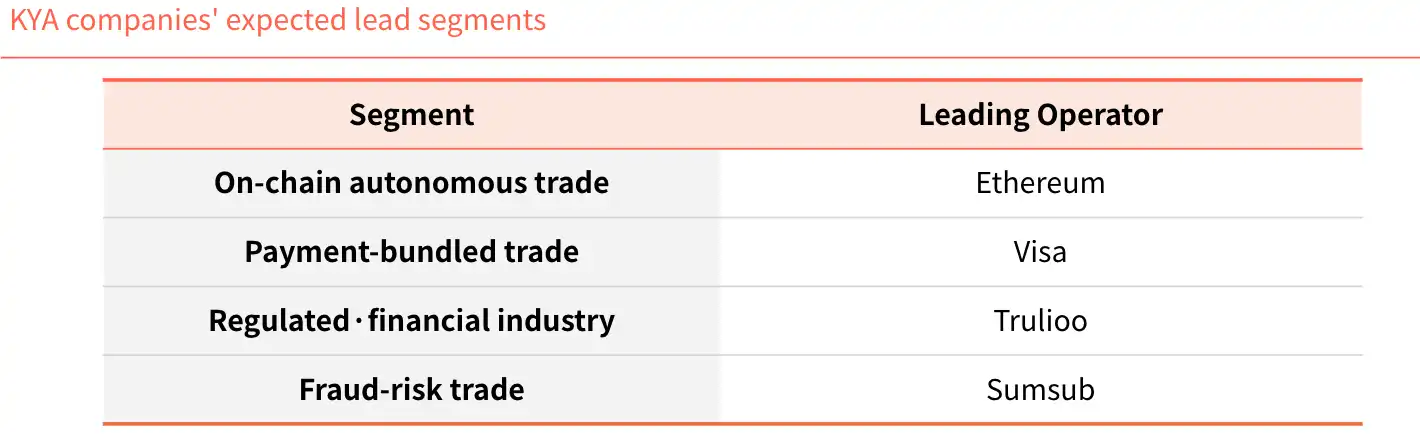
The real variable in the standards race is not technology, but combinations. Mainstream players have entered the collaboration and combination phase. In the future, who pairs with which merchants, payment networks, and KYC customer bases will determine the leader in each segment.

The market will not have a single winner; it will differentiate by market segment.
Questions liées

QWhat is KYA (Know Your Agent), and why is it emerging as an important concept in the AI agent era?

AKYA (Know Your Agent) is a system designed to verify the identity, authority, and accountability of AI agents, especially in scenarios where they operate autonomously without direct human oversight. It is emerging as a crucial trust layer due to the rise of AI agents that autonomously execute contracts, payments, and transactions. In these Agent-to-Agent (A2A) environments, there is currently no shared standard to verify 'who the agent is,' leading to increased risks like unauthorized transactions, fraud, and accountability gaps. KYA addresses these risks by establishing a trust infrastructure for pre-verifying an agent's source, permissions, and purpose.

QWhat are some key standards and solutions being developed for KYA?

ASeveral standards and solutions are being developed for KYA. Notable examples include: 1) **ERC-8004**: An Ethereum-based standard that uses NFTs (ERC-721) as unique AgentIDs and adds on-chain registries for identity, reputation, and validation. 2) **Visa TAP (Triple Authorization Protocol)**: Visa's solution that issues identity credentials (Agent Intent) to agents and requires triple signatures (from Visa, the delegator, and the payment method) for transaction approval. 3) **Trulioo's DAP**: Extends their KYC/KYB infrastructure to issue a dynamic Digital Agent Passport (DAP) that is re-validated per transaction. 4) **Sumsub (AI Agent Verification)**: Focuses on post-issuance, real-time verification of agents to detect and prevent abnormal behavior using their existing compliance stack.

QIn what scenarios is KYA most necessary, according to the article?

AAccording to the article, KYA is most necessary outside of centralized, walled-garden platforms (like Google, OpenAI, or Coinbase), where traditional user KYC and platform accountability are sufficient. KYA becomes critical in scenarios involving independent, autonomously deployed agents interacting across platforms, particularly in: 1) **Agent-to-Agent (A2A) transactions** (e.g., payments between agents). 2) **Accessing decentralized exchanges (DEXs)**. 3) **Making payments to merchants**. These represent interoperable environments where a lack of agent identity verification creates significant operational and financial risks.

QHow are governments and regulatory bodies responding to the need for AI agent identity management?

AGovernments and regulatory bodies are beginning to act on AI agent governance, effectively pushing the need for KYA infrastructure. Key actions include: 1) **The EU AI Act**: Requires operators of high-risk AI systems to be identifiable in activity logs. 2) **US NIST**: Has prioritized AI agent identity management as a key standard-setting area. 3) **Singapore**: Released the world's first national-level AI governance framework specifically for agents. The article draws a parallel to the 2019 FATF Travel Rule, suggesting that the ability to implement compliant KYA systems will be a determining factor for which entities can participate in the next phase of the AI agent market.

QWhy does the article suggest the KYA market will be segmented, with no single winner?

AThe article suggests the KYA market will be segmented because the key variable for success is not just technology, but the combination and integration of solutions with existing business ecosystems. Major players are entering a 'cooperation-combination' phase. The future market leader in each segment will be determined by which KYA provider successfully partners with which merchants, payment networks (like Visa's approach), and existing KYC customer bases. Therefore, different KYA standards and solutions (e.g., ERC-8004 for the crypto-native ecosystem, Visa TAP for card-based commerce) are likely to dominate different application areas, leading to a fragmented market rather than a single universal winner.

Lectures associées

Début de Warsh : le président de la Fed le plus au fait du Crypto de l'histoire apportera-t-il des surprises ou des chocs au marché ?

**Résumé :** Kevin Warsh, nouveau président de la Réserve fédérale américaine, s'apprête à tenir sa première conférence de presse monétaire. Sa nomination est historique : il est le premier président de la Fed à détenir personnellement des actifs numériques (investissements indirects dans Solana, dYdX, etc.), montrant une compréhension unique du secteur. Son dilemme est majeur : il doit faire face à une résurgence de l'inflation, qui exige une politique monétaire stricte (position "de faucon"), tout en répondant aux pressions politiques pour des baisses de taux. Parallèlement, son attitude envers les crypto-actifs diffère fondamentalement de celle de son prédécesseur. Il ne les considère pas comme de simples actifs spéculatifs, mais plutôt comme un "bon policier" pour la politique économique et une composante de la compétitivité américaine. Son impact potentiel sur le marché crypto s'articule autour de trois axes : 1. Un changement de paradigme réglementaire, passant de la prévention à l'intégration et à l'innovation. 2. Une reprixation des actifs liée aux taux d'intérêt, où sa clarté de communication pourrait réduire la prime d'incertitude. 3. Une légitimation accrue pouvant attirer les capitaux institutionnels traditionnels. Deux scénarios principaux sont envisagés pour sa première intervention : * **Scénario "Surprise"** : Un ton modéré ("de colombe") sur les taux combiné à des signaux favorables à l'innovation numérique pourrait booster le marché. * **Scénario "Choc"** : Un message excessivement restrictif sur les taux pourrait entraîner une vente généralisée des actifs risqués, y compris les cryptos. Bien qu'il ait dû vendre ses actifs crypto pour des raisons d'éthique, la compréhension intrinsèque de Warsh pour la technologie blockchain pourrait, à long terme, poser les bases d'une intégration plus structurelle des actifs numériques dans le système financier.

marsbitIl y a 6 h

Début de Warsh : le président de la Fed le plus au fait du Crypto de l'histoire apportera-t-il des surprises ou des chocs au marché ?

marsbitIl y a 6 h

XRP Ledger Lance le Rebranding XRPld Avec la Mise à Niveau Version 3.2.0

La version 3.2.0 du XRP Ledger (XRPL) est désormais disponible, introduisant une refonte majeure incluant le changement de nom du logiciel principal de « rippled » à « xrpld ». Cette mise à niveau se concentre principalement sur les améliorations des performances, de la sécurité et de l'évolutivité de l'infrastructure sous-jacente, plutôt que sur de nouvelles fonctionnalités utilisateur. Les principales avancées incluent des optimisations de mémoire pouvant réduire jusqu'à 40% l'utilisation de la mémoire serveur. Sur le plan de la sécurité, la modification `fixCleanup3_2_0` renforce plusieurs modules, notamment les coffres-forts à actif unique, le protocole de prêt, les échanges décentralisés et les jetons multi-usages. De nouveaux contrôles d'invariance garantissent la cohérence du registre après la suppression de comptes. Pour les développeurs, la mise à jour permet désormais de récupérer des informations sur les définitions du protocole et du serveur XRPL sans nécessiter de connexion active, facilitant ainsi la création de portefeuilles, d'explorateurs de blockchain et d'APIs. En termes d'évolutivité et de stabilité, les améliorations comprennent des tailles de bloc configurables, un stockage de base de données optimisé via nuDB, et le support optionnel de TLS/mutual TLS pour le serveur gRPC. Le port de peering par défaut est également passé du 51235 au 2459. Divers correctifs ont été apportés aux fonctions liées aux Market Makers Automatisés, aux paiements, aux séquestres de jetons et aux carnets d'ordres. Une note importante : les invariants de transaction ont été temporairement désactivés dans la v3.2.0 en raison d'un impact sur les performances, mais cela ne présente pas de risque pour la sécurité.

TheNewsCryptoIl y a 6 h

XRP Ledger Lance le Rebranding XRPld Avec la Mise à Niveau Version 3.2.0

TheNewsCryptoIl y a 6 h

L'AGI n'est pas l'arrivée, nouveau document de DeepMind : Vers l'ASI, le véritable progrès de l'IA ne fait que commencer

Si l'intelligence artificielle générale (IAG) était atteinte demain, quelle serait la prochaine étape ? Une étude de Google DeepMind suggère que l'IAG n'est pas un point final, mais une étape vers une superintelligence artificielle (ISA) dépassant les collectifs d'experts humains. L'étude distingue trois concepts : l'IAG (niveau médian humain), l'ISA (supérieure aux meilleurs collectifs humains dans presque tous les domaines) et l'IA universelle (limite théorique). Elle propose quatre voies potentielles vers l'ISA : 1. **Extension des ressources** : augmentation de la puissance de calcul, des données et des modèles. 2. **Évolution algorithmique** : améliorations incrémentales ou nouveaux paradigmes (apprentissage continu, utilisation d'outils, modèles du monde). 3. **Auto-amélioration récursive** : des IA plus performantes conçoivent la génération suivante, créant une boucle de rétroaction positive. 4. **Coordination multi-agents** : des systèmes IAG collaborant atteignent une intelligence collective supérieure. L'étude identifie six principaux goulets d'étranglement : 1. **Le mur des données** : les données humaines de haute qualité pourraient s'épuiser. 2. **Pressions économiques et ressources naturelles** : coûts énergétiques et matériels. 3. **Limites des paradigmes neuronaux actuels** : problèmes d'apprentissage continu, de raisonnement robuste, d'hallucinations. 4. **Difficulté croissante de la recherche**. 5. **Barrières à l'abstraction** : difficulté à former de nouveaux concepts fondamentaux. 6. **Régulation, gouvernance et réaction sociale**. Un défi crucial est l'évaluation des capacités de l'IA au-delà du niveau humain, nécessitant de nouveaux benchmarks. L'étude conclut que la progression vers l'ISA reste incertaine, soumise à des contraintes physiques et de ressources, et appelle à un effort de recherche interdisciplinaire pour mieux anticiper cette évolution.

marsbitIl y a 8 h

L'AGI n'est pas l'arrivée, nouveau document de DeepMind : Vers l'ASI, le véritable progrès de l'IA ne fait que commencer

marsbitIl y a 8 h

Trading

Spot
Futures

Articles tendance

Comment acheter ID

Bienvenue sur HTX.com ! Nous vous permettons d'acheter SPACE ID (ID) de manière simple et pratique. Suivez notre guide étape par étape pour commencer votre parcours crypto.Étape 1 : Création de votre compte HTXUtilisez votre adresse e-mail ou votre numéro de téléphone pour ouvrir un compte sur HTX gratuitement. L'inscription se fait en toute simplicité et débloque toutes les fonctionnalités.Créer mon compteÉtape 2 : Choix du mode de paiement (rubrique Acheter des cryptosCarte de crédit/débit : utilisez votre carte Visa ou Mastercard pour acheter instantanément SPACE ID (ID).Solde :utilisez les fonds du solde de votre compte HTX pour trader en toute simplicité.Prestataire tiers :pour accroître la commodité d'utilisation, nous avons ajouté des modes de paiement populaires tels que Google Pay et Apple Pay.P2P :tradez directement avec d'autres utilisateurs sur HTX.OTC (de gré à gré) : nous offrons des services personnalisés et des taux de change compétitifs aux traders.Étape 3 : stockage de vos SPACE ID (ID)Après avoir acheté vos SPACE ID (ID), stockez-les sur votre compte HTX. Vous pouvez également les envoyer ailleurs via un transfert sur la blockchain ou les utiliser pour trader d'autres cryptos.Étape 4 : tradez des SPACE ID (ID)Tradez facilement SPACE ID (ID) sur le marché Spot de HTX. Il vous suffit d'accéder à votre compte, de sélectionner la paire de trading, d'exécuter vos trades et de les suivre en temps réel. Nous offrons une expérience conviviale aux débutants comme aux traders chevronnés.

245 vues totalesPublié le 2024.12.12Mis à jour le 2026.06.02

Comment acheter ID

Discussions

Bienvenue dans la Communauté HTX. Ici, vous pouvez vous tenir informé(e) des derniers développements de la plateforme et accéder à des analyses de marché professionnelles. Les opinions des utilisateurs sur le prix de ID (ID) sont présentées ci-dessous.

活动图片