Why Are GPU Prices Spiraling Out of Control?

marsbitPublié le 2026-04-06Dernière mise à jour le 2026-04-06

Résumé

GPU prices are surging due to a fundamental shift in market dynamics, driven by AI's transition from a tool to core infrastructure. Demand is exploding from multi-agent systems, AI-generated content, and coding tools like Claude Code, causing token consumption growth. This has led to a severe GPU shortage, with H100 one-year lease prices rising nearly 40% from late 2025 to early 2026. Supply is constrained further by component cost increases (e.g., DRAM, NAND) and extended delivery times for new clusters, many pre-booked into late 2026. The market is dominated by long-term contracts, with AI labs locking in capacity for 4-5 years. High ROI (5-10x) from AI tools makes demand relatively inelastic to price hikes. Neocloud providers now hold pricing power, and the divergence between physical scarcity and market expectations of future oversupply is reshaping valuation logic. Key factors to watch: GB300 cluster deployment pace, chip supply chain stability, and AI lab revenue growth.

Editor's Note: As AI transitions from a "tool" to a "workflow infrastructure," GPU rental prices are accelerating upwards, with supply continuously tightening.

From the nearly 40% price surge in H100 one-year contracts to computing power being locked in until the second half of 2026, and AI labs continuously securing supply through long-term contracts and renewal mechanisms, the operating logic of the GPU market has fundamentally changed: prices are no longer primarily determined by hardware costs but are shaped by token consumption, model capabilities, and production efficiency.

Changes on the demand side are particularly critical. New paradigms like multi-agent systems, native content generation, and AI programming tools are driving token usage into an exponential growth phase. The core conclusion of the report is also becoming clear: the return on investment (ROI) of AI tools has been validated, with 5–10x returns making it difficult for computing power prices to effectively constrain demand for a considerable period.

The resulting tension is increasingly evident: the real-world computing power market shows comprehensive shortages and shifting pricing power upwards, while the capital market remains stuck in the expectation of "eventual oversupply and commoditization." This misalignment between expectations and reality is reshaping the valuation logic of the AI infrastructure sector.

As computing power becomes a new factor of production, its pricing mechanism, supply structure, and capital returns are undergoing a deep restructuring.

The following is the original text:

Anthropic's Claude 4.6 Opus and Claude Code demand has surged significantly. Its Annual Recurring Revenue (ARR) leaped from $9 billion at the end of last year to over $25 billion currently in just one quarter, nearly tripling. Meanwhile, open-source models represented by GLM and Kimi K2.5 have also driven the rapid expansion of application scenarios related to open-source models. Continued financing by companies including Anthropic, OpenAI, and several Neolabs is also intensifying the demand for GPU resources.

This inflection point means demand has risen sharply in a short period, triggering a GPU buying frenzy among hyperscalers and emerging cloud service providers (Neoclouds).

This new demand is pushing prices higher along the entire supply chain, from DRAM and NAND storage to fiber optic cables, data center colocation, and infrastructure like gas turbines—almost all related products and services are experiencing price increases.

GPU rental prices have become the latest area among computing power-related products and services to experience supply tightness and price surges. The price of a one-year H100 GPU rental contract rose from a low of $1.70 per GPU per hour in October 2025 to $2.35 in March 2026, an increase of nearly 40%.

On-demand GPU rental capacity is almost completely sold out across all models—users who have secured on-demand instances are unwilling to release computing power back to the market even after price increases. In early 2026, finding GPU computing power was almost like trying to snag a ticket for the "last flight out": prices were high, and tickets were scarce. A more apt analogy might be "finding a channel to buy medicine."
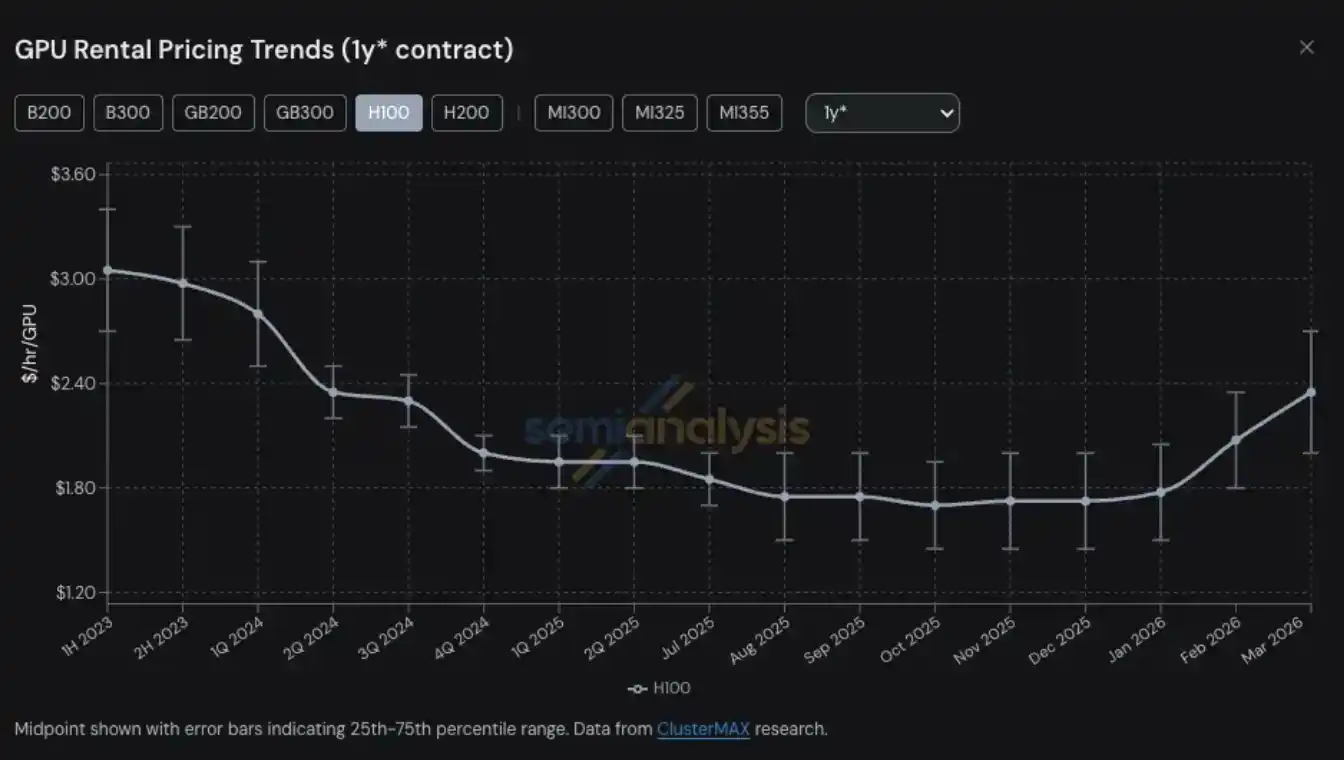
At SemiAnalysis, we have long and deeply tracked various trends and key issues within the Neocloud and hyperscaler ecosystem, including GPU rental prices. This capability stems from our ongoing research and practice in projects like ClusterMAX, InferenceX, and AI Cloud Total Cost of Ownership (TCO).

Simultaneously, we invest significant effort in helping various AI labs connect with Neocloud service providers, search for GPU rental resources on the market, and continuously exchange insights on GPU rental price trends with almost all participants in the ecosystem.

Since 2023, we have established and maintained a GPU rental price index system for our clients, covering mainstream GPU models (such as H100, H200, B200, B300, GB200, GB300, MI300, MI325, MI355) across different lease terms, from on-demand and 1-month short-term leases to long-term contracts of up to 5 years. This index is built based on survey data from multiple Neocloud service providers and computing power buyers, cross-validated with actual transaction data and our participation in facilitating negotiations and deals.
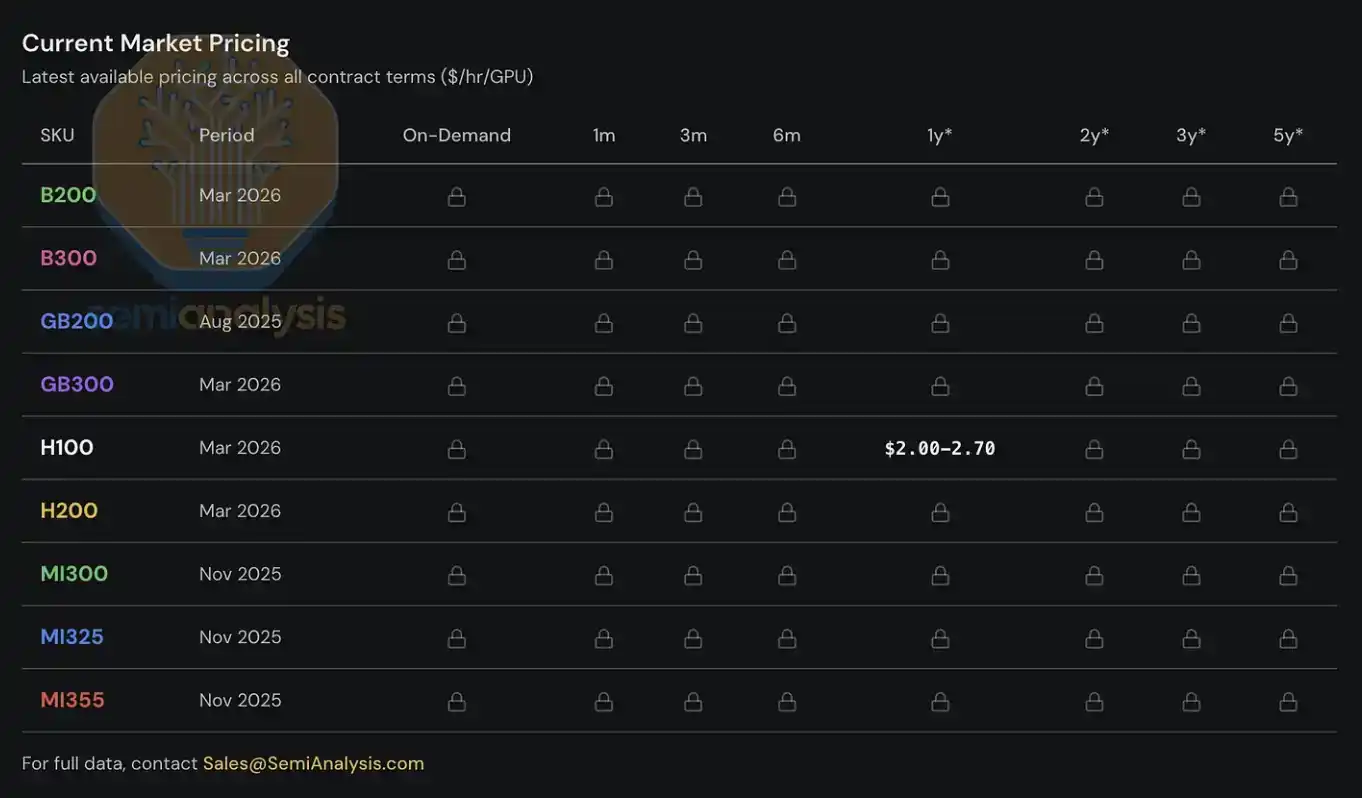
Today, we are making the SemiAnalysis H100 One-Year GPU Rental Price Index publicly available, hoping to provide the industry with more data and insights. This index is updated monthly, and we will also continuously publish the latest trend interpretations and market observations via X and LinkedIn. As for the complete pricing data covering different lease structures and other mainstream GPU models, it is currently only available to institutional subscribers of our AI Cloud TCO model.

This report will focus on the latest trends in the GPU rental market, firsthand market observations, and key data, analyzing how we understand the overall market structure and providing a preliminary judgment on the future direction of rental prices.

GPU Rental Market Enters "Dynamic Pricing" Phase

Looking solely at the H100 one-year rental price curve is insufficient to fully capture the market's tightness—our actual experiences sourcing computing power on the front lines and feedback from market participants paint a more severe picture.

Current demand comes from multiple highly heterogeneous use cases, with almost no "one-size-fits-all" solution. For instance, on the inference side, large-scale Mixture-of-Experts (MoE) models are better suited to run on the latest large-scale systems like the GB300 NVL72; whereas on the training side, H100 still holds a cost-performance advantage, keeping demand for even relatively "older generation" GPUs high.

Clients are now even scrambling to pay $14 per GPU per hour for AWS p6-b200 spot instance prices; some leading Neocloud providers have stopped selling single nodes; renewal prices for some H100 contracts are identical to those signed two or three years ago; and some H100 contracts have been directly renewed until 2028, a lease term of 4 years. Finding even an 8-node (64 GPU) H100 or H200 cluster is not easy now—half the providers we asked were completely sold out, and most replied that no Hopper architecture GPUs would be released from expiring contracts anytime soon.

We've even heard that some computing power lessees have started subdividing and subletting the clusters they've rented, much like splitting apartments for short-term rentals during the Monaco Grand Prix. The emergence of so-called "Neocloud subletters" might not be a joke anymore.

Blackwell supply is also extremely tight. We understand that due to strong demand for open-weight models and the ongoing inference boom, the deployment and delivery cycle for new Blackwell clusters has now extended to June-July. Moreover, these upcoming clusters are mostly pre-booked. In fact, looking at the entire market, almost all new capacity scheduled to come online until August-September 2026 has already been reserved.

GPU Rental Prices: Making a Comeback

But how did the market get here? Just 6 months ago, most market observers were skeptical about the GPU's "terminal value" and普遍认为 GPU rental prices would inevitably decline over time. Back then, if a Neocloud or hyperscaler used a 6-year depreciation cycle for GPU computing assets in their financial models, they might even be criticized by financial analysts. Before discussing future trends, let's quickly review how things evolved to this point.

Before the second half of 2025, the mainstream expectation across the ecosystem was that with the large-scale deployment of Blackwell and its significantly lower cost per unit of compute, Hopper (i.e., H100 and H200) rental prices would noticeably fall. The opposite happened. By H2 2025, H100 demand not only didn't weaken but intensified in many scenarios. The rapid adoption of open-weight models and the continued acceleration of inference demand at that time were the earliest signals of this near-limitless wave of computing demand.

By January 2026, the computing power market reached its next inflection point: DRAM and NAND storage prices, after several quarters of rapid increases, began a near-"parabolic" surge. According to our storage models, LPDDR5 and DDR5 contract prices saw year-on-year increases approaching approximately 4x and 5x respectively in Q1 2026.

To mitigate margin risks from sharply rising component costs, OEMs began raising AI server prices, with increases significantly higher than the underlying component price hikes themselves. This complicated cluster capital expenditure decisions: higher server procurement costs compressed project expected returns, forcing some operators to slow deployment pace or even cancel projects outright. The result was that some potential new supply was delayed or shelved, further exacerbating the tightness in the rental market.
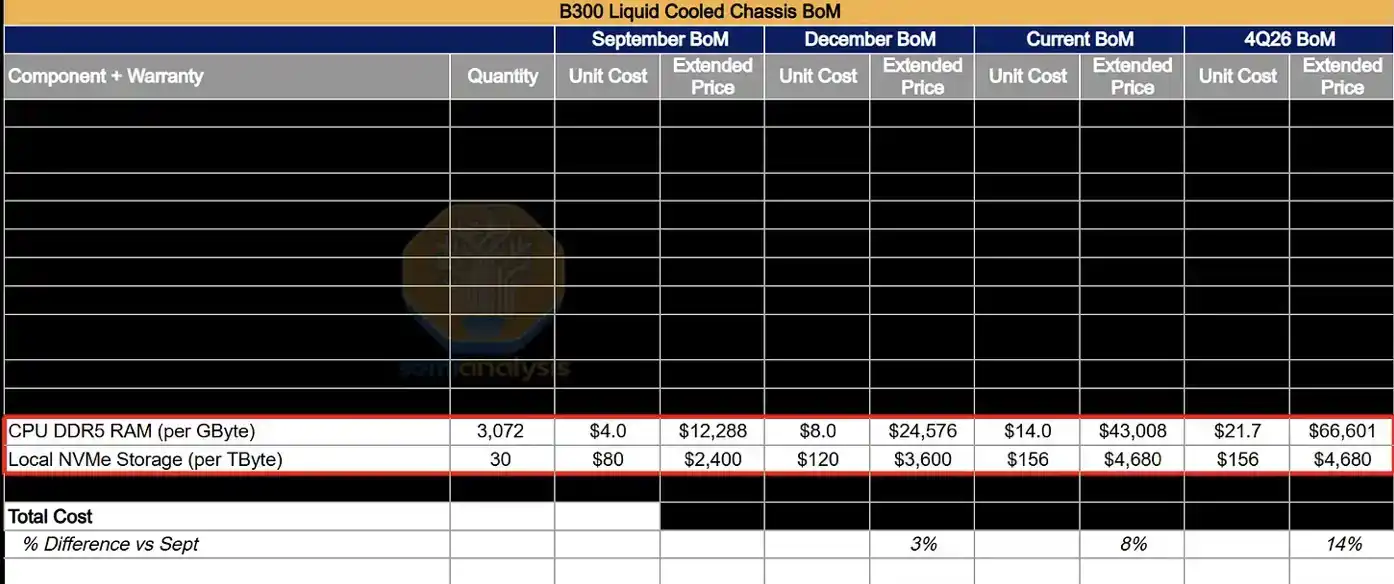
Amid this procurement chaos triggered by "AI server pricing getting out of control," GPU rental demand accelerated significantly, and the remaining computing power on the market was almost completely absorbed in January and February. By March, available capacity was nearly impossible to find for H100, H200, or B200 across any lease term. One-year rental prices broke through $2 per GPU per hour by the end of January and rose another 15%–20% from late January levels by mid-to-late February, with an expected further 15%–20% month-on-month increase by the end of March.

A key driver of demand earlier this year came from native media generation. Applications like Seedance and Nano Banana are driving users to generate and iterate images and videos at scale, significantly increasing token throughput. But a more critical and visible source of demand is the rise of multi-agent workloads—these systems execute multi-step processes, continuously iterating in high-concurrency environments, driving token consumption and computing demand in an "exponential" growth pattern.

This trend is particularly evident in the data related to Claude Code, which we have mentioned in several articles. Taking SemiAnalysis as an example, in just the past 7 days, the company internally consumed billions of tokens, at an average cost of about $5 per million tokens. But the resulting time savings, workflow expansion, and capability enhancements far exceeded the cost itself. Today, SemiAnalysis has embedded a suite of AI tools into multiple workflows, no longer limited to simple search and summarization but extending to data dashboards, automated scraping, large-scale data processing, and agent-based financial modeling.

We also track this explosive demand growth through metrics like Claude Commits Daily. At the current trend, we expect Claude Code to account for over 20% of all code commits by the end of 2026. It's fair to say that, in the time you haven't noticed, AI has begun "eating" the entire software development process. Institutional clients interested in accessing this dataset can contact our API team. A sneak peek: this commit volume is already significantly higher than when we first released it.
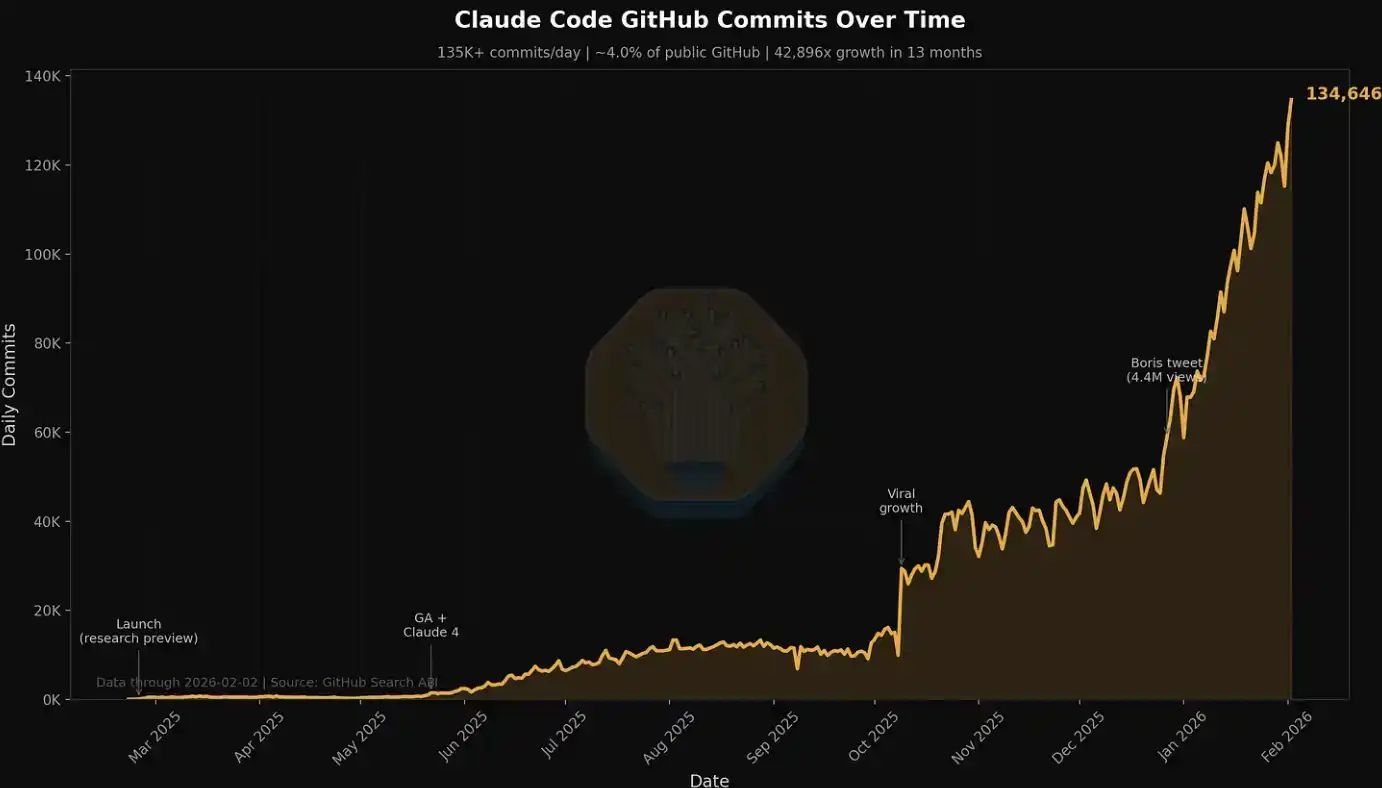
In our circle, almost everyone is a heavy user of Claude Code. But we also know this circle is deeply immersed in AI and semiconductors, essentially just "a small group on the front lines."

For many Fortune 500 companies and the broader public, Claude Code and the "agent world" are merely slightly novel fringe topics, occasionally appearing in Facebook feeds or NPR podcasts. They have hardly realized that a productivity wave and structural shock driven by agents is approaching.

As more participants from the real economy gradually realize the astonishing ROI offered by using AI tools and join this "computing power wave," token consumption will continue to see step-like increases. The debate about AI ROI is, in fact, settled—the value created by using AI tools often exceeds their cost by an order of magnitude. Against this backdrop, the continuous rightward shift of the token demand curve is forming a strong and (at this stage) relatively inelastic force pushing GPU rental prices higher.

Simply put, if the ROI from using AI tools can reach 5–10x, then GPU rental prices still have considerable room to rise before they truly start to suppress demand. We also cannot rule out the possibility that further increases in rental prices will continue to be passed upstream, pushing server and core component costs even higher.

SemiAnalysis H100 One-Year Rental Price Index Release

Today, we are making the SemiAnalysis H100 One-Year Rental Contract Price Index freely available to the public, aiming to enhance market awareness and transparency regarding GPU rental price trends.

This index is built based on monthly survey data from over 100 market participants (including Neocloud providers, computing power buyers, and sellers) to determine the representative range (25th to 75th percentile) of GPU rental prices. It is also cross-validated with actual transaction data, and we facilitate deals between buyers and sellers within our network, directly participating in some transactions to further calibrate price levels.
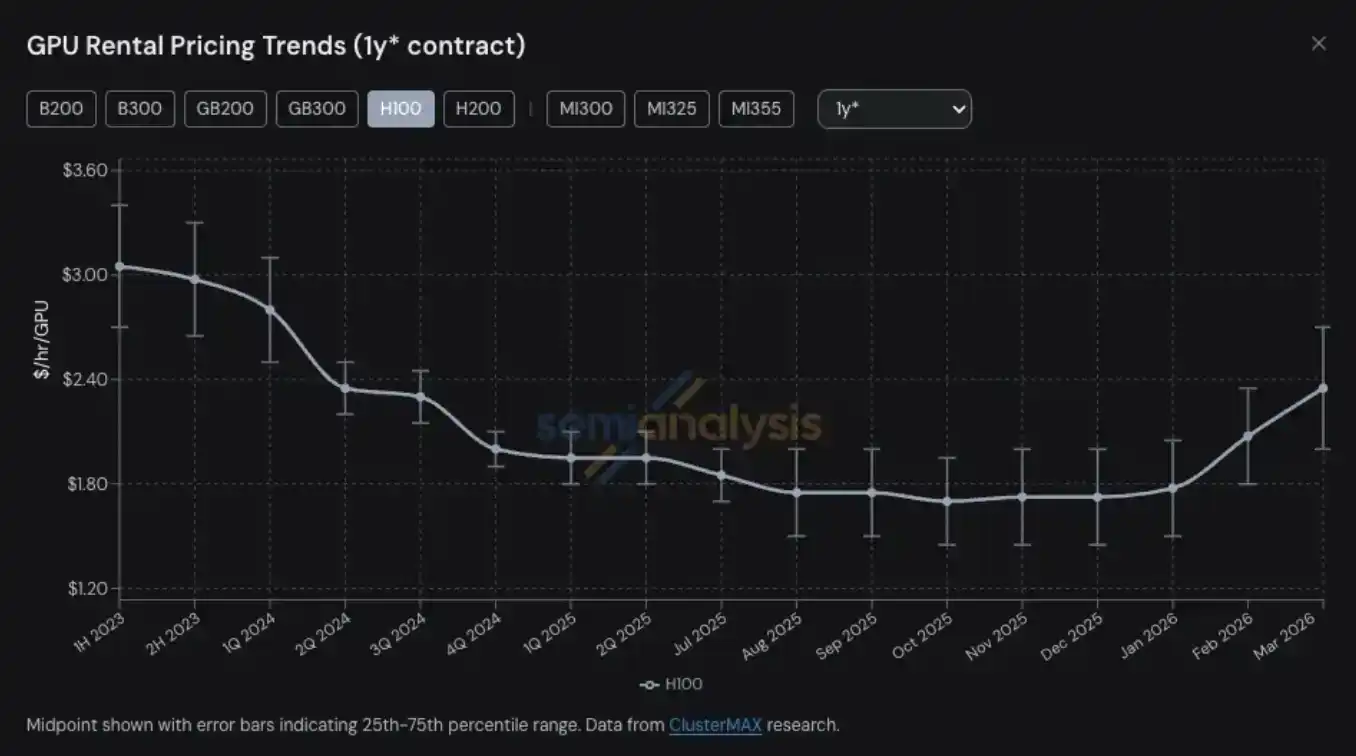
Since 2023, we have continuously tracked contract prices for GPUs including H100, H200, B200, B300, GB200, GB300 across lease terms from 3 months to 5 years; data for the AMD series (MI300, MI325, MI355) is also included.

Compared to existing GPU indices on the market, the SemiAnalysis H100 One-Year Contract Price Index has several key differences:

First, many GPU rental indices are based on spot/on-demand quotes or publicly listed prices, but in reality, the vast majority of GPU rental transactions are completed through long-term contracts, typically with terms of 6 months or more. These prices are often formed through bilateral negotiations and do not appear in any public database. Most large Neocloud providers prefer leases of at least 1 year, 2–3 years is more ideal, and 5-year large-scale offtake agreements are even better. The SemiAnalysis H100 One-Year Rental Index focuses precisely on this "contract market"—where the actual transaction volume is most concentrated. By clearly targeting a specific lease term, this index also makes it easier for users to understand the market segment it covers and compare it with their own observations.

Second, publicly disclosed prices do not represent actual transaction prices. Prices published by hyperscalers and Neoclouds provide more of a directional reference for trends rather than actual transaction levels. These prices often lag behind changes in the contract market, usually adjusting only after computing demand has already shifted. Especially in the on-demand market, prices are often set at relatively fixed levels, while actual supply-demand changes are reflected through utilization or occupancy rates, with adjustments made only when necessary. This market mechanism will be discussed further later in the article.

Third, while there are many indices capable of processing large-scale quote, price, and transaction data, offering advantages in trend analysis, our approach emphasizes direct interaction with market participants. Behind every quote, every transaction, there is specific context and decision logic. We aim to complement quantitative data with these qualitative insights and frontline observations to more fully还原 the true structure of the GPU rental market.

For institutional subscribers, we also provide complete term structure data covering almost the entire mainstream GPU rental market.
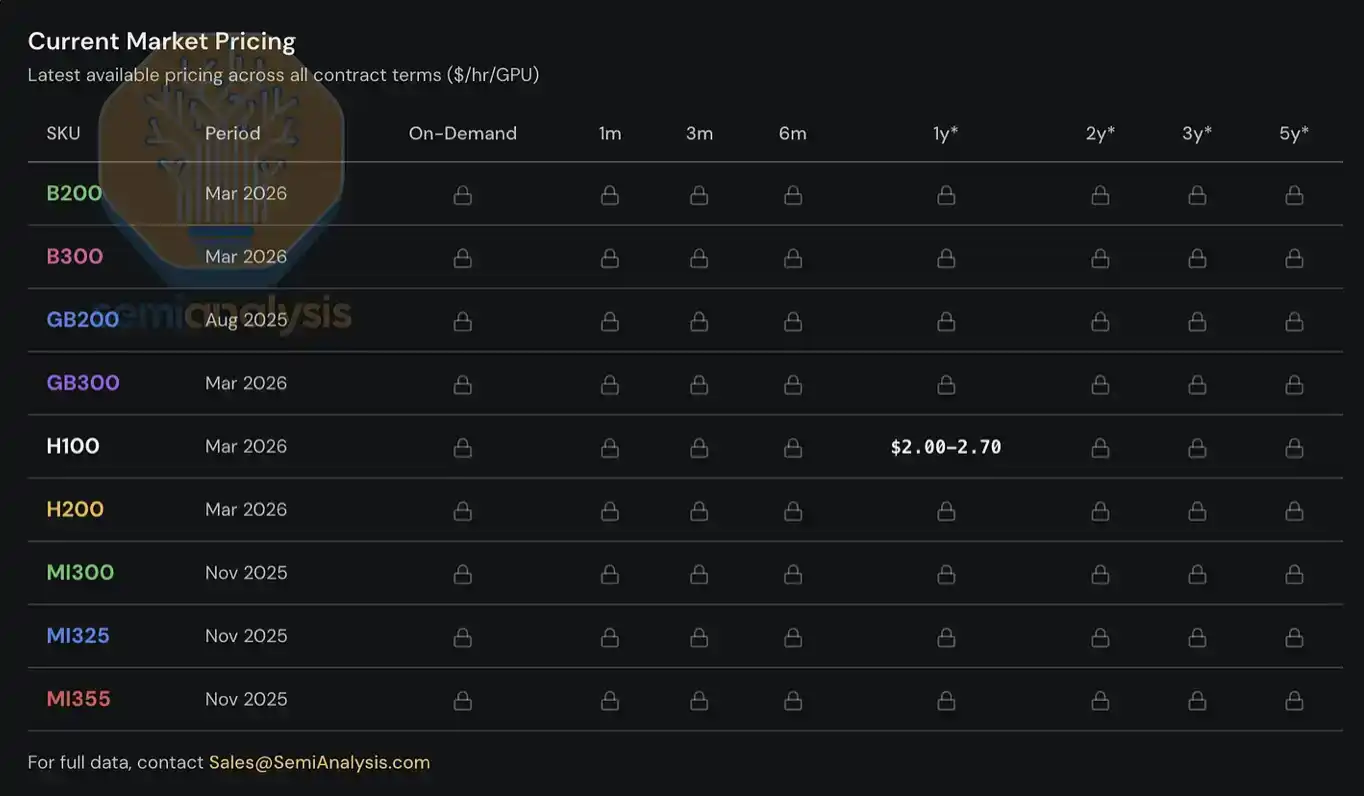
Alongside releasing the H100 One-Year Contract Price Index, we have also launched the SemiAnalysis Tokenomics Dashboard for institutional Tokenomics model subscribers, to track and understand the frontier AI model landscape. This dashboard allows users to perform custom comparisons across dimensions like code, reasoning, math, and agent evaluation, compare API pricing across different models and service providers, and view key data disclosed by major AI labs, including token usage, revenue, valuation, and customer scale.

Current Structure of the GPU Rental Market

Before the second half of 2025, the pricing environment in the GPU rental market was relatively more competitive. At that time, operators had more ample GPU inventory, and end demand was just beginning to accelerate. Therefore, competition among Neocloud service providers was fierce,普遍通过更具吸引力的价格来争夺客户 with the core goal of increasing utilization,尽可能 "extracting" the value of existing computing assets before the next GPU iteration cycle arrived.

Since then, the market landscape has done a 180-degree turn. Today, Neoclouds and hyperscalers completely hold the initiative—they can demand higher upfront payments, better pricing, longer contract terms, and even自主选择合约的起止时间 to match their own inventory and capacity plans. Time is also on the supply side's side: they can proceed with deployment at their own pace and, in a continuously rising price environment, gradually筛选出最优质的客户组合.

Structurally, the GPU rental market can be roughly divided into three segments, corresponding to different types of customer demand:

Short-Term Leases: On-demand, spot, and contracts under 3 months

Mid-Term Contracts: Contracts from 3 months to over 3 years

Long-Term Offtakes: 4–5 year contracts, with 5 years being most common

Short-Term Leases: On-Demand, Spot, and Sub-3-Month Contracts

Short-term leases are at the very front end of the entire term structure and often correspond to "excess capacity." However, some providers (like Runpod, Lambda) specialize in providing sizable, flexible on-demand or spot computing power.

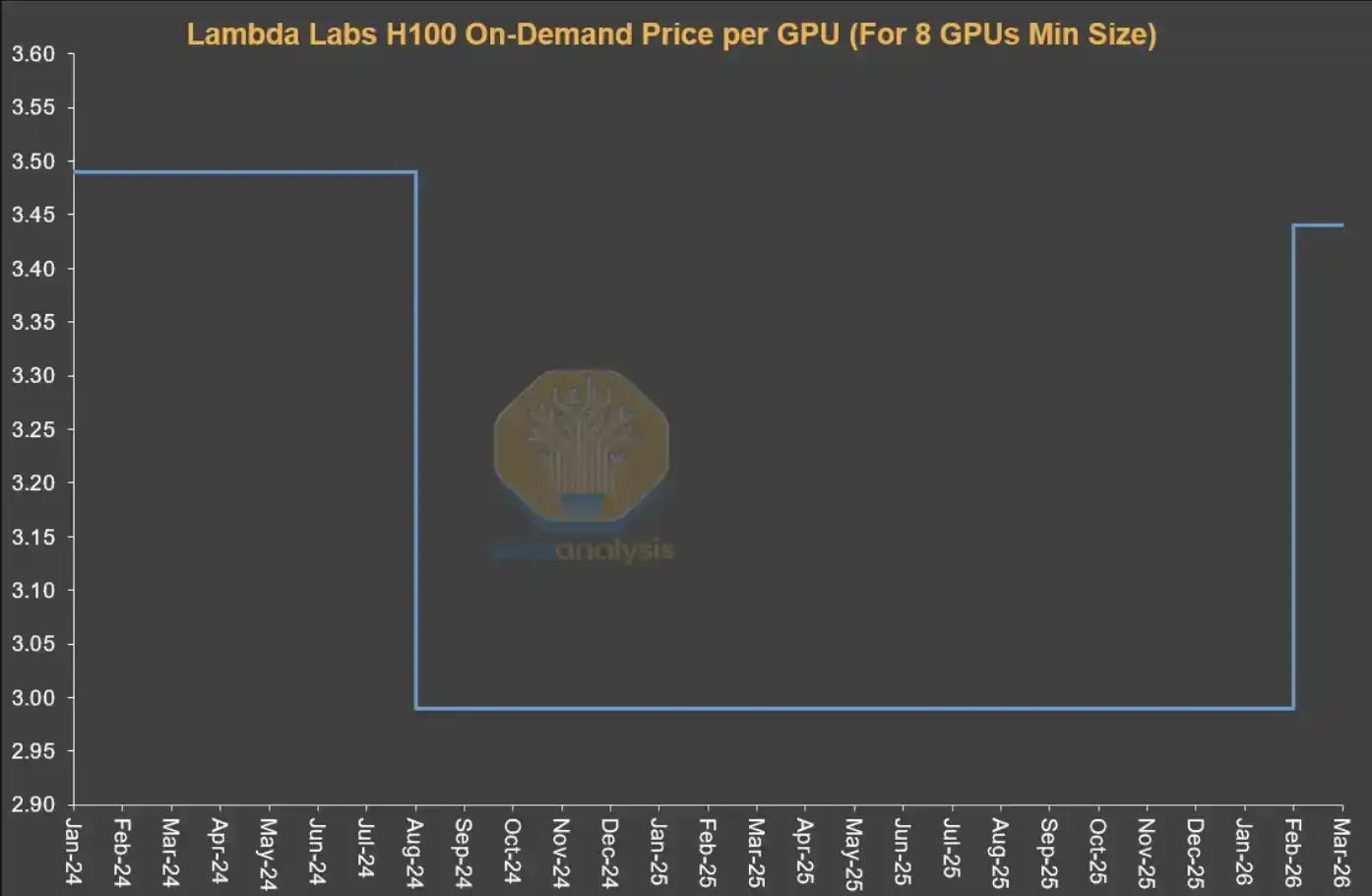
It's important to note that the pricing mechanism of the on-demand market differs significantly from other contract markets. Typically, service providers set a relatively fixed price level for on-demand resources and adjust it only in rare circumstances. In other words, prices in the short-term market are not entirely driven by real-time supply and demand but rather reflect market tightness through changes in resource utilization.
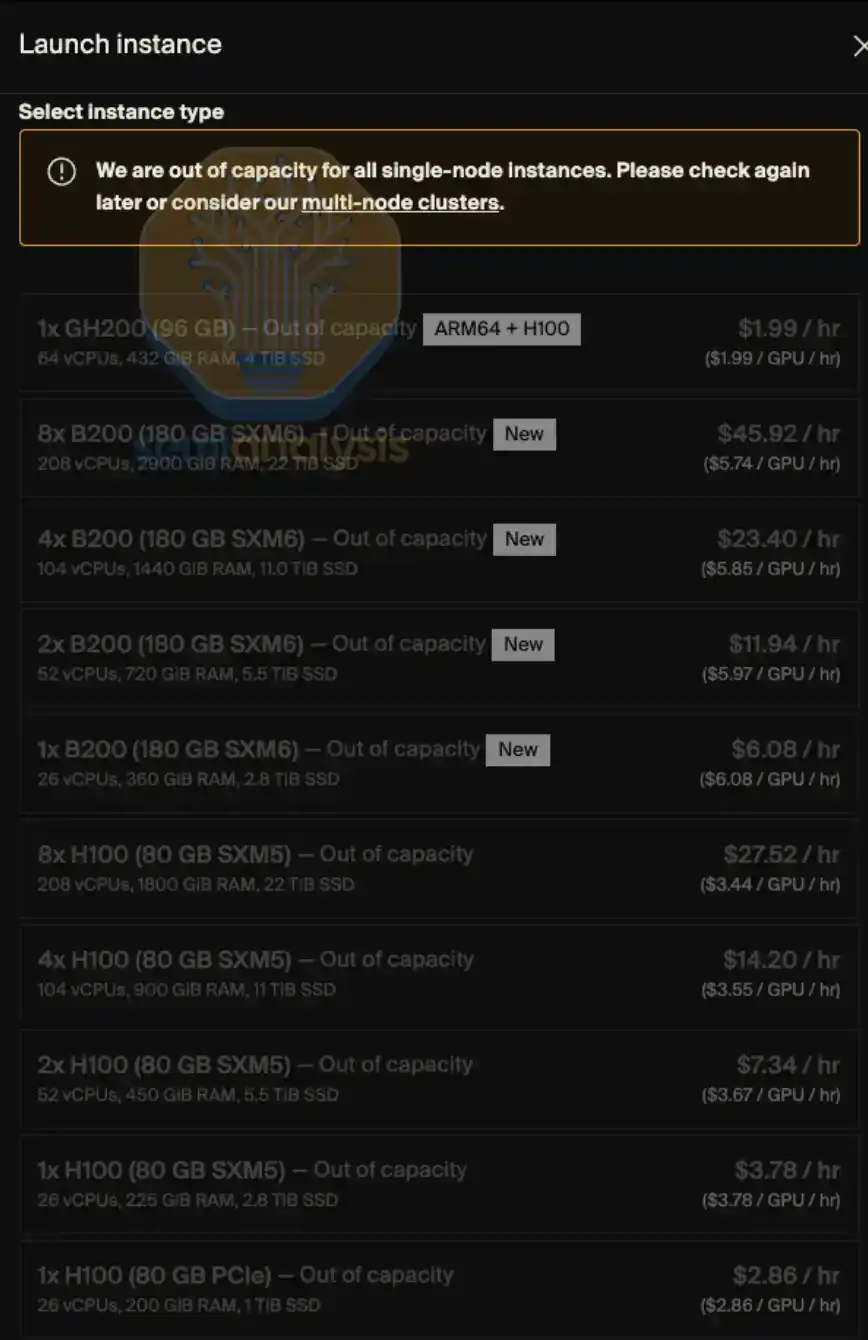
Service providers usually make one-time adjustments to prices based on resource utilization: when utilization is low, they stimulate demand by lowering prices; when utilization is near full capacity, they raise prices because demand can still be sustained even at higher price levels.

This also explains why, viewed over time, the on-demand prices published by Neoclouds often remain unchanged for long periods before suddenly experiencing "jump-like" increases or decreases. For the on-demand market, the true high-frequency indicator of demand change is not price, but resource utilization.
Mid-Term Contracts

From an economic perspective, the more critical segment is the "contract market," as the vast majority of GPU rental transaction value occurs here. Among these, 1-year contracts are particularly important—they reflect both the marginal demand from non-AI lab customers and the spillover demand from large customers, making them the most sensitive indicator for gauging market tightness.

AI-native companies and small-to-medium-sized AI labs are primarily active in the 1–3 year range. However, a recent clear trend is that these organizations are also beginning to try to lock in computing resources through longer-term contracts—many extending to 4 years or more, even willing to pay over 20% upfront payments, which was not common in past contracts over 4 years.

Long-Term Offtakes

In the longer-term 4–5 year market, the dominant force is large AI labs, which lock in large-scale computing resources early on. These deals typically correspond to clusters of 50MW, 100MW, or even larger scale, roughly equivalent to about 24,000 to 48,000 GB300 NVL72 GPUs. Overall,这类长期包销协议已占据 Neocloud GPU 租赁市场相当大的份额.

AI labs favor such contracts because they can lock in large-scale computing power at once to cope with rapidly growing end demand. Simultaneously, these organizations often deeply participate in cluster design, including key aspects like storage, networking, and CPU configuration. These transactions are often delivered in **bare metal** form, as AI labs possess sufficient engineering capability to customize the technology stack at a lower level, achieving optimal TCO (Total Cost of Ownership) and performance.

For Neocloud service providers, such deals are also attractive. On one hand, they can concentrate sales efforts on a few large orders rather than handling numerous small clients for the same revenue; on the other hand, long-term contracts facilitate better terms for debt financing—matching financing duration with contract terms可以有效降低期限错配与价格波动风险, and in most cases lock in project internal rates of return (IRR) of several percentage points.

Furthermore, hyperscalers often play the role of "backstop"—they act as direct承购方, purchasing computing power from Neoclouds and reselling it to AI labs. This structure is a win-win for all parties: Neoclouds can secure better financing terms based on AAA-rated承购方; while hyperscalers can share in a portion of the project's profits by providing credit backing without expanding their own balance sheets.

The table below lists some large offtake agreements we are tracking. We conduct in-depth analysis of these deals to reverse-engineer the implied GPU hourly price ($/hr/GPU), as well as key profitability metrics like project IRR and EBIT margins.
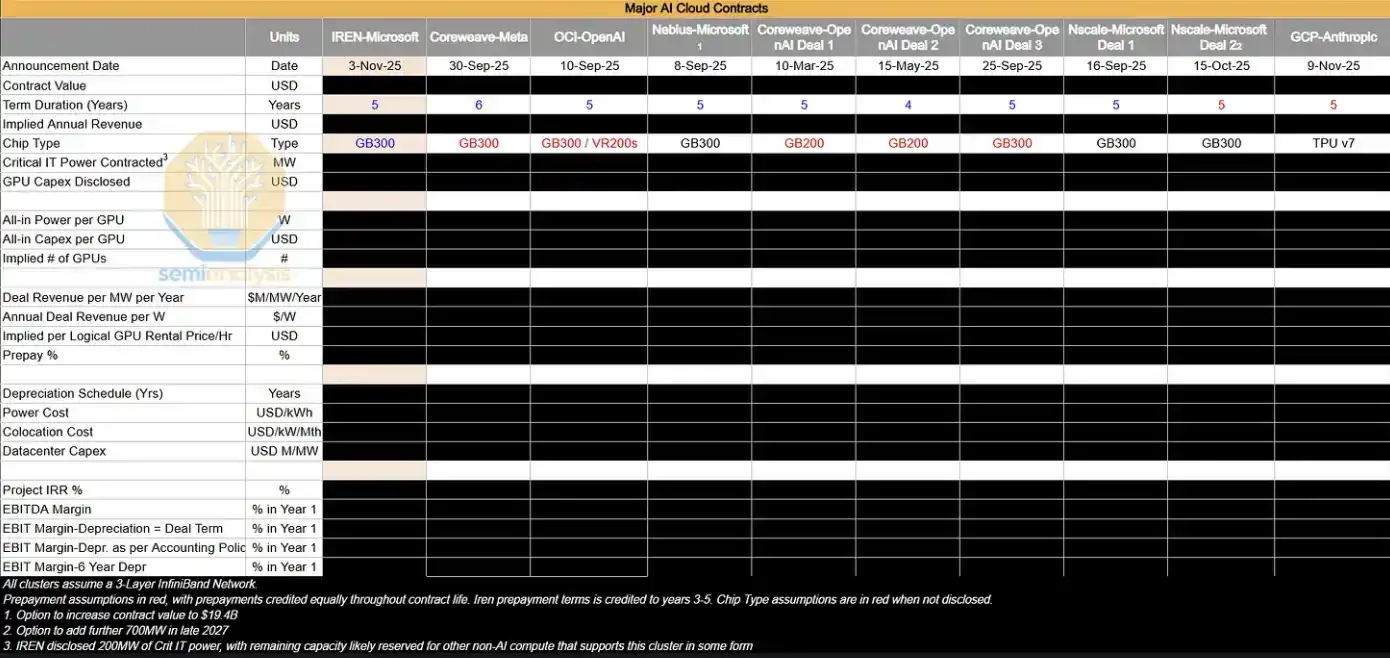
In the current market environment, the vast majority of large AI clusters being expanded are actually "internally consumed" by AI labs. However, these organizations still enter the sub-4-year contract market to supplement computing power, while also indirectly preventing supply from re-entering this market by renewing existing H100 and H200 clusters. As GB200 and GB300 ultra-large-scale clusters gradually come online, how the supply-demand relationship evolves in the 1–3 year contract market will become a key variable to watch.

"Where The Puck is Going"

Currently, the most striking feature is the clear divergence between underlying reality and market sentiment. Although signals that should be bullish for Neoclouds (margin expansion, extended asset useful life) like supply tightening and rising prices are very clear, the public market has grown increasingly pessimistic about companies like CoreWeave, Nebius, Iris Energy, whose stock prices remain near the lows of the past 6–12 months.

The market is still dominated by the narrative of "eventual oversupply and compute commoditization," and the aforementioned changes have not truly alleviated investor concerns about the long-term value of GPUs. But from the frontline perspective,持续紧张, enhanced pricing power means almost all computing power is being "absorbed" by demand—even with performance variations, it remains in short supply in this extreme shortage environment.

Three Key Future Observables

To judge whether GPU rental prices will remain high, focus on three variables:

1、GB300 Cluster Expansion Pace (2026)
The key is the relative speed between新增算力 and token demand—whether supply alleviates tightness or demand continues to outpace supply. This will directly affect whether AI labs continue to participate in the sub-4-year market and the price trend in that segment.

2、Worsening Chip Shortages
Including key bottlenecks like TSMC's N3 process capacity, HBM, DRAM, NAND—any fluctuations in manufacturing execution could further tighten supply.

3、AI Lab Revenue (ARR) & Token Consumption Growth Rate
The expansion of AI commercialization and usage scale will determine the strength of end demand, which is the core variable driving computing power demand.

Prices Move Unidirectionally Upward, Returns Follow

Overall, a relatively clear conclusion is: the probability of GPU rental prices continuing to rise is higher than the probability of them falling.

This process is distinctly self-reinforcing: when Neoclouds observe supply tightening and prices rising, they lock in more hardware in advance, further compressing market supply and pushing prices even higher. This is similar to the GPU shortage cycle of 2023–2024—where supply tightness drove significant profit expansion for OEMs and led to substantial server price increases (though this process may not fully repeat given the market's higher maturity this cycle).

Simultaneously, the renewed rise in GPU rental prices is also improving Neoclouds' Return on Invested Capital (ROIC):

On one hand, it increases the profit margin of deployed assets

On the other hand, it extends the economic useful life of GPUs, allowing capital to generate cash flow for a longer period

Who Benefits Most Currently?

The most direct beneficiaries currently are computing power providers with the following characteristics:

· Short-cycle contracts为主 (can be repriced quickly)

· Possess large存量 of H100 equipment

· Have new capacity coming online in the short term

Neoclouds with short-lease structures can release old contracts faster and re-sign at higher prices, quickly achieving profit expansion. Also, hyperscalers and Neoclouds that locked in next-generation computing power (multi-year contracts) early will benefit in the future cycle.

So the question arises: This time, will it really be "different"?

Questions liées

QWhat are the main factors driving the surge in GPU rental prices according to the article?

AThe surge in GPU rental prices is primarily driven by three key factors: 1) Exponential growth in token consumption due to new AI paradigms like multi-agent systems, native content generation, and AI programming tools. 2) Supply chain constraints affecting components like DRAM, NAND storage, and AI servers, which have delayed new deployments. 3) A shift in market dynamics where AI labs and large cloud providers are locking in long-term contracts (up to 4-5 years), reducing available supply in the market.

QHow much did the H100 one-year lease price increase from October 2025 to March 2026?

AThe H100 one-year lease price increased from $1.70 per GPU per hour in October 2025 to $2.35 per GPU per hour in March 2026, representing a nearly 40% price increase.

QWhat role do long-term offtake agreements play in the GPU rental market?

ALong-term offtake agreements (typically 4-5 years) allow large AI labs to secure massive compute resources early, often for clusters of 50MW or larger. These agreements benefit Neocloud providers by enabling better debt financing terms and reducing market risk, while AI labs gain guaranteed capacity for their growing needs. These contracts significantly reduce available supply in shorter-term markets.

QWhy is the investment return ratio of AI tools significant for GPU demand?

AThe investment return ratio of AI tools is significant because it creates relatively inelastic demand for GPU compute. With AI tools delivering 5-10x returns on investment, companies are willing to pay significantly higher prices for GPU rentals before cost becomes a constraint on demand, creating sustained upward pressure on prices.

QWhat are the three key variables to watch for future GPU rental price trends?

AThe three key variables to watch are: 1) The pace of GB300 cluster expansion in 2026 relative to token demand growth. 2) Whether chip shortages worsen further across TSMC N3 capacity, HBM, DRAM and NAND. 3) The growth rate of AI lab revenue (ARR) and token consumption, which drives ultimate demand for compute resources.

Lectures associées

Panorama complet de l'écosystème de confidentialité de Solana : de l'informatique à l'IA, la pile de confidentialité totale

**Résumé : La cartographie de l'écosystème de confidentialité de Solana** L'écosystème de confidentialité de Solana en est à ses débuts, avec des priorités spécifiques comme les "Neobanks" et la "DeFi privée". Une pile de confidentialité mature combinerait probablement le chiffrement complètement homomorphe (FHE) et les preuves à connaissance nulle (ZK). Deux projets principaux abordent le **calcul confidentiel** : * **Arcium** utilise le calcul multipartite (MPC) pour traiter des données chiffrées, avec un règlement sur Solana. Il développe également une norme de jetons confidentiels (C-SPL). * **Magic Block** utilise des environnements d'exécution de confiance (TEE) via des "Private Ephemeral Rollups". Sur cette base, des cas d'utilisation émergent : * **Transferts et soldes privés** : Des projets comme **Umbra** (basé sur Arcium), **Privacy Cash** et **Hush** permettent des transferts cryptés et masquent les liens entre expéditeurs et destinataires, avec parfois des fonctions de conformité. * **Pas de traces sur la chaîne** : Pour protéger les stratégies de trading, **encifherio** et **VanishTrade** offrent un routage d'échanges confidentiel, tandis que **Darklake** construit des marchés de liquidités et des pools sombres natifs ZK. * **Marchés prédictifs privés** : **Melee Markets** utilise l'infrastructure MPC d'Arcium pour crypter les carnets d'ordres, protégeant les positions des traders. * **IA privée** : **Loyal** utilise à la fois Magic Block et Arcium pour créer des agents IA sur chaîne dont les requêtes et les données utilisateur sont cryptées et stockées de manière confidentielle sur Solana. En résumé, bien que jeune, l'écosystème de confidentialité de Solana développe une pile technologique complète, de l'infrastructure de calcul aux applications financières et d'IA, visant à permettre des transactions et des interactions privées et composables.

Foresight NewsIl y a 2 mins

Panorama complet de l'écosystème de confidentialité de Solana : de l'informatique à l'IA, la pile de confidentialité totale

Foresight NewsIl y a 2 mins

7 questions clés sur le financement de plus de 50 milliards de yuans de DeepSeek

Le premier tour de financement de DeepSeek fait l'objet d'un nouvel éclairage. Selon un rapport de The Information (non officiellement confirmé), DeepSeek aurait levé plus de 50 milliards de yuans (plus de 500 milliards RMB), portant sa valorisation à plus de 50 milliards de dollars. Lancé en avril 2026, ce premier tour de table externe marque un changement pour l'entreprise, auparavant adepte du principe "pas de financement, pas d'introduction en bourse, pas de commercialisation". L'opération présente plusieurs caractéristiques notables. La plupart des investisseurs, dont Tencent, CATL, JD.com et IDG Capital, injectent leurs fonds dans une société en commandite contrôlée par le fondateur Liang Wenfeng, avec une période de blocage de 5 ans et sans droit de vote. Seul le Fonds national pour l'industrie de l'intelligence artificielle investit directement dans DeepSeek, bénéficiant d'un droit de vote et sans restriction de blocage. Cette structure vise à préserver le contrôle absolu de Liang Wenfeng et à garantir que les capitaux investis soient "patients", alignés sur la vision à long terme de l'entreprise qui priorise la recherche vers l'IA Générale (AGI) plutôt que le profit immédiat. Les investisseurs stratégiques ont des motivations distinctes. Tencent, un partenaire précoce, renforce une synergie stratégique. CATL voit un alignement avec son développement dans les solutions énergétiques pour les data centers d'IA, essentiels à l'entraînement des modèles. L'entrée d'un fonds d'État souligne l'importance stratégique nationale de DeepSeek, d'autant plus que ses modèles sont déjà adaptés aux puces AI chinoises. Après cette levée, DeepSeek devrait intensifier ses investissements dans les infrastructures (comme un data center en Mongolie-Intérieure), le recrutement et l'entraînement de modèles. L'entreprise prévoirait également de nouveaux outils pour les entreprises et le support multimédia. Le défi pour Liang Wenfeng sera de concilier sa vision idéaliste d'une IA accessible avec les attentes légitimes de retour sur investissement. Ce financement n'est que le début d'une longue marche vers l'AGI.

marsbitIl y a 48 mins

7 questions clés sur le financement de plus de 50 milliards de yuans de DeepSeek

marsbitIl y a 48 mins

La Coupe du monde approche, la guerre pour l'accès aux marchés de prédiction est lancée

Avec le coup d'envoi de la Coupe du Monde 2026, un nouvel acteur prend place sur le terrain des pronostics : le marché prédictif (Prediction Market). Ces plateformes, issues de l'univers des cryptomonnaies, permettent de transformer l'intelligence collective en cotes financières sur des événements allant du résultat sportif aux sujets macroéconomiques. Cependant, leur adoption par le grand public se heurte à la complexité des infrastructures blockchain (portefeuilles, gas, contrats intelligents...). Pour surmonter cette barrière, des plateformes comme Gate, un exchange centralisé (CEX), jouent un rôle crucial en simplifiant l'accès. En partenariat avec Polymarket, Gate permet à ses utilisateurs de participer aux marchés prédictifs directement depuis leur compte, en utilisant de l'USDT, sans avoir à gérer les complexités de la blockchain. L'offre de Gate se veut complète. Elle propose deux modes d'interaction : un mode "Prédiction" simplifié et un mode "Transaction" plus avancé avec carnet d'ordres. Elle intègre également des outils d'aide à la décision comme un classement des "smart money", un suivi de portefeuilles, des actualités en direct et des analyses IA. Pour la Coupe du Monde, un espace dédié agrège calendrier, cotes et informations. En résumé, l'enjeu pour les marchés prédictifs n'est plus seulement de prouver leur utilité, mais de conquérir un public large. La clé de cette démocratisation réside dans l'expérience utilisateur. En agissant comme un pont simplifié entre les utilisateurs traditionnels et les marchés prédictifs décentralisés, Gate et d'autres CEX pourraient être les catalyseurs de leur adoption de masse, transformant ces outils d'un cercle crypto-restreint en un marché ouvert où chacun peut échanger sur la probabilité d'événements futurs.

Odaily星球日报Il y a 57 mins

La Coupe du monde approche, la guerre pour l'accès aux marchés de prédiction est lancée

Odaily星球日报Il y a 57 mins

L'Espagne tenue en échec par le Cap-Vert, le marché de prédictions Jucom assiste à la plus grande surprise de son histoire

Le 16 juin, un énorme coup de théâtre a marqué le premier tour du groupe H de la Coupe du Monde 2026 : l'Espagne, l'un des grands favoris, a été tenue en échec 0-0 par les nouveaux venus du Cap-Vert, malgré une domination écrasante (27 tirs, 74% de possession). Avant le match, le marché de prédiction Jucom donnait l'Espagne gagnante à 92%. Ce résultat inattendu, le premier match sans but du tournoi, a provoqué de violentes fluctuations sur les marchés de prédiction. Le match a vu le gardien cap-verdien de 40 ans, Vozinha, réalisé 7 arrêts et être élu homme du match. L'entraîneur espagnol a reconnu un manque d'efficacité malgré la maîtrise du jeu. Cet événement illustre le fonctionnement des marchés de prédiction : les prix reflètent la probabilité collective d'un événement. Suite à ce match, plusieurs anticipations sont en cours de réévaluation radicale : la probabilité de l'Espagne de finir première de son groupe et de remporter le titre, ainsi que les chances auparavant quasi nulles du Cap-Vert de se qualifier. Ce résultat met en lumière à la fois l'efficacité et les limites des marchés de prédiction. Bien qu'ils agrègent l'information disponible, le football reste un sport à faible score où des facteurs imprévisibles (forme du jour, psychologie) peuvent tout changer. La valeur de ces marchés réside dans leur capacité à réagir en temps réel et à intégrer constamment les nouvelles informations pour reformer un consensus, comme le montre le réajustement en cours après cette surprise. La plateforme Jucom continuera de refléter ces dynamiques tout au long de la compétition.

链捕手Il y a 1 h

L'Espagne tenue en échec par le Cap-Vert, le marché de prédictions Jucom assiste à la plus grande surprise de son histoire

链捕手Il y a 1 h

Trading

Spot
Futures

Articles tendance

Qu'est ce que G$

Comprendre GoodDollar ($G$) : Un plan pour un revenu de base universel décentralisé Introduction Dans le paysage en constante évolution des cryptomonnaies et de la technologie blockchain, les initiatives qui cherchent à résoudre des problèmes sociaux pressants ont suscité une attention accrue. L'un de ces projets est GoodDollar ($G$), une solution de revenu de base universel (RBU) basée sur le Web3. GoodDollar s'efforce de lutter contre l'inégalité et de réduire l'écart de richesse en créant et distribuant des ressources économiques accessibles aux plus nécessiteux. Grâce à son utilisation innovante de la finance décentralisée (DeFi), GoodDollar présente un modèle unique qui pourrait potentiellement transformer la manière dont l'assistance financière est perçue et délivrée à l'échelle mondiale. Qu'est-ce que GoodDollar ($G$) ? GoodDollar est un protocole de cryptomonnaie qui facilite l'émission et la distribution de jetons numériques, appelés $G$, à ses utilisateurs enregistrés sur une base quotidienne. Ces jetons fonctionnent comme une forme de revenu de base universel, promouvant l'autonomisation financière pour les individus de divers horizons, en particulier ceux traditionnellement exclus du système financier. Fonctionnant sur la blockchain, GoodDollar utilise plusieurs chaînes, notamment Ethereum, Celo et Fuse, garantissant un large accès et une bonne utilisabilité. L'objectif fondamental de GoodDollar est de rendre la cryptomonnaie accessible et bénéfique pour tous, indépendamment de leur point de départ économique. Le créateur de GoodDollar ($G$) Les détails concernant le créateur de GoodDollar demeurent quelque peu obscurs. Cependant, il est notable de souligner que le projet bénéficie d'un solide soutien de la part d'eToro, une plateforme d'investissement largement reconnue qui a fourni le financement initial et le soutien fondamental pour le développement de GoodDollar. La vision derrière le projet n'est pas uniquement motivée par le profit, mais se tourne fortement vers l'entrepreneuriat social, visant un changement systémique dans l'accessibilité économique. Les investisseurs de GoodDollar ($G$) GoodDollar bénéficie du soutien financier et opérationnel d'eToro. Ce partenariat a joué un rôle significatif dans le lancement du protocole et ses développements ultérieurs. Bien qu'eToro ait été instrumental dans l'établissement des bases du projet, GoodDollar envisage de transitionner vers un modèle financé par sa communauté sur le long terme. Ce passage au financement communautaire est en ligne avec l'engagement de GoodDollar envers la décentralisation, permettant à ses utilisateurs d'avoir une part directe dans l'avenir du projet. Comment fonctionne GoodDollar ($G$) ? Le cadre opérationnel de GoodDollar repose fortement sur les principes de DeFi pour générer des intérêts à partir des cryptomonnaies mises en jeu. Ce mécanisme permet au projet de frapper et de distribuer des jetons $G$ comme un revenu de base numérique pour les utilisateurs du monde entier. Plusieurs caractéristiques clés contribuent à l'unicité et à l'innovation de GoodDollar : Revenu de base universel (RBU) : Chaque jour, les utilisateurs enregistrés reçoivent des jetons gratuits, établissant un flux de revenu automatique destiné à alléger les pressions financières. Modèle économique durable : La tokenomics du projet vise à équilibrer l'offre et la demande de jetons $G$, garantissant que la valeur reste stable au fil du temps. Jetons adossés à des réserves : Chaque jeton $G$ est soutenu par une réserve de cryptomonnaies, lui conférant une valeur inhérente et une fiabilité, un aspect crucial pour maintenir la confiance des utilisateurs. Gouvernance décentralisée : GoodDollar adopte une approche démocratique de la prise de décision grâce à une gouvernance décentralisée alimentée par les jetons. Cela permet aux membres de la communauté de participer activement à l'orientation du projet, le rendant véritablement dirigé par la communauté. Accessibilité mondiale : GoodDollar a établi une empreinte communautaire considérable, comptant plus de 640 000 membres dans 181 pays. Un tel rayonnement est essentiel pour faciliter le RBU à l'échelle mondiale. Chronologie de GoodDollar ($G$) L'évolution de GoodDollar est marquée par plusieurs jalons significatifs au cours de son histoire : 2019 : Le lancement du portefeuille GoodDollar a marqué le premier pas vers la mise en œuvre de sa vision de délivrance du RBU par le biais de la cryptomonnaie. 2020 : Après le succès du portefeuille, le protocole GoodDollar a été officiellement lancé. Cela a marqué une phase cruciale dans sa mission de fournir un revenu distribué quotidiennement. 2021 : Le projet a progressé avec l'introduction de son Organisation Autonome Décentralisée (DAO), favorisant un plus grand niveau d'implication et de gouvernance communautaire. 2022 : GoodDollar a dévoilé sa version 2 (V2) axée sur la DeFi, s'efforçant d'améliorer l'engagement des utilisateurs et l'efficacité opérationnelle. La même année a également vu la transition vers une structure de gouvernance décentralisée via GoodDAO. 2022 : Une nouvelle feuille de route a été conceptualisée, axée sur des initiatives telles qu'un programme de subventions conçu pour promouvoir les projets entrepreneuriaux liés à $G$ et un marché GoodDollar amélioré. Caractéristiques clés de GoodDollar ($G$) Le projet GoodDollar introduit de nombreuses caractéristiques critiques visant à redéfinir le paysage du revenu de base : Revenu de base universel : La délivrance quotidienne de jetons gratuits à ses utilisateurs souligne fondamentalement sa mission d'éliminer la précarité économique. Opération multi-chaînes : Le fait de tirer parti de plusieurs réseaux blockchain améliore l'accessibilité et la scalabilité, garantissant une plus large participation. Engagement avec la finance décentralisée : L'utilisation de la DeFi permet un financement durable du modèle RBU, renforçant sa viabilité en tant que solution économique. Engagement communautaire et gouvernance : GoodDollar envisage un modèle où la communauté influence les opérations grâce à une participation démocratique, favorisant la transparence et la responsabilité. Communauté mondiale : Avec une communauté mondiale diversifiée, le projet est en mesure de mettre en œuvre des solutions de RBU adaptées à divers contextes culturels et économiques. Conclusion GoodDollar représente un saut transformationnel vers l'incorporation des principes de revenu de base universel à travers le prisme innovant de la technologie blockchain. En exploitant la finance décentralisée, le projet ne fournit pas seulement une solution à l'inégalité financière, mais engage également activement les utilisateurs dans sa gouvernance et ses opérations. Avec une communauté en croissance et une feuille de route évolutive, GoodDollar se positionne comme un acteur significatif à l'intersection des cryptomonnaies et du bien social, ouvrant la voie à un avenir financier plus équitable. Alors qu'il continue d'évoluer, le parcours de GoodDollar pourrait finalement inspirer d'autres initiatives à envisager des modèles similaires, favorisant ainsi la cause de l'autonomisation économique pour tous.

95 vues totalesPublié le 2024.04.05Mis à jour le 2024.12.03

Qu'est ce que G$

Comment acheter G

Bienvenue sur HTX.com ! Nous vous permettons d'acheter Gravity (G) de manière simple et pratique. Suivez notre guide étape par étape pour commencer votre parcours crypto.Étape 1 : Création de votre compte HTXUtilisez votre adresse e-mail ou votre numéro de téléphone pour ouvrir un compte sur HTX gratuitement. L'inscription se fait en toute simplicité et débloque toutes les fonctionnalités.Créer mon compteÉtape 2 : Choix du mode de paiement (rubrique Acheter des cryptosCarte de crédit/débit : utilisez votre carte Visa ou Mastercard pour acheter instantanément Gravity (G).Solde :utilisez les fonds du solde de votre compte HTX pour trader en toute simplicité.Prestataire tiers :pour accroître la commodité d'utilisation, nous avons ajouté des modes de paiement populaires tels que Google Pay et Apple Pay.P2P :tradez directement avec d'autres utilisateurs sur HTX.OTC (de gré à gré) : nous offrons des services personnalisés et des taux de change compétitifs aux traders.Étape 3 : stockage de vos Gravity (G)Après avoir acheté vos Gravity (G), stockez-les sur votre compte HTX. Vous pouvez également les envoyer ailleurs via un transfert sur la blockchain ou les utiliser pour trader d'autres cryptos.Étape 4 : tradez des Gravity (G)Tradez facilement Gravity (G) sur le marché Spot de HTX. Il vous suffit d'accéder à votre compte, de sélectionner la paire de trading, d'exécuter vos trades et de les suivre en temps réel. Nous offrons une expérience conviviale aux débutants comme aux traders chevronnés.

583 vues totalesPublié le 2024.12.10Mis à jour le 2026.06.02

Comment acheter G

Qu'est ce que @G

Graphite Network, $@G : Relier TradFi et Web3 Introduction à Graphite Network, $@G Dans le monde dynamique des cryptomonnaies et des projets web3, Graphite Network émerge comme un phare d'innovation. Avec son jeton natif, $@G, cette blockchain de couche 1, Proof-of-Authority (PoA), est conçue pour combler le fossé entre la finance traditionnelle (TradFi) et l'écosystème Web3 en pleine évolution. Alors que les monnaies numériques gagnent en traction, Graphite Network s'efforce d'offrir une plateforme blockchain qui privilégie la sécurité, la conformité et la rapidité, se présentant comme un facilitateur de confiance et de responsabilité. Qu'est-ce que Graphite Network, $@G ? Graphite Network n'est pas simplement un autre projet blockchain ; il vise à redéfinir la façon dont la décentralisation, la sécurité et la responsabilité des utilisateurs sont perçues dans le domaine de la finance numérique. Le projet se vante d'une série de caractéristiques distinctives : Blockchain Basée sur la Réputation : Au cœur de Graphite Network se trouve une politique d'un utilisateur, un compte, renforcée par des mécanismes intégrés de vérification et de notation Know Your Customer (KYC). Ce design assure un équilibre entre la confidentialité des utilisateurs et la transparence, un aspect critique des opérations financières dans le monde numérique d'aujourd'hui. Revenus des Nœuds de Point d'Entrée : Le réseau incite les utilisateurs à mettre en place des nœuds de point d'entrée, permettant aux opérateurs de gagner des récompenses provenant des transactions du réseau. Ce modèle de génération de revenus non seulement stimule l'engagement des utilisateurs mais renforce également la santé et la décentralisation du réseau. Compatibilité EVM : Avec une machine virtuelle (VM) compatible avec Ethereum, Graphite Network permet une intégration transparente des applications décentralisées (dApps) et des contrats intelligents Solidity existants, invitant ainsi les développeurs à tirer parti de ses capacités sans modifications étendues. Intégration KYC : À une époque où la conformité est primordiale, le cadre KYC intégré avec plusieurs niveaux de vérification améliore le contrôle des opérations financières sans participation obligatoire, établissant un précédent pour l'autonomie des utilisateurs. Qui est le Créateur de Graphite Network, $@G ? Graphite Network est né des efforts de la Graphite Foundation, une organisation à but non lucratif dédiée au développement, à la maintenance et à l'évolution de Graphite Network. L'engagement de la fondation souligne la vision du projet de créer un environnement blockchain sécurisé et durable axé sur un véritable engagement des utilisateurs et la conformité. Qui sont les Investisseurs de Graphite Network, $@G ? Actuellement, il existe peu d'informations disponibles sur les investisseurs spécifiques soutenant l'initiative Graphite Network. L'organisation fondatrice, la Graphite Foundation, fonctionne de manière indépendante pour favoriser la croissance du projet tout en recherchant des partenariats qui résonnent avec sa vision d'une plateforme blockchain conforme et accessible. Comment Fonctionne Graphite Network, $@G ? Le fonctionnement de Graphite Network repose sur son mécanisme de consensus unique Proof-of-Authority, qui trouve un équilibre impressionnant entre un haut débit et la décentralisation. Examinons les différents composants qui définissent son fonctionnement : Nœuds de Transport : Servant de nœuds de point d'entrée, ceux-ci sont critiques pour l'écosystème. Les opérateurs peuvent générer des revenus à partir des transactions qui traversent le réseau, ce qui non seulement donne du pouvoir aux utilisateurs individuels mais renforce également la décentralisation du réseau. Nœuds Autorisés : Au cœur de Graphite Network se trouvent des validateurs principaux qui subissent des tests de conformité rigoureux, englobant une vérification KYC robuste ainsi que des évaluations techniques. Ce niveau de confiance est essentiel pour garantir que les transactions au sein du réseau maintiennent un haut niveau d'intégrité. Système de Ticker : Graphite Network utilise un système de ticker distinctif pour ses jetons enveloppés, désignés sous le nom de @G. Cette fonctionnalité améliore la clarté dans l'intégration des actifs, rendant les transactions des utilisateurs compréhensibles et simples. L'approche innovante de Graphite Network reflète une avancée significative dans la résolution des problèmes cruciaux de la finance numérique, se positionnant favorablement pour l'avenir alors que de plus en plus d'utilisateurs passent des formes traditionnelles de finance au monde des applications décentralisées. Chronologie de Graphite Network, $@G Pour comprendre la progression et les jalons de Graphite Network, il est utile de passer en revue les événements clés de sa chronologie : 2021 : La création de Graphite Network par la Graphite Foundation marque le début d'un nouveau chapitre dans le développement blockchain, axé sur la conformité et l'autonomisation des utilisateurs. Développements Clés : Suite à son lancement, l'introduction des revenus des nœuds de point d'entrée, l'établissement d'un modèle basé sur la réputation, la vérification KYC intégrée et la fourniture de compatibilité EVM représentent des avancées significatives dans le projet. Activités Récentes : Les efforts continus de développement et de soutien de la Graphite Foundation se sont concentrés sur l'augmentation des fonctionnalités du réseau tout en favorisant la croissance de l'écosystème, démontrant un engagement à long terme envers la durabilité et l'innovation. Points Clés Supplémentaires Au-delà de ses composants fondamentaux, Graphite Network englobe plusieurs outils et fonctionnalités qui renforcent son utilité : Graphite Wallet : Une extension Chrome conviviale qui facilite l'accès à diverses fonctionnalités et applications du réseau sur des chaînes compatibles avec Ethereum, améliorant la commodité pour les utilisateurs. Graphite Bridge : Cet utilitaire permet des transferts transparents des actifs Graphite entre différents réseaux, favorisant un écosystème intégré et interopérable. Graphite Explorer : Servant d'outil essentiel au sein de l'écosystème, cette fonctionnalité permet aux utilisateurs de visualiser et de vérifier le code source des contrats intelligents, de suivre les transactions et d'explorer d'autres informations vitales en temps réel. Graphite Testnet : Le projet fournit un environnement de test robuste pour les développeurs, leur permettant d'assurer la stabilité et l'évolutivité avant le déploiement sur le mainnet. Cette initiative non seulement donne du pouvoir aux développeurs mais améliore également la fiabilité de l'ensemble du réseau. Conclusion Graphite Network, avec son jeton natif $@G, représente un pas significatif vers le rapprochement de la finance traditionnelle et de la technologie blockchain de pointe. En se concentrant sur la sécurité, la conformité et la décentralisation, cette plateforme innovante est prête à mener la transition vers l'ère Web3. À mesure que l'engagement des utilisateurs croît et que de plus en plus de projets tirent parti de ses capacités, Graphite Network est en bonne position pour apporter des contributions durables au paysage numérique en pleine évolution. En conclusion, Graphite Network est un témoignage de ce qui peut être accompli lorsque la pensée innovante rencontre les demandes croissantes de la finance moderne et de la technologie. Alors que le monde explore le potentiel de la finance décentralisée, Graphite Network restera sans aucun doute un acteur notable dans ce domaine.

15 vues totalesPublié le 2025.01.06Mis à jour le 2025.01.06

Qu'est ce que @G

Discussions

Bienvenue dans la Communauté HTX. Ici, vous pouvez vous tenir informé(e) des derniers développements de la plateforme et accéder à des analyses de marché professionnelles. Les opinions des utilisateurs sur le prix de G (G) sont présentées ci-dessous.

活动图片