KuCoin Consensus Hong Kong 2026 Participation Benefits LiquidChain and the L3 Narrative

bitcoinistPublié le 2026-02-09Dernière mise à jour le 2026-02-09

Résumé

The pivot of crypto's center of gravity to Asia is accelerating, highlighted by events like Consensus Hong Kong 2026 and participation from major players like KuCoin. A key challenge in Asian markets is fragmented liquidity across major chains like Bitcoin, Ethereum, and Solana, leading to inefficiencies and risks with wrapped assets. LiquidChain ($LIQUID) emerges as a Layer 3 (L3) solution designed to unify these liquidity pools into a single execution layer, eliminating reliance on bridges and wrapped tokens. It offers a "deploy-once" model for developers to access users across all three chains seamlessly. The project’s presale has raised over $532K, with tokens priced at $0.0136, attracting early capital focused on infrastructure and interoperability. The $LIQUID token serves as transaction fuel and offers staking rewards, positioning it as a potential key player in the cross-chain narrative leading up to 2026.

The pivot of crypto’s center of gravity from West to East isn’t just a forecast anymore; it’s an active migration. With Consensus, the industry’s premier gathering, planting its flag in Hong Kong for 2025 and setting the stage for future iterations, the narrative has firmly shifted toward Asian liquidity dominance.

This momentum is further solidified by major players like KuCoin, which recently announced its participation in Consensus Hong Kong 2026. On February 12, Edwin Wong, KuCoin’s Vice President and Head of Risk Control, will join the featured panel ‘Turning Intelligence Into Action’ on the Explorations Stage to discuss how on-chain signals and AI capabilities can be translated into trust-first infrastructure and practical governance.

Hong Kong’s aggressive regulatory clarity has created a vacuum for liquidity hubs. While major exchanges figure out the licensing maze, the underlying trend is the unification of fragmented markets. Traders in the Asian session historically drive massive volume across Bitcoin, Ethereum, and increasingly, Solana. But there’s a catch: the friction of moving capital between these chains remains the industry’s glaring inefficiency.

Context matters. Bitcoin recently tested the $100K psych-level before retracing, while Ethereum struggles to maintain dominance against Solana’s monolithic speed. This ‘chain tribalism’ fractures liquidity, making execution expensive and slow. The winners of the 2026 cycle won’t be the L1s fighting for dominance. It’ll be the L3s that connect them. (It’s somewhat ironic that while users argue over which chain is ‘best,’ smart money is quietly funding the protocols that make the underlying chain irrelevant to the end-user.)

This infrastructure gap is where new interoperability layers enter the chat. As exchanges and institutions look toward the 2026 horizon, they need ‘deploy-once’ architectures. This macroeconomic setup creates a perfect storm for LiquidChain ($LIQUID), a project designed to dissolve the barriers between the industry’s three largest liquidity pools.

LiquidChain Solves the ‘Wrapped Asset’ Risk Plaguing Asian Markets

Fragmentation defines the current market structure. To trade $BTC on Solana, users rely on wrapped assets, derivatives that introduce counterparty risk and bridge vulnerability. LiquidChain flips this dynamic by operating as a Layer 3 (L3) infrastructure that fuses Bitcoin, Ethereum, and Solana liquidity into a single execution environment.

That matters for one big reason: institutional capital, the kind courted at events like Consensus Hong Kong, can’t tolerate bridge exploits. LiquidChain offers verifiable settlement without the complex user flows that currently plague DeFi. By enabling a ‘single-step execution’ model, it allows developers to build apps that access users on all three chains simultaneously.
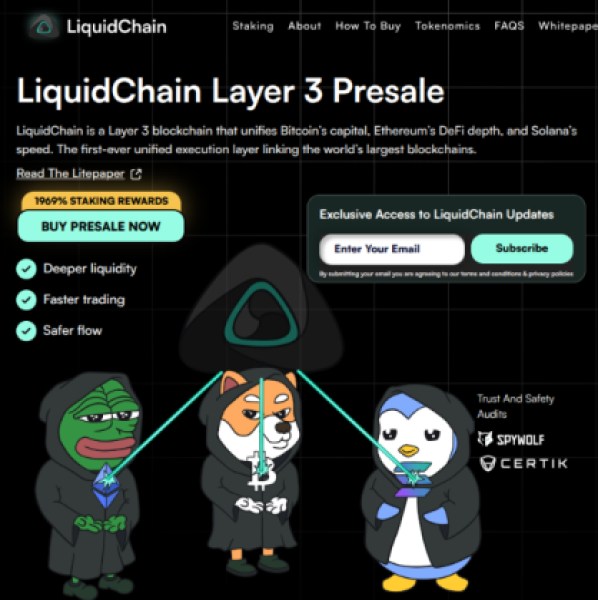
For a developer, the pitch is efficiency: deploy code once on LiquidChain, and instantly access liquidity from the top three ecosystems. No need to maintain fragmented liquidity pools across different networks, a redundancy that currently bleeds capital efficiency. As the dialogue moves toward the 2026 institutional horizon, protocols offering this level of unification are positioning themselves as the ‘TCP/IP’ of the blockchain era, invisible, essential, and highly valued.

CHECK OUT THE UNIFIED LIQUIDITY LAYER

Early Capital Flows into $LIQUID Presale Signal Infrastructure Demand

While headlines fixate on meme coin volatility, capital allocators are rotating into infrastructure plays that solve the interoperability crisis. The LiquidChain presale data reflects this methodical accumulation. It has already raised over $532K, and tokens are priced at $0.0136. Early investors also have access to staking rewards, currently sitting at 1943%.

This sub-million market cap entry point is notable compared to legacy interoperability protocols, which often trade in the billions. The pricing suggests the project is still in a discovery phase, distinct from the retail mania that usually follows major exchange listings.

The utility of the $LIQUID token extends beyond simple governance. It functions as the transaction fuel for the cross-chain VM and is required for liquidity staking. The tokenomics are designed to incentivize bonding assets from $BTC, $ETH, and $SOL into the LiquidChain ecosystem, rewarding users who provide the ‘glue’ for this unified layer. We see it as one of the next crypto to explode, due to its offering.

Investors are eyeing the $0.0136 price point not just for immediate gains, but as a derivative bet on cross-chain volume growth. If the thesis holds, that Asia will demand seamless execution across chains, LiquidChain’s ability to merge these ecosystems places it in a prime position to capture value from every transaction it facilitates.

CHECK OUT THE $LIQUID PRESALE

This article is for informational purposes only and does not constitute financial advice. Cryptocurrency investments, including presales like LiquidChain, carry high risks. Always conduct independent due diligence before participating.


Cryptos en tendance

Questions liées

QWhat is the significance of KuCoin's participation in Consensus Hong Kong 2026?

AKuCoin's participation, with its Vice President Edwin Wong joining the 'Turning Intelligence Into Action' panel, signifies the exchange's commitment to discussing and shaping the future of trust-first infrastructure and practical governance using on-chain signals and AI, aligning with the event's focus on Asia's growing dominance in the crypto space.

QAccording to the article, what is the primary market inefficiency that LiquidChain aims to solve?

ALiquidChain aims to solve the industry's glaring inefficiency of friction and high cost when moving capital between major blockchains like Bitcoin, Ethereum, and Solana, which fractures liquidity and makes execution expensive and slow.

QHow does LiquidChain function to unify liquidity from Bitcoin, Ethereum, and Solana?

ALiquidChain operates as a Layer 3 (L3) infrastructure that fuses liquidity from Bitcoin, Ethereum, and Solana into a single execution environment, eliminating the need for wrapped assets and their associated counterparty risk by enabling verifiable settlement and a 'single-step execution' model.

QWhat are some key details about the LiquidChain ($LIQUID) presale mentioned in the article?

AThe LiquidChain presale has raised over $532,000, with tokens priced at $0.0136. Early investors have access to staking rewards, currently at 1943% APY, and the project's low market cap entry point is seen as a discovery phase distinct from typical retail mania.

QWhat is the core utility of the $LIQUID token within its ecosystem?

AThe $LIQUID token functions as the transaction fuel for the cross-chain Virtual Machine (VM), is required for liquidity staking, and is used to incentivize users to bond assets from $BTC, $ETH, and $SOL into the LiquidChain ecosystem, rewarding those who provide liquidity for the unified layer.

Lectures associées

Le PDG de Coinbase énonce la condition pour que le Bitcoin atteigne les 400 000 $

Le PDG de Coinbase, Brian Armstrong, a prédit lors d’un entretien avec Fox Business que le bitcoin pourrait atteindre entre 300 000 et 400 000 dollars d’ici quatre ans, grâce à sa capacité à concurrencer l’or et d’autres actifs de réserve de valeur. Pour y parvenir, la cryptomonnaie devrait cependant enregistrer une hausse d’environ 317 % pour 300 000 dollars, et de 456 % pour 400 000 dollars, ce qui impliquerait une croissance significative de sa capitalisation boursière, actuellement de 1 500 milliards de dollars. Armstrong attribue la période de stagnation prolongée du bitcoin au retard dans l’examen du projet de loi américain CLARITY sur la régulation des actifs numériques. Il espère qu’un compromis sera trouvé lors du vote prévu au Sénat le 15 septembre, où le texte nécessitera plus de 60 voix pour être adopté. Selon lui, la majorité des banques comprennent que CLARITY ne constitue pas une menace, mais permettra une concurrence équitable avec les entreprises du secteur crypto. Les craintes initiales des banques concernaient une éventuelle fuite des dépôts vers les stablecoins, ce qui a contribué à bloquer l’avancée du projet de loi. Ces déclarations font suite à une récente rencontre à la Maison Blanche entre l’ancien président Donald Trump et des acteurs majeurs de l’industrie crypto, au cours de laquelle Trump a exhorté le Congrès à adopter rapidement CLARITY. En janvier dernier, Armstrong avait déjà envisagé un scénario où le bitcoin pourrait atteindre le million de dollars d’ici quatre ans, porté par les investissements croissants des grands investisseurs institutionnels.

cryptonews.ruEn ce moment

Le PDG de Coinbase énonce la condition pour que le Bitcoin atteigne les 400 000 $

cryptonews.ruEn ce moment

La tokenisation des RWA passe à l'étape suivante : quel est l'avantage qui prend vraiment du temps à se construire ?

Le jetonnement d'actifs du monde réel (RWA) entre dans une nouvelle phase où l'avantage concurrentiel se déplace de la simple capacité d'émission vers la construction d'un avantage durable par une exécution opérationnelle de long terme. Si l'infrastructure technique pour l'émission de jetons (custodie, conformité, blockchain) est désormais mature, la question clé devient : que se passe-t-il après l'émission ? La pérennité des projets RWA dépendra de leur capacité à créer un « étage de réserve » (Reserve Layer) fiable sur la blockchain, reposant sur deux piliers. Premièrement, l'actif sous-jacent doit être adapté à un rôle de réserve. Cela implique une valeur déterminable, des caractéristiques standardisées et des marchés liquides (ex : obligations d'État à court terme, or physique). Les crédits privés, bien que valorisables, présentent une hétérogénéité qui les rend moins idéaux comme actifs de réserve purs. Deuxièmement, et c'est l'avantage le plus long à construire, la qualité opérationnelle de l'émetteur est cruciale. La sécurité, les audits indépendants réguliers, les mécanismes de rachat éprouvés, la gestion de la liquidité et les intégrations avec l'écosystème DeFi doivent fonctionner de manière fiable, cycle après cycle. C'est l'accumulation de cette « trace » ou preuve opérationnelle sur plusieurs années, dans différentes conditions de marché, qui construit une confiance inaltérable. Cette confiance permet ensuite une adoption institutionnelle plus large, une liquidité plus profonde et une utilité accrue comme collatéral, créant un cercle vertueux. Ainsi, la combinaison gagnante est celle d'un actif de haute qualité intrinsèque (haute « applicabilité de réserve ») soutenu par un émetteur démontrant une discipline opérationnelle élevée et un historique vérifiable. C'est cette fondation qui transforme un jeton RWA en une véritable infrastructure financière durable pour la finance décentralisée.

marsbitIl y a 14 mins

La tokenisation des RWA passe à l'étape suivante : quel est l'avantage qui prend vraiment du temps à se construire ?

marsbitIl y a 14 mins

Trading

Spot

Articles tendance

Comment acheter L3

Bienvenue sur HTX.com ! Nous vous permettons d'acheter Layer3 (L3) de manière simple et pratique. Suivez notre guide étape par étape pour commencer votre parcours crypto.Étape 1 : Création de votre compte HTXUtilisez votre adresse e-mail ou votre numéro de téléphone pour ouvrir un compte sur HTX gratuitement. L'inscription se fait en toute simplicité et débloque toutes les fonctionnalités.Créer mon compteÉtape 2 : Choix du mode de paiement (rubrique Acheter des cryptosCarte de crédit/débit : utilisez votre carte Visa ou Mastercard pour acheter instantanément Layer3 (L3).Solde :utilisez les fonds du solde de votre compte HTX pour trader en toute simplicité.Prestataire tiers :pour accroître la commodité d'utilisation, nous avons ajouté des modes de paiement populaires tels que Google Pay et Apple Pay.P2P :tradez directement avec d'autres utilisateurs sur HTX.OTC (de gré à gré) : nous offrons des services personnalisés et des taux de change compétitifs aux traders.Étape 3 : stockage de vos Layer3 (L3)Après avoir acheté vos Layer3 (L3), stockez-les sur votre compte HTX. Vous pouvez également les envoyer ailleurs via un transfert sur la blockchain ou les utiliser pour trader d'autres cryptos.Étape 4 : tradez des Layer3 (L3)Tradez facilement Layer3 (L3) sur le marché Spot de HTX. Il vous suffit d'accéder à votre compte, de sélectionner la paire de trading, d'exécuter vos trades et de les suivre en temps réel. Nous offrons une expérience conviviale aux débutants comme aux traders chevronnés.

353 vues totalesPublié le 2024.12.06Mis à jour le 2026.06.02

Comment acheter L3

Discussions

Bienvenue dans la Communauté HTX. Ici, vous pouvez vous tenir informé(e) des derniers développements de la plateforme et accéder à des analyses de marché professionnelles. Les opinions des utilisateurs sur le prix de L3 (L3) sont présentées ci-dessous.

活动图片