From Satoshi to Saylor: The Crypto Undercurrent in the Epstein Files

比推Publié le 2026-02-03Dernière mise à jour le 2026-02-03

Résumé

Recent disclosures from the "Epstein Files" reveal significant, previously unknown connections between the late financier Jeffrey Epstein and the cryptocurrency industry. As early as 2011, Epstein was aware of Bitcoin, calling it a "brilliant idea" with "serious flaws." The documents show he was involved in discussions about Bitcoin's nature, invested in the seed round of infrastructure firm Blockstream, and received updates on market developments from figures like a16z's Steven Sinofsky. The files suggest Epstein may have met with "some Bitcoin creators," potentially including Satoshi Nakamoto, raising questions about Bitcoin's origins and the U.S. government's knowledge. He also proposed creating Sharia-compliant digital currencies to Middle Eastern contacts. Additionally, the documents include a harsh critique of MicroStrategy CEO Michael Saylor from 2010, describing him as a socially awkward "weirdo" at one of Epstein's parties. The revelations, which also involve investments in projects like Ripple and Stellar, hint at a deeper, hidden history of crypto's early days, with more information potentially yet to be disclosed.

Author: Cookie, Block Rhythm BlockBeats

Original Title: Claimed to Have Met Satoshi, Called Saylor a Freak: The Crypto Secrets in the Epstein Files


On January 30, the U.S. Department of Justice disclosed a large number of "Epstein Files" for the first time, immediately attracting widespread attention and discussion globally. While we were seeing whether Musk "went to the island," Bill Gates's extramarital affair, or the next Fed chairman nominee Kevin Warsh also appeared on Epstein's party invitation list, these newly disclosed files also dropped a series of bombshells about the cryptocurrency industry.

The history of the cryptocurrency industry may have finally revealed the tip of the iceberg and could be rewritten from now on.

Was Epstein a "Crypto OG"?

As early as 2011, Epstein had already taken notice of Bitcoin. That year, Bitcoin's total annual trading volume had not yet exceeded $100 million, and its price had surged past $30 only to plummet by 90%.

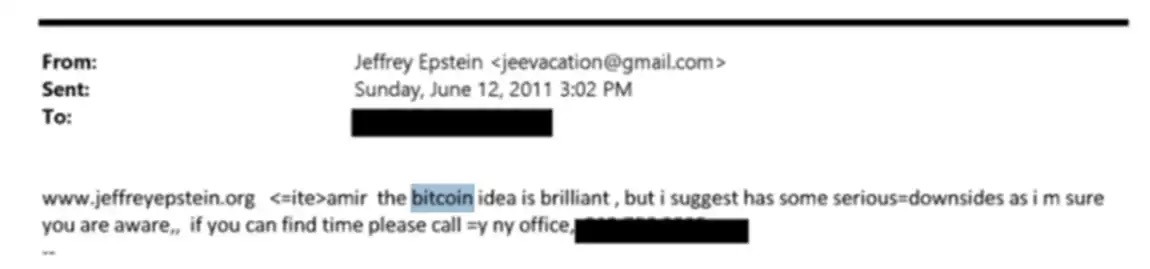
The email below is dated June 12, 2011, right around the peak of Bitcoin's price that year. Epstein stated in the email, "Bitcoin is a brilliant idea, but it has some serious drawbacks."
In 2013, the frequency of cryptocurrency mentions in Epstein's correspondence increased.

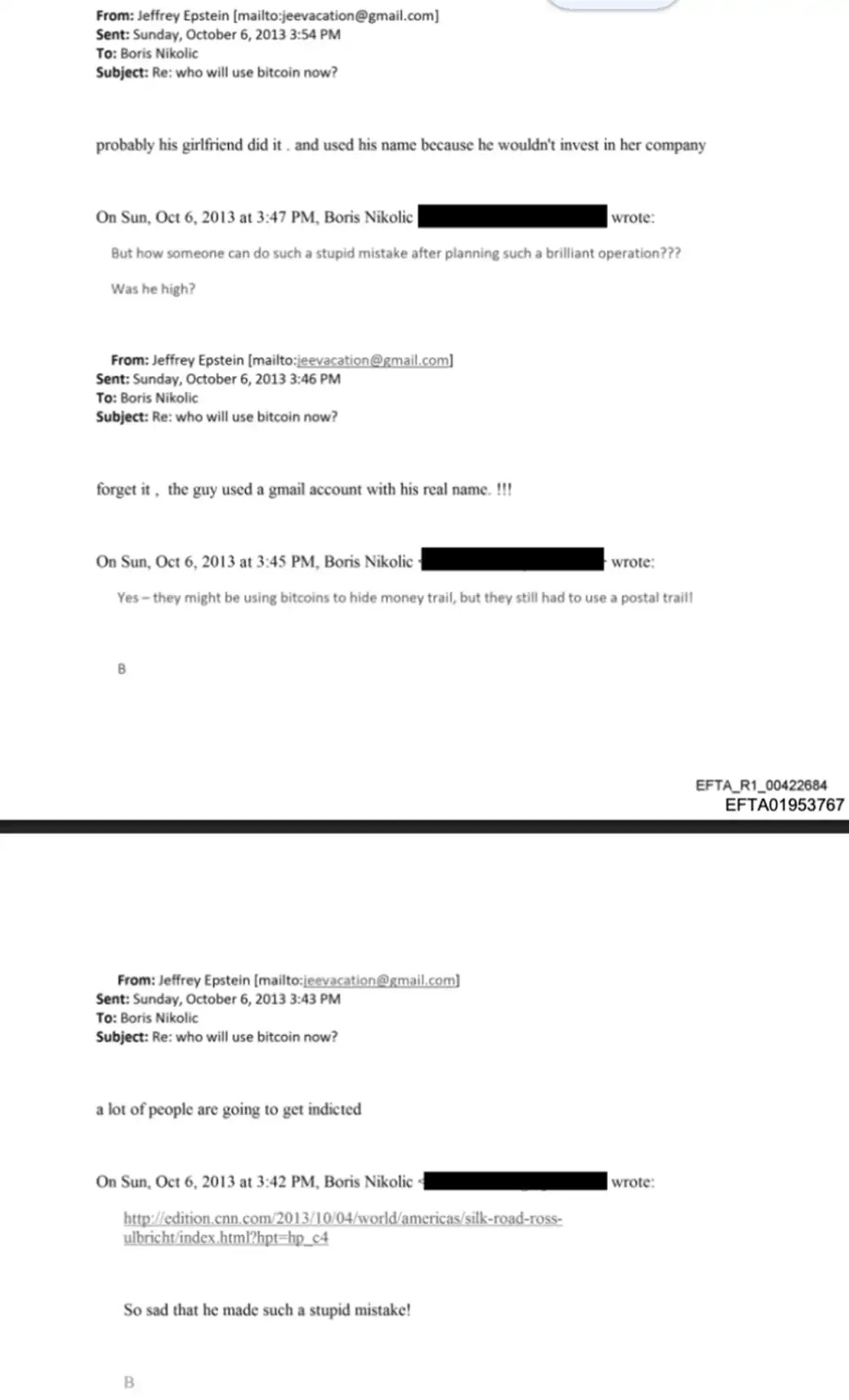
First, in an email exchange with Boris Nikolic (who once served as Bill Gates's chief technology advisor and was named in Epstein's will), the subject was "Who uses Bitcoin now?" They sarcastically discussed Ross Ulbricht, the founder of Silk Road who was arrested that year, saying that Ross's use of a Gmail account with his real name was a stupid mistake.
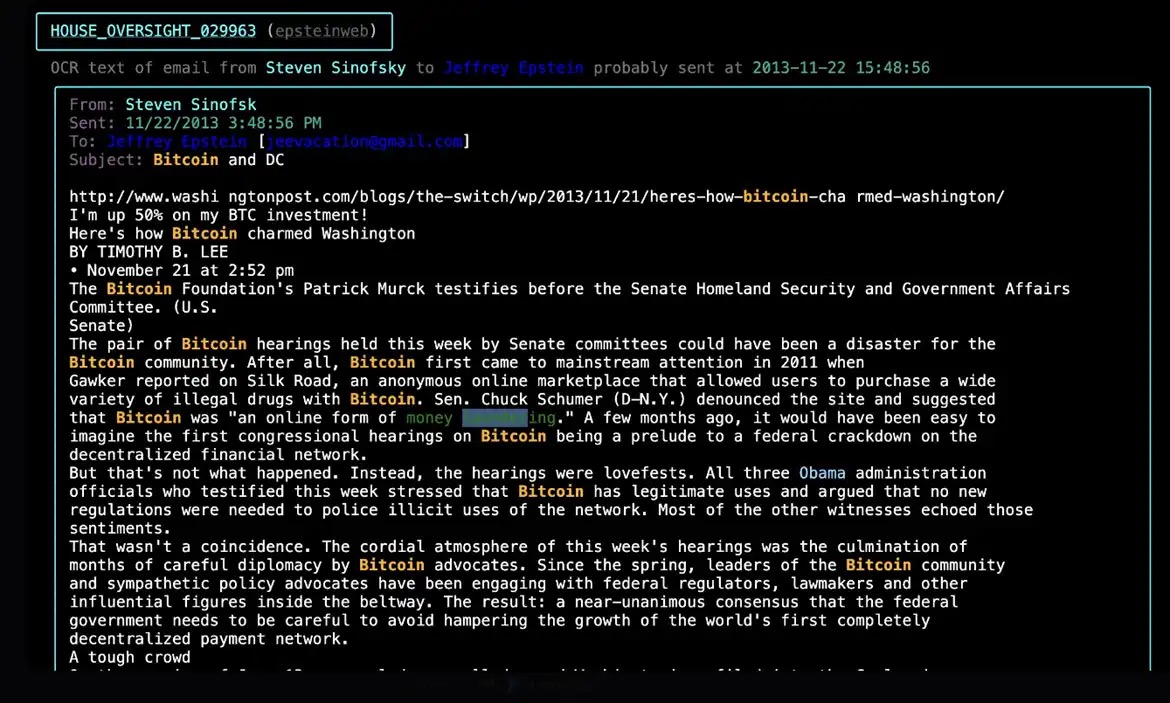
a16z board partner and former president of Microsoft's Windows division, Steven Sinofsky, emailed Epstein to say that his Bitcoin investment had increased by 50% and shared Timothy B. Lee's article "How Bitcoin Captivated Washington."
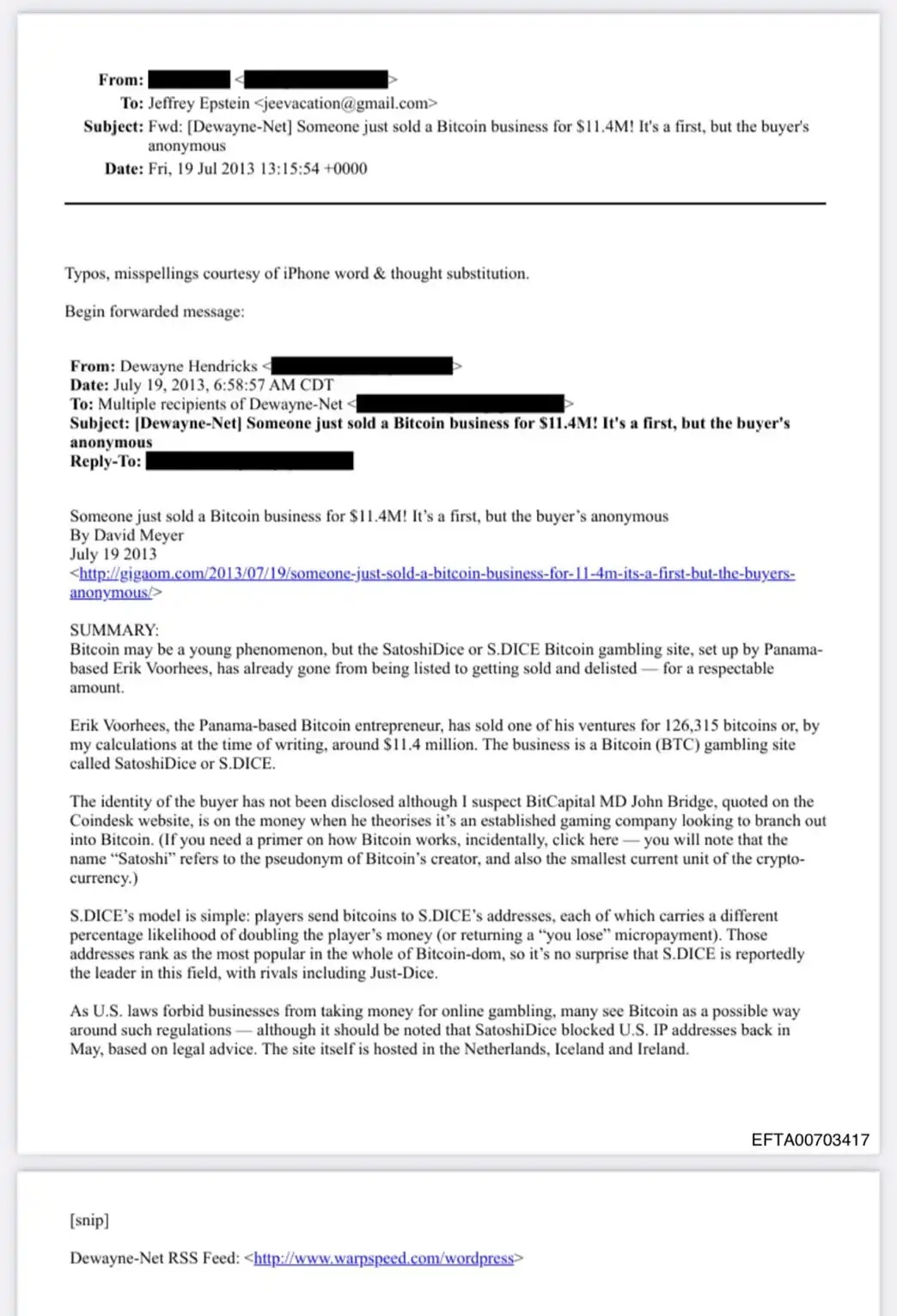
He also received news that the once-famous Bitcoin website Satoshi Dice had been sold for $11.4 million.
In 2014, Epstein engaged in an in-depth discussion with PayPal co-founder Peter Thiel about the nature of Bitcoin.
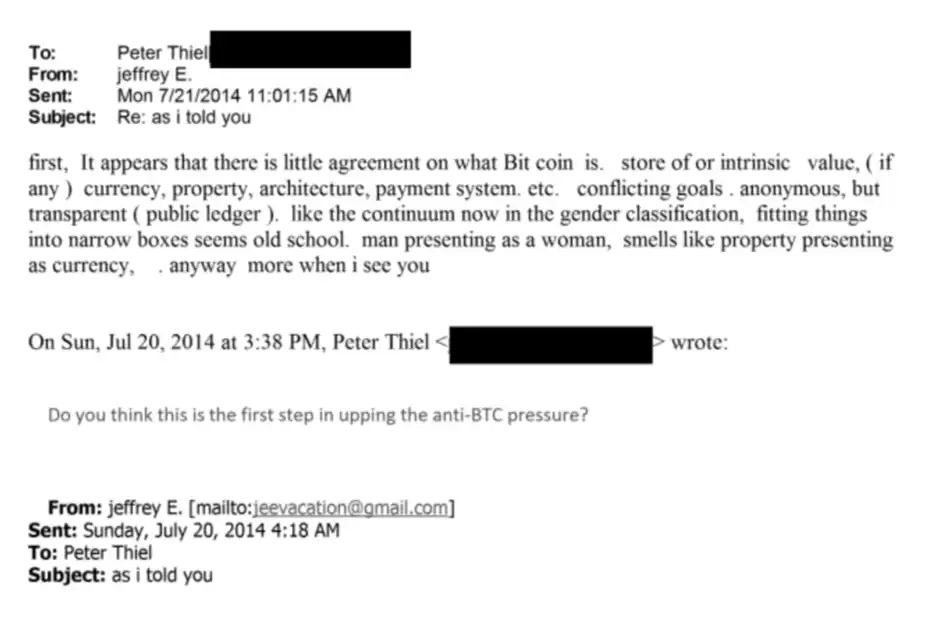
"There is no consensus on what Bitcoin is—a store of value, a currency, or property... It's like a man dressing as a woman, like property masquerading as currency."

This exchange shows that Epstein was very familiar with the ideological debates surrounding Bitcoin's nature in the early stages of the cryptocurrency market. He even compared it to gender identity.

Another email revealed that Epstein participated in the seed round funding of Bitcoin infrastructure company Blockstream. The round totaled $18 million, and Epstein's investment increased from $50,000 to $500,000.
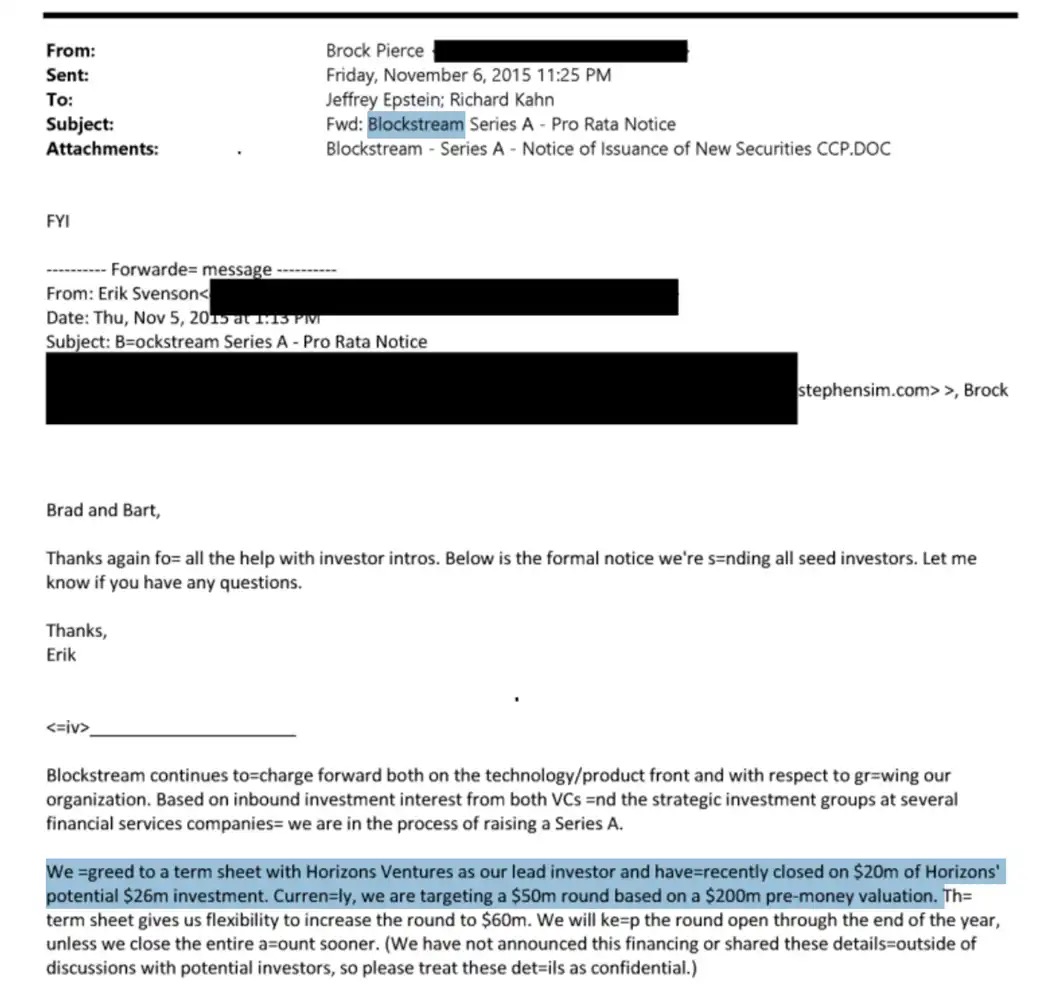
Blockstream CEO Adam Back recently issued a statement denying any direct or indirect financial connection between the company and Epstein or his estate. He explained that Epstein was a limited partner in a fund that once held a minority stake in Blockstream but had since fully divested.

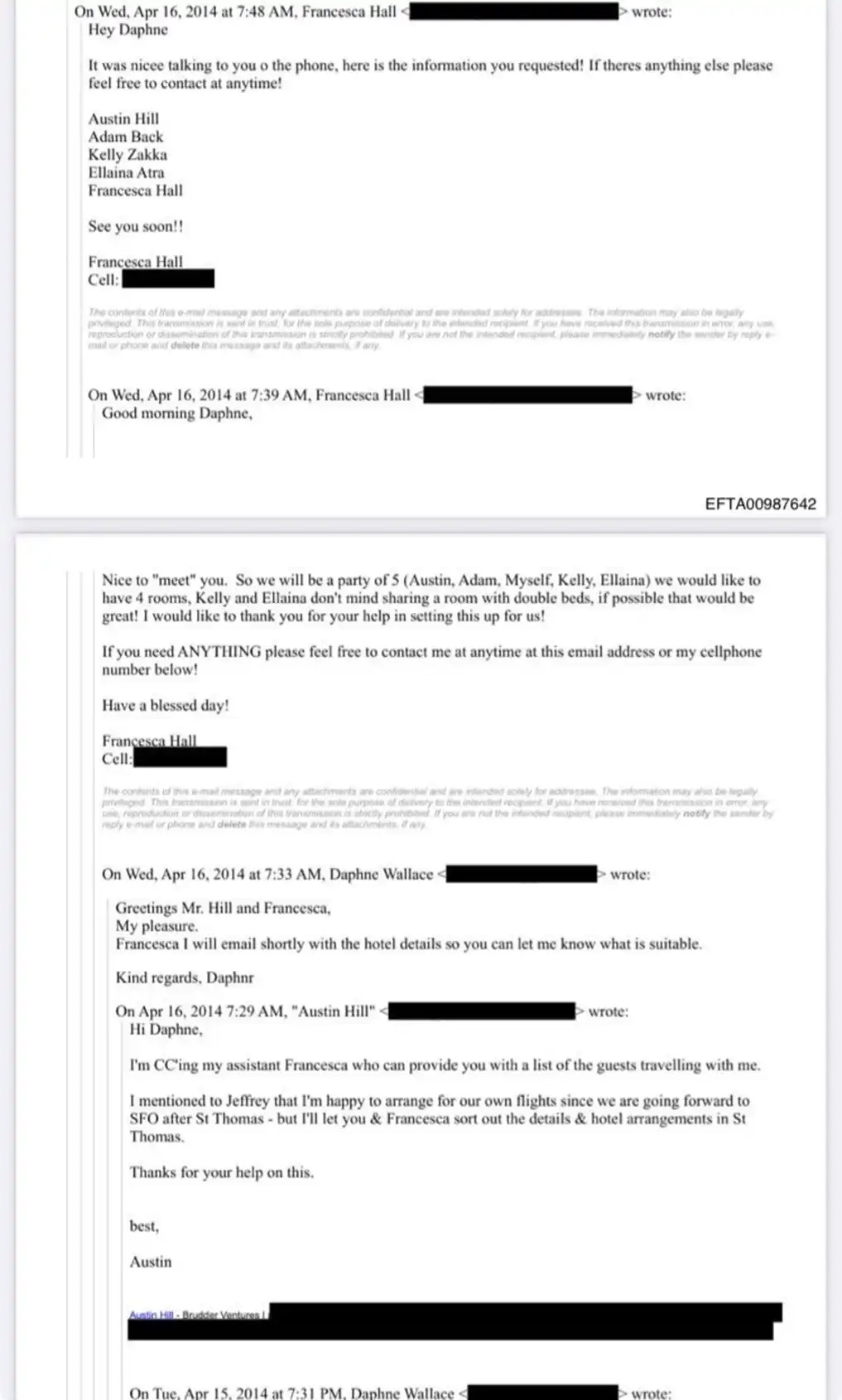
However, the names of Adam Back and Austin Hill (Blockstream co-founder) appeared in travel arrangement emails for St. Thomas Island (about 2 miles from "Epstein Island"):
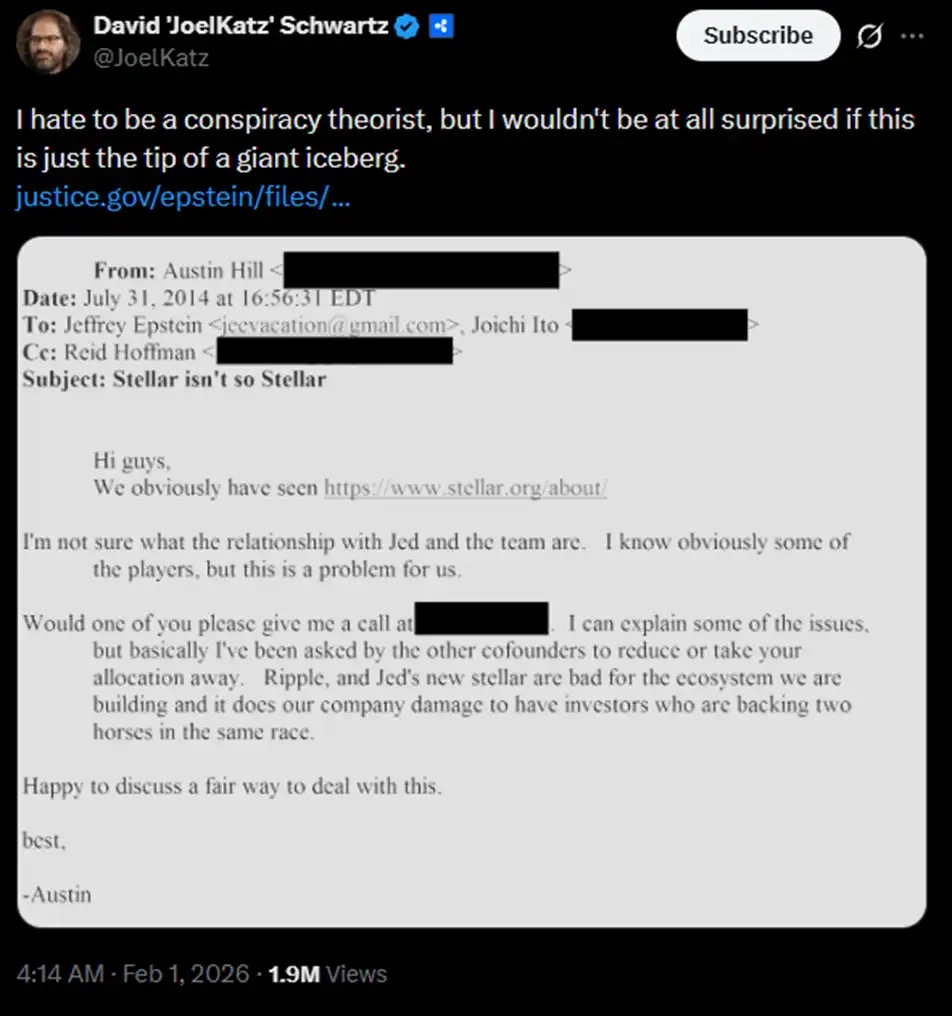
Additionally, in 2014, Austin Hill emailed Epstein and Joi Ito (former director of the MIT Media Lab; Epstein invested in Blockstream through his fund). He stated that Ripple ($XRP) and Stellar (a new project by Ripple founder Jed McCaleb after leaving Ripple) negatively impacted the ecosystem Blockstream was building and harmed Blockstream because their investors were "backing two horses in the same race."
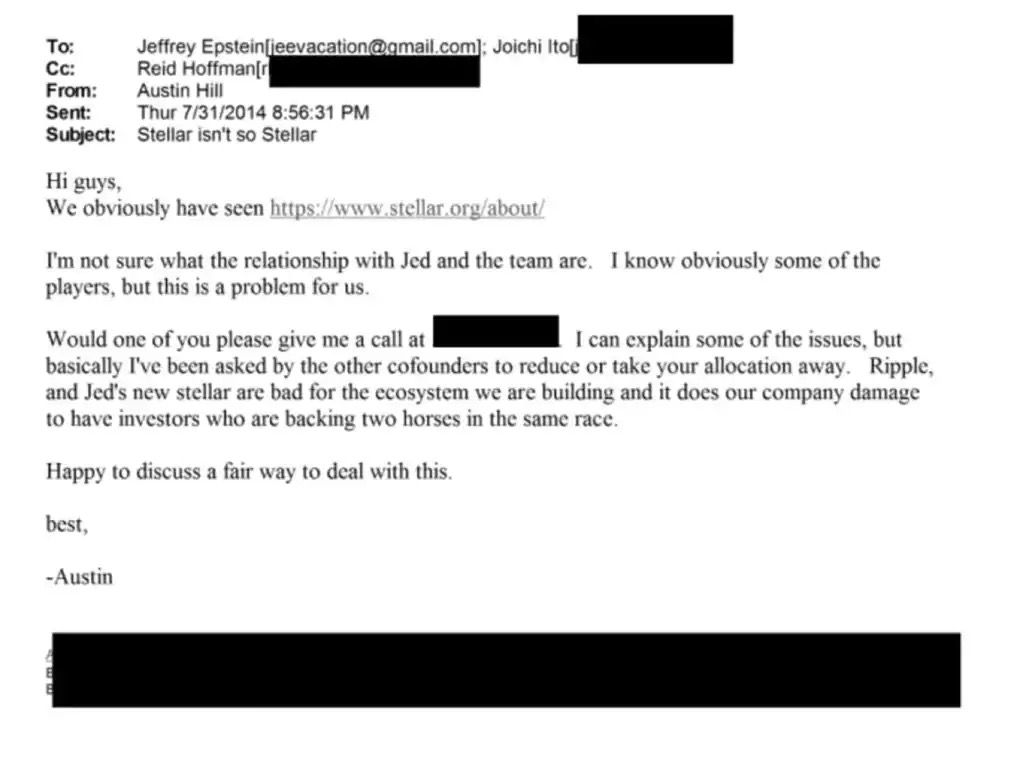
There is some divergence in the English-speaking community regarding the interpretation of this. Based on the context, I personally tend to adopt the interpretation that Epstein may have also invested in Ripple/Stellar at the time, which displeased Blockstream. This led Austin Hill to state in the email, "I was asked by other co-founders to reduce or even cancel your allocation."

Although Ripple and Stellar's growth was not affected, we do not know if more, unknown, excellent cryptocurrency projects have been stifled in their infancy through such behind-the-scenes pressure, from then until now.

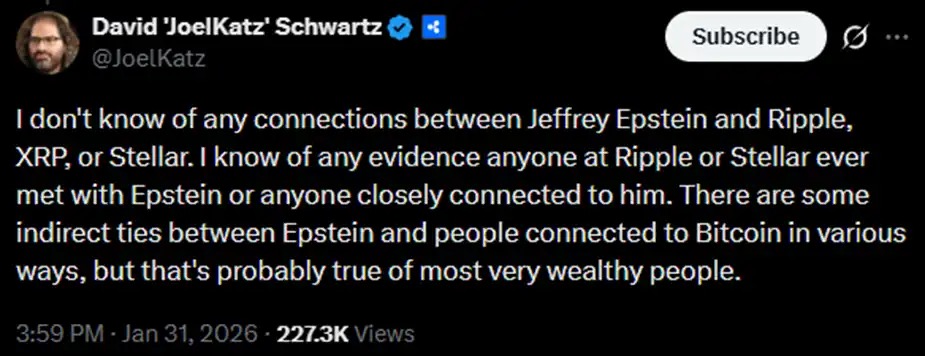
In response, former Ripple CTO David Schwartz tweeted, "I don't want to be a conspiracy theorist, but if this is just the tip of the iceberg, I wouldn't be surprised at all."
So, does this mean Epstein's evil also existed in the cryptocurrency field? David Schwartz also stated that for most ultra-wealthy individuals, having some connection to Bitcoin is probably very common.
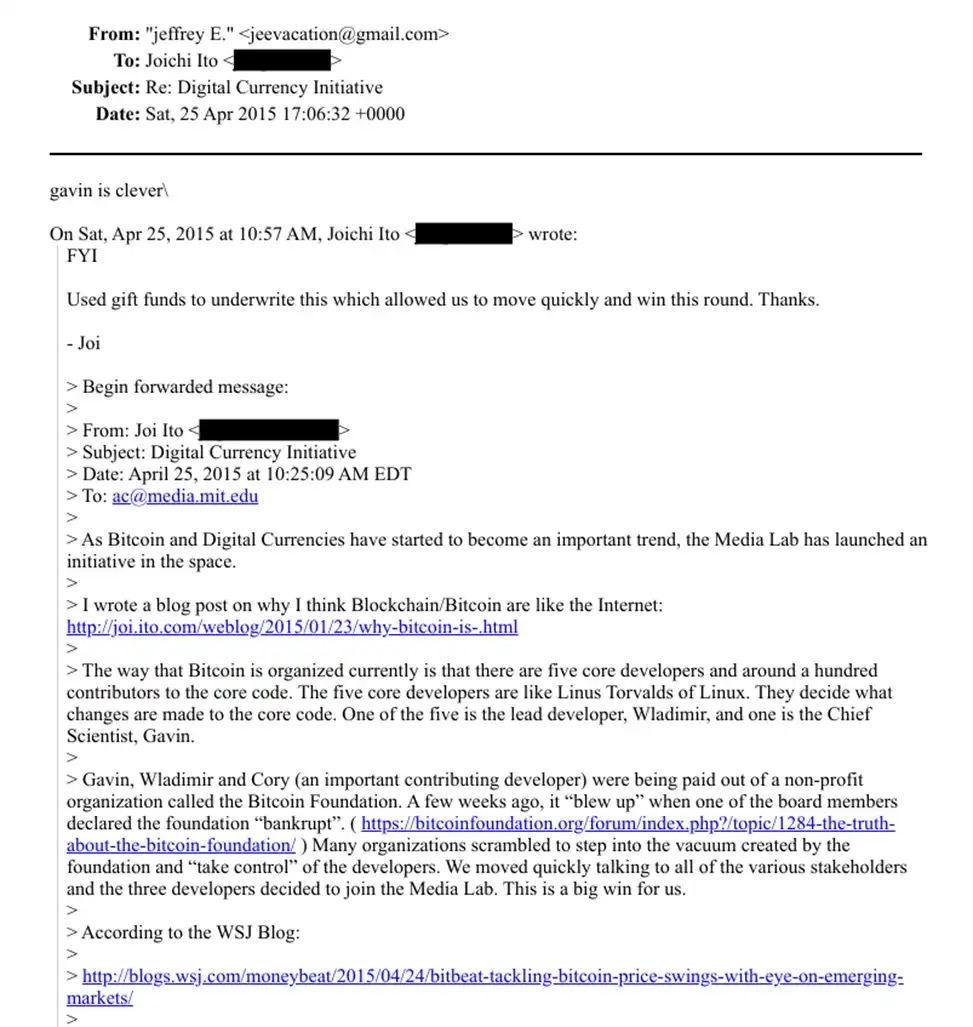
Furthermore, in 2014-2015, the collapse of the Bitcoin Foundation left Bitcoin Core developers without stable salaries. The MIT Media Lab's Digital Currency Initiative (DCI) began paying salaries to several Bitcoin Core developers. As a result, three Bitcoin Core developers—Gavin Andresen, Wladimir van der Laan, and Cory Fields—decided to join the MIT Media Lab.

At that time, the scandal had not yet broken, and the public was unaware of Epstein's anonymous donations to the MIT Media Lab. Joi Ito thanked Epstein via email, not only explaining Bitcoin's development operations to Epstein but also stating that thanks to this money, the lab was "able to move quickly and score a huge victory" because "many organizations wanted to take advantage of the situation to control Bitcoin's developers."

Epstein's reply was a simple compliment about Gavin Andresen: "Gavin is very smart."
Did Epstein Meet Satoshi?

In 2016, Epstein emailed Saudi Royal Court advisor Raafat AlSabbagh and current Abu Dhabi Department of Culture and Tourism advisor Aziza Al Ahmadi with two "radical ideas for creating two new currencies." One was a "Sharia" dollar. Just as all U.S. dollar bills have "In God We Trust," the Middle East could have its own "Sharia" dollar for internal use.
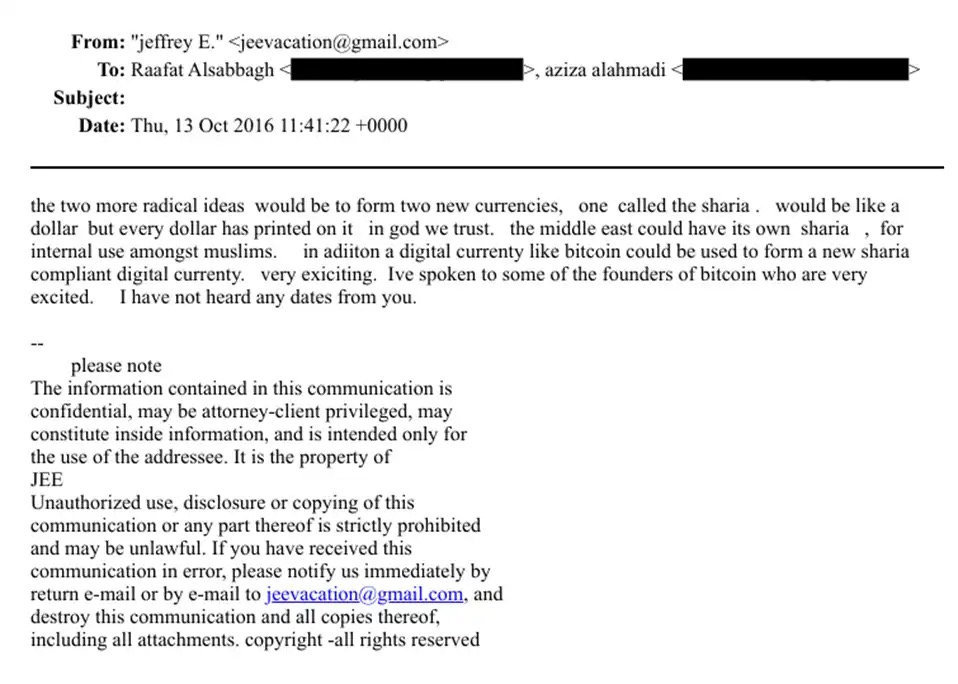
The other idea was to create a digital currency like Bitcoin to make money compliant with Sharia law. Then, after this idea, he casually and lightly dropped this piece of information:

"I have spoken with some of the Bitcoin creators, and they are very excited."

Epstein's purpose at the time might have been more about showing off his connections to enhance his reliable image, so he mentioned it offhand. But this could completely rewrite the history of Bitcoin and even the entire cryptocurrency industry. "Some Bitcoin creators"—does this mean Satoshi Nakamoto was not an individual but a team? If so, many mysteries surrounding Satoshi Nakamoto would have a reasonable explanation.

There are even more thought-provoking questions. Who was this team? What was their motivation for creating Bitcoin? If Epstein really met them, how did he initially find out who they were and establish a relationship with them? If even Epstein knew who created Bitcoin, wouldn't the U.S. government know? What motives does the U.S. government, which has remained silent on this issue, have?

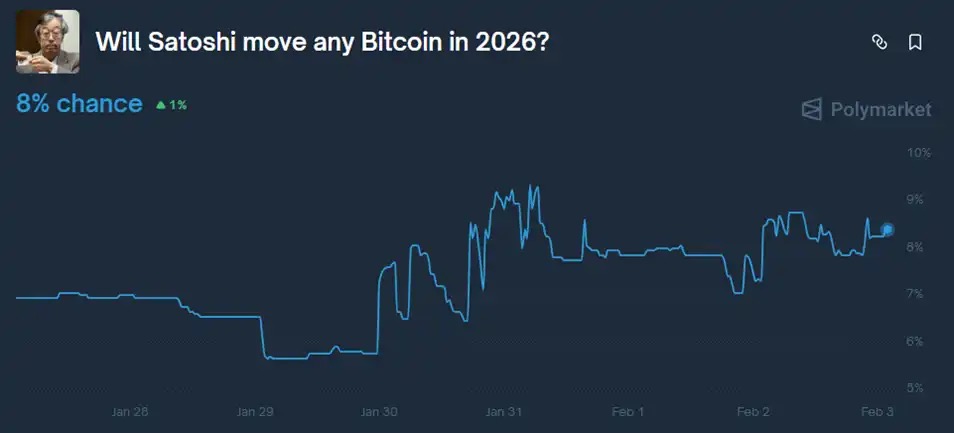
After this latest batch of Epstein files was disclosed, the possibility of "Satoshi Nakamoto's Bitcoin address taking action in 2026" on the prediction market Polymarket rose from about 6% to about 9.3% and is currently holding at 8%.
If Epstein did meet Satoshi Nakamoto, it seems Satoshi was not successful in evangelizing Bitcoin to him during their contact. In an email exchange on August 31, 2017, when asked "Is it worth buying a Bitcoin?" Epstein simply said "No." At that time, one Bitcoin was less than $5,000.

Whether Epstein actually met Satoshi Nakamoto is still unknown. However, we do know that he met the now most famous Bitcoin bull—MicroStrategy CEO Michael Saylor.

For years, Saylor's determination to only buy and never sell Bitcoin has been堪称变态 (abnormal/perverse, used here for emphasis on his extreme behavior). But in 2010, he was not yet famous for this identity.

That year, Comrade Saylor spent $25,000 to attend a party organized by Epstein's publicist Peggy Siegal and initially displayed his "autistic" traits at the event. This is how Peggy Siegal described Saylor:
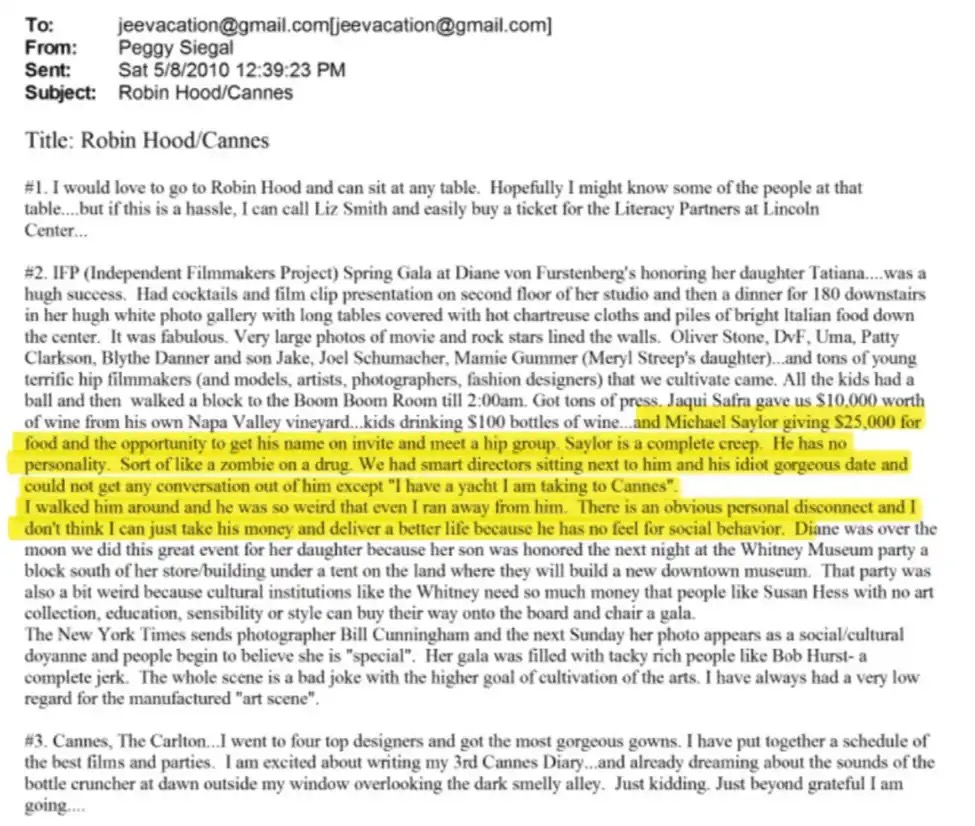
"This guy is a total freak, completely charmless, like a zombie on a drug overdose. We had smart directors at our party, sitting right next to him and his pretty, idiotic chick, and besides 'I have a yacht' and 'I'm going to Cannes,' there was no conversation. I took him around, but he was so weird I just had to run away. He has no personality and no social skills. I don't even know how to get money from him."

Being called变态 (freak/weirdo) by a变态 (freak/weirdo, referring to Epstein's associates) shows just how变态 Saylor) Saylor really is. Perhaps only a creation as great as Bitcoin could accommodate a变态 like Saylor and allow him to build a great career.

Conclusion

About half of the Epstein files have not yet been disclosed. How many more bombshells related to the cryptocurrency industry are hidden in these remaining files?

Will time clear the fog?


Twitter:https://twitter.com/BitpushNewsCN

Bitpush TG Discussion Group:https://t.me/BitPushCommunity

Bitpush TG Subscription: https://t.me/bitpush

Original link:https://www.bitpush.news/articles/7608204

Questions liées

QWhat was Jeffrey Epstein's initial opinion on Bitcoin in 2011, and what did he identify as its key issue?

AIn 2011, Jeffrey Epstein described Bitcoin as 'a brilliant idea' but noted that it had 'some serious drawbacks.'

QWhich prominent Bitcoin infrastructure company did Epstein invest in through a fund, and what was the controversy surrounding his involvement?

AEpstein invested in Blockstream's seed round through a fund, initially putting in $50,000 which grew to $500,000. Blockstream's CEO later denied any direct or indirect financial ties, stating Epstein was a limited partner in a fund that held a minority stake and had fully divested.

QWhat startling claim did Epstein make in a 2016 email regarding the creators of Bitcoin?

AIn a 2016 email, Epstein claimed, 'I have been meeting with some of the bitcoin creators and they are very excited,' suggesting he may have had contact with Satoshi Nakamoto or the founding team.

QHow did Epstein's associate, Peggy Siegal, describe MicroStrategy CEO Michael Saylor after meeting him at a party?

APeggy Siegal described Michael Saylor as a 'complete freak' with 'no charm,' comparing him to a 'zombie on too many drugs.' She found him socially awkward and difficult to engage with.

QWhat role did Epstein's donations to the MIT Media Lab play in the Bitcoin ecosystem?

AEpstein's anonymous donations to the MIT Media Lab allowed its Digital Currency Initiative (DCI) to fund the salaries of key Bitcoin Core developers like Gavin Andresen, Wladimir van der Laan, and Cory Fields, which the lab's director saw as a crucial move to prevent other organizations from controlling the developers.

Lectures associées

Début de Warsh : le président de la Fed le plus au fait du Crypto de l'histoire apportera-t-il des surprises ou des chocs au marché ?

**Résumé :** Kevin Warsh, nouveau président de la Réserve fédérale américaine, s'apprête à tenir sa première conférence de presse monétaire. Sa nomination est historique : il est le premier président de la Fed à détenir personnellement des actifs numériques (investissements indirects dans Solana, dYdX, etc.), montrant une compréhension unique du secteur. Son dilemme est majeur : il doit faire face à une résurgence de l'inflation, qui exige une politique monétaire stricte (position "de faucon"), tout en répondant aux pressions politiques pour des baisses de taux. Parallèlement, son attitude envers les crypto-actifs diffère fondamentalement de celle de son prédécesseur. Il ne les considère pas comme de simples actifs spéculatifs, mais plutôt comme un "bon policier" pour la politique économique et une composante de la compétitivité américaine. Son impact potentiel sur le marché crypto s'articule autour de trois axes : 1. Un changement de paradigme réglementaire, passant de la prévention à l'intégration et à l'innovation. 2. Une reprixation des actifs liée aux taux d'intérêt, où sa clarté de communication pourrait réduire la prime d'incertitude. 3. Une légitimation accrue pouvant attirer les capitaux institutionnels traditionnels. Deux scénarios principaux sont envisagés pour sa première intervention : * **Scénario "Surprise"** : Un ton modéré ("de colombe") sur les taux combiné à des signaux favorables à l'innovation numérique pourrait booster le marché. * **Scénario "Choc"** : Un message excessivement restrictif sur les taux pourrait entraîner une vente généralisée des actifs risqués, y compris les cryptos. Bien qu'il ait dû vendre ses actifs crypto pour des raisons d'éthique, la compréhension intrinsèque de Warsh pour la technologie blockchain pourrait, à long terme, poser les bases d'une intégration plus structurelle des actifs numériques dans le système financier.

marsbitIl y a 1 h

Début de Warsh : le président de la Fed le plus au fait du Crypto de l'histoire apportera-t-il des surprises ou des chocs au marché ?

marsbitIl y a 1 h

XRP Ledger Lance le Rebranding XRPld Avec la Mise à Niveau Version 3.2.0

La version 3.2.0 du XRP Ledger (XRPL) est désormais disponible, introduisant une refonte majeure incluant le changement de nom du logiciel principal de « rippled » à « xrpld ». Cette mise à niveau se concentre principalement sur les améliorations des performances, de la sécurité et de l'évolutivité de l'infrastructure sous-jacente, plutôt que sur de nouvelles fonctionnalités utilisateur. Les principales avancées incluent des optimisations de mémoire pouvant réduire jusqu'à 40% l'utilisation de la mémoire serveur. Sur le plan de la sécurité, la modification `fixCleanup3_2_0` renforce plusieurs modules, notamment les coffres-forts à actif unique, le protocole de prêt, les échanges décentralisés et les jetons multi-usages. De nouveaux contrôles d'invariance garantissent la cohérence du registre après la suppression de comptes. Pour les développeurs, la mise à jour permet désormais de récupérer des informations sur les définitions du protocole et du serveur XRPL sans nécessiter de connexion active, facilitant ainsi la création de portefeuilles, d'explorateurs de blockchain et d'APIs. En termes d'évolutivité et de stabilité, les améliorations comprennent des tailles de bloc configurables, un stockage de base de données optimisé via nuDB, et le support optionnel de TLS/mutual TLS pour le serveur gRPC. Le port de peering par défaut est également passé du 51235 au 2459. Divers correctifs ont été apportés aux fonctions liées aux Market Makers Automatisés, aux paiements, aux séquestres de jetons et aux carnets d'ordres. Une note importante : les invariants de transaction ont été temporairement désactivés dans la v3.2.0 en raison d'un impact sur les performances, mais cela ne présente pas de risque pour la sécurité.

TheNewsCryptoIl y a 2 h

XRP Ledger Lance le Rebranding XRPld Avec la Mise à Niveau Version 3.2.0

TheNewsCryptoIl y a 2 h

L'AGI n'est pas l'arrivée, nouveau document de DeepMind : Vers l'ASI, le véritable progrès de l'IA ne fait que commencer

Si l'intelligence artificielle générale (IAG) était atteinte demain, quelle serait la prochaine étape ? Une étude de Google DeepMind suggère que l'IAG n'est pas un point final, mais une étape vers une superintelligence artificielle (ISA) dépassant les collectifs d'experts humains. L'étude distingue trois concepts : l'IAG (niveau médian humain), l'ISA (supérieure aux meilleurs collectifs humains dans presque tous les domaines) et l'IA universelle (limite théorique). Elle propose quatre voies potentielles vers l'ISA : 1. **Extension des ressources** : augmentation de la puissance de calcul, des données et des modèles. 2. **Évolution algorithmique** : améliorations incrémentales ou nouveaux paradigmes (apprentissage continu, utilisation d'outils, modèles du monde). 3. **Auto-amélioration récursive** : des IA plus performantes conçoivent la génération suivante, créant une boucle de rétroaction positive. 4. **Coordination multi-agents** : des systèmes IAG collaborant atteignent une intelligence collective supérieure. L'étude identifie six principaux goulets d'étranglement : 1. **Le mur des données** : les données humaines de haute qualité pourraient s'épuiser. 2. **Pressions économiques et ressources naturelles** : coûts énergétiques et matériels. 3. **Limites des paradigmes neuronaux actuels** : problèmes d'apprentissage continu, de raisonnement robuste, d'hallucinations. 4. **Difficulté croissante de la recherche**. 5. **Barrières à l'abstraction** : difficulté à former de nouveaux concepts fondamentaux. 6. **Régulation, gouvernance et réaction sociale**. Un défi crucial est l'évaluation des capacités de l'IA au-delà du niveau humain, nécessitant de nouveaux benchmarks. L'étude conclut que la progression vers l'ISA reste incertaine, soumise à des contraintes physiques et de ressources, et appelle à un effort de recherche interdisciplinaire pour mieux anticiper cette évolution.

marsbitIl y a 3 h

L'AGI n'est pas l'arrivée, nouveau document de DeepMind : Vers l'ASI, le véritable progrès de l'IA ne fait que commencer

marsbitIl y a 3 h

Trading

Spot
Futures

Articles tendance

Comment acheter COOKIE

Bienvenue sur HTX.com ! Nous vous permettons d'acheter Cookie DAO (COOKIE) de manière simple et pratique. Suivez notre guide étape par étape pour commencer votre parcours crypto.Étape 1 : Création de votre compte HTXUtilisez votre adresse e-mail ou votre numéro de téléphone pour ouvrir un compte sur HTX gratuitement. L'inscription se fait en toute simplicité et débloque toutes les fonctionnalités.Créer mon compteÉtape 2 : Choix du mode de paiement (rubrique Acheter des cryptosCarte de crédit/débit : utilisez votre carte Visa ou Mastercard pour acheter instantanément Cookie DAO (COOKIE).Solde :utilisez les fonds du solde de votre compte HTX pour trader en toute simplicité.Prestataire tiers :pour accroître la commodité d'utilisation, nous avons ajouté des modes de paiement populaires tels que Google Pay et Apple Pay.P2P :tradez directement avec d'autres utilisateurs sur HTX.OTC (de gré à gré) : nous offrons des services personnalisés et des taux de change compétitifs aux traders.Étape 3 : stockage de vos Cookie DAO (COOKIE)Après avoir acheté vos Cookie DAO (COOKIE), stockez-les sur votre compte HTX. Vous pouvez également les envoyer ailleurs via un transfert sur la blockchain ou les utiliser pour trader d'autres cryptos.Étape 4 : tradez des Cookie DAO (COOKIE)Tradez facilement Cookie DAO (COOKIE) sur le marché Spot de HTX. Il vous suffit d'accéder à votre compte, de sélectionner la paire de trading, d'exécuter vos trades et de les suivre en temps réel. Nous offrons une expérience conviviale aux débutants comme aux traders chevronnés.

246 vues totalesPublié le 2025.07.23Mis à jour le 2026.06.02

Comment acheter COOKIE

Discussions

Bienvenue dans la Communauté HTX. Ici, vous pouvez vous tenir informé(e) des derniers développements de la plateforme et accéder à des analyses de marché professionnelles. Les opinions des utilisateurs sur le prix de COOKIE (COOKIE) sont présentées ci-dessous.

活动图片













