Off to a Strong Start! USDD TVL Surpasses $1 Billion Mark, Embarking on a Powerful Journey in 2026

marsbitPublié le 2026-01-16Dernière mise à jour le 2026-01-16

Résumé

USDD, a decentralized stablecoin, has achieved a significant milestone at the beginning of 2026 by surpassing $1 billion in Total Value Locked (TVL). This growth reflects strong market confidence in its decentralized mechanism, value stability, and sustainable model. Key drivers include its innovative yield-generating mechanism, multi-chain ecosystem, and robust risk management. USDD functions as an "interest-bearing USDT" through its Smart Allocator system, which dynamically allocates reserve funds to vetted on-chain projects, generating over $8.34 million in actual returns. The introduction of sUSDD allows users to easily earn passive yield with auto-compounding features. USDD has expanded across major blockchains like TRON, Ethereum, and BNB Chain. A collaboration with Binance Wallet’s Yield+ campaign attracted over 3,000 users in its first week, boosting sUSDD TVL by 867% to $295 million. The stablecoin uses an over-collateralized debt model with strict minimum collateral ratios, ensuring transparency and 1:1 redeemability with major stablecoins. In 2026, USDD aims to shift from incentive-driven growth to real-use-case adoption, focusing on deeper integration with DeFi protocols, exchanges, and payment tools. Its decentralized, non-freezable, and yield-bearing features position it as a compelling alternative to centralized stablecoins. Breaking the $1 billion TVL mark is just the beginning of its upward trajectory.

At the beginning of 2026, the decentralized stablecoin USDD has achieved a significant milestone—its Total Value Locked (TVL) has officially surpassed the $1 billion mark! This accomplishment not only marks a new phase in the development of the USDD ecosystem but also demonstrates the market's high recognition of its decentralized mechanism, stable value support, and sustainable development model.
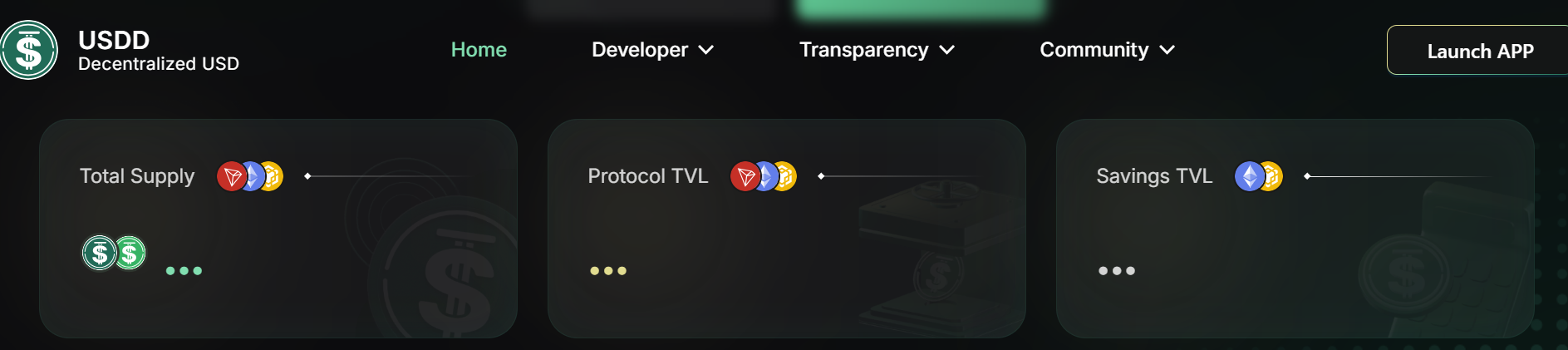
At a time when the DeFi industry is still undergoing structural differentiation and continuous reshuffling, USDD's "strong start" carries significant symbolic meaning. It not only validates USDD's long-term value logic but also injects new growth confidence into the decentralized stablecoin sector, setting a positive tone for the industry's development in 2026.

The Underlying Logic of Counter-Trend Growth: Synergistic Efforts in Mechanism, Ecosystem, and Risk Management

USDD's achievement of this milestone growth is primarily attributed to its three core advantages: an innovative sustainable yield mechanism, a robust multi-chain ecosystem layout, and an exceptional risk management system.

In terms of the yield mechanism, USDD has been positioned as an "interest-bearing version of USDT" since its inception. Through the Smart Allocator yield distribution mechanism, the protocol dynamically allocates a portion of reserve funds to rigorously vetted high-quality on-chain projects, generating diversified returns such as interest, protocol incentives, and platform rewards. According to disclosures, this mechanism has already generated over $8.34 million in actual returns.

Building on this, USDD introduced the interest-bearing token sUSDD, allowing users to seamlessly convert USDD to sUSDD with one click, enabling passive yield generation and automatic compounding without complex operations. This design significantly lowers the barrier to entry for users and extends USDD's utility from a mere value-pegging tool to a capital efficiency tool with yield attributes, enhancing its appeal within the DeFi ecosystem.

In terms of ecosystem layout, USDD has completed the critical transition from a single chain to a multi-chain framework, demonstrating strong user adoption and capital retention during its expansion. For example, during the recent Yield+ campaign launched in collaboration with Binance Wallet, the first week attracted over 3,000 participants, with sUSDD's TVL surging by over 867% in a short period, exceeding $295 million and becoming the fastest-growing stablecoin product during the same period.

Currently, USDD is natively deployed on mainstream public chains such as TRON, Ethereum, and BNB Chain, gradually building a cross-chain synergistic stablecoin infrastructure.

In terms of risk management, USDD adopts an over-collateralized debt position model with strict minimum collateral ratio requirements, ensuring that every USDD is backed by sufficient and transparent assets. Additionally, its stable peg module allows users to exchange USDD for mainstream stablecoins at a 1:1 ratio with zero slippage, providing dual guarantees for liquidity and price stability. It is this series of mechanism designs that enable USDD to maintain its price peg even during market volatility, continuously earning user trust.

Growth Driven by Real-World Adoption: Multi-Chain Ecosystem and Real-World Use Case Deployment in 2026

Looking ahead to 2026, USDD's development roadmap is becoming clearer and more long-term oriented. The team has explicitly stated its intention to gradually shift the ecosystem from "incentive-driven" to "real-use-driven." This means that USDD will increasingly focus on building application scenarios based on genuine demand, gradually reducing reliance on short-term subsidies and external incentives, and instead creating distributable value through endogenous mechanisms like the Smart Allocator.

Simultaneously, USDD plans to further deepen cooperation with on-chain exchanges and core DeFi protocols, exploring a dual-drive model that synergizes on-chain and off-chain activities. On one hand, it aims to expand the native use of USDD in scenarios such as trading, lending, and yield strategies; on the other hand, it seeks to enhance user reach and capital retention through wallets, payment systems, and aggregation tools, forming a positive feedback loop between the protocol, partners, and users.

Facing increasingly fierce competition in the stablecoin market, USDD has also established a clear differentiated positioning. Compared to centralized stablecoins, which offer ample liquidity but pose risks such as freezing and opaque yields, USDD provides a more attractive alternative through its decentralized architecture, anti-freezing characteristics, and mechanisms that reward holders. As the industry demands higher levels of transparency and sustainability, USDD's advantages are expected to become even more pronounced.

Surpassing $1 billion in TVL is just the beginning. In the opening phase of 2026, USDD has already charted a clear and steady upward trajectory, making its future growth potential and industry influence increasingly promising.


Cryptos en tendance

Questions liées

QWhat major milestone did USDD achieve at the beginning of 2026?

AUSDD's Total Value Locked (TVL) surpassed the $1 billion mark.

QWhat are the three core advantages that contributed to USDD's growth?

AThe three core advantages are its innovative sustainable yield mechanism, robust multi-chain ecosystem layout, and excellent risk management system.

QWhat is the purpose of the sUSDD token introduced by USDD?

AThe sUSDD token allows users to convert USDD to sUSDD to participate in passive yield generation and automatic compounding with low entry barriers.

QWhich major blockchains has USDD been natively deployed on?

AUSDD has been natively deployed on TRON, Ethereum, and BNB Chain.

QHow does USDD ensure price stability and liquidity for its users?

AUSDD uses an over-collateralized debt model with strict minimum collateral requirements and a stable peg module that allows 1:1, no-slippage swaps between USDD and major stablecoins.

Lectures associées

Le Bitcoin a-t-il touché le fond, ou une 'secousse' se prépare-t-elle ? Quelle est la situation du XRP ?

La plateforme d'analyse cryptographique Santiment a publié une analyse des marchés du Bitcoin et des altcoins, basée sur les tendances du marché et les données on-chain. L'indicateur 365-jours MVRV du Bitcoin est tombé à -26%, signalant des pertes importantes pour les investisseurs à long terme. Historiquement, de tels niveaux négatifs profonds ont correspondu à la formation de creux de marché et à des opportunités d'achat à long terme. Le MVRV sur 30 jours est neutre (+1.1%), indiquant une absence de signal directionnel clair à court terme. Les données montrent une divergence de comportement : les grands portefeuilles (10 à 10 000 BTC) ont continué à accumuler, ajoutant environ 18 500 BTC en 10 jours. À l'inverse, la forte demande des petits investisseurs individuels pourrait créer un risque de "shakeout" ou correction finale du marché. La situation des altcoins est mitigée. L'Ethereum présente un risque de correction à court terme malgré son MVRV négatif, en raison d'un optimisme excessif sur les réseaux sociaux. Le XRP, en revanche, est en territoire de survente avec des MVRV très négatifs (-57.5% sur 30 jours, -45.5% sur 365 jours), ce qui pourrait signaler un fort rebond à moyen/long terme. L'optimisme est croissant pour Solana, tandis que les sentiments sont plus calmes pour Cardano. La trajectoire future dépendra également de facteurs macroéconomiques (comme les décisions de taux de la Fed) et réglementaires (comme l'incertitude autour du projet de loi sur la clarté cryptographique aux États-Unis), qui pourraient accroître la volatilité. *Ceci n'est pas un conseil en investissement.

cryptonews.ruIl y a 46 mins

Le Bitcoin a-t-il touché le fond, ou une 'secousse' se prépare-t-elle ? Quelle est la situation du XRP ?

cryptonews.ruIl y a 46 mins

Une file d'attente de 43 jours pour le staking sur Ethereum s'est formée : mais selon un expert, ce n'est pas un véritable signal haussier

La forte augmentation des validateurs souhaitant miser leurs jetons sur Ethereum a créé une file d'attente d'activation d'environ 2,5 millions d'ETH, imposant une attente d'environ 43 jours. Thomas Brunner de Sygnum Bank souligne que cette congestion n'est pas un signal haussier direct, car elle est influencée par des facteurs techniques du protocole, comme la capacité quotidienne limitée à environ 57 600 ETH depuis la mise à jour Dencun, inchangée avec Pectra. L'accumulation dans la file d'attente ne représente pas uniquement une nouvelle demande, mais inclut aussi des réallocations d'ETH déjà misés, des ajouts aux validateurs existants et des processus de capitalisation. Un indicateur plus fort, selon Brunner, est la file de retrait quasi vide, signe que les investisseurs actuels maintiennent leurs positions, ce qui reflète une véritable confiance. Environ 41,2 millions d'ETH sont actuellement misés, soit environ 33,8% de l'offre en circulation. Malgré la faiblesse des prix, les investisseurs institutionnels continuent de considérer les revenus du staking comme une caractéristique fondamentale d'Ethereum. Cependant, les préoccupations concernant la confidentialité des adresses et transactions sur la blockchain restent un obstacle majeur à une adoption institutionnelle plus rapide.

cryptonews.ruIl y a 2 h

Une file d'attente de 43 jours pour le staking sur Ethereum s'est formée : mais selon un expert, ce n'est pas un véritable signal haussier

cryptonews.ruIl y a 2 h

Trading

Spot

Articles tendance

Comment acheter USDD

Bienvenue sur HTX.com ! Nous vous permettons d'acheter USDD (USDD) de manière simple et pratique. Suivez notre guide étape par étape pour commencer votre parcours crypto.Étape 1 : Création de votre compte HTXUtilisez votre adresse e-mail ou votre numéro de téléphone pour ouvrir un compte sur HTX gratuitement. L'inscription se fait en toute simplicité et débloque toutes les fonctionnalités.Créer mon compteÉtape 2 : Choix du mode de paiement (rubrique Acheter des cryptosCarte de crédit/débit : utilisez votre carte Visa ou Mastercard pour acheter instantanément USDD (USDD).Solde :utilisez les fonds du solde de votre compte HTX pour trader en toute simplicité.Prestataire tiers :pour accroître la commodité d'utilisation, nous avons ajouté des modes de paiement populaires tels que Google Pay et Apple Pay.P2P :tradez directement avec d'autres utilisateurs sur HTX.OTC (de gré à gré) : nous offrons des services personnalisés et des taux de change compétitifs aux traders.Étape 3 : stockage de vos USDD (USDD)Après avoir acheté vos USDD (USDD), stockez-les sur votre compte HTX. Vous pouvez également les envoyer ailleurs via un transfert sur la blockchain ou les utiliser pour trader d'autres cryptos.Étape 4 : tradez des USDD (USDD)Tradez facilement USDD (USDD) sur le marché Spot de HTX. Il vous suffit d'accéder à votre compte, de sélectionner la paire de trading, d'exécuter vos trades et de les suivre en temps réel. Nous offrons une expérience conviviale aux débutants comme aux traders chevronnés.

399 vues totalesPublié le 2024.12.11Mis à jour le 2026.06.02

Comment acheter USDD

Discussions

Bienvenue dans la Communauté HTX. Ici, vous pouvez vous tenir informé(e) des derniers développements de la plateforme et accéder à des analyses de marché professionnelles. Les opinions des utilisateurs sur le prix de USDD (USDD) sont présentées ci-dessous.

活动图片