Interop Roadmap Accelerates: After Fusaka Upgrade, Ethereum Interoperability May Take a Key Leap

marsbitPublié le 2025-12-11Dernière mise à jour le 2025-12-11

Résumé

Recent Ethereum Fusaka upgrade, while primarily focused on Blob capacity expansion, introduced the underappreciated EIP-7825, a critical enabler for Ethereum's zero-knowledge (ZK) and interoperability roadmap. This proposal sets a hard per-transaction gas limit (~16.78 million gas), preventing "mega-transactions" from monopolizing a block. This change transforms block proof generation from a sequential logic problem into a parallelizable computational task, making real-time ZK proofs an engineering feasibility rather than a theoretical impossibility. This foundational shift is pivotal for the L1 zkEVM vision, where Ethereum itself generates verifiable proofs for its state transitions. L1 zkEVM acts as a universal "trust anchor," allowing Layer 2s (L2s) to instantly and trustlessly verify the mainnet's state without waiting for challenge periods. This eliminates the speed-trust decentralization trade-off, enabling near-instant, decentralized cross-chain interoperability. Concurrently, ZK technology is evolving from EVM-compatible zkEVMs to more efficient, ZK-optimized zkVMs. EIP-7825's parallelizable environment allows these zkVMs to operate at peak efficiency, drastically reducing proof generation cost and time. The convergence of EIP-7825, L1 zkEVM, and advanced zkVMs paves the way for the final stage of interoperability (Interop)—abstracting away chain boundaries to deliver a single-chain user experience where cross-chain actions are seamless, secure, and instantaneous.

Author: imToken

In previous articles of the Interop series, we discussed OIF (Intent Framework) and EIL (Interoperability Layer), which respectively address the standardization of cross-chain intents (making the entire network understand what you want to do) and the execution channel problem (enabling funds to move in a standardized manner).

However, achieving a perfect "single-chain experience" still involves a trade-off between speed and trust. After all, in the current interoperability experience, one must either endure slowness (such as Optimistic Rollup requiring a 7-day challenge period to confirm finality) or sacrifice decentralization (relying on the trust assumptions of multi-signature bridges).

To break this "impossible triangle," it is essential to have a foundational capability that spans the "acceleration" and finalization of Ethereum's interoperability roadmap—the "real-time proof" brought by ZK technology (extended reading: "Ethereum Interop Roadmap: How to Unlock the 'Last Mile' of Mass Adoption").

And the recently activated Fusaka upgrade, with its inconspicuous EIP-7825, has cleared the biggest engineering obstacle for this ultimate goal.

I. Behind the Fusaka Upgrade: The Underestimated EIP-7825

On December 4, the Ethereum Fusaka upgrade was officially activated on the mainnet. Unlike the fanfare of the Dencun upgrade, the market spotlight was largely focused on Blob scaling and PeerDAS, with much discussion about the further reduction of L2 data costs.

But beyond this buzz, there was actually a low-profile proposal, EIP-7825, which removed the biggest obstacle to achieving L1 zkEVM and real-time proof for Ethereum, and can even be said to be quietly paving the way for the ultimate goal of Interop.
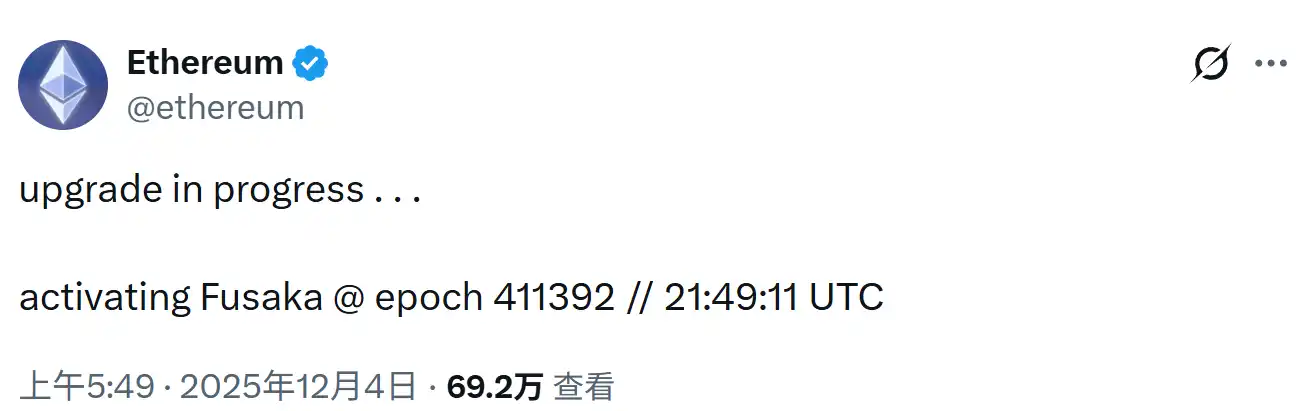
In this Fusaka upgrade, the focus was almost entirely on scaling: Blob capacity expanded by 8 times, combined with PeerDAS random sampling verification, making the cost narrative of the DA (Data Availability) track a thing of the past.

Indeed, cheaper L2s are a good thing, but for Ethereum's long-term ZK roadmap, EIP-7825 is the real game-changer because it sets a Gas limit for a single transaction on Ethereum (about 16.78 million Gas).

As we all know, Ethereum's block Gas Limit was increased to 60 million this year. But even as the upper limit continues to rise, theoretically, if they were willing to pay an extremely high Gas Price, someone could send a super-complex "Mega-Transaction" that directly occupies the entire block's 60 million Gas capacity, thereby clogging the entire block.

This was allowed before, but EIP-7825 introduces a new restriction: no single transaction can consume more than 16.78 million Gas, regardless of the block size.

So why limit the size of a single transaction? This change actually has no impact on ordinary user transfers, but for ZK Provers (proof generators), it is a matter of life and death, and it is also closely related to how ZK systems generate proofs.

To give a simple example, before EIP-7825, if a block contained a "Mega-Transaction" consuming 60 million Gas, the ZK Prover had to run this extremely complex transaction sequentially—it couldn't be split or parallelized. This is like a single-lane highway where a giant, extremely slow truck is in front, and all the cars behind (other transactions) have to wait for it to pass.

This would undoubtedly sentence "real-time proof" to death—because the time to generate the proof would be completely unpredictable, potentially taking dozens of minutes or even longer.

After EIP-7825, even if the block capacity expands to 100 million Gas in the future, since each transaction is forcibly limited to within 16.78 million Gas, each block is broken down into predictable, bounded, and parallelizable "small task units." This means that Ethereum's proof generation has changed from a tricky "logical puzzle" to a pure "money problem":

As long as enough parallel computing power is invested, we can process these split small tasks simultaneously in an extremely short time, thereby generating ZK proofs for huge blocks.

As Michael, co-founder and CEO of Brevis, said, EIP-7825 is the most underestimated upgrade on the future path of ZK and 100x scaling for Ethereum. It turns "real-time proof" from "theoretically impossible" to "engineerably schedulable." As long as we can solve the computing power problem through parallel computation, even a 200 million Gas block could achieve second-level proof. This is not only a breakthrough for ZK technology but also the physical foundation for Ethereum's Interoperability Layer (EIL) to achieve second-level cross-chain settlement.
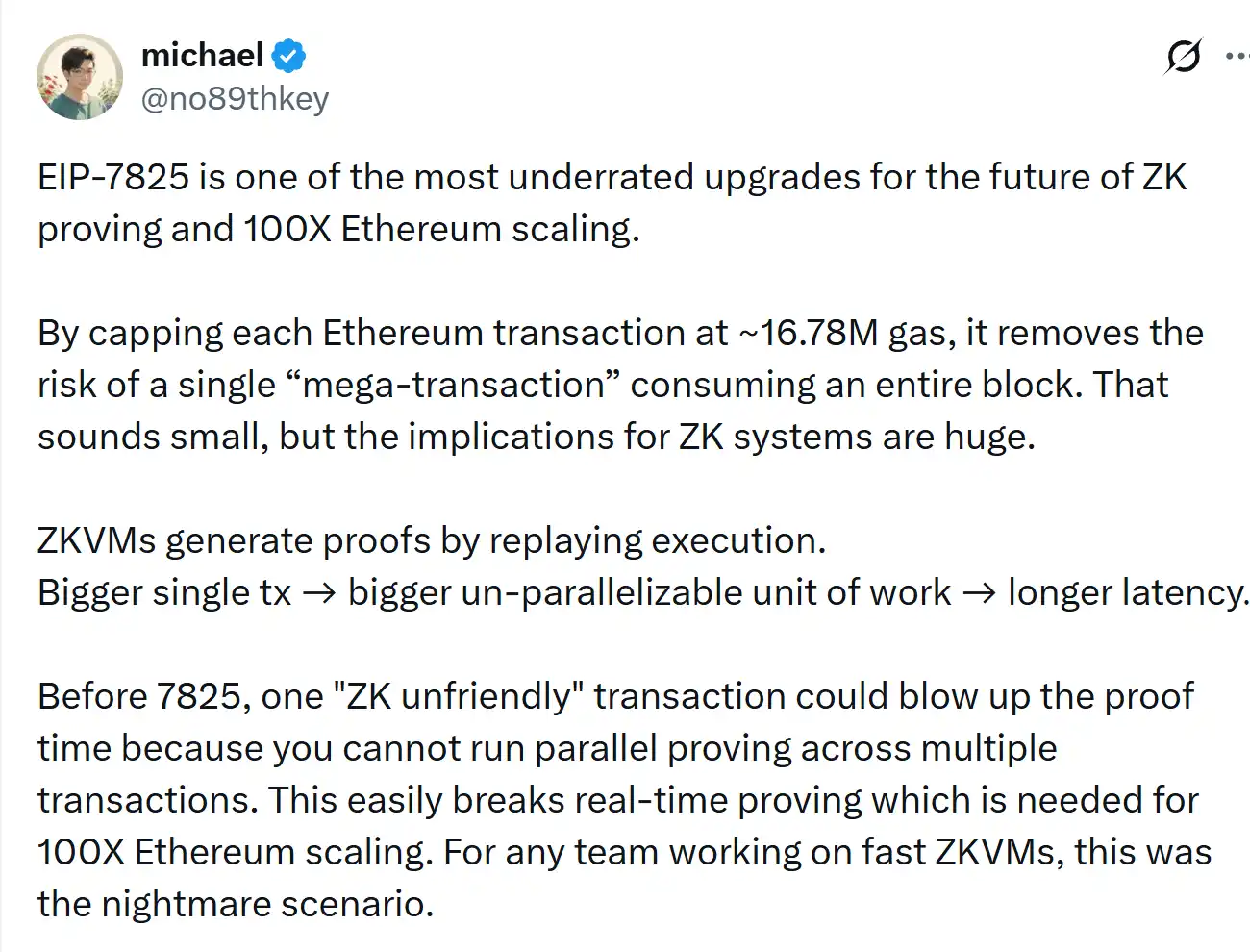
So this upgrade might not seem like the main event, but it is actually a huge breakthrough for the ZK roadmap and Ethereum's scaling future in 2026.

II. L1 zkEVM: The "Trust Anchor" for Ethereum Interoperability

However, although EIP-7825 paves the physical path (parallelizability) for real-time proof by limiting single transaction size, this is only one side of the coin. The other side is how the Ethereum mainnet itself utilizes this capability?

This involves the most hardcore narrative in Ethereum's roadmap—L1 zkEVM.

For a long time, zkEVM has been regarded as the "holy grail" for scaling Ethereum, not only because it can solve performance bottlenecks but also because it redefines the trust mechanism of blockchain. Its core idea is to enable the Ethereum mainnet to generate and verify ZK proofs.

In other words, in the future, after each Ethereum block is executed, it can output a verifiable mathematical proof, allowing other nodes (especially light nodes and L2s) to confirm the correctness of the result without repeating the calculation—if the ability to generate ZK proofs is directly written into the Ethereum protocol layer (L1), the proposer packs a block and generates a ZK proof, and validating nodes no longer need to rerun the transactions; they only need to verify this tiny mathematical proof.

What does this mean for interoperability?

In the context of Interop, the significance of L1 zkEVM far exceeds scaling itself. It can be said to be the "trust anchor" for all L2s. After all, if Ethereum L1 can generate proofs in real time, it means all L2s can read L1's final state in real time and trustlessly. This will bring about two qualitative changes:

  • Eliminate the Challenge Period: The confirmation time between chains will be compressed from "7 days (OP mechanism)" to "seconds (ZK mechanism)";
  • Decentralized Interconnection: Cross-chain will no longer require trust in third-party multi-signature bridges but will trust the mathematical truth of the Ethereum mainnet;

This is also the physical foundation we mentioned in the previous article for EIL (Interoperability Layer) to truly work—without real-time finality from L1, interoperability between L2s will never escape the shadow of "delay."

The goal is set (L1 zkEVM), and the physical limitation is removed (EIP-7825). So what about the specific implementation tools?

This leads to the subtle evolution happening in the ZK technology stack: from zkEVM to zkVM.

III. Fusaka & EIP-7825: The Interoperability Roadmap is Liberated

If EIP-7825 provides a "parallelizable hardware environment" for ZK by limiting single transaction size, then the evolution of the ZK technology stack is to find a "more efficient software architecture." This might sound like a tongue twister, but the difference is significant and represents two stages of ZK development.

The first stage is naturally zkEVM, which can be seen as the compatibility faction or the reformist faction.

The logic is to strive to imitate every instruction of the Ethereum EVM, allowing developers to deploy Solidity code directly, reducing migration costs and barriers.

In other words, the biggest advantage of zkEVM is its compatibility with existing Ethereum applications, greatly reducing the workload for Ethereum ecosystem developers. They can reuse most of the existing infrastructure and tools (including execution clients, block explorers, debugging tools, etc.).

However, precisely because of this, since the EVM was not designed with ZK-friendliness in mind, for the sake of compatibility, zkEVM's proof efficiency often has a ceiling, and proof times are much slower, burdened by historical baggage.

zkVM, on the other hand, belongs to the radical revolutionary faction, directly building a virtual machine that is extremely friendly to ZK proofs (such as based on RISC-V or WASM) to speed up proof time and achieve better execution speed and performance.

But it also loses compatibility with many EVM features and the ability to use existing tools (like low-level debuggers). However, a clear trend is that more and more L2 projects are shedding their baggage,极致 optimizing proof speed and cost, and exploring architectures based on zkVM.

So why is the Fusaka upgrade the unlocker?

After all, before EIP-7825, whether zkEVM or zkVM, once they encountered a Mega-Transaction on Ethereum, the proof generation time would skyrocket due to the inability to split the task.

Now, EIP-7825 forcibly breaks down transactions into predictable small units. With a parallelizable environment, an efficient architecture like zkVM can exert its maximum power. Even complex Ethereum blocks, when placed in a zkVM and combined with parallel computing power, can achieve real-time proof.

What does this mean for interoperability? The proliferation of zkVM combined with EIP-7825 means the cost of generating proofs will drop significantly. When the cost of generating a cross-chain proof is low enough to be negligible, and the speed is as fast as sending an email, traditional "cross-chain bridges" will completely disappear, replaced by underlying universal message protocols.

In Conclusion

As repeatedly mentioned in previous articles of the Interop series, the ultimate goal of Interop is not just asset "cross-chain," nor is it limited to the concept of "asset bridges" anymore. It is a comprehensive set of system-level capabilities, including cross-chain data communication, cross-chain logic execution, cross-chain user experience, cross-chain security, and consensus.

From this perspective, Interop can be understood as the universal language between future Ethereum ecosystem protocols. Its significance lies not only in transferring value but also in sharing logic. ZK's role in this is to guarantee execution correctness and support real-time state verification, making cross-domain calls "dare to do, able to do." It can even be said that without real-time ZK, there can hardly be truly usable Interop UX.

So when EIP-7825 was quietly activated in the Fusaka upgrade, and as L1 zkEVM gradually becomes a reality, we are getting closer to that ultimate goal: execution, settlement, and proof are completely abstracted in the background, and users are completely unaware of the chain's existence throughout the process.

This is the Interop endgame we all look forward to in the future.

Questions liées

QWhat is the significance of EIP-7825 in the Fusaka upgrade for Ethereum's interoperability?

AEIP-7825 introduces a gas limit per transaction (approximately 16.78 million gas), which prevents a single complex 'mega-transaction' from blocking an entire Ethereum block. This allows for parallel processing of transactions, making it feasible to generate ZK proofs in real-time. This is a critical engineering enabler for Ethereum's ZK roadmap and interoperability, as it transforms proof generation from a logical challenge into a solvable computational problem, paving the way for near-instant cross-chain settlements.

QHow does L1 zkEVM serve as a 'trust anchor' for Ethereum interoperability?

AL1 zkEVM integrates the ability to generate and verify ZK proofs directly into the Ethereum protocol layer. This means every block produced on Ethereum L1 can be accompanied by a verifiable mathematical proof. For interoperability, this allows all L2s to read the final state of L1 in real-time without trust. It eliminates the need for long challenge periods (e.g., the 7-day wait in Optimistic Rollups) and enables decentralized cross-chain communication without relying on trusted multi-signature bridges, as chains can trust the mathematical truth of Ethereum's mainnet.

QWhat is the key difference between zkEVM and zkVM in the context of ZK technology evolution?

AzkEVM focuses on full compatibility with the Ethereum Virtual Machine (EVM), allowing developers to deploy existing Solidity code with minimal changes. However, this compatibility often results in slower proof generation due to EVM's design not being ZK-friendly. In contrast, zkVM is a more radical approach that builds a new virtual machine (e.g., based on RISC-V or WASM) optimized for ZK proof efficiency and execution speed. While zkVM sacrifices some EVM compatibility and existing tooling, it offers significantly faster proof generation and better performance, which is crucial for real-time interoperability.

QHow does the combination of EIP-7825 and zkVM architecture enhance Ethereum's interoperability capabilities?

AEIP-7825 ensures that Ethereum transactions are broken down into small, predictable units that can be processed in parallel. This eliminates the problem of 'mega-transactions' causing unpredictable proof generation times. When combined with the efficient architecture of zkVM, which is designed for speed and low cost, it becomes possible to generate ZK proofs for complex Ethereum blocks in real-time. This drastically reduces the cost and increases the speed of cross-chain proof generation, making traditional cross-chain bridges obsolete and enabling seamless,底层通用消息协议 for interoperability.

QWhat is the ultimate goal of Interop (interoperability) in the Ethereum ecosystem, as described in the article?

AThe ultimate goal of Interop is not just cross-chain asset transfers but a comprehensive system-level capability that includes cross-chain data communication, logic execution, user experience, security, and consensus. It aims to create a universal language for protocols within the Ethereum ecosystem, enabling not only value transfer but also logic sharing. ZK technology ensures execution correctness and real-time state verification, making cross-domain interactions feasible and user-friendly. The end vision is a fully abstracted backend where users are unaware of the underlying chains, experiencing seamless interoperability.

Lectures associées

Le Bitcoin devient un actif stratégique national ? Un représentant américain propose l'achat annuel de 200 000 pièces, avec blocage pendant 20 ans

Le représentant américain Nick Begich (Républicain – Alaska) a officiellement présenté le 21 mai le « American Reserve Modernization Act » (ARMA), une loi visant à transformer l'ordre exécutif de mars 2025 sur la réserve stratégique de Bitcoin en une loi permanente. Le projet, soutenu par plus d'une dizaine de parlementaires bipartites, confierait au Trésor la gestion d'une réserve de Bitcoin et créerait un autre fonds distinct pour les autres actifs cryptographiques fédéraux. Begich compare le Bitcoin à l'or, le désignant comme le principal moyen de stockage de valeur dans sa catégorie d'actifs. La loi ARMA, version améliorée d'un précédent texte, autoriserait le Trésor à acquérir jusqu'à 200 000 Bitcoins par an pendant cinq ans, pour un objectif final d'un million de Bitcoins (environ 5% de l'offre totale). Ces actifs seraient bloqués pendant au moins 20 ans. Actuellement, le gouvernement américain détient déjà environ 328 000 Bitcoins, majoritairement saisis lors d'affaires judiciaires, mais sans stratégie de gestion cohérente. Cette initiative s'inscrit dans une période d'avancées législatives favorables aux cryptomonnaies à Washington, comme l'adoption récente du « Digital Asset Market Clarity Act » en commission sénatoriale. Parallèlement, le Trésor intensifie la lutte contre les activités financières illégales liées aux crypto-actifs. La Maison Blanche aurait indiqué que les détails opérationnels de la réserve stratégique de Bitcoin seront bientôt annoncés, les principaux obstacles juridiques ayant été levés.

marsbitIl y a 1 h

Le Bitcoin devient un actif stratégique national ? Un représentant américain propose l'achat annuel de 200 000 pièces, avec blocage pendant 20 ans

marsbitIl y a 1 h

Dragonfly, Sequoia et autres ont levé plus de 60 millions de dollars. Un aperçu du protocole de produits dérivés sur chaîne Variational | CryptoSeed

La plateforme de produits dérivés décentralisée Variational a levé 50 millions de dollars en série A, portant son financement total à 61,8 millions de dollars. La ronde est menée par Dragonfly, avec la participation de Sequoia Capital, Coinbase Ventures et autres. Son open interest (OI) dépasse 8,1 milliards de dollars, la classant au 4e rang dans le secteur. Fondée par Lucas Schuermann et Edward Yu, anciens d'un fonds quantitatif acquis par Digital Currency Group, l'équipe possède une solide expérience en trading et ingénierie. Le protocole, déployé sur Arbitrum, propose deux produits : Omni pour les particuliers et Pro pour les institutions. Contrairement à des concurrents comme Hyperliquid qui utilisent un carnet d'ordres central (CLOB), Variational adopte un modèle RFQ (Request for Quote), agrégeant la liquidité en temps réel depuis des CEX, DEX et market makers traditionnels afin d'offrir une expérience proche des marchés traditionnels sans frais de transaction pour l'utilisateur. Le protocole est encore en phase Pre-TGE, le jeton $VAR n'étant pas encore émis. Un programme de points (Omni Points) est en cours, attribuant des récompenses basées sur le volume de trading hebdomadaire. 50% de l'offre totale de $VAR sera distribuée via des incitations communautaires. La principale opportunité de participation actuelle consiste à effectuer des trades de contrats perpétuels sur la plateforme Omni pour accumuler des points.

链捕手Il y a 2 h

Dragonfly, Sequoia et autres ont levé plus de 60 millions de dollars. Un aperçu du protocole de produits dérivés sur chaîne Variational | CryptoSeed

链捕手Il y a 2 h

Blockchain Capital Partenaire : La structure bicouche des capitaux on-chain est encore à un stade précoce de découverte de valeur

L'économie on-chain possède des caractéristiques uniques comme la programmabilité, la composabilité et une distribution mondiale, permettant une innovation rapide et ouverte. Cependant, ces mêmes traits, combinés à la nature sans permission des infrastructures, posent des défis d'évaluation des risques pour les grands investisseurs institutionnels. Une architecture à deux couches est en train d'émerger pour concilier innovation ouverte et besoin de capitaux massifs. La première couche reste l'environnement sans permission, véritable creuset où les protocoles sont construits et testés dans des conditions adverses avec des capitaux réels. La seconde couche est constituée de chaînes (L2, L1 ou autres) qui, bien que basées sur des bases similaires, intègrent des mécanismes de gestion des risques extrêmes, comme la possibilité de geler des transactions, rendant ainsi l'exposition au risque acceptable pour les capitaux institutionnels. L'interaction entre ces deux couches est cruciale. Un protocole éprouvé dans l'environnement sans permission peut, après avoir démontré sa robustesse, se déployer sur la couche institutionnelle pour accéder à des pools de capitaux bien plus importants. Ce cycle permet à l'innovation de prospérer avec des capitaux cryptonatifs assumant les risques initiaux, tandis que la couche institutionnelle offre liquidité et stabilité, augmentant considérablement la récompense pour les protocoles qui gagnent sa confiance. Le principal défi réside dans le démarrage à froid : les blockchains privilégiées par les institutions ne sont pas nécessairement celles où résident les meilleures applications actuelles. La dynamique future montrera comment cette tension sera résolue, mais l'architecture globale apparaît solide. Elle permet à différents pools de capitaux d'affluer vers un écosystème partagé, où la couche sans permission crée en permanence, la couche institutionnelle apporte la profondeur, et leur jonction fait fonctionner l'ensemble du système.

链捕手Il y a 2 h

Blockchain Capital Partenaire : La structure bicouche des capitaux on-chain est encore à un stade précoce de découverte de valeur

链捕手Il y a 2 h

Coins.ph étend ses paiements cryptographiques QRPh avec la prise en charge du BTC et de l'ETH

Coins.ph a annoncé l'ajout du Bitcoin (BTC) et de l'Ethereum (ETH) à sa fonction de paiement par cryptomonnaie QRPh, étendant un système qui permettait déjà aux clients de payer des commerçants avec des stablecoins comme l'USDT. En scannant le code QR national standardisé (QRPh) de la banque centrale philippine (BSP), les utilisateurs peuvent désormais effectuer des transactions dans environ 700 000 magasins aux Philippines. Les soldes en cryptomonnaie sont instantanément convertis en pesos philippins au moment du paiement. Cette évolution s'appuie sur le déploiement précédent des paiements crypto via QRPh, qui avait intégré l'USDT dans l'infrastructure nationale, une première pour un portefeuille digital dans le pays. Le système, au cœur duquel figurent les stablecoins, permet de basculer facilement entre actifs fiduciaires et numériques. Ceci est particulièrement pertinent pour les Philippines, l'un des plus grands bénéficiaires de transferts de fonds internationaux (plus de 38 milliards de dollars par an), où l'usage des stablecoins pour les envois transfrontaliers se développe. L'ajout du BTC et de l'ETH élargit la gamme d'actifs acceptés tout en maintenant une expérience de paiement unifiée. Wei Zhou, PDG de Coins.ph, souligne que cela redéfinit les capacités d'un portefeuille numérique et intègre les cryptomonnaies les plus populaires dans la vie quotidienne des Philippins. Coins.ph, opérant sous licence de la BSP, compte plus de 15 millions d'utilisateurs dans le pays, une région en tête pour l'adoption des cryptomonnaies. La plateforme vise à construire la prochaine génération de transferts internationaux en combinant les réseaux de paiement locaux et les règlements en stablecoins.

TheNewsCryptoIl y a 2 h

Coins.ph étend ses paiements cryptographiques QRPh avec la prise en charge du BTC et de l'ETH

TheNewsCryptoIl y a 2 h

Trading

Spot
Futures

Articles tendance

Comment acheter HPP

Bienvenue sur HTX.com ! Nous vous permettons d'acheter House Party Protocol (HPP) de manière simple et pratique. Suivez notre guide étape par étape pour commencer votre parcours crypto.Étape 1 : Création de votre compte HTXUtilisez votre adresse e-mail ou votre numéro de téléphone pour ouvrir un compte sur HTX gratuitement. L'inscription se fait en toute simplicité et débloque toutes les fonctionnalités.Créer mon compteÉtape 2 : Choix du mode de paiement (rubrique Acheter des cryptosCarte de crédit/débit : utilisez votre carte Visa ou Mastercard pour acheter instantanément House Party Protocol (HPP).Solde :utilisez les fonds du solde de votre compte HTX pour trader en toute simplicité.Prestataire tiers :pour accroître la commodité d'utilisation, nous avons ajouté des modes de paiement populaires tels que Google Pay et Apple Pay.P2P :tradez directement avec d'autres utilisateurs sur HTX.OTC (de gré à gré) : nous offrons des services personnalisés et des taux de change compétitifs aux traders.Étape 3 : stockage de vos House Party Protocol (HPP)Après avoir acheté vos House Party Protocol (HPP), stockez-les sur votre compte HTX. Vous pouvez également les envoyer ailleurs via un transfert sur la blockchain ou les utiliser pour trader d'autres cryptos.Étape 4 : tradez des House Party Protocol (HPP)Tradez facilement House Party Protocol (HPP) sur le marché Spot de HTX. Il vous suffit d'accéder à votre compte, de sélectionner la paire de trading, d'exécuter vos trades et de les suivre en temps réel. Nous offrons une expérience conviviale aux débutants comme aux traders chevronnés.

118 vues totalesPublié le 2026.04.29Mis à jour le 2026.04.29

Comment acheter HPP

Qu'est ce que GENIUS

I. Introduction au projet1. Qu'est-ce que Genius ?Genius (GENIUS) se positionne comme le « terminal ultime sur chaîne », une plateforme de trading décentralisée axée sur la confidentialité et la rapidité. En intégrant une technologie de confidentialité de premier plan, elle vise à construire une infrastructure de trading privée de nouvelle génération à travers des réseaux tels que BNB Chain, permettant aux utilisateurs d'interagir sur chaîne avec une expérience fluide comparable à celle des échanges centralisés.2. Comment fonctionne Genius ?L'architecture technique de base de Genius est structurée comme suit :(1) Invisible sur la chaîne : Les utilisateurs n'ont pas besoin de gérer manuellement des approbations en plusieurs étapes pour les opérations inter-chaînes, l'emballage d'actifs ou la gestion complexe des frais de gaz.(2) Trading sans signature : Grâce à des intégrations telles que Turnkey, Genius permet un trading instantané sans confirmations pop-up ni autorisation par transaction.(3) Agrégateur d'agrégateurs : Genius est alimenté par une pile d'agrégation de premier ordre intégrée à plus de 150 DEX, revendiquant une efficacité de cotation supérieure par rapport aux produits concurrents.(4) Gestion de compte : La plateforme adopte une architecture non custodiale et utilise Turnkey et Lit Protocol pour la gestion des clés, permettant aux utilisateurs d'accéder en toute sécurité à leurs comptes via des clés d'accès.3. Qui a créé Genius ?Selon ses Conditions de Service officielles, Genius a été développé par Shuttle Labs, Inc. D'après le compte officiel X du projet, Ryan Myher est l'un des contributeurs clés qui fait avancer l'itération du produit, y compris des développements tels que le déploiement du protocole Ghost, ainsi qu'un engagement communautaire plus large.Le fondateur de Binance, CZ, a officiellement rejoint le projet en tant que conseiller, avec pour objectif d'aider l'équipe à construire une expérience de trading sur chaîne plus rapide et plus respectueuse de la vie privée.De plus, le projet a reçu un fort soutien de YZi Labs, qui a investi dans Genius et travaille aux côtés de la Genius Foundation, responsable du maintien du protocole Genius Bridge (GBP).4. Tokenomics de GeniusGENIUS est le token natif de l'écosystème Genius. À l'heure actuelle, le projet n'a pas publié de document complet sur la tokenomics.Selon les dernières divulgations officielles, Genius incorpore un mécanisme déflationniste, et 4,6 % de l'offre totale de tokens a déjà été brûlée lors de la phase de lancement initial.Système de Genius Points (GP) :(1) Trade-to-Earn : La plateforme a établi un pool de récompenses de 200 millions de Genius Points, et les utilisateurs gagnent des GP pour chaque trade exécuté via le terminal.(2) Niveaux et Badges : Genius propose un système de badges basé sur la progression allant de Smart à God, avec des niveaux supérieurs débloquant des avantages et des bénéfices supplémentaires.(3) Rendement natif : Les utilisateurs détenant des actifs désignés tels que usdGG dans le tableau de bord peuvent gagner un rendement natif directement sans passer par un staking complexe.(4) Incitations à la recommandation : Les référents peuvent gagner des remises sur les frais de plus de 45 % payées en USDC, ainsi que des GP supplémentaires.5. Chronologie & Jalons clésMars 2020 : Le compte officiel X du projet a été créé, marquant le début de sa phase de préparation initiale.13 janvier 2026 : Genius a annoncé un investissement de plusieurs millions de dollars de YZi Labs et a simultanément confirmé CZ en tant que conseiller pour accélérer le développement de son infrastructure de trading respectueuse de la vie privée.18 avril 2026 : Le projet a annoncé que le protocole de confidentialité Ghost serait lancé bientôt.29 avril 2026 : Le protocole Ghost a officiellement ouvert ses portes à ses 50 premiers testeurs, marquant le début d'une nouvelle ère pour le trading privé sur BNB Chain. En même temps, l'équipe a confirmé que 4,6 % des tokens avaient été brûlés.​II. Informations sur le token1) Informations de baseNom du token : GENIUS (Genius)III. Liens connexesSite Web : https://www.tradegenius.com/homeExplorateurs : https://bscscan.com/address/0x1f12b85aac097e43aa1555b2881e98a51090e9a6Réseaux sociaux : https://x.com/GeniusTerminalNote : L'introduction au projet provient des documents publiés ou fournis par l'équipe officielle du projet, qui est à titre de référence uniquement et ne constitue pas un conseil en investissement. HTX ne prend pas la responsabilité des pertes directes ou indirectes qui en résultent.

212 vues totalesPublié le 2026.04.29Mis à jour le 2026.05.12

Qu'est ce que GENIUS

Comment acheter GENIUS

Bienvenue sur HTX.com ! Nous vous permettons d'acheter Genius (GENIUS) de manière simple et pratique. Suivez notre guide étape par étape pour commencer votre parcours crypto.Étape 1 : Création de votre compte HTXUtilisez votre adresse e-mail ou votre numéro de téléphone pour ouvrir un compte sur HTX gratuitement. L'inscription se fait en toute simplicité et débloque toutes les fonctionnalités.Créer mon compteÉtape 2 : Choix du mode de paiement (rubrique Acheter des cryptosCarte de crédit/débit : utilisez votre carte Visa ou Mastercard pour acheter instantanément Genius (GENIUS).Solde :utilisez les fonds du solde de votre compte HTX pour trader en toute simplicité.Prestataire tiers :pour accroître la commodité d'utilisation, nous avons ajouté des modes de paiement populaires tels que Google Pay et Apple Pay.P2P :tradez directement avec d'autres utilisateurs sur HTX.OTC (de gré à gré) : nous offrons des services personnalisés et des taux de change compétitifs aux traders.Étape 3 : stockage de vos Genius (GENIUS)Après avoir acheté vos Genius (GENIUS), stockez-les sur votre compte HTX. Vous pouvez également les envoyer ailleurs via un transfert sur la blockchain ou les utiliser pour trader d'autres cryptos.Étape 4 : tradez des Genius (GENIUS)Tradez facilement Genius (GENIUS) sur le marché Spot de HTX. Il vous suffit d'accéder à votre compte, de sélectionner la paire de trading, d'exécuter vos trades et de les suivre en temps réel. Nous offrons une expérience conviviale aux débutants comme aux traders chevronnés.

158 vues totalesPublié le 2026.04.29Mis à jour le 2026.05.12

Comment acheter GENIUS

Discussions

Bienvenue dans la Communauté HTX. Ici, vous pouvez vous tenir informé(e) des derniers développements de la plateforme et accéder à des analyses de marché professionnelles. Les opinions des utilisateurs sur le prix de A (A) sont présentées ci-dessous.

活动图片