Mantra CEO tells OM holders to withdraw from OKX over ‘inaccurate’ migration plan

cointelegraphPublié le 2025-12-08Dernière mise à jour le 2025-12-08

Résumé

Mantra CEO John Patrick Mullin has urged users to withdraw their OM tokens from the OKX exchange, accusing the platform of posting an "inaccurate" migration plan. Mullin claims OKX provided incorrect dates and details about the upcoming token migration from an Ethereum-based ERC-20 token to a native Mantra Chain token. He stated that OKX has not communicated with Mantra since April 13, when the OM token crashed over 90%, an event Mantra attributed to aggressive exchange leverage policies. Mullin advised users to avoid relying on OKX and complete the migration independently. The official migration is set to occur after January 15, contrary to OKX’s announced December timeline.

Tensions between blockchain platform Mantra and crypto exchange OKX are rising after Mantra accused the exchange of posting incorrect information about its token migration.

In a Monday X post, Mantra CEO John Patrick Mullin urged users of centralized cryptocurrency exchange (CEX) OKX to withdraw their Mantra (OM) tokens and cut their “dependency” on the platform.

“Users should consider withdrawing their OM tokens from OKX[...]. Avoid OKX Exchange Dependency: Complete migration without relying on potentially negligent or malicious intermediaries,” said Mullin.

His warning came in response to a Friday announcement from OKX about supporting the incoming OM token migration.
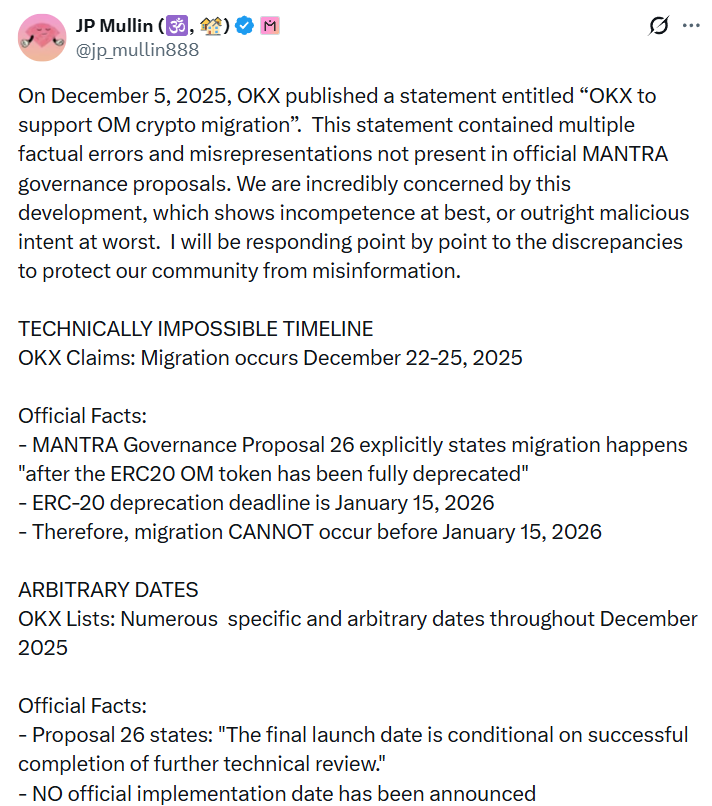
Source: JP Mullin

Related: BitMine buys $199M in Ether as smart money traders bet on ETH decline

According to Mullin, the OKX post contained multiple inaccuracies, including false migration and implementation dates.

OKX said the migration would occur between Dec. 22 and Dec. 25. Mantra’s governance proposal, by contrast, states that the migration will only take place after the Jan. 15 deprecation of the Ethereum-based ERC-20 OM token.

Mullin also said OKX’s post referenced “arbitrary dates throughout December 2025,” while Mantra has not yet announced an official implementation date.

He claimed OKX has not communicated with Mantra since “the events” of April 13, while Mantra has “helpfully [been] communicating with all other major exchanges regarding our migration.”
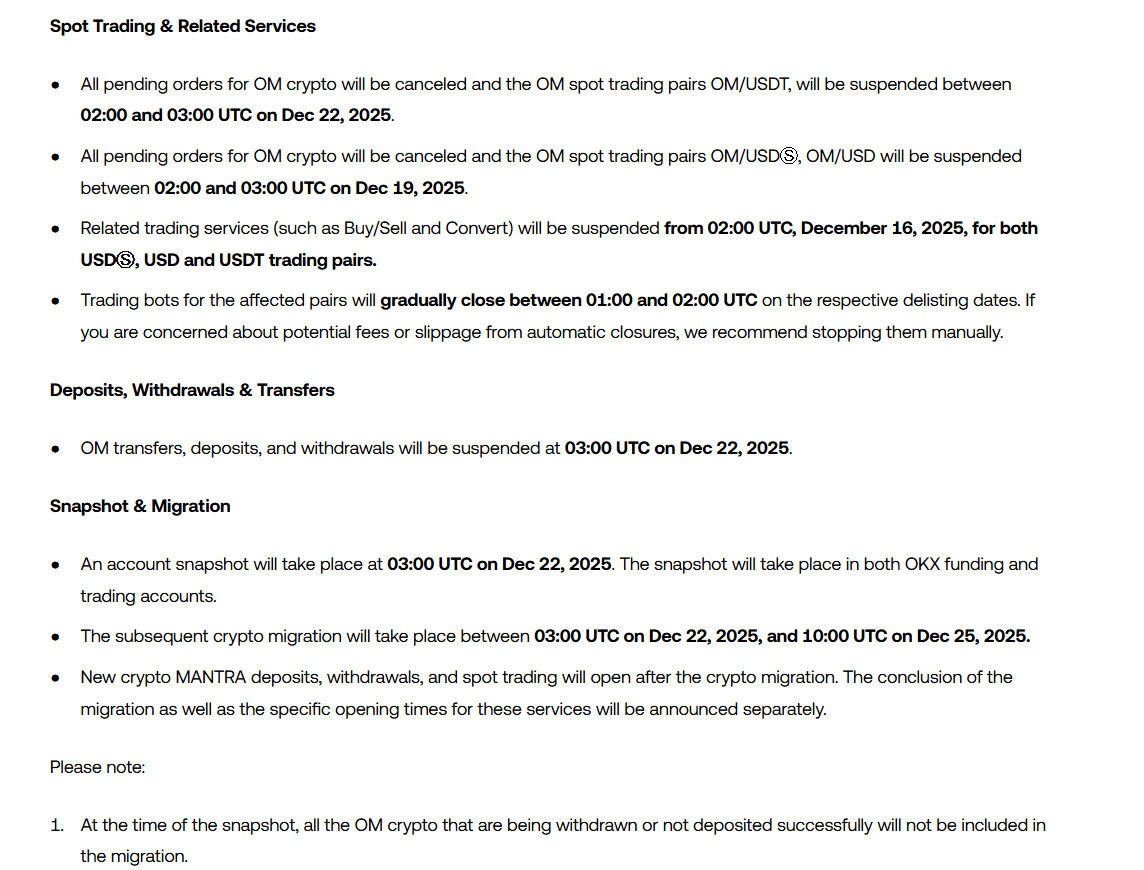
OKX’s OM Crypto Migration post. Source: okx.com

During the incoming migration, the OM token will migrate from an Ethereum-native ERC-20 token to a Mantra Chain-native token.

Cointelegraph has contacted OKX for comment but had not received a response by publication time.

Related: Prediction markets emerge as speculative ‘arbitrage arena’ for crypto traders

April crash still casting a shadow

On April 13, the Mantra’s OM token price fell by over 90% from around $6.30 to below $0.50.
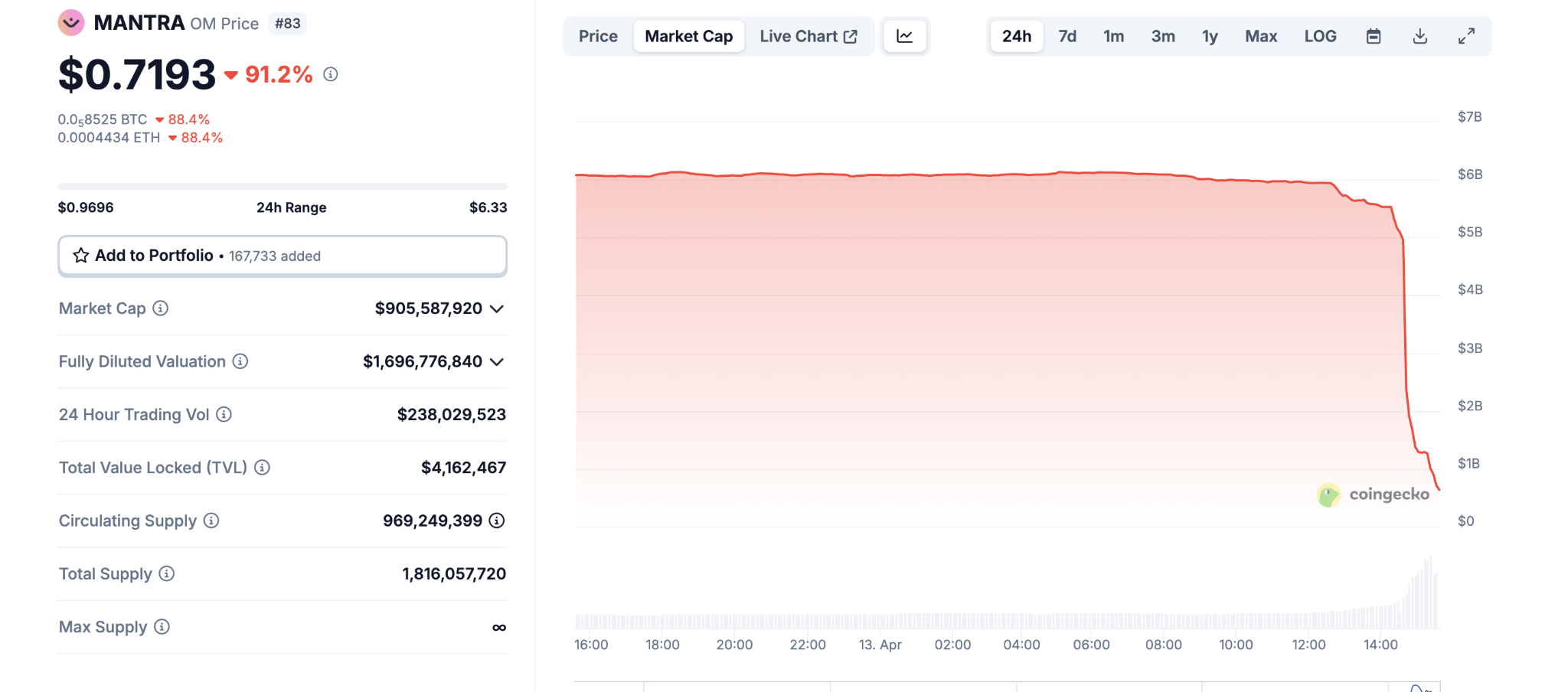
OM/USD, 1-day chart. Source: Coingecko.com

On April 30, Mantra published a post-mortem report that blamed the aggressive trading policies and high leverage on cryptocurrency exchanges for the token crash.

“Liquidation cascades could happen to any project in the crypto industry,” Mullin said in the post, pointing to the role of “aggressive leverage positions” on exchanges as a broader threat to investor safety.

Mullin also urged exchanges to review their leverage policies while implementing a transparency dashboard for OM tokenomics, along with announcing the burning of 150 million staked OM tokens, permanently removing them from circulation in a bid to tighten the token’s supply.

Magazine: If the crypto bull run is ending... it’s time to buy a Ferrari — Crypto Kid
Lectures associées

Le nouveau blog de Weng Li propose que « l'auto-évolution commence par le Harnais », Cui Tianyi de DeepSeek relaie et approuve

L'ancienne vice-présidente de la sécurité d'OpenAI et cofondatrice du Thinking Machines Lab, Weng Li, propose dans un nouveau blog une voie réaliste pour l'auto-évolution de l'IA. Elle suggère que les progrès initiaux en matière d'amélioration récursive de soi (RSI) pourraient provenir non pas de la modification directe des poids du modèle, mais de l'optimisation du **Harness** – le système externe qui gère l'appel d'outils, la gestion du contexte, la planification des tâches et la validation des résultats pour un agent IA. Le chercheur de DeepSeek, Cui Tianyi, a soutenu cette vision, notant que l'auto-évolution du Harness est une direction de recherche très prometteuse, au même titre que l'auto-évolution du modèle lui-même. Weng Li décrit une progression claire des travaux récents : de l'ingénierie du contexte (comme ACE et MCE, qui structurent la mémoire de l'agent), à la conception de workflows (où l'agent optimise son propre processus de travail, comme dans AI Scientist ou ADAS), et enfin à l'**auto-amélioration du Harness**. Cette dernière couche permet à l'agent d'analyser ses échecs, de proposer des modifications incrémentielles et vérifiables à son propre système d'exécution, puis de les valider avant adoption. Des méthodes comme l'**Evolutionary Search** ou **DGM** (Darwin Gödel Machine) poussent ce concept plus loin en faisant évoluer le code du Harness lui-même par sélection, conduisant à des gains de performance significatifs sur des benchmarks de code, rivalisant avec des agents conçus manuellement. Cependant, Weng Li souligne plusieurs défis persistants : la faiblesse des évaluateurs pour les tâches subjectives ou à long terme, les risques de *reward hacking*, la perte de diversité dans les cycles d'évolution, et la difficulté à concilier succès à court terme et santé à long terme des systèmes. Elle conclut que le Harness et le modèle se renforceront mutuellement, et que le rôle humain évoluera vers une supervision à un niveau d'abstraction plus élevé, sans être exclu de la boucle. La compétitivité future des systèmes d'IA dépendra donc de plus en plus de la sophistication de leur Harness.

marsbitIl y a 34 mins

Le nouveau blog de Weng Li propose que « l'auto-évolution commence par le Harnais », Cui Tianyi de DeepSeek relaie et approuve

marsbitIl y a 34 mins

Un ancien « génie adolescent » de Huawei critiquant l’entretien DeepSeek se retrouve pris dans une « tempête » déclenchée par un investisseur Web3

L'ancien « talent prodige » de Huawei, Li Bojie, a suscité l'attention en critiquant publiquement son expérience d'entretien avec DeepSeek, dénonçant des délais injustifiés et une accusation de tricherie qu'il a jugée insultante. Ce litige a ouvert la voie à une controverse plus large avec son ancien investisseur, ABCDE Capital, concernant son projet Web3+AI, Metagent. Le co-fondateur d'ABCDE, Du Jun, a accusé Li Bojie d'un « manque d'esprit contractuel », affirmant que le projet Metagent, dans lequel ils avaient investi 500 000 USD sur une promesse totale de 1,5 million, avait produit des démonstrations de mauvaise qualité et que Li avait cessé de communiquer. D'autres investisseurs ont critiqué son approche peu professionnelle lors des levées de fonds. Li Bojie a répondu que le manque de financement complet avait entravé le développement, et qu'il avait quitté Metagent en 2024 pour des raisons familiales et de conformité, avec l'approbation du conseil. Le projet est depuis tombé en sommeil. Li s'est ensuite tourné vers le projet Pine AI, une plateforme d'agents IA pour les consommateurs, où il a occupé le poste de scientifique en chef avant de démissionner récemment pour se consacrer à la recherche sur les modèles de base, précisant qu'il n'en était pas le fondateur.

Foresight NewsIl y a 1 h

Un ancien « génie adolescent » de Huawei critiquant l’entretien DeepSeek se retrouve pris dans une « tempête » déclenchée par un investisseur Web3

Foresight NewsIl y a 1 h

Trading

Spot
活动图片